Slashdot Mirror
Domain: caldera.com
Stories and comments across the archive that link to caldera.com.
Comments · 334
-
Sure but first...
you need to get one of these.
<apology>couldn't ressist</apology> -
Re:Not so
hammered home by the fact that SCO talked of adding a Linux compatibility layer to their UNIX product a few years back, but dropped it because it just would have been too difficult to impliment IIRC
You mean this? They don't seem to have "dropped" i, in fact they seem to be selling it... -
Re:Its about time IBM
It's looking likely that they mean that SCO distributed SAMBA etc after breaking the terms of the GPL, but wouldn't it be lovely if there was GPL code illicitly stashed away in Unixware... now *that* would be satisfying
This must make your day then - a copy and paste job from Linux. -
Version number games
I can't be the only one who has noticed that major product version numbers are a) inflated, and b) the same (+- 1) as the competetors. For example, this is Suse 9.1, Mandrake has some 9.x stuff and even a 10.0, RedHat had a version 9. RedHat even stripped the
This happened when there was competition with word processors (Word vs. WordPerfect), also this happened when there was competition with Web Browsers (Netscape vs IE). etc. Microsoft has surpassed the whole version number thing by appending 2 random letters at the end of their products, so I guess that is next for everyone else to do.
Just an observation. -
I have used it and say "S - C - O"
I've never heard anyone who has actually used one of their products say "S-C-O"
In 1989 The Theoretical Linguistics Program through the Research Institute of Linguistics of the Hungarian Academy of Science got a grant from the Soros Foundation to (among other things) get ourselves appropriately wired.We chiefly looked at Sun and SCO as solutions. Sun hardware was just prohibitively expensive. So we went with SCO. In about a year, we migrated to NetBSD. By 1995 most things were moved over to Linux.
I'd had a personal copy of SCO Xenix for a 286 for a while.
So I have used, purchased and managed SCO systems.
I also went to school with some of the founders or SCO (back when it was in Santa Cruz). I'd foolishly passed up the opportunity to invest back then (1984).
Anyway, as you can imagine, as someone who had some (minimal) connection to SCO twenty years ago, I am not at all please by the litigious bastards they are now.
-
Wait a minute...
I'm a little bit confused... So is it Open SCOurce or not?
-
Be careful!
DON'T LOOK!
This publicly available Caldera documentation could contain items including but not limited to proprietary, unpublished SCO code, copyrights, trade secrets, and/or patents! -
Re:This is a GOOD thing. Or is it?
-
YOU FAIL IT.
You are an interplanetary failure.
-
Re:SCO related?
I have to agree. After so many people got burned by the dot bomb companies of the late 90's, my guess is that Google wants to wait for this whole mess with the litigious bastards to blow over.
If I were in Googles shoes, I would wait for the litigious bastards to be reduced to smoldering crater by the likes of Red Hat, IBM et al.
-
Re:Misleading/slanderous headline
Is open source software never used for anything bad?
You're right, possibly the worst case being here. For some reason the site seems down right now though... -
Re:Where's the distros
You gotta change that link to "Obligatory Litigious Bastards Link". Google has managed to put some sort of stop on the google bombing of SCO. And maybe even Caldera I guess.
-
Their own worst enemies
It seems like the most damning evidence and contradictions about SCO comes from their own website. Perhaps this is why they want to appear to be DOS'd.
-
Full Article TextThis article is the result of a group research project, compiled and primarily written by Frank Sorenson with Pamela Jones. The special footnoted article explaining some of the terms for nonprogrammers was written by Nick Richards. The research group was primarily composed of Frank Sorenson, Dr. Stupid, Harlan Wilkerson, Rand McNatt, Roland Buresund, and Pamela Jones, all of whom contributed both research and writing, with input from some Linux kernel contributors. Everyone worked on editing, including an invited group of Groklaw regulars. However, Frank carried the load more than anyone else, so his name is on the finished article.
We are now publishing the article and welcome Groklaw readers' further contributions, corrections, improvements, and comments. This is an ongoing project. This article is the first in a series where we'll discuss the System V UNIX ABI, or Application Binary Interface. We approached the research as, What if Linus Torvalds had not already claimed paternity of most of the header files? Then what?
The article will first explain what the ABI is and what it does, then discuss whether the code was released under the GPL and if so whether management at SCO knew and approved, and finally show how the Linux files that pertain to this do not appear to be infringing files that SCO can claim.
For those who are not programmers, such as myself, there is a footnoted section to explain in greater detail and in plain English what ABIs and APIs and shared libraries are and how they work. If you read it first, it will clarify the terminology for you and you will be able to follow the thread in the article more easily. At least, it helped me tremendously.
I think you will see from this article alone that if SCO is planning to sue anyone over the ABI files, unless there are facts we haven't unearthed, they seem to be leaning on a rickety bamboo reed.
GROKLAW TAKES A CLOSER LOOK AT THE ABI FILES
~by Frank Sorenson et alBack in January 2003, word leaked out that SCO was planning to charge Linux users for "System V Intellectual Property" in Linux. SCO created a new business division called SCOSource to come up with new ways to make money from this "intellectual property". The original SCOSource Presentation (PowerPoint version) talks of licensing SCO's shared UNIX Libraries from OpenServer and UnixWare for use in Linux.
A Little Background: What Are ABI Files? [1]
As background information, shared libraries are files containing information to be loaded when an application is run. They usually implement common routines, and their inclusion simplifies programming, reduces file size, and standardizes interfaces. A simple example of this would be the "copy file" and "move file" commands: both commands check file permissions and manipulate the file system. When applications have a great deal of functionality in common, this functionality is often placed into shared libraries.
Shared libraries are architecture, operating-system, and version specific. Executables for different systems follow various standard formats, such as a.out, ELF, and COFF. To load an application, the system must do several things: the system interprets the format of the executable (or binary), loads any shared libraries referenced, and begins executing the code found in the binary.
If the executable is in a different format from those the system supports, or if the library files are for the wrong architecture or operating system version, the binary normally will not run. In 1991, Intel announced the availability of the iBCS-2 (Intel Binary Compatibility
-
Full Article TextThis article is the result of a group research project, compiled and primarily written by Frank Sorenson with Pamela Jones. The special footnoted article explaining some of the terms for nonprogrammers was written by Nick Richards. The research group was primarily composed of Frank Sorenson, Dr. Stupid, Harlan Wilkerson, Rand McNatt, Roland Buresund, and Pamela Jones, all of whom contributed both research and writing, with input from some Linux kernel contributors. Everyone worked on editing, including an invited group of Groklaw regulars. However, Frank carried the load more than anyone else, so his name is on the finished article.
We are now publishing the article and welcome Groklaw readers' further contributions, corrections, improvements, and comments. This is an ongoing project. This article is the first in a series where we'll discuss the System V UNIX ABI, or Application Binary Interface. We approached the research as, What if Linus Torvalds had not already claimed paternity of most of the header files? Then what?
The article will first explain what the ABI is and what it does, then discuss whether the code was released under the GPL and if so whether management at SCO knew and approved, and finally show how the Linux files that pertain to this do not appear to be infringing files that SCO can claim.
For those who are not programmers, such as myself, there is a footnoted section to explain in greater detail and in plain English what ABIs and APIs and shared libraries are and how they work. If you read it first, it will clarify the terminology for you and you will be able to follow the thread in the article more easily. At least, it helped me tremendously.
I think you will see from this article alone that if SCO is planning to sue anyone over the ABI files, unless there are facts we haven't unearthed, they seem to be leaning on a rickety bamboo reed.
GROKLAW TAKES A CLOSER LOOK AT THE ABI FILES
~by Frank Sorenson et alBack in January 2003, word leaked out that SCO was planning to charge Linux users for "System V Intellectual Property" in Linux. SCO created a new business division called SCOSource to come up with new ways to make money from this "intellectual property". The original SCOSource Presentation (PowerPoint version) talks of licensing SCO's shared UNIX Libraries from OpenServer and UnixWare for use in Linux.
A Little Background: What Are ABI Files? [1]
As background information, shared libraries are files containing information to be loaded when an application is run. They usually implement common routines, and their inclusion simplifies programming, reduces file size, and standardizes interfaces. A simple example of this would be the "copy file" and "move file" commands: both commands check file permissions and manipulate the file system. When applications have a great deal of functionality in common, this functionality is often placed into shared libraries.
Shared libraries are architecture, operating-system, and version specific. Executables for different systems follow various standard formats, such as a.out, ELF, and COFF. To load an application, the system must do several things: the system interprets the format of the executable (or binary), loads any shared libraries referenced, and begins executing the code found in the binary.
If the executable is in a different format from those the system supports, or if the library files are for the wrong architecture or operating system version, the binary normally will not run. In 1991, Intel announced the availability of the iBCS-2 (Intel Binary Compatibility
-
netcraft article
This is OT but Netcraft has an amusing article about what options SCO, the litigious bastards, are not using to avoid being DOSed by Mydoom tomarrow.
-
Cornered Rabid Rats, eh?
Linus, don't hold back, let us know how you really feel about those litigious bastards?
-
Re:IBM
But I think that building an arsenal of patents for ammunition is like stockpiling nukes for National Defense. During peacetime everything will be fine, but if litigation starts (i.e. as in now), then all hell breaks loose.
You want a pissing contest? IBM's game. And so is SCO, Amazon, Microsoft, Google, and all of the big players. All you'll need to do is put your lawyers to work and pay some processing feed.
Sure IBM (i.e. "America" in this analogy) is the major superpower with zillions of patents that might be able to sink all these other companies with all of the patents they've accumulated, but these other companies do have patents also and might be able to call IBM out on some of them also.
So, if IBM starts a shopping spree of patents, even if the goal is merely to have them so others cannot, it could lead to an arms race of IP where companies focus more on locking up patents than actual innovation or business (and become one of the patent-litigation firms that has become notorious on slashdot).
Call me a pessimist, but we could very possibly see other companies rush to patent everything under the sun, just to gain some power. Then every company will have its hands tied by all of the patents they don't own, and it'll be a nuclear winter of technology.
And even with IBM's good intentions, whose to say that IBM's strategy won't incite some Hussein in some rogue company to make some ridiculous claims about their IP and assert that they've got some sort of clout or power when they actually don't? And then IBM would have to try to step in and break it up, but not before damage has been done to our community. Oh, wait
IBM will win whatever comes to them, don't doubt this, but winning might not be the best thing for technology. -
Remember..
-
Re:You must remember...
Caldera as a company was founded with the sole purpose of suing Microsoft over DR-DOS.
Unless you have insider evidence that proves otherwise, that's simply not true. Caldera was founded in 1994 by the programmers who were working on Novell's original Linux product in the early '90s, which Ray Noorda wanted to bundle with DR-DOS and make a "Windows 95 killer" before Windows 95 got to market. Infoworld did a fair amount of reporting on this back in the day, referring to it as "the Corsair Project." Caldera's original web site talked about this project originally, and had internal logos that they were using for the project, although they were referring to it as "Expose." When Noorda was forced out and the project was canned, the programmers took what they could and built a Linux distribution from it.
Caldera acquired DR-DOS in 1996 from Novell, and Novell had already laid out the groundwork for the litigation, which they had chosen not to pursue. Caldera did pursue it, and frankly, they were right to. At the time, I can assure you the general feeling on Slashdot was, "Yeah! You go!" Seven or eight years ago, these were the good guys. Caldera certainly wasn't sitting around and waiting for a big payoff, though--they were actively developing both Caldera Network Desktop and embedded systems based on Linux and DR-DOS.
Last but not least, what you really must remember is that the current SCO Group has no executives, no products--and quite possibly no employees at all--in common with Caldera Systems. For all practical purposes, they're a completely different company.
-
Re:Lie detector glasses
Yup, using this with Darls Picture gave me a score of 9999%&"$[buffer overflow]
-
Obligatory SCO troll
The SCO Group seems to have promised, but never delivered, UNIX code that was "copied verbatim" into Linux . None of the millions of lines, 65 files, or some new type of undefined intellectual property have yet materialized.
Hey, maybe this isn't as much a troll as I thought. Oh well, the mod points are yours.
------
UNIX is a registered trademark of The Open Group in the U.S. and other countries
Linux is a trademark of Linus Torvalds. -
Re:Other options?
I think I'll just use the Caldera version of linux instead.
What? What, do I have programmer funk? Why are you backing away? -
Prosser
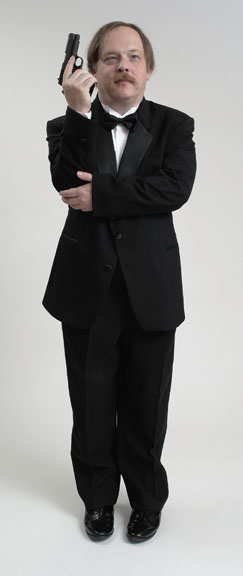
Perhaps this gentleman would be perfect for the role of Mr. L. Prosser.
-
Re:having just finished reading all of the PDFsAre they aware of their company crumbling from the inside *before* this Linux attack started?
I believe SCO was well aware that their company was on shaky ground & that that was the #1 reason for their spurious attempt to force all Linux distributors to pay them a fee. SCO may not be good at making money selling software, but they are good at making money with litigation.
Barring a successful lawsuit (which now looks like a long shot), McDarl has already entertained the possibility of a buyout. This reinforces the contention that SCO was pretty wobbly to begin with.
There might be a reason that McDarl has a bit of a hardon for Novell: McBride bio.
-
Re:System VThey can't argue any of that without looking even more stupid than they already do.
LKP incorporates both the kernel interfaces and a Linux application environment directly into the Open UNIX 8 system. Lxrun emulates the system calls through SEGV signals that are generated by int80 instructions. This emulated Linux kernel function calls.
lkp faq -
Re:Still waiting and waiting....
from the LKML
SCo's infringing files list thread (51 articles)
AIX has crappy code (ctype.h)
(end lkml)
this week SCO puts up or shuts up
Smking Crack (and running Linux -
Re:I use Xandros 2.0
> as I know it's my only option if I want a made-in-Canada distro.
Are there any options beside a made-in-Finland distro
ah..wait, they're all made in Santa Cruz, California these days.... -
Re:My experiences with tech business trendsI figured it out, after reading McBride's biography here:
I'll quote:
A technology industry veteran, McBride has 19 years of executive management and leadership experience. Before joining SCO, McBride was the president of Franklin Covey's online planning business. Prior to that, McBride has been the CEO of PointServe, a workforce optimization software company; and the founder, chairman, and CEO of SBI and Company, a professional services company. While at the helm of these companies, McBride was responsible for raising more than $100 million in venture capital.
In other words, he is good at talking people into giving him money to fund his projects. People who read Slashdot probably don't believe this, but I will bet that he is slick to the "right" people.
So, the reason why he is considered an industry leader is because people believe him when he says, "I'm an industry leader." Confidence men work the same way. Did you ever read the life story of Carlo Ponzi? Here it is The Life of Carlo Ponzi. A lot of people have heard of Ponzi shcemes, but most people don't realize that at one time Carlo Ponzi was considered, you guessed it, a business leader:
With the success he experienced with Tony and Guiseppe, Carlo started Securities Exchange Company at 27 School Street in Boston the day after Christmas 1919. Advertising a 50-percent return in ninety days, money from investors large and small poured in.
Who knows, in the future we may call something, "A McBride scheme."With all this money pouring in, Carlo had to figure out a plausible explanation for how he could pay 50-percent interest in ninety days when no place in the world paid that much. But Carlo's ingenuity for scams came through again. He told investors that he had a network of agents in Europe that purchased depreciated European currencies, converting the currencies into international postal coupons, which were then redeemed at face value in the United States in U.S. dollars. Carlo claimed all the high rollers were doing it--the Rockefellers, J.P. Morgan, Jr., everybody. But Saint Carlo instead was sharing the wealth and helping the common man (while helping himself of course). Redistributing their money was more like it.
Every day, tens of thousands of dollars were deposited with Carlo's tellers. Outside the building, crowds lined up, waiting to invest. And every day, Carlo would arrive at work in his chauffeur-driven limousine. The key to the entire scheme continued to work its magic, as the deposit counters were usually a swarm of activity, and the withdrawal counters were practically deserted. As the deposits grew and grew, Carlo even opened branch offices, eventually totaling thirty-five. He also used some of the deposits to purchase two actual businesses, Hanover Trust Co. and J.P. Poole Co. Carlo even found time in his busy schedule to buy Rose a mansion.
-
Re:gnaa tirel
-
He was following open standards...Moreover, a very pertinent lwn post by 'NZheretic' points outs that
'The SCO Group cannot expect to win any case based upon application interfaces which it's AT&T, USL and Novell predecessors relased in open standards specifically for the purpose of interoperability.
signal.h, errorno.h,and ioctl are all parts of many released standards including The Open Group and IEEE POSIX Base Specifications and the Federal Information Processing Standards Publication 151-2.
Note that The SCO Group does not own the copyrights on any of those standards and it does not own clear title to the copyrights on most of the AT&T Unix base.
From 1989, the then SCO activity pushed for the adoption of the iBCS Intel Binary Compatibility Specifications across *all* i386 Unix vendors
For the benefit of the entire user base, as well as the industry as awhole, SCO encourages all UNIX System vendors for Intel processors to join SCO, USL, Intel, ISC and OSF in supporting the iBCS-2 standard for x86 applications.
'Even SCO admits, no requries these definitions to be present in order to be standards compliant.
-
COFF history
Well, I know that COFF & ECOFF are pretty well known by now, COFF having been created for SVR3 to extend and replace a.out and support shared libraries but also having been used and extended by Microsoft since NT. According to this message, the format can be found in the programmer's reference manuals for SVR3. The a.out format debuted with UNIX V7.
Both are extremely well known formats, and SCO's claim pretty much has to be direct copying, because there's no way that a reimplementation could be a violation to two well-known, publicly published formats. Humorously enough, Caldera/SCO itself publishes the definitions of both COFF and ELF.
While I'm pretty sure you can copyright an interface like this, I'm positive that implementing code based on a published description (and not published source code) is not in and of itself a copyright violation, especially due to the importance that recent copyright laws have given to interoperability. Like I said, it's safe to bet that either SCO is either claiming direct copying (which could be shown to be false if it is) or they're once again invoking Chewbacca defense-like logic in defending their case like they have been in their claims about the GPL being against US copyright law. -
COFF history
Well, I know that COFF & ECOFF are pretty well known by now, COFF having been created for SVR3 to extend and replace a.out and support shared libraries but also having been used and extended by Microsoft since NT. According to this message, the format can be found in the programmer's reference manuals for SVR3. The a.out format debuted with UNIX V7.
Both are extremely well known formats, and SCO's claim pretty much has to be direct copying, because there's no way that a reimplementation could be a violation to two well-known, publicly published formats. Humorously enough, Caldera/SCO itself publishes the definitions of both COFF and ELF.
While I'm pretty sure you can copyright an interface like this, I'm positive that implementing code based on a published description (and not published source code) is not in and of itself a copyright violation, especially due to the importance that recent copyright laws have given to interoperability. Like I said, it's safe to bet that either SCO is either claiming direct copying (which could be shown to be false if it is) or they're once again invoking Chewbacca defense-like logic in defending their case like they have been in their claims about the GPL being against US copyright law. -
Re:More Power To Them
Most Deleware corporations are shams. . . SCO being the first one to come to my mind. . . however nevada corporations don't seem to good either.
NOTE***
These incorporating schemes are riddiculous, and seem to promote illicit use of taxable income.
SCO defines itself as a deleware corporation in the IBM amended Counterclaims (page 1) -
These are the people behind the actions.
The executive board of SCO consists of:
Darl C. McBride
Chris Sontag
Robert K. Bench
Reg Broughton
Sean Wilson
Larry Gasparro
Jeff Hunsaker
Ralph J. Yarro III
Steve Cakebread
Edward E. Iacobucci
R. Duff Thompson
Darcy Mott
K. Fred Skousen
Thomas P. Raimondi, Jr
If you see any of these people in years following the implosion of SCO, do not give them a job. Do not enter into contracts with them. Do not loan them your car. They have proven themselves incapable of planning for the future of a company and incapable of behaving like mature partners in the sphere of business. At a time when SCO desperately needs to be investing in research and development, these people are plunging the company into bankruptcy. They're taking a tremendous gamble with their shareholders money, a gamble which even if successful would only mean residuals on existing Linux implementations in the US, and a painful migration for everyone else to OpenBSD. They're betting everyone else's money on a long shot, and should be held accountable for their irresponsible actions.
Once again, those names are
Darl C. McBride
Chris Sontag
Robert K. Bench
Reg Broughton
Sean Wilson
Larry Gasparro
Jeff Hunsaker
Ralph J. Yarro III
Steve Cakebread
Edward E. Iacobucci
R. Duff Thompson
Darcy Mott
K. Fred Skousen
Thomas P. Raimondi, Jr
-
Re:Expect their products to be leased not sold
Win4Lin is a derivative of Merge. Guess which three-letter company that begins with S and ends with litigation originally sold Merge? I'm not saying that you shouldn't use Win4Lin (on the contrary, it's a very good product), but I just wanted to mention it.
-
Re:Solaris will become a legacy OS..
A better stratergy for SUN would be to provide an upgrade path of Solaris to Linux, and to ride the wave, not fight it.
Maybe they can license the upgrade path from SCO. No I'm not trying to be funny or trollish. SCO has a product called "Linux Kernel Personalities" for thieir UNIX OS that enables Linux binaries to be run on that platform. Can't get any more info because SCO's website because its not responding. Hmmmm. -
Is SCO counting on /. effect?Pinging www2.sco.com (216.250.128.33) produces a reply, and the corresponding website contains some seriously long-in-the-tooth (like, 2001) links to Caldera and Tarantella (what the bleep is that?) stuff. www.caldera.com (216.250.128.12) proper does not respond to pings or http requests, while www2.caldera.com resolves to the same long-in-the-tooth site.
All this looks rather dodgy. Maybe they just hope to get slashdotted and then claim that this was the DDOS attack...
-
Is SCO counting on /. effect?Pinging www2.sco.com (216.250.128.33) produces a reply, and the corresponding website contains some seriously long-in-the-tooth (like, 2001) links to Caldera and Tarantella (what the bleep is that?) stuff. www.caldera.com (216.250.128.12) proper does not respond to pings or http requests, while www2.caldera.com resolves to the same long-in-the-tooth site.
All this looks rather dodgy. Maybe they just hope to get slashdotted and then claim that this was the DDOS attack...
-
Re:Online mentions in IBM filingI wish someone would deliver something like 32 tons of horse shit to th SCO offices.
Only looks like a couple hundred pounds, but it's a start.
-
SCO's lawyers didn't write this...
check this out (from groklaw):
[...]
But here is the odd part: SCO's lawyers didn't write this manifesto and neither did Darl, judging by the headers on the Word file. Yes, thanks to Microsoft's utter disregard for user privacy, we know who actually wrote this document, or at least whose computer was used. You see, Microsoft preserves such info as metadata, little pieces of info about you in the headers of each document you write in Word. Someone on Yahoo took a look at the document's Properties, and the document records that it was written by Kevin McBride and Dean Zimmerman, who is apparently a tech writer.
[...]
-
Re:Four words
-
Darl McBride hires bodyguards - film at 11
This is Darl McBride. He hires bodyguards because people infringing on his "intellectual property", while in fact being very nice and harmless scare him. (There are more of them.) Am I really the only one not surprised?
-
Re:Diagnosis
for anyone who wants to see this jerk we've been hearing so much about, here's a short bio and a pic of him on the caldera website
http://www.caldera.com/company/execs/dmcbride.html -
If you need everything like that....
If you need USB, audio and video, just build a mini-itx computer. Cheap, small, and it's a fully functioning computer. The VIA EPIA 5000 is only 7 by 7 inches, pretty small, while it's bigger counterpart is still only a few inches bigger. Plus, you can get small cases, fairly cheap memory, optical drives like CD burners, DVD, etc, thin versions of the optical drives, hard drives, and more. If you need so much functionality, then mini-itx is better.
If you're concerned about paying SCO's license fees ($32 for embedded devices, $699 for single CPU's), don't worry: that offer expired October 1. You're in the same boat as the rest of us, buddy!
-
Re:RMS
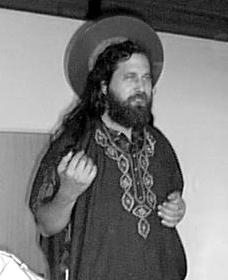
Obviously, you'd much rather have a clean-cut, God-fearing ex-Jock representing "the movement".
If you think about, you can figure out for yourself what the priorities are of people who wear expensive suits, get great hair cuts, buy expensive cars, and all that. Frankly, I prefer RMS's priorities. -
It makes sense
Actually, as some people say, "What makes GNU so great is that there are so many distros I can choose Debian from." I think it makes sense. From every GNU distro (RedHat, Mandrake, SuSE, Caldera---you name it) Debian is the only one which is truely kernel-independent, the only one with social contract making it free as in freedom and the only one not Intel-centric, so in other words, if there is any single distro which is better than any one else, it can be only Debian. I'm proud to say that once again I can fully agree which Bruce Perens.
-
How you use your $,$$$,$$$,$$$,$$$
Dear Mr. Gates and Mr. Ballmer:
Rather than spending more money on MS funded studies to undermine OpenSource and $5mil to play "bounty hunter game" just to ward off criticisms toward your swiss cheese OS, you might want to spend the same money to improve code in your products. Needless to say, I am very aware that my suggestion will be disregarded, as you do not agree a very common notion that better coding will improve security of an operating system.
It doesn't matter, really, as the amount of money you are spending for all these FUD tactics, marketing, settlements and donations to politicians is nothing significant in your bank account. But from my perspective, all your FUD attempts to undermine OSS is making you look like a biggle clown. You look good when you are with this fella.
Yours,
0 -
Don't Run Windows?!?!
It might, except for students that don't run Windows.
Oh wait...you mean those crazy linux people. Right. That's true, but those people are left-wing commie pirates and there's no stopping them anyway, so what does that matter? -
Re:Alien Technology?
You forgot UNIX. But we already know that came from outer space.