Slashdot Mirror
Domain: canadiandriver.com
Stories and comments across the archive that link to canadiandriver.com.
Comments · 43
-
Valid point but overstated
To me it suggests that older drivers are having more difficulty coping with the situation once it arises.
Forbes says that the guy who got himself plastered all over cable last week was 'afraid' to put the vehicle into neutral, or to turn off the engine:
(They link the 911 recording:
http://www.thetruthaboutcars.com/the-jim-sikes-911-call-23-minutes-of-unintended-acceleration/
)
So apparently being an idiot is also a likely factor in the failing to cope with the incident before it becomes lethal.
But they key observation is that the higher number of fatalities among older drivers doesn't really point to the source of the problem being driver error (rather, the driver error is in failing to deal with the situation once it arises).
You certainly don't have to be an idiot to fail to handle a stuck throttle, most people will never have the experience, and if it becomes a problem starting at highway speeds, many drivers may feel the need for both hands on the wheel. I would want to know in advance that I could turn the engine off without engaging the steering wheel lock. And that it kills both the electric and gas power in a Prius. Shifting to neutral is likely to to be the last resort, but most effective.
There could well be an issue with the anti-lock brakes as well, if the braking power is being limited, they may well not have the stopping power needed to overcome the engine, the recent police assisted stop was made made after slowing with the emergency brake which probably is mechanical and will actually lock the wheels. That would explain the claims that the brakes were full on but the car didn't slow down, and the odd signs of only partial brake application noted in some cases. Apply full engine power and limit brake effectiveness, if that bug could be proved it would explain many things.
It would also probably exonerate the man who is in prison after unintended acceleration.
-
Re:Impressive car, but I'd like an extra wheel ple
> Volkswagen will soon have a 1L/100km (240mpg) car
They already have one as a technology demonstrator, they promise a production model soon:
http://www.motorauthority.com/vw-chairman-promises-1l100km-car-in-3-to-4-years.html
http://www.canadiandriver.com/articles/gw/vw1litre.htm -
The VW may be even more impressive
While this car is impressive, I think the car designed in 1999 and going on sale in a year and a bit is much more amazing.
Just think, the pres of VW got 317 miles per (imperial) gallon driving this thing to a press conference. This is without any batteries or hybrid tech.
I would be happy with a runabout that achieved just half of that.
Below are links if you have not read about it yet.
-
Re:My best mileage is around 55 mph
http://www.canadiandriver.com/news/060403-11.htm
I found a bunch more citing the same study, but could find no other comprehensive studies.
-
Re:built-in coffinyou subtracted a lot of factors, but they mentioned one new aspect that could offset the 1-cylinder to 2-cylinder switch (though it does say "may"):
Doubling the number of cylinders is sure to cut fuel economy, so VW may install a diesel-hybrid drivetrain.
The efficiency letdown may not be the worst of it though, I'm not sure how many people would appreciate this aspect mentioned in the original Canadian Driver article:
The passenger puts his/her feet on footrests located on the sides of the driver's seat.
it might be tough to convince someone to climb into that sort of a backseat at the start of your first date, that sounds more like a medical exam than a trip to the movies
-
Re: Fuel economy
oh, and the first link:
but those systems still use an electric motor operated throttle to control engine speed. -
Here it comes...The Slashdotters who would look like Bibendum (the Michelin Man) in this suit are going to make cracks about the suit designer modelling the prototype. Typical pathetic geeks.
http://www.canadiandriver.com/articles/pw/images/
b ibendum.jpg -
Re:Changing percpetion
Have a look at the smart. http://www.metacafe.com/watch/60538/smart_car_cra
s h/ Yes they also crashed a smart into some kind of jeep and the results were devastating, for the jeeph tm). Not 'reactive' but smaller/lighter != weaker -
somebody call Volkswagen!
volkswagen already did more than double this with their 1-litre car (100km on 1 litre of gas. that's a little more than 235 miles per gallon).
i imagine we can do a little better given that this was created nearly 5 years ago. -
Re:BSAs of ~1980, the world record for most miles was held by an SUV driven by a rural mail carrier in Montana, with 1.2 MILLION miles under its belt... having never had anything but routine maintenance, and still going strong. ONLY 1.2 million?
http://www.volvoclub.org.uk/press/releases/3377.sh tml
Longer but older article:
http://www.canadiandriver.com/news/020312-5.htm -
Re:Would you, could you. . .
It would definitely be nice to work one something like that. Unfortunately, we lack the budget, the time, the support and the knowledge to build a true consumer car. There are many factors that you'd have to take into account which are generally beyond the scope of building for a competition. With most research based projects (even if not completely groundbreaking) you sacrifice some safety and reliability to get your end product - something that is simply not acceptable for a consumer product.
There are attempts to do something similar to what you're getting at... smart cars ( www.smart.com/ ) and a prototype from Volkswagen: http://www.canadiandriver.com/articles/gw/vw1litre .htm
For anything smaller (something that uses bicycle tires), I'd guess you may have a hard time making it road legal, though it's not something I've looked into closely. -
Bio-diesel from algae from dying salton sea
I think we need to look for alternatives to Middle East oil in the short term,
and alternatives to polluting fuels in the long term .
http://en.wikipedia.org/wiki/Biodiesel
The Algae is the best producer per this chart excerpted from that site :
* Soybean: 40 to 50 US gal/acre (40 to 50 m/km)
* Rapeseed: 110 to 145 US gal/acre (100 to 140 m/km)
* Mustard: 140 US gal/acre (130 m/km)
* Jatropha: 175 US gal/acre (160 m/km)
* Palm oil: 650 US gal/acre (610 m/km) [2]
* Algae: 10,000 to 20,000 US gal/acre (10,000 to 20,000 m/km)
It also burns cleaner than conventional diesel and bio-diesel is added to petrol
diesel to meet emissions requirements . It is also better for the engine as well .
Some environmental groups take issue with the amount of fertilizer and other factors
it would take to grow enough Algae to produce enough oil to replace petrol diesel .
Fortunately some ppl have a solution to that .
In Southern California the Salton Sea has no outlet and is become super saturated
with phosphates and salt , more saline than the ocean in fact .
Tract ponds with Solar powered slow crawling harvesters could skim the Algae,
Extracting the algae which used the phosphates to grow and traps a large portion
of the salt in it thus lower salt levels in the water and fertilizer levels .
The tract ponds could be covered by clear recycled plastic to avoid massive
evaporation due to spreading out the water over such a large surface area .
It would be expensive to implement, but current we use over 140 billon gallons
of petrol based fuel , and at $3 a gallon approx. that is over 420 billion a year ,
4.2 trillion in a decade .
I think we could do it for a great deal less than that .
http://www.unh.edu/p2/biodiesel/article_alge.html
The above article covers the math behind what I have said .
Taking the above method and then using it with a very fuel efficient vehicle
and offer a REALISTIC tax break on the super fuel efficient car .
This prototype diesel car could reduce the amount of fuel used by commuters .
http://www.canadiandriver.com/articles/gw/vw1litre .htm
It is made from VERY expensive alloys and composites, a much more affordable
version would still achieve well over 100 mpg vs. near 300 mpg .
In the Long term the Algae production could be converted over to this :
http://www.wired.com/news/technology/0,1282,54456, 00.html
Algae making hydrogen
The synergy of saving the salton Sea and providing a tremendous amount of oil
to end our dependence on foreign oil for all time is taking lemons and making
lemonade in my mind .
Not to mention the eventual hydrogen production once more hydrogen cars ,
and filling stations are available and affordable .
All the variables are not worked out fully, nothing worth doing is easy, but it beats
the situation we face now and the worse one in the future .
Hope for the Future...
Ex_MislTech -
Re:vegetable oil running cars already exists
It isn't like it was a well researched or writen article.
They even left in the oil company conspiracy crap.
As for a 4 second 0-60 and 50mpg I don't believe it.
However I find this ethanol vehicle quite a bit more interesting.
http://www.canadiandriver.com/news/060228-4.htm -
HUD should reduce the danger...
I especially like the one that "floats" the map in front of the vehicle: http://www.canadiandriver.com/articles/jk/021016.
h tm
I wouldn't want to have to wear special goggles.
I would want to be able to announce/push a button/otherchoice to chose alternate routes if my shosen route is blocked, and I'd like a switch in the steering wheel to engage/disengage the display at will. I defineitely want a passenger to be able to choose routes if I'm driving.
This should be an opportunity for some enterprising geek.
MEB -
Re:A Different Kind of Goal
No one has made a [practical] vehicle that runs much above the 40 mpg mark (that I know of).
Ever hear of the TDI engine from Volkswagon? My wife and I have a 2003 Volkswagen Jetta (Wagon) with the TDI engine and get an *average* of 50 mpg.
Solid car, great safety record (http://www.internetautoguide.com/crash-tests/09-i nt/2003/volkswagen/jetta/index.html)
More info:
http://www.canadiandriver.com/testdrives/03jetta_t di.htm -
Re:Another Brasilian here -- you tergiversed.
The real question is: is there hydrogen in the pumps anywhere you know?
Yes, at the Munich Airport, which I have been to often.If you buy this BMW you mentioned, where will you fuel it?
http://www.canadiandriver.com/articles/tw/bmw_hydr ogen.htm
It's dual fuel, you can use gasoline as well. In fact, one of the first hydrogen cars in the 50s or 60s was converted from a normal (american) car. Nothing had to be changed with the engine itself, just the fuel lines and such, as hydrogen tended to corrode certain materials that gasoline didn't.
And what you are talking about is a chicken and the egg problem. 150 years ago, I doubt that there was much of a gasoline infrastructure for cars.
And in Germany, there are enough pumps for Natural Gas powered cars which I have never seen in America. Because there are natural gas powered vehicles in Germany (it's cheaper). Does that mean natural gas will always be a non-option in America?
You ask why. I ask why not.
From the article I just linked:
"I once rode from downtown Munich to the city's airport (a lengthy trip) in a fourth generation BMW 750hL and even "filled up" at a hydrogen service station located right on the airport property. It was an interesting experience, but a common enough routine at Munich airport where many of the vehicles used around the facility, including apron buses, are hydrogen-fuelled.
BMW has been operating 7-Series hydrogen-powered sedans on a daily basis in both Munich and Hanover. When running on hydrogen, the 750hL 12-cylinder engine develops 204 horsepower, tops 100 km/h in 9.6-seconds and is capable of a top speed of 226 km/h. The car's 140-litre cryogenic hydrogen tank gives the fully-equipped luxury car a range of 350 km. The cars are "dual fuel" units capable of being run on gasoline when needed. After all, you won't find a hydrogen filling station on every street corner just yet." -
VW has a pretty amazing protype as well
280+ miles per gallon .
http://www.canadiandriver.com/articles/gw/vw1litre .htm
Pretty amazing .
A model made with less expensive materials would still exceed 100 mpg .
Ex-MislTech -
Re:key word is catalyst
New Aluminum Cell batteries by Europositron should take care of the battery issue
to some degree, they are far and away many times better than what we use now .
http://www.europositron.com/en/techniques.html
Using Hybrid Tech and maybe Diesel engines like the prototype VW made could help our
car situation world wide .
http://www.canadiandriver.com/articles/gw/vw1litre .htm
282 miles per gallon for a non hybrid is pretty amazing even if it is a small car
made with expensive parts .
Very posssible to make one twice as big with parts that weigh , 50% more , and still
hit gas mileage near 100 mpg w/o it being a hybrid . As a hybrid prolly over 100 mpg .
Bio-disel from algae would solve the fuel issue , and burns cleaner .
* Soybean: 40 to 50 US gal/acre (40 to 50 m/km)
* Rapeseed: 110 to 145 US gal/acre (100 to 140 m/km)
* Mustard: 140 US gal/acre (130 m/km)
* Jatropha: 175 US gal/acre (160 m/km)
* Palm oil: 650 US gal/acre (610 m/km) [2]
* Algae: 10,000 to 20,000 US gal/acre (10,000 to 20,000 m/km)
As you can see the Algae outperforms by a massive amount .
Ref : http://en.wikipedia.org/wiki/Biodiesel
Diesel Electric Hybrid running on algae based bio-diesel could solve a lot of problems .
Ex-MislTech -
Re:Are you serious?
The One Tank Challenge demonstrated that on a 62L gas tank it's possible to drive Toronto city traffic for 972 KMs getting better than 5.9L/100KM (or roughly 50MPG).
While that's interesting, it doesn't quite match up with what others have reported. Seeing as the people touting the 50MPG are Ford themselves, I'd have to take their numbers with a grain of salt. -
Re:The issue is still freedomAssuming it's me you're replying to....
Maybe I'm missing something, but what's your beef with motorcycles?
My only problem with motorcycles is that I don't get to ride them enough. I rode for seven years before I took my car test.
I hate Hummers as much as anyone, and I also hate Harleys that aren't properly muffled (most of them around here in the USA, it seems). But what's the problem with a motorcycle being powerful? If he goes too fast and hits you, he's only going to kill himself, assuming you're in some type of car. Bikes always lose in collisions.
Hmmm. Maybe you're not replying to me? Oh well.
Now, I would agree that there are various other problems with bikes: noise and emissions come to mind immediately.
Maybe it's better on your side of the pond, but over here, Harleys (and only Harleys) seem to be somehow exempt from any type of noise pollution laws. Kids who install noisy mufflers on their Hondas get pulled over by the cops, but Harleys that drive by with absolutely deafening exhausts go unnoticed.
The other big problem with bikes is emissions. Just like SUVs somehow have more lax emissions restrictions than cars, bikes have almost no restrictions. From what I've read, you'd be doing the environment a favor by driving a Hummer H2 to the mall instead of almost any motorcycle, because of the pollutants per mile spewed out by them.Of course Harleys don't get pulled over! Harleys are Righteous American Motorcycles, ridden by Righteous Americans, not dirty little tin boxes from gook-land, driven by Jap-lovin' sonsabitches. Get with the program, guy!
I don't know what you read or where you read it, but I think you should leave the Hummer at home. It gets about 15-16 mpg on average - this figure will probably be worse on our urban trip to the mall. It's hard to get most bikes to return less than 40 mpg, so as far as CO2 goes, the bike wins.
With other substances, it's not so certain. I'm fairly sure the Hummer has a catalytic converter, in which case it wouldn't produce noticeable levels of CO, HC or NOx. However, a growing number of bikes do have these nowadays (notably, BMWs), so we get either 'some' or 'even less noticeable than the Hummer'.The problem here, however, is with regulation. Our stupid governments need to regulate these items on bikes (and SUVs) just like they do on cars, and not give any special treatment to anyone. With fuel injection being standard on cars for over twenty years, it's time that it's required on bikes as well, and that their emissions are more inline with small cars. And noise limits should be the same for all vehicles, regardless of size. There's no technical reason these things can't be achieved on bikes, only the monetary reason that it saves costs for the manufacturers.
I have no problem with vehicles being regulated wrt emissions, as long as it is done in a sane and sensible manner. Currently, all regulation is aimed at ensuring vehicles have catalytic converters and run stoichiometric air/fuel mixtures, using fuel injection. This reliance on the 'cat' to sort out any problems between the engine and exhaust has caused engine development to stagnate. It also means that, because CO2 is not officially a 'pollutant', our putative H2 is officially 'greener' than a pre-cat Honda Civic.
More and more bikes are becoming fuel-injected - BMW led the way here, my 1986 K75 has multi-point EFI and so does everything they've made since.
As for noise limits, good luck getting a 300hp direct-injection diesel truck engine to sound like a gently idling Bentley.
Bike engines (and exhausts) have been getting quieter, but they will always suffer from being far more exposed than car engines, and also from a much shorter exhaust pipe. Loading bikes up with sound insulation to compensate will just increase weight and aerodynamic profile, reducing fuel economy. -
Re:Commodore is dead
Car manufacturers do it all the time. Classic nameplates on new vehicles that have nothing in common with the originals.
Chevrolet Impala
Dodge Charger
Hummer H2
Hummer H3 -
Re:The FASTEST...erm...
-
Re:Old known in Europe
In fact, it's a joint venture between Daimler-Benz and Swatch (yes, the watch makers), IIRC. It's got Mercedes technology under the hood, and the design is from Swatch ( check http://www.canadiandriver.com/articles/pw/05smart
c abriolet.htm for the new cabriolet version) -
Re:Hydrogen Power._Noone_ has yet produced a hydrogen fuel cell or hydrogen ICE that produces both the same amount of power, or has the same range, as an equivalent gas or diesel engine.
The Saskatchewan Research Council has produced a hydrogen/diesel truck which had "as much if not more power and the accelerator pedal inputs were more responsive." http://www.canadiandriver.com/articles/jk/040721.
h tm -
Re:Here's my 2 cents
And that Dodge probably comes with a 4 ton boat on an unbraked trailer...
Btw for something completely irrelevant, some background on the Dodge. I guess there is one reason not to drive it: gas prices... In Holland... -
Re:Delta P, Delta E
The moms love the SUVs coz they feel safe - problem is, when they hit a Smart even slighly, they kill the occupant.
Not necessarily. Smart is designed with safety in mind and has pretty good crash test results. Don't forget that crash tests describe only the passive safety (can you survive when bad things happen?), while Smart excels in active safety (can you avoid the bad things to happen in the first place?). I was driving a rented one on a business trip and the thing is agile like a TIE-fighter. Unless you're asleep at the wheel, you will be able to make an evasive manoeuvre avoiding getting hitted by the SUV.
On the other hand, large SUVs are hopeless in active safety (a pick-up truck with a wagon-like interior will always remain a pick-up truck in terms of agility), they prone to rollover and the frame chassis does not add to passive safety, contrary to popular belief. Yes, the chassis will remain untouched by a minor collision, but it does not mean your spine will remain untouched as well. If someone drops you in a steel cage from a steep cliff, the cage might itself remain untouched on the bottom - but your spine probably won't. Modern cars wreck so horribly precisely because the chassis takes all the energy that would otherwise release - among other things - on your spine. It's no wonder that the safest 4x4 according to NHTSA is subaru forester. It's a car-based SUV that gets totally wrecked in a crash - but that's because the driver leaves from collision in perfectly good health. Someone has to explain this to all the SUV moms... -
GM is *not* a proper Hybrid
The GM Truck is what they are calling a "parallel" hybrid. It is *NOT* used to propell the vehicle.
See here: http://www.canadiandriver.com/articles/pw/05gmhybr id.htm To wit:
But the GM trucks may not qualify as true hybrids in the minds of some observers, as their electric motors don't actually drive the wheels.
Unlike some other hybrids on the North American market, the GM pickup truck hybrid system doesn't use a supplementary motor to propel the vehicle. It does, however, use an electric motor to start the vehicle and generate electricity that powers accessories....The Sierra/Silverado hybrid system is used specifically to reduce the load on the standard 295-horsepower, 5.3-litre Vortec V8 engine (read that as "idiot sized"), ensuring that it's only burning fuel when required to drive the truck.
In short, GMs truck isnt hybrid at all.
As for the Escape, Ive driven it -- it is UNBELIEVABLE. Ive ordered mine already. Expect it October 13th.
My dream car: A Ford Focus Z5 with a Hybrid / PZEV diesel. -
Re:You don't have to give up SUV'sNice Generalization. I own an SUV, for one reason, and considering current gas prices, one reason only; to tow a trailer and still carry the family. A crew cab truck could do the same - but that's just a bigger SUV.
If not for that, and Toyota Siennas and Subaru Outbacks do not tow trailers, I'd have something else - probably a minivan of some sort. Our other vehicle is a Toyota Corolla (Pontiac Vibe actually, rebadged Toyota) which gets used for 80% of our driving (literally), so we're not suffering that much for mileage.
What cracks me up (not really, it's frustrating) though is that US Manufacturers that do sell diesels do not do it for mileage purposes, but only for larger trucks that require heavy load capacities. They only sell large diesels. I'm assuming it's to do with the available diesel fuel and emissions. Checkout this study by Cummins (1 of the big 3 diesel engine companies in the US) on building a light diesel for the Durango. I'd love to see a smaller diesel motor such as this combined with a hybrid setup like GM is working on.
As an alternative to the above, I think that California has a good idea with mandating hydrogen pumping stations by 2010. I think the use of hydrogen in vehicles is being hampered by a chicken and egg type of problem, there will be no vehicles w/o the fuel, and no fuel without the vehicles. I think this will remove that for car manufacturers, and hopefully the public will latch on and buy.
To the parent poster - what do you drive with a 5.7L engine that's not a block - a Corvette, or something from Daimler-Chrysler with the Hemi?
-
Cadillac has a 1000hp car, too.
For that matter, Cadillac has a "1000 horsepower car." No way could it deliver that much power through the wheels, though.
-
John Z DeLorean, Ireland, Flux Capacitors
He was neither Irish, nor a junkie. He was an American of French decent, and was charged with conspiracy to traffic cocaine, and aquitted due to the cop's obvious attempt to entrap him.That's right. I used to have a DeLorean (rare, 1983 model, note the fuel fill door on the hood) and still have a driver's side gull wing door kicking around my garage. Lemme tell you, they're already a pain in the ass to work on - the engine is in the back and there are the little "sail windows" which give it the rough profile of a hatchback when it isn't. I can't imagine how it is to try to get at the motor with all the BTTF props on it!
Anyway, I read a lot about DeLorean. Here's the problem. DeLorean was a former Pontiac executive, and one of the creators of the Pontiac GTO.
(The Vega and its twin the Pontiac (dis)Astre, was the predecessor to the Chevette, produced from 1971-1977, and is probably the single worst car ever made by Detroit - still not so bad compared to lots of early Japanese and Eastern European cars, though... Renault Beep-Beep Dauphine!)
DeLorean decided to make his own personal luxury car, the ethical luxury car. Stainless steel body that would never rust, best of the best materials (yeah, as a former DeLorean owner, tell me how to fix dents in the stainless steel!). By the time he'd arranged for the production (factory in Ireland for the tax breaks), it was 1981.
When the Guigaro (same styling house that did most VW, Hyundai, Audi) styled the DeLorean, it was the mid-1970s. Such a simple rectangular, clean car was unheard of.
In 1978 Ford introduced the Ford Fairmont and Mercury Zephyr, also the restyled "Fox-body" Mustang. GM introduced the super-square Impala about this time - all of these are things that we associate with 1980s cars, versus the rounded and skirted shapes of 1970s cars. All of a sudden, the DeLorean's simple clean angular body wasn't so cutting-edge.
In 1981, inflation was rampant, and the economy was doing poorly. Chrysler was on the verge of bankruptcy. When you factor in inflation, gasoline was more expensive then than it is now. People were not in the mood to buy luxury cars; people were buying Chevettes and Ford Escorts and Plymouth Reliants. DeLorean's nascent car company launched at the wrong time.
By 1983, he was running out of money. The cars were already looking dated as the simple early 1980s angular shape was giving way to the "Aerobird" shapes of the new 1984 Thunderbird, Cougar and Tempo, all premiering in the 1983 car show circuit. There was no money to restyle and retool, and DeLorean started to look for other ways of keeping the company afloat, at least for a little while.
The car had been produced with massive subsidies from the (North/South - can't remember which) Irish government. When the company finally folded (with a little over 2,000 DeLorean DMC-12 sports cars produced), the government destroyed all the stamping dies and tooling to ensure that no more DeLoreans would ever be made.
-
Re:Aren't all American cars in this category?
Daimler-Chrysler makes SMART. So it's not all bad news...
Hooray! The smart is due in the US in 2006. Unfortunately, they have decided for their first model to be the ForMore, an SUV-like iteration of the ForFour, their upcoming four-door four-seat model.
Then maybe we'll get the ForFour and the ForTwo later on. The powers that be at DaimlerChrysler seem to think that we won't buy the things, despite a barrage of grey-marketers trying to bring the the little cars into the US. And their US product announcement FAQ basically says that we won't get the smaller cars.
But there's hope!
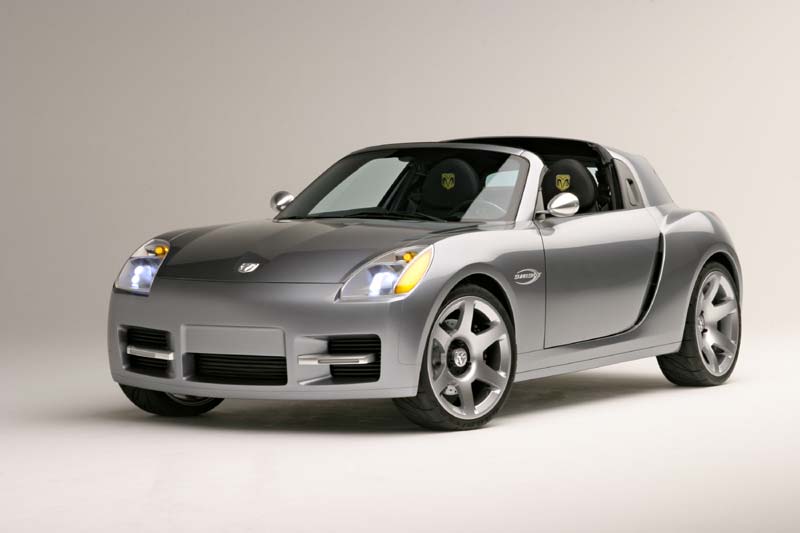
An "Americanized" version of the roadster was debuted at the Detroit Auto Show. The Dodge SlingShot concept car is obviously based on the smart roadster, down to its three-cylinder rear-mounted engine and the targa style removable roof panels.
I'll keep my '94 del Sol a little longer, thank you!
-
Re:My carAlcohol for example
One of the requirements is that it be COST EFFECTIVE. Alcohol isn't. Alcohol is more expensive to produce than gasoline and has less heat content than oil which leads to decreased fuel efficiency and less range on a single tank of gas. So you'd be paying more to drive less.
You could also run your car on natural gas (I mean LPG...yes, I know that it is fossil fuel too).
While this is better than oil from an energy independence standpoint, it seems like a temporary solution since, as you said, it is still a non-renewable fossil fuel. Plus about 30% of LPG (in the U.S. anyway) comes from the oil and gas refinery process making the production of this "clean" alternative somewhat suspect.
So, yes, better than gas but I'm not sure it's worth an investment to get people to switch. I'd rather develop a renewal alternative and get people to switch 10 years from now when the alternative is ready than spend money on trying to push everyone to LPG today and then spend more money in 10 years when a truly renewable alternative is available.
-
Re:nonononono.....
Go for luxury man:
Cadillac -
Toyota Prius Reliability
In the compact segment it was the remarkable Toyota Prius that took top honours with 4.5/4.7 and 63/60 mpg. This car is reliable too - a Vancouver-based Prius taxi was recently taken off the road with over 332,000 km on the clock and no major repairs. It was only taken out of service because Toyota in Japan wanted to strip it down and check everything out (the driver was given a new Prius at no charge). Perhaps even Toyota was amazed at this vehicle's astonishing durability, but some credit must go to driver, Andrew Grant.
http://www.canadiandriver.com/articles/tw/thrifty. htm -
Re:You know...
Car sales are dropping significantly too. Might as well blame KaZaA for that too!
-
Re:Why a bus? Why not a bicycle?It does not matter since when you plug your car it only keep the motor block warmer.
Unless you also have a battery blanket in your car.
And, Billy, I have never heard of someone pulling the battery from their vehicle on a daily basis to take it inside. To thaw it out after it's been frozen, sure. But if a battery has been frozen your next trip had better be to the parts store to get a new one.
Hmmm.. looks like it's going down to -33C tonight. Better make sure the truck is plugged in. -
trucks--I sort of like the concept of the hybrids, but in my mind the jury will be out as for their longeveity with road salt, mud, weather, very rough roads and off road useage, etc. Electrical systems on vehicles in the real world are notoriously vulnerable to major FUBAR, check any garage on what needs fixing all the time on any newer vehicles now.
With that caveat, here's a link to what's happening with trucks, which is much more interesting to me than with the little commuter urban cars. The dodge contractor is nifty idea, you can use it stationary as an advanced home or jobsite generator. As someone who curently runs PVsolar with genny backup, I like the idea of eliminating cost, ie, you own a truck because you live rural, trucks are necessary out here, so you can save on the cost of your backup genny and truck simultaneously, no need for separate purchases. And 20 kw is a no-joke sized genny.
-
Re:Finally!I'd buy a hybrid for around-town running, maybe. Not for my "fun" car, though
Are you sure? This hybrid looks pretty fun.... -
Re:All hail the all powerful republicans!
If you have the money, dodge may be selling the 2003 Dodge Ram SRT-10. (a lot is unknown, but sources suggest it's going to be for sale, not a concept truck)
500 HP
500 Ft.-lbs torque
5000 lbs curb weight
0-60 in 5 secs
0-100-0 in 18 secs
¼ mile in 12.9
150 mph top speed
(All ests)
The 10 in the name is for the 10 Cyl. all aluminum viper engine driving the beast (with the 6 speed manual viper tranny too).
If you're states side, you're looking an estimated $40,000 to $52,000 for it (around $60,000 Cdn. I believe). Not bad, all things considered. And it looks sweet too.
See here and here.
A very sweet ride indeed. -
Using myself to fuel the carWeight Watchers beware!
Scientists say 50 grammes of sugar would keep a 40-watt light bulb lit for eight hours.
Now, what I will do, is to just connect this liposuction device with me and their innovation, turn my fat into hydrogen and fuel my car. I assume my excess kgs of excess fat will take me to whereever I want. Haha! Here we come McDonald's!
-
YES. safest car!
No matter how badly you "crash" , you won't get physically hurt!
Seriously though, this article suggests a fair number of manufacturers including BMW use Microsoft based systems in their cars. It's Windows.CE. -
Magna does make their own cars (just a small nit)
This probably supports your point, but I can't resist nit-picking just a little. Magna does complete vehicles (including design), although these are primarily OEM'd to other companies as well as their parts are.
You're right about it being lucrative to just make the parts.
Christopher -
There's even a car called MP3 - Mazda MP3
look here