Slashdot Mirror
Domain: cmu.edu
Stories and comments across the archive that link to cmu.edu.
Comments · 2,977
-
More Info
"By the early 1980's, the Computer Science community at Carnegie Mellon was making heavy use of online bulletin boards or "bboards". These were a precursor of today's newsgroups, and they were an important social mechanism in the department - a place where faculty, staff, and students could discuss the weighty matters of the day on an equal footing. Many of the posts were serious: talk announcements, requests for information, and things like "I've just found a ring in the fifth-floor men's room. Who does it belong to?" Other posts discussed topics of general interest, ranging from politics to abortion to campus parking to keyboard layout (in increasing order of passion). Even in those days, extended "flame wars" were common."
"Given the nature of the community, a good many of the posts were humorous (or attempted humor). The problem was that if someone made a sarcastic remark, a few readers would fail to get the joke, and each of them would post a lengthy diatribe in response. That would stir up more people with more responses, and soon the original thread of the discussion was buried. In at least one case, a humorous remark was interpreted by someone as a serious safety warning."
"This problem caused some of us to suggest (only half seriously) that maybe it would be a good idea to explicitly mark posts that were not to be taken seriously. After all, when using text-based online communication, we lack the body language or tone-of-voice cues that convey this information when we talk in person or on the phone. Various "joke markers" were suggested, and in the midst of that discussion it occurred to me that the character sequence
Smiley Lore -
More Info
"By the early 1980's, the Computer Science community at Carnegie Mellon was making heavy use of online bulletin boards or "bboards". These were a precursor of today's newsgroups, and they were an important social mechanism in the department - a place where faculty, staff, and students could discuss the weighty matters of the day on an equal footing. Many of the posts were serious: talk announcements, requests for information, and things like "I've just found a ring in the fifth-floor men's room. Who does it belong to?" Other posts discussed topics of general interest, ranging from politics to abortion to campus parking to keyboard layout (in increasing order of passion). Even in those days, extended "flame wars" were common."
"Given the nature of the community, a good many of the posts were humorous (or attempted humor). The problem was that if someone made a sarcastic remark, a few readers would fail to get the joke, and each of them would post a lengthy diatribe in response. That would stir up more people with more responses, and soon the original thread of the discussion was buried. In at least one case, a humorous remark was interpreted by someone as a serious safety warning."
"This problem caused some of us to suggest (only half seriously) that maybe it would be a good idea to explicitly mark posts that were not to be taken seriously. After all, when using text-based online communication, we lack the body language or tone-of-voice cues that convey this information when we talk in person or on the phone. Various "joke markers" were suggested, and in the midst of that discussion it occurred to me that the character sequence
Smiley Lore -
With a face like that...
Check out the inventors home page.
Looks like a happy guy, how appropriate. -
Re: genetically generated code?
Have a look at the comp.ai.genetic faq.
-
zerg
I would willingly sacrifice all three testicles if it meant getting into CMU. In any case, here's what you need to know about CMU's graduate program:
clicka -
CMU West - Best of both worlds
If you dont like the rain, but like CMU, there is another option. Apparently, CMU West is accepting applications, and offers the same MSE program. I thought CMU's expansion plans died with the
-
Matter and InteractionsMatter and Interactions by Bruce Sherwood and Ruth Chabay is an excellent 2-book series covering college-level (ie. Calculus-based) Physics I and II (Mechanics and Electricity+Magnetism).
The whole idea is to go from fundamental physical principles and derive everything. This is unlike high-school physics books which merely force you to accept various equations, while handwaving over the assumptions required to get their simplified result.
I am a Physics Major. I have used both books in-class, and I keep them around because they're good, comprehensive Classical references.
Hope this helps.
-
Re:BS Required
There's actually a course on Information Warfare taught at CMU. First assignment:
Your task, should you choose to accept it, is to gather information about one of three instructors in this course (Benoit, Scott, or Tim). The one you select is your 'target'. They are all wanted by the U.S. Government for crimes against students. In order to more successfully prosecute them for these crimes, we need to know every bit of information on them. -
Re:Corruption and democracy
I, for one, reject the notion that spending money is covered by the First Amendment.
Yes. Especially when source code isn't.
I'm willing to bet that if the politicos bought votes with lines of code, and us geeks wrote programs by arranging bits of green paper, the situation would be very different. (Does that make sense?) -
Re:What do ITC and Afga claim as violating DMCA?
Wrong wrong wrong! That software was written by me, and is an entirely different DMCA complaint by Monotype. I have no clue about the Adobe stuff, though I'd be very interested in hearing about it...
Macromedia?? -
Re:Monotype's corresponding release(?)
That's actually a press release about My Software . I can't find anything about the Adobe business, but I'd be very interested in hearing Agfa Monotype's complaint, for obvious reasons...
-
Analysis of Something Else
Actually, that comment is about my software , not Adobe. However, the similarities are striking. I think Agfa Monotype and ITC just love to send out empty threats...
-
Damn
I wish that they'd asked the guy who wrote the movie about fighting evil corporate intrusion countermeasures how he feels about his movie being distributed with evil corporate intrusion countermeasures.
-
Saw it at SIGGRAPH
The Public Anemone was presented at SIGGRAPH '02 in San Antonio, about a month ago - that's where the pictures in the article were taken. The exhibit was in the Emerging Technologies area. I visited the exhibit almost daily (reactive robotics is an area of interest), and spent some time observing both the exhibit and people's reactions.
The Media Lab students explained that it was an experiment in social interaction - but how people react with something that doesn't have a face, or a voice. In a way, it's easier to create a creature that doesn't have to synthesize speech, etc. At the same time, it's much more difficult to elicit a reaction from people when they can't interact the same way that they do with other humans.
The Public Anemone had two main forms of reaction that I could make out - shrinking back from people who reached out toward it, and tracking faces. (With the assistance of dual stereo cameras in the back wall.) The exhibit was more like a terrarium than an aquarium (as the BBC article mentions), but the creature had a silicone skin which allowed it to play in the small pond and waterfall without shorting. During the day cycle, the anemone interacts with guests. During the night mode, the anemone goes to sleep and guests can interact with other fiber-optic anemones (that also shrink away) and drum on gemstones embedded in the surface of the exhibit. The exhibit certainly looked cool, with fiber optics, a soundtrack, and changing colored stones (using ColorKinetics lights), but the interaction left something to be desired. Almost all the people I observed in the exhibit did the typical museum "Oh, that's nice, let's look at it for a few minutes." Almost no-one tried to interact unless prompted to by the media lab representative that was standing there, describing what was going on. Nobody that I saw tried to play with the face tracking abilities of the robot.
Cynthia Brazeal(the person in the second pic) is more commonly known for her work on Cog & Kismet. (Pic)
IMHO, The coolest project in this area is Doc Beardsley, by the Entertainment Technology program at Carnegie Mellon. Here's an article at Discover Magazine. Interaction with Doc emphasizes fun over artificial intelligence.
I have more pics of the Anemone from Siggraph. If anyone wants to post them somewhere where they can stand the slashdotting, send email to mistermund@yahoo.com -
It *does* control your mp3 player
For the record (I'm one of the researchers on the project), the prototype can control shelf-top mp3 players (we've implemented the control protocol for the AudioRequest device). (And one of the paper prototypes considered an office phone and voicemail system, though we haven't implemented that, so we're pretty confident we could handle your answering machine with no problem.)
The system will control anything you write a specification for.
Some neat features that the article sort of glossed over: the system generates UIs that are demonstrably better than traditional remote controls. It requires no programming at all. It can generate multi-modal interfaces (combining speech and GUI). It can generate interfaces for any form factor remote control device (this is the same flexibility that allows multi-modal interfaces).
The CMU page has lots of information about what the system is really capable of.
Oh, and yeah, the system is currently implemented in Java and it runs on Linux as well as PocketPC (in fact, the widgets look better on the Zaurus).
Unfortunately, our system is not smart enough to read slashdot and detect duplicate posts. -
It *does* control your mp3 player
For the record (I'm one of the researchers on the project), the prototype can control shelf-top mp3 players (we've implemented the control protocol for the AudioRequest device). (And one of the paper prototypes considered an office phone and voicemail system, though we haven't implemented that, so we're pretty confident we could handle your answering machine with no problem.)
The system will control anything you write a specification for.
Some neat features that the article sort of glossed over: the system generates UIs that are demonstrably better than traditional remote controls. It requires no programming at all. It can generate multi-modal interfaces (combining speech and GUI). It can generate interfaces for any form factor remote control device (this is the same flexibility that allows multi-modal interfaces).
The CMU page has lots of information about what the system is really capable of.
Oh, and yeah, the system is currently implemented in Java and it runs on Linux as well as PocketPC (in fact, the widgets look better on the Zaurus).
Unfortunately, our system is not smart enough to read slashdot and detect duplicate posts. -
a link to the pebbles project
The universal remote (actually known as the Personal Universal Controller, or PUC) is part of the Pebbles Project at CMU. It's website is here.
-
Re:Better technology is already available for sale
(Bias alert: I was the project manager for MAYA on the PUC.)
The article is a little light on the details. The PUC does some things that systems like the Pronto can't.
First, there is NO programming. Zero, nada. The appliance sends an abstract specification of its features to the remote, which then automatically generates an appropriate interface. This interface can be tailored to the needs or preferences of the user, and can take advantage of idiosyncratic features of the device being used as a controller (for instance, we could use a jog-wheel for volume if one is available).
The interface specification language is VERY abstract. So abstract that we can automatically generate interfaces in multiple modalities, like, say speech. We're working on mixing modalities.
Plus, our remote is two way. If someone else changes the channel, the remote's display reflects the change. This lets you design much better interfaces because you can hide features that aren't currently available. This minimizes the number of buttons you need and drastically reduces mode errors.
Find out more. Check out CMU's page and MAYA's more markety page.
P.S. The whole needing-a-laptop thing is because we hacked all this into a $75 shelf stereo we got from Best Buy. Obviously a production system would not have any such kludge. -
Re:I notice it's running WinCE Pocket PC Edition
Actually, the prototype client is Java. Runs fine on the Sharp Zaurus (and the widgets look nicer).
Anyway, the important facet of the system is the XML specification and protocol, which could be implemented on any platform. We'd love to do a cellphone... -
Re:I notice it's running WinCE Pocket PC Edition
Actually, the prototype client is Java. Runs fine on the Sharp Zaurus (and the widgets look nicer).
Anyway, the important facet of the system is the XML specification and protocol, which could be implemented on any platform. We'd love to do a cellphone... -
I worked on this
I'm the Mike Higgins quoted in the article. The article is less than informative. If you want better info, try CMU's page. MAYA has a page too but it's a bit more markety.
The system is actually pretty neat: no programming is required. We're working on generating multi-modal interfaces. The remote is two-way, so it gives much better feedback than traditional remotes (leading to better interfaces). -
Interesting stuff
At a recent conference there was a paper discussing one interesting aspect of this work. They are working on defining a standard remote control markup language to allow clients to render appropriate layouts. The pdf is here.
This could be pretty cool... -
Re:Being free (Was:It Would be Nice...)
> Let me start by saying I'm all for Open Source software
That's it. You don't grok free software. It is not the same thing philosophically.
> Oh grow up!
I'm amazed my maturity interests you, but I am 30, have a job and a family, and have had some pretty good education, including some reading in Philosophy. Now on to the debate.
> Think for a moment about who you're freeing.
The users, and in the measure in which government has grown dependent on Informatics, the people.
> Most corporations are given the right to modify programs to fit their individual needs.
No, they aren't. I work at a big European telecom operator, and we have neither the Microsoft source code nor the Amdocs (our billing system vendor) one. Now, I think it is self-defeating proposition to run a business without the source code to one's core system, as is a billing system to a telecom operator. But the incredible thing is that MBAs think it is good. No need to tell you how much shareholders' money is wasted.
> The average consumer doesn't know source code from techno-bable. They couldn't change or modify their programs any way.
The main purpose of source code is not modifying it, but avoiding proprietary lock-in. Please educate yourself.
> now stop fighting the licence war
If we allow everyone to hoard software and claim it's free or open or standard, like Apple and the Unix vendors and Microsoft all have done, we loose our freedom again.
> make your products useable.
That needs efforts currently wasted on useless forking, semi-free code and proprietary systems interoperability.
> So then why are people complaining when Apple and other companies release the sorce to programs?
They didn't. Apple released under a quasi-free license mostly that was already available under a really free license.
> Just because it isn't GPL licensed?
No, because it is not free.
> You can't have consensus because different people want different things.
Yes, but most forking is not because of different, valid goals: it is because of bad technical decisions (for instance RPM as a dpkg fork), proprietary licensing (for instance the original TrollTech Qt licensing) or just the not-invented-here syndrome.
> Freedom and Security are on to ends of a scale. There has to be a balance. Complete freedom means no security, complete security means no freedom, but you have to provide a reason.
Go educate yourself about risks and security. Usually free software is more secure than equivalent proprietary software.
> Safety, if M$ Office breaks, theres technical assistance for them.
There isn't. There is no warranty, there is no security, there is no source code to fix things. There are thousands of people who know a little about MS Office, but no one has the source code. The end result is that people learn to live with brokenness in proprietary programs, while with free software it can always be fixed.
> Ease of use, most OSS software is nice sometime seven great once it's running, but getting it up and running is a pain.
This is being addressed by several distributions. Rome wasn't built in one day.
> Extra steps, as nice as the OSS office suite is, the users still have to select M$ Office format to save their documents so everyone else can read them.
This is because MS Office documents are proprietary. If they were open standards, there would be no need of converstion. But still, if things are saved in XHTML, PDF, RTF and the like, MS Office users can read them.
I don't know why I loose time trying to teach people who can't to their homework reading.
-
Apparently my memory was faulty...
Apparently my memory of the 1964 Picturephone is faulty, because it says here that "The image only refreshed once every few seconds." That's sure not the way I remember it, but...
On the other hand, something doesn't quite jibe, because this article says that the bandwidth was 1,000,000 Hz, which was about one-quarter that of full broadcast EIA RS-170-A black-and-white video; so if you assume that the screen resolution was half that of broadcast in both dimensions, it should have been possible to get a full 30 fps. Or if the screen had full broadcast resolution, it should have been possible to get 7 fps, which is a far cry from "once every few seconds." -
Staying awake 101Boys and girls, the redundant post you've been waiting for... a complete list of all things makey-wakey known to mankind (and then some), featuring caffeine level where avaiable, legality, and possible side effects.
Soft drinks range from anywhere between 35 (Pepsi light) to 71 mg of caffeine per 12 oz. Also, most of them add sugar for an enhanced energy kick. Sugar highs are short-time, meaning you get power for only a few minutes, but with caffeine, which works long-term, that's quite okay. Except for getting fat, there are no real side effects. Depending on your constitution, age and weight, you'd need to drink between 4 and 8 litres of this stuff to get caffeine shock. (Please don't try this at home, kids, I know the feeling, and it's not good.)
Energy drinks, like Red Bull, XTC, etc. contain about 100mg caffeine per 8 oz, with additons such as guarana, ginseng or taurine. Because of the higher doses, it's generally not smart, though widespread, to mix those with alcohol. Remember, caffeine may enance the effects of any other drugs you consume.
Coffee, the allmighty coffee. From a low 65 mg in instant coffee to a nice 175 in drip per 8 oz, it is easy to get, tastes okay, and will give you heart and stomach diseases. 2 cans of strong drip coffee will make you shake like a boogie dancer.
I put tea in this category (yes, tea also containes a form of caffeine), strong black tea has 50-80mg per 8 oz, while iced tea and fruit tea range from nada to 15mg. Not quite the kick, but your digestive organs will be much more happy.Tabs. The all time favorite would be NoDoz, with eiter 100mg in the standard or 200mg in the shiny "kill your brains" edition. Also, you can get various caffeine tablets at your local pharmacy, with different names, those will mostly contain 100mg per tab. Also, many painkillers use caffeine as an ingredience. Your doc will probably tell you that you should not consume more than 500mg of caffeine per day. Understand that 500mg may be enough for the non-coders and non-gamers out there. Real hax0r doods swallow half a gram for breakfast
Speed. The common name for Amphetamines and Metaamphetamines, at least you can hope that they are inside the stuff. Usually snorted or swallowed, sometimes injected or smoked. Speed is avaiable from your friendly neighbourhood dealer(tm), ILLEGAL, and can be very dangerous to your health. One dose will keep you awake for 6 to 24 hours, in this time you will expirience a "brain high", and a lack of emotions. When getting stoned, you'll be dead tired, will sleep for a long time (12+ hours), and have a serious hangover afterwards. Physical addition is possible, but it's more likely that you'll take downers afterward to sleep, followed by more speed when you wake up, and the cycle is finished. May cause seizures, heart strokes, and other nasty things you want to avoid. Just say know.
Crack. Leave your hands of it. 'nuff said.
Well kids, that concludes today's lesson. The next time, you'll learn where
Links of interest :
caffeine content of food and drugs
Amount of caffeine in drinks
a salute to caffeine
thinkgeek : caffeine
amphetamine facts -
here is some C source
chec the "Utility to Remedy fileOpen PDF Encryption" at this site
-
Internet Message Support Protocol
Another protocol that can be used for shared address books is IMSP, which was written as part of Carnegie-Mellon's Project Cyrus. The problem is that few applications support it. In fact, the only one I know of is Mulberry.
-
Stupid Peasants and Flawed Government
I don't know the particulars of the situation, but it sounds like your organization (like most others) focuses on people and not on process. Basically, you assume that when something fails or someone doesn't "work out", it's the fault of the person ("Stupid Peasants") and not the processes, policies, and management ("Flawed Government") that dictate much of their everyday routine.
I've seen many companies like yours where you focus on insanse quizzes (which are most likely illegal in some states of the U.S.) and questionaires to hire people. Then, when the person gets the job, they are forced to wander around the building begging people to help them get started. There is no documentation on your processes. You have no way of initiating new developers. There is no software quality assurance group responsible for the quality of the process and the code. Projects only succeede if the grandmaster coder or super project manager are on the team. And, you insist that all developers perform as well as your current "uber-geek-god-coder" rather than accepting that people work at different levels. Worst of all, you have no way of empirically measuring what the uber-geek does different, let alone what "perform as well" even means.
What you need to do is move away from your people focus, and start adopting a process focus. This way of running things assumes that people are intelligent, and that if they don't perform well, then there's something wrong with the processes and policies. In other words, rather than firing people, find a way to improve things for them. If you do this, then you can spend less effort trying to find uber-geeks as regular folks should be able to work efficiently.
The best thing I've seen for this (and what I currently follow) is the Capability Maturity Models at CMU's SEI. It is a very good process which focuses on measurement and doesn't require any particular development method. We use a mix of XP and other stuff for our processes. The primary thing CMU tries to emphasize is that you should always try to improve your process (something the manufacturing industry has known for about 20 years). This continuous improvement is what is needed to stay ahead of the competition, and has worked well for many other industries. The trick is improving process without stifling creativity (although, most coding I do isn't that creative).
The downside to CMM is that people assume it will cause all their projects to instantly succeed. This would be a matter for another discussion, but let's just say that I can't think of any other industry that tries so hard to make so much crap "succeed". CMM will only help you produce the best crap you can, it doesn't turn crap into gold.
Finally, it seems that your managers tend to blame the workers when things go wrong, even though managers setup nearly everything in the environment. This way of running things will probably need to be the first to go since CMM (and any process improvement) forces management to admit that they are responsible for failure since they are in control. Once that psychological hump is rolled over, things get easier.
Enjoy! And I hope you start looking at your management practices, not your hiring practices.
-
Re:From what I've seen...
When I visited Waterloo to see their CompSci department, they basically told me that half of my classes would be mathematics, the other half would be computer science. Sure there were a few elective spots if you didn't choose one of the more particular options available.
For example: Honors CS - Bioinformatics (one of the more varied CS programs). I don't see any non science/math courses required. Sure you get 5 or 6 electives, but that's not really encouraging a diverse education. Similarly, U of T seems to only require one writing course for CS students. UVic requires one technical writing course and one English course.
Check out this from CMU for a comparison. All CS students are required to complete a non-CS minor. Also see UTD for another example.
As a senior in HS deciding where to go for college I am forced to make some generalizations to narrow down the field. My observation has been that a typical American school requires a broader education than a typical Canadian school (no offense to Canadians; heck, I'm originally from Canada).
So why is this a problem? I've read plenty of articles in Canadian news publications that complain about the loss of students to American programs and, later, American jobs. As a Canadian living in the US, I'm not likely to head back to Canada for an education. -
Re:Bayes Rule spam implemention *and* seeding
Andrew McCallum's BOW (Bag Of Words) statistical classifier is released under the LGPL. It's available here.
-
Re:A Clarification on the NY/Cell issueHere's a study using fMRI, in case y'all don't believe tshak:
http://www.cmu.edu/cmnews/010906/010906_cell.html
Just, co-director of Carnegie Mellon's Center for Cognitive Brain Imaging (www.ccbi.cmu.edu), said making cell phones "hands free" won't help.
"Use of cell phones doesn't just distract the eyes," he said. "The conversation itself also distracts the brain. Making the cell phone hands-free will not help eliminate the brain distraction."
-
Oh Really?
"If the public believes that the DMCA is stopping Professor Felten and other researchers from conducting legitimate research, then that is a major victory for opponents of the law."
well, us the "opponents" must be making things up and this entire site is a fraud -
What did you think i meant?Cascading style sheets?
Why dont I give you a link:clue; -
Here's a Tutorial I WroteMaking really nice fonts is tough (even after making 65, I still don't really have the patience to make ones that are appropriate for large bodies of text!). But there's no reason why we shouldn't have more people making fonts. Check out my tutorial,
-
Re:The simple solution
A wearable computer might work...
-
Genetic Algorithms? Anybody?There are lots of posts from people who don't really get what these guys did. I don't think they made a particularly amazing achievement, but many slashdotters out there don't seem to understand the science behind the achievement (the Reuters article was awful, second hand from New Scientist, which is often poor on presenting the basics).
What the researchers did was to build a robot that had wings and motors for manipulating them. These could be controlled by a computer. But instead of writing an explicit program telling the robot how to fly, they got the robot to learn how to fly. They did this using some sort of Genetic Algorithm.
Basically, what a GA does is to generate a large population of possible solutions to the problem, then evaluate how good each one is (i.e. measure the lift each one creates in this example) and then to breed good solutions to create successive generations of possible solutions which are (hopefully) better than the previous generations.
Then, once some criterion is met (for example, once the average fitness of your population doesn't change much for several generations), you then select the best solution found so far as being your answer.
In mathematical terms, GAs are stochastic methods of optimising a function; they are typically used when solving the problem using an analytic method would be problematic (i.e. it would take too long etc.).
So it's not really surprising the robot learned to 'fly' -- the researchers just managed to find an optimal sequence of instructions to send to the wings.
The next step would be to get a robot to learn how to hover without the aid of the stabilising poles; then fly from one location to the other; then fly in a straight line in the presence of varying wind etc.
What the research does do is to lend credence to the argument that insects and birds could have evolved, rather than having been 'designed' by some sort of a God.
-
Re:1991 prior art right here
Yeah, I don't know how the bot scene is at MIT these days, but at CMU (zephyr migrated to multiple realm thingies here a while ago) there are bots that have been around for years, one of the more pointless ones being the Cube. The Cube was born in 1996, still in "use" daily, may be vaguely familiar to anyone who saw ye olde Forum 2000.
-
Re:Nooooooo!Here at CMU, it's the "Mathematical Sciences" department. That's because the university classifies math as a science. Other schools do the same thing. I fail to see how that, from an academic perspective, is any different from only having math in your title.
Maybe it's different from an administrative standpoint, but when you've got a faculty working on math and students taking math courses in the school... if it looks like a duck, if it quacks like a duck, and if it smells like a duck...
-
Re:It only took 10 years :)
They look pretty cool inside too
-
Re:Just for some context...
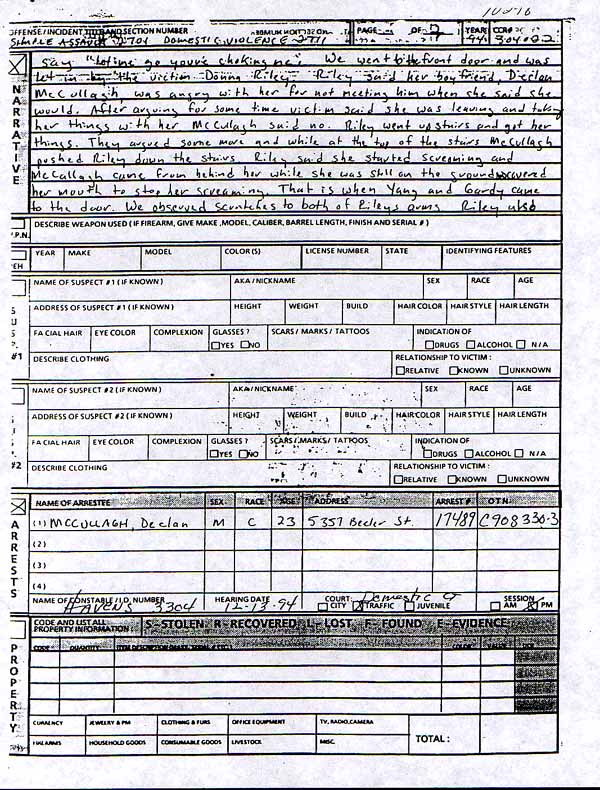
Not "supposedly". Declan was arrested, (page 2), (page 3), and pled guilty
-
Re:Just for some context...
Not "supposedly". Declan was arrested, (page 2), (page 3), and pled guilty
-
Re:Just for some context...
Not "supposedly". Declan was arrested, (page 2), (page 3), and pled guilty
-
Re:Just for some context...
Not "supposedly". Declan was arrested, (page 2), (page 3), and pled guilty
-
Re:Just for some context...
Ah, here's a link: student senate minutes from January 1995
-
Alan Black (the researcher)
Wow... just look at this guy. Strongly indicates someone trying to be outside the box.
Expanded picture from the article.
Another pictures is on his homepage that even has some information on "running Unix on IBM PC110 palmtop computer" and "a Casio E-105 Palm-sized PC" -
technical link
if you arent satisfied with the pc magazine summary, you can read this
-
He did so much more...
It's a shame that
-
Java instead of FORTRAN for NC?
This is an interesting paper on the subject: paper
-
Re:600?"What type of bots do they need to test on such an expanse?"
These are robots which need to be able to autonomously traverse 50-100 miles of unknown terrain, perform operations at their destinations, and return. Testing them on the 3 acre front lawn doesn't quite give enough opportunity to prove out systems like that.
-
Re:600?"What type of bots do they need to test on such an expanse?"
These are robots which need to be able to autonomously traverse 50-100 miles of unknown terrain, perform operations at their destinations, and return. Testing them on the 3 acre front lawn doesn't quite give enough opportunity to prove out systems like that.