Slashdot Mirror
Domain: columbia.edu
Stories and comments across the archive that link to columbia.edu.
Comments · 1,401
-
I've always wanted the opposite
I've always wanted to make a computer into a typewriter. By sending characters and control commands to an old dot matrix printer, one should be able to make a passable typewriter application that outputs dot matrix characters in real time. It would use carriage control logic such as that used in the old DecWriter dumb terminal to scoot the print head away from the active printing area to show the user what's being typed and then reposition the print head when they start typing again.
Sometimes you just need to type words into some odious government form and a hacked typewriter made from some leftover computer junk would be just the thing. I've got an old Mac LC II and an Imagewriter that would be just perfect for this hack, but any old computer and dot matrix printer should work. With a custom application that autoruns during boot, the thing wouldn't even need a monitor. -
Re:That's no misquote. Here's your context
I grant that Gore, and hundreds of other politicians, voted for funding and new taxes for the Internet. But that does not mean he took the initiative in creating the Internet. Even when Al Gore tried to take credit for some of the funding for when ARPANET transitioned to NSFNET, he was still exaggerating. Yes, he recognized a good thing when he saw it. But, he was not involved in the early funding of ARPAnet, the initial NSFNET, or even the initial effort to further increase funding for NSFNET. He merely became a government cheerleader of a prior movement that had little opposition. It was the strong pressure within the Reagan Administration to privatize government operational activities that lead to the privatization of the Internet. Not only is it fair to lampoon Gore for claiming to have created the Internet, it's accurate. If there are any questions, ask Al Gore, who admitted that it was mistake to have claimed to have created the Internet.
http://www.columbia.edu/dlc/wp/citi/citi488.html -
Re:Intelligent debate
No you haven't. You said that if the institution has trained medical personnel for a procedure, it shouldn't refuse it. Well, what if there is no trained personnel (as in Catholic hospitals in regards to abortion)? Should the hospital be forced to hire medical personnel to give out abortions?
Where is the evidence for your assertion that Catholic hospitals do not have any personnel capable of performing abortions as opposed to simply prohibiting the procedure?
No. The Treaty of Triopoli proves nothing but a good move in international relations by Humphrey, written decades after the founding of the country (not a founding father, nor a constitutional scholar). The US is based on divine-origin rights ("We hold these truths to be self-evident, that all men are created equal, that they are endowed by their Creator with certain unalienable Rights, that among these are Life, Liberty and the pursuit of Happiness" ).
The Treaty of Tripoli was ratified unanimously by Congress and signed by the President and represents the prevailing attitude of the time. It was put into law a mere five years after the founding of the country (which was 12/15/1791, when the Constitution was ratified). The document you quote from is the Declaration of Independence, which is not U.S. law. The Constitution is very clear on the subject of the U.S. not being based on religion. The First Amendment recognizes that people may be of any religion or none and Article VI Section 3 declares that no religious test shall ever be required to hold public office. There is no other mention of religion in the text and no mention of "God" at all.
Just as I suspected: A bigot. I don't blame you. College tends to brainwash you because the typical professor holds the popular but erroneous belief that reason and religion are at odds (the reason is simple: it makes them, the so-called proponents of reason, feel more important).
How typical of a religious person to make a broad assumption with no basis in facts. As it happens I was raised Christian but came to my senses late in high school, well before I entered college.
That's also why Slashdot seems to have somewhat of a hive mentality. Most people here still haven't grown up to see past their ego.
Expanding your ad hominem attacks to encompass the entire population of Slashdot does not make them any less invalid. You appear to believe that you alone are "grown up" but you've shown no signs of it.
To start, modern science would not have been possible without religion (http://www.columbia.edu/cu/augustine/a/science_or igin.html). Are you saying that no good came from science?
The site you quote references a biased source that provides no evidence for its assertions. You have failed to prove that science would not have come into being without religion and your question is therefore fallacious and not worthy of a response.
The US's tremendous economic growth, too, has in large part been attributed to the Judeo-Christian ethic of most of it's people (http://en.wikipedia.org/wiki/Max_Weber).
I notice that the site you link to indicates that this "Protestant work ethic" that Weber writes about applies to non-Christians as well. What was your point again?
Until now, I haven't taked much about religion per se, but now I can pity you. You are blind and you think that you can see everything. I hope to God that you get past your blind hate of things you do not understand.
I understand religion in general and Christianity in particular, probably better than you. Having an outside perspective tends to do that for you. Don't let that get in the way of your ignorant judgement of me though. -
Re:Intelligent debateThis is a stupid question that is already answered in my previous response.
No you haven't. You said that if the institution has trained medical personnel for a procedure, it shouldn't refuse it. Well, what if there is no trained personnel (as in Catholic hospitals in regards to abortion)? Should the hospital be forced to hire medical personnel to give out abortions?
This is false. The Treaty of Tripoli conclusively proves otherwise that the United States was not founded on christianity. The Constitution and the writings of the founders provide additional edification if you're interested (and I'm sure you're not).
No. The Treaty of Triopoli proves nothing but a good move in international relations by Humphrey, written decades after the founding of the country (not a founding father, nor a constitutional scholar). The US is based on divine-origin rights ("We hold these truths to be self-evident, that all men are created equal, that they are endowed by their Creator with certain unalienable Rights, that among these are Life, Liberty and the pursuit of Happiness" ). The divine-origin rights mean that the country is founded on theist beliefs. Secular systems don't allow for unalienable rights. Though the Government itself is religion-neutral (what the Treaty you mentioned tries to make clear), the government nonetheless is based on the most basic principle of religion: The belief on a God. The vast majority of Americans, too, are of Judeo-Christian background
Religion has been the enemy of enlightenment and progress throughout history.
Just as I suspected: A bigot. I don't blame you. College tends to brainwash you because the typical professor holds the popular but erroneous belief that reason and religion are at odds (the reason is simple: it makes them, the so-called proponents of reason, feel more important). That's also why Slashdot seems to have somewhat of a hive mentality. Most people here still haven't grown up to see past their ego. It took me a decade to get over that brainwashing. To start, modern science would not have been possible without religion (http://www.columbia.edu/cu/augustine/a/science_o
r igin.html). Are you saying that no good came from science? The US's tremendous economic growth, too, has in large part been attributed to the Judeo-Christian ethic of most of it's people (http://en.wikipedia.org/wiki/Max_Weber).Until now, I haven't taked much about religion per se, but now I can pity you. You are blind and you think that you can see everything. I hope to God that you get past your blind hate of things you do not understand.
-
Re:ALL YOUR CODE IS BELONG TO US!
Putting Stallman on the stand is about the only way to fuck the case up.
Don't send a hacker to do a lawyers job. Even if FSF were to get involved, it doesn't have to involve RMS. Send Eben Moglen, he'd probably do a good job. -
Drop in the Ocean
While we feel close to the 'huge' losses of the dotcom boom/bust, we must not loose sight of the fact that two US corporations (Enrom, $80+ billion, WorldCom $74+ billion in 2000/2001 alone, and Tyco) probably account for more direct losses than all the dotcom spending. It was these big corporate failures trashing the stock market, that led to widespread losses amounting to trillions of dollars (billions from State pensions alone), that then brought down our favourite dotcoms.
The dotcoms may have been pretty fireworks, but they were not the monetary black hole that snak the economy.
-
Subconscious copying
So I'm moving along writing my book when the drm chip steps in and decides that my book is copyrighted by someone else. ( obviously it's not as I'm writing it now)
This has in fact happened, albeit with music rather than books. See Bright Tunes Music v. Harrisongs Music .
-
Re:Have you heard of Nero?
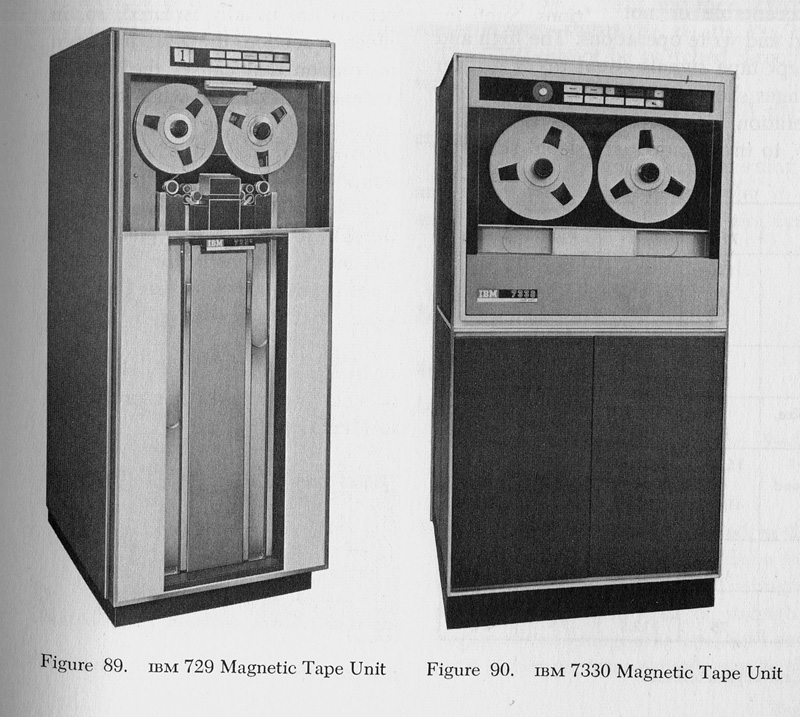
check this link out for 9 track tapes on ebay You can also buy used 9 tracks tapes from an ebay store as well. The guy has about 120 of them. As for 7 track drives I don't know. I found this on wikipedia. And what is really interesting if you click on the picture you can see the picture was taken from an old NASA video! Here is another picture I found of 2 different IBM 7 track drives here from this article.
-
Re:Have you heard of Nero?
check this link out for 9 track tapes on ebay You can also buy used 9 tracks tapes from an ebay store as well. The guy has about 120 of them. As for 7 track drives I don't know. I found this on wikipedia. And what is really interesting if you click on the picture you can see the picture was taken from an old NASA video! Here is another picture I found of 2 different IBM 7 track drives here from this article.
-
Re:Have you heard of Nero?
According to some quick googling:
http://www.columbia.edu/acis/history/media.html
At 1600 bpi, a 2400-foot 9-track tape could hold about 50MB (depending on blocking, etc). In earlier times there were 4-track and 7-track drives at lower densities such as 200 and 556 bpi.
According to TFA:
The Pioneer data exists on a few hundred ancient 7- and 9-track magnetic tapes, which can only be read on "antique" outdated computers
So, at 50mb a pop, let's estimate really high and say 1000 tapes, you're looking at about 50GB. -
Punched cards
I'm not sure if "fond" is the right word, but I still remember my very first 1st year Computer Science assignment, essentially "Hello, world" in Algol W. Done on punched cards, no less, in September 1978.
If you did really well you could use IBM 3270 terminals.
All this was with the campus mainframe, an IBM 370/168 with one whole megabyte of RAM and a 40 MHz clock. Even programmed that puppy's replacement (Amdahl 470/V8) in assembler in one course.
STM 14,12,12(13)
...laura
-
What composition?
what matters in music is not the execution, which anybody with some training is able to do after a while. What really matters is the composition
At least the court system agrees, unfortunately. Subconsciously copied melody + completely original execution = copyright infringement and seven-figure liability, according to this journal entry. With precedents like Bright Tunes Music v. Harrisongs Music and Three Boys Music v. Michael Bolton on the books (look them up here), what is a composer to do?
-
Re:Against Concept of the Internet?
Actually the backbone routers are far more of a liability - take down the DNS root servers and caches would keep things ticking over for a few days. Take down a couple of backbone routers and the resulting BGP storm might take down the internet...
-
Research Experiences
Designing interfaces for visually impaired users was a topic of my own research for a couple of years at ISEF and affiliated fairs while I was in high school. As far as interfaces go, I experimented with a braile keyboard (tried and true) and voice recognition (ammount of success varies depending on possible input vocabulary). One tool I found particularly useful for designing interactive voice interfaces using both speech synthesis and recognition was VoiceXML, which defines a markup language with basic scripting logic for quickly building voice interfaces. During my junior year of High School, I implemented a perl module for automagically generating voice interfaces (my ultimate goal was to create a replacement for the integrated cgi modules for live internet-aware voice apps), and showed it off by designing a basic newsreader app that pulled data from NewsBlaster (this was back in the day before Google News).
My research experiences taught me several things. Firstly, it is important to offer auditory feedback for blind users. With voice recognition on a limited vocabulary, this isn't really a problem, as the user always knows what they said. With a broader range of input vocabulary, or with keyboard input, it's important to verify what has been entered at least every sentence or so, as there is naturally no way to provide visual feedback. Secondly, you must realize that all data being transmitted to the user is necessarily in a totally linear format. That means that, in any interface you are designing fresh, you should keep the interface as slim as possible. When you are reading out information that was originally intended for sighted users, some sort of adaptive content filtering is a must. If a blind user goes to slashdot, chances are "image, image, image, image, image, image, username, preferences, subscribe, journal, etc..." is not the first thing they want to hear.
-
Re:This seems like a very narrow and careful rulin
I don't agree that is what the ruling says...
Hmm. That part didn't get quoted in the article referenced two levels above (or three, I can't find it in all the 2nd amendment debate that's taken over this sub-thread). Indeed, that DOES make a difference.
The one thing that I find worrisome is this: the objective that recipients use it to download copyrighted works and locating and playing copyrighted materials...
It's not illegal to locate, download, and play copyrighted materials. Making them available for download against the wishes of the copyright owner is the actual illegal activity, and the way P2P works you normally make them available when you download them, but... here: I'm about to help you locate, download, and play copyrighted materials. Follow these URLs:
http://magnatune.com/
http://www.lujorecords.com/
http://www.columbia.edu/cu/cuo/audio.html
http://www.pianosociety.com/
http://www.serg.vangennip.com/www/piano.html
http://zebox.com/woodmoran/music/
I realise this isn't the kind of "copyrighted materials" he's talking about, but I'd REALLY like to see words like "non-royalty-free" or "restricted distribution" in there somewhere. -
Re:NSA...
More on this here; also see Simon Singh's The Code Book: The Science of Secrecy from Ancient Egypt to Quantum Cryptography, which, IIRC, has a section about this.
-
Re:Don't believe everything NASA spews
All right, I know I shouldn't be replying to flamebait but here goes.
It is in fact possible to at least partially reconstruct blurry images as long as you have some idea about what kind of distortion or motion is causing your problems. In some cases you can get useable information without even knowing exactly what your problem was! Don't take my word for it, look up "blind deconvolution" in your favorite image processing textbook or just use google.
If you're an IEEE member there is an interesting tutorial entitled "Image Deblurring: I Can See Clearly Now" by James Nagy and Dianne O'Leary. In addition to this a real world applications in motion deblurring can be seen here http://www1.cs.columbia.edu/CAVE/research/demos/ne w/motiondeblur.html/
The problem may not be identical to NASA's problem but the mathematical deconvolution techniques are the same.
I realize you just want some attention but a small sense of disbelief is in order since many new developments in the sciences are pretty indistinguishable from magic at first glance. -
Re:SSH is wonderful, and yet users still don't get
You might want to learn about secure telnet before you outlaw the protocol.
Kermit includes a secure telnet client. The same web page says Linux and Solaris ship secure telnet servers.
Complaining about how insecure telnet is without security enabled is like complaining about how insecure NFS is without security enabled. -
Re:Old, Old, Old, News
Sorry, make that at least 10 years old.
-
Re:The Inverse
Yep, you are correct... here is a source:
http://emoglen.law.columbia.edu/blog/2005/04/12#pa yment-rumor -
Re:The Inverse
From what I have heard ESR/RMS are considering requiring companies who derive revenue from GPL'd code (Amazon & Google for example) to provide a revenue stream back to the authors. This is a terrible idea... it sounds like a way of limiting the usage.
If so, I think the "Free" might go out of "Free Software."
You're right, it is FUD - read this -
Re:This is hardly news.
- Something less invasive. Skype's peer-to-peer discovery techniques used at startup "learns" too much about my network "inside" my firewall by doing all kinds of broadcasting, exploring, poking, etc. I don't like it when some other, random company's software starts dissecting the organization of my internal network. I don't trust what they will, or won't do with that info, particularly since it is in the hands of a company who has a demonstrated willingness to do things the rest of the world may not be happy with but that it thinks are "good."
- Something that the open source community can expand on in the way the Skype APIs are doing, but not do it in only the ways Skype -- in it's infinite wisdom -- decide are things that are useful / ok / interesting. This is the very beauty of open source -- lemme do what I want.
- Play well with others. There are tons of SIP-based products and services starting to enter the market. (See the lists at www.sipforum.org and www.sipcenter.org, etc.) Skype is attracting some providers for SkypeOff, but I'd rather take advantage of the SIP industry's last 5 years of work to make a broad array of products (VXML engines, conference control interfaces, media servers, IP PBXs, etc.)
Oh, and to the point that Skype's firewall piercing is unique or unacceptable -- it isn't. See an analysis of Skype signaling done at Columbia University. Skype appears to use a variant of the STUN/ICE technique currently being worked through in the IETF for use with SIP, too. What isn't acceptable in the corporate environment is the local LAN probing / discovery that Skype does at startup!!!
So I want something that plays well with me, and others.
-
Re:Categorized results?
- Something less invasive. Skype's peer-to-peer discovery techniques used at startup "learns" too much about my network "inside" my firewall by doing all kinds of broadcasting, exploring, poking, etc. I don't like it when some other, random company's software starts dissecting the organization of my internal network. I don't trust what they will, or won't do with that info, particularly since it is in the hands of a company who has a demonstrated willingness to do things the rest of the world may not be happy with but that it thinks are "good."
- Something that the open source community can expand on in the way the Skype APIs are doing, but not do it in only the ways Skype -- in it's infinite wisdom -- decide are things that are useful / ok / interesting. This is the very beauty of open source -- lemme do what I want.
- Play well with others. There are tons of SIP-based products and services starting to enter the market. (See the lists at www.sipforum.org and www.sipcenter.org, etc.) Skype is attracting some providers for SkypeOff, but I'd rather take advantage of the SIP industry's last 5 years of work to make a broad array of products (VXML engines, conference control interfaces, media servers, IP PBXs, etc.)
Oh, and to the point that Skype's firewall piercing is unique or unacceptable -- it isn't. See an analysis of Skype signaling done at Columbia University. Skype appears to use a variant of the STUN/ICE technique currently being worked through in the IETF for use with SIP, too. What isn't acceptable in the corporate environment is the local LAN probing / discovery that Skype does at startup!!!
So I want something that plays well with me, and others.
-
What I want that Skype can't provide
- Something less invasive. Skype's peer-to-peer discovery techniques used at startup "learns" too much about my network "inside" my firewall by doing all kinds of broadcasting, exploring, poking, etc. I don't like it when some other, random company's software starts dissecting the organization of my internal network. I don't trust what they will, or won't do with that info, particularly since it is in the hands of a company who has a demonstrated willingness to do things the rest of the world may not be happy with but that it thinks are "good."
- Something that the open source community can expand on in the way the Skype APIs are doing, but not do it in only the ways Skype -- in it's infinite wisdom -- decide are things that are useful / ok / interesting. This is the very beauty of open source -- lemme do what I want.
- Play well with others. There are tons of SIP-based products and services starting to enter the market. (See the lists at www.sipforum.org and www.sipcenter.org, etc.) Skype is attracting some providers for SkypeOff, but I'd rather take advantage of the SIP industry's last 5 years of work to make a broad array of products (VXML engines, conference control interfaces, media servers, IP PBXs, etc.)
Oh, and to the point that Skype's firewall piercing is unique or unacceptable -- it isn't. See an analysis of Skype signaling done at Columbia University. Skype appears to use a variant of the STUN/ICE technique currently being worked through in the IETF for use with SIP, too. What isn't acceptable in the corporate environment is the local LAN probing / discovery that Skype does at startup!!!
So I want something that plays well with me, and others.
-
Re:Ocremix.org legal?
Nothing you read on Slashdot is legal advice.
There are no lyrics, so no worry of copyright infringement there. And to the best of my knowledge, the actual melodies of the music cannot be copyrighted
Sorry, but the best of your knowledge is incorrect. Please read these cases and this analysis.
-
Re:don't dismiss this one so fastCan you give me an example of a possible exploit?
According to this page:
Dashboard does not present a prompt before running a privileged widget that is one of the Library/Widgets folders, including our auto-installed widgets.
If a widget contains a native Mach-O executable, Safari will present a warning before downloading the widget. However, because widgets in ~/Library/Widgets can run shell commands with the widget.system() call, this protection is easily defeated.
And then, even if they fix this, are users going to refuse to allow what appears to be a system-provided widget to run?
When Dashboard encounters two or more widgets with the same bundle identifier, it only displays the last one loaded. And -- you guessed it -- widgets in ~/Library/Widgets are loaded after the system-supplied widgets in
And finally, a sandboxed environment is one in which dangerous things are not possible. Not one in which dangerous things are only possible if a user approves them. And Dashboard's "sandbox" is the latter kind of environment, not the former. -
They should post an advisory
It's pretty stupid that Apple's policy prevents them from discussing the issue before they have a patch for Safari. They really ought to post an advisory urging users of their shiny new operating system to turn off the ``open safe files after downloading" preference in Safari. Considering that it's now established that malicious widgets can replace the Apple-supplied widgets, run with full user privileges once activated, and execute arbitrary binary code, Apple really owes it to its users to warn them.
-
Chungles
Why don't they just use Kermit?
-
Subconscious copying
If John Cage makes a musical work consisting of silence, and you make one which is identical to it, but without copying from it, then your work is not infringing and is copyrightable to you. OTOH, if you based your work on his, then that would be infringing.
Problem is that if you have heard his work once, the court will assume that you based your work on his, whether you intended to or not. This precedent of strict liability for subconscious copying (Bright Tunes Music v. Harrisongs Music) could easily lead to a chilling effect on composition of new music.
As a rule of thumb, since it's improbable that works of even moderate length and complexity will happen to be independently created
The problem is that a work doesn't need "moderate length and complexity" to earn a copyright. For instance, "He's So Fine" is just one three note pattern repeated four times, followed by a five note pattern repeated four times. Read it and weep.
After all, what are the odds that I would write War and Peace, word for word, without reference to the other one? But if I can show that that's what happened
Please skim the two pages I linked to and then answer the following question: How would you go about showing independent creation in a court of law?
-
Re:widgets limited
And this business about not being able to uninstall widgets is complete garbage. To uninstall, just delete it from ~/Library/Widgets.
Yes of course that's how it's done, but strangely Apple's help documentation states: You cannot remove widgets from the Widget Bar or change their order. You can read the pertinent Help page at:
file:///Library/Documentation/Help/MacHelp.help/Co ntents/Resources/English.lproj/pgs/mh2037.html
Clearly they're not doing their computer-novice users any favors here.And this is different than downloading a malicious program to the Desktop or Downloads folders, because I expect things to download there. It's more like downloading a malicious program and automatically copying into
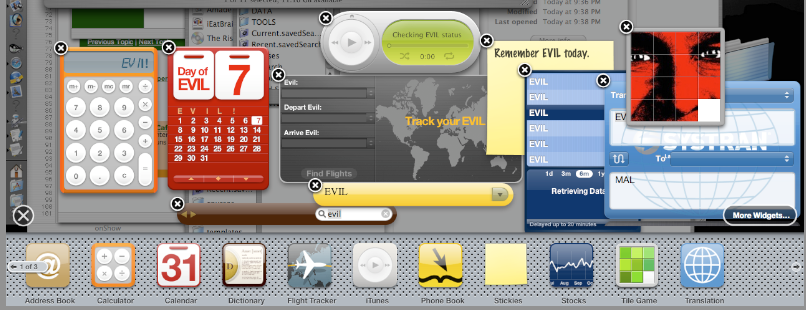
And as for inadvertently clicking, do see my rather over-exuberant example exploit page, which fills your Widgets Bar with widgets that look just like the Apple ones.
I agree it's not the worst exploit in the world, because it does require a small degree of user intervention. But the look-alike widgets show that it won't take a very conscious user intervention -- not even clicking `okay' to some vague warning, or double-clicking an unfamiliar file.
-
Re:The really funny part is
No, it's a conscious design choice, just an unbelievably lunatic one. What's more, it doesn't prompt for permission before running an auto-installed widget that has requested full system privileges. Check out this example exploit page for a demonstration. (Warning: downloads a bunch of widgets!)
-
Re:Sky not falling, Safari warns user twice.
Safari will warn you when downloading a widget with cocoa calls in it by saying "widgetname contains an application. Are you sure you want to continue downloading widgetname?". You have the option to abort download and installation.
Yes, but you won't get that prompt for a widget that doesn't have Cocoa code, but does contain widget.System() calls -- which effectively means it's an application. You could put an executable in your widget, not set the executable bit, but then chmod a+x and run it from widget.System() calls.
Dashboard will ask you the first time a third-party widget is run and give you the option of not running it.
It's so bizarre I didn't believe myself at first, but this is not true of widgets that are auto-installed. Try it yourself -- here is my example exploit page with an entire set of widgets that look identical to the Apple widgets. You will be prompted for permission with none of them, including the `Calculator' widget, which makes a widget.System() call and could conceivably have deleted your home directory.
-
Re:Bad design, for sure, however.
It installs the widget, but does not activate it.. it just makes it available.
Yes, but it's trivial to make a widget that appears identical to, say, the Apple Stickies widget. Moreover, as this example exploit page shows, you can make an entire slate of widgets which look like the first page of Apple widgets, but appear before them (by putting spaces in front of the names). So you might inadvertently visit a web page that auto-installs widgets, then later go to the Dashboard to write a new Sticky Note, never seeing any indication that something has changed, and -- oops! -- you've been pnwed. (screenshot)
Further, widgets do run in a sandbox, and require user approval to execute if they want to do certain things (like erase your HD).
Unfortunately -- and incredibly -- this is not true of auto-installed widgets. Try the Calculator `evil widget' in the above page, for example. It requests full system access, uses it to launch the command-line `say' program to speak some text, and the user is never prompted for approval, beyond simply dragging the widget out of the Widget Bar in the first place. This is very, very, bad. Such a widget could erase your home directory, and you might never even know it had installed!
-
Some relevant research papers
There's a bunch of interesting papers out there on content-based image analysis and retrieval. Below is a sampling from my bibtex file. Does anyone else have others they'd like to share?
* Finding Naked People (Fleck et al, 1996)
* Video google: A text retrieval approach to object matching in videos (Sivic & Zisserman, 2003): web page demo here
* Names and Faces in the News (Berg et al, 2004)
* FACERET: An Interactive Face Retrieval System Based on Self-Organizing Maps (Ruiz-del-Solar et al, 2002)
* Costume: A New Feature for Automatic Video Content Indexing (Jaffre 2005) -
Re:This is waaaaay overblown...I beg to differ with you on that, and as it were, there is a rather prominent court case involving SNL that agrees with me.
excerpted from this case:
The song "I Love Sodom," as well as the sketch of which it was a part, was clearly an attempt by the writers and cast of SNL to satirize the way in which New York City has attempted to improve its somewhat tarnished image through the use of a slick advertising campaign. As such, the defendant's copying of the song "I Love New York" seems to come within the definition of parody. The plaintiff, however, relying upon MCA, Inc. v. Wilson, 425 F.Supp. 443 (S.D.N.Y.1976), and Walt Disney Productions v. Mature Pictures Corp., 389 F.Supp. 1397 (S.D.N.Y.1975), contends that, while the sketch may have parodied New York City and its problems, it had nothing to do with, and did not parody, either New York State and its "I Love New York" advertising campaign or the song "I Love New York" itself. As a result, the plaintiff asserts that the copying of its song constituted an infringement upon it and not a fair use.
Satire, while not parody in and of itself, is a legitimate form of parody, albeit on a much narrower scope than that which you describe. However, that narrow scope dose not exclude satire from being parody.
Cheers.
-
Re:Once a spyware co always a spyware co...
The only problem is that the protocol is proprietary and only Skype knows how it works.
There has been some effort put into figuring out the protocol. The control data itself is encrypted, but packet analysis to outline the behaviour of the protocol, and try to figure out just how it organises it's overlay structure has been carried out, and is potentially ongoing.
Paper here. -
Error in the article
The article writes that the Apollo missions lobbed up machines that were marginally more powerful than an i386. By that I assume they mean the decidedly fixed-to-the-ground System/360 Model 91, an ultra-high-end machine at the time, later replaced by a Model 195.
NASAs on-board computer was the ingenious AGC (Apollo Guidance Computer). It's slower than an 8086. -
Been There, Dont That.I did that 3 years ago! Fit a linux kernel, X (vesa, so should work everywhere), dhcp and rdesktop on bootable floppy image (though the linux kernel only had one ethernet driver compiled in), basically a thin client you can take with you and would work on most computers (albiet network issues) you can find.
people can still get the image from
http://www1.cs.columbia.edu/~spotter/floppy.bin
though I give no warrenties for it still working, as haven't looked at it in years (and probably needs to be manually setup once it boots). though I recall it working well enough to get me an A on the project it was for.
the idea was that this floppy would give you a full screen X (via tiny X's Xvesa) and you'd run rdesktop full screen on top of it.
-
SCO, basically
because this will create the opportunity for a Creative Commons licensed music industry
The space of distinct computer programs is extremely large. However, the space of legally distinct musical works is much smaller. Once a commons of Free music springs up, watch the incumbent music publishers sue prominent members of the commons, claiming that they subconsciously copied copyrighted music.
-
Songwriting?
the Decemberists have really excellent performance and songwriting on their side.
Then how do they know that they actually wrote their own song and didn't subconsciously copy it from somebody else's?
-
The simplifications of substantial similarity
Given all quarter notes or what? Because for every melody, you can create a new one by splitting any given note into two different notes, the sum of whose durations is equal to the original. And you could split it into 3 notes, or 4 notes
There are three parts to a musical misappropriation case: defendant's access to the plaintiff's work, probative similarity, and substantial similarity. Lack of intent is no defense. Access and probative similarity are circumstantial evidence of whether copying occurred; substantial similarity determines whether the copying is actionable infringement. Access can often be assumed if a work has been in rotation on commercial FM radio. Probative similarity involves testimony of an expert witness, but substantial similarity refers to the impression on somebody with less musical training. For instance, laymen tend to simplify the model of rhythm down to just (say) short, medium, and long notes within a work. Unfortunately, even if such simplifications of the musical model don't make it possible to enumerate all possible melodies, they make it possible to enumerate enough melodies to make music publishing a legal minefield for people outside the cartel, comparable to the software patent situation.
To say nothing of stuff like fermatas, key signitures, etc.
Which are completely ignored in the substantial similarity phase.
-
Access and Bright Tunes v. Harrisongs
to win a copyright case, you have to prove *copying*. If someone else independently came up with the same tune as you, you'd be unlikely to win unless you could prove they had access to your musical work
If you've heard a musical work even once in a grocery store or on the car radio ten years ago, you are deemed to have had access to the work. And once the plaintiff demonstrates evidence of access and similarity, the judge is likely to rule that copying occurred. See Bright Tunes Music v. Harrisongs Music .
-
Drilling Technology Upgrades Needed
EOS covered this recent work just recently. The problem with offset drilling is that it does not provide the same informatio as a continuous core. These cores are obtained from 'windows' in previous flows and there is a problem with correlation between boreholes when horizons are not sampled widely. This complicates the historical interpreation and genesis of the oceanic crust.
The demand for advanced drilling technology is one problem with the current Moho sampling efforts. Exploration drilling of the kind used for oil production is not well suited for the work that the ODP is engaged in. Bit designs for the lithostatic loads that these dense rocks develop at depth require a different approach than those used to drill continental sediments buried at depth beneath the ocean. -
Re:Question for the Abiogenesis Crowd
Jeez who knew
-
Re:You've got mail!
While you can't get an MS in Engineering from Stanford from the comfort of your own home, you can get a PhD from Columbia.
Actually, you'd be suprised how many 'prestigious' schools are offering degrees online. We live in an era of 'cheap paper' (or not so cheap...).
-
Just enough truth to draw the wrong conclusionWithout a doubt there is some truth in her comments. The open source community has a definite anti-capitalist element to it. See, for example, Moglen's Dot-Communist Manifesto. And RMS is not of this planet.
Still, Linus Trovalds has his head on his shoulders. He seems to think open and proprietary software can get along just fine. So does IBM, who are strong supporters of the movement (more, I'm sure out of self-interest than feelings of public service).
I think it will be elements from the corporate world which will drive this "radical movement" forward, based on a mixture of self-interest and altruism. To define the open source community from the most socialist of the personalities is a mistake.
-
Re:DNA didn't "evolve" as per the theory of evolui
What bacteria would that be?
Bzzt! Thank you for playing our game. Please try again.
Arceobacteria,Proteobacteria, and Cyanobacteria are the oldest, and all have a nucleoid ( non-membrane region containing one circular DNA molecule -- one circular chromosome).
The membrane is not a defining attribute for DNA use. First DNA developed, then the cell evolved a purse to stash it in.
DNA may or may not be the basal component of what constitues life, but once you get past its presence, things look pretty mechanical, not organic.
-
Lawsuits alleging subconscious copying?
You are free to do business with others, should you choose. You don't have to use their service. And other services are available that don't restrict.
Oh really? If independent musicians make their music popular through DRM-less services, won't the incumbent music publishers file lawsuits alleging subconscious copying? It happened to George Harrison soon after the Beatles broke up.
-
Harvard Sentences
The Harvard Sentences used to test, that are mentioned in the article, seem to be missing a key phrase:
I had an idea that we parked our car in the Harvard Yard.
(Boston Dialect article here or here.) -
Getting back to the subject...
A few years back there was some fuss about asynchronous chips. Looks to me like this is the solution to the distance problem.