Slashdot Mirror
Domain: commodore.ca
Stories and comments across the archive that link to commodore.ca.
Comments · 61
-
Re:One word: JavaScript
Never been simpler? Maybe not in your lifetime.
What was simple in my lifetime: turn on a Commodore 64. When it finishes booting a half second later it immediately dumps you to a terminal screen. Type: PRINT "HELLO, WORLD" and hit the Return key. There, my first program using the built-in BASIC interpreter.Not only that, but the computer came with a printed Commodore BASIC instruction manual. I spent many hours of quality time studying that manual as I began to learn how to program.
-
Re:It's a strange thing
Live by the patent, die by the patent. Apple has been know to abuse patents also. The irony is so heavy.
Yeah, esp. considering your username: By the early 1980’s Tramiel’s Commodore was so ‘law suite happy’ that a joke inside the company was that the legal department had become a profit center. And yes, that was about patents.
-
Re:Commodore Amiga or Commodore PC?
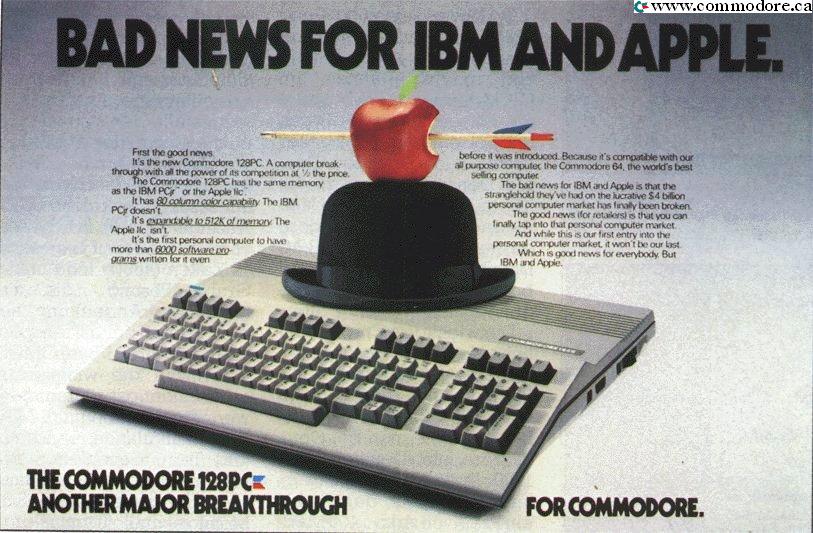
Commodore never used the PC acronym in its marketing or branding.
Yes, they did. For their IBM PC clones, for the C128 in some markets, and for the Amiga. Your theory that "PC" referred exclusively to IBM PC compatibles is not true. It did eventually come to mean that, but in the 1980's it simply meant "personal computer".
-
Promising lead
The "Redmond Crunch" seemed promising:
-
C=64 Programmers Reference Guide
If this were another era.... This book did wonders for me -- http://www.commodore.ca/manuals/c64_programmers_reference/c64-programmers_reference.htm
-
Not any of the above ancient languages
Speaking one who learned BASIC on various micros , and then taught himself more complex coding using http://www.commodore.ca/manuals/c64_users_guide/c64-users_guide.htm, pretty sure that was the book, assembly code in any case, tom fooled with fortran and pascal, can I just say: none of those languages are well suited to learn coding on one's own, especially. Most importantly, all of those were designed when computers were far more expensive than programmers
And for fuck's sake: not C. Pointers and memory management are not things one should learn when grasping simple coding concepts, as we all know, the only result of this will be: segmentation fault and a bemused look -
interview from 1989
http://www.commodore.ca/history/people/1989_you_dont_know_jack.htm
seems he got around to do quite a lot.
-
And if it wasn't for some help from Chuck Peddle
it may not have been completed.
http://www.commodore.ca/history/people/chuck_peddle/chuck_peddle.htm
Apparently when he turned up to help them out, he ended up doing a lot of analysing of what they were doing and helping them understand how the 6502 worked and what they were doing wrong.
-
Re:Control
I had a C64. It came with a single instruction manual which described the hardware board, the chip interrupts
Are you sure? I couldn't find anything like that here, unless you mean the pin-out charts and the "what to poke where to get sound" tables.
-
Prophets! I bow down!
Penguin Computing had foretasted this:
-
Re:Interesting
I'm still not sure how Commodore managed to go from selling 50 million machines to bankruptcy in a couple of years.
A man named Jack - have a read: http://www.commodore.ca/history/company/chronology_portcommodore.htm
-
Re:Seconded!
Commodore Basic taught me to love programming, have fun making little games and all important binary operations and encoding for sprites and font
Preach it. My first exposure to binary was working through the examples in the Commodore 64 Programmers Reference Guide (still the best manual I've ever read). Sprites were 8x8 images stored as a 8 bytes, each byte representing a row, and each bit representing a pixel. I probably went through that section 15 times before I truly understood and believed that binary math works, but the lesson paid off in spades. Back then, it was figuring out how to peek and poke a memory location to make a single pixel blink. Now it's loading and storing a memory location to toggle a serial control line on an embedded controller. That little machine gave me a good start.
-
Re:Oh well...
Well hey - it had copy and paste.
But it's still unknown as to which of them will finally get Java support first.
To be honest, I think the comparison understates the revolution of modern technology by limiting itself to the Iphone. Nevermind $199 - with any old dirt cheap phone these days, I can browse the Internet, navigate with Google maps, and store GBs of music, photos and other data. (Without being locked into a carrier!) And the comparison of 30 million to one million is very misleading - the Commodore 64 is the single best selling computer, and was one of the mainstream home platforms in its day. The Iphone however isn't even close - far from the market shrinking, there are now something like 2.1 billion Java phones out there. That's before you consider the range of choice offered by PC laptops and netbooks.
-
Re:Google's competitors
How much did an operating system (that you could install on commodity hardware) cost before MS came along?
-
Re:A faster PET in sight?
Maybe too obscure, foobsr. Only us old farts remember what a PET is. Kids these days...
-
Probably a Commodore PET
It was probably a Commodore PET that my dad used in teaching college finance courses (which would be how I got into computers, and how I eventually got into game development). I have no idea what the first game would have been... probably something from here, maybe Space Invaders, AFO or Lunar Lander. There was also a gold mining game and a dam buster game.
I took a look at several of them again on an emulator a year ago or so, and was struck with two interesting thoughts. First, disregarding graphical limitations, almost all of the genres we see today were represented in some way (shooter / action, sports, adventure, simulation, strategy). Second, some of the game design was very good, some was an exercise in frustration.
In particular, the dam buster game was just annoying. Your airplane flies from right to left across the screen. You need to drop a bomb at just the right time, and with enough passes you can break the dam. Fine, that might have almost been a good game, or the core of one. But they put in a gun that shoots at you. There is no way to control the plane, no way to choose your altitude (which seems to be chosen randomly) and absolutely nothing you can do about whether you get shot down or not. In fact, odds are excellent that you will be shot down randomly enough that it is simply impossible to win before you run out of planes most of the time, regardless of your skill at the game.
I like to believe that game designers have learned from this mistake. That causing the player to randomly die helplessly and hopelessly is bad. That making the player the hero is rewarding for the player, and that frustrating the player by not providing enough information for them to succeed or killing them randomly without recourse is something we have learned is Not Fun in the last 25 years. But really, you still see it all the time in various forms. I find it fascinating that, on one hand, game design has changed so much over the last 25 years, while on the other hand, so much of it is still the same.
-
Re:Probably not enough to undo the damage
I agree, I guess they know that in the short term a lot of people will pass up an A3 if it doesn't have benefits over a cheap $50 DVD player other than the HD DVD feature.
The "Major initiatives" thing is a long time coming. I've seen barely any advertising of HD DVD aside from cheesy trailers on DVDs themselves. HD DVD has captured a third of the market despite Toshiba and the DVD Forum, not because of them. And what exactly are they going to advertise? It'll be amusing to see them go negative on Blu-ray: "Blu-ray says it's a new advanced way to watch movies. But Blu-ray plans to force you to upgrade your player every few months. And Blu-ray still has an unsustainable plan for social security. I'm HD DVD and I approve this message", but they can't go positive when they're not exactly pushing out the kinds of equipment that HD DVD is theoretically capable of. I've spent the last few weeks rattling on about the benefits of mandatory managed copy, but where the hell is Toshiba or Microsoft's centralized media server that you can just load all your HD DVDs onto and have them streamed around the house?
You begin to wonder if Mehdi Ali is involved in some way...
-
Re:Again forgetting CommodoreSurely you are joking. The Commodore PET with it's sub-par graphic system and unusable chiclet keyboard was released in September 1977:
The 2001 was announced in 1977 and started deliveries around September. However they remained back-ordered for months, and to ease deliveries they eventually cancelled the 4 KiB version early the next year.
The first Apple II computers went on sale on June 5, 1977.
I think you have been huffing too much of the Commodore propaganda!
I was a huge Commodore fan in the eighties, but that doesn't necessarily make me a history revisionist. -
Re:More Relevant Info?
I don't need to "read the article"
Glad that your memory is better than mine!
That's interesting. I always thought that Motorola 6502s were just a second-source on the chip - one of more than a dozen second-sources. They certainly didn't sell any that I ever saw, presumably preferring instead to push their own 6800/6802/6809 (now THAT was a nice 8-bitter!)
Here's another article for you to not read
Anyway, enough of my wafflings - this has been a good trip down memory lane
-
Re:The failure of the Amiga comes down to one thinSeveral marketing links for C64:
- C64 1985 commercial
- Bunch of C64 links, photos, and videos (For $595, you get what nobody else can give you for twice the price.)
Then of course we have C64.com for additional links, game info, etc...
John T. -
Re:Definition of PC
You could argue that, but I'm sure someone would quickly point out that a BASIC interpretter isn't an operating system.
The Commodore 128 also mentions Microsoft BASIC on its startup screen. Does this mean that its software is compatible with the Coco's software? (Hint: No) -
Re:He missed...
http://www.commodore.ca/gallery/video/video.htm - check out I Adore My 64 - Version 1 - Radio!!! That will get stuck in your head.
I hear a remix of this pretty often on http://slayradio.com/ -
Re:Which "Atari"?Well, They could sell books about their fall. There has to be cash in that. Commodore was bought/sold a zillion times.
But we all know Jack Tramiel bought into Atari after Commodore ousted him.
We all know how that turned out.
Anyway, his philosophy in business was interesting.
He mused that after the experience of the concentration camps, coping with the problems of business or life was a piece of cake by comparison. His own hoary version of "if it doesn't kill you, it will make you."
qz
-
Re:Which "Atari"?Well, They could sell books about their fall. There has to be cash in that. Commodore was bought/sold a zillion times.
But we all know Jack Tramiel bought into Atari after Commodore ousted him.
We all know how that turned out.
Anyway, his philosophy in business was interesting.
He mused that after the experience of the concentration camps, coping with the problems of business or life was a piece of cake by comparison. His own hoary version of "if it doesn't kill you, it will make you."
qz
-
Re:Which "Atari"?Well, They could sell books about their fall. There has to be cash in that. Commodore was bought/sold a zillion times.
But we all know Jack Tramiel bought into Atari after Commodore ousted him.
We all know how that turned out.
Anyway, his philosophy in business was interesting.
He mused that after the experience of the concentration camps, coping with the problems of business or life was a piece of cake by comparison. His own hoary version of "if it doesn't kill you, it will make you."
qz
-
Not another 18 years dammit!
i have seen something like this RAM Drive back in the ISA-Bus days... it hasnt been quite successful
ISA-Bus days..lmao! SCSI and PCI based RAM Drives were a key strategy for 68K developers on the Mac (22 years ago) and Amiga (21 years ago) platforms until the early 1990s. The huge number of header files needed to support the GUI frameworks and OS-kernel/Toolbox APIs with such slow (MFM/RLL) hard-drives and busses (60KB/s) of the era dictated this as an absolute necessity. Of course, the poor guys who were dealing with "ISA-Bus" just had to pull in stdio.h (to support DOS) and thought all all of us (3,000 or so) 68K developers were insain.
[begin slowly-i-turn-step-by-step-inch-by-inch] If Irving Gould hadn't messed with Jack Tramiel and John Sculley hadn't messed with Steve Jobs, I don't think it would have taken 18 years and a few Dead Geniuses to prove them all wrong, either.[end slowly-i-turn-step-by-step-inch-by-inch]
Back in the present, if you check the latest version of Apple's development tools (included FREE with every Mac, yo), you'll find that they are more than pretty syntax-aware editors with hyper-linking and documentation-lookup. Under the hood, these tools support Killer features that decrease the compile-link-debug turnaround using every trick in the book (except reaching into the page-table-entries --they'll realize that once they come up for air from Rosetta). These features, some 20 years in the making, afford developers more time to do trial-and-error tweaks and unit-testing (since changes in the source are "instantly" visible in the executable), so the quality of the code shipped to customers can be much better, even when using dog-slow CPU chips (thank you Motorola) or (4200-5400rpm) laptop drives. In fact, unless your (executable) App needs a lot of CPU or disk performance, it's really hard to justify buying a top-of-the-line Mac with 10,000 rpm RAID-1 drives just to support software engineering and certainly no need for PCI or SCSI based RAM drives --you can get by very nicely with a 17" laptop, an external monitor, firewire 7200rpm drive and an a couple of mini-macs to play "target practice" with.
[begin lets-not-waste-another-18-years]Now, if Apple can only overcome the windfall its competitors (HP, DELL and Gateway) are in for as customers realize they really do need a new PC to support Windows Vista, then world domination is assured. Can you say to Apple, "Give me a $200 competitive upgrade discount off any IntelMac in exchange for my activated-copy of WinXP (which Apple can then tell the Microsoft-overseers to have Microsoft de-authorize some 30 days after your upgrade to OSX86)?"... If not, then Windows will likely continue its long history of "borg-ing" every other company's cool ideas and leveraging them to make money through that big market share they gained with exclusionary contracts at the end of the 1980s (when our anti-trust people were pre-occupied with IBM mainframes and Selectron typerwriters). Gates is no idiot and he just doomed PalmOS on the mobile platform (so when the PC is dethroned by cell-phones, those phones are likely going to be running Windows. Jobs is no idiot either and nobody cares about Windows Media 11 for a reason... Let's just hope he can make Gates lose as many customers as possible in the transition from XP to Vista! [end lets-not-waste-another-18-years] -
Re:Short sighted(ever I've never heard of GEOS, and I'm obviously older than you).
I wouldn't brag about being older than 46!
GEOS Came on the scene about 1986, the link has a screenshot with the date showing 1988
-
Re:Did the sun rise from the West?
I'm sure MS Bob seemed like a good idea, at the time. Certainly an interesting concept.
But not an original concept. -
Re:Screw a PDF
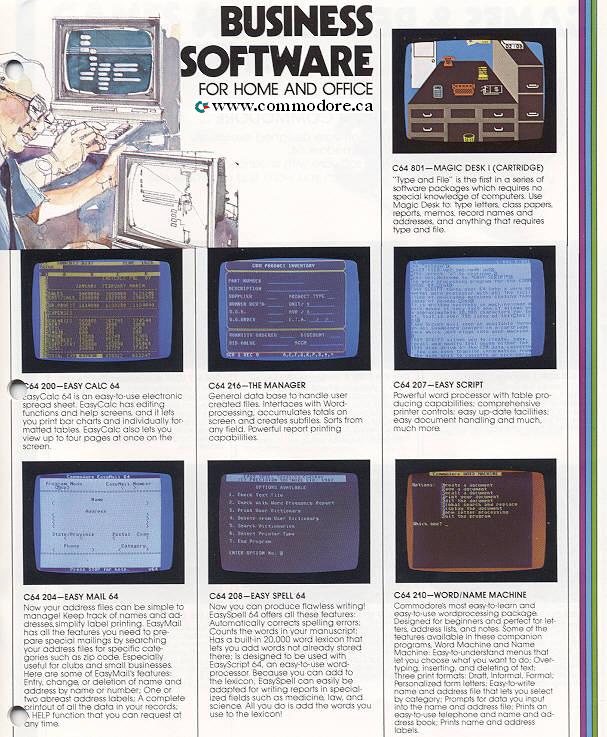
Actually, it wasn't. MS Bob uses concepts and functionality that I believe were first used in Magic Desk for the Commodore 64.
MS Bob is not original. -
Re:So much easier to knock down than to build up...dead products and companies: the Commodore Pet, 64, Amiga...
Living dead products on some of these... The Commodore company has been purchased, you can buy a brand new Amiga, etc...
-
Commodore 64 commercials at another site...
Here's a catchy radio commercial. Well, catchy in a mid-80s sort of way...
Check out the price and RAM comparison in the TV commercial.
And lots more here. -
Commodore 64 commercials at another site...
Here's a catchy radio commercial. Well, catchy in a mid-80s sort of way...
Check out the price and RAM comparison in the TV commercial.
And lots more here. -
Commodore 64 commercials at another site...
Here's a catchy radio commercial. Well, catchy in a mid-80s sort of way...
Check out the price and RAM comparison in the TV commercial.
And lots more here. -
Re:Welcome to the Present
Slightly tending towards off-topic, but there is a great page listing (utterly incorrect) Commodore 'Firsts' including such gems as
* First Multitasking Operating System
* First hand held calculator
* First LCD display
Very funny indeed. If you mail the author to 'correct' him, you just get back a torrent of abuse. Give it a go. -
Re:"Personal Computers" do not belong on their lisI believe you're wrong, the Apple I came out in 1977. This was also more of a technology toy. The first real personal computer that was mass-marketed was the Commodore PET.
But hey, let's not let facts get in the way of Apple fanboiness, huh?
-
Re:Revision or Revolution? Commodore Is the Hero
CORRECTED LINKS
Sorry, I incorrectly added a slash to all of the links above. Below are the corrected links:
http://www.commodore.ca/products/default.htm
http://www.commodore.ca/gallery/video/video.htm
http://www.commodore.ca/history/company/6502/6500c pus.htm
-
Re:Revision or Revolution? Commodore Is the Hero
CORRECTED LINKS
Sorry, I incorrectly added a slash to all of the links above. Below are the corrected links:
http://www.commodore.ca/products/default.htm
http://www.commodore.ca/gallery/video/video.htm
http://www.commodore.ca/history/company/6502/6500c pus.htm
-
Re:Revision or Revolution? Commodore Is the Hero
CORRECTED LINKS
Sorry, I incorrectly added a slash to all of the links above. Below are the corrected links:
http://www.commodore.ca/products/default.htm
http://www.commodore.ca/gallery/video/video.htm
http://www.commodore.ca/history/company/6502/6500c pus.htm
-
Revision or Revolution? Commodore Is the Hero
The key (and indisputable) facts are well documented:
http://www.commodore.ca/products/default.htm/
1: the MOS / Commodore KIM-1 was the worlds first single board computer, released in 1976
2: the Commodore PET was the worlds first recognizable computer. It was announced and released several months before the TRS80 or Apple I
3: Apple I through III all used Commodore / MOS CPU's. Therefore no Commodore, no Apple (Motorola and Intel were just too slow to market and way too expensive for home users)
4: Commodore sold more computers than anyone prior to 1985/6. They were the first computer company to sell a million units of anything and were the first computer company to have a billion dollars in sales. To this day Commodore is credited by the Guiness Book of Records for having the best selling single computer in history, The Commodore 64.
5: The juggernaught that was Commodore took 10 years of bad decisions to go bankrupt after its founder and visionary Jack Tramiel quit in, you guessed it 1985.
It is definately true that Jobs and Apple made an enormous contribution to the PC/Home Computer world but it is just plain wrong to claim that Apple was responsible for the growth or development the PC market. Without any question Commodore was the single most important driver behind the genesis of home computing and Commodore is the only company that can legitimately claim such a title.
For a mid-80's validation of Commodore's total dominance click the COMMODORE VIC-20 STARTED HOME COMPUTING link on http://www.commodore.ca/gallery/video/video.htm/ which is from the TV show The Computer Chronicles in December of 1985.
For the amazing list of hughly successful computers which used the Commodore 6502 CPU click the 6502 link at the top of this article:
http://www.commodore.ca/history/company/6502/6500c pus.htm/
-
Revision or Revolution? Commodore Is the Hero
The key (and indisputable) facts are well documented:
http://www.commodore.ca/products/default.htm/
1: the MOS / Commodore KIM-1 was the worlds first single board computer, released in 1976
2: the Commodore PET was the worlds first recognizable computer. It was announced and released several months before the TRS80 or Apple I
3: Apple I through III all used Commodore / MOS CPU's. Therefore no Commodore, no Apple (Motorola and Intel were just too slow to market and way too expensive for home users)
4: Commodore sold more computers than anyone prior to 1985/6. They were the first computer company to sell a million units of anything and were the first computer company to have a billion dollars in sales. To this day Commodore is credited by the Guiness Book of Records for having the best selling single computer in history, The Commodore 64.
5: The juggernaught that was Commodore took 10 years of bad decisions to go bankrupt after its founder and visionary Jack Tramiel quit in, you guessed it 1985.
It is definately true that Jobs and Apple made an enormous contribution to the PC/Home Computer world but it is just plain wrong to claim that Apple was responsible for the growth or development the PC market. Without any question Commodore was the single most important driver behind the genesis of home computing and Commodore is the only company that can legitimately claim such a title.
For a mid-80's validation of Commodore's total dominance click the COMMODORE VIC-20 STARTED HOME COMPUTING link on http://www.commodore.ca/gallery/video/video.htm/ which is from the TV show The Computer Chronicles in December of 1985.
For the amazing list of hughly successful computers which used the Commodore 6502 CPU click the 6502 link at the top of this article:
http://www.commodore.ca/history/company/6502/6500c pus.htm/
-
Revision or Revolution? Commodore Is the Hero
The key (and indisputable) facts are well documented:
http://www.commodore.ca/products/default.htm/
1: the MOS / Commodore KIM-1 was the worlds first single board computer, released in 1976
2: the Commodore PET was the worlds first recognizable computer. It was announced and released several months before the TRS80 or Apple I
3: Apple I through III all used Commodore / MOS CPU's. Therefore no Commodore, no Apple (Motorola and Intel were just too slow to market and way too expensive for home users)
4: Commodore sold more computers than anyone prior to 1985/6. They were the first computer company to sell a million units of anything and were the first computer company to have a billion dollars in sales. To this day Commodore is credited by the Guiness Book of Records for having the best selling single computer in history, The Commodore 64.
5: The juggernaught that was Commodore took 10 years of bad decisions to go bankrupt after its founder and visionary Jack Tramiel quit in, you guessed it 1985.
It is definately true that Jobs and Apple made an enormous contribution to the PC/Home Computer world but it is just plain wrong to claim that Apple was responsible for the growth or development the PC market. Without any question Commodore was the single most important driver behind the genesis of home computing and Commodore is the only company that can legitimately claim such a title.
For a mid-80's validation of Commodore's total dominance click the COMMODORE VIC-20 STARTED HOME COMPUTING link on http://www.commodore.ca/gallery/video/video.htm/ which is from the TV show The Computer Chronicles in December of 1985.
For the amazing list of hughly successful computers which used the Commodore 6502 CPU click the 6502 link at the top of this article:
http://www.commodore.ca/history/company/6502/6500c pus.htm/
-
Minor trivia tidbit --
The Commodore PET predates the Apple as the first personal computer by an itsy bitsy margin.
-
Bah, you call that impressive?
Have you not heard the story behind the Commodore 64? Jack Tremeil's venerable "computer for the masses, not the classes."
The thing was developed in TWO WEEKS. The OS took another TWO WEEKS.
In 1981.
And blew the doors off of anything Apple was selling. And kept blowing the doors off of Apple until 1992.
You all were playing Sticky Bear and Oregon Trail while I was playing, well, everything from Donkey Kong to Project Firestart.
And, oh yeah, it's still in Guinness for selling better than any other single PC ever. 30 million units were sold.
Apple doesnt deserve nearly the amount of admiration they get. They've always been a me-too company with hipster doofus appeal, all the way from the first kit computers to the iPod.
-
What About my Model M Keyboard?
Much to my surprise, I find myself seriously considering buying one of these $500 Macs.
I have wanted a Mac since I got to use one of the originals which was on display at Science North in Sudbury, Ontario the summer after their commercial release in 1984.
Price has always been the major sticking point. When I was thinking of upgrading my Commodore 128, I had a few choices. In the Time Before the Internet (for us home computer users), I wrote Apple and got brochures back for their two new models, the Mac SE and the Mac II. According to the price list that came with them, the cheaper Mac SE cost more than three times as much as a similarly equipped Commodore Amiga or Atart ST. Remember, all of these computers were roughly equivalent at the time.
In the 1990s, I started buying the horrid, commodity IBM PC clones, starting with 486s, and I have not changed since then. If Apple were to release a cheap Mac, I would be seriously tempted to buy it.
Why? Because my recent brushes with Apple hardware and software have been positive. I used iTunes on my PC to convert my CD collection to MP3s. Later, I bought a used 10GB second-generation iPod, and have been pleased with it too. After the front-page articles on Slashdot, I even have downloaded and run Mac OSX on my 2.5GHz 32-bit PC using Pear PC. The emulation was slow (the two times I tried it), but it did give me some idea of what a Mac is like.
So, now to my question: I have a favourite keyboard, an IBM Model M. What kind of keyboard port is standard on Macs these days?
From my limited knowledge, I would guess that this new headless Mac would take a USB keyboard, in which case I would need some kind of USB to PS/2 converter.
Does anyone have any experience with present-day Macs using IBM PS/2 keyboards? -
Re:RAID 0,1,5
You started out correctly, but then you described RAID3. RAID5 is Redundant striped disks, with a XOR bit stored on each of the disks, for each of the stripes.
Close.. very close. Actually, the XOR block is written to one of the drives for each stripe (not to each of them) and is alternated between drives for each stripe. So each stripe has one XOR block on a single drive and that XOR block is written to a different drive each time. A good diagram for this can be found here.
The grandparent post could have been describing RAID-4 as well as RAID-3. The only real difference is that data is broken into blocks in RAID-4 (and 5) but is striped at the byte-level in RAID-3. His post doesn't say what level the striping is being done.
-
Re:Very nice, but...How can this be very useful? The C64 has about 32K of useable RAM and about an 800K floppy... am I missing something, have they come up with larger mass storage systems for the C64 or something?
Even 'back in the day' there was mass storage for Commodore 64s. My father taught computer studies at a local high school, and part of his job was managing a network of--if memory serves--sixty or so Commodore 64s.
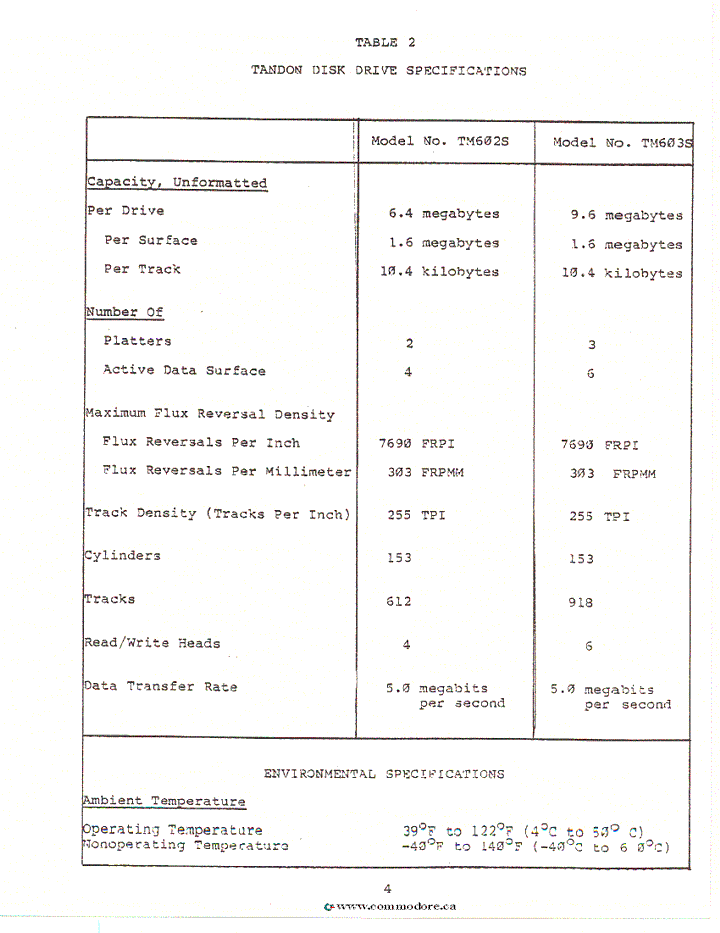
The Commodore 9060 and 9090 offered 6.4 and 9.6 MB of storage, respectively. Manual here, for anyone who wants it. Pictures here.
-
Re:Very nice, but...How can this be very useful? The C64 has about 32K of useable RAM and about an 800K floppy... am I missing something, have they come up with larger mass storage systems for the C64 or something?
Even 'back in the day' there was mass storage for Commodore 64s. My father taught computer studies at a local high school, and part of his job was managing a network of--if memory serves--sixty or so Commodore 64s.
The Commodore 9060 and 9090 offered 6.4 and 9.6 MB of storage, respectively. Manual here, for anyone who wants it. Pictures here.
-
Re:8 bit or 64 bit?
Quoting this page: There is a lot of debate over the origins "20" portion of the VIC-20 name but the Commodore Executive responsible for the VIC's development, and the author of The Home Computer Wars, Michael Tomczyk, stated repeatedly that he choose the name simply because he thought it "sounded good". (For extra credit, why didn't they call it "VIC" in Germany?)
-
Re:The Video Toaster was a revolution in videoNot IBM, it was Jack Tramel at Atari around 1984.
SGI was also interested in the Amiga's chips, but that obviously never got very far.
-
Re:Commodore was the leader ?
history
Commodore computers were there first before apple (the apple I does not count, I'm taking assembled and working not a kit) and were hugely popular in small businesses in the early 80's many schools had droves of them before apple.