Slashdot Mirror
Domain: dieselnet.com
Stories and comments across the archive that link to dieselnet.com.
Comments · 33
-
Interesting that the EU is so far behind the U.S.
trucks and buses tested in Germany and Finland emitted about 210mg NOx per kilometer driven, less than half the 500mg/km produced by diesel cars that meet the highest "Euro 6" emission standards.
The current standard for diesel passenger vehicles in CARB states (California Air Resources Board, which sets the limit for California and 16 other states) is 0.05 grams/mi, which is 80 mg/km.
And if you're curious, here's how much the cheating 2.0L VW diesels were emitting. If the Euro 6 standard is 500 mg/km (0.310 g/mi), it looks like the 2015 VWs were already in compliance, and the 2013-2014 VWs were just barely out of compliance. -
Re:NOx odor
So if the majority of the NOx emmissions are Nitric Oxide you couldn't smell it even if you wanted to.
An engine without any emissions equipment will output >90% NO emissions. However, once exhaust catalysts are installed, they shift the ratio closer to 50%.
-
Re:Euro 6
Most of the diesel passenger vehicles are exempt below 5 C, so especially in the winter there is almost no NOx emissions control on any of these vehicles. If you are a heavy duty vehicle, there is no exemption. You have to put an electric heater on your exhaust system to keep it at operating temperature. Also, as there are very few labs that can accommodate large truck testing the testing, the certification test for heavy duty trucks is on the road with a portable emissions measurement system.
Whoa! You are very confused. I'm a diesel emissions engineer. Electric heaters are not used to heat the exhaust by any manufacturer that I'm aware of. That would require a ridiculous amount of electricity. Electric heaters are only used to keep the DEF lines from freezing.
Furthermore, the same low temperature exemptions that are made for passenger vehicles apply to heavy duty trucks. Details on the US EPA rules can be found here. The difference in the US, is that heavy duty trucks are subject to in use testing with portable emissions equipment.
The standards in Europe are different that the US of course. However, my understanding is that the European rules are more relaxed for both heavy duty and light duty applications. -
Re:Witch hunt
The allowed NOx levels being much lower in the US than most other countries makes an argument for the EPA regulations being unreasonable
The pre-Euro 6 (2014) regulations allowing NOx levels for compression engines (i.e., diesel) three times higher than those for spark-ignition engines (i.e., petrol) makes an argument for the European regulations being drafted to permit diesel engines lacking NOx controls regardless of the smog issue. Their own governments say so.
The Euro 6 regulations that came into effect in the 2015 model year (late 2014) finally push NOx limits down to 0.08 g/km (diesel) vs. 0.06 g/km (petrol), approximating parity for the first time. Meanwhile, the US Tier 2 standard is a fleet average of 0.07 g/mi (~0.043 g/km) for both engine types.
So, if the US regulations were devised to protect manufacturers of gasoline engines, then why are the Euro regulations clamping down from 0.50 g/km to only slightly more than double the US limits now? Why are spark-ignition engines even closer to the US limits now? What is your basis for levels being "unreasonable" besides the apparent fact that you view the European regulations as being infallible, even though they themselves do not.
The smog in European cities more than makes an argument that the Euro regulations are unreasonable, not the other way around.
-
Re:Hardly surprising
You cant make diesel cleaner. It's impossible. Everyone I know who worked with diesel engines from the fitter and mechanic level to the design and engineering level predicted this kind of revelation happening years ago. Being engineers, you can imagine the level of smug they generated after Dieselgate.
As a diesel emissions engineer I resent that statement. The trouble with diesel is exactly as the GP mentioned. Hotter burn is more fuel efficient, but makes more NOx. SCR is the option that can provide good fuel economy and lower emissions. However, SCR is expensive and has it's own consumable.
Diesel engines are heavier and more complex than petrols, they require turbochargers regardless (if you want to know what a truly gutless car feels like, drive a naturally aspirated diesel). The returns are less than non-turbo petrol engines of the same size, if you turbo a petrol engine, you could easily knock 25% of the capacity off and still have a faster car with the same fuel efficiency and is kinder to the baby foxes.
Diesels are not very volumetrically efficient. True.
The only time a diesel engine is better than a petrol is when you need pulling power. This is why almost all big rigs and tractors are turbo diesels. Even decent 4x4's like a Hilux or Triton tend to use diesels, not for fuel efficiency but to pull 3 tons of bricks about using a 2.4L 4 banger.
Not true. Diesels are fuel efficient because they run at higher compression ratios and don't use intake throttling to control power output. Gasoline engines can be built that rival diesels in torque. However, most consumers of such products demand the fuel efficiency of diesel.
There's a lot of FUD being spread around about diesel. Yes, it has issues. But those of us in the industry had been wondering how VW was making that system work without SCR. Now we know.
If the system is to improve, emissions regulatory agencies need to audit more engines themselves rather than trust the self reported results. They also need to implement Not to Exceed limits on all engines. -
Diesels produce more NOx per mile
The VW engines produce less nox per mile than a gasoline engine, but more per gallon
Inaccurate. NOx is measured per mile, not per gallon, and Diesel engines produce more NOx per mile.
http://www.technology.matthey....
https://www.dieselnet.com/tech...
somewhat less technical: https://www.quora.com/Why-does...
http://www.livescience.com/522... -
Re:Might not need?
"Might not need vs does not have is a stretch."
Exactly, and a very large stretch at that. The article doesn't even offer a guess as to what these "sensors that a noncheating car might not need" are. Steering angle sensor - used for stability control. Individual wheel speed - used for ABS. Throttle position - used for drive by wire. What else is needed to tell that the car is being run on a dyno and not the road? EGR control is a common part of diesel emissions controls.
The author stated "I mention hardware because it widens the scope of the Volkswagen conspiracy." No, it doesn't, not unless you can point to specific hardware which would otherwise not exist.
Apparently, Physics Today doesn't require actual knowledge. -
Re:What exactly is the law/rule?
If the rulebook says "When we plug in our testing machine, your car needs to be emitting X, Y and Z", then they were totally within the rules.
I am familiar with the rules, but they are too long and complex to explain here. It used to be about passing the test, but other companies got caught doing the same thing 20 years ago. Now there are limits on real world emissions as well, called NTE, for heavy trucks. Apparently cars are not subject to the same restrictions.
-
Re:Hang 'em high...
I skimmed through the Federal Test Procedures, and didn't find an explicit rule saying "car should be in normal operating mode", however, I did not search exhaustively, and this is a SECRET mode.
All modes have to be communicated to the EPA in the certification documents as an AECD (auxiliary emission control device). Volkswagen is in trouble for an AECD that is "neither described nor justified" in certification documents.
There is also a "Not to Exceed" emissions law that was put into effect when manufacturers tried to do something similar years ago. In my opinion as a diesel emissions engineer, (IANAL) Volkswagen violated that regulation as well.
Remember software engineers, always document your code. There could be a legal obligation to do so! -
Re:23% of the company
I have yet to see a study which shows that this actually produces less pollution
https://www.dieselnet.com/stan...
That's a list of standards, and not at all what I said. Thanks for playing, but you just failed your reading comprehension test.
-
It's not the first time...
https://www.dieselnet.com/stan...
Basically, the big-rig engine manufacturer's did the same thing - the engine software detected when it was running on the freeway and switched to a more fuel-efficient but also more polluting mode.
-
Re:Not surprising
Yeah, it looks like the 2015 model year lots of manufacturers made the jump.
Looking at the EPA site though, Tier 3 regs don't kick in until model year 2017: https://www.dieselnet.com/stan...
There's probably more to the story that a quick search isn't turning up.-Rick
-
Re:Maybe 40k
And if you can get high-temp nuclear it gets even better. As the high temp can directly drive a gas turbine, with effecient-on demand access capacity from natural gas. (baseload of 30MW up to 60MW with stociometic mix of natural gas. And if production from renewables low-temp nuclear is enough to make the spot price of nuclear dip below a certain price, then you can use the heat on the high-temp nuclear to make ammonia, small hydrocarbons (for fertilizer or carbon-nuetral motor fuels (You'll not be powering semi's on electic, by you can convert them to run on dimethyl ether.) http://dieselnet.com/tech/fuel...
You could probably get rid of coal entirely, which by the way releases more radioactive isotopes per GW than nuclear does. -
Re:This is not about effects on global warming
because their fuel economy has gotten worse, in terms of fleet averages.
Ah, no. No they haven't gotten worse.
http://www.dieselnet.com/standards/us/fe.php
http://en.wikipedia.org/wiki/Corporate_Average_Fuel_Economy#Effect_on_automotive_fuel_economyOther readers are advised to consider this an indication that the balance of that post is also abject bullshit.
-
Re:What took it all so long??
Actually the ppm (parts per million) ratios are gone for on highway in the US, it is purely a grams per mile emissions standard for on highway cars in the US. It is percent emissions only for off highway. However, that's for the manufactures to meet, your local emissions test is going to be a PPM rating that they look-up for compliance, so I understand the confusion.
-
Re:To be fair?
I think EVs need to be more strictly regulated in their mileage claims. Let them go on the same treadmill as they gasoline/diesel cars must ride.
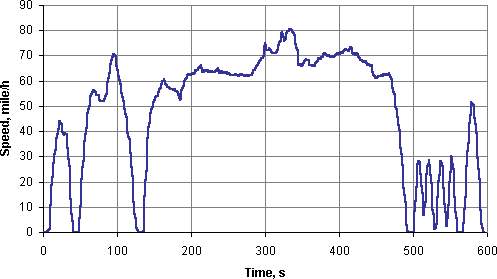
That's part of the problem, actually. They *do* go on the same treadmill that gasoline/diesel cars must ride. However, gasoline cars are most efficient at around 55mph. On the contrary, the Tesla Roadster, like most EVs, is most efficient at low speeds -- in its case, about 18 miles per hour. Plus, it regens from stop and start, while conventional gasoline cars don't. The net result is that they ace their city mileage, and due to the fact that the US06 highway cycle still has lower speed sections and stops and starts, they do better than they would if you're driving long distances on an interstate (the US06 cycle is more like taking a highway from your home to work than driving from state to state). So out of pure coincidence, our current cycles tend to overstate EV ranges.
Some EVs are even worse than Tesla. The Nissan Leaf's 100 miles range is on the LA-4 city cycle, which is even gentler than the FTP-75 cycle that our cars' city mpg rating is based on. And the Mitsubishi MiEV's 100 mile range is based on the Japanese 10-15 cycle, which is also exceedingly gentle.
I like Aptera's approach for stating range. The Aptera 2e is a composite 2-seater with a large payload area and a ridiculously low drag coefficient. They only give their vehicle a 100 mile range, but that's for 75mph, two passengers, a full payload, and AC and headlights on.
-
Re:Diesel in the USA..?
Why so few diesels in the US? Largely due to far more stringent emissions standards in the US.
The largest market for cars in the US is California, and due to the unique geography of Los Angeles, traditional "smog causing" forms of pollution (NOx, SOx and soot) have been regulated far more strictly than anywhere else in the world. Several other states (New York, Massachusetts, Vermont, Maine) have adopted the California standards and many more states are considering them.
Part of the problem (SOx) is being solved through a switchover to low-sulfur diesel, and NOx may largely be handled by new technology like BlueTec, but soot/particulates are still a problem. The current Euro 4 European regulations for diesel allow 150% more particulate matter than does California's LEV II.
As much as many Slashdotter's would like to make everything into a "USA sucks - why can't we be more like [Canada/Europe/Botswana]", this is actually largely the result of a few things that we are either more stringent about (particulate pollution) or have little control over (Europe's source of crude oil - the Middle East - being naturally lower in sulfur than the US/Canadian crude that is our primary source). The US is actually far more stringent about all sorts of pollution than anywhere else - it's just that carbon gets all the ink, and even there, we've done a lot better in real terms than either our or the European's rhetoric would lead you to believe.
In the end, no car company is going to sell cars that are illegal to own in half the country, so they just don't bother. That may change when Euro 5 compliant cars start rolling off the lines in a year or so, but we still have "two-fleet" regulations hindering things. (The "two-fleet" rule states that the Big 3 have to calculate their CAFE/fuel efficiency standards for cars they build in the US separately from cars they import, so it makes no economic sense for Ford to import fuel-efficient models built in its plants in Europe.) -
Re:Diesel in the USA..?
Why so few diesels in the US? Largely due to far more stringent emissions standards in the US.
The largest market for cars in the US is California, and due to the unique geography of Los Angeles, traditional "smog causing" forms of pollution (NOx, SOx and soot) have been regulated far more strictly than anywhere else in the world. Several other states (New York, Massachusetts, Vermont, Maine) have adopted the California standards and many more states are considering them.
Part of the problem (SOx) is being solved through a switchover to low-sulfur diesel, and NOx may largely be handled by new technology like BlueTec, but soot/particulates are still a problem. The current Euro 4 European regulations for diesel allow 150% more particulate matter than does California's LEV II.
As much as many Slashdotter's would like to make everything into a "USA sucks - why can't we be more like [Canada/Europe/Botswana]", this is actually largely the result of a few things that we are either more stringent about (particulate pollution) or have little control over (Europe's source of crude oil - the Middle East - being naturally lower in sulfur than the US/Canadian crude that is our primary source). The US is actually far more stringent about all sorts of pollution than anywhere else - it's just that carbon gets all the ink, and even there, we've done a lot better in real terms than either our or the European's rhetoric would lead you to believe.
In the end, no car company is going to sell cars that are illegal to own in half the country, so they just don't bother. That may change when Euro 5 compliant cars start rolling off the lines in a year or so, but we still have "two-fleet" regulations hindering things. (The "two-fleet" rule states that the Big 3 have to calculate their CAFE/fuel efficiency standards for cars they build in the US separately from cars they import, so it makes no economic sense for Ford to import fuel-efficient models built in its plants in Europe.) -
Re:GO for it,You'll notice that the diesels have 40% larger engines here.It would have been nice to see the power produced for both types of engine, to get an idea what we got back for the emissions.
The other key words for me areIf we take an average of all of the petrol cars and all of the diesel cars on sale today the average petrol car produces 214g/km of CO2 whilst the average diesel produces just 169g/km of CO2. However this tends to under estimate the performance of petrol vehicles as high performance (and therefore high CO2 emitting vehicles) are petrol not diesel.
High performance engines always perform badly in urban situations. Is it wise to keep buying them ? Also the PM (particulate matter) issue with diesels is pretty much solved and the NOx issue is getting better (Euro 5).
-
Re:At least China has a gas standard for cars
Well, the US does have standards for emissions that are more stringent than China*
That's not what I've heard in Al Gore's documentary "An Inconvenient Truth".
I just searched for other sources and I found the following:
http://www.wri.org/climate/newsrelease_text.cfm?Ne wsReleaseID=304
http://forests.org/articles/reader.asp?linkid=2709 8
http://www.dieselnet.com/standards/us/fe.php -
Re:Time for a little balance to the propaganda
RE: There are no "environazi" standards preventing you from buying a beefy car. Buy one of these: http://modernmusclecars.net/
http://www.dieselnet.com/standards/us/light.html
Take a look underneath the hood of a 1969 Charger and what you sent me. The first vehicle has a relatively straightforward engine that is mostly user maintainable - the latter, well, the first like is a blobby Dodge Neon Car (have to get the aerodynamics to meet the standards!!!!) and the other is a CONCEPT CAR, just like the Dodge Charger Concept Car that NEVER GOT BUILT. Oh, and by the way the original muscle cars were relatively inexpensive and most cars out there were solidly built and well powered. These links are for limited edition cars that'll set you back QUITE a lot of money. And most cars out there now are like the Dodge Neon. Light, underpowered GARBAGE. You've proven nothing apart from the fact that concept cars and limited edition specialty cars also exist. Buddy of mine went down to a car dealership - went to Ford, Dodge and Chev and said basically "what have you got?" and frankly, his choices were Dodge Neon Clone Roller Skate, and hefty SUV. You can argue that's anecdotal, but frankly, it's how a lot of people think - and they go with the SUV.
And, I guarantee you that even if the car you send me a link to gets built, it will have fifteen levels of fuel injectors, computerized control, beryllium dioxide radiators that shatter when hit (unlike the old ones you knocked the dents out of), etc. If you wanna work on one, you'll need a $50,000 computer and God knows what else.
I also fail to see why you feel the need to be abusive and rude. If you've got to be insulting to try and make your so called point, that shows just how limited your brain happens to be. -
bad comparison: diesel!=gasolineYou didn't even respond to the relevant point of my post: I believe SVO is more beneficial to the environment than biodiesel. Worse, you didn't seem to understand what you did respond to. You said
OTOH if you had even Googled "biodiesel carcinogens" you would know that one of the benefits of BD is exhaust that is 90% less carcinogenic than exhaust from petro-diesel.
I'm already aware of the benefits of bio-fuels over petroleum diesel. I'm even aware of the CO2 benefits of bio-fueled diesel engines over gasoline engines. It would be difficult to read slashdot without being aware of the benefits, but that's not what I was commenting on. I was pointing out a negative that is seldom mentioned on slashdot; diesel engines, even when they run on biofuels, have more soot particles in their exhaust than gasoline engines. If you google "biodiesel particulate emissions" you will see that even biodiesel advocates admit this.
Those soot particles are the main reason why the EPA gives the 2006 Jetta diesel a horrible air pollution score even though it gets over 40 mpg. The difference in particulate (soot) emissions for diesel and gasoline engines is so great that it is very difficult - perhaps impossible - to get light duty diesel vehicles (i.e. cars) Tier II certified in California.
Right now, every gasoline burning car that is replaced by a biodiesel or SVO burning car causes us to have higher levels of soot in the air. From my original link:
Diesel-powered cars will always produce more particulate matter. The particulate matter, now a known carcinogen, will contribute to immediate health problems if breathed in.
[...]
Bad for lungs, better for the ozone layer
Granolas are split: some think the soot from diesels does more damage to people and animals here and now, while others want to minimize reliance on fuel resources and oil drilling, and to slow climatic change.That was the problem I was commenting on, and you responded with something totally off topic (a comparison of biodiesel and petroleum diesel.) Now, it is actually possible to clean up the exhaust on diesels quite a bit. That same article goes on to mention a way to solve the sooty particulate emmissions:
Diesel engines can be clean, as clean as comparable gasoline engines if the right measures are taken to reduce particulate matter. Advanced engine controls, particulate-matter traps, and new-design catalysts have helped all but eliminate particulate matter.
Unfortunately, the article does NOT explain the drawbacks of this process; the extra emmissions control equipment costs a LOT, and it reduces the power and fuel efficiency of the diesel engine. That's a problem, since fuel efficiency is one of the main reasons we are considering diesels in the first place, which is probably why most of these methods are still not used on new diesel vehicles. Besides using oxidizing-type particulate filters to get rid of soot can even increase the levels of carbon monoxide:
http://www.fleetguard.com/fl -
Enviromental / Health Aspects
This just goes to prove that the State of California is more concerned with making money than the welfare of its citizen... Why does california, one of the richest states need more money... so that legislators can have larger paychecks and spend more money on gettin re-elected!!
I have live in california all my life and have actully seen the smog get better during the last 10 years. When I was a child almost half of the days we were not allowed to go outside since the pollution levels were so high. This has a direct effect on my health. see link
http://www.dieselnet.com/news/9711aqmd.html/
California citizens have encouraged more fuel efficient cars as the purchase of more effiecnt cars show.. If anything california should tax gasoline more.. even know it's currently $2.10 a gallon here.. Make it $3.00 then people will drive less, stop buying monster trucks for cars, and exercise more.. Something we all need.
Also the traffic is so bad in southern california that it would be cheaper for me.. since I only drive 30 miles.. but I sit in traffic for almost 2-3 hrs each day burning fuel.
What a scam.. I'm disgusted by the gov't of california.. -
Actually, the H2 is a problemThe H2 is a "heavy light-duty" truck, and is allowed to emit much more of most pollutants than a passenger car. See this document.
Ironically, many California cities restrict trucks over 6500 lbs GVW to truck routes; they wouldn't have to raise mileage standards to get those Hummers and Durangoes off the roads, all they'd have to do is enforce the truck restrictions they already have.
-
Re:diesel is not the eco solution
There are two solutions to the soot problem. There are diesel oxidation catalysts that get rid of much of the problem (cost ~$500/car), or soot filters that get rid of almost all of the problem (cost ~several $1000's per car).
You can also combine the two.
I think if biodiesel begins to take off, we can expect soot-reducing technologies to come down in price. -
Re:Diesel is Dirty
Diesel cars with particle filters are the answer to 4.) They actually make the air cleaner.
-
in html
-
yet another reason
that we should go with biodiesel and synthetic diesel fuels.
-
EPA White Paper (etc)
Diesels do not burn petrol or any other highly volatile fuel (although they can burn jet fuel, kerosene, or home heating oil, with varying degrees of sucess).
Of course you are right, I simply used the two extremes diesel fuel vs petrol to make a point: fuel has different properties. Peanut oil is not diesel fuel, vegetable oil is not diesel fuel, biodiesel is not 100% diesel fuel and even among the diesel blends the properties differ dramatically.
See the DOE's fuel property database.
Yes, in the good old days of low-pressure distribution pumps (3000-5000psi as one other slashdotter mentioned) you simply could change the injection timing by tampering with the mechanically governor.
With modern cars being sooner a mobile network of dedicated ECU's, you can't do this anymore. Not only because of the inaccessability but also because you now have some more objectives than just burning fuel somehow to release torque on the flywheel: You need to control the combustion in order to comply with emission legislations.
I do not know if your extensive practical experience covers this topic as well. Usually NOx and smoke show contrary tendencies, so does CO2 and NOx, engine response and smoke etc... you have to think about all those factors when designing an engine and a combustion process. Really, it's not the old days anymore!
EPA staff has released an excellent paper where they try to summarize latest trends. Definitely worth a read!
To recap: Modern diesels burn "biodiesel" with no modifications. They can also burn vegetable oil with a few minor modifications, mostly because that's what Dr. Diesel originally designed his machine for.
Theoretically "minor" adjustments but this is only valid for the designer/manufacturer, not the individual customer. See above.
BTW: I am not quite sure that Rudolf Diesel ever was a "Dr.", AFAIK he studied Mechanical Engineering in Munich, but that's it. Just because other web sites keep calling him "Dr." doesn't mean it is true... But I'm not 100% sure about this either. -
Stay away from this crap!
If you really want to promote alternatives then demand earlier introduction of low sulfur fuel. Some more info here and yes, the pretroleum industry is whining about cost increase, while even the car industry is demanding this fuel...
-
Sorry, won't work...
Having worked with the development of high-pressure direct-injection diesel engines at both Volkswagen and Volvo, I am quite critical towards any replacement fuel that has not been widely and thoroughly tested.
To begin with, some links for self study:
- Dieselnet.com has a great glossary and provides some excellent links
- Delphi has some nice PDF's on Unit Injectors and Common Rail
- Here some information from Bosch - Siemens has some nice pictures of injection systems, mainly common rail
Due to the very high pressures (up to 2100 bars) and therefore high temperatures with modern fuel injection systems, you really go to the limit of what diesel fuel can do: You use it simultaneously as fuel, coolant and oil and it takes a good blend to fulfill all these requirements! The chemical formula is important as well as the physical properties. The DOE has a webpage about diesel fuels. Have a look at their online diesel fuel property database and see which properties are essential for characterizing fuel. Other important factors are
- durability
- particles/filtration
- compressability/resistance against cavitation
Not to forget resistance of all sealings etc against the fuel. Think RME and you know why almost everybody in the industry (e.g. SCANIA) only approves blends with max 5% alternative fuels...
Don't get me wrong, but if those fuels are ruining the car, we really can't talk about environmental advantages then, now can we? On the other hand, serious life cycle analysis like this one and field studies will hopefully help to develop cleaner cars. If those are then driven by gas engines, diesel engines or fuel cells... who knows? -
Sorry, won't work...
Having worked with the development of high-pressure direct-injection diesel engines at both Volkswagen and Volvo, I am quite critical towards any replacement fuel that has not been widely and thoroughly tested.
To begin with, some links for self study:
- Dieselnet.com has a great glossary and provides some excellent links
- Delphi has some nice PDF's on Unit Injectors and Common Rail
- Here some information from Bosch - Siemens has some nice pictures of injection systems, mainly common rail
Due to the very high pressures (up to 2100 bars) and therefore high temperatures with modern fuel injection systems, you really go to the limit of what diesel fuel can do: You use it simultaneously as fuel, coolant and oil and it takes a good blend to fulfill all these requirements! The chemical formula is important as well as the physical properties. The DOE has a webpage about diesel fuels. Have a look at their online diesel fuel property database and see which properties are essential for characterizing fuel. Other important factors are
- durability
- particles/filtration
- compressability/resistance against cavitation
Not to forget resistance of all sealings etc against the fuel. Think RME and you know why almost everybody in the industry (e.g. SCANIA) only approves blends with max 5% alternative fuels...
Don't get me wrong, but if those fuels are ruining the car, we really can't talk about environmental advantages then, now can we? On the other hand, serious life cycle analysis like this one and field studies will hopefully help to develop cleaner cars. If those are then driven by gas engines, diesel engines or fuel cells... who knows? -
Sorry, won't work...
Having worked with the development of high-pressure direct-injection diesel engines at both Volkswagen and Volvo, I am quite critical towards any replacement fuel that has not been widely and thoroughly tested.
To begin with, some links for self study:
- Dieselnet.com has a great glossary and provides some excellent links
- Delphi has some nice PDF's on Unit Injectors and Common Rail
- Here some information from Bosch - Siemens has some nice pictures of injection systems, mainly common rail
Due to the very high pressures (up to 2100 bars) and therefore high temperatures with modern fuel injection systems, you really go to the limit of what diesel fuel can do: You use it simultaneously as fuel, coolant and oil and it takes a good blend to fulfill all these requirements! The chemical formula is important as well as the physical properties. The DOE has a webpage about diesel fuels. Have a look at their online diesel fuel property database and see which properties are essential for characterizing fuel. Other important factors are
- durability
- particles/filtration
- compressability/resistance against cavitation
Not to forget resistance of all sealings etc against the fuel. Think RME and you know why almost everybody in the industry (e.g. SCANIA) only approves blends with max 5% alternative fuels...
Don't get me wrong, but if those fuels are ruining the car, we really can't talk about environmental advantages then, now can we? On the other hand, serious life cycle analysis like this one and field studies will hopefully help to develop cleaner cars. If those are then driven by gas engines, diesel engines or fuel cells... who knows?