Slashdot Mirror
Domain: dot.gov
Stories and comments across the archive that link to dot.gov.
Comments · 866
-
Re:Nah...
It's not cars that cause the deficit, it's subsidies for buses and trains that are depleting the Highway Trust Fund. Congress authorized spending from that pot of money for mass transit - and it's a massive drain on the system. Conversely, cars actually generate net revenue for the system.
-
Re:PEAK OIL!
I'm disappointed that someone who feels that the free market will provide is using roads that are provided by the tax payers. We should cut this budget cost and move it to the road users.
Great! Because in the US, cars are a net revenue producer for the highway system. I guess we need to seriously bump up the costs of planes, buses, and trains however to make them also pay for the costs of using the systems provided by the tax payers...
-
Re:Illegal cartel
Actually a new law took effect earlier this year to curb deceptive airline advertising. I won't claim it's 100% effective, but it does specifically preclude the two cases you mention: "airlines and ticket agents include all mandatory taxes and fees in published airfares and that they disclose baggage fees to consumers buying tickets."
And it's being contested:
Meanwhile, Spirit Airlines, Allegiant Air and Southwest Airlines - with backing from industry trade associations - are asking the Supreme Court to reverse an appeals court ruling forcing them to include taxes in their advertised fares. The appeals court upheld a Transportation Department rule that went in effect nearly a year ago that ended airlines' leeway to advertise a base airfare and show the taxes separately, often in smaller print. Airlines say the regulations violate their free-speech rights.
Falcon
-
Re:Illegal cartel
Actually a new law took effect earlier this year to curb deceptive airline advertising. I won't claim it's 100% effective, but it does specifically preclude the two cases you mention: "airlines and ticket agents include all mandatory taxes and fees in published airfares and that they disclose baggage fees to consumers buying tickets."
-
Re:Meanwhile in the US...
HSR are not developed to compete against automobiles. For shorter trips up to about 300km, automobiles will be faster, even though in the grand scheme of things, rail is probably the cheapest is in terms of dollars per passenger per kilometer (no source, but the economy of scale, relatively cheap equipment (operating cost of one HSR train set, versus the operating cost of 100 automobiles), track maintenance may be more expensive than road maintenance?).
HSR is meant to compete against Air travel. Trains is without a doubt cheaper, and less demanding on resources than airplanes. And safer in theory. Not only cost, train will be faster for any trip less than about 2,000km (provided you can do 300kmh type speeds), and may even be preferable for >2k km trips for the above cost and safety reasons.
The Japanese, Europeans, Chinese seem to like to tinker with HSR. While we are guzzling resources jetting around the country, and wondering why the Chinese have surplus income. It's too bad America has lost its edge.
Actually, in the US rail is subsidized much higher than commercial air or automobiles, by several orders of magnitude, on a per-passenger mile basis.
-
Re:Meanwhile in the US...
The interstate highway system is paid for by the federal government. $425 billion. Apparently the largest public works system since the pyramids.
How much would the proposed HSR system cost? Would it operate at a surplus like the highway system does?
-
Re:Not necessarily
According to the DOT's Bureau of Transportation Statistics, probably not. Rail is subsidized at a 10-40 times higher rate, per passenger mile, than air. Note that cars are actually a net revenue generator, with a negative subsidy.
-
Re:Therewhile ...
Planes are heavily subsidized and burn fuel at rates that will not continue to be possible. The advantage is if we build HSR now we can still use it when we don't have the oil to spare for jets.
Per the Bureau of Transportation Studies (a part of the Federal DOT), rail is subsidized at a 10+ times rate over planes, per passenger mile. If HSR was able to cut that subsidy by an order of magnitude the best you could do is become competitive with planes, in terms of Federal subsidies.
-
Re:Gingrich & Huckabee Weigh In
According to the NHTSA, 4,869 children (aggregate of ages 0-20) died in car crashes in 2010, out of a total of 32,885 crash fatalities (all ages).
For slightly more modern stats, according to this data, there were a total of 3,067 gun deaths in 2007 for children age 0-19, and the breakdown is as follows:
2,161 - homicide
683 - suicide
138 - unintentional
60 - indeterminate cause
25 - legal intervention -
Re:videogames are like #3 or lower on that list
Because kids also die in car accidents and from hunger, we shouldn't be bothered to do anything about gun violence? That is illogical.
No. Your wrong. Because of facts:
Death to children in 2005:
Unintentional Motor Vehicle Traffic 560
Homicide Firearm 44
Source: http://www.cdc.gov/healthyyouth/injury/facts.htmMotor vehicle crashes are the leading cause of death for children of every age
from 2 to 14 years old
In the United States, an average of 6 children 0-14 years old were killed and 694
were injured every day in motor vehicle crashes during 2003.
Source: http://www-nrd.nhtsa.dot.gov/Pubs/809762.pdfAnd fact: You're not going to make any meaningful reform to gun laws... at all. period. No matter how bad you want it, no matter how many times you yell "It's for the children!" it's not going to happen. How much energy do you want to expend on a hopeless cause when you could be doing something about those 560 deaths that we can all agree on and all do something about? You are a liberal, clearly... you will never convince a gun rights person to agree with you on guns and they make up 50% of the population. Not only that, but gun violence is an order of magnitude less deadly to children than cars. And if you propose automobile safety laws that would actually address those deaths, those same gun rights advocates would be marching with you. Fix what you can fix... leave the impossible for last.
Please explain how the so-called "fiscal cliff," related to taxes and spending, has anything to do with school security, gun violence, or mental health care.
Because last week you were probably arguing with your friends about what we should do about the economy. And now you're not... why is that? Why did we forget about the biggest story of the modern era? The story that will probably save or kill more children via it's effect on the economy and poverty than anything in modern history? Because a school shooting happened... and the politicians all pointed to it, and pushed the fiscal problem behind a curtain. And now you're falling for it. They're using those kids deaths, to bring up issues, like gun control, that they know will not go anywhere, but will distract you from the real issues in the world.
-
Re:When is it ok to discuss gun proliferation?
Thank you.
If we stop and think about things logically instead of emotionally we might come to some way to deal with this.
If you take away the "why" of the matter and simply correlate dead kids with use of a gun we can also make that correlation with other things/events. If we consider a lot of dead kids in a year to be bad and we consider the way to stop this is to ban the object and / or event causing it then we must either ban cars or prevent them from being able to back up. The number of children killed by cars and guns is about the same actually:
http://www-nrd.nhtsa.dot.gov/Pubs/809762.pdf
(I couldn't find a reputable source for child gun shot deaths but most of the anti-gun sites quote a figure around 3k without source - google it.)If you don't think we should ban cars then you've obviously put a higher value on use of cars than on the life of a child. Accept it. You have.
You may respond, "but I've never run over a child. I'm a good driver."
Or you might say, "but our society has always used cars. It's part of our culture. I know other places don't rely on cars so much but we're American."
You might even say, "look at England. They have lots of cars and it's not a problem for them."
And that's pretty much the response of gun owners.So... where does this leave us?
Like the parent post said, figure out why. The "why" is the only difference that matters.
-
Re:Not legal here.
-
Re:Red light cameras increase both crashes and saf
I'm sorry but this is distorting the statistics and neglecting problems with the vehicle fleet that cause fatalities at ALL intersections, whether or not there are stop lights present.
According to the FHWA red light running accounted for less than 10% of deaths at intersections in 2008. And this number is roughly 2% of the total traffic deaths in the US.
http://safety.fhwa.dot.gov/intersection/redlight/
The primary way to make stop lights safer is to increase the yellow time and have a period where all the lights are red. But this ISN'T done with most red light camera installations because it reduces revenues to the point where the red light camera revenues don't pay for the operation of the cameras.
In NJ there have been several cases where red light cameras have been found to be operating at traffic signals with yellow light periods shorter than the basic requirements. There was recently a state-wide shutdown of red light cameras because of this problem.
http://brick.patch.com/articles/red-light-cams-shut-down-over-yellow-light-length-concerns
Then of course there is the history of municipalities intentionally shortening yellow light periods for profit:
http://blog.motorists.org/6-cities-that-were-caught-shortening-yellow-light-times-for-profit/
-
Red light cameras increase both crashes and safety
The Department of Transportation also said, however, that rear-end crashes have risen by 20 percent and total crashes are up by 0.9 percent at intersections where cameras have operated for at least a year.
Assemblyman Declan O'Scanlon, R-Monmouth..wants the cameras removed.
That would be an extremely bad idea. "In the immediately aftermath of the [red light camera] law's expiration, the risk of someone running a red light at an intersection was three times higher than it had been when cameras were on."
If safety is the goal, they should keep the red light cameras and lengthen the yellow light duration. "An Institute study conducted in Philadelphia, Pennsylvania, evaluated effects on red light running of first lengthening yellow signal timing by about a second and then introducing red light cameras. While the longer yellow reduced red light violations by 36 percent, adding camera enforcement further cut red light running by another 96 percent."
-
Re:Richard Muller
... we don't WANT a speedy federal government (remember the PATRIOT Act?)
So how come they're really fast to take away our freedoms when confronted with imaginary threats, but with *real, actual threats they act like a toroise with its fucking legs cut off?
In 2010, 32,885 people died in motor vehicle traffic crashes in the United States - the lowest number of fatalities since 1949
That's ten times the number that were killed in 9/11, and that was the lowest year in a long time!
-
Re:California is paying the price
No, you're paying the price for turning the state into one big freeway.
Sometimes stereotypes just turn out not to be true. State by state driving data is available from NHTSA . Toss those numbers into a spreadsheet and you find that California is 41st in miles driven per capita (8644 miles/person vs. a national average of 9589 miles/person). and 35th in miles per driver (13,592 miles/driver vs. a national average of 14,118 miles/driver). I would imagine though that the extensive freeway system means that the gallons consumed per mile driven is lower in California than the national average.
State mi/person mi/driver
WY 16,965 22,835
MS 13,414 20,664
AL 13,409 16,858
OK 12,692 20,326
ND 12,260 17,108
NM 12,258 18,012
MO 11,819 16,690
IN 11,672 13,651
VT 11,578 14,129
GA 11,502 17,167
AR 11,466 16,123
MT 11,292 15,040
TN 11,081 15,944
KY 11,046 16,274
ME 10,956 14,264
SD 10,865 14,728
NC 10,707 15,662
MN 10,663 17,261
NE 10,622 14,377
SC 10,596 14,721
KS 10,458 14,707
WI 10,441 14,377
FL 10,389 14,033
WV 10,358 15,923
IA 10,291 14,485
VA 10,239 15,211
ID 10,058 14,767
LA 10,000 14,499
DE 9,942 12,875
NH 9,920 12,599
MI 9,877 13,775
MD 9,700 14,325
OH 9,695 14,044
UT 9,577 16,015
AZ 9,364 13,516
CO 9,297 12,421
TX 9,265 15,438
OR 8,798 12,193
CT 8,749 10,662
CA 8,644 13,592
WA 8,480 11,201
NJ 8,297 12,267 -
"Max driving" has been reached in the US
The US hit max vehicle miles in 2007. What seems to be happening is that 1) driving for social and communications purposes is down due to online social and working from home, and 2) driving for shopping purposes is down due to online shopping. Young people are getting their drivers licenses later. Higher gas prices are also an issue.
China, though, still has a lot of road building to do. They're building their inter-provincial expressway system rapidly. The interior provinces will benefit.
-
Do we need gas guzzlers?Short answer: yes we do.
For those who don't know why, look at this link http://www.fhwa.dot.gov/policy/ohim/hs06/htm/nt5.htm
Average commuting trip length is about 14 miles in rural environments and about 10.3 in urban environments. Now that's short.
With such distances air transport is totally ridiculous, and rail transport is not viable. With one exception: when there are large numbers of trips that run parallel for the main part of the journey.
This is why most of the US is (deliberately or otherwise) impossible to serve by public transport: it's so spread out that you get almost nil overlap, and hence almost nil opportunities for public transport.
Exceptions are big cities (New York (subway), San Fransisco (Bay Area Rapid Transport), Boston) that have a structure that allows public transport to compete.
So: we're committed to cars and we'd better maintain our roads if we want to to use them.
-
Re:But that's not the real problem.
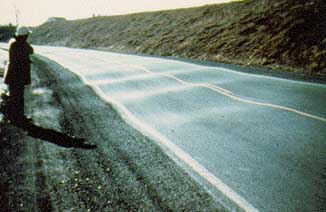
if you don't believe the parent, drive on any freeway in the US where freezing temperatures are common in the winter. You'll no doubt experience a "frost heave" and think you're about to fly through the windshield.
-
Re:Tax Gas won't work yet
You made references as if I was in Europe. I'm not. Read the first two letters of my name, or my sig for a better hint of where I am.
Heh, talk about coincidence- I'm in Fairbanks. In any case, I didn't want to make any allegations. As far as I knew you had an unhealthy obsession with Harry Potter, or 'AK' were your initials. I normally pay no real attention to sigs.
After that, let me let you in on a little secret. I'd bet there are more PV panels per capita in Alaska than Nevada.
I know of 2 installs here in Fairbanks. I'm willing to bet there's a lot more down in Nevada, even per capita, though the remoteness and low population density which makes our electricity bloody expensive makes PV attractive here, at least in the summer.
http://en.wikipedia.org/wiki/List_of_countries_by_oil_consumption The EU has more population and lower oil consumption. Thus savings measures will have a greater effect in the USA than Europe. Thus, EVs *should* be adopted in the US before Europe.
You live in Alaska and you don't know that there are more uses for oil than simply burning it in automobiles? I use approximately equal measures in my truck and house! If I had a family and the house was occupied more I'd be seriously looking at wood.
In any case:
Fewer cars? False. Though if you include 'all' 4+ wheel vehicles, we take the lead again(though it's still around 75% as many vehicles per capita).
Fewer miles? 14k km(9k miles), vs ~15k miles, though latest DOT is closer to 13k. So about 50% more. Your earlier assumption of 8k km was therefore only slightly above HALF of what the statistics actually say about average driving over in Europe, and is still less than if you misstated and meant miles. Plus Americans are driving less as well.
Better Economy: True, but I never disagreed with you there. On average, US vehicles use 32% more fuel. Still, Europe averaged €1.59/liter vs USA's $3.85. A US gallon is 3.79L, And 1 Euro =$1.28. Making European gas $7.71/gallon. Adjusting for the average superior mileage of European vehicles, they're still falling behind at $5.84/gallon equivalent. Raise prices that much and Americans drive less.Again: My statement was merely trying to state that EV adoption should be quicker over in Europe.
1, The battery is the single thing that drives the cost of an EV higher than a traditional gasoline vehicle.
2. An EV driven less doesn't need as large of a battery.
3. A denser average population also means that potential charge points are also more common.
4. The cost of fuel is far higher in EuropeConclusion: Small EVs should be quite popular over there(if they were 'almost' economical in the USA), but they're not, so they're not really that close yet.
Most of the land in Alaska has no access to any utilities at all.
True; though if you want water it's more 'dig a well' or 'drive into town once a week/month to fill up a big tank in the back of your truck' and most of our population IS collected around population centers where utilities(at least electricity) is available.
Still, just to fact check:
Alaska: -
Re:Robots ho! Whar me robot hos?
According to a quick google the number of fatal accidents per 100 million miles was 1.11 in 2010. That is with 30,196 fatal crashes and 2,967 billion miles.
Now this is where my HAVO (Highschool) maths break. Is the 2,72 times less likely to crash equal to 99% certain it's safer? -
Re:300 million miles
So what are they basing this on?
According to http://www-fars.nhtsa.dot.gov/Main/index.aspx, the rate of fatal automobile accident in the US is about 1.11 fatal accident per 100 million vehicle mile.
Assume the Google car's traveled distance between two fatal accident follows a Poisson law (that is there's a constant probability of having a fatal accident in a Google car for any mile traveled).Null hypothesis: the Google car has the same rate of accident as the U.S.
The probability that the Google car given the null hypothesis has no fatal accident over 300,000,000 miles traveled is exp(-3.33) ~ 3.58%
Thus the null hypothesis can be rejected with a p-value of 3.58%.To get a p-value 5%, the following would do:
270M vehicle mile with 0 fatal accident
430M vehicle mile with 1 fatal accident
570M vehicle mile with 2 fatal accidents
700M vehicle mile with 3 fatal accidents
etc... -
Re:They don't have to be (just generate a GUID)
The program is called 'Connected Vehicle' http://www.its.dot.gov/connected_vehicle/connected_vehicle.htm. Safety is just one of many mobility applications intended to be supported within the National Intelligent Transportation Systems Architecture using the 5.9GHz Dedicated Short Range Communications band for vehicle-to-vehicle (V2V) and vehicle-to-infrastructure (V2I) communications.
The program takes privacy very seriously. The current concept uses security certificates with a life span of 5 minutes with separate systems issuing and validating certificates.
-
Re:Not safe
> with 310+ million Americans each would only need to drive 3 miles a year to reach a billion.
With actual numbers:
"There were 190,625,023 licensed drivers in the United States in 2000." [1]
190625023 * 3 = 571875069So not only are you wrong, but I don't see your point either. Americans drive a lot, but they also have a lot of car accidents. (Feel feel to provide more recent numbers, but you won't get a billion even if you count the whole population.)
To be fair, I think that computer controlled car should be granted the right to drive, if it can pass the driving test, which human drivers need to pass. Should there be an accident, the company that provided the car should pay. That is unfair for the company, but it is to earn the trust of the population and to ensure that cars have as little defects as possible.
-
Re:Not safe
Not at all. Airline statistics tell a big story. They are incredibly safe now. Not too many computers are flying the plane into a mountain.
Wow, I lol'd at this... How could you possibly compare these two? Airspace has an incredibly consistent, standardized and mostly centralized air-traffic control system. you have ~7,000 aircraft simultaneously in the entire US Airspace. We have over 242 Million registered vehicles in the United States. I couldn't find data on how many are in operation simultaneously, but I think it is safe to say you can find over 7000 in operation simultaneously during rush hour in any average city on the interstates there alone.
Add to that the room/flexibility to maneuver in a vehicle on a road system, parking lot, parking garage, shoulder, dirt road, etc. compared to "air space".
Both have weather hazards, granted. Except that often when weather is rough, planes don't fly there (route around it). Motor vehicles don't work that way.
I'm sure I have BARELY scratched the surface here. Maybe we should instead be debating what I meant by "quite a long time". I'd say a significant number of autonomous vehicles in operation in the U.S. is at least a decade away, maybe two. -
Re:Overcomplicated solution.
I didn't give any references since I've heard that figure often enough to consider it well-known. (A quick google gives me the somewhat dated http://www.nhtsa.dot.gov/cars/rules/cafe/docs/Summary-Fuel-Economy-Pref-2004.pdf, concluding that European passenger car fuel economy is 47% better than that of the US - sorry about those 3%.)
And you are quite right in that this is in part, but not completely, caused by differences in size. But are you really saying that SUVs are mainly driven off-road? According to studies, they are not. (see Automobile Politics by Pateron). If your big car has actually tasted mud, it should count itself lucky.
I live in the country-side of Sweden, where road salt is illegal for environmental reasons, and we have more than our fair share of snow. Seeing that Americans have ~420% higher death rates in traffic than we do (2.9 per 100,000 in Sweden, 12.3 in the U.S, see http://en.wikipedia.org/wiki/List_of_countries_by_traffic-related_death_rate), I'd say our "european-style" cars are handling it quite nicely, thank you.
-
Re:Got this wrong..
>>>city driving, but that's where most people do most of their day-to-day driving.
Citation please. I don't go anywhere near a city for my commute, and neither do most people I know. In fact the average American drives almost 20 miles a day on an interstate or highway
80% of citizens live in "urban areas", and 86% of commuters travel by car. Even if you look only at workers that live and work inside their principal metro area, 82% of them commute by car).
http://www.census.gov/prod/2011pubs/acs-15.pdf
http://www.fhwa.dot.gov/planning/census_issues/archives/metropolitan_planning/cps2k.cfmOf course, not everyone in an Urban area has a "city driving" commute, nor does everyone in a rural area have a "highway" commute, but this is the closest metric I could find.
If you want to use personal anecdotes as evidence, most people I know live in a large city and commute to work either inside or near that city.
-
Re:effectively raising the cost of vehicles once a
There will always be pathological cases such as yours that skew the findings. The average American drives 13,500 miles per year. Lets assume a worst-case scenario where one person drives a different car and you don't have multiple people sharing a single car (and thereby putting more than the average number of miles on it). Your numbers would indicate that you get about 24MPG. Into 13,500 miles, that gives $2,250 per year in fuel costs per person. At 35.5MPG, that would be $1,520. I appreciate the time value of money, and enjoy spend $730 a year less of it.
That all assumes that gas prices never go European. At the UK average price of $10/gallon, your car would cost the average drive $5,625 a year in fuel. A car meeting the proposed standard would cost $3,802, or $1823 a year less.
In your perfect world, your clunker is cheaper to drive (even though it's dumping 27% more pollutants into the air per mile and making the air suckier for everyone). In the real world, 35.5MPG cars are cheaper for the average driver.
-
link to project page
Here is the DOT project page on the experiment, which includes a nice FAQ, and a description of the purpose.
This particular 3,000-vehicle experiment, fwiw, is not intended to test the crash-avoidance technology in a live trial, but rather to collect a data set. The indicators aren't going to be displayed to the drivers on a HUD or anything, but just recorded for analysis, along with vehicle position/telemetry.
-
Re:300k miles isn't much.
The odds of being in an accident for the average person each year is 1 in 6,500.
Wrong, according to that article, those are the odds of dying in a car accident per year. Nobody died in the Google car, or likely would have died if it carried passengers.
According to passenger vehicle stats from NHTSA (2009) and Wikipedia, I calculate that there is a 1 in 49 chance that a particular passenger vehicle will be in an accident in a year (5.211 million accidents to 254.4 million registered vehicles). That means that the odds of any vehicle being in an accident in 23 years is close to half.
But seriously, the accident was not likely preventable anyway. Give the car a break.
-
Re:We should test all drivers inside simulator als
http://www-fars.nhtsa.dot.gov/Help/Terms.aspx
You are the one that's wrong. If BAC is 0.01 or greater, then it is alcohol-involved. That's from another NHTSA document. So which NHTSA document is right? Depends on who's quoting it and why. Also note that the document you refer to also includes passengers who are drunk in the statistics. Those are included in alcohol-involved incidents. I never said "alcohol-impaired" so correcting me by quoting unrelated stats doesn't prove me wrong. It just proves your reading skills are poor. -
Re:We should test all drivers inside simulator als
While speeding is the leading cause for most traffic accidents
False. http://www-nrd.nhtsa.dot.gov/cats/listpublications.aspx?Id=A&ShowBy=DocType Document 811630 pages 4 and 6 demonstrate that alcohol is just as big a factor in fatal crashes. In fact, I would argue that it is a much bigger factor because a lot more people speed than drink and drive.
-
Re:Not me!
The majority of Americans do, in fact, live in urban areas. The link includes a breakdown of various degrees of urbanity.
-
Re:First dissent
Please name me the US Federal Government Car Insurance Mandate. Oh wait, there isn't one... because the Federal Government mandating car insurance would be unconstitutional.
Here you go.
http://www.fmcsa.dot.gov/rules-regulations/administration/fmcsr/fmcsrruletext.aspx?reg=387.9
If you transport cargo over state lines, you must carry insurance on your vehicle. -
Re:Inexperienced drivers are inexperienced
According to Wikipedia, only 2% to 3% of the US population works in agriculture.
Actually, more than 20% of us *live* in rural America:
http://www.fhwa.dot.gov/planning/census_issues/archives/metropolitan_planning/cps2k.cfm -
Worse threat than terrorism.
- Plane crashes caused by lithum batteries, last 10 years: 2.
- Plane crashes caused by terrorism, last 10 years: 0.
And Fast Company is whining that the USPS is overreacting because they refuse to ship a product that randomly catches fire and blows up? And sets off other batteries in the same shipment?
The FAA has a whole site on aircraft fires. All their lithium battery documents appear there. Here are the current US battery rules for air transportation. Phone batteries usually aren't big enough to be a problem, but as battery sizes move up from "small" to "medium" (laptop batteries) the restrictions get tougher.
-
Re:Google Beta
Quick question: they like to advertise that they have only had once accident, and it was when someone hit them from behind. How many accidents would we have expected the cars to have experienced? Answer: 0
According to the FARS, we expect about 1 fatality per 100 million vehicle miles. According to NY state, there are 1-3 accidents per million vehicle miles (I could not find california numbers). So, talk to me when they have a couple million vehicle miles.
-
Re:Google Beta
Logic isn't your strong suit, is it? Any AI Cars that join the ranks won't be in addition to other cars, they'll be INSTEAD of other cars. Google isn't going to just put a million empty cars out cruising the roads for kicks.
Besides, there's already 200 million licensed drivers in the US, and well over 250 million cars on the US roads. If/when a couple thousand AI Cars get added to the mix, it'll be such a minor addition that you'd likely never even see one.
-
Re:Diesel: The Way Forward
And how much does the bike cost you if you get hit by a car? (As happened with my dad, my uncle, my coworker, and one of my dad's friends.) Then you're spending close to $100,000 on broken bone repair, rehabilitation, and will likely walk with a limp the rest of your life. I'd rather have my body surrounded by the $20K of solid metal.
Yes, because no one is ever killed while driving. The NHTSA lists 30,797 people died in automobile accidents in 2009. Source: http://www-fars.nhtsa.dot.gov/Main/index.aspx
It also shows that 630 "pedalcyclists" and 4,092 pedestrians died.
Of course, proportionally more people drive, and the amount of time spent driving vs. other transportation activities is significantly higher.
If we're bringing out personal anecdotes however, I've been in one roll-over car crash, and zero crashes on the bike. So I in my reality, cycling is no more dangerous than driving.
I'd estimate that last year I spent ~50 minutes per day in my car 5x a week commuting, with an unknown quantity on weekends/evenings/non-work trips.
That works out to 208 hours of driving strictly for work, covering somewhere around 5,000 city miles. I'd estimate I have probably a little over twice that amount in actual usage, as my annual driving is almost 12,000 miles.
However, I *do* know that I spent 164 hours last year cycling a total of 2,168 miles, as my GPS + Strava software tracks everything.
And you can't predict an accident. I might cycle for 20 years with no issues and get into another serious car wreck tomorrow. Besides, I'd rather spend my time cycling if I can rather than driving... much more fun.
-
Re:Now this could be potentially game changing....
On transmission I agree with you, there are minimal losses moving electrical energy. However, storing energy is a whole different issue. Storing electricity as a liquid fuel is a very attractive possibility.
We lack a good storage capability for electrical power, but I'm not convinced this would be the solution.
Not when you calculate the losses likely involved in liquid storage. I suspect the CO2-->Butanol-->Combustion-->Kenetic/heat would be much more lossy than simply pumping water up-hill, and releasing it thru generators, something like done at Grand Coulee where the pump generators are used to pump water uphill, and the exact same device us used to create electricity from the release of that water. Pumped hydro is the most efficient method in current use.
Ultimately, I suspect the storage problem will end up being ameliorated by battery powered Electric Vehicles. After all, once 256 million vehicles are converted to battery or hybrids there is a boatload of storage distributed across the grid. Most of it sitting idle most of the time.
-
Re:In other news...
The trouble with this type of driverless car tech is that it's going to be as brittle as the AI it's based on. It may work fine for normal, complex or not, situations, but the day a child runs out in front of it in a way it's not been programmed to handle there's going to be a tragedy.
The question is, how prepared is the average driver? I don't mean hazardous driving but according to stats (1, 2) I found there's about 3 trillion miles driven, 6 million crashes and 40,000 fatalities in the US each year. That's one crash for every 500,000 miles driven - that sounds incredibly little to me but it says 3000 billion miles. Even if you consider that near-accidents and emergencies happen more often they're many thousands of miles apart. Nobody is really able to stay alert that long for something that doesn't happen 99.99% of the time.
It's great what you learned at your driver's exam, but most people aren't there. At best they're simply cruising and need to snap into emergency mode, not counting all those who aren't paying sufficient attention, are tired, fiddling with the stereo, their phone, distracted by passengers, fail to react, panic, do stupid things like swerve into opposing traffic, on alcohol, on drugs and so on. Nor do they have a 360 degree view or IR vision or any of the other tools an automated car would use. By far most often the threat is obvious if observed and the solution usually equally so.
After all, there's only so many things you can observe about the people around you too, you can see the child but you can't know what it's thinking. It's just the basics of that it's a child, what trajectory it's on, is it unaccompanied and in all honesty there's not that much you manage to process while you're driving by at a fair speed. It's mostly attention, if that child runs in direction of the road I have to react instantly and break which will cut a typical response time from 1.5 seconds to 0.2 seconds. It might just not be that relevant to a computer that's still analyzing all possible problems simultaneously.
-
Re:I disable my airbag
It's definitely slowly improving though.
http://www-nrd.nhtsa.dot.gov/Pubs/811493.pdf
For instance, my state was 94.7% compliance as of 2010.
The lowest state was 72.2%, the highest was 97.6% with the 2010 national average at 85%.
Sam
-
Re:Who feels that driving is "too dangerous" now?
Actually from what I've read and heard lately, driving is far safer now than it used to be. When I was a mere youth, there were an average of 55,000 people killed on the US highways each year, a rate of about 5.25 deaths per 100 million miles. (Stats from 1957-1997 here.) By 1997 the total was down to about 41,000 with many more miles driven, for a rate of about 1.64 deaths per 100 million miles. And according to The NHTSA itself, the death rate is now (2009) about 33,000 for a rate of about 1.14 deaths per 100 million miles.
Of course, there is a valid position that says one is too many, and that is the charter of NHTSA. The rational economic way to view this is to balance the various costs (assuming that one can 'monetize' costs like loss of a loved one), and find the most cost effective balance between deaths due to accidents and the loss of lifetime and value in becoming too safety-conscious. Obviously we could ban automobiles entirely, but the cost in human time that would accrue - wasting an entire day going to the store to buy groceries is a real loss in effective useful lifespan - is patently unreasonable. So all these things can be balanced out. Limiting speeds would make the highways safer, but again how much time do we want to lose? So there are things that can be done, and some of them are a good idea. I've been in one accident in the last year-plus, where the guy who hit me might well have been toast had it not been for his air bag. Both cars were junked but both of us came out well under the circumstances.
-
Re:What they are really looking for ....
Violation of OSHA
Violation of osha hell that is straight up violation of DOT regs. No driver shall... There are explicit rules for how much you can work. By federal law. 70 is the max btw... And that is only if you have a 36 hour break.
Companies like this need to be turned in and put out of business. One DOT audit and that place would be shut down. Those rules were made to not only protect the workers but to create less accidents.
Please *PLEASE* turn them in.
http://www.fmcsa.dot.gov/about/outreach/consumers/safthotline.htm1-888-DOT-SAFT call it now please. This is for the safety of not only those people but everyone who drives near them. There is a shortage of good drivers. They would have no trouble getting work elsewhere. Probably at higher pay too.
I have seen too many rolled over trucks and the like to have any sympathy for that business. Most of the time it is guys like your old boss who care nothing for the welfare of anyone else but himself.
There are gov regs to control this. They were invented just because of idiots like your old boss. You dont even need a union involved with this.
It will basically go down like this. They will show up tear him a new one. Give him warnings to clean up his mess (about 6months to a year). Then show up and give him hefty fines if he hasnt cleaned up. Give him another 6 months to clean up. After that they will pull all of his vehicles permits. In effect putting him out of business.
-
Show me the actual accident data
Show me the massive increase in accidents and fatalities that have come along with the massive increase in cell phone usage. Then I'll believe there's a real correlation. The results of a controlled test designed to yield a certain result isn't useful data.
Here's the fatality list through 2009. It shows steady decreases in fatalities per mile driven.
http://www-fars.nhtsa.dot.gov/Main/index.aspx
Of course, that's 3 years old now, but still... there's been an increase in cell phone use through 2009, so if using a cell phone is as dangerous as drunk driving, I'd expect to see a big increase in the fatality rate, not a decrease.
And here's another flawed study (2010)... http://www.nsc.org/Pages/NSCestimates16millioncrashescausedbydriversusingcellphonesandtexting.aspx
They estimate that 25% of crashes involve the use of cell phones. Based on that, I would expect accident rates to increase (to a degree) along with cell phone usage. But they don't. Many states have banned cell phone use by drivers. In those states, shouldn't see a big decrease in accidents? Do we? I doubt it.
-S
-
Re:Oh Frack!
Actually, they aren't so flimsy anymore.
http://www.fmcsa.dot.gov/rules-regulations/administration/fmcsr/fmcsrruletext.aspx?reg=393.67
http://www.fmcsa.dot.gov/rules-regulations/administration/fmcsr/fmcsrruletext.aspx?reg=571.304
I havn't seen any evidence refuting
Burden is on person making the claim.
-
Re:Oh Frack!
Actually, they aren't so flimsy anymore.
http://www.fmcsa.dot.gov/rules-regulations/administration/fmcsr/fmcsrruletext.aspx?reg=393.67
http://www.fmcsa.dot.gov/rules-regulations/administration/fmcsr/fmcsrruletext.aspx?reg=571.304
I havn't seen any evidence refuting
Burden is on person making the claim.
-
Re:That link is dead.
the businessweek link is indeed dead.
on top of that, if you search for the article, you can find it on the businessweek site, but that link is a 404 too, and most other sites linked to that.
anyhow. http://www.dot.gov/affairs/2011/dot16411.html should suffice.
-
Re:Winter/mud/etc.
" (OK, there are accidents, but 9 times out of 10 it's because some idiot just drives out without checking over their shoulders and mirrors)."
Citation needed."That's a death rate of 1.1% of accidents. That's a pretty good survival rate for car accident."
so? lets make it better."Wouldn't this time/money be better spent on better driver education?"
nope." Bob has to list that as a car accident if he wants an X-Ray for his toe."
since backing up over a tow is highly unlikly to result in a visit to the Dr, do you ahve any non extreme examples?Many accident are because you CAN"T see the person you are about to hit. There are big ass blind spots in almost every car.
http://www.consumerreports.org/cro/cars/car-safety/car-safety-reviews/mind-that-blind-spot-1005/overview/index.htm
and more info: -
Re:Why?
Considering the number of deaths on the road (30k in 2009, down from 43k in 2005), you can hardly blame them for taking an active role in trying to reduce deaths.
Kind of makes Iraq, Afghanistan, terrorists attacks, the crack down in Syria, the violence in Mexico and almost anything else you can think of outside of Africa from the last decade look like nothing.