Slashdot Mirror
Domain: econbrowser.com
Stories and comments across the archive that link to econbrowser.com.
Comments · 21
-
Re:Those were the days.
Progressives have a death grip on the educational system. It's good that some, like you, can deprogram themselves. Even by the 80's, things like the population explosion,
Global population is still rising, the rate of growth is slowing now, but I'm really skeptical it will continue.
peak oil,
For the US, peak oil has come and gone and conventional production has plateaued world wide. Even ignoring CO2 there's only a limited amount of oil in the ground and we're using up the stuff that's easy to get to. People aren't extracting from oil sands and shale oil because they're such a wonderfully convenient resource. They're crappy sources that are becoming feasible because there's no longer enough easy stuff to get to.
-
Re:This is retarded conservatism to help 'coal'
I would question what year it happened. Because US shale came online in 2010.
The OPEC embargo in the 70's should most certainly classified as "shenanigans". And it's kinda the reason OPEC exists. But I think they've lost all control over their members and they can't convince themselves to tighten their belts to try and control prices.
-
Re:More tax breaks for the oil companies next year
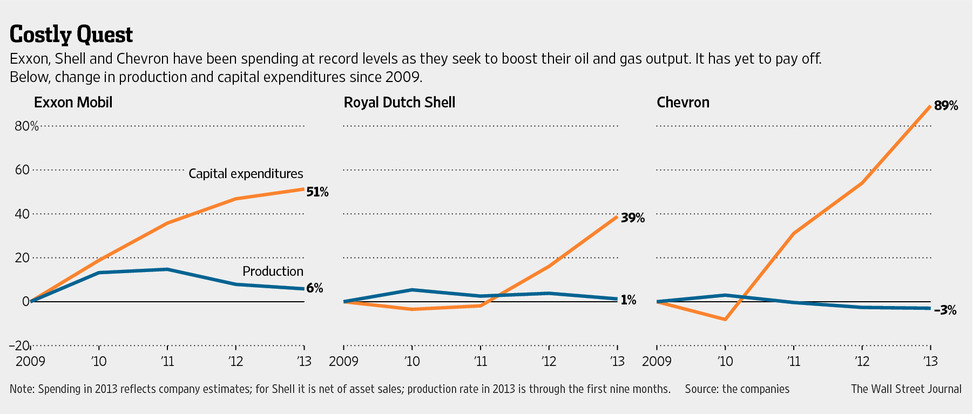
Nah. Investment expenditures are at all time highs. Besides, they'll just pass that subsidy-expiration on to the consumer.
http://econbrowser.com/wp-cont... -
Re:Defintion of Pyramid Scheme
I'd just like to point out that gold have had the same characteristic, in the beginning it's easy to mine/wash/find, but as time goes it's getting harder and harder as all the easy spots are cleared out. And it's only economical to mine those harder spots out because the value of gold have risen.
Would you say gold is a pyramid scheme, because it was easier in the beginning? Bitcoin is in many ways digital gold, where the rarity comes from the resources it takes to "extract" bitcoins. Gold itself is not currency, but can be bought and sold. And also have fluctuations in value.
Personally I think bitcoin will be doomed in the long run, since there's a max limit to amount of coins, and coins will slowly fall out of the system (if the cryptographic wallet key is lost, all coins in that walled will be unable to be moved to a new address - and with time and Murphy's law, more and more coins will be rendered inactive).
-
Re:Energy exports
I did not say that USA was NOT net energy importer, however USA is now selling refined products and this is what helped to reduce its monthly trade deficit a few months back.
Bloomberg: Oil Exports Trim U.S. Deficit as Fuel Gap Shrinks: Economy
Energy exports boosting US trade position
However my point remains, USA energy consumption is lowest in at least a decade, you can find various data on this subject, like this here, and here
Also oil imports are very low, here is a 2013 story talking about lowest oil imports into USA in 25 year span.
My point is that USA is too poor to keep using more or even equal amount of fuel that it used to in the recent decade(s) and it's going to progress even faster from now and the fact that oil prices are going up has nothing to do with USA lack demand, it has everything to do with inflation, which eventually will allow foreign consumers to buy much more energy products than today as the inflation will hit USA home and USA MAY become a net energy exporter at least for a while.
-
Re:Ron Paul 2012
The gold standard is overrated. The longer a country stayed on the gold standard during the Great Depression, the longer it took that country to get out of the Great Depression.
As this article notes,... 13 other countries besides the U.K. had decided to abandon their currencies' gold parity in 1931. Bernanke and James' data for the average growth rate of industrial production for these countries (plotted in the top panel above) was positive in every year from 1932 on. Countries that stayed on gold, by contrast, experienced an average output decline of 15% in 1932. The U.S. abandoned gold in 1933, after which its dramatic recovery immediately began. The same happened after Italy dropped the gold standard in 1934, and for Belgium when it went off in 1935. On the other hand, the three countries that stuck with gold through 1936 (France, Netherlands, and Poland) saw a 6% drop in industrial production in 1935, while the rest of the world was experiencing solid growth.
A gold standard only works when everybody believes in the overall fiscal and monetary responsibility of the major world governments and the relative price of gold is fairly stable.
Enough with the gold standard nonsense already.
-
Re:Exploitation for the win!
This is due to reducing taxes on the rich, tax loopholes for the rich, wages not keeping up with inflation, decrease in benefits for American workers,
1) Despite marginal top tax rates of >90% until the Kennedy tax cut of 1964, the effective tax rate for the richest one 1% of households was 32.2% in 1952 going down to 24.6% in 1963. After the Kennedy tax cuts, effective tax rates for the richest 1% rose to 28.9% until Ronald Reagan took office and declining to 22.1% following the 1986 tax reductions.
The interpretation is massive tax avoidance and outright fraud by the richest 1% during the post-war years to avoid the 90%+ top marginal tax rates. The IRS did not have computers to track down the rich, nor was there much support in the executive branch to do so, nor in the judicial branch to effectively support the high tax rates.
2) Total employee compensation HAS kept up with inflation. The issue is that compensation is being moved from taxable wages to tax-avoiding benefits. We have to blame WWII-era law that made employee-paid health care tax free. Over time as medical technology improved and became more and more utilized, this tax loophole has forced a linkage between health care and employers, which we don't see with auto insurance, for example. Over the past forty years US compensation per hour and productivity per hour have moved up almost in unison.
3) And benefits are not going down, they are going up, especially health care.
To put a number on it, US private industry employers spent an average of $27.64 per hour worked for employee compensation in June 2010. Wages and salaries averaged $19.53 per hour worked and accounted for 70.6% of these costs, while benefits averaged $8.11 and accounted for the remaining 29.4%.
-
Re:If they want a lasting legacy...
Remember, the decline of the number of union workers in the US exactly tracks the decline of real income of American workers, which has been inexorable since the election of Ronald Reagan
US total real compensation per hour (the total of wages and benefits, such as health coverage, life insurance, and 401(k) plans) has been rising monotonically since at least 1950, with the notable exception of a plateau between 1992 and 1997. Graph here.
Moreover, US real median family income rose during the Reagan era (1981-1989) from $40K to $45K (2006 dollars). After Reagan, real median family income fell a bit but then went back up to nearly $50K in 1999. Data on Wikipedia.
In 2007, US real median household income was $50,233 in (2007 dollars.)
-
Re:The Money that was created by this error....
I'll let others explain it.
The short answer seems to be: monetary base is not money supply. This spike is related to the Fed's decision to pay interest on excess reserves, and it has not translated into a similar rise in the supply of currency.
-
Re:meh
Barring monopolistic practices, the mining companies would no more be in charge of our economy than the banks are now.
You're missing the point. A central bank controls the money supply deliberately with an eye toward the effect of that money supply on the overall economy. Mining companies produce gold, and industrial users consume gold, for their own purposes, with no regard for the effect of the gold supply on the economy.
Exactly, the duration may have gotten shorter, but the effect when reality finally hits is worse.
Any evidence for this claim?
This is why we had the Great Depression, and why we are heading into another major downturn now.
Good luck finding anyone who isn't a crank who believes that the Great Depression was caused by insufficient goldbuggery. If anything, gold standard contributed to the Depression.
-
Re:Nice -- more of what we already knew
I just have to wonder how much more of this erosion of the U.S. the U.S. is willing to accept and permit? H1-Bs and lowering of wages,
US real total compensation per hour has doubled since 1970. Real hourly earnings aren't up much over that time, but that is because our additional compensation is going into 401k plans, health insurance, and more paid sick time. It is going there because tax policy makes it preferable for your employer to pay that compensation rather than paying you wages, having your wages taxed, and then you pay for them.
Note that real disposable income actually rose the last four months.
People constantly ask "so protectionism is the answer?" Right now, yes it is!
Protectionism is a false promise, it supports unsustainable and inefficient businesses at the expense of consumers. I work for a US company in an industry that earns 1/3 of its revenue (that's $10 billion dollars) in exports. So go ahead, put me out of a job!
-
Re:Fuel economy
Not usual, perhaps something very specific with your car.
A similar question popped up on econbrowser a few months ago. They traced the origins of the chart to a 1998 study, whose data can be found at Table 7.23 of the DOE's Transportation Energy Data Book (large pdf warning).
At the time, I found a 2006 short note on greencarcongress , about a comparison published by Auto Bild, a German weekly magazine. Their data support the notion of a steady increase in fuel consumption with increased speed, even with modern, high speed autos.
-
Re:Protection of the tech jobs market
real wages are down from their peak (which occurred more than 35 years ago)
However real hourly compensation has been rising pretty steadily. More benefits are being passed through employers tax free, such as health care costs, which don't show up in wages. And the government pulls out more of your money in payroll taxes (of course, if you think Social Security and other taxes are a waste, then you might be able to argue that real compensation has not actually been going up).
minimum wage is just over half of its peak
Minimum wage workers tend to be young. Only 2% of workers over age 25 earn the minimum wage. About half of minimum wage earners are under age 25, and about one-fourth are age 16-19.
The minimum wage probably causes more unemployment (and for illegal aliens, informal employment) than it helps to reduce poverty. Most people in poverty earn more than the minimum wage, but are poor because they work fewer hours than those not in poverty. Often this is because they are single parents.
there are 12 million more Americans living in poverty today than 30 years ago
Of course, the definition of "poverty" has been raised during this time. 30 years ago, most people in poverty did not have microwave ovens or refrigerators or a car. See this article for a comparison of "the poor" from 30 years ago to today.
I'm not saying it is cool to be poor, but it is far easier to be poor in 2008 than 1978.
Keep in mind we have taken on about 30 million illegal immigrants over the last 30 years as well. They are doing a heck of a lot better in the US than they would have were they came from (where they would be truly "poor"), but they will pull down average wage numbers as they don't come in highly skilled.
millions are now losing their homes
That is true, but of course homeownership was at an all time high of 69% before the bubble burst. It still remains higher than most other developed countries. Plus while they may be defaulting on home loans, most are able to rent.
Unemployment is at 6 percent nationwide and 11 percent in my state of Michigan.
US unemployment is actually 5.7%, while Michigan's is 8.5%.
But this does make one think that Michigan is doing something wrong. According to the Economic Freedom of North America study, Michigan is ranked 39th of the states and provinces in terms of subnational level economic freedom. Thus, I suggest that Michigan improve its policies to enhance its economic freedom.
You might not be aware of this fact it if you come from a background of privilege, but that doesn't say good things about you.
Well I've done the taxes for many poor immigrants to help them get the Earned Income Tax Credit, which actually does something to reduce poverty.
-
Re:Wow, that's mature
"Tell people you are drilling and yeah, the oil won't enter the stream for 10, 15 years but the speculative properties alone will drop crude by another $20 or $40, easy."
You're nuts. Today's price is virtually irrelevant to the price 10+ years from now, or on predictions about what the price and supply/demand will be by then. The simple fact is: a decision on opening up new areas to drilling won't make a speck of difference to today's price whether the decision is made tomorrow or next year, or the year after that. At best it will have an effect on a decade scale (assuming the exploration pays off, which isn't a guarantee). Heck, it takes 5-10 years to bring a typical frontier area oil field development on-line even if you know exactly where the oil is, and the Arctic is about as frontier as you get on land.
The recent modest decline in prices has more to do with signs of reduced demand in the U.S., both due to people actually waking up that this stuff is getting expensive and driving less, because the higher prices are pulling money out of the economy and slowing all of it down both in the U.S. and elsewhere in the world (which also makes people consume less for work), and because the price varies seasonally anyway (on average it's usually higher early in the season, flattens out, and declines in late summer and into fall). Prices are almost *always* highest in the spring-early summer, and then flat or lower.
Here, I'll make a bold prediction: even if the Arctic drilling decision is made this fall and companies are all excited about it, the gas prices will go up in the period from January through May of 2009. Why? Because it always goes up then.
Basically, if you think the recent decline in crude or gasoline prices has *anything* to do with the contemplation of this decision (let alone an *actual* decision), you're sadly misinformed. You may as well be talking about the impact of Intel's technology plans for 2013 or so on today's stock price. THE MARKET DOESN'T CARE, because a lot can change between now and then, and the shorter-term influences dominate. In the oil market we all know that 5 or 10 years down the line the oil supply will *probably* be tighter, and the demand will *probably* be higher, so prices will *probably* be higher, but there could also be a global economic collapse as there was in the late 1970s-1980s, and anybody paying today's prices and saving it for 5-10 years could take a financial bath. There are no guarantees. Nobody's going to drive prices down because 10 years down the line they think a relatively small drop in the bucket may or may not come on-line in the Arctic.
-
Wrong type of inflation..
I'm talking about commodities... take a look. And if you think the fact that a the value of a dollar is now about
-
Re:Queue "Ron Paul is a nut" posts.
Um, what about the studies that try to pin down the causes of the Great Depression? Inflexible money supply after a period of wild speculation caused a deflation of the currency that sent the economy packing. I guess I was not verbose enough in my original post. The gold standard itself may be theoretically workable in a perfect system, but in real world practice (the 1930s for example) it has a lot of shortcomings that cause problems. It's like communism in a way, it works great on paper, but it makes assumptions that aren't true in the real world where real people are trying to game the system and where you have to interact with other (not gold-based) economies.
-
Re:Wonder and amazementNo, we're not. We've seen no signs of approaching the peak of our ability to extract oil from the earth. It's not about ability. It's about cost. Increasing oil prices are mostly due to an unstable political environment a panicky speculation market. Primarily increasing demand from China and India... Plus the dollar consistently falling.
However, Saudi is by far the largest oil producer and:
http://www.iags.org/n0331043.htm
http://www.theoildrum.com/node/2331
http://www.econbrowser.com/archives/2007/02/saudi_oil_produ_1.html -
Re:I really hate these type of arguments...
Well, "honorable" lawmakers, how many of your teacher's pensions are in IBM stock?
Heh, knowing how some government pension funds are being run (San Diego), I wouldn't be surprised if the State of California has a big stake in some hedge fund that's short-selling IBM. -
Re:Why is this news?
1. The USA is the world's most progressive nation, in the sense that it is the first and best democracy,
From what I remember about rankings last time I looked at various world surveys:
one of the most disliked nations on the planet
about 130th in citizen happiness
53rd in literacy
45th in press freedom
lower 30s in math and science literacy
high teens in longevity
About seventh in social mobility
Gross Domestic Product: http://www.econbrowser.com/archives/2007/01/the_di stributio.html
The South African constitution explicitly protects gays and they are one of several countries with gay marriage
one of the greatest income disparities in the world
one of a couple of the 35 industrialized nations that still executes citizens
one of a couple of the top 7 industrialized nations without national health care
highest per capita imprisonment in the world
Are most new democracies choosing a republican government or a parliamentarian government? And why?
And Switzerland might have a word to say about the "world's first democracy".
Sociology and Political Science grad here. Just saying. -
Re:US mint verses online games
No, it doesn't suck. The Gold Standard was one of contributing factors to The Great Depression. http://www.econbrowser.com/archives/2005/12/the_g
o ld_standa.html The US government value is a lot stronger than value of gold - we don't need gold anymore to prop up the value of the dollar. If you still think gold is more valuable, you still have the option to buy it - albeit at fluctuating prices. And those price fluctuations had something to do with giving up on the Gold Standard. -
Oil company FUDThis is all just more FUD from the oil companies to keep oil prices high. Everyone has been predicting peak oil for a century and yet it never comes, nor is it likely to.
We have 2 trillion barrels of oil in the US in the form of oil shale. This oil is recoverable at $30 a barrel. There are many other forms of oil to recover and many new deep water fields left to explore.
In the mean time, we should continue to work on hybrid and other technologies to reduce our consumption. Doom and gloom on this is not justified or necessary.