Slashdot Mirror
Domain: economist.com
Stories and comments across the archive that link to economist.com.
Comments · 2,721
-
Re:Not swarm, or SWARM, but SwarmThe Economist had an article a couple of weeks ago about a NASA-funded project.
Stone Aerospace named the penetrator VALKYRIE. This is not in reference to the Norse deity but rather because it needed “a frickin’ cool acronym”, Dr Stone says.
A refreshing dose of honesty.
-
there is enough glory in any fieldif you are good enough.
This said I think every prospective engineer should consider carefully the reasons to become one. It is advised to do something on top too - like applied business practice or Business Economics as they call it. Seems to be a common practice in Germany these days and I find the idea appealing. Then again I am not sure whether any engineering title will guarantee you a job in the future. I saw today the stats for education in Germany and the number of people finishing off the courses at universities has increased over the years. What has not increased is number of people going secondary paths of education and ending up in industry 'lower' positions. Gosh when I look around in my settlement - there are only few houses where owners are engineers. There is one where there is a civil servant and another one university teacher and 4 households with engineers including mine. The rest of the settlement is owned by technicians doing intelligent work for others sometimes even supervising the floor in small industrial companies. Quite frankly I find them more worthy than those engineers with a title that I have to work with but that is another story.
So if one takes property ownership as a proxy for well done career choices then being an engineer does not mean much. But hell it makes fun if you can assemble things and see them work. There is certain great positivist joy in doing that! The question is: do you need to become an engineer to do these things today? I wonder if that is really true.
Original question was about digital and analogue being put as opposites - tell me then whether doing this stuff is analogue or digital? Surely lots of silicon is being used and a little processed into an actual product. As surely as a lots of digital processing used to control completly automated factory producing those things.
The statistics I meantioned briefly before makes me also think about history. There were times where engineer was a sign of high intelligence and skill. The I got a degree..... And then all these people I work got degrees too..... Now it seems to me the value the engineers before had in society is now attributed to scientists but not even them are at the level an engineer like this was before. This guy had an impact on societies he lived in. Do YOU think that your input is anywhere around this level? Why do we talk about glory then?
-
Re:Either get rid of the primaries.The British news rag "The Economist" recommends duelling:
[...] When the constitution was drawn up it was standard practice for people suspected of making anonymous attacks on their political opponents to be challenged to duels. Congress should either pass something like Chris van Hollen’s Disclose Act, which aims to bring spending out into the open, or bring back pistols at dawn. Having members of Congress shoot at each other on the banks of the Potomac might even rekindle interest in politics, boosting voter turnout and persuading smaller donors to give money to their favourite shooters. On reflection, this is clearly the way to go.
-
Re:Not the first time I've heard this kind of theo
The problem I have with these theories is that they don't explain why the hand is so poorly adapted to *deliver* punches.
Actually it has been proposed that humans are unique amongst primates in the fact that their hands developed in part to maximize destructive punching power.
-
Re:War of government against people?
First of all, the level of firearm ownership in an area does have an effect on the firearm homicide rate. It correlates -
http://ajph.aphapublications.o...
Violent crime has gone down in most of the industrialized world over the past 3 decades, regardless of whether a country restricts firearms or not -
http://rgambler.com/2013/11/03...
http://jpo.wrlc.org/bitstream/...
http://www.economist.com/news/...However, America's violent crime rate is much higher than most developed countries -
http://www.rawstory.com/rs/201...
http://en.wikipedia.org/wiki/C...The growing consensus (in public policy circles at least) these days is that it is not gun ownership that is causing this violence, but the American gun culture -
http://www.businessweek.com/ar...
http://world.time.com/2012/12/...
http://www.cbc.ca/news/world/t...The problem is that we keep looking at gun ownership rates The Swiss has high levels of gun ownership, but they also have a very strict culture of gun safety and training. Men are required to undergo military training and be in the reserves for 10 years, keeping their sealed army-issued firearm at home or in the Zeughaus, for use in case of invasion. Thus, they have lots of guns, but little gun crime.
Now, the question is how do you measure gun culture? In America you have this issues with two main groups poisoning the culture - the gangs and the "don't tread on me" types. How can you design a study to measure the effect of this culture on gun crime?
-
Re:Current apes?
Human hand structure seems to be particularly suited to making a strong fist. So the development of homo sapiens facial/skull bone structure capable of withstanding impact does make sense. Other primates possess much greater arm strength than humans. So in a fight, a human would almost certainly come out on the losing end. One recommendation applicable to most animal/human conflicts: If a fight is inevitable, punch the animal in the nose. Its a move that none of them expect. And if it doesn't work, you are probably dead anyway.
-
Re:ZOMG PANIC!
The fact that the Wii U has been available for longer makes the PS4 2013 sales look even more lacklustre. All the consoles have their best sales immediately after launch (which is why having a good launch catalogue is critical).
I don't think that's true, certainly not from this data:
http://www.economist.com/blogs...
By now you would expect Wii U to be into its stride, with a good catalogue and selling many consoles whereas PS4 is earlier in its cycle. (It's also higher priced, so you wouldn't expect it to sell as many units). Wii U is struggling when it should be doing well.
-
Analysis paralysis
There's a concept called analysis paralysis. With too many choices, one is likely to be unable to arrive a decision for fear of making one that he will regret. Experiments show that people buy less when more is available. I think this so-called paradox of choice explains part of why certain computing platforms, such as iOS and game consoles, thrive despite their restrictions or even because of them.
Besides, Jews and Christians have ample evidence in their scriptures that humans suck at decision making. Start with Jeremiah 10:23.
-
Re:Same Manpower as in Canada?
Technically you can still outsource a plumber job to another company. I guess you meant offshoring not being really possible for plumbers and until technology does not replace that job completely this and lawyers stay a good option. Surely due to currently existing legal limitations one still needs lawyers in flesh standing in front of the judge. But research can be outsourced already.
-
Re:I can never wrap my head around this.
For example an US Gallon of petrol is about 6.6USD right now
Petrol in the US is very cheap compared to other western nations, so it is not a very good indications of prices. You are better off looking at the The Big Mac Index to do comparisons.
So how in the word is it possible that in the US 15/hour is barely a living wage? How wasteful a life are you living there seriously?
In a word
-
Citation provided
Rent-seeking
Cutting yourself a bigger slice of the cake rather than making the cake bigger. Trying to make more money without producing more for customers. Classic examples of rent-seeking, a phrase coined by an economist, Gordon Tullock, include:
a protection racket, in which the gang takes a cut from the shopkeeper's PROFIT;
a CARTEL of FIRMS agreeing to raise PRICES;
a UNION demanding higher WAGES without offering any increase in PRODUCTIVITY;
lobbying the GOVERNMENT for tax, spending or regulatory policies that benefit the lobbyists at the expense of taxpayers or consumers or some other rivals.
Whether legal or illegal, as they do not create any value, rent-seeking activities can impose large costs on an economy.Source The Economist Magazine Dictionary of Economic Terms. I can cite many other sources, but I'm posting this from a phone so you can Google them yourself.
The Wikipedia article is about the rent seeking as described in Anne Kreuger's well-known 1974 paper. However that is only one example of how investors attempt to seek higher than normal profits without creating any utility, which is the more general sense of the word.
-
Re:Disbelief in evolution=proof of science illiter
> the event of Creation was 13 and a bit billion years ago.
13 billion is just an estimate. Newer data possibly suggests 18 billion years.
-
Re:Piketty's real problem isn't spreadsheet-relate
"Oh, that's just a right-wing smear from EVUL RETHUGLICANS!!!"?
Well the part about figures being constructed "out of thin air" is a smear (whoever it may be who claims it), as becomes clear when one reads the rest of the article you cite. The most balanced assessment of the Giles vs Picketty dispute is perhaps the piece Inequality: A Piketty problem? from The Economist.
-
Re:What's the problem?
Time to wake up to reality. There is a vast difference between an education at a top school and the other colleges.
That depends on the market. A recent Economist article (probably paywalled) compared the ROI for degrees from a number of universities. The ROI from the University of Washington (Seattle) is higher than that for MIT, Stanford, Berkeley, Caltech and a bunch of other 'big name' tech schools.
It depends on what the market wants. And the market in business is willing to pay well for talent, regardless of the name of the school. Faculties, on the other hand, probably place a higher premium on the name and type of degree. The Economist article didn't look at market segments that way, so if you have your heart set on a faculty job, the big name might be worth it. But on average, no.
-
Re:Yes!
some parts of the US *never have* gotten out of third world nation conditions.
-
Re:Glimmer of hope, squashed
I'm not conflating anything and you are being a drama queen with her facts wrong.
You are innately wrong. Without government standing up for the citizens of this country, we have nothing more than a feudal state where the wealthy do as they please, and fuck everyone else.
Wrong. It has been the stifling regulation that does more to protect established wealthy than proffer regulation that would be effective without limiting the little guy. Please read this article that explains it better than I can.
That's the direction it's going with the fascist corporate enablers on SCOTUS the past decade, but that's not government... that's ideologues who are dismantling the government in favor of corporations and oligarchs. When "the rich and powerful take advantage" is not a definition of "government help" in any sense of the phrase, or reality.
Unless you are talking about campaign donations, I am clueless to what you mean. If you are talking about campaigns and donations PACs and Super PACs, then you and I are in agreement about it being politicians. I personally do not care if BigOil or WalMart or whatever spends a bagillion dollars on some candidate. You will know they are doing it and you will either agree or disagree with the candidates. But make no mistake, it is the politicians- duly elected by the people, who are the root cause of this. How many politicians are not well off and wealthy if not millionaires. How many went to congress that way. We aren't exactly over paying them.
You also seem to forget that Bush Jr had a republican house and senate for his first 6 years, and what that got us was them pissing away a budget surplus that was projected to be able to pay off the entirety of the national debt in 11-13 years, the first two wars in the countries history that did not come with a tax increase to help pay for them, and a taxpayer money giveaway to big pharma by enshrining the price fixing/no negotiation of medication costs in Medicare Part D.
Lets not make stuff up simply because we do not understand it. First, I said the congress works best when it's controlled by the opposite party as the white house. Bush and company is hardly anything close to that. Second, Bush's first 2 budgets, even after the tax cuts, projected continues surpluses. what happened was 9/11 and the economy dropped big time. This caused expansion of the economy to slow and tax income to drop. This is the same process that caused a lot of Obama's massive trillion dollar deficit spending. Third, most of the Clinton surplus was smoke and mirrors anyways. Well, let me put it another way. Changes in regulation scheduled to take effect regardless of who was in office, the expiration of the roth IRA conversions, and the end of the Y2K specific economic activity would have stressed any president's ability to maintain a surplus even without 9/11 and the recession that followed. Finally, the wars did not go on budget until Obama put them there in his first year of office. The wars had nothing to do with a budget surplus. Bush funded the wars on off budget emergency spending that had to be renewed ever 6 or 8 months. This is the way wars should be funded because A) you do not want to permanently budget for war, and B) due to rules on new spending needing to be paid for, when the wars die down, instead of stopping the spending, it ends up being spent on other things. Or in other words, if your war is spending 8 billion a year, off budget, then the war is over, you simply stop spending the 8 billion a year. If the war is on budget, that 8 billion can go to charcoal filtered underpants research or a bike path to the bridge to nowhere due to it being a popular tourist attraction now. And yes, we have seen most all of the on budget war spending getting spent elsewhere now that it isn't needed for the wars.
But what you are doing it getting confused between the
-
Re:Sensationalism at it's finest...
You think biodiversity and climate haven't changed radically in the last 4.5 billion years? You think the earth is static state? Have sea levels fallen and risen before?
No, I think that the current warming is primarily caused by human activity, and that this is putting extinction pressure on great swathes of a wide range of ecosystems, is responsible for the observed acceleration in sea level rise.
Forbes is using NOAAs data.
They're not understanding that the increase in CO2 is responded to my a warming over the following decades though. Scientific sources are better, and Forbes' opinion pieces are appallingly unscientific when it comes to climate change.
The economist reported the 25% number
So they did. A well researched and intellectual publication. Not scientific as such, but educated. It gets a pass.
Yet, still no warming during that time
Not quite true. There has been warming.
That is because the CO2 greenhouse effect is weak and marginal compared to natural causes of global temperature changes.
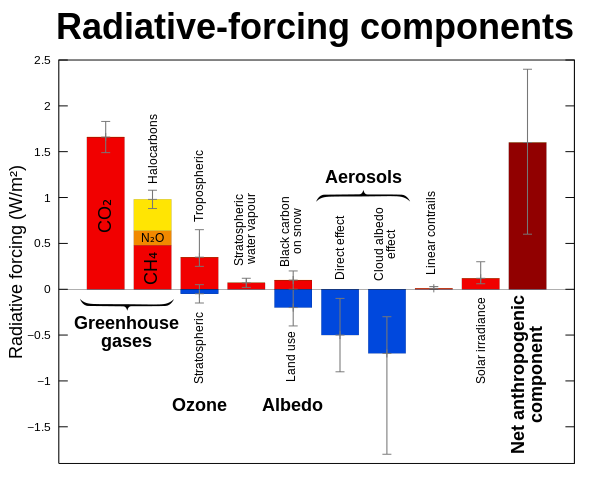
Not even close to correct. Completely wrong. Every time you decompose global warming into the response to natural and anthropogenic forcing it looks something like this. Most or all of the observed warming is anthropogenic. Every time you look at what is applying radiative forcing it looks like this. Anthropogenic forcing dominates, and of the anthropogenic forcings, CO2 forcing is the largest part.
There is no question in the scientific literature that most of the current warming is likely anthropogenic. About 0% of scientific organisations and 0% of scholarly papers refute this fact. We know it better than we know an asteroid impact killed the dinosaurs. -
Eh?
Batteries have gone through multiple generations of technology in the last two decades. Solar panels are now so cheap that the physical installation costs are the biggest part of installed costs. Solid-state storage is increasingly the norm. OLEDs are now in TVs, 77" diag. 4k-ish, WRGB. e-Paper readers cost tens of dollars and are seen as outdated tech. Smartphones cost tens of dollars. 4G phones. Gb/s Wi-Fi. Etc etc.
How much fucking progress do you need?
(When Li-Ion was introduced in '91, it stored less than 90 Wh/kg, now it's over 200 Wh/kg. The price was over $3/Wh, and is now less than 30c/Wh. http://www.batteryuniversity.com/images/parttwo-55h.gif. And there's no reason to suspect it will stop, we're still pushing Li-polymer capacity. With LiS, LiMetal, and ZnAir all in the early commercialisation stage, and graphite-everything in the lab stage.)
((Solar panels have doubled in capacity/m^2 every ten years, and halved in price/m^2. Every doubling of global production cuts the price by 1/5th. http://www.economist.com/blogs/graphicdetail/2012/12/daily-chart-19. And there's no reason to suggest the trend will stop.))
-
Re:Space programs as a crowbar?
Keep electing republicans and america will end up with so many starving and jobless people
Both the number of food-stamp recipients (starving) and unemployment (jobless) increased under Obama. Why, when the unemployment was 6% under Bush, he was blamed for "jobless recovery" by some. Worse, as his figure went further down to 5%, he was still blamed by others.
Obama's figure today — six years later — is still above 6% (despite millions leaving the workforce for good and thus not figuring into the count) — but you are blaming Republicans? Wow...
And, no, the mortgage-crisis was not Bush's fault. The do-gooding Democrats are to blame.
-
Re:Deficit Spending In The Guise of Job Creation
While I don't agree with Rick Perry on everything, the budget in Texas is just fine. Could there be changes? Yes, but there is no perfect economy in this nation and at some point you have to question governments that would much rather practice bureaucratic wealth re-distribution in the name of social progressiveness. That becomes collective thought where initiative dies. All that gets you is bigger government and more people wanting a hand out. Large, wealthy corporations don't deserve hand-outs and that's what needs to be curtailed but at the same time don't just use that as an argument to start spreading the wealth disproportionately on areas where we really don't need the investment, big government. Big government equates to a lot of fuckwads who have nothing better to do all day than fuck with people. Look at Massachusetts and the Justina Pelletier case! A bunch of fucking retarded social workers and hospitals getting in the middle of parental rights where no cause for parental right termination has been proven.
-
Thorium - a classic acadmic reactor
The Economist had an article about thorium reactors recently too. It was a bit rosier than this one. Anyway, all this press I've seen recent about thorium reactors reminds me of an article Admiral Rickover wrote in 1953 about the difference between academic and practical reactors. It's a good read, and there are definitely parallels here.
-
Freight has higher priority over Passenger in US.
"Amtrak's passenger services are sparse compared with Europe's. But America's freight railways are one of the unsung transport successes of the past 30 years. They are universally recognised in the industry as the best in the world."
http://www.economist.com/node/...
From Das Wikipedia [1]
Amtrak's financial situation is not its only problem. While tens of thousands of kilometers of railroads criss-cross the North American continent, virtually all the lines that Amtrak uses are owned and maintained by private freight companies. While Amtrak has a legal right to be given priority over freight trains, in many instances Amtrak services are disrupted due to freight trains which have been given priority over them. Many rail lines are not double-tracked, and passing places are often few and far between.
Freight is awesome in the US simply because the deregulated rail ownership allows for companies to prioritize freight, even over passengers.
-
Re:U.S. Railways
"Amtrak's passenger services are sparse compared with Europe's. But America's freight railways are one of the unsung transport successes of the past 30 years. They are universally recognised in the industry as the best in the world."
-
Re:Breaking News: Rand Paul Invents...
I know it is genius. I am from here and the reference was to British youth or did you happen to miss that while you were quoting it?
I knew The Economist was British. What was unclear is wether you knew that the article was in a British publication. Attempting to rebut a British author in a highly respected British magazine by claiming that you are British is a bit strange, suggesting that you were unaware of the later.
If British youth really were libertarian leaning as that opinion piece seems to suggest then they would see the NHS as a bad thing.
That is your opinion. The article says no such things, hence the labeling of your original objection as a straw man.
Knowing more British youth than either you or the author, I'm telling you that's not true.
The attitudes expressed in the article are from the British Social Attitudes survey, a survey that has been running for many decades. If you read the first Economist article, I guess you didn't click on the link to a different article where the details were presented.
"More than two-thirds of people born before 1939 consider the welfare state “one of Britain’s proudest achievements”. Less than one-third of those born after 1979 say the same. According to the BSA, members of Generation Y are not just half as likely as older people to consider it the state’s responsibility to cover the costs of residential care in old age. They are also more likely to take such a hard-hearted view than were members of the famously jaded Generation X (born between 1966 and 1979) at the same stage of life."
http://www.economist.com/news/...But then you also missed the fact that I was making a sarcastic reference to the ridiculous hysteria about universal healthcare in your country.
No, I got the reference, but it was irrelevant, a straw man.
-
Re:Still waiting to see 3 things
A snow storm is the big one. Also, rain and dust can be a big problem as well. The thing is, when you R&D these systems in sunny California, silly things like "precipitation" seem to get forgotten. I remember seeing a presentation about the Google street view cars, and how when they deployed them to other regions, they had to institute lens cleaning procedures because they had pretty much forgotten it rains in other places in the world.
The cars use a combination of optical, ultrasonic, and radar sensors. I doubt rain presents too much of a problem. Hell, I imagine they could drive pretty well at night with the headlights off.
-
Re:If you're just beaming it down to earth anyways
We actually have multi layered technology today. They figured out how to do it in the last year or so. I don't think they have done commercial production yet.
-
German Mittelstand
It's an interesting term to Google (video 4:20): http://www.economist.com/blogs/schumpeter/2012/04/germanys-mittelstand
Also, these companies have a long term focus and eschew debt, something which is anathema to the US corporate culture.
-
Re:Nothing to do with hole size
All the stats I've seen say we work marginally fewer hours than 20 years ago, and significantly fewer than 50 years ago.
http://www.economist.com/blogs/freeexchange/2013/09/working-hours
http://www.newyorker.com/online/blogs/currency/2013/10/why-the-french-are-fighting-over-work-hours.html
What's changed is that the middle class has proportionately less income to splurge on luxuries such as playing golf. -
Re:dupe
So chronologically
2012-06-?? Video filmed
2014-03-05 arXiv.org submission
2012-03-07 Video published on TED
2014-03-07 wired.com article
2014-03-08 pipedot.org story
2014-03-10 slashdot.org first story
2014-03-14 economist.com article
2014-03-15 slashdot.org second storySo, someone may have filmed the video a few years ago, but the video was only posted online recently. Afterwards the story made the rounds on various news sites over the next few weeks. Hardly that old of news...
-
Re:Another thing
I do think the west, especially the US, is likely headed for a period of slower growth than we're accustomed to, or perhaps worse, stagnation or decline. This is because globalization (which many think is a dirty word, but I think is fantastic) is spreading the wealth over more of the human race.
This may seem to contradict the other current trend of concentration of capital, but historically they've gone hand in hand.
Not just historically, but currently. Inequality within nations is increasing, but inequality between nations is shrinking:
Indeed. Sorry I was a little unclear; I mixed two things together there. One is the global equalization, which is going to cause some pain in the wealthy world. Another is the concentration of wealth within nations, particularly (but not only) the wealthy nations. The latter is something that has happened during each technological revolution and the resulting creation of new industries. The captains and leaders of those new industries get insanely wealthy, then over time competitive market forces push margins down and the benefit of the new productivity gets spread to the people.
Both of these things are going on at once, of course.
-
Re:Another thing
I do think the west, especially the US, is likely headed for a period of slower growth than we're accustomed to, or perhaps worse, stagnation or decline. This is because globalization (which many think is a dirty word, but I think is fantastic) is spreading the wealth over more of the human race.
This may seem to contradict the other current trend of concentration of capital, but historically they've gone hand in hand.
Not just historically, but currently. Inequality within nations is increasing, but inequality between nations is shrinking:
But the majority of the people on the planet live in countries where income disparities are bigger than they were a generation ago.
That does not mean the world as a whole has become more unequal. Global inequalityâ"the income gaps between all people on the planetâ"has begun to fall as poorer countries catch up with richer ones. Two French economists, FranÃois Bourguignon and Christian Morrisson, have calculated a âoeglobal Giniâ that measures the scale of income disparities among everyone in the world. Their index shows that global inequality rose in the 19th and 20th centuries because richer economies, on average, grew faster than poorer ones. Recently that pattern has reversed and global inequality has started to fall even as inequality within many countries has risen. By that measure, the planet as a whole is becoming a fairer place. But in a world of nation states it is inequality within countries that has political salience, and this special report will focus on that.
-
Re:What if we overcorrect?
That humans are causing climate change isn't a debate anymore. Hasn't been for a long time, the science is fundamental and would require major revisions to fundamental science that we'd have to throw away 50+ years of scientific progress across the board. A whole new system of chemistry, a whole new physics going back to the 1800s (When scientists first started warning about the 'greenhouse effect' after discovering CO2's infra-red properties in the lab) , a whole new system of optics to account for why CO2 appears to be creating banding in the infra-red spectrum, it just goes on and on.
You are very good at chaining together statements and making them sound plausible.
Consider the following statements:
* Carbon dioxide is a greenhouse gas.
* Global warming has been observed over the last decades of the 20th Century.
* Increasing the amount of carbon dioxide in the atmosphere will have a warming effect on the world.
So far, any climatologist worthy of the title agrees.
* Carbon dioxide is the only important variable; it is more significant than variations in solar output.
* Feedbacks will make even small increases in temperature "run away" with dire consequences.
* The computer models are sufficiently trustworthy that we need to spend trillions of dollars based on their outputs.
* Geoengineering must never be considered as a solution; only controlling carbon may be considered.
Now I'll give you 20:1 odds that there is far from a "consensus" on these points.
And I'll give you a few "denier" (damn I hate that word) points.
* Warming due to carbon dioxide is not linear. Doubling the CO2 in the atmosphere does not double the warming, and in fact there is enough CO2 in the atmosphere already that almost all the possible warming is already occurring. In other words, adding more CO2 to the atmosphere will not significantly add to the warming.
* The computer models have completely failed to predict the past 15 years of non-warming. We are now outside the "95% confidence" interval of the predictions. There is more CO2 in the atmosphere than ever, yet warming did not increase over the past 15 years. (See above point)
Well it exactly how strange science needs to get for AGW to be false.
The CAGW position, as I understand it:
* Global warming will be catastrophic
* The computer models predict it correctly
* CO2 is the main driver
* "feedbacks" will cause the warming to "run away"It doesn't take your sarcastic suggestions about the laws of physics no longer working to invalidate any or all of the above. If the "feedbacks" are not correctly modeled, instead of huge temperature increases we would get moderate ones. If the computer models contain errors, they aren't correct. If solar output turns out to be an important factor in warming, and CO2 is already doing almost as much of the warming as it can, then maybe CO2 isn't the most important factor.
In short, there are non-insane reasons why intelligent and informed people can doubt CAGW, and your straw men cannot change that.
Thus the precautionary principle states that even taking into account the small likelyhood we are wrong about it, we've got to do something, as long as the something isn't worse. Climate engineering might be worse, much worse even. Economic intervention however definately won't be (In fact most academic economists think climate intervention would have beneficial effects on the economy)
Oh like hell. The planned "interventions" would cost trillions of dollars. No serious economist thinks this will have beneficial effects on the economy... and if you really think it will, please explain the economic example of Germany, which has spent big large huge money on Green Energy and whose people are frustrated by how expensive it has become.
http://www.economist.com/blogs/economist-explains/2014/01/economist-explains-0
-
Re:Good choice
http://www.economist.com/node/...
Apparently, there are some election rigging issues. Something about voter turnout exceeding the number of eligible voters, 99.5% of people in one region voting for one party, etc.
-
Re:Them Brits is smart
I know, don't feed... but you're wrong
http://www.economist.com/node/...
Brits have some of the healthiest teeth in the world, but it's a different culture here than in the US. In the US, if you're poor, you don't get your teeth done because it's expensive. Here it's free-for-all due to the NHS, but the NHS budget is such that it would be considered a waste to spend taxpayers money on the cosmetic treatments such as the capping and polishing and whitening that are so common in the states. Straightening is normally only done when there's a medical need for it. Obviously, all the same cosmetic treatments are available privately but most people balk at the cost even without the cultural bias - free private dentistry is a perk of my job but still no-one goes for american-style white gnashers.
Haven't had a cavity or anything in fifteen years but by american standards my teeth might well be considered horrible since they're not pearly white (thanks, tea, coffee and fags!); personally, I don't like perfectly even white teeth since to me they look like a horse just jumped out of a toothpaste advert.
Now, if you'd have brought marmite into the conversation you'd have had a point.
-
Re:Japan is getting back in the war business
Uh, hate to break this to you but the US has been selling arms to Japan for decades as part of the 1951 Mutual Cooperation and Security Treaty between the US and Japan.
I think you're referring to the recent change in Japanese policy change that will allow Japanese weapons manufacturers to export weapons. While I'm not a fan of weapons sales it is a business that can't be outlawed unilaterally because even if nations would agree to ban weapons exports and sales to other nations, there will be still nations like North Korea or Cuba who have a vested interest in selling their own weapons in violation of sanctions imposed by the UN. If your neighbor next door is ramping up their military in what you believe is going to negatively impact your nation, then you'll look to buy weapons yourself. If you can't buy them through normal channels, you'll buy them from illegal channels and that's where the North Koreans and Cubans come into play. Even the Ukraine has been caught pushing weapons into Africa for example.
-
Re:Medicalizing Normality
Well, people with autism sometimes have extreme talents. It's hard for a "normal" person to actually have or attain these talents, so maybe it's a happy side effect of an evolutionary trait that otherwise would be a complete negative. That we get geniuses out of it.
Just a thought. Good examples of what I'm talking about that I found are here and here.
It may be a byproduct of evolution, but that doesn't necessarily mean it's purely for the sake of bettering reproductive capabilities. -
Re:The Luddites
In different words, you have no meaningful, sound definitions for "unskilled worker" or "living wage".
Evidence? Are you that incapable of using google? http://www.economist.com/news/...
Primary conclusion from your link: "America is no less socially mobile than it was a generation ago"
Nothing in that article supports your statement "yet the workers themselves never make enough money to improve their own circumstances."
-
Re:The Luddites
An unskilled worker is a person who can do a job which doesn't require much independent thought, rinse/repeat and so on. Skilled labor is when the labor often requires engaging the brain.
A living wage is a wage that allows the person earning it to cover any normal expenses, like rent, food and heat/water/elec (things designated as important, if not fundamental for living).
Thanks for stating the obvious.
Evidence? Are you that incapable of using google? http://www.economist.com/news/...
-
Re:We've gone beyond bad science
-
Re:We've gone beyond bad science
Here's a paper that says unless we have more CO2 we're not going to be able to grow enough food to feed the world in the future:
http://www.liebertpub.com/MCon...
All plants have a temperature range they're happy in. Irelands used to grow wheat, but when it cold colder and wetter they switch to potatoes. The kind of temperature increases being talked about (that didn't happen) aren't going to affect anything.
Water matters more. And it's known when you cut down all the trees, rain sorta stops - think of trees as hydraulic pumps that squite water into the air from the ground and you'd not be too wrong.
We've killed half the trees in the last 100 years.
Is there a chance AGW is a smoke screen for that?
AGW has also attenuated discussion of pollution, any chance AGW is a smokescreen for that?
http://rs79.vrx.net/opinions/i...
Co2 keeps going up, but temperatures haven't risen as projected. Does that mean mother nature is wrong or the IPCC model is? Pick one.
-
It's always in the future.
"pointing to a future stalked by floods, drought, conflict and economic damage if carbon emissions go untamed."
This has been asserted since 1985.
Meanwhile:
Freeman Dyson speaks out about climate science, and fudge
Climatologists Are No Einsteins, Says His Successor"in the late 1970s, he got involved with early research on climate change at the Institute for Energy Analysis in Oak Ridge, Tenn."
"That research, which involved scientists from many disciplines, was based on experimentation. The scientists studied such questions as how atmospheric carbon dioxide interacts with plant life and the role of clouds in warming.
But that approach lost out to the computer-modeling approach favored by climate scientists. And that approach was flawed from the beginning, Dyson said.
“I just think they don’t understand the climate,” he said of climatologists. “Their computer models are full of fudge factors.”
A major fudge factor concerns the role of clouds. The greenhouse effect of carbon dioxide on its own is limited. To get to the apocalyptic projections trumpeted by Al Gore and company, the models have to include assumptions that CO-2 will cause clouds to form in a way that produces more warming.
“The models are extremely oversimplified,” he said. “They don’t represent the clouds in detail at all. They simply use a fudge factor to represent the clouds.”
Dyson said his skepticism about those computer models was borne out by recent reports of a study by Ed Hawkins of the University of Reading in Great Britain that showed global temperatures were flat between 2000 and 2010 — even though we humans poured record amounts of CO2 into the atmosphere during that decade.
http://www.economist.com/news/...
"Atmospheric CO2 may actually be improving the environment.
“It’s certainly true that carbon dioxide is good for vegetation,” Dyson said. “About 15 percent of agricultural yields are due to CO2 we put in the atmosphere. From that point of view, it’s a real plus to burn coal and oil.”
In fact, there’s more solid evidence for the beneficial effects of CO2 than the negative effects, he said. So why does the public hear only one side of this debate? Because the media do an awful job of reporting it.
“They’re absolutely lousy,” he said of American journalists. “That’s true also in Europe. I don’t know why they’ve been brainwashed.”
I know why: They're lazy. Instead of digging into the details, most journalists are content to repeat that mantra about “consensus” among climate scientists.
The problem, said Dyson, is that the consensus is based on those computer models. Computers are great for analyzing what happened in the past, he said, but not so good at figuring out what will happen in the future. But a lot of scientists have built their careers on them. Hence the hatred for dissenters."
Lovelock: who predicted disaster -
http://www.independent.co.uk/o...Now says:
The problem is we don't know what the climate is doing. We thought we knew 20 years ago. That led to some alarmist books — mine included — because it looked clear-cut, but it hasn't happened," Lovelock said. "The climate is doing its usual tricks. There's nothing much really happening yet. We were supposed to be halfway toward a frying world now," he said. "The world has not warmed up very much since the millennium. Twelve years is a reasonable time it (the temperature) has stayed almost constant, whereas it should have been rising — carbon dioxide is rising, no question
-
Re:Retaliation is fair game
Right.
However I have some Chinese friends who aren't too happy with the history of their government. The remember things like relatives being bundled off to the provinces to never be seen again.
Remember the empty chair.
http://www.economist.com/blogs...
America has plenty of problems but....
-
Re:Science, I think not
The Economist published an article last fall: Unreliable Research: Trouble at the Lab discussing that scientists may be looking at the wrong questions, and that well respected work may not be reproducible. I work at a university and to some extent, the new grad students reproduce the results that the senior grad students found en route to learning how to use the equipment, but it's not always that way.
-
Re:View from a writer who is starting his career
The problems are in the basic sense two or three. I am not sure. One of the problem is that people creating the content are not getting paid. This applies mostly to writers and musicians. I am not sure the status of actors in this regards. One of the problem is also copyright grab of corporations this is done via exclusive agreements that remain valid for number of years sometimes decades. There are often also agreements that means (common in the music industry) that means the corporations them self own the copyright not the creator. This has also been taking place in book publishing. It's bad and I don't think it's getting any better in this regards. There is also no point in having copyright 90 years after authors death. Unless when you view it from the corporation preservative. Since corporations can and do last for hundreds of years this amount of time is no issue at all. As for my published material, it's all going to be publish domain sometimes at the start of next century if it's not grabbed by some corporation (I plan on doing my best to stop that from happening).
The there is the public. Today public want the free lunch. I don't have much problem with that if the supplier is willing as often is the case. Sometimes it's not. Piracy isn't a problem since it increases sales of DVD and blue-ray's. So I don't technically have a problem with it. People who don't intend to buy the music, show series or films are not going to start to do so just because they downloaded the material in the first place (it just gets watched and then deleted in most cases). As Netflix has shown this is also an service problem. People are willing to pay for entertainment if it's at low price and easy to access. What the Sons of Anarchy doesn't understand is the service issue. If his shows are getting pirated it's because they are not easy to find or access.
Here is an news about the end of the free launch. This applies to more then just internet companies, http://www.economist.com/node/...
-
Re: Montessori trinomials
The author of that Economist piece not only lacks understanding of Montessori, he has, as far as I can tell from Google searches, invented the term "Montessori Management." He gives no evidence or citation that open floor plans come from Montessori rather than the generally accepted Henry Ford factories and subsequent secretarial pools. See also the critical reader comments to that Economist story.
-
Re:Montessori trinomials
the open floor plan has its roots in the 20th century philosophy of Modernism combined with a focus on industrial efficiency by early 20th century industrialists.
That's a very long winded way of saying it's cheaper.
-
Why caste matters
H1B coupled with http://www.economist.com/blogs... is dooms day for you.
-
Foxconn and friends were faster
Foxconn is already doing arcologies. Workers never have to leave the company's premises. I don't know whether they already include graveyards.
-
New Headline, Old Pork
The Economist shined the light on all these "rural internet stimulus" projects when they were kickstarted by the feds with $7B in 2011. http://www.economist.com/node/...
The general subject of rural subsidies, from airports to highways to analog television, is older. http://www.downsizinggovernmen... Geography, unlike race or income, is a choice. I'm not red-baiting tea party-er, but the "last mile of track" forgives a lot of costs the private sector won't ignore, and governments with a mission to ignore costs attracts a lot people who represent the worst of capitalism, eager to exploit the willingness of pork politicians to pay for mountain hermits to view streaming porn.
-
Re:"suicide, which all religions frown upon"
So when these atheist dictators banned religion and went around killing those who practiced it, that was just ONE BIG COINCIDENCE and had nothing to do with their atheism?
dictator
1. a person exercising absolute power, especially a ruler who has absolute, unrestricted control in a government without hereditary succession.How can you have absolute power when people follow religious leaders, not you? And that claim to answer to a higher authority than you? Dictators suppress and eradicate religion because it's a threat to their power, it's in the nature of a dictator not an atheist. Sharing a religion means you are both working for the same god, you might disagree on the ways and means and goals but you're in it together. Branding it as ateists makes it sounds like we're your equal and opposite, but it's not. If two people go skydiving, they have something in common. If two people don't go skydiving, they still have nothing in common.
But the fact that 99.9% of Muslims oppose terrorism doesn't seem to be swaying the terrorists.
Are you lying or just ignorant? Here's an example from a huge study showing that just in Bangladesh is 150 million * 90% muslim * 26% = 35.2 million who think suicide bombing of civilians is sometimes/often justified. In Egypt there is another 85 million * 90% muslim * 29% = 22.2 million people and the same in Pakistan with 180 million * 97% muslim * 13% = 22.7 million. Together that's over 80 million people or about 5% of muslims that DO support terrorism. And a majority of the population in Egypt, Jordan, Afghanistan, Pakistan, Palestine and Malaysia want to kill you for leaving Islam.