Slashdot Mirror
Domain: eia.gov
Stories and comments across the archive that link to eia.gov.
Comments · 833
-
Wrong.
Only three big questions:
1) Is the process net positive? From acquisition of CO and Water, to whatever process is used to arrive at the end result.Otherwise pointless.
2) COST. If 160 liters cost 10000$ it is going to be pretty pointless.
3) Scale-ability. So far they are talking 1 barrel of oil a day. Consumption is in the Millions. Is that reasonable or even feasible? Otherwise of little impact.There have been a number of alternatives to oil thrown out there over the last number of years. How efficient is only a small part of the problem. It can be the most efficient process in the world, but if it costs too much, or can't be replicated in any amount that matters, it just isn't that useful. (other than perhaps R&D which may lead somewhere that is)
For reference:
http://www.eia.gov/countries/i...Germany consumes about 2.4 Million barrels of oil a day... The world is about 90 Million.
-
Re:Talk about creating a demand
http://www.eia.gov/todayinener...
http://www.theguardian.com/env...
It dipped 2.9%, I wouldn't say that is "less coal for the past few years.
We shall see if that is a trend (a single datapoint doesn't made one) or a blip.
http://thinkprogress.org/clima...
http://www.businessinsider.com...
Of course, all that misses the point. China is aiming to cap their coal production by 2020. They might hit it, they might even be early, but that is a far cry from doing much to reduce it.
-
Re:What is inexpensive?
Where is that? Most electricity in America comes from natural gas, which has fallen in price by 80% in the last ten years.
That is nonsense.Gas prices might have fallen, but I doubt it, electric power prices certainly have not. The biggest joke is the claim that most electric energy is produced by gas. Obviously most is produced by all the other "non gas" sources together, and even in direct comparison gas is only second with 27%
Super easy to google
-
Re:Not an April Fools post!
http://www.eia.gov/state/ranki...
Actually, look at the graph, its startling.CA, TX, FL, and NY are the most populous states.
New York is 50/51 (way to go dense packing!)
Florida is 44/51 (way to go, good climate and sensible policy!)
California is 49/51 (way to go, hippies)
Texas is 5/51, using more than double the energy of Florida or California, despite similar climate, and nearly double the energy usage of Washington, despite similar population density. WTF Texas? -
Re:Not an April Fools post!
Indeed, California is 49th in per capita energy use, no doubt due in large part to having the largest population in the nation.
-
Re:Economics
Also, this link is a good quick summary using US metrics.
-
Re:Countries without nuclear weapons get invaded
"Japan wanted the oil in the Philippines"
uh, wut? Japan wanted the Philippines to protect their southern flank and for agricultural purposes....they wanted Indonesia for oil.
http://en.wikipedia.org/wiki/G...
http://en.wikipedia.org/wiki/D...
http://en.wikipedia.org/wiki/P...But you are correct.....Afgahnistan does not have oil, and the U.S. gets very little of its overall oil from Iraq.
http://www.eia.gov/energy_in_b...
http://news.mongabay.com/2007/... -
Re:Space for solar hasn't been much of a concern
You're just a troll so I shouldn't respond but someone else might be interested in a few facts from the real world:
- California has had a budget surplus for a few years now and a growing economy so we seem to have figured out how to "pay for things".
- California has a growing population and a growing economy and still manages to use less energy per capita and per unit of economic output that any other state.
A few other facts from the real world (from EIA http://www.eia.gov/state/?sid=... )
Excluding federal offshore areas, California ranked third in the nation in crude oil production in 2013, despite an overall decline in production rates since the mid-1980s.
California also ranked third in the nation in refining capacity as of January 2014, with a combined capacity of almost 2 million barrels per calendar day from its 18 operable refineries.
In 2012, California’s per capita energy consumption ranked 49th in the nation; the state's low use of energy was due in part to its mild climate and its energy efficiency programs.
In 2013, California ranked fourth in the nation in conventional hydroelectric generation, second in net electricity generation from other renewable energy resources, and first as a producer of electricity from geothermal energy.
In 2013, California ranked 15th in net electricity generation from nuclear power after one of its two nuclear plants was taken out of service in January 2012; as of June 2013, operations permanently ceased at that plant, the San Onofre Nuclear Generating Station.
Average site electricity consumption in California homes is among the lowest in the nation (6.9 megawatthours per year), according to EIA's Residential Energy Consumption Survey.Thank you, California is doing just fine in the energy department (and also in paying for things).
If you are looking for problems, you might look at Kansas or Wisconsin which are run by right wing idiots and are going bankrupt. -
Re:Capacity vs availability
If capacity factor is never used then why is it tracked? Also the following quote from this report seems to refute your idea that CF is not used in planning.
In the tables in this discussion, the levelized cost for each technology is evaluated based on the capacity factor indicated, which generally corresponds to the high end of its likely utilization range.
-
Re:Capacity vs availability
If capacity factor is never used then why is it tracked? Also the following quote from this report seems to refute your idea that CF is not used in planning.
In the tables in this discussion, the levelized cost for each technology is evaluated based on the capacity factor indicated, which generally corresponds to the high end of its likely utilization range.
-
Re:Wind and Solar Converge
Those growth rates are exponential because they're receiving massively disproportionate subsidies relative to the amount of power they're generating. Tables ES4 and ES5 have the relevant data.
Coal received 6% of the subsidies, and generated 40.1% of 2013's electricity. A 0.15 ratio.
Gas received 4% of the subsidies, and generated 26.4% of 2013's electricity. A 0.15 ratio.
Nuclear received 10% of the subsidies, and generated 20.1% of 2013's electricity. A 0.5 ratio.
Hydro received 2% of the subsidies, and generated 6.8% of 2013's electricity. A 0.29 ratio.
Geothermal received 2% of the subsidies, and generated 4.2% of 2013's electricity. A 0.48 ratio.
Wind received 37% of the subsidies, and generated 4.3% of 2013's electricity. A 8.6 ratio.
Solar received 27% of the subsidies, and generated 0.2% of 2013's electricity. A 135 ratio
Once the subsidies dry up and they're forced to compete on their own economic merits, their growth rate is going to plummet, or even start shrinking. -
Re:Wind and Solar Converge
The latest EIA 2014 projections for growth. Hardly exponential, and they've been pretty close to reality in those projections.
http://www.eia.gov/forecasts/a... -
Re:Wind is
According to this wind will add almost 4.5 times as many MWs of utility-scale capacity as solar in 2015.
-
Re:Lots of carefully worded obfuscation
That may be, but here is the currently scheduled 2015 generation additions and closings. There are no new coal plants listed. In fact there is ~13,000 MWs of coal unit retirements.
-
Re:Energy Rich
Also, once that technology is mature, it will make things so much easier to manage. We lose a lot of power just in transmission. One estimate states that about 6% of the power generated is lost in transmission. By decentralizing, and not shipping power over long distances, we can cut into that number quite a bit. Put battery backups in houses so that there's no so much fluctuation in demand. The main reason we still use fuels like coal and gas is because they can be ramped up quickly to meet varying demands. If you can smooth out the power demand with batteries,either industrial sized for the grid, or home sized, then you can eventually go to using only nuclear and renewable sources.
-
Re: bad headline (shock!)
Wind is not base load, you fail.
Base load plant: A plant, usually housing high-efficiency steam-electric units, which is normally operated to take all or part of the minimum load of a system, and which consequently produces electricity at an essentially constant rate and runs continuously. These units are operated to maximize system mechanical and thermal efficiency and minimize system operating costs. -
System Development Foundation
Its "System Development Foundation" not "System Development Corporation" and Charlie's full name is Charles Sinclair Smith. He's semi-retired now and living the next county over from me in southeast Iowa where we've been collaborating on a couple of projects -- one of which is to photosynthesize all of the CO2 effluent from US fossil fuel power plants (as Charlie got his start co-founding the Energy Information Administration of the DoE under Carter).
Its ironic that in the 80s I was living in La Jolla, which was an epicenter of the neural net revival at UCSD, had taken neural net courses from Robert Hecht-Nielsen and by 1990 had prototyped the highest performance neural network image processing system (as Neural Engines Corporation) -- but I then later worked with Charlie for almost 15 years before discovering he had had played such a key role in the revival of neural nets. Even more ironic is that, circa 2005, I came up with the idea for the Hutter Prize for Lossless Compression of Human Knowledge -- based on Hutter's entirely different, top down mathematics approach to AI -- and Shane Legg, founder of Deep Mind, which is largely identified with deep learning neural nets, actuality studied under Hutter and achieved Deep Mind's famous ability to learn to play video games using Hutter's approach but everyone thinks that capability is uniquely attributable to deep neural net learning alone.
-
Re:The Keystone Pipeline already exists
The US is a net exporter of everything energy-related except oil.
Everything enegry-related? Like what? The US is a net importer of natural gas, uranium, and probably electricity too, as Canada is a net exporter to the US
The only thing US is a net exporter must be coal. -
Re:Unreliable indeed
Don't be ignorant. Its been used long before Global Warming was even talked about. We used it in the 80s and 90s.
http://www.eia.gov/tools/faqs/... -
Re:Coal power cars make little sense
Its misleading to specify torque at zero rpm, your power is zero because there is no movement.
What does movement have to do with anything? Do you even know what torque is? Here, let me help you with that. In a nutshell, it's force. There's all kinds of forces in the world that don't result in movement. Lucky for you. You're sitting in a chair, aren't you? Demonstrating an instance of force without movement all by yourself. Amazing, isn't it. Forces get applied before movement starts.
nice try lol. You must be homeschooled or something. With no movement the static force gives no acceleration - might as well say a section of a tree trunk is providing thousands of pounds of thrust and make a free energy machine. Or gear down a hobby servo motor ten billion times and 'prove' you can generate more torque than any tesla with a 1.5V AAA battery. Or you may realize you lack a basic grasp of physics. Electric motors have higher torque than internal combustion motors of a similar size only at lower speeds.
All of the above cars you mention can beat the tesla in some or many of what people would call performance specifications, such as acceleration...
Tesla P85D 0-60 mph 3.2 s Audi S8 0-60 mph 3.9 s Yes, the sports cars can beat it. It's a SEDAN. A five door liftback sedan. For crying out loud... And for the record, the curb weight of the Audi is 4685 lbs. The curb weight of the Model S is 4647 lbs. The Model S is lighter than the gasoline car in the same class and price bracket.
The tesla 60 gets a 0-60 of 5.9 seconds but acceleration isn't the only performance metric. The 208 (60) to 270 (85D) mile range puts it at the bottom of the list. Handling and braking are also important - its a fact you can get a comparable performing vehicle for less money if you forgo electric.
Efficency isn't hard to see - in the case of pollution its co2/distance. coal power to charge your battery isn't going to be any better for the environment than economy fossil fuel cars. Its not my opinion, a simple google search would show you this if you took off your fanbois goggles.
Really? Truly? Sorry, those links are probably too hard for you. They require you to calculate the efficiencies yourself by dividing. Here, let me help you.
2012 Coal 33.8% 2012 Internal Combustion 32.8%
Coal is more efficient. Not a lot, but it is. It's definitely not radically worse, or even slightly worse. So shifting from petroleum to coal for transportation is a gain, made better by the fact below about the efficiency of electric motors in transportation applications.
Lmao you have no idea - your link shows the power plant effciency, not the transmission losses, charging losses or the efficiency of the electric vehicle. By that logic gas vehicles are 100% efficient as they require no power plant for recharging. http://shrinkthatfootprint.com... you can get the same or better emissions with a economy gas car and far better co2/mile emissions from a modern diesel vehicle, in the vast majority of locations that people live around the entire planet, and at less than half the cost. Not to mention that site is highly biased toward electric cars and if anything have overestimated things. People would buy them if they got the crazy subsidy electric vehicles get, if you could get one new for 5-10k usd instead of 15-20k usd people would line up around the block.
-
Re:Coal power cars make little sense
Its misleading to specify torque at zero rpm, your power is zero because there is no movement.
What does movement have to do with anything? Do you even know what torque is? Here, let me help you with that. In a nutshell, it's force. There's all kinds of forces in the world that don't result in movement. Lucky for you. You're sitting in a chair, aren't you? Demonstrating an instance of force without movement all by yourself. Amazing, isn't it. Forces get applied before movement starts.
nice try lol. You must be homeschooled or something. With no movement the static force gives no acceleration - might as well say a section of a tree trunk is providing thousands of pounds of thrust and make a free energy machine. Or gear down a hobby servo motor ten billion times and 'prove' you can generate more torque than any tesla with a 1.5V AAA battery. Or you may realize you lack a basic grasp of physics. Electric motors have higher torque than internal combustion motors of a similar size only at lower speeds.
All of the above cars you mention can beat the tesla in some or many of what people would call performance specifications, such as acceleration...
Tesla P85D 0-60 mph 3.2 s Audi S8 0-60 mph 3.9 s Yes, the sports cars can beat it. It's a SEDAN. A five door liftback sedan. For crying out loud... And for the record, the curb weight of the Audi is 4685 lbs. The curb weight of the Model S is 4647 lbs. The Model S is lighter than the gasoline car in the same class and price bracket.
The tesla 60 gets a 0-60 of 5.9 seconds but acceleration isn't the only performance metric. The 208 (60) to 270 (85D) mile range puts it at the bottom of the list. Handling and braking are also important - its a fact you can get a comparable performing vehicle for less money if you forgo electric.
Efficency isn't hard to see - in the case of pollution its co2/distance. coal power to charge your battery isn't going to be any better for the environment than economy fossil fuel cars. Its not my opinion, a simple google search would show you this if you took off your fanbois goggles.
Really? Truly? Sorry, those links are probably too hard for you. They require you to calculate the efficiencies yourself by dividing. Here, let me help you.
2012 Coal 33.8% 2012 Internal Combustion 32.8%
Coal is more efficient. Not a lot, but it is. It's definitely not radically worse, or even slightly worse. So shifting from petroleum to coal for transportation is a gain, made better by the fact below about the efficiency of electric motors in transportation applications.
Lmao you have no idea - your link shows the power plant effciency, not the transmission losses, charging losses or the efficiency of the electric vehicle. By that logic gas vehicles are 100% efficient as they require no power plant for recharging. http://shrinkthatfootprint.com... you can get the same or better emissions with a economy gas car and far better co2/mile emissions from a modern diesel vehicle, in the vast majority of locations that people live around the entire planet, and at less than half the cost. Not to mention that site is highly biased toward electric cars and if anything have overestimated things. People would buy them if they got the crazy subsidy electric vehicles get, if you could get one new for 5-10k usd instead of 15-20k usd people would line up around the block.
-
Re:Unreliable indeed
'Capacity' factor is a word that is only used in the climate denier scene and recently by marketing droids.
I know you have a massive anti-nuclear streak, but lets be real here. Solar couldnt cope with the storm either, gets awful generation during winter especially at latitutes where these types of storms are common due to insolation, and cant provide base load.
Nuclear on the other hand has caused-- past, present, and anticipated future-- FAR fewer deaths than hydro or coal. Heres a question for you: Do you protest as vigorously when a new hydro plant opens? Because a single dam event around 20 years ago killed ~triple the number of people expected to die from Chernobyl, and well over double the number of people who have died or are expected to die from nuclear since its inception till now.
A plant has no capacity factor.
From the Energy Information Administration:
Capacity factor is a measure of how often an electric generator runs for a specific period of time. It indicates how much electricity a generator actually produces relative to the maximum it could produce at continuous full power operation during the same period.For example, if a one megawatt generator produced 5,000 megawatthours the entire year, its capacity factor would be 0.57 or 57%
In fact they provide capacity factor information for various technologies if you so desire.
Im really not sure where you get your information but it seems terribly off.
-
Re:Unreliable indeed
'Capacity' factor is a word that is only used in the climate denier scene and recently by marketing droids.
I know you have a massive anti-nuclear streak, but lets be real here. Solar couldnt cope with the storm either, gets awful generation during winter especially at latitutes where these types of storms are common due to insolation, and cant provide base load.
Nuclear on the other hand has caused-- past, present, and anticipated future-- FAR fewer deaths than hydro or coal. Heres a question for you: Do you protest as vigorously when a new hydro plant opens? Because a single dam event around 20 years ago killed ~triple the number of people expected to die from Chernobyl, and well over double the number of people who have died or are expected to die from nuclear since its inception till now.
A plant has no capacity factor.
From the Energy Information Administration:
Capacity factor is a measure of how often an electric generator runs for a specific period of time. It indicates how much electricity a generator actually produces relative to the maximum it could produce at continuous full power operation during the same period.For example, if a one megawatt generator produced 5,000 megawatthours the entire year, its capacity factor would be 0.57 or 57%
In fact they provide capacity factor information for various technologies if you so desire.
Im really not sure where you get your information but it seems terribly off.
-
Re:Coal power cars make little sense
Its misleading to specify torque at zero rpm, your power is zero because there is no movement.
What does movement have to do with anything? Do you even know what torque is? Here, let me help you with that. In a nutshell, it's force. There's all kinds of forces in the world that don't result in movement. Lucky for you. You're sitting in a chair, aren't you? Demonstrating an instance of force without movement all by yourself. Amazing, isn't it. Forces get applied before movement starts.
All of the above cars you mention can beat the tesla in some or many of what people would call performance specifications, such as acceleration...
Tesla P85D 0-60 mph 3.2 s
Audi S8 0-60 mph 3.9 s
Yes, the sports cars can beat it. It's a SEDAN. A five door liftback sedan. For crying out loud... And for the record, the curb weight of the Audi is 4685 lbs. The curb weight of the Model S is 4647 lbs. The Model S is lighter than the gasoline car in the same class and price bracket.Efficency isn't hard to see - in the case of pollution its co2/distance. coal power to charge your battery isn't going to be any better for the environment than economy fossil fuel cars. Its not my opinion, a simple google search would show you this if you took off your fanbois goggles.
Really? Truly? Sorry, those links are probably too hard for you. They require you to calculate the efficiencies yourself by dividing. Here, let me help you.
2012 Coal 33.8%
2012 Internal Combustion 32.8%Coal is more efficient. Not a lot, but it is. It's definitely not radically worse, or even slightly worse. So shifting from petroleum to coal for transportation is a gain, made better by the fact below about the efficiency of electric motors in transportation applications.
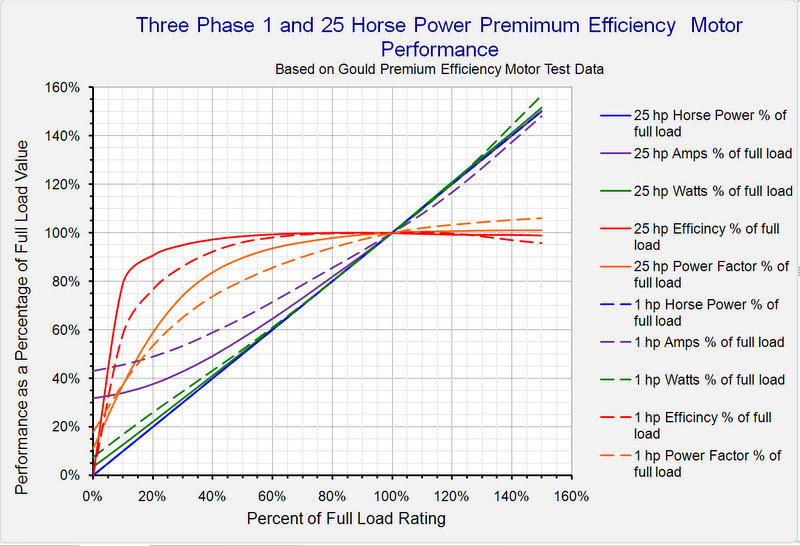
Also you are highly misinformed with electric motors, they are often 80-95% efficient when very lightly loaded and are near 50% efficient at peak power at half the no load speed - these are basic facts even a high school student should know.
Really? I guess you haven't made it to high school yet. I'll just describe the graph for those who won't follow the link. At 10% load the tested 25 horse power premium efficiency motor hits 80% efficiency. At 40% load, it hits 97% efficiency and it never drops below that, all the way out to 160% of its rated load.
and yes 10, 20, 30, 40 years from now we will replace our industrial electrical power production with better sources, but cars last 10 years at best. So right now the wrong thing to do is buy electric if you care about pollution.
My infernal combustion car is 14 years old, thanks. Right now, if you care about pollution, and can afford the gasoline-competitive electric cars (either of them), you can also afford to cover your roof in solar panels from one end to the other. I can't, just yet, but someday I will. At which point I won't care what "industrial power production" is doing.
Then again I don't suppose facts are your thing.
I replied with links. With numbers. You didn't. You should stop typing now.
-
Re:Coal power cars make little sense
Its misleading to specify torque at zero rpm, your power is zero because there is no movement.
What does movement have to do with anything? Do you even know what torque is? Here, let me help you with that. In a nutshell, it's force. There's all kinds of forces in the world that don't result in movement. Lucky for you. You're sitting in a chair, aren't you? Demonstrating an instance of force without movement all by yourself. Amazing, isn't it. Forces get applied before movement starts.
All of the above cars you mention can beat the tesla in some or many of what people would call performance specifications, such as acceleration...
Tesla P85D 0-60 mph 3.2 s
Audi S8 0-60 mph 3.9 s
Yes, the sports cars can beat it. It's a SEDAN. A five door liftback sedan. For crying out loud... And for the record, the curb weight of the Audi is 4685 lbs. The curb weight of the Model S is 4647 lbs. The Model S is lighter than the gasoline car in the same class and price bracket.Efficency isn't hard to see - in the case of pollution its co2/distance. coal power to charge your battery isn't going to be any better for the environment than economy fossil fuel cars. Its not my opinion, a simple google search would show you this if you took off your fanbois goggles.
Really? Truly? Sorry, those links are probably too hard for you. They require you to calculate the efficiencies yourself by dividing. Here, let me help you.
2012 Coal 33.8%
2012 Internal Combustion 32.8%Coal is more efficient. Not a lot, but it is. It's definitely not radically worse, or even slightly worse. So shifting from petroleum to coal for transportation is a gain, made better by the fact below about the efficiency of electric motors in transportation applications.
Also you are highly misinformed with electric motors, they are often 80-95% efficient when very lightly loaded and are near 50% efficient at peak power at half the no load speed - these are basic facts even a high school student should know.
Really? I guess you haven't made it to high school yet. I'll just describe the graph for those who won't follow the link. At 10% load the tested 25 horse power premium efficiency motor hits 80% efficiency. At 40% load, it hits 97% efficiency and it never drops below that, all the way out to 160% of its rated load.
and yes 10, 20, 30, 40 years from now we will replace our industrial electrical power production with better sources, but cars last 10 years at best. So right now the wrong thing to do is buy electric if you care about pollution.
My infernal combustion car is 14 years old, thanks. Right now, if you care about pollution, and can afford the gasoline-competitive electric cars (either of them), you can also afford to cover your roof in solar panels from one end to the other. I can't, just yet, but someday I will. At which point I won't care what "industrial power production" is doing.
Then again I don't suppose facts are your thing.
I replied with links. With numbers. You didn't. You should stop typing now.
-
Re:Helping Castro
That gasoline in your car most likely comes from Saudi Arabia, and we are openly allies with other Gulf Arab states.
I've seen this repeated a bunch of times, but it's simply not true. Canada was far and away the largest source of foreign oil to the United States. In November 2014, the USA imported an average of 3.443 million barrels per day from Canada, and only imported 1.014 million barrels from Saudi Arabia. If you add up all the gulf states, and other less friendly nations, that the total imports to the US total 2.630 Mbpd (I totalled Saudi Arabia, Venezuela, Iraq, Angola, Russia, Kuwait, and Algeria in that). Additionally, the United States extracts 9.020 Million barrels per day of crude.
The long and short of this is that the gasoline in your car most likely came from domestic crude, followed by Canadian crude, or crude from other friendly nations, and not from Saudi Arabia, or other less friendly nations.
Sources:
http://www.eia.gov/petroleum/i...
http://www.eia.gov/dnav/pet/pe... -
Re:Helping Castro
That gasoline in your car most likely comes from Saudi Arabia, and we are openly allies with other Gulf Arab states.
I've seen this repeated a bunch of times, but it's simply not true. Canada was far and away the largest source of foreign oil to the United States. In November 2014, the USA imported an average of 3.443 million barrels per day from Canada, and only imported 1.014 million barrels from Saudi Arabia. If you add up all the gulf states, and other less friendly nations, that the total imports to the US total 2.630 Mbpd (I totalled Saudi Arabia, Venezuela, Iraq, Angola, Russia, Kuwait, and Algeria in that). Additionally, the United States extracts 9.020 Million barrels per day of crude.
The long and short of this is that the gasoline in your car most likely came from domestic crude, followed by Canadian crude, or crude from other friendly nations, and not from Saudi Arabia, or other less friendly nations.
Sources:
http://www.eia.gov/petroleum/i...
http://www.eia.gov/dnav/pet/pe... -
Re:Sweet, sweet karma
http://shrinkthatfootprint.com... So explain to me why electric cars get 25-30mpg in co2 emissions when many economy cars to better for half or one third the cost? The FACT is electric cars are bad for the environment. Further, if you mean http://www.eia.gov/tools/faqs/... Canada, yes I always suspected them of being turrest's. It dosent make sense to buy electric today when 10 years from now things will be marginally different - major power plant installations take decades. cars last less than 10 years on average - replacing those tesla -s batteries is gona be a 20k paycheck before subsidy. Then again you must care more about dogma than actual impartial facts.
-
if by "much higher efficiency" you mean 40% vs 25%
If you think burning fossil fuels in an ICE at 25% efficiency is green, then keep on sending your money to the terrorists.... EVs emit less CO2 than ICE cars even if the electricity comes from dirty coal because there is much higher efficiency at all stages.
if by "much higher efficiency" you mean 40% vs 25%
then yes.
factor in transmission line losses (6%) and charging losses (10-20%)
and it's not so much more efficient.
-
Re:Terrible price
Replying to OP to clarify the figures for all the replies who clearly don't know how these things are measured.
130 MW is the nameplate capacity, aka peak generating capacity. i.e. If the sun were directly overhead on a cloudless day and the panels had just been cleaned, how much power would they generate?
Actual production over a year is the nameplate capacity times capacity factor times one year. PV solar's capacity factor for the continental U.S. averages about 0.145. It peaks in the desert southwest at about 0.185. Places like Germany and France are closer to 0.10. Capacity factor takes into account night, movement of the sun across the sky, clouds and weather, dirt building up on the panels, downtime for maintenance, etc. Everything that on average diminishes production below the peak.
Using the 0.185 figure, the annual production of this array is (130MW) * (0.185) * (8766 hours) = 210822 MWh. At California's average retail electricity price of $0.1353 / kWh, this works out to $28.5 million dollars of electricity generated per year. Break-even period for the $850 construction cost (excluding financing) is then 29.8 years. Financing (either taking out a loan to pay for the panels up-front, or the opportunity cost of investing cash on hand into something with a payback time in decades) is a factor which should be taken into account, but whose exact impact depends on interest and inflation rates over those 30 years.
$ per watt is a shortcut used to quickly gauge installation costs. It's just the $ cost for installation divided by the nameplate capacity in Watts. OP correctly calculated this as $6.54. The $1-$2 per Watt figure commonly quoted by PV salesman for economy panels is just the cost of the panels. You also need framework to mount the panels on, as well as regulation electronics to even out the voltage, and disconnect the array from the grid during a power failure so you don't electrocute the utility worker who's trying to fix a downed power line. That typically increases the cost to the $3-$7 per Watt range. My guess is the $ per Watt is so high because Apple is opting for higher efficiency panels, which are more expensive. (That doesn't change any of the above math though, since it's based on nameplate capacity which already accounts for panel efficiency.) -
Wrong wrong wrong
bit of financial relief but what really happens is consumption sky-rockets.
http://www.eia.gov/forecasts/i...
you may want to check your facts. oil consumption does not "sky rocket" if price falls. It's not an elastic commodity - it doesn't respond to prices very much at all.
-
Re:reduce production
Is his complete failure to reduce production the reason you (likely) hate him? Since Obama took office, oil production has increased 50%:
http://www.eia.gov/dnav/pet/hi...
The reason it's probably going to drop precipitously in the next few months/year is due to the whims of OPEC, not the administration. Do heartland states really want to tie your economies so tightly to how Arabs are feeling?
-
Re:Electricity not going to curb in general sense
average home averages 1KW load --> 24kwh/day. Nissan Leaf (and similar smallish EVs) has a 24kwh battery.
You're missing that the battery isn't going to be empty on average. If the battery is at 50% charge, that's only 12kwh needing to be charged, or another 500 watts of average load. 50% more.
Keep in mind that I said 'median everything' for a reason.
Redoing some work:
12k miles/year per car
11k kWh/year per household
1.9 vehicles per household(2.58 people)
6,840 kwh, about a 62% increase.Thanks, I need to update my figures - electricity use has dropped per household(and/or I hit on a study that was looking at higher usage areas more). If you use the alternate 15k average miles per vehicle, that would be 8.5k extra kwh per household per year, or 78%.
-
Re:even better
My take on this is if they put up wind or solar arrays, it would work better than trying to charge people's cars live off it.
Have you ever calculated how big a solar array it would take to charge a Tesla battery?
Solar constant on the ground at U.S. latitudes is about 750 Watts/m^2.
High-efficiency panels are about 22% efficient. Commercially, 18% is more realistic, but let's go with 22%.
Solar capacity factor for the desert Southwest U.S. is about 0.18. Multiply by 2 to account for night.
The big Tesla S battery has a 85 kWh.
750 Watts/m^2 * 22% efficiency = 165 W/m^2
times 0.36 capacity factor (average for the day) = 59.4 W/m^2 average generation during the 12 hours of daylight
Assume 90% charging efficiency. Real-life measurements put it at about 85%, but solar would charge it a lot slower so let's be generous and say 90%. At 90% charging efficiency, you need 94.4 kWh to fill the 85 kWh battery.
To charge the battery in 12 hours would thus take:
94,400 Wh / (12 hours * 59.4 W/m^2) = 132.5 m^2 of solar panels
A car parking space is about 9' x 18', or about 15 square meters. So you'd need roughly 9 car parking spaces worth of solar panels to charge one big Tesla S battery per day in the desert Southwest U.S.
Costs of implementing a PV Solar generation system are about $3.30/Watt in the U.S. on a utility-level scale. Technically this is commercial scale, but let's go with best case. 1 m^2 of these panels would be rated at 165 Watts peak capacity. At a price of $3.30/Watt, this would be $544.50/m^2 * 132.5 m^2 = $72,146.25 worth of PV to be able to charge 1 Tesla battery per day.
The amount of electricity used by a busy Tesla battery charging station would put it into the industrial category. The average U.S. electricity price for industrial customers was $0.07/kWh for 2014. At $0.07/kWh, the panels would essentially be charging the battery with $6.61 worth of electricity per day. It would take 10,913 days, or 29.9 years for the PV system to pay for themselves.
I won't go through the math in detail, but if you use more realistic figures of 18% efficient panels, 0.145 capacity factor (average for the U.S. overall), 85% charging efficiency, and the $4.50/Watt cost of commercial PV installations, the numbers end up 213 m^2 (14.2 parking spaces) of panels to charge one battery per day, and 61.9 years before the panels pay for themselves.
The costs are coming down, and we will eventually get to the point where it's cost-effective. But please do a reality check on the notion that you'll be able to prop up a few square meters of solar panels and charge your car for free. -
Re:Not a cargo ship
You're numbers aren't even close:
3.6 million tonnes a year, projected.
http://www.bbc.com/news/scienc...1 million metric tons LNG = 52 trillion Btus
http://www.extension.iastate.e...3.6 * 52 trillion
that's about 175 trillion BTUs.Current price ~10 dollars per million BTU.
http://www.eia.gov/dnav/ng/his...1.75 Billion a year, BEFORE cost of operation.
Once again, when not using made up numbers, Green energies are the same.
-
Re:Reduced revenues != lost profit
Not flat and not growing as fast as before. Most estimates show 1-2% growth per year http://www.eia.gov/forecasts/a..., depending on whose estimates you use and the future oil prices. The sad part is that the loss of US manufacturing to China is partly responsible. Demand in some regions and states like California continues to climb much faster than the US average, driving the higher rates in those areas.
I suspect you'll see co-ops and companies investing in and maintaining local solar farms once the pricing comes down enough. Much the same way you see wind farms popping up everywhere.
-
Re:soo....
Hydropower. Lots of it. The same reason Alcoa has aluminum plants in WA. Electricity is cheap here, cheapest in the nation apparently: http://www.eia.gov/state/?sid=...
-
Re: the best use
Price per MWh is not dishonest, those are the only units that matter in the field of energy production. Even if wind/solar were at parity with nuclear they would be receiving more per MWh. In 2013, nuclear produced 19% of US power, while solar and wind produced a combined 4.36% source. Let's assume that solar and wind are also producing 19% of US power, or 4.36 times their current level (interestingly enough 4.36 is almost exactly the square root of 19). divide the $24/MWh by 4.36 and you get $5.5/MWh, still several times that of nuclear.
The cost of waste is not infinite, they do eventually degrade, and it's irrelevant anyway because the cost of waste storage is 100% paid for by the nuclear plants, not government subsidies. If you would use actual data then we could have an argument, but it seems you're content to just ignore everything I say just because it doesn't fit within your worldview.
-
Re: Why
CO2 is a pollutant and is the primary driver of climate change.
It is NOT a pollutant, much like how water isn't - normally. It's only a concern when levels get too high, much like with water- too much in one spot is bad. As they say, the poison is in the dose. Pollutants are those things that you ideally want to reduce to zero.
Not sure where you got the idea that reducing pollution from cars increases CO2.
Not sure why you think it doesn't. Still, quick rundown: The CO2 emissions from a vehicle are pretty much entirely from the fuel it burns. 1 gallon of gasoline = 19.64 pounds of CO2. 22.38 if it's diesel. Assuming a well running car, all of the fuel will be burned. Pollution from the exhaust of an automobile consists of items like SO2, CO, NOx, and particulates. You get rid of the first by having low sulfur fuel. The second by running a lean mixture - plenty of oxygen to burn all the carbon. NOx compounds are tricky in that you get MORE of them by running a lean hot mixture. But that's where the catalytic converter comes in - it uses catalysts to re-react NOx back to O2 and N2, as well as finish burning any remaining CO. Particulates depends on complete burning of the fuel.
All this means that car manufactures aren't just trying to maximize fuel economy - they're tuning the engine to pass emissions, which isn't the most fuel economic.
The situation is most apparent with diesel - the regeneration of the soot trap 'require the engine to consume several gallons' and 'This has been shown to adversely affect the overall fuel economy of vehicles equipped with DPF systems'.
-
Re:Deliberate
"Most of it's green. Like most northern areas if you take pictures at the right time you can get very dead looking terrain."
The problem isn't the green, the problem is the growing mass of dead tissue that is decomposing at an incredibly slow rate due to the lack of (or greatly reduced population of) bacteria, fungus, and molds that aid in the decomposing process.
http://www.smithsonianmag.com/...
As stated previously, a single incident like Chernobyl can be isolated and mitigated. A 'Chernobyl event every year' on the other hand, can lead to a cascading effect where microbial life is so effected that the standard processes our ecologies depend on shift dramatically.
"I suggest you check your research. They've been testing/developing pebble bed reactors, but they've run into issues such that they're not replacements for rod type reactors yet."
Fair point, I was under the mistaken impression that France have taken a pair of pebble bed reactors live many years ago. That's what I get for trusting my recollection of a 30 year old news story
"My point has always been not that nuclear is harmless, but that it's less harmful than the alternatives while still remaining affordable(minus political stuff)."
Nuclear without incident is less harmful. A single incident is still less harmful. But a sustained practice that leads to a significant incident each year can have a much larger impact by means of cascading ecological change.
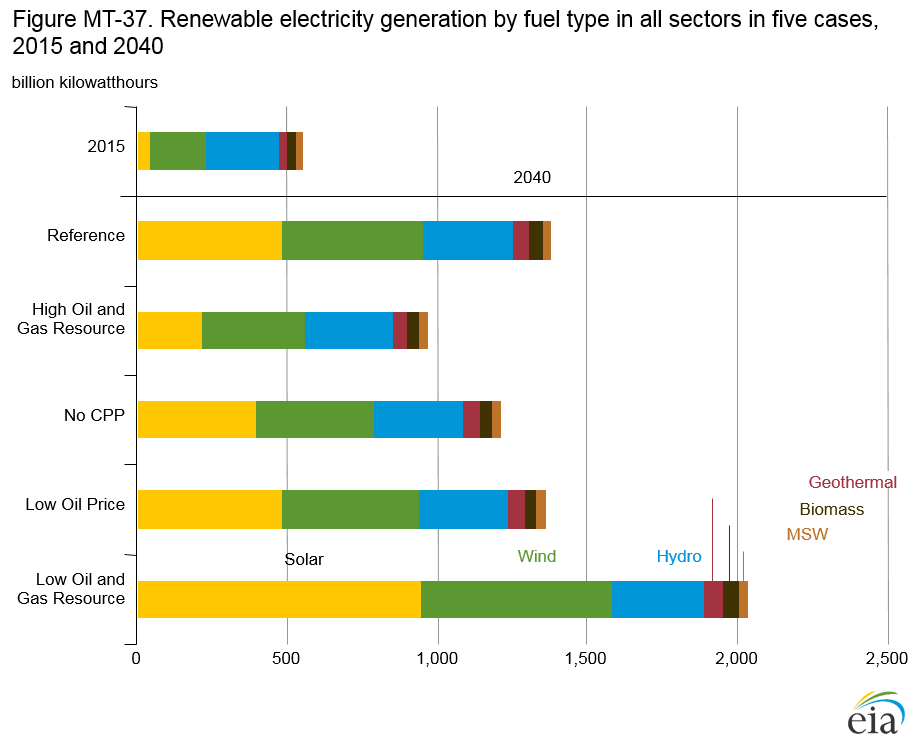
And when you get back to the root issue, $/kW, we wind up in an interesting position. http://www.eia.gov/forecasts/a... has a nice breakdown of what we can look forward to. And the question then is, if Nuclear is no cheaper than wind/hydro, and comes with dramatically more risk, why aren't we investing in more wind/hydro solutions instead?
-Rick
-
Re:Deliberate
Renewable biomass will expand (the largest portion of current non-Hydro renewables).
Geothermal will expand.
Wind will expand.
Solar will expand.Geothermal is smaller than wind.
Actually no. My plan isn't calling for 1/4 of what yours is. Mine is looking at roughly a 3-4-fold increase across the board. What you're looking at is closer to a 500-fold increase for solar and 100-fold increase for wind.
Your target: 25%. Subtract the 7% hydro, because we both agree it's maxed: 18% remaining.
Per the EIA, in 2013 wind actually led behind hydro at 4.13%, not 2.08, and solar was at
Biomass: 1.48
Geothermal:
Solar:
Wind: 4.13%
Actually adds up to 6%. To reach 18% we'd need to build 3x as much of 'all of the above'.
To reach my goal(60%), we'd need 10X as much. 10X/3=3.33. I should have said 1/3rd, not 1/4, sorry.
To reach my goal you 'only' need a 5 fold uptick on wind, not 100x, solar would be 100x, not 500x. I'm curious as to how you worked your math, because 100*2.08%= 208% of current generation, which means we'd be more than doubling our generation capability in wind alone.Given that solar has had a relatively late start over wind, the fact is that it only needs another 4% of total generation over wind. That's a better way to look at it than goal percentage/current percentage = difficulty.
Biomass and geothermal would need around a 6X increase(they only need to hit ~12%). Of course, to outright state it again: There's a reason I said rough percentages. I'm not going to cry if the mix ends up being 50% nuclear, 15% wind, 10% solar, 25% 'other'. I also didn't state any real timeline, though 'sooner is better' should be implied.
source -
Re:Gas not less CO2 on refiring coal plants
If you just replace coal with natural gas in the same plant to heat the water it is not significantly less CO2
Burning coal is pretty much just turning bulk carbon into carbon dioxide. Burning natural gas (methane, CH4) creates carbon dioxide, too, of course, but also releases energy from burning the hydrogen to make water. As a result, the combustion of natural gas produces less CO2 for the same energy output. From the Energy Information Agency - Pounds of CO2 emitted per million BTU of energy: Coal (anthracite): 228.6 Gasoline: 157.2 Natural Gas: 117.0 [I'll apologize for the units - I'm just quoting the result. If you must know, 1 lb / 1e6 BTU is equivalent to 0.43e-3 kg/MJ. Or, just look at the number as a figure of merit: lower is better.] more data here
It is even more effective than that- these numbers don't take plant efficiency into consideration. The "per million BTU of energy" is just the amount of heat produced, not the amount of electricity. A very efficient traditional coal plant is about 35-40% efficient in turning the heat into electrical power. A typical combined cycle gas power plant is about 57-60% efficient due to the nature of the different cycle. So, on a per-MW produced basis, Natural gas looks a lot better.
It also doesn't hurt that natural gas is at all-time low prices in the US thanks to our gas boom and the high cost of transporting natural gas across oceans. Gas is cheaper than coal now in many places. The only coal plants which are going to survive are the more efficient plants with short coal supply lines. It has little to do with environmental concerns, it is strictly an economic calculation in many cases. The environmentalists didn't defeat coal, the accountants did. -
Re:Gas not less CO2 on refiring coal plants
If you just replace coal with natural gas in the same plant to heat the water it is not significantly less CO2
Burning coal is pretty much just turning bulk carbon into carbon dioxide. Burning natural gas (methane, CH4) creates carbon dioxide, too, of course, but also releases energy from burning the hydrogen to make water. As a result, the combustion of natural gas produces less CO2 for the same energy output. From the Energy Information Agency - Pounds of CO2 emitted per million BTU of energy: Coal (anthracite): 228.6 Gasoline: 157.2 Natural Gas: 117.0 [I'll apologize for the units - I'm just quoting the result. If you must know, 1 lb / 1e6 BTU is equivalent to 0.43e-3 kg/MJ. Or, just look at the number as a figure of merit: lower is better.] more data here
It is even more effective than that- these numbers don't take plant efficiency into consideration. The "per million BTU of energy" is just the amount of heat produced, not the amount of electricity. A very efficient traditional coal plant is about 35-40% efficient in turning the heat into electrical power. A typical combined cycle gas power plant is about 57-60% efficient due to the nature of the different cycle. So, on a per-MW produced basis, Natural gas looks a lot better.
It also doesn't hurt that natural gas is at all-time low prices in the US thanks to our gas boom and the high cost of transporting natural gas across oceans. Gas is cheaper than coal now in many places. The only coal plants which are going to survive are the more efficient plants with short coal supply lines. It has little to do with environmental concerns, it is strictly an economic calculation in many cases. The environmentalists didn't defeat coal, the accountants did. -
Re:Gas not less CO2 on refiring coal plants
If you just replace coal with natural gas in the same plant to heat the water it is not significantly less CO2
Burning coal is pretty much just turning bulk carbon into carbon dioxide. Burning natural gas (methane, CH4) creates carbon dioxide, too, of course, but also releases energy from burning the hydrogen to make water. As a result, the combustion of natural gas produces less CO2 for the same energy output.
From the Energy Information Agency - Pounds of CO2 emitted per million BTU of energy:
Coal (anthracite): 228.6
Gasoline: 157.2
Natural Gas: 117.0
[I'll apologize for the units - I'm just quoting the result. If you must know, 1 lb / 1e6 BTU is equivalent to 0.43e-3 kg/MJ. Or, just look at the number as a figure of merit: lower is better.]
more data here -
Re:Gas not less CO2 on refiring coal plants
If you just replace coal with natural gas in the same plant to heat the water it is not significantly less CO2
Burning coal is pretty much just turning bulk carbon into carbon dioxide. Burning natural gas (methane, CH4) creates carbon dioxide, too, of course, but also releases energy from burning the hydrogen to make water. As a result, the combustion of natural gas produces less CO2 for the same energy output.
From the Energy Information Agency - Pounds of CO2 emitted per million BTU of energy:
Coal (anthracite): 228.6
Gasoline: 157.2
Natural Gas: 117.0
[I'll apologize for the units - I'm just quoting the result. If you must know, 1 lb / 1e6 BTU is equivalent to 0.43e-3 kg/MJ. Or, just look at the number as a figure of merit: lower is better.]
more data here -
Re:don't tax alternative energy and transportation
You are so very wrong.
Solar IS cost competitive. And with in a very short period, if current manufacturing price drops continue, it will be the cheapest source of power. But sure, ignore the real numbers the real reality of the situation if you wish. These numbers have been the talk of wall street for more than 2 years. Solar companies are turning down investment right now because there is too much being offered. But feel free to continue to display your ignorance. Even a fool could verify the real numbers with Google.
Ok, first, you're a moron.
Yes, if you read some nonsense put out by a "Green energy" group... it's easy to get confused... if you're a moron.Coal has an average btu of 20,000,000
http://www.eia.gov/tools/faqs/...It takes 10,107 BTU of coal for a power plant to produce 1 kilowatt of power.
http://www.eia.gov/electricity...Basic math is 20 million / 10,107 = 1979 killwats per short ton of coal
The price of coal per short ton: $56.30
http://www.eia.gov/coal/news_m...$56.30 / 1979 = Coal costs 3 cents per kilowatt
If you exclude taxes, regulation and infrastructure.
Now you're going to say "Solar's free!"
No it's not. You need a solar panel. Just like coal needs a mine and equipment.
The average price of a solar panel system for your home is $10,000... I'm even including federal subsidies. The real price is almost double.
http://www.wholesalesolar.com/...
and it lasts about 20yrs.The average us household uses 11,000 kilowatts per year
http://www.eia.gov/tools/faqs/...
So in 1yr, that's $313 worth of coal.
Over 20yrs, they'll use $6000 worth of coal.That's production of the energy source, compared.
Solar is almost twice the cost.
The rest of the money you pay for coal power is going to the government, who will still want their money after coal is gone.
We're still need the electrical grid. I doubt the panels will be on your home, they will likely be somewhere else, and there will be batteries. -
Re:don't tax alternative energy and transportation
You are so very wrong.
Solar IS cost competitive. And with in a very short period, if current manufacturing price drops continue, it will be the cheapest source of power. But sure, ignore the real numbers the real reality of the situation if you wish. These numbers have been the talk of wall street for more than 2 years. Solar companies are turning down investment right now because there is too much being offered. But feel free to continue to display your ignorance. Even a fool could verify the real numbers with Google.
Ok, first, you're a moron.
Yes, if you read some nonsense put out by a "Green energy" group... it's easy to get confused... if you're a moron.Coal has an average btu of 20,000,000
http://www.eia.gov/tools/faqs/...It takes 10,107 BTU of coal for a power plant to produce 1 kilowatt of power.
http://www.eia.gov/electricity...Basic math is 20 million / 10,107 = 1979 killwats per short ton of coal
The price of coal per short ton: $56.30
http://www.eia.gov/coal/news_m...$56.30 / 1979 = Coal costs 3 cents per kilowatt
If you exclude taxes, regulation and infrastructure.
Now you're going to say "Solar's free!"
No it's not. You need a solar panel. Just like coal needs a mine and equipment.
The average price of a solar panel system for your home is $10,000... I'm even including federal subsidies. The real price is almost double.
http://www.wholesalesolar.com/...
and it lasts about 20yrs.The average us household uses 11,000 kilowatts per year
http://www.eia.gov/tools/faqs/...
So in 1yr, that's $313 worth of coal.
Over 20yrs, they'll use $6000 worth of coal.That's production of the energy source, compared.
Solar is almost twice the cost.
The rest of the money you pay for coal power is going to the government, who will still want their money after coal is gone.
We're still need the electrical grid. I doubt the panels will be on your home, they will likely be somewhere else, and there will be batteries. -
Re:don't tax alternative energy and transportation
You are so very wrong.
Solar IS cost competitive. And with in a very short period, if current manufacturing price drops continue, it will be the cheapest source of power. But sure, ignore the real numbers the real reality of the situation if you wish. These numbers have been the talk of wall street for more than 2 years. Solar companies are turning down investment right now because there is too much being offered. But feel free to continue to display your ignorance. Even a fool could verify the real numbers with Google.
Ok, first, you're a moron.
Yes, if you read some nonsense put out by a "Green energy" group... it's easy to get confused... if you're a moron.Coal has an average btu of 20,000,000
http://www.eia.gov/tools/faqs/...It takes 10,107 BTU of coal for a power plant to produce 1 kilowatt of power.
http://www.eia.gov/electricity...Basic math is 20 million / 10,107 = 1979 killwats per short ton of coal
The price of coal per short ton: $56.30
http://www.eia.gov/coal/news_m...$56.30 / 1979 = Coal costs 3 cents per kilowatt
If you exclude taxes, regulation and infrastructure.
Now you're going to say "Solar's free!"
No it's not. You need a solar panel. Just like coal needs a mine and equipment.
The average price of a solar panel system for your home is $10,000... I'm even including federal subsidies. The real price is almost double.
http://www.wholesalesolar.com/...
and it lasts about 20yrs.The average us household uses 11,000 kilowatts per year
http://www.eia.gov/tools/faqs/...
So in 1yr, that's $313 worth of coal.
Over 20yrs, they'll use $6000 worth of coal.That's production of the energy source, compared.
Solar is almost twice the cost.
The rest of the money you pay for coal power is going to the government, who will still want their money after coal is gone.
We're still need the electrical grid. I doubt the panels will be on your home, they will likely be somewhere else, and there will be batteries. -
Re:don't tax alternative energy and transportation
You are so very wrong.
Solar IS cost competitive. And with in a very short period, if current manufacturing price drops continue, it will be the cheapest source of power. But sure, ignore the real numbers the real reality of the situation if you wish. These numbers have been the talk of wall street for more than 2 years. Solar companies are turning down investment right now because there is too much being offered. But feel free to continue to display your ignorance. Even a fool could verify the real numbers with Google.
Ok, first, you're a moron.
Yes, if you read some nonsense put out by a "Green energy" group... it's easy to get confused... if you're a moron.Coal has an average btu of 20,000,000
http://www.eia.gov/tools/faqs/...It takes 10,107 BTU of coal for a power plant to produce 1 kilowatt of power.
http://www.eia.gov/electricity...Basic math is 20 million / 10,107 = 1979 killwats per short ton of coal
The price of coal per short ton: $56.30
http://www.eia.gov/coal/news_m...$56.30 / 1979 = Coal costs 3 cents per kilowatt
If you exclude taxes, regulation and infrastructure.
Now you're going to say "Solar's free!"
No it's not. You need a solar panel. Just like coal needs a mine and equipment.
The average price of a solar panel system for your home is $10,000... I'm even including federal subsidies. The real price is almost double.
http://www.wholesalesolar.com/...
and it lasts about 20yrs.The average us household uses 11,000 kilowatts per year
http://www.eia.gov/tools/faqs/...
So in 1yr, that's $313 worth of coal.
Over 20yrs, they'll use $6000 worth of coal.That's production of the energy source, compared.
Solar is almost twice the cost.
The rest of the money you pay for coal power is going to the government, who will still want their money after coal is gone.
We're still need the electrical grid. I doubt the panels will be on your home, they will likely be somewhere else, and there will be batteries. -
Net Metering won't be part of the future
At the very least, rooftop solar producers will wind only being credited at the rate the utilities buy power wholesale. If you take a look http://www.eia.gov/electricity... that's considerably less than the retail cost.