Slashdot Mirror
Domain: epa.gov
Stories and comments across the archive that link to epa.gov.
Comments · 1,291
-
Re:Avoid CFL mistakes
among other problems
When one of the CFL's broke in my kids room, I followed the EPA rules to clean it up. What a pain.
So I bought a bunch of no-name LED bulbs on Amazon and although the lighting is a little harsh (as many others have noted), it's a good light to read by (1000+ luments/75 W equivalent) and a lampshade helps (a lot).
Now I am just waiting for someone to sell a reasonably powerful G16.5 base led (like 300+ lumens/25-40 W equivalent) so that I can replace the remaining incandescents left in the house (except for the oven light!). -
Re:FUD summary as usual
snopes had a very old thread on this, without much discussion and very little to no investigation
The one thing about it that really makes me suspicious though: "It's no coincidence that between 1938 and 1960, the level of polonium 210 in American tobacco tripled"
I can't find a single reference to any investigation of polonium in tobacco before the 1960s, in fact, according to wikipedia's Polonium article, it was discovered to be in tobacco leaves in the early 60s.
amusingly, the article you link lists yet another article as its source for that, which goes on to claim it has been tracked since 1950, but trippled since 1938.
Not saying the theory is bunk of course, in fact, the EPA has weighed in, without sourcing dubious online doctors: http://www.epa.gov/radiation/sources/tobacco.html
-
Re:History rhymes
You are, the river is everyone's to use, now the US gov just made a rule saying that no one can have a drain from their backyard in the river because company X is using it to get rid of dioxins..
That's a good example of the kind of distinction I was making. I don't know if the situation you described is actual or hypothetical, but either way — as long as the individual property owner's discharge meets the same stormwater and/or effluent guidelines that the EPA applies to industry/municipalities, I don't see any legitimate reason for prohibition that supersedes the individual's right to use the river.
-
Re:History rhymes
You are, the river is everyone's to use, now the US gov just made a rule saying that no one can have a drain from their backyard in the river because company X is using it to get rid of dioxins..
That's a good example of the kind of distinction I was making. I don't know if the situation you described is actual or hypothetical, but either way — as long as the individual property owner's discharge meets the same stormwater and/or effluent guidelines that the EPA applies to industry/municipalities, I don't see any legitimate reason for prohibition that supersedes the individual's right to use the river.
-
Re:Ask Michael Oppenheimer.
If global warming is real why not reduce and tax nitrogen oxide that has 310 times the effect on global warming compared to co2 according to the EPA? The impact of 1 pound of N2O on warming the atmosphere is over 300 times that of 1 pound of carbon dioxide and accounts for 4% of greenhouse gasses emmited in the US anually. My source is http://epa.gov/climatechange/ghgemissions/gases/n2o.html. I'm sure you can do the math.
-
Re:So much hatred
Why so much Apple hate here?
Their actions, past and present.
Yes, they make the most of a capitalist system.
Well, you got it in one. So why are you asking?
I couldn't care less if Apple went bankrupt tomorrow.
So why are you commenting? I call bullshit.
I'm just asking, WHY SO MUCH HATRED?
Yes, and we saw that at the beginning of your comment.
This company actually invests in renewable energy - how many other fortune 200 companies are doing this?
Fortune 200? Hahahaha. HahaHAHAhHAHAHA. Anyway, here's a serious answer to your question. The HAHA is because Fortune 500 is completely arbitrary, and Fortune 200 is an arbitrary partitioning of that. Nice try, though.
It seems like this is just more of the same old attitude - "It's a money making entity! Kill it!"
Uh no. It's evil, kill it. Apple not only sees themselves as guardians of morality but they also see your devices as their devices and see it as their right to stifle dissent transmitted through them. They are in general deceptive scum of an even higher order than Microsoft, simply far less successful. My favorite example remains the B&W G3 Rev.1 UDMA data corruption failure, which Apple wanted you to spend money to solve — quite a bit, in fact, due to the Apple Tax. But holding iPhones wrong is fairly precious, as was Apple's initial reaction to reports of cracking cubes — they at first denied that it was even possible. The arrogance of selling 68k macs for a jillion dollars to pay for the R&D on the Powermacs, which ended up being a costly dead-end for many of their users. The hypocrisy of actions like this one. Closing functioning assembly plants in the US only to reopen others later, with a real cost to workers. None of this really causes it to differ from other Fortune 500 companies, but Apple is first and foremost about style and image. Complaining that people have personal reactions to a company which sells products on a personal basis is beyond irrational.
-
Re:Fracking is good technoglogy
For all the spills and air pollution how often do you hear about fines?
Frequently. Here's a map. Those dots you see are aggregate. Zoom in and they bloom into many, many enforcement actions, which are nearly always fines. The rest of your post is nonsense based on your false premise.
You don't hear about this stuff because you isolate yourself from sources that cover EPA abuse.
-
Re:Fracking is good technoglogy
FWIW, Congress told the EPA to study this. Their first progress report was issued December 2012.
I've only skimmed the report, so I can't be sure, but it looks like the report is long on methodology but short on actual results.
-
Re:Coal radiation is a talking point, not a risk
Hmm... When I bother to post a source and actual statistics, you might want to reference those, or at least dig up references of your own.
Still:
1. Fly ash accidents still happen, and it's NOT nice stuff, bearing substantial amounts of contamination from various heavy metals. Contaminants include "arsenic, beryllium, boron, cadmium, chromium, hexavalent chromium, cobalt, lead, manganese, mercury, molybdenum, selenium, strontium, thallium, and vanadium, along with dioxins and PAH compounds."
2. Existing pollution measures not directly targeted at mercury only caught about a third of it.
3. I wasn't talking just about mercury. Heck, not even just heavy metals, NOx, SOx, and such. You addressed a tiny proportion of pollution, when I specified pollution, accidents, and 'other'. All mining is dangerous, and coal mining is on such a scale that you can expect deaths from it each year even in the USA, while in China, THOUSANDS of coal miners die each year in accidents, just as tens or even hundreds of thousands a year die from the pollution coming out of their largely unregulated smokestacks. -
The rate of change is problematic
Global temps are being helped along by anthropogenic emissions. The *rate* at which temps have gone up over the past 100 years is unprecedented in any climate record and that is what's most alarming. It's never climbed this fast in this short amount of time. This is the part most "research" reports leave out but is a key fact in the debate.
http://www.epa.gov/climatechange/science/indicators/weather-climate/temperature.html
-
That stopped being true 50 years ago
I absolutely understand your point about their attitudes back then. Nonetheless, the war ended some time back, and since then nobody wants to take responsibility for cleaning up the mess. They detected significant uranium, tritium and strontium-90 in the local water 25 years ago, and still nobody's been prepared to clean up the hundreds of square miles of disposal locations.
For all the advantages of nuclear power, *this* is the problem that environmental groups have with it. We know we can make power plants pretty safe, and we can even store the waste pretty safely - if we want to go to the trouble, and if we want to keep checking on the plants, fixing storage leaks, maintaining enough funding etc etc, regardless of what party is in power or how well the economy is doing, for many many decades and even centuries. This is long term stuff.
It's simply human nature to not want to keep dealing with an ongoing problem (applies to any toxic facility). A few decades go by, there's no obvious problems, and vigilance (and funding) wane. We've seen this over and over, when facilities get old enough. And when the inevitable problems do show up, the safety procedures are no longer what they once were. Will they still be enough, or will the locals get hit with a dangerous release? Will that be slightly above background, or will it reach disaster levels? That is where the real risks are, and our track record is not encouraging.
-
That stopped being true 50 years ago
I absolutely understand your point about their attitudes back then. Nonetheless, the war ended some time back, and since then nobody wants to take responsibility for cleaning up the mess. They detected significant uranium, tritium and strontium-90 in the local water 25 years ago, and still nobody's been prepared to clean up the hundreds of square miles of disposal locations.
For all the advantages of nuclear power, *this* is the problem that environmental groups have with it. We know we can make power plants pretty safe, and we can even store the waste pretty safely - if we want to go to the trouble, and if we want to keep checking on the plants, fixing storage leaks, maintaining enough funding etc etc, regardless of what party is in power or how well the economy is doing, for many many decades and even centuries. This is long term stuff.
It's simply human nature to not want to keep dealing with an ongoing problem (applies to any toxic facility). A few decades go by, there's no obvious problems, and vigilance (and funding) wane. We've seen this over and over, when facilities get old enough. And when the inevitable problems do show up, the safety procedures are no longer what they once were. Will they still be enough, or will the locals get hit with a dangerous release? Will that be slightly above background, or will it reach disaster levels? That is where the real risks are, and our track record is not encouraging.
-
That stopped being true 50 years ago
I absolutely understand your point about their attitudes back then. Nonetheless, the war ended some time back, and since then nobody wants to take responsibility for cleaning up the mess. They detected significant uranium, tritium and strontium-90 in the local water 25 years ago, and still nobody's been prepared to clean up the hundreds of square miles of disposal locations.
For all the advantages of nuclear power, *this* is the problem that environmental groups have with it. We know we can make power plants pretty safe, and we can even store the waste pretty safely - if we want to go to the trouble, and if we want to keep checking on the plants, fixing storage leaks, maintaining enough funding etc etc, regardless of what party is in power or how well the economy is doing, for many many decades and even centuries. This is long term stuff.
It's simply human nature to not want to keep dealing with an ongoing problem (applies to any toxic facility). A few decades go by, there's no obvious problems, and vigilance (and funding) wane. We've seen this over and over, when facilities get old enough. And when the inevitable problems do show up, the safety procedures are no longer what they once were. Will they still be enough, or will the locals get hit with a dangerous release? Will that be slightly above background, or will it reach disaster levels? That is where the real risks are, and our track record is not encouraging.
-
That stopped being true 50 years ago
I absolutely understand your point about their attitudes back then. Nonetheless, the war ended some time back, and since then nobody wants to take responsibility for cleaning up the mess. They detected significant uranium, tritium and strontium-90 in the local water 25 years ago, and still nobody's been prepared to clean up the hundreds of square miles of disposal locations.
For all the advantages of nuclear power, *this* is the problem that environmental groups have with it. We know we can make power plants pretty safe, and we can even store the waste pretty safely - if we want to go to the trouble, and if we want to keep checking on the plants, fixing storage leaks, maintaining enough funding etc etc, regardless of what party is in power or how well the economy is doing, for many many decades and even centuries. This is long term stuff.
It's simply human nature to not want to keep dealing with an ongoing problem (applies to any toxic facility). A few decades go by, there's no obvious problems, and vigilance (and funding) wane. We've seen this over and over, when facilities get old enough. And when the inevitable problems do show up, the safety procedures are no longer what they once were. Will they still be enough, or will the locals get hit with a dangerous release? Will that be slightly above background, or will it reach disaster levels? That is where the real risks are, and our track record is not encouraging.
-
Just one of many
Silicon Valley. Not sure if this is the same as the Mountain View site, where problems with the soil and groundwater are ongoing.
See also, Willits, in Mendocino County where toxins were dumped in a stream that flows to the watershed to the north. There's a cancer cluster there too; with the company trying to blame it on residents tendency to smoke, drink, do drugs, etc.
California in general has a lots of sites due to mining activities extending from gold rush times well into the late 20th century.
Yeah, you'd think the Chinese would have learned from looking at what happened to us. So much for the idea that only Americans are short-sighted and/or ignorant.
-
Re:Nope
I have not read his previous articles, but I have read about them. I tend to share his point of view, not from a car perspective, but from an environment perspective. Electrical cars are a nonsensical solution to a problem that doesn't exist. Let me elaborate a little before you take my head off.
I am not a climate scientist, but it does seem that he prevailing idea is that we are in a warming period. It is also claimed that it is anthropogenic. Again, it does appear to me that the data supports this to a greater or lesser extent. I therefore have no reason to doubt it. I do know a little bit about statistics though, and I have been looking at data that explain the sources of this anthropogenic warming. All the sources I have looked at say the same thing. Private cars are a statistical a rather small contributor to the release of the gases that are at the cause of this AGW. All transportation in the world accounts for (according to the epa) about 27%, and cars are about 43% of that. So, private driving accounts for perhaps 10% of GHG - this is the highest estimate I have seen though, other estimates are closer to 5-7%, but even with the high estimate, it's a nonsensical discussion when talking about cars and AGW. Make cars more efficient by 50%, and you have accomplished very little, and even moving them all to electricity would probably not cut the emissions by 50% - see below). Also, the process of making cars more efficient (making new and better cars in staggering numbers) is a significant source of GHG.
Electricity production is 34% of GHG emissions (I have seen estimates far higher), a number that would go up significantly if the US moved from gasoline to electrical over night. These emitters are (comparatively) few, and fixing their emissions would have a significantly better end result. Cut coal and oil power plant GHG emissions by 50%, which is a lot easier than doing it for cars, would mean a real-world drop of 17 percentage points in GHG emissions. That's a lot!
Now, if this was all, the manic drive for electrical cars would be bad enough, but this isn't enough. From what I have been able to see, electrical cars are, compared to gasoline guzzlers, "gross polluters" (in an AGW sense, though CO2 is not and never was a pollution). I know a little bit about electricity production, and an issue is that the amount of energy that leaves its production site is quite a bit higher than the energy that actually comes out of the wall on the consumer end. There are many, many inefficiencies in the system, so there is a significant amount of loss. Not only that, but the industry that produces said electricity is among (actually the according to the epa) biggest man-made contributor to this AGW. So, when you move cars away from gasoline you move them onto coal and heavy oil burning. Industries that emit enormous amounts of CO2 and the like. So, again, electrical cars appear to be not only an inefficient problem solver, it seems they are significant contributors to the problem. More so than gasoline operated cars.
It appears to me that people who talk about solutions involving private cars when they talk about solving the AGW problem are retarded and ignorant. It also seems to me like a significant portion of them are cowards. Putting hard caps on emissions from electricity production would be easy technically, but it would hit everybody with higher prices on electricity. Therefore, in order to be seeming to do something, they attack a problem that isn't and try to force upon us solutions that will not even theoretically work.
It might very well be that I am wrong, and I would love to get information that contradicts what I (based on the epa and others) have.
-
Re:Sigh
> CFCs were replaced with hydrochlorofluorocarbons (HCFCs)
> the problem was economically solved for the most part.Excep that HCFC turns out to be more of a problem
http://www.rsc.org/chemistryworld/News/2007/September/25090702.aspHCFC Phaseout Schedule | Ozone Layer Protection - Regulatory
http://www.epa.gov/ozone/title6/phaseout/hcfc.html
To learn more about the HCFC phaseout, including frequently asked questions, please visit this link.Producing HCFC-22 also produces, as a byproduct, HCF-23.
Oops. oversight in the initial protocol? Or clever loophole-drafting?
China gets paid for destroying HCF-23.
And it hasn't been against the rules to produce more, to get paid more to destroy more of the stuff.
So they ramped up HCFC-22 production instead of going with alternatives that didn't make money quite so fast."China is, in fact, gaming the system today as we speak by
producing harmful HCFC-22 for the sole reason of destroying
HCF-23 by-product
http://www.gpo.gov/fdsys/pkg/CHRG-110hhrg44428/html/CHRG-110hhrg44428.htmChina was very happy with that situation, but is quite unhappy with the next step, stopping the production completely:
http://www.chinadaily.com.cn/china/2012-09/17/content_15761265.htm
read down the text beyond the self-congratulations to the part where they say the next step is, well, very, very difficult.Yeah, giving up free money is always hard. Read the fine print -- more carefully
-
Re:Mooo!Here are the data: http://www.epa.gov/ghgreporting/ghgdata/reported/index.html
Unfortunately, neither the slashdot submission nor the articles it referenced pointed to the actual data. Sloppy writing. They cited their sources but in this day and age one expects a link to public data.
The data are for what they call "direct emitting facilities." That is, industrial sites where the gases are emitted. It doesn't count what comes out of tailpipes and I don't think it counts what goes up residential furnace flues.
Power plants emit approximately 10x as much as oil and gas production, but I think the figure for oil and gas production is startlingly high at 225 million tonnes. Aren't there regulations in force that say you can't just vent methane from oil wells? If you flare it, you reduce the environmental impact by 96%. If you collect and produce it, even better.
-
Re:Mooo!
As a cautionary tale though, I checked with the EPA website, and their figures indicate that electricity(40%) and transportation(31%) are the largest contributors to U.S. CO2 emissions from 1990-2010. It may indeed be determined one day that the sacrifice in land and water resources is too great to sustain the First World luxury that is the ribeye steak (sorry about that, grandchildren), but I would grudgingly eat lab-grown protein way, way, way before I would be willing to live without power and a horseless carriage.
CO2 is non synonymous with greenhouse gas. Greenhouse gases include CO2. Methane is 21x more potent than CO2 as a greenhouse gas according to this EPA methane page . Therefore it's possible (at least theoretically) that the effects of leaks of natural gas can exceed the effects of burning that gas.
-
Re:I grew up there
-
Re:I grew up there
-
Its a HYDRAULIC Hybrid
The compressed air designation is very misleading. This is a hydraulic hybrid, using a hydraulic pump/motor the same way a normal hybrid uses a battery - for acceleration and storing braking energy.
Hydraulic hybrid vehicle (HHV) technology has been slowly maturing and is very promising. It is already in use for some advanced heavy trucks. Garbage trucks in particular, with their stop and go usage profile benefit from their efficiencies.
UPS is trying some out. Manufacturers like Navistar and Eaton are on boardIn the U.S the EPA has been at the forefront of the research. See their page about it: Hydraulic Hybrid Research
In 2011 the EPA announced a partnership with Chrysler to produce an HHV minivan that would give you a 60% improvement in city driving fuel economy.
Hybrid Batteries are expensive and can't handle the braking energy a truck generates. Hydraulic technology is cheap, well understood, and gives you more bang for your buck.
-
Re:Food exists, but you can't have it
According to this site total global food production is 4.4 billion tonnes per year, so in a world of 7 billion people that's 629 kg per person per year, or 1.7 kg per day. The average (median) American eats 1.03 kg per day, and the 90th percentile eats 1.73 kg per day, according to the EPA.
About 2.4 billion tonnes is cereals (e.g. corn, rice, wheat).
So yeah, if we're producing enough to feed 7 billion 90th percentile Americans, I think it's safe to say it's a distribution problem not a supply problem.
-
Re:Not in my lifetime
You will never get rid of the imperial system in the US for automobiles..
But are you aware that the US Environmental Protection Agency uses Grams per Mile as the unit for vehicle emission standards?
-
Re:burden of proof goes the other way
Yes, some people do not turn off their devices but most people carefully comply with the restriction and turn their devices off. If the restrictions were removed many times more devices would be turned on which would greatly increase the risk of accident. Look at this list of contaminants in water. Notice that low levels of cyanide is even allowed though we all know that high levels will kill. By your logic we should allow any amount of cyanide as we know low levels are OK. It is the same with RF on an aircraft. We know that low levels are OK as seen by today's real life experience. What we do not know is what will happen if 300+ people turn on a large number of RF transmitters on the same plane at the same time. A person with a cell phone, wireless headset, tablet, laptop and games device could have 8 transmitters on them. That could be up to 2400 transmitters on one aircraft though a more realistic figure is closer to 1200. The line between what does not and what does cause an issue has not been tested for. It may not even be an issue but testing needs to be done before it is allowed.
-
Re:The argument against regulation ...
without proof that the regulated activity will harm anyone.
Give me a break. What happens is the EPA acts based on scientific evidence like this:
The E.P.A., following the recommendation of its scientific advisers, had proposed lowering the so-called ozone standard of 75 parts per billion, set at the end of the Bush administration, to a stricter standard of 60 to 70 parts per billion.
http://www.nytimes.com/2011/09/03/science/earth/03air.html?pagewanted=all and then the politicians caves in to industry. Mercury regulations were delayed 20 years despite that based on the scientific evidence.
EPA estimates that the new safeguards will prevent as many as 11,000 premature deaths and 4,700 heart attacks a year. The standards will also help America’s children grow up healthier – preventing 130,000 cases of childhood asthma symptoms and about 6,300 fewer cases of acute bronchitis among children each year.
http://yosemite.epa.gov/opa/admpress.nsf/d0cf6618525a9efb85257359003fb69d/bd8b3f37edf5716d8525796d005dd086!opendocument of course, now industry is suing to block the new regulations. http://www.edf.org/health/timeline-delay
-
Re:And the trumpeting doesn't help
Reality?
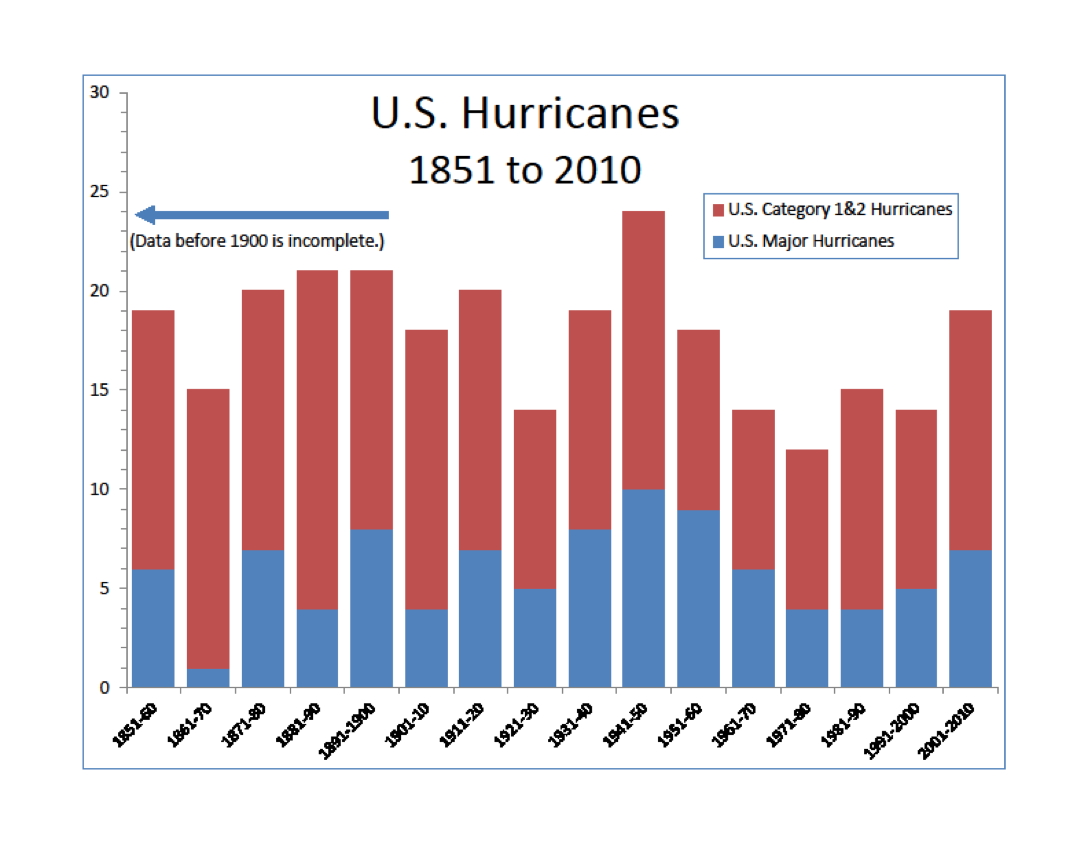
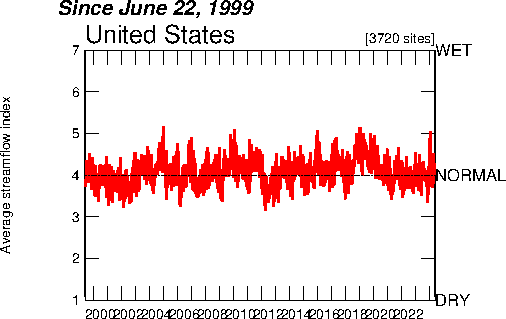
There's no data pointing to today's weather being any different than the weather we've always had. If you believe differently, please point to such a data set.
Here's some to get your started:
http://policlimate.com/tropical/global_running_ace.png
http://policlimate.com/tropical/frequency_12months.png
http://policlimate.com/tropical/global_major_freq.png
http://www1.ncdc.noaa.gov/pub/data/cmb/images/cei/step6.ytd.gif
http://www.aoml.noaa.gov/hrd/Landsea/gw_hurricanes/fig33.jpg
http://www.ncdc.noaa.gov/oa/climate/severeweather/tornadoes.html
http://www.epa.gov/climatechange/images/indicator_figures/precipitation-figure2.gif
http://waterwatch.usgs.gov/new/regplots/real/real_us_2.gif -
Re:-1 for linking to FOX news
There are a lot of sensible things we can do to stop burning fossil fuels (such as the telecommuting idea you propose)
Electricity generation produces more CO2 than telecommuting. A few more nuclear power stations would reduce emissions more than people giving up their SUVs would (I think the "you'll have to drive a really crappy small car!!" argument is also put out by the oil companies to help the people deny...)
See: http://www.epa.gov/climatechange/ghgemissions/gases/co2.html
-
Different than any other environmental disaster?
How is this different than any other environmental disaster? Are you aware that huge swaths of land have been rendered uninhabitable by mining and other industrial operations? That spills caused by oil drilling have residual environmental impacts decades after cleanup? If an uninhabitable zone is your concern, what about the huge swaths of land consumed by hydro-electric, solar, and wind power?
http://www.epa.gov/superfund/sites/
http://www.groundtruthtrekking.org/Issues/AlaskaCoal/CoalMineReclamation.html -
Re:Another instance of...
http://www.epa.gov/nrmrl/wswrd/dw/smallsystems/pubs/625r04108.pdf
Warning, large PDF. This is the EPA guidelines for reuse of water. They all have to meet certain standards, additional treatment may need to be done to meet those standards. If you hooked up the outlet of a waste water treatment plant (what I call a poo processing plant or 3P) to the inlet of a water treatment plant (my term is a chlorination and filtration emporium), you'd have better quality water in most cases.
-
Re:I still don't get it...
You don't have toddlers, do you. And the irony in your post, bashing people about how it's "not that hard", is that your advice is wrong. The mercury is not in liquid form, it is released as vapor. The correct thing to do is immediately open the doors and windows and leave the room for 15 minutes to allow the vapor can dissipate. I guess it wasn't as easy as you thought. http://epa.gov/cfl/cflcleanup.html http://www.snopes.com/medical/toxins/cfl.asp So when your toddler pulls over a lamp and noone knowledgable happens to be watching (and you've just proven how easy it is to be ignorant), then he/she will lean in and look closely with curiosity breathing in big gulps of mercury vapors, just perfect for developing young brains.
-
Re:I am having a vision of the future...
It's also the government that has to clean up the land fills and ground water when they get sued for letting people dump so much mercury into them.
Do you have proof for this claim?
http://www.epa.gov/superfund/ would be a good indication of this.
-
Re:CFCs aren't naturally occurring?
-
Re:If it's too cheap to ignore then make it clean!
10 to 15 years is too short to measure global temperature changes, because short term oscillations (such as El Nino, and North Atlantic) cause too much annual variation to separate a signal from the noise. So stop holding it up as data, it is "statistically meaningless". Also, focusing on air temperature is wrong-headed. The oceans have about 1000 times the mass of the atmosphere, and most of the planetary heating is going there, not into the air. The steady 3 mm rise per year of the oceans is pretty unmistakeable evidence of thermal expansion and glacier flow.
http://www.epa.gov/climatechange/images/indicator_figures/sea-surface-temp-figure1.gif
-
Re:Why not reduce emissions?
Wow, lot's of hostility to my comment, and a few good points too.
Boats - I stand corrected, boats have some modest emissions controls. We could definitely stand to see something stronger though:
http://www.guardian.co.uk/environment/2009/apr/09/shipping-pollution, http://www.dailymail.co.uk/sciencetech/article-1229857/How-16-ships-create-pollution-cars-world.htmlPlanes - Yes, I understand that the U.S. is large, but we can start with modern trains that connect smaller distances, like Milwaukee to Chicago, L.A. to Vegas, etc. Trains are more efficient than planes, and can actually travel very fast. I'm also speculating that trains suffer from fewer delays, have quicker security checkpoints, and require less maintenance.
Coal power plants: There is no such thing as clean coal plant. Look at the destruction caused just to GET the coal, let alone burn it. It's dangerous for the workers and disastrous for our environment. Search for images before and after mining, it's unsettling.
http://en.wikipedia.org/wiki/Coal_power_in_the_United_States, http://en.wikipedia.org/wiki/Centralia,_PennsylvaniaLawn Mowers - Operating a mower for an hour is the pollution equivalent of driving a car 200 miles. Consider how many lawns are in the U.S. alone. That is not insignificant: http://www.epa.gov/oaqps001/community/details/yardequip_addl_info.html.
Excessive Water Consumption - Too many people underestimate the value of clean, fresh water. It takes energy and costly equipment to clean and deliver fresh water to your home. Water is also a limited resource. If/when our rapidly draining aquifers run dry, the consequences will be disastrous to our food supply and economy. We can do some simple things to reduce our usage, without much effort. Front load washing machines save ~20 gallons per use. Low flow toilets can save ~2 gallons per flush. I have no regrets switching to either, and I have a lower water bill. http://environment.nationalgeographic.com/environment/freshwater/water-conservation-tips/
-
Re:They just need to...
Ionizers literally drove The Sharper Image into bankruptcy. The Sharper Image produced the Ionic Breeze ionizer which Consumer Reports concluded was "ineffective" as an air cleaner and produced "almost no measurable reduction in airborne particles."
Worse, all ionizing purifiers generate ozone. The EPA states, "Relatively low amounts [of ozone] can cause chest pain, coughing, shortness of breath, and, throat irritation. Ozone may also worsen chronic respiratory diseases such as asthma and compromise the ability of the body to fight respiratory infections".
So in reality not only are ionizers ineffective, they're actually bad for you.
-
Re:Might be incentive to buy American?
I think this is about when you go buy some mercury and "accidentally" spill it on your property before taking the buyout money.
Sell your home to a newly-created shell company first...
Superfund liability for cleanup includes *previous* owners of a site, especially if they owned the site when the pollution occurred.
-
Re:Rigged, because of the presidential debate
Your map would be flawed unless it was also adjusted for policies implemented by them. The reason is because areas with the R's inside them tend to be cheaper to live in and have less regulation. The D's like California is in a particularly suffering because of added environmental regulations. Some of these are imposed by the federal government and some are adopted voluntarily by the state. If you follow the link I provide and select the RFG (reformulated gas) and then select area, you will find a lot of California is federally limited to gas that is not required to be used in the surrounding states.
http://www.epa.gov/otaq/fuels/gasolinefuels/index.htm
California right now is suffering because of a formulation requirement in Gasoline that is different then all the states around them. A refinery that supplies the state had a fire and went off line where another refinery was doing some scheduled maintenance before gearing up for the winter blend, another lost power for a few days and had to completely shut down causing the latest spike, and a major pipeline carrying oil to the refineries was shut down because a sensor showed elevated levels of organic chloride.
This is a non-political issue in the current sense of politics. It is ultimately a political issue because it is imposed by politics- but it was the politics of past actions- not current or future actions and not because of subsidies. The subsidies the oil companies see are more of making the oil companies do certain things that aren't profitable to them. Most of them go to the smaller oil companies who are trying to compete with the big boys and if they are eliminated, it just means the smaller companies would be bought out by the big boys and some of the practices we decided the oil companies should be doing by dangling subsidies in front of them will disappear. Oil companies will simply reorganize their operation and big oil will not miss the oil subsidies whatsoever at all.
-
Re:EVERY STATE
Not every state.. The nation is divided into zones regulated by the EPA based around climate and population and most states will fall into one of these zones and have a default formulation. California decided it was going to make its own more stringent requirements because it wouldn't hurt anything and save the environment. Some other states have followed but I'm not sure which ones.
http://www.epa.gov/otaq/fuels/gasolinefuels/index.htm
Will give some information on the federal requirements and maps. -
Re:Pesticides in organic productionFrom epa.gov:
"Organically grown" food is food grown and processed using no synthetic fertilizers or pesticides. Pesticides derived from natural sources (such as biological pesticides) may be used in producing organically grown food.
Contrary to your ladybug example, this is what the epa.gov has to say about one biological pesticide option:
Biochemical pesticides are naturally occurring substances that control pests by non-toxic mechanisms. Conventional pesticides, by contrast, are generally synthetic materials that directly kill or inactivate the pest. Biochemical pesticides include substances, such as insect sex pheromones, that interfere with mating, as well as various scented plant extracts that attract insect pests to traps. Because it is sometimes difficult to determine whether a substance meets the criteria for classification as a biochemical pesticide, EPA has established a special committee to make such decisions.
I prefer organic produce personally, but that doesn't mean that I'm willing to misrepresent the facts and call people idiots over the matter.
-
Re:Pesticides in organic productionFrom epa.gov:
"Organically grown" food is food grown and processed using no synthetic fertilizers or pesticides. Pesticides derived from natural sources (such as biological pesticides) may be used in producing organically grown food.
Contrary to your ladybug example, this is what the epa.gov has to say about one biological pesticide option:
Biochemical pesticides are naturally occurring substances that control pests by non-toxic mechanisms. Conventional pesticides, by contrast, are generally synthetic materials that directly kill or inactivate the pest. Biochemical pesticides include substances, such as insect sex pheromones, that interfere with mating, as well as various scented plant extracts that attract insect pests to traps. Because it is sometimes difficult to determine whether a substance meets the criteria for classification as a biochemical pesticide, EPA has established a special committee to make such decisions.
I prefer organic produce personally, but that doesn't mean that I'm willing to misrepresent the facts and call people idiots over the matter.
-
Re:While...
which would have been equally attacked had the environmentalist movement been around when they were invented.
Unfortunately the movement wasn't, so now we taxpayers get to pay for fixing it.
-
Re:The key word is "Correlation"
Global warming and the decline of pirates was mostly about the correlation between the will to ignore one set of facts with the enthusiasm for ignoring another set of facts.
-
Green Building
I don't know what your company is planning to build currently but they should look at Green buildings like the amazing Heifer International - Green Building. I have visited it and know someone who was show the various costs month by month running the building and he was amazed at how much they saved on energy, water and all the rest.
The EPA has various funding options I believe for Green Buildings and some places may well offer Tax break incentives to go green. In the long run a well designed Green building pays for itself. It is also a good idea to have good Natural lighting if you can manage it, the Heifer International building is beautifully designed with this in mind.
Another thing to consider is indoor air quality, I remember there was a TED Talk by Kamal Meattle: How to grow fresh air depending where your building is built and the air quality this can be amazingly good for everyone in the office.
I hope you find this useful even if it wasn't exactly what you were seeking. -
Green Building
I don't know what your company is planning to build currently but they should look at Green buildings like the amazing Heifer International - Green Building. I have visited it and know someone who was show the various costs month by month running the building and he was amazed at how much they saved on energy, water and all the rest.
The EPA has various funding options I believe for Green Buildings and some places may well offer Tax break incentives to go green. In the long run a well designed Green building pays for itself. It is also a good idea to have good Natural lighting if you can manage it, the Heifer International building is beautifully designed with this in mind.
Another thing to consider is indoor air quality, I remember there was a TED Talk by Kamal Meattle: How to grow fresh air depending where your building is built and the air quality this can be amazingly good for everyone in the office.
I hope you find this useful even if it wasn't exactly what you were seeking. -
Re:Press coverage
No it doesn't... The outline of the coast has more to do with tides than the water quantity. The largest tides are areas where there is a long inlet that is oriented east-west. For example, it is disputed but the Great Lakes have very small tides, but the largest of them are superior and erie (longest east-west dimensions) whereas the largest quantities of water are in superior and michigan.
http://www.great-lakes.net/teach/chat/answers/100100_tides.html
http://www.epa.gov/glnpo/factsheet.html -
Re:I'm really lucky ...
I hate to break this to you but there is a little of everything in everything. You just can't tell until you're able to count parts per million.
Parts per billion, actually. 700 of them in fact for glyphosate. Another way to say "700 ppb" is 1 part in 1.5 million. An acre-foot of water is about a quarter million gallons. So if you had a magical cubical pond, that was about 60 feet on every side including 60 feet deep, and an idiot neighbor sprayed a gallon of the stuff to kill the weeds in his driveway (which is only about 10000 times the recommended agricultural dosage, hurray for retail sale of herbicides to the untrained ! ) and it all ran off into your pond, it would be pretty borderline. Luckily the stuff is chemically unstable and biodegrades fast.
http://water.epa.gov/drink/contaminants/basicinformation/glyphosate.cfm
You can see how a small inland lake can end up contaminated enough to be undrinkable. Or a river. All you need is about a dozen idiots going to home depot then spraying about 10000 times the recommended dosage "just to make sure" after all more is better, right?
-
Bioterrorism protection is a farce
How can bioterrorism threats be taken seriously when we are our own worst enemy? Munincipal waste systems are prime targets - this is the soft underbelly of america.
Imagine the scenario -
1) Flush biologically active agent that thrives in sewage treatment plant (i believe this can be engineered)
2) dewater, concentrate and truck to farm field - fling in rural area (area of few hospitals and less than average intelligence community)
3) innoculate residents
4) residents travel to urban areas, spreading diseasePossible? Plausible? I think so.
Look up what we do with the "residuals" from a sewage treatment plant - yes - we use it on farm fields as "fertilizer".
Yes - its biologically active (they dont pasturize it).
Sewage sludge is a money maker for some and busy work for others.
When you do some reasearch, you will find that we dump biologically active "sludge" on farm fields - sludge that can "rebloom" and contains many of the hazards identified in bioterrorism response plans.
More info:
http://vimeo.com/24854061
http://www.biomedcentral.com/1471-2458/2/11/
http://www.youtube.com/watch?v=iHsIjMPP2M8
http://thewatchers.us/NCDENR.html
http://cwmi.css.cornell.edu/sewagesludge.htm -
Re:Not loaded - pointless
As to "safety of food and water supplies, vaccination" - what are they really going to say? "No I don't think food should be safe" or "no vaccines"? Only fringe groups think that way. Hell, if anything Republicans would be more prone to allowing food irradiation, so who is on the nutty side of THAT debate?
I think you are massively oversimplifying things. In a debate the question isn't going to be "Are you for or against poisonous drinking water". More realistic questions would be "What measures, if any, do you plan to take to reduce the amount of perchlorate in the drinking water?" (easy, non threatening question. The EPA already has a proposal to address it), or a similar question for any number of other toxic chemicals, food additives, and processes like hydraulic fracturing. Perhaps a more general question could also be asked "What measures if any do you intend to take to improve the quality of drinking water in this country?". Another question I would like to see asked: "US food and water safety regulations are among the most relaxed in the developed world, why do you think this is the case?"
And I only chose food and water as a convenient example, there are important questions to be addressed in policy in every one of the areas you mentioned. -
Try Reading TFA ( /dotterers )
It's only emissions of CO2 FROM COAL that are down.
"Since 1990, U.S. greenhouse gas emissions have increased by 10.5%."
Source: U.S. Greenhouse Gas Inventory Report
It's not as if burning natural gas doesn't also release CO2 into the atmosphere, and where I'm happy that coal fired power plants are going away, I'm sad that we're not more serious about reducing overall power consumption by increasing efficiency, especially in our residences.
The U.S. has almost completely left rental property residences out of the picture. There's no real business (monetary or tax) incentive to encourage apartment owners or developers to include more efficient appliances or to use better building methods, design standards or other systems that would lower energy usage.
Apparently no one that posts here has their head in the clouds...