Slashdot Mirror
Domain: esa.int
Stories and comments across the archive that link to esa.int.
Comments · 950
-
Re:What's up with that motor?
There is some speculation that the AR2-3 may not be the engine used in current flights (see other replies to you post).
However, the AR2-3 is human rated. The X-37 is nominally unmanned, but hey the missions are classified, and because Halo Orbital Drop Shock Troopers. Of course some of the alternative engines you mentioned have been used on stages of previous manned flights and are thus presumably man-rated as well.
I did some Binging on the AR2-3 and found a NASA/Rocketdyne/OSC presentation that looks to be drafted around 2000.
Here that seem to make the case high test peroxide (HTP) technologies are the way of the future for upper stage propulsion:
Hydrogen peroxide was selected over liquid oxygen because it is dense, storable, capable of tolerating months in orbit, and meets safety restrictions for being part of the payload in the Space Shuttle.
Of course the Shuttle aspect is no longer a factor, but the other factors still seem to be in play.
Further into the paper, the USFE 10k peroxide motor is mentioned as a project to develop new HTP technologies. These technologies would be used for future HTP-based upper stages. They even have a goal of over 100 uses of an engine before it has to be removed for overhaul. Is that a lot in the world of rockets? As this paper was drafted around 2000 I would guess that the X-37 is using something a bit different that the bog-standard AR2-3 or has moved away from HTP technologies altogether.
Now to say that rocket science has moved away from HTP is not quite true. I don't think there are any big HTP engines used in lower stages. However, the Bloodhound SSC is using a HTP hybrid motor they are designing.
There is also research in to using HTP as a monopropellant for thrusters using a catalytic bed. I suppose the advantage here is that you have HTP as your oxidizer for an upper stage and then it can be used for maneuvering once on orbit. Similar, as you mentioned, to UDMH.
Take a look at the Introduction from the ESA paper referenced above. They cite several reasons why HTP is desirable and advantageous. Cost and safety being paramount. They also mention that Soyuz has been using HTP in its maneuvering systems for over 40 years. I think that HTP safety concerns have been effectively mitigated from the "explode because you looked at it funny" era.
As for performance it seems that HTP is as good as some other technologies, but it's no dog either and it seems to be a good fit for the X-37 or other small stages. Quote from the ESA paper:
The propulsive performance of hydrogen peroxide monopropellant rockets is about 20% lower than hydrazine, but the volume specific impulse achievable with 90% H2O2 is higher than most other propellants due to its high density. This is particularly useful for systems with significant aerodynamic drag losses and/or stringent volume constraints. With respect to bi-propellant and hybrid rocket engines, hydrogen peroxide yields a specific impulse comparable to other liquid oxidizers like dinitrogen tetroxide, nitric acid and even liquid oxygen..
It seems that HTP has many uses and rocket science has not moved away from HTP, indeed, it is being actively researched. It may or may not be used on the X-37 right now. It may or may be used on the X-37 in the future. With further attention to cost, safety, and, increasingly, environmental impact, HTP seems to be coming for you...
-
Re:NOT "network timekeeping", just timekeeping
Yes there is Galileo (once all sattelites are up an you hava a two frequency reciver) will probably be better until GPS Block IIIA is operational, so for applications where you need realy precise time synching your best bet witt be a local (as in on site) galileo reciver that serves to sync a ntp+ptp server used to sync all on site system Disclaimer: I am not an expert on time sync problems so any corrections are greatly appreciated
-
Re:Let me see
Well, here's where you open yourself up. Distance measurements benefit from longer baselines. The biggest one we have now is about 2AU wide. Take a picture now, wait 6 months, take a picture again when the earth is on the opposite side of the sun. If we have a base on mars, we can have a slightly wider baseline with earth and mars on opposite sides of the sun for a simultaneous measurement (can't do that now at all) and two martian orbital radii for non-simulataneous measurements about a year apart.
Now you might say: well why can't we do this with a remote probe?
We are: It's called Gaia. The baseline isn't really the limiting factor, nor is mirror size: it's mostly about atmospheric distortion and instrument stability, both of which are vastly improved in space. Gaia will be able to do parallaxes to accuracy of 20 micro-arcseconds.
-
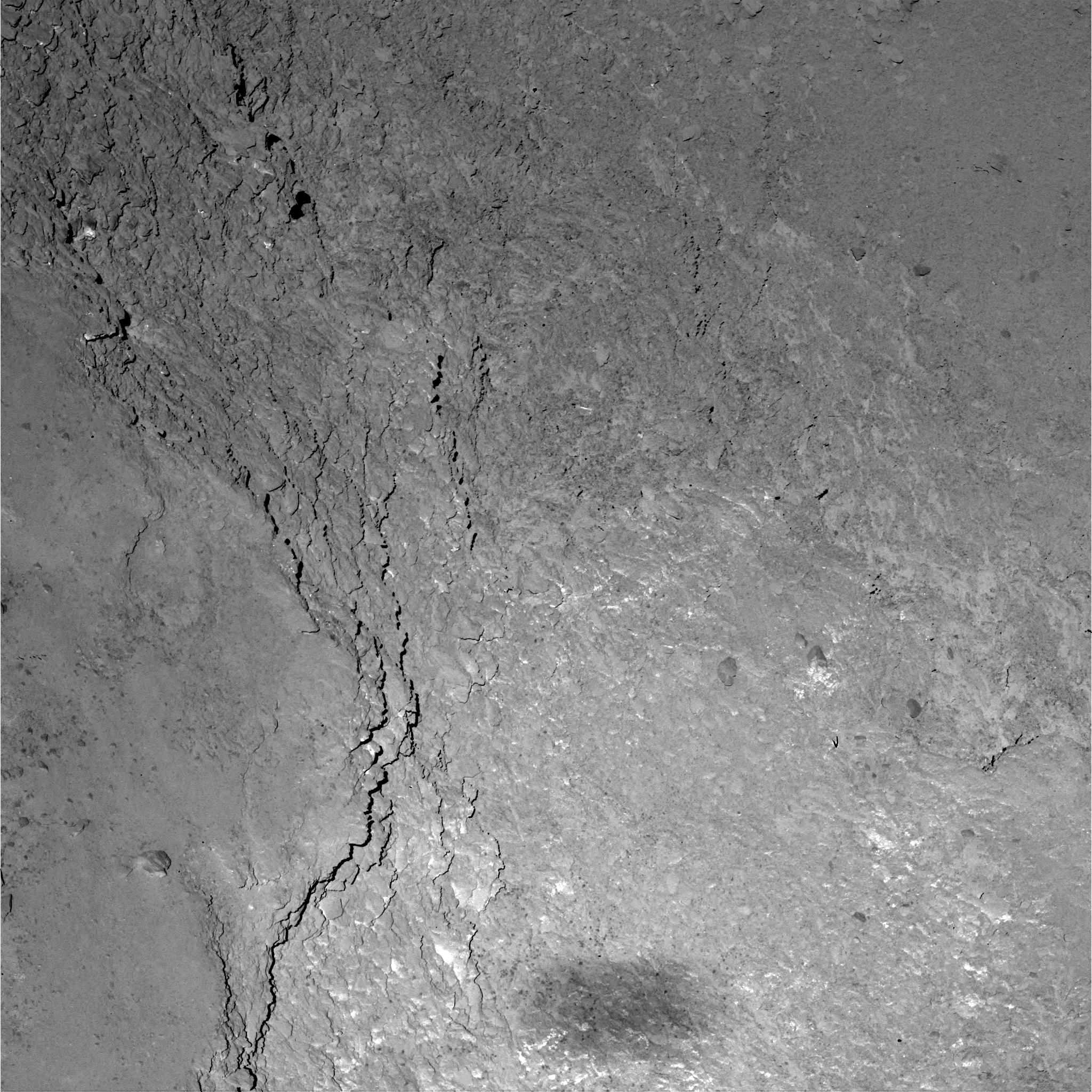
Ice "boulders" visible in photo
What I notice in this photo (hi-res version) around the area of the shadow are the apparent shapes of the ice "boulders" that came together to form the comet in the first place. It reminds me of looking at chondrules in meteorites, that show the siliceous "hailstones" that formed as the planetary disc that would go on the form the planets cooled.
-
Re:Bless you.
Fortunately, the Lisa Pathfinder project has already developed ion engines that would be helpful against that. While they generate very minuscule thrust, unsuitable for space travel purposes, they have enormous specific impulse, meaning they can go on for years stabilizing given object against solar wind, gravitational influences and the likes. Several such engines attached to the disk would easily keep it stabilized against solar wind, and another couple on the telescope part would keep it aligned.
Of course you'd need somewhat more powerful jets to turn it around aiming at a different part of the sky, and these would likely need periodic refuelling (note as the disk rotates towards another place in the sky, the telescope part needs to travel a couple thousand kilometers!) but we've got the stabilization covered.
-
Bullshit
Disclaimer: I work in a cosmology department. What you've just written is total bullshit.
We make predictions, and they work. I could tear apart the nonsense you've written, but instead let me just point to the facts:
http://sci.esa.int/planck/5155...
http://www.astro.virginia.edu/...
I could go on an on posting pretty pictures and graphs matching data, but let me just say that we work incredibly hard to make predictions from our models, we test those predictions against observations and test many of our systems to over 5 sigma. To say that what we're doing is just guessing is frankly insulting to a lot of incredibly hard working people. We
other little things, and we damned well test them, lining up our models against observations. We certainly haven't got everything right yet - there's a lot of room for investigation as to what went on before inflation, say, or exactly what type of matter dark matter is (but before you say we know nothing about it, I suggest you educate yourself - we don't know what it comprises, but we have damned good bounds on certain properties like its ratio of pressure to density). We don't know why the cosmological constant takes the value it does, but a whole host of checks all come up with the same number.So no, we don't have "Guesses". We have repeatedly tested hypotheses from which we observe consistent data and find heavy statistical significance. What you've done is insult a lot of incredibly hard working, very smart people who are very serious about their work.
-
Bigger news
They have pictures of the neck fracturing. Unbelievable luck if they can capture how a comet disintegrates.
-
Re:parachutes?
Well don't just tell us, do something about it!
-
RIP Venus Express
ESA also declared end-of-mission for Venus Express the other day.
I'm way more curious about Venus than Mars. I hope we can explore it more.
-
Actually...
The more informative article from the ESA website says that the Deuterium/Hydrogen (D/H) isotope ratio is significantly higher (more than three times, in fact) than that of water found on Earth.
However, The comet in question is not of the same type and composition as *all* comets. In fact, comets (even those that generally share orbits with the one sampled) vary widely in their D/H ratios. As such, the paper does not claim that comets didn't bring water to Earth, merely that comets like the one sampled (comet 67P/Churyumov–Gerasimenko) by ROSINA did not bring water to Earth.
From the better TFA:
Previous measurements of the deuterium/hydrogen (D/H) ratio in other comets have shown a wide range of values. Of the 11 comets for which measurements have been made, it is only the Jupiter-family Comet 103P/Hartley 2 that was found to match the composition of Earth’s water, in observations made by ESA’s Herschel mission in 2011. [Emphasis added]
-
Next step...
...printing a moon base. http://www.esa.int/Highlights/...
-
Re:"...moving east."
I checked that for one of the previous posts: http://blogs.esa.int/rosetta/2... lists the declination and ascension of its axis of rotation so the wobble must be modest.
And here's asteroid Toutasis. It wobbles. http://www.solarviews.com/raw/...
-
Landing gif
This ESA blog link has a Gif of the landing from Rosetta... http://blogs.esa.int/rosetta/2...
-
Water pipe sticking out of comet?
Anyone know what the deal is with the pipe or rod looking object in the lower right hand side of this picture http://www.esa.int/var/esa/sto...
-
Re:Huh
"It seems to me the design and/or planning of this mission were poorly thought out"
Is the funniest fucking thing I've heard all day. Do you have any idea how well thought out this mission was? FFS look at the trajectory it took 10 YEARS(!) to get to the comet. And you think they overlooked the fact that the comet is craggly?
Jesus-Dunning-Kruger-Christ.
http://www.esa.int/esatv/Video...
True, it's easy to throw snide comments at the people who designed this mission but until now nobody really even knew any details of what the surface of a comet looks like. Furthermore landing on Mars is difficult enough, the success rate for landings on the Martian surface is something like 30%. Getting a probe to rendezvous with a comet and land on the surface is a way bigger achievement. Finally I'm not exactly surprised that some systems failed after almost a decade in space. I just hope they manage to milk the maximum amount of data out of this probe.
-
Re:Huh
"It seems to me the design and/or planning of this mission were poorly thought out"
Is the funniest fucking thing I've heard all day. Do you have any idea how well thought out this mission was? FFS look at the trajectory it took 10 YEARS(!) to get to the comet. And you think they overlooked the fact that the comet is craggly?
Jesus-Dunning-Kruger-Christ.
http://www.esa.int/esatv/Video...
And Philae bounced twice, finally settling in two hours after first touching the comet, which is enough time for the comet to rotate almost 60 degrees. The two systems meant to prevent bouncing - the thruster and the harpoons - failed, so it ended up some kilometer away from the carefully chosen site. That we are getting any science at all after that potentially mission-killing news is just fantastic.
I'm hoping they make some last-ditch effort to have Philae try to jump over to another part of the comet to get more sunlight, though I'm not sure what kind of resources they have to try it. Can they command the drill and/or the legs to jab downward relatively quickly? Command the harpoons to fire? I don't know, but you can bet this will be part of the design on future missions. I actually did some work on this, which made hopping around a key part of the mission.
-
Re:Huh
"It seems to me the design and/or planning of this mission were poorly thought out"
Is the funniest fucking thing I've heard all day. Do you have any idea how well thought out this mission was? FFS look at the trajectory it took 10 YEARS(!) to get to the comet. And you think they overlooked the fact that the comet is craggly?
Jesus-Dunning-Kruger-Christ.
-
paste from Reddit...Got fresh news from the team, they are broadcasting live right now on french TV ! Philae landed, and bounced slowly for 2 hours, and travelled 1km away the targeted site. Yes 1000m. It's now stopped slanted, some cams are shooting the sky, other the ground, and other nearby rocks, as seen on the first photo. It's inside some kind of hole, not much sun for the solar panels. EDIT1: It landed on the core of the comet, it sees the light from the sun for about 1 to 2 hours per day. In the next days/week the angle of the comet will change relative to the sun, and it very likely the solar panel will get more sunlight so more power for the probe. EDIT2 : Many labs are performing right now and performed the whole night. For now they put the drilling on hold since they don't know if it's tied to the ground or not. Drilling op is also power hungry so it's kinda a good thing it's on hold since there's not much sun available for the panels. Battery life been re-estimated to 50-55hours due to the lack of sunlight. This includes the 7 hours of descent.They are constantly adjusting missions goals, depending on conditions, power available, etc, EDIT3 : The probe has been working to gather scientifict data the whole time, including during the bounces. There's already a large amount of data available, whatever happens next.
EDIT4 : It's resting on "hard" ground, with a layer of dust about 30cm, and that's good news because it allows measurements to proceed as planned. As in, it's not burried into soft soil.
EDIT5 : Solar panels are deployed, radio link is up and running, but the fact the probe is slanted/in a hole/random ground limits the time it can communicate with the orbiter, altho that's not jeopardizing the mission. There's already a lot of things transmitted successfully to the orbiter. Contact between the orbiter and the probe can be done twice per day. EDIT6 : The first place it touched the comet was exaclty where it was planned, flat and cosy, too bad it didn't harpoon there. EDIT7 : Next contact will be near 19:30GMT, until 23:45GMT approx. This night they made contact with the probe (from the orbiter) at about 4:00GMT, and at 5:30GMT they had safely recovered all the data from the first batch of tests. From the ESA blog :
The team are ensuring that Rosetta maintains an orbit that is optimised for lander communication support; they are planning a manoeuvre (thruster burn) today to be conducted on Friday that will help keep Rosetta where it should be. Rosetta already conducted a burn last night as part of this effort.
Rosetta is presently sending signals to the ground stations at about 28 Kbps; Ignacio says that the spacecraft's own telemetry downlink uses about 1 or 2 Kbps of this, so the rest is being used to download science data from Rosetta and lander science and telemetry from the surface.
Important press conference from ESA at 13:00GMT. Over now. http://rosetta.esa.int/ EDIT8 : So there was more photos, and details. Important bit, they're planning on righting the lander, studying the best way to do it. First rebound was about 1000m long, 0.38m/s up, lasted 2 hours. 2nd rebound was 0.03m/s, 7 minutes long. Then it stuck itself in the side of the crater at the 3rd impact.
EDIT9 : Harpoons received the signal to fire, but didn't activate. There's no indication of damage on solar panels. The lander can hibernate and may likely still work several monthes from now, even if under limited power. They confirmed the orbiter will make adjustement tomorrow morning (friday) to optimize communication time with the lander. Operations are prioritized, from the less risky to the most.
permalink
-
Re:Black and White?
This comet is extremely dark, darker than coal. What you need is a very high dynamic range and certainly no bits wasted for colour, because there is none.
-
It worked
We've got a picture: http://www.esa.int/spaceinimag...
-
Re:Congratulations!
Over 6.4 billion kilometers, actually...
The oft-stated 510 million kilometers is merely the current distance between Earth and 67P Churyumov-Gerasimenko.
It's taken Rosetta quite a journey to be able to match orbit with the comet.
-
Links for a quick review of today's Rosetta events
-
Webcam sound
The link to the webcast did not have any sound for me, but I found another official one that works: http://rosetta.esa.int/
-
Re:Electric Universe Preditions
There's about as much chance of that happening as you revising your theory when it doesn't match observations: practically none.
I'm wondering what Talbott and Thornhill have been reading, or perhaps I should say what they have been smoking, because their description of the observations does not match the ESA's. It has lots of water and a dust trail, and while there has been some unexpected magnetic activity, there isn't some electrical bogeyman waiting to jump out at the lander — and it's not like the scientists involved aren't paying attention to such things. Apparently in order to believe in EU not only do you need to ignore a century's worth of physics (including Einstein), you also have to ignore current observations and make up your own. This is beyond intellectually dishonest and far into flat-earth crackpot territory.
-
Re:Electric Universe Preditions
There's about as much chance of that happening as you revising your theory when it doesn't match observations: practically none.
I'm wondering what Talbott and Thornhill have been reading, or perhaps I should say what they have been smoking, because their description of the observations does not match the ESA's. It has lots of water and a dust trail, and while there has been some unexpected magnetic activity, there isn't some electrical bogeyman waiting to jump out at the lander — and it's not like the scientists involved aren't paying attention to such things. Apparently in order to believe in EU not only do you need to ignore a century's worth of physics (including Einstein), you also have to ignore current observations and make up your own. This is beyond intellectually dishonest and far into flat-earth crackpot territory.
-
Re:Uh, simple
-
Re:It's getting hotter still!
The article states "two dimensional area". A couple of years ago satilite images showed more ice coverage then expected. What they found was that instead of the meters thick ice they found chucks of ice that had melted and then refroze, it was thin and brittle with notice loss of over volume of ice.
http://www.csmonitor.com/Envir...
The same decline can be seen in northern lakes
http://www.esa.int/Our_Activit...
Are you trying to suggest that the earths ice sheets are NOT diminishing? -
Re:A good slice of luck.
The "luck" part is Philae's landing ellipse. If they're off by even a few tens of meters they might hit something or sail off into space.
-
Re:Effing JS
try this... http://blogs.esa.int/rosetta/2...
-
Re:Science creates understanding of a real world.
You are misinformed. The arctic ice has steadily been increasing in both extent and volume since an arctic cyclone decimated it in 2012. For example: http://www.esa.int/Our_Activities/Observing_the_Earth/CryoSat/Arctic_sea_ice_up_from_record_low
Antarctic ice is at record highs. -
Re:unfair policy
Taking your advice......looks like you're lying....
-
Re:In Orbit?
Glad to see that you jumped in on this: good description.
Because the comet is so small, the gravity changes a lot with "altitude" from the surface. For a 2-km diameter sphere, say, then the difference in gravity between an altitude of 2-km and 6-km (i.e. between 4 and 8-km from the centre of the sphere) is a factor of 4. On the Earth, it barely changes at all between altitudes of 2 and 4-km, because this is a tiny change relative to the 6400-km radius of the Earth.
So, yes, at 100-km and 50-km, we'll be flying these hyperbolic arcs (slightly bent by the very weak gravity), using thrusters to "turn the corner" at the end of each leg. But at 30-km, we'll be on closed more-or-less circular orbits: I'm pretty sure that it is natural orbit though (and thus fairly long in duration), but not powered.
I do work on the project, albeit not on the flight dynamics side. One of our experts on this, Frank Budnik, did give a talk on this in the science session I moderated yesterday afternoon, starting at 11:28 into the recording of the live stream here:
http://www.esa.int/spaceinvideos/Videos/2014/08/Rosetta_at_comet_First_images_science_results
-
Re:In Orbit?
The comet 67P has a mass of 3.14E12 kg
Today the comet is 186,444,271 km from the Sun Where is Rosetta?
Using F=GMm/R^2, the Sun's gravity on Rosetta is equal to 67P's gravity on Rosetta at 700m from the center of Rosetta on 6 August 2014, which means that Rosetta will never really be completely within 67P's field. (At Perihelion on 13 Aug 2015, 67P's gravity field will be as strong as the Sun's only 250m from the centre) However, now that Rosetta is in the same orbit as 67P we can mostly disregard the Sun's gravity and the elliptical path that Rosetta and 67P now share as of today. (Earth's pull on Rosetta is at least a million times weaker than the Sun's pull - so forget any influence from the Earth's mass.)
The "orbits" at 100km are called hyperbolic because Rosetta is not trapped in 67P's gravity well since the gravity is so weak and because Rosetta is still moving FAST at 1 m/s. But this hyperbola is so weak it is effectively a straight line.
Rosetta will turn 60 degrees after every 100 km of a hyperbolic path to make a triangular "orbit". This triangular path cannot be called an orbit because it is not a conic section, nor is the comet at a focal point of the conic section Kepler's First Law.
These "straight"/"hyperbolic" paths of 100km and 50km are deliberately done for two reasons:
-to calculate exactly the gravity field of the comet, because it is clearly not a uniform sphere. They will likely use radar&cameras to continuously measure the precise distance to the comet
-to keep in front of the comet to avoid its coma and tail.
After these maneuvers, Rosetta will go into a 30 km "orbit", so that the task of mapping 80% of the surface all happens from the same distance. This orbit is not natural and will be powered because a natural 30km orbit of 67P takes 26 days.
Here's how to calculate the natural circular orbits for 67P (it won't be circular, because of the crazy shape, but close enough). Kepler's 3 Law gives us
T^2=4pi^2/GM*r^3. 4pi^2/GM=0.19 for this comet. G=6.67×10¹¹ N(m/kg)2
if r=30km=3e4m, the natural orbit would have a period of T=2.3e6 seconds=26.11 days
If r=2.5km, the natural orbit would have a period of T=15 hours
If r= 5km, the natural orbit would have a period of T=1.77 days
If r= 100km, the natural orbit would have a period of 159 days So I could imagine that when Rosetta gets within 5km it is mostly using the natural orbit and hence saving fuel. -
Re:Doesn't an orbit require gravity?
The ESA overview uses the terms 'orbit' and 'orbiter' many times when describing this craft so I am a little confused. How could Rosetta follow the comet for 15 months, when they had to power it off for years just to get there, if it isn't orbiting the comet? Maybe it is simply sharing the comet's orbit around the sun? Maybe just a difference in what is meant by 'orbit'
-
Re:Doesn't an orbit require gravity?
You are correct. The gravity is insufficient. So I looked it up.
They will basically "drive" the probe around the comet, firing thrusters as needed. After a bit, they will "drive" it onto the surface, then:
"As Philae touches down on the comet, two harpoons will anchor it to the surface; the self-adjusting landing gear will ensure that it stays upright, even on a slope, and then the lander's feet will drill into the ground to secure it to the comet’s surface in the low gravity environment. Philae carries 9 scientific instruments, including a drill to sample subsurface material." ( http://www.esa.int/Our_Activit... )
-
NavCam animation 6 August
http://www.esa.int/spaceinimag... "This animation comprises 101 images acquired by the Navigation Camera on board ESA's Rosetta spacecraft as it approached comet 67P/C-G in August 2014. The first image was taken on 1 August at 11:07 UTC (12:07 CEST), at a distance of 832 km. The last image was taken 6 August at 06:07 UTC (08:07 CEST) at a distance of 110 km."
-
Where is Rosetta?
Here it is
Roughly 23 light minutes away. -
Re:The ESA video stream URL is
Also at http://rosetta.esa.int/
-
Re:Well done everybody
... on completely missing the point. This project is about testing autonomous visual landing site selection and guidance, NOT proposing that quadcopters can fly on Mars. To be fair, the linked article isn't especially clear on that point either.
To be fair, the ESA's own site insinuates that this project is a quadcopter for Mars.
"The dramatic conclusion to ESA’s latest StarTiger project: a ‘dropship’ quadcopter steers itself to lower a rover gently onto a safe patch of the rocky martian surface."
-
Re:This is not going to work.
He's right though, that thing will drop like a rock.
-
Re:This is not going to work.
It's ESA, not NASA, and the focus of the work was apparently the vision-based guidance system, not the quadcopter propulsion (which indeed would be absurd on Mars).
-
Horrible Article
Here is the official press release, which states the real goal of the project:
Starting from scratch for the eight-month project, the Dropter team was challenged to produce vision-based navigation and hazard detection and avoidance for the dropship.
The quadcopter was just a COTS stand-in for testing their software.
-
Titian Hero
The man who saved the Huygens lander:
"...Smeds was able to confirm the existence of the flaw only after pushing through an extensive series of tests that was initially rejected by mission managers as unnecessary.
Smeds confirmed the existence of the fatal software flaw in the Probe Support Avionics (PSA), mounted onboard Cassini, in a series of tests conducted in February 2000...
"They said it was too complex," says Smeds, adding, "But then I started to investigate the equipment available at JPL's ground stations..."
-
Re:These guys just don't get it.
I get that you're complaining about the clarity of the post
The problem is, they linked to SOCIS, and to the NEST SOCIS page
tasks they'd like people to propose to doVery few of those pages include 'about this project' type information
disclaimer : I was a mentor for the 2011 SOCIS on a project that I don't even work on. (the task was to have their software use some APIs that I help to maintain).
-
Re:The centre of the visible universe
it just complicates the orbital mechanics equations when you want to fly a space ship to Mars somewhat, that's all.
Yeah, but it makes the equations to get from here to things besides mars essentially impossible to compute given the hardware available to run the course correction software. Take a look at Rosetta, the ESA's mission to catch a comet by its tail this year. Those are some crazy gravity assists.
-
Re:Projections
Well
my first impression was that I didn't see any obvious error in logic, other than where he said this showed no greenhouse effect for earth or Venus; what he demonstrates is no EXTRA greenhouse effect on Venus. A couple of commenters call him on this but he misses it. Just a side issue though.
So, I did a search to see if anybody else had anything to say, and I find this
http://joannenova.com.au/2011/...
The gist of which is that this is coincidental, in that the albedo difference, which was left out, turns out to be the factor which accounts for the missing heat, which he can show by identifying it with the altitude of the venusian cloud layer.
There is additional information, in the form of a graph of temp vs pressure for both planets. It's a bit confusing. The green is labeled earth temp, so the blue must be Venus temp, and the two red lines ?? They're symmetrical around the blue so maybe confidence interval?
Anyway, you can see that the temps are parallel from pressures equal to earth surface (50 km up in Venus) to 60 km up, Venus ( up is to the left of the graph).
According to this guy, that's the altitude of the cloud level on Venus, so below that venus' atmosphere will be (1/1.1) the temp due to the reduced albedo.
Up from there, you can see that the Venus temp falls off more quickly than the earth temp, as expected by the additional CO2 absorbing the IR more; greenhouse effect warms the surface and lower atmosphere while cooling the upper atmosphere.
And on the right side of the graph you can see that as the pressure rises above earth 's surface level, towards Venus ' surface, the temp continues to rise as expected until you get to the proverbial hellhole.
I checked the guy's primary source for that temp graph and it checks out, and I looked for altitude of Venus' cloud and that checked out with this site http://www.esa.int/Our_Activit...
So I have to decide which model/argument to follow. I chose the second guy, because 1) he can explain the observations in terms of well established mechanisms, whereas the no - greenhouse model has the mystery of why there is no greenhouse. (This is something not well understood in the big debate; when you have something as well understood as CO2 absorbing IR, and you can even see it operate in that graph of earth's emission spectrum, if you say it doesn't exist you are ADDING an effect, not subtracting one, and Occam's razor works against you unless you have proof of why it doesn't operate. Maybe this is what trips the guy up regarding his not understanding that his calculations leave the greenhouse effect operating on earth, but having the same effect on Venus, rather than his jump to it not opetating in either place)
2) and the second guy provides more data, demonstrating that the equivalence only occurs below the venusian cloud layer, which would require even more complication for the no - greenhouse theory to explain.
But, bottom line, for me as a somewhat informed reader, I couldn't see the holes In the first guy's theory without copying off the expert's test paper. -
Re:Cambridge Dogma
Whoah. Are you even remotely aware of what is being done in cosmology these days?
Planck Sloan Digital Sky Survey
Square Kilometer Array
Ice Cube
Large Synoptic Survey Telescope
Euclid
Hardly "ideologically/branding driven pseudoscience". Who the hell modded you up? -
Re:Cambridge Dogma
Whoah. Are you even remotely aware of what is being done in cosmology these days?
Planck Sloan Digital Sky Survey
Square Kilometer Array
Ice Cube
Large Synoptic Survey Telescope
Euclid
Hardly "ideologically/branding driven pseudoscience". Who the hell modded you up? -
Re:Wouldn't opening the helmet clear the water?
The article summary has a link to Parmitano's blog in which he mentions your solution: "The only idea I can think of is to open the safety valve by my left ear: if I create controlled depressurisation, I should manage to let out some of the water, at least until it freezes through sublimation, which would stop the flow. But making a ‘hole’ in my spacesuit really would be a last resort."
-
ESA page
Here is the ESA Plato page.