Slashdot Mirror
Domain: fnal.gov
Stories and comments across the archive that link to fnal.gov.
Comments · 289
-
Re:How immutable are these plans?
The US has already started to build one collider to compete with the LHC at CERN and abandoned it after spending a billion or so on it. This is a wish list, not a final decision.
Quite why anyone thinks the linac is worth building is beyond me, by the time the machine is finished the LHC will have done all the interesting work at this energy scale. Also note the comment about the world wide web being created by the high energy physics world, but without mentioning it was actually their competitor at cern who did that one.
This is a really unimformed set of statements on high-energy particle physics which have appeared in several forms throughout this discussion. Let me clarify a couple things.
The Next Linear Collider (NLC) is not competition for the LHC. The Superconducting Supercollider (SSC) which was cancelled here about 10 years ago was competition to the LHC.
I'm really too young to know much about the SSC's cancellation, but I have heard older folks say that their big mistake was not putting enough money into R&D before beginning construction. (Hence expensive mistakes in design like another poster here mentioned.) Hopefully lessons have been learned from the failure of the SSC.
Back to the SSC vs LHC vs NLC. There are two fundamentally different types of collider. Hadron machines (SSC,LHC, TeVatron @ Fermilab) collide protons against (anti)protons. Lepton machines (LEP @ CERN closed in 2000, NLC, various machines at SLAC over the years) collide electrons and positrons (aka anti-electrons).
The hadron approach is good because a proton is 2000 times heavier than an electron. So it's much easier to get to very high energies. On the down side, protons are not point particles, but rather "bags" of 3 quarks each. So it's hard to get precision information because you don't know exactly what the initial 4-vectors of the interacting quarks were.
Lepton collisions are clean because the electrons are point particles. But as I said, they are a lot lighter than protons. This motivates building the NLC as a linear collider as opposed to a storage ring ala SSC, TeVatron, LEP, LHC, or PEP-II (@SLAC). The energy loss from syncrotron radiation goes as the relativistic gamma to the sixth (!!) power. For a given energy, a lepton machine will have a gamma 2000 times bigger than a proton machine. And so putting really high energy electrons into a ring is very difficult because they lose so much energy.
The general concensus among high-energy physicists is that for the field to progress both machines are necessary (LHC and Linear Collider). The LHC will (probably) find the Higgs boson and measure its mass. It may also find physics beyond the Standard Model. A lepton machine will then be necessary to do precision studies and really untangle what the LHC will (hopefully) discover.
Having the LHC allows us to have an idea what goals the NLC should be designed for. For example, if the LHC discovers some amazing new physics at (say) 800 GeV, then this gives us information about buildng the NLC--it had better not be a 500 GeV machine.
The big question is not whether to build the NLC--it is whether it will be here or in Europe, and how long will we have to wait.
-
It's only going to get worse...
-
It's only going to get worse...
-
Re:And mac fans are complaining?Sure, but almost everything he states also goes for PC clusters. Esp. for the firsts to appear on the Top 500 list, most of which used plain PCs (Fermi National Accelerator Laboratory, new entry in current list at place 117), while the others used huge servers, not 1U racks. And the bandwidth constraints of the G5 desktop? Cough, yeah right, compare to PCs please - even high end.
Last, but not least: If the Mac G5 is such a "piss-poor design for supercomputers", why will it reach the top 10 (maybe even top 5), beating almost all specialized "PC"-clusters including many costing more? Another benchmark ruined by Macs.
PS: they "only" use the Combo drive, not the DVD burner, so nyah-nyah.
-
Re:Benefitted the mankind?First off, congrats to Tony. The locals have been saying it was only a matter of time before he was awarded a Nobel.
Nobel Prize winners should be people whose invention "benefitted the whole mankind". Did these guys theoretical research achieve that?
Do you think the experimentalists would be doing anything other than flailing about without great theorists like Anthony Leggett? In an awards ceremony for Tony in the physics department at UIUC a few months ago, I heard experimentalists telling of how important their interaction with him was. How most of their major contributions to science stemmed from discussions with him. How he'd politely tell them when they were wasting their time (but were welcome to continue, since they might discover something new and unexpected, like that the 0th law of thermodynamics was wrong).
When the condensed matter theory group was moved to a different building, the experimentalists were happy that they'd have theorists walking past their labs. There was even a video [warning, 156M] of them trying to catch the theorists in big nets and force them to do calculations.
When did Physics change from an empirical science into a theoretical one?
Physics has always been about understanding. From my theorist perspective, it pisses me off to see all the experimentalists that get PhDs without having the slightest clue of what they've done. They have something strange happen in an experiment, manage to reproduce it, and they've gotten themselves a PhD. It's then a theorist's job to figure out why. Of course, I'm exaggerating here. I know several good experimentalists.
Now for my own little rant:
Why does everyone constrain physics into Theory and Experiment? What about those of us that do Computational Physics? You know, like lattice QCD? Our work is necessary and important, but I can guarantee it'll never get a Nobel.Hrmm... now I'm gonna have to listen to one of my friends say "My advisor got the Nobel Prize and yours didn't."
-
Re:Macs ?You have no clue what SIMD is, do you?
As for the setup of the machines - even going through the Apple Store you can change the DVD-R for a Combo. I guess with a 1100 machine order, Apple lets you choose more (or rather less) than just that. Which brings us to the desktop boxes - many of the PC clusters in the Top 500 Supercomputer Sites list are build with plain-jane desktop PCs, why can't one build one with "gold-plated, fashionable Apple desktop boxes"? Because you say so?
-
Re:ProblemsActually, the problem is that when the device *does* break, it heats up a LOT. That means that the liquid nitrogen is no longer a liquid. It vaporizes so quickly that you have to have a pressure-release valve to avoid an explosion. Assuming your device doesn't melt, cooling it back down again is a lenghly process.
They have these sorts of issues at particle accelerators, like at Fermilab.
-
Chicagoians couldn't come up with this one?!?!?!
Fermi Lab. Ok, so it's Batavia, Il, but close enough. And how about Argonne ?(the lab, not the guy from LOTR) Not to mention UofI, birthplace of Mosiac. And the ultimate geek stop The Mystery Spot! Or this one. Isn't there one of these in just about every state in the Union?
-
Yerkes ObservatoryIf you are a reall astronomy buff, go see the world's largest refractor at Yereks Observatory.
As long as you are in the Chicago area, you might as well check out Fermi Lab (though it looks like security is a little more of a pain recently) and The Museum of Science and Industry.
-
Re:"But why?" asked Little Johnny.Disclaimer: IAAPP (I am a particle physicist).
First, as another poster pointed out, these detectors produce a LOT of data. I'm on an experiment slated to take data at about the same time as the LHC experiments, with similar rate requirements.
We plan to use a 2500 node cluster (of year 2007 CPUs) to filter our data in real time. The input rate into this cluster will be about 10 GB/s, output rate about 200 MB/s.
But, each interaction is analyzed (usually) by just one computer. There are so many interactions, though, that you need massive clusters, but not much communication between nodes of the cluster.
That's just for the data filter. You need even larger amounts of computing to analyze what comes out in that 200 MB/s and to simulate what happens in the experiment. Much larger amounts.
Our experiment will ultimately require clusters this size at the laboratory and at something like a dozen other institutions.
-
Not quite Quantum Computing, but...
I've been working with one of the Physics profs at my school (U of Rochester) for the past year, helping him update the software they use for cosmic particle experiments. We use a data aquisition board and particle detectors designed by FermiLab. The software runs on Linux, and accesses the DAQ board through the serial port. My job has mostly been adding a GUI to the program, so that the students running the experiments can concentrate more on getting results than understanding the weird command line interface for the program. For more info on the project, see the FermiLab page for the QuarkNet project, and the PARTICLE project page at the university.
-
Re:Superconducting Super Collider (SSC)
Another excellent example of congressional pork masquerading as a high-level commitment to major scientific research investment.
Why? The SSC would be billions of dollars' worth of construction and logistics, not to mention the jobs created, tourism, and most of all, prestige for the region that landed it.
Never mind that the US already had an advanced functional particle accelerator at Fermilab in "scenic" Batavia, IL, with an existing infrastructure and culture. Never mind that the SSC could have been built faster at less cost had it been constructed at Fermi.
So careful about using the word 'advocacy.' Barton was 'advocating' that the US Govt spend a few billion dollars in his district, not some Illinois (most likely) Democrat's.
-mj -
Dark side of Particle PhysicsBeing a physicist and Yorkshireman I can't help commenting on this...The mine in question is the Boulby Potash mine and there have been Dark matter experiments going on there for quite a few years.
Although these experiments are performed deep underground, like neutrino, experiments their physics is somewhat different. Dark matter experiments are aimed at finding new fundamental particles as yet unknown to physics. Neutrino experiments, on the otherhand, study the properities of neutrinos and it is these experiments (SNO, SuperKamiokande) which have produced the exciting discovery of neutrino oscillations.
The reason dark matter is such an interesting field at the moment is because of the WMAP result. This indicates that only ~5% of the universe is what we call "baryonic matter" i.e. the stuff that we are made of. A further ~20% is made up of non-baryonic matter. This includes things like neutrinos, but just neutrinos is nowhere near enough. So, if we believe the WMAP result, there is a sizeable amount of matter which we cannot account for given our current understanding of physics.
However, dark matter experiments are not the only ones out there looking for this missing mass. I'm working on a collider experiment called D0 on the Tevatron collider at Fermilab near Chicago. This is currently the highest energy collider in the world (until the LHC at CERN, Geneva starts in ~2006). As such it is an excellent place to look for new physics and one such example is something called SuperSymmetry. You can essentially think of this as a symmetery between force and matter (in technical terms its a symmetry between fermions and bosons) and it doubles the number of fundamental particles.
So how does this explain the dark matter? Well, a lot of supersymmetrical models have the lightest supersymmetric particle being stable i.e. it cannot decay. Now being neutral, stable and weakly interacting, this would be an ideal candidate for dark matter and might make up the missing mass of the universe. So instead of looking for these particles scattering off nuclei (as dark matter experiments do) we can actually look to see if we can make them in high energy interactions.
Some interesting web sites you might like to read for more information are
I'd particularly recommend the last site if you want to know how much we still have to understand! (click on "Unsolved Mysteries") -
Education centers...I work at a national laboratory, and we have an education center which has several sections targeted at elementary school aged kids.
You can find a list here.
-
Education centers...I work at a national laboratory, and we have an education center which has several sections targeted at elementary school aged kids.
You can find a list here.
-
Re:Gamma Ray Bursts?
Imagine if the first signal we decode is: "don't build a particle accelerator larger than 5 kilometers in diameter or you will destroy your whole world."
That would be pretty darn bad - because it would be too late
Fortunately though, the message probably reads, "don't build a particle accelerator with more than XXX TeV center of mass energy", and even this would be accurate only for lepton (i.e. electrons or muons; tau or neutrino accelerators being not very likely) accelerators. The Tevatron, for instance, uses protons (and antiprotons) as ammunition. The proton itself consists of quarks and gluons, and in a proton-antiproton collision, only one of them actually interacts - the rest is just fragments that clutter the forward regions of the detector.
-
Re:Happens in Virginia all the time...
And I think it's the remaining 10% that we need to worry about
No kidding, that's where buffalo work--quitely controlling our nation's leaders. -
Re:Doesn't matter
Millions of dollars in federal grant money later, do you think anyone gives a rat's ass?
I know that this is a troll, but I am going to respond anyway. I know/work with physicists at Fermilab, and I can vouch for how hard these people work to make sure that everything works perfectly and that data generated is valid. They have teams of people checking to make sure that every assumption made is correct (I'm involved in one such group). Physicists like those at Fermilab, or LIGO, or other such facilities are among the most dedicated, competent people you will ever meet. They aren't there for the money, they are there for the science. Even after they "retire", many continue to work for decades for free. Physicists are there to get shit done, and I'm sure that their retirement benefit packages are not their primary motives.
Don't bother us with details like "how do you verify that it's calibrated?". There's a board of directors who have pensions! Nice little retirement nesteggs!If that were the case, I doubt that they would have gone through 4 hard years of painful undergraduate courses, followed by even harder grad school, then working through a post-doc position... all to secure a good pension. People like that just go into business.
They're in it for the hunt, the dream, the achievement... the advancement.
-
Re:Wow.
With a short-range gravitational force, decaying exponentially with distance, stable planetary orbits and galaxies, with their literally astronomical extent, could not exist.
Actually, stable solar systems could work just fine; assuming the constant terms were right. If you plot x**2 against 2**x, over the [1,4] range, they don't differ very much at all.Now galaxies, that would probably break down.
-
Re:There is a good reason to use these:
You might be interested in this, then...
Saw an interesting article on someone in an an astronomy lab using the 3-ware cards to setup striped (Raid0-software) array of Raid5 arrays.
I thought this was an interesting idea: use the Raid5 3-Ware cards and get your fault-tolerance, but get the speed and size improvements provided by striping...
Check it out: http://home.fnal.gov/~yocum/storageServerTechnica
l Note.html -
Re:100th?
Given that Slashdot time was 100 years and wall-clock time was 102 years, we can determine that Slashdot is moving at an average velocity of 2.941 x 10^8 meters per second relative to the news source. No wonder no one has time to read the article...
-
Sorry about the spelling...
Since I goofed on the last post, I'll add the obligatory links to:
CERN
The Enrico Fermi Institute
Fermi National Accelerator Laboratories
Agronne National Laboratories
Los Alamos National Laboratories
Yep, all the information you could want on modern Quantum Physics. -
And while in lovely Chicago...Fermi Labs!
Seriously, though, I was recently talking to my boss (another engineering geek!) about where to take my vacation time, and he told me about the time he went to Fermi... Apparently, if you ask the right questions (ahead of time), you can get on the tour with one of the doctoral grad students who will show you all around the miles of underground tunnels, and show you the entire particle accelerator!
-T
-
screw the Museum of Science and Industry
There are better places to go in Chicagoland if you're interested in technology history. Like the University of Illinois at Champaign-Urbana, where the first web browser (Mosaic) was developed. Or the University of Chicago, the site of the Manhattan Project, where the first atomic pile was developed and the first artificial nuclear chain reaction occurred. Or the Fermi national accelerator laboratory. Or the Argonne national laboratory. Or the Northwestern University Institute for Nanotechnology. Or the Northwestern University's International Center for Advanced Internet Research. The first sandwich transistor was also designed here, while William Shockley was in town for New Year's Eve, 1947/8.
Also, the MoSaI is a damn sight more than $9, especially now that they encourage you to buy "city passes", which are a combined ticket for the MoSaI, the Field museum, the Shedd aquarium, the Adler planetarium, the Art Institute, the Historical Society, and probably a whole fucking slew of other things. -
Re:Stereotype are appropriateThe real point to the whole article is that she's a hot chick.
Other article with picture and her interests as well as her phone number are here.
(Brought to you as a free service by the KWS, Karma Whores of Slashdot - linking you to a better future, right now.)
-
Re:Real Men Have Racks
-
Re:I was lucky...
You say they make very ffew antiprotons from all that power, and I guess that in human terms that is correct. However, I'm looking at live readouts at the Tevatron status, and there are currently 48.38*10^10 anti-protons in the antiproton storage ring you speak of, and another 246.92*10^9 in the Tevatron itself.
Just you give you a sense of how much antimatter is produced. Cern didn't produce much antimattter at all with these 50,000 atoms. Fermilab doesn't produce any antiatoms because they have no use for them. Only negative antiprotons (pbars) are of any use. -
More informative articleHere is a far more informative article, straight from the horse's mouth. (I hate it when lay journalists "distill" the actual information down to nothingness and don't provide a reference to the original source...anyway) And Here is the experiment's home page, with a nice plot of the measurement.
This is simply a fantastic experiment. The level of precision they have acheived is phenomenal, and they should all be commended for their efforts. The fact that the experiment was cancelled is a great tragedy. These kinds of experiments are a cheap way to look for new forms of matter. They won't tell you what the new matter is, but they will tell you it's there. They do this by very accurately measuring things that are easy to measure (like the muon's magnetic moment, or "g-2"), which are changed very slightly by the presence of new matter. The complimentary experiments are The Tevatron and The Large Hadron Collider which may be able to directly produce the new kinds of matter (if the new matter isn't too heavy) and thus identify it and study its properties.
From a theoretical point of view, it is very easy to "screw up" this measurement. That is to say, if you write down a new theory that has almost any kind of new matter, it gives a contribution to the muon's g-2. This is why there was so much excitement last year when they announced a deviation from the Standard Model. One must remember however that the community's accepted standard for a "discovery" is 5 standard deviations between the measurement and the prediction. The top quark discovery had more than 5 standard deviations signal over background. I cannot find numbers on their home page but it appears from their plot that their measurement is around 2 standard deviations.
Practically speaking, 2-standard deviation measurements pop up and then disappear all the time in physics. This is why we require the stringent "5-sigma" rule.
-- Bob
-
Re:Neutrino researchI still recall the big recent newsbreak when they discovered that they can spontaneously change to another form
Yeah, and that proved that neutrinos have mass, so both the CNN article and the Slashdot blurb are inaccurate. I'm sure there is something new that this experiment is going to be able to find out, something different than the solar neutrino experiments. But determining whether neutrinos have mass isn't it.The MINOS site has a bunch of information, but I didn't have much luck finding any specifics on how it really differs from the solar neutrino approach. A bunch of it is PowerPoint files of people's talks, which I can't read, and a bunch of it is password-protected.
-
Re:I think he's right in a way
fermilab tools homepage [gnal.gov]. Now granted this stuff wasn't developed spontaneously...
The corrected link for fermitools -
Re:They beat emFerm[i]lab is in the process of building an X million dollar project to send neutrinos 735km to minnesota to see if they oscilatte during the trip... Kinda pointless now.
This is not a pointless experiment. In both experiments that the article mentions (SNO and SuperKamiokande) neutrinos are produced by a natural process (either nuclear reactions in the Sun or cosmic rays in atmosphere). There is always a possibility that we don't understand these natural processes good enough and that we misinterpret the data.
In these planned terrestrial neutrino oscillation experiments (such as NOMAD, K2K, OPERA, MINOS, etc.) neutrinos will be produced in controlled reactions on Earth, making interpretation and measurements easier, more precise and more model-independent.
-
They beat em
Fermlab is in the process of building an X million dollar project to send neutrinos 735km to minnesota to see if they oscilatte during the trip... Kinda pointless now. The project is called NuMI, its kinda interesting, they were going to send neutrinos through the ground to an old mine- check out the NuMI web site.
For the people who have no idea what neutrinos oscillating is about - try here. It gives a good overview, made so someone like me could even understand it. -
They beat em
Fermlab is in the process of building an X million dollar project to send neutrinos 735km to minnesota to see if they oscilatte during the trip... Kinda pointless now. The project is called NuMI, its kinda interesting, they were going to send neutrinos through the ground to an old mine- check out the NuMI web site.
For the people who have no idea what neutrinos oscillating is about - try here. It gives a good overview, made so someone like me could even understand it. -
They beat em
Fermlab is in the process of building an X million dollar project to send neutrinos 735km to minnesota to see if they oscilatte during the trip... Kinda pointless now. The project is called NuMI, its kinda interesting, they were going to send neutrinos through the ground to an old mine- check out the NuMI web site.
For the people who have no idea what neutrinos oscillating is about - try here. It gives a good overview, made so someone like me could even understand it. -
Re:First impression
The article says construction would have to begin by 2006, so there'll definitely be enough time for me to get out of the way.
Neutrinos interact so weakly that standing in the beamline would not cause you any harm. I have walked through the beamline of the NuTeV Experiment (while it was running). Not only that but a beam pointed at Super-K will not be a straight line, it will be more of a cone. At the surface in Japan, where the beam exits the earth, the size of the beam will be ~kilometers.
-- Bob
-
Re:bitterness...
It may be just my opinion (as a former chemist turned physicist), but I think that chemists are rather limited. They're (in general) not very well versed in technological issues and the hard science -- I've found that they're usually an "end-user" of other disciplines' accomplishments.
Well, as a former physicist turned chemist I can say that I think you're a bit off here. All professions have these sort of people and these statements you have made are true with physicists as well.
One of the main difference between chemists and physicists is that more chemists tend to be experimentalists and more physicists tend to be theorists. That is, a good deal of chemistry is focused on physical experiments with the end goal of being able to produce physical substances. A much larger percentage of physics is focused on mathematical theory and mathematical constructs. For many more branches of physics than of chemistry the focus is on producing models rather than physical objects.
This doesn't mean that chemists are not versed in physics or math. It's just that for many branches of chemistry the focus on higher-order physics and math is not as necessary. This is just like for physicists the focus is not on higher-order chemistry and biochemistry. Most chemists do have a good understanding of fast fourier transforms and quantum mechanics because these things are integral to the field of chemistry. I wouldn't expect, however, for a chemist to instantly know all there is to know about general or special relativity, or string theory - this are topics not vital to a chemist's job.
Chemists do get a good share of the grant money out there, but don't discount the amounts that physicists get. There are quite a few physics centers out there that pull in the big bucks, such as Kamioka Observatory, CERN, and Fermilab, among others. Sure the total amount of money that all physics projects receive is not as much as the total that all chemistry projects receive, but people are more focused on the quicker fruits that chemistry tends to produce rather than the future fruits that physics tends to produce. This does not diminish the importance of the work of physicists and physicists should not blame chemists for getting the grant money, it's not a horse race for who can get the most cash. -
Re:Government should be *contributing* tooActually, here at Fermilab, where I work, we have recently switched our Fermitools program over to a BSD-style license, and have released 26 different packages so far. So there is at least one example of your tax dollars providing Free Software.
This is due in part to Mark Edel's work on getting nedit (originally developed here at Fermilab) released under the GPL, but also to the patient efforts of folks in the Computing Division here like Ruth Pordes and Betsy Schermerhorn. I believe several other of the National Labs have similar programs.
-
Re:Government should be *contributing* tooActually, here at Fermilab, where I work, we have recently switched our Fermitools program over to a BSD-style license, and have released 26 different packages so far. So there is at least one example of your tax dollars providing Free Software.
This is due in part to Mark Edel's work on getting nedit (originally developed here at Fermilab) released under the GPL, but also to the patient efforts of folks in the Computing Division here like Ruth Pordes and Betsy Schermerhorn. I believe several other of the National Labs have similar programs.
-
Re:Government should be *contributing* tooActually, here at Fermilab, where I work, we have recently switched our Fermitools program over to a BSD-style license, and have released 26 different packages so far. So there is at least one example of your tax dollars providing Free Software.
This is due in part to Mark Edel's work on getting nedit (originally developed here at Fermilab) released under the GPL, but also to the patient efforts of folks in the Computing Division here like Ruth Pordes and Betsy Schermerhorn. I believe several other of the National Labs have similar programs.
-
Re:Movies about robots are always good.Let's see...brainstorm with me here...suppose, just suppose that there's a form of expression that isn't like nonfiction at all...we could call it non-nonfiction, or just "fiction" if you want to be informal.
Under this hypothetical genre, you could do something nutty like relax the constraints of historical accuracy and current scientific understanding in order to optimize for other, non-engineering attributes like drama, tension, and the progression of a storyline even though fundamental carrying particles for these forces are yet to be generated at Fermilab.
There might be value in presenting "stories" in this new "fictional" way, so long as people are made to understand that they're "just movies" and that they shouldn't take them so "seriously" and that nobody but nobody confuse a movie theatre with a library. (*)
Just a thought.
(*) hint: both theatres and libraries are louder places than they used to be, but in general, the theater is the one with the sticky floor and the THX sound system.
-
Re:distributed computing
let's see. 1 GB in 10 ms works out to 100 GB per second. how recently did GB ethernet come about? and what would the average bandwidth of users be? i would guess much less, but let us assume 100KB per second.
Well 100 GB per second is the raw data rate, as read out (heavily parallel) from the detector, i.e. the data rate the DAQ (Data AQuisition) system has to keep up with. That's pretty difficult really, but done completely in hardware: the readout chips have relatively large on-chip buffers for each read-out channel. NOST OF THIS DATA IS DISCARDED RIGHT AWAY from the so-called Level 1 Trigger, whose purpose is to throw away the most obviously uninteresting collisions.
Since the data rate after L1 is still WAY too large to be all stored, another trigger, unimaginatively called Level 2 Trigger, sorts out even more crap. Since the data rate is lower than for L1, L2 can use more sophisticated algorithms to figure out which event is crap and which is an ever-famous Higgs decay
One more trigger, Level 3 (you guessed it), is used to even further reduce the amount of data, again with more sophisticated means.
Still, the required bandwidth is quite impressive. At CDF II, the data rate after Level 3 will be about 75 events per second, at half a meg each, summing up to 30-40 MB per second (well enough to saturate Gbit ethernet), which are all reconstructed right away.Note that for the LHC experiments (CMS, ATLAS) the amount of data is more than an order of magnitude larger than for CDF and D0 (at Fermilab).
The LHC data will be spread all over the world, using a multi-tier architecture with CERN being Tier 0, and national computing centers as Tier 1 centers, universities being Tier 2, etc. No national computing center will be able to store ALL data, so the idea is that e.g. your Higgs search will be conducted on the U.S. Tier 1 center, B physics on the German Tier 1 center and so on. Obviously not only US scientists will search for the Higgs, so others will also submit analysis jobs on the US Tier 1 and vice versa. To get this working, the GRID is designed. A current implementation is GLOBUS.
Having said this, it is important to note that right now, the GRID is nowhere near this goal. To submit jobs in this "fire and forget" way is not possible yet. There is a shitload of problems to yet solve, the most important ones: trust and horsepower.
Trust: you must allow complete strangers to utilize your multi-million dollar cluster, and they haven't even signed a term-of-use form.
Horsepower: everybody expects to get more CPU cycles out of the GRID than he/she contributes. Obviously, this will not work. (Albeit the load levveling might improve the overall performance.) -
Re:distributed computing
let's see. 1 GB in 10 ms works out to 100 GB per second. how recently did GB ethernet come about? and what would the average bandwidth of users be? i would guess much less, but let us assume 100KB per second.
Well 100 GB per second is the raw data rate, as read out (heavily parallel) from the detector, i.e. the data rate the DAQ (Data AQuisition) system has to keep up with. That's pretty difficult really, but done completely in hardware: the readout chips have relatively large on-chip buffers for each read-out channel. NOST OF THIS DATA IS DISCARDED RIGHT AWAY from the so-called Level 1 Trigger, whose purpose is to throw away the most obviously uninteresting collisions.
Since the data rate after L1 is still WAY too large to be all stored, another trigger, unimaginatively called Level 2 Trigger, sorts out even more crap. Since the data rate is lower than for L1, L2 can use more sophisticated algorithms to figure out which event is crap and which is an ever-famous Higgs decay
One more trigger, Level 3 (you guessed it), is used to even further reduce the amount of data, again with more sophisticated means.
Still, the required bandwidth is quite impressive. At CDF II, the data rate after Level 3 will be about 75 events per second, at half a meg each, summing up to 30-40 MB per second (well enough to saturate Gbit ethernet), which are all reconstructed right away.Note that for the LHC experiments (CMS, ATLAS) the amount of data is more than an order of magnitude larger than for CDF and D0 (at Fermilab).
The LHC data will be spread all over the world, using a multi-tier architecture with CERN being Tier 0, and national computing centers as Tier 1 centers, universities being Tier 2, etc. No national computing center will be able to store ALL data, so the idea is that e.g. your Higgs search will be conducted on the U.S. Tier 1 center, B physics on the German Tier 1 center and so on. Obviously not only US scientists will search for the Higgs, so others will also submit analysis jobs on the US Tier 1 and vice versa. To get this working, the GRID is designed. A current implementation is GLOBUS.
Having said this, it is important to note that right now, the GRID is nowhere near this goal. To submit jobs in this "fire and forget" way is not possible yet. There is a shitload of problems to yet solve, the most important ones: trust and horsepower.
Trust: you must allow complete strangers to utilize your multi-million dollar cluster, and they haven't even signed a term-of-use form.
Horsepower: everybody expects to get more CPU cycles out of the GRID than he/she contributes. Obviously, this will not work. (Albeit the load levveling might improve the overall performance.) -
Fermilab's UPS/UPDHere's an example of what happens when you try to put 2000 entries in your $PATH:
Fermilab's computing division made an interesting effort to solve the problem of a cluttered
I don't think this is an ideal solution by any means. You can quickly end up with an extremely long $PATH, and exceed the built-in limitations. Besides, putting all this in your $PATH is a shell-dependant approach, which has many disadvantages. You also have to setup every program you are using, whether you know you are using it or not. There are problems with dependencies, and all sorts of other stuff.
Even so, I have not seen any other solution in Unix to the problem of maintaining multiple versions of a product.
-
Re:So...
It is suspected that neutrinos can oscillate between several types, and the detectors are sensitive to certain types. The MINOS project will test this starting in 2003, by firing neutrinos from Fermi Lab near Chicago, under Wisconsin, to the detector in a mine near Soudan, Minnesota.
-
Just speculation, but...
One of my colleagues used to work at Fermi Lab and he mentioned once that the light sensors that were damaged are extremely sensitive to saline solutions (such as water that has any appreciable amount of non-neutral-pH molecules). His speculation was that the deionized water that they were using had developed impurities in it, possibly from rusting pipes or failed filters, and those impurities set off the chain reaction in question.
Naturally this is all speculation, but it sounded plausible to me. Does anyone with a stronger chemistry background than mine know if this is a likely cause?
-sting3r -
More Information
A quick search of the Fermilab site found some more specifics than in the Washington Post article: a press release, the paper itself: A Precise Determination of Electroweak Parameters in Neutrino-Nucleon Scattering, and some slides [PDF] from a Fermilab seminar.
-
10 LTO drives...Well, you can get the numbers you want with 10 LTO tapedrives writing in parallel. Thats about 100G/cartridge uncompressed, at $150/cartridge, and you'd want an extra hot spare drive or two.
Then there's the issue of loading the drives. With small tape changers, you could load them up with a days worth at a time, or you can pay someone to physically change tapes every couple hours.
Of course, I work at a place where we used to run 32 Exabyte tapedrives in parallel to take data for experiments. But we had Graduate Students (read Slave Labor) to change tapes every two hours on shift...
-
Heh, I work at Fermi.And we're in the middle of replacing a farm of NT machines with good 'ol linux, which are used to filter data that comes in off the accelerator ring in "some fashion" (IANAphysicist so I can't get more specific).
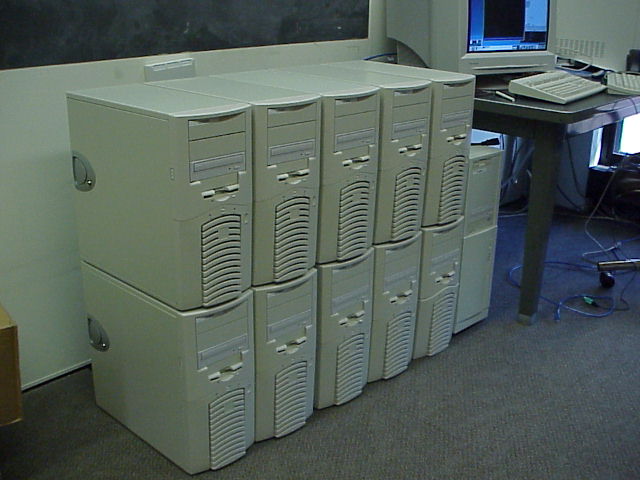
48 2 unit, 2 cpu 1ghz machines in three racks all run by Fermi's homegrown redhat distro.
And this is just one of our farms.. there's another linux one that I don't work on back in there, somewhere, with similar capacity.
Linux is becoming the standard desktop here as well. The price/performance ratio has really cranked up linux's desireability. PBS-type systems are getting popular here, too. Many linux desktops are linked into a homegrown batch system that they're trying to get off the ground, which is intended to build software of various types.
Linux is definetly big here.. and it's getting bigger. They hired me on just because of the influx of linux that's appeared.
-
Fermi borrowed their setup from GodI interviewed at Fermi a few months ago and got a tour of a few of their cold rooms.
Oh...my...*drool* *wipe* *wipe*
Rows of Origin machines churning away...tape rooms with robot arms zipping about faster than you can figure out what they're doing...Linux everywhere you turn...it was heaven. I was dizzy with envy. Alas, they didn't pay enough to make the commute worth it - they're about 45 minutes out on I-55 (non-rush hour) and I like living downtown.
-
Fermilab
Try Fermilab (Department of Energy)
www.fnal.gov
More than 2000 emploees and most of the scintists use Linux as Desktop OS. We even have our own Linux distribution: Fermi Linux