Slashdot Mirror
Domain: geekwire.com
Stories and comments across the archive that link to geekwire.com.
Stories · 303
-
Microsoft Could Be First Tech Company To Reach Trillion-Dollar Market Value: Analyst (geekwire.com)
Microsoft's $26.2 billion acquisition of LinkedIn could help the Redmond company become the first technology giant to reach a market value of $1 trillion, or so thinks a notable analyst. Analyst Michael Markowski believes that Microsoft will be able to leverage LinkedIn to become a leader in social media space and the emerging crowdfunding platform. So much so that it will beat Amazon, Google, Apple, and Facebook in becoming the first company to hit $1 trillion market value. From a report on GeekWire: Here are the market caps of these big tech companies as of Monday morning: Apple: $622.6B, Alphabet: $549.7B, Microsoft: $489.3B, Amazon: $358.7B, and Facebook: $337.6B. "The public has an insatiable appetite for making small bets and purchasing lottery tickets, etc., that provide the chance to make a big profit," Markowski wrote. "The millennials will be a good example. Many will want to routinely invest $100 or even less into high-risk ventures that could produce returns of 10X to 100X." Microsoft, through LinkedIn, will be able to take advantage of this trend because it has a monopoly on the business social media sphere. Markowski predicts that all the big tech companies will eventually build services to facilitate crowdfunding investments. -
Can Consumers Fight Package Thieves With Technology? (geekwire.com)
Every year more than 10 million packages are stolen off doorsteps, according to a study by August Home Inc. -- a company which sells a "smart" door lock that's controlled by your cellphone so you can remotely let a delivery person into your house. But that's just one of the weird ways consumers are using technology to try to fight package thieves. An anonymous reader reports: Some online shopping sites will now also text you when one of their packages gets left on your doorstep, according to GeekWire, which reports that for a thousand bucks you can also just buy a lockable iBin parcel-delivery box. But there's also a startup selling an odd new product called Package Guard, "a Frisbee sized, wi-fi-enabled device that alerts a user when a package has been delivered and set on top of it. Package Guard sets off a loud alarm if anyone unauthorized tries to remove the package."
GeekWire details the frustration of one Seattle police detective. "Bach knows the crimes are happening, he knows it all spikes during the holiday season and he knows that the few thieves who are caught are likely to see little if any jail time." (Though Bach admits "We do a wide variety of undercover stings," including a recent operation involving mobile surveillance with a "major delivery company.") One Seattle man even attempted to stop thieves by installing a Ring smart doorbell to film activity on his doorstep, only to discover that this only enabled him to watch helplessly as a thief opened his package, and then successfully stole all of its contents.
Though he yelled at the video "Bring my package back now!" that thief was never caught. -
Another One Bites the Dust: Cisco Discontinues Its $1B Cloud Initiative as AWS, Azure and Others Expand (geekwire.com)
Cisco will abandon its InterCloud cloud-computing offering on March 31 and will move any InterCloud workloads to other, unnamed cloud providers, including "in some cases, public cloud." From a report on GeekWire: Cisco's pull-back from the cloud scene marks the latest example of smaller participants -- many of them hardware-makers -- bailing in the face of huge growth by Amazon Web Services and Microsoft Azure, and to some extent by Google Cloud, IBM and other, smaller public-cloud services. Hewlett-Packard in 2015 abandoned its efforts to be a public-cloud company. Then, Hewlett-Packard Enterprises essentially shut down its much-ballyhooed Helion cloud offering earlier this year. VMware still offers its vCloud Air hybrid-cloud service, though it has agreed to partner with AWS, which it once viewed as its arch-rival for cloud workloads. "We do not expect any material customer issues as a result of this transition," Cisco said in response to a request for comment. "For the last several months, we have been evolving our cloud strategy and our service provider partners are aware of this." -
Wielding Their Windows Phones, Microsoft Shareholders Grill CEO Satya Nadella On Device Strategy (geekwire.com)
At a meeting with shareholders Wednesday, Microsoft CEO Satya Nadella was asked numerous times what the company is doing about Windows Phones, and why do they keep hearing that Microsoft is abandoning smartphone manufacturer business. The stakeholders also asked why the company is seemingly focusing more on Android and iOS rival platforms instead of its own. From a report on GeekWire: Microsoft shareholder Dana Vance, owner of a Windows Phone and a Microsoft Band, said he received an email about the Microsoft Pix app but was surprised to learn that it was available for iPhone and Android but not Windows Phone. Ditto for Microsoft Outlook. He also alluded to reports that Microsoft has put the Band on the back burner. Given this, he asked Nadella to explain the company's vision for its consumer devices. As part of his response, Nadella said Microsoft's Windows camera and mail apps will include the same features as in Microsoft's apps for other platforms. "When we control things silicon-up, that's how we will integrate those experiences," Nadella said. The company will "build devices that are unique and differentiated with our software capability on top of it -- whether it's Surface or Surface Studio or HoloLens or the phone -- and also make our software applications available on Android and iOS and other platforms. That's what I think is needed in order for Microsoft to help you as a user get the most out of our innovation." Another shareholder, who says he uses his Windows Phone "18 hours a day," said he has heard Microsoft is "stepping away from mobile." He asked, "Can you calm me down ... and tell me what your vision is for mobile?" Nadella answered, "We think about mobility broadly. In other words, we think about the mobility of the human being across all of the devices, not just the mobility of a single device. That said, we're not stepping away or back from our focus on our mobile devices," Nadella said. "What we are going to do is focus that effort on places where we have differentiation. If you take Windows Phone, where we are differentiated on Windows Phone is on manageability. It's security, it's Continuum capability -- that is, the ability to have a phone that can act like a PC. So we're going to double-down on those points of differentiation." -
Amazon Puts New Limit On Customer Reviews: No More Than 5 a Week Except For Verified Purchases (geekwire.com)
Amazon says it will start capping the number of product reviews any customer can submit in a given week, limiting each person to five/week except for products that have been verified by the company as purchased by the reviewer. From a GeekWire report: Books, music and video are exempt from the limit, but the new cap applies to the rest of Amazon's vast online selection of products. It's the latest move by the e-commerce giant to police its online reviews, a critical resource used by many online shoppers to assess products before buying. The news comes during the peak holiday shopping season, the most important time of year for Amazon, as the company tries to get more people comfortable with doing more of their shopping online. An Amazon spokeswoman confirmed the changes in a message to GeekWire, and they're spelled out in Amazon's updated Community Guidelines. -
Amazon Wants To Include Live Sports as Part of Prime Membership (geekwire.com)
An anonymous reader writes: Amazon's next Prime membership benefit could be the ability to stream live sports. The Wall Street Journal reported Monday that Amazon is in talks with leagues like the NFL, NBA, MLB, and a handful of others about live game rights. The fact that Amazon wants to stream live sports isn't a new development. But the Journal did have a noteworthy tidbit: Amazon could offer a "premium, exclusive sports package" to those who pay for a $99 per year, or $8.99 per month, Prime membership. Amazon is exploring streaming rights to multiple sports at a variety of levels. The Journal reported that Amazon wanted to exclusively license NBA's League Pass streaming product; it is also reaching out to traditional broadcasters like Univision and ESPN about the content they own but don't end up airing on TV.Amazon was also recently exploring deals with Indian Premier League, a cricket match league. In a recent interview with David Remnick of The New Yorker, Reed Hastings said that one of the most difficult decisions for him has been to not do live sports. He said Netflix doesn't want to move away from movies and TV shows, and only focus on improving the quality of the shows and user experience. -
SpaceX Files FCC Application For Internet Access Network With 4,425 Satellites (geekwire.com)
An anonymous reader quotes a report from GeekWire: SpaceX has laid out further details about a 4,425-satellite communications network that's expected to provide global broadband internet access, with its Seattle-area office playing a key role in its development. The plan is explained in an application and supporting documents filed on Tuesday with the Federal Communications Commission. In the technical information that accompanied its application, SpaceX said it would start commercial broadband service with 800 satellites. That service would cover areas of the globe from 15 degrees north to 60 degrees north, and from 15 degrees south to 60 degrees south. That leaves out some portions of Alaska, which would require a temporary waiver from the FCC. Eventually, the network would grow to 4,425 satellites, transmitting in the Ku and Ka frequency bands. "Once fully deployed, the SpaceX system will pass over virtually all parts of the Earth's surface and therefore, in principle, have the ability to provide ubiquitous global service," SpaceX said. The satellites would orbit the planet at altitudes ranging from 714 to 823 miles (1,150 to 1,325 kilometers) -- well above the International Space Station, but well below geostationary satellites. SpaceX said it would follow federal guidelines to mitigate orbital debris. Each satellite would weigh 850 pounds (386 kilograms) and measure 13 by 6 by 4 feet (4 by 1.8 by 1.2 meters), plus solar arrays, SpaceX said. Operating lifetime was estimated at five to seven years per satellite. -
SpaceX Files FCC Application For Internet Access Network With 4,425 Satellites (geekwire.com)
An anonymous reader quotes a report from GeekWire: SpaceX has laid out further details about a 4,425-satellite communications network that's expected to provide global broadband internet access, with its Seattle-area office playing a key role in its development. The plan is explained in an application and supporting documents filed on Tuesday with the Federal Communications Commission. In the technical information that accompanied its application, SpaceX said it would start commercial broadband service with 800 satellites. That service would cover areas of the globe from 15 degrees north to 60 degrees north, and from 15 degrees south to 60 degrees south. That leaves out some portions of Alaska, which would require a temporary waiver from the FCC. Eventually, the network would grow to 4,425 satellites, transmitting in the Ku and Ka frequency bands. "Once fully deployed, the SpaceX system will pass over virtually all parts of the Earth's surface and therefore, in principle, have the ability to provide ubiquitous global service," SpaceX said. The satellites would orbit the planet at altitudes ranging from 714 to 823 miles (1,150 to 1,325 kilometers) -- well above the International Space Station, but well below geostationary satellites. SpaceX said it would follow federal guidelines to mitigate orbital debris. Each satellite would weigh 850 pounds (386 kilograms) and measure 13 by 6 by 4 feet (4 by 1.8 by 1.2 meters), plus solar arrays, SpaceX said. Operating lifetime was estimated at five to seven years per satellite. -
Google Cloud Will Add GPU Services in Early 2017 (geekwire.com)
Google Cloud will add GPUs as a service early next year, the company has said. Amazon Web Services, Microsoft Azure and IBM's Bluemix all already offer GPU as a service. From a report on GeekWire: Google may be seeking to distinguish itself, however, with the variety of GPUs it's offering. They include the AMD FirePro S9300 x2 and two offerings from NVIDIA Tesla: the P100 and the K80. And Google will charge by the minute, not by the hour, making GPU usage more affordable for customers needing it only for short periods. CPU-based machines in the cloud are good for general-purpose computing, but certain tasks such as rendering or large-scale simulations are much faster on specialized processors, Google explained. GPUs contain hundreds of times as many computational cores as CPUs and excel at performing risk analysis, studying molecular binding or optimizing the shape of a turbine blade. Google's GPU services will be available in early 2017 through Google Compute Engine and Google Cloud Machine Learning. -
Edward Snowden Kills Team Trump's Conspiracy Theory By Explaining How The FBI Can Quickly Comb Through Email (geekwire.com)
FBI director James Comey told Congress Sunday that the further investigation of emails related to Hillary Clinton didn't turn up anything that would cause the bureau to recommend charges against her. The FBI had reviewed over 650,000 emails under nine days. Upon hearing this, GOP presidential candidate Donald Trump and his supported started to question whether the FBI could go through all those emails in such a short period of time. We will never know for sure until the FBI explains its process to us all (which is unlikely to happen), so people turned to Edward Snowden over the weekend for answers. And Mr. Snowden didn't disappoint. From a report on GeekWire: How easy would it be to cull out the duplicate emails? Outspoken journalist Jeff Jarvis posed that question to Snowden in a tweet, and got a quick response: "Drop non-responsive To:/CC:/BCC:, hash both sets, then subtract those that match. Old laptops could do it in minutes-to-hours." -
Where Does Jeff Bezos Foresee Putting Space Colonists? Inside O'Neill Cylinders (geekwire.com)
Elon Musk of SpaceX wants to settle humans on Mars. Some talk about taking the Moon Village route. But Jeff Bezos has a different kind of off-Earth home in mind when he talks about having millions of people living and working in space. His long-range vision focuses on a decades-old concept for huge artificial habitats that are best known today as O'Neill cylinders. From a report on GeekWire (edited and condensed): The concept was laid out in 1976 in a classic book by physicist Gerard O'Neill, titled "The High Frontier." The idea is to create cylinder-shaped structures in outer space, and give them enough of a spin that residents on the inner surface of the cylinder could live their lives in Earth-style gravity. The habitat's interior would be illuminated either by reflected sunlight or sunlike artificial light. Bezos referred to his long-term goal of having millions of people living and working in space, as well as his enabling goal of creating the 'heavy lifting infrastructure' to make that happen. In Bezos' view, dramatically reducing the cost of access to space is a key step toward those goals. "Then we get to see Gerard O'Neill's ideas start to come to life, and many of the other ideas from science fiction," Bezos said. "The dreamers come first. It's always the science-fiction guys: They think of everything first, and then the builders come along and they make it happen. But it takes time." For Musk, the prime driver behind settling people on Mars is to provide a backup plan for humanity in the event of a planetwide catastrophe -- an asteroid strike, for example, or environmental ruin, or a species-killing pandemic. Bezos sees a different imperative at work: humanity's growing need for energy. "We need to go into space if we want to continue growing civilization," he explained. "If you take baseline energy usage on Earth and compound it at just 3 percent per year for less than 500 years, you have to cover the entire surface of the Earth in solar cells. That's just not going to happen. [...] I predict that in the next few hundred years, all heavy industry will move off planet. It will be just way more convenient to do it in space, where you have better access to resources, better access to 24/7 solar power," he said last weekend. "Solar power on Earth is not that great, because the planet shades us half the time. In space, you get solar power all the time. So there'll be a lot of advantages to doing heavy manufacturing there, and Earth will end up zoned residential and light industry. [...] We want to go to space to save the Earth. I don't like the 'Plan B' idea that we want to go to space so we have a backup planet. ... We have sent probes to every planet in this solar system, and believe me, this is the best planet. There is no doubt. This is the one that you want to protect." -
People Like Netflix's Original Content More Than Its Other Content: AllFlicks (allflicks.net)
According to a study by IHS Markit this month, in the last two years Netflix's spending on original content rose from $2.38 billion to $4.91 billion. The company has invested big in original programming -- and it looks to be paying off. The folks over at AllFlicks have found that Netflix's subscriber base prefers Netflix's original content to that of its syndicated content. AllFlicks reports: Netflix user ratings show that Netflix's subscriber base prefers Netflix's original content to its syndicated content. Netflix originals sport an average rating of 3.85 stars out of five; all other content averages 3.47 stars. That means that user ratings for Netflix originals are 11% higher, on average, than user ratings for syndicated content. Netflix does best in the documentaries category, where users rate non-original content, on average, at 3.54. Netflix's documentaries average 4.07 stars, a pretty impressive showing. Netflix's TV shows do the worst, but still edge their other TV show content by 5.7%. It's possible that the frequent reviewers among Netflix's user base differ from the user base as a whole, but there's not a lot of reason to doubt the raw data here. The Netflix originals and non-originals were both reviewed on the same service and using the same rating system, yet originals consistently outperformed the rest of the content. -
Netflix's Big Bet on Original Shows Finally Seen Paying Off (reuters.com)
Netflix shares jumped as much as 20 percent on Tuesday, after the company added 50 percent more subscribers than expected in the third quarter. Reuters adds: At least 10 brokerages, including Goldman Sachs and RBC Capital Markets, raised their price targets on the stock, praising the company's focus on developing original content. The video streaming company also said it was getting ready to spend $6 billion on content next year, up $1 billion from 2016. "The benefits of Netflix-produced original content including attractive economics and greater control are clear and we believe returns on original spend are high," J.P. Morgan Securities analyst Doug Anmuth said in a research note. Strong subscriber additions after two quarters of disappointing growth helped Netflix post a 31.7 percent jump in third-quarter revenue. Anmuth said he believed Netflix was on track toward 60 million plus subscribers in the United States and about 100 million internationally by 2020.A study by IHS Markit this month noted that both Netflix and Amazon are challenging major networks by upping spending on original shows. The study noted that Amazon and Netflix both had doubled spending on new shows in the last two years. Amazon dropped $1.22 billion in 2013 and spent $2.67 billion in 2015. Netflix's spending on original content rose from $2.38 billion to $4.91 billion over the same period. -
Amazon Launches New 'Music Unlimited' Service, Starts At $4/Month For Use On Just One Echo (geekwire.com)
Speaking of giant ecommerce companies, Amazon has launched a streaming music service dubbed, Amazon Music Unlimited, that starts at $3.99 (cheaper than Spotify or Apple Music) and has tens of millions of songs. There's a catch, however. The service has three payment tiers, but the lowest one -- which again, costs $3.99 -- only works with company's Amazon Echo, or Echo Dot, or Amazon Tap speakers. GeekWire adds: To use Amazon Music Unlimited on multiple devices, including smartphones, you'll need to pay $7.99 if you're an Amazon Prime member, or $9.99 if you're not. In a world where people increasingly expect everything to work everywhere, the Echo-only tier might seem out of place, even at less than $4 a month. But Amazon is pitching the option as an add-on experience for Echo owners, going beyond the 2 million tracks available in the existing Amazon Prime Music service that comes with the $99/year Amazon Prime subscription. The company is also using some smart computing behind the scenes to differentiate the experience. For example, Echo users will be able to ask Alexa to "play the new song by Adele." -
Amazon Eyes Its Own Convenience Stores In Addition To Drive-Up Grocery Sites (geekwire.com)
Amazon's next push into the grocery business could be convenience stores as well as curbside pickup locations, reports WSJ. The Seattle-based company aims to build small brick and mortar stores that would sell things like milk, meat and other perishable items (Editor's note: the link could be paywalled; alternate source). GeekWire adds: But the convenience stores are a new twist. The WSJ says Amazon "aims to build small brick-and-mortar stores that would sell produce, milk, meats and other perishable items that customers can take home," according to its sources. "Primarily using their mobile phones or, possibly, touch screens around the store, customers could also order peanut butter, cereal and other goods with longer shelf lives for same-day delivery." However, the report cautions, the convenience stores "may take a year or more to open while Amazon scouts locations, and may be shelved because of financial or operational concerns, the people said."Interesting move from Amazon, a company that has run many convenience stores out of business with its online business. -
Amazon Piles On the Prime Benefits With New 'Prime Reading' Perk (geekwire.com)
Amazon today unveiled the latest perk for Prime members in the United States: Prime Reading. With this, the company is offering access to "over a thousand" Kindle books, comics, magazines and more. The selection will rotate, the company says, suggesting that you should be able to read titles that aren't available today. GeekWire adds: The new perk, Prime Reading, lets Amazon Prime members access more than 1,000 e-books from best-selling authors at no extra charge, read a rotating selection of popular magazines, and read content from the company's Kindle Singles library, including classic short stories and essays. Prime reading is available on the Kindle app for iOS and Android, and on the company's Kindle e-readers and Fire tablets. The new perk comes in addition to the Kindle Owners' Lending Library, which lets Prime members who own Amazon devices borrow one e-book a month from a larger selection of titles. Separate from a Prime membership, Amazon offers the $10/month Kindle Unlimited e-book subscription service.Amazon Prime program costs $99 per year. -
What Jonathan Coulton Learned From The Technology Industry (geekwire.com)
In a new article on GeekWire, Jonathan Coulton explains why he left a comfortable software development job in 2005 to launch a career as an online singer-songwriter. But he also describes the things he learned from the tech industry. "These guys were doing this thing they wanted to do, this thing they felt competent doing. They didn't chase after things, and they worked hard, but it was a business they created because they enjoyed it. They tried to minimize the things they didn't want to do. It wasn't about getting rich; it was about getting satisfied...
"I wanted to a set a good example to my children. I wanted to be the person I wanted to be, someone willing to take chances -- a person who didn't live with enormous regrets..." Within the first year, he had not replaced his software salary, but had enough success to cover his babysitter and to keep food on the table.
When he was younger -- in the pre-internet days -- "It was very unclear how to become a musician," Coulton explains. But somehow rolling his own career path eventually led to a life which includes everything from guest appearances on radio shows to an annual cruise with his fans (this year featuring Aimee Mann, Wil Wheaton, and Redshirts author John Scalzi). -
WSJ: Facebook's Point System Fails To Close Diversity Gap
theodp writes: Gizmodo and others are picking up on a Wall Street Journal story (Warning: may be paywalled) which reported that Facebook's failure to move the needle on diversity is all the more surprising because the social network awarded Facebook recruiters double points for a "diversity hire" -- a female, Black, or Hispanic engineer -- compared to the hire of a White or Asian male. Facebook declined to comment on whether this points-based system is still in effect. The WSJ also notes that Intel has paid its employees double referral bonuses for women, minorities, and veterans. The reward schemes evoke memories of gender-based (and later race-based) incentives offered for K-12 coding and STEM programs run by tech-backed Code.org (to which Facebook just pledged $15 million) and Google, which offered lower funding or no funding at all to teachers if participation by female students was deemed unacceptable to the sponsoring organizations. Facebook's efforts also seem consistent with the tech-backed Every Student Succeeds Act, which calls for increasing CS and STEM access to address a tech-declared national crisis, but only "for students through grade 12 who are members of groups underrepresented in such subject fields, such as female students, minority students, English learners, children with disabilities, and economically disadvantaged students." Hey, sometimes "every" doesn't mean "every!" -
Microsoft Acquires Beam Game Streaming Service, Embracing Alternative To Amazon's Twitch (geekwire.com)
An anonymous reader shares a GeekWire report: Microsoft's Xbox group announced Thursday that it has acquired Seattle-based interactive game streaming service Beam, bringing the Redmond, Wash.-based tech giant into an arena dominated by Amazon's Twitch. Microsoft said in a blog post the deal will help make Xbox more social and interactive. Beam launched in January, with a goal of giving people watching gamers the ability to participate in the experience. Viewers can affect gameplay by presenting new challenges and quests using visual controls. -
Apple Acquires Machine Learning and AI Startup Turi (geekwire.com)
An anonymous reader quotes a report from GeekWire: Machine learning and artificial intelligence startup Turi has been acquired by Apple in a deal characterized as a blockbuster exit for the Seattle-based company, formerly known as Dato and GraphLab, GeekWire has learned. The acquisition reflects a larger push by Apple into artificial intelligence and machine learning. It also promises to further increase the Cupertino, Calif.-based company's presence in the Seattle region, where Apple has been building an engineering outpost for the past two years. Multiple sources with knowledge of the deal confirmed that Turi has been acquired. Sources close to the deal pegged the purchase price at around $200 million, marking a huge outcome for the original investors and early shareholders. Apple's plans for Turi's technology are not clear, but the company has been making a broad push into artificial intelligence through an expansion of its Siri personal assistant and related technologies. Turi lets developers build apps with machine learning and artificial intelligence capabilities that automatically scale and tune. Its products -- which include the Turi Machine Learning Platform, GraphLab Create, Turi Distributed, and Turi Predictive Services -- are largely designed to help large and small organizations make better sense of data. Use cases include recommendation engines, fraud detection, predicting customer churn, sentiment analysis, and customer segmentation. -
Amazon Reaches New High Of 268,900 Employees -- Skyrocketing 47% In Just One Year (geekwire.com)
Amazon remains one of the biggest attractors of talent worldwide. During its quarterly earnings, the company said it hired 23,700 employees in the second quarter -- making the total employee headcount at the company 268,900. GeekWire reports: Amazon's headcount has grown by a staggering amount over the last few years. Its employment numbers increased close to 10 percent in the last three months and 47 percent over a year ago, when its employee count stood at a paltry-by-comparison 183,100 people. That's an increase of 85,800 employees in one year -- more than the entire city of Bellingham, Wash.Related: The New York Times report on work challenges at Amazon. -
Kurzweil Argues Technology Improves The World, Compares DNA to Code (geekwire.com)
Futurist Ray Kurzweil told a Seattle conference specific ways in which technology is already improving our lives. For example, while there's a general perception that the world's getting worse, "What's actually happening is our information about what's wrong in the world is getting better. A century ago, there would be a battle that wiped out the next village, you'd never even hear about it." An anonymous Slashdot reader quotes two of Kurzweil's other interesting insights: "We're only crowded because we've crowded ourselves into cities. Try taking a train trip across the United States, or Europe or Asia or anywhere in the world. Ninety-nine percent of the land is not used... we don't want to use it because you don't want to be out in the boondocks if you don't have people to work and play with. That's already changing now that we have some level of virtual communication..."
[And on the potential of human genomics] "It's not just collecting what is basically the object code of life that is expanding exponentially. Our ability to understand it, to reverse-engineer it, to simulate it, and most importantly to reprogram this outdated software is also expanding exponentially. Genes are software programs. It's not a metaphor. They are sequences of data. But they evolved many years ago, many tens of thousands of years ago..." -
Amazon Isn't Saying If Echo Has Been Wiretapped (zdnet.com)
An anonymous reader writes from a report via ZDNet: Since announcing how many government data requests and wiretap orders it receives, Amazon has so far issued two transparency reports. The two reports outline how many subpoenas, search warrants, and court orders the company received to cloud service, Amazon Web Services. The cloud makes up a large portion of all the data Amazon gathers, but the company does also collect vast amounts of data from its retail businesses, mobile services, book purchases, and requests made to Echo. The company's third report is due to be released in a few weeks but an Amazon spokesperson wouldn't comment on whether or not the company will expand its transparency report to include information regarding whether or not the Amazon Echo has been wiretapped. There are reportedly more than three million Amazon Echo speakers out in the wild. Gizmodo filed a freedom of information (FOIA) request with the FBI earlier this year to see if the agency had wiretapped an Echo as part of a criminal investigation. The FBI didn't confirm or deny wiretapping the Echo. Amazon was recently awarded a patent for drone docking and recharging stations that would be built on tall, existing structures like lampposts, cell towers, or church steeples. -
Chinese Telecom Giant Huawei Sues T-Mobile For Patent Infringment (geekwire.com)
Nat Levy, reporting for GeekWire: Huawei alleges that Bellevue-based T-Mobile would not make a deal to license several 4G patents from the Chinese telecom company, and is still using those technologies, according to a lawsuit filed Tuesday. The complaint, filed in the U.S. District Court in Eastern Texas, alleges that Huawei offered to give T-Mobile license for several 4G patents under fair, reasonable and non-discriminatory terms (FRAND). T-Mobile allegedly didn't take the offer and continues to use the patented technologies. According to the lawsuit, the conflict goes back to 2014, when Huawei wanted to begin a licensing discussion, but T-Mobile allegedly would not sign a non-disclosure agreement and negotiations stalled. Earlier this year, Huawei filed several patent infringement complaints, according to the Puget Sound Business Journal, which first reported on today's suit. Huawei is not looking for monetary damages, but instead wants a declaratory judgment that would help facilitate a licensing agreement. -
New York Falls and Seattle Rises on 'America's Top Tech Cities' List (geekwire.com)
CRBE has released their annual list of the top tech cities in the U.S., analyzing 13 metrics (including salaries and housing costs) to "gauge the competitive advantage of markets and their ability to attract, grow and retain tech-talent pools." An anonymous Slashdot reader quotes an article from Geekwire: Seattle is the third best tech market in North America, trailing only the San Francisco Bay Area and Washington D.C.... Seattle passed New York for third this year on the back of a growing, well-paid and well-educated class of tech employees and a strong roster of big companies...with New York and Austin rounding out the top five.
The report shows a big divide in Seattle between a prosperous tech community and everyone else. Tech workers in Seattle make $110,999 on average, and their wages have increased close to 20 percent since 2010... The 177,380 people who work in other professional fields like finance, sales and marketing make an average of $57,603 per year and their wages have only increased 6.3 percent since 2010. During that same time period, apartment rents increased 39 percent to an average of $1,619 a month.
San Francisco had the highest annual salary for tech workers -- $123,921 -- followed by Seattle, which also had the highest percentage of workers with at least a bachelor's degree -- 59%. And there's also an interesting second list of the top small tech markets, which is led by Columbus, Ohio followed by Charlotte, North Carolina, and Portland, Oregon. -
Amazon Gobbles Downtown Seattle, Builds Biospheres (bloomberg.com)
Amazon has grabbed more than 15% of Seattle's office space inventory, which a local book author is describing as "the Amazocalypse". And now Amazon is building three "gigantic spheres resembling melted-together Milk Duds in the shadow of their new 500-foot-tall office tower," according to Bloomberg: The 100-foot-tall orbs -- Amazon calls them Biospheres -- will host more than 300 plant species from around the world, creating what the company sees as the workplace of the future. Amazonians will be able to break from their daily labors to walk amid the greenery along suspension bridges and climb into meeting spaces resembling bird nests perched in mature trees... Many of the plants are endangered species, meaning that the spheres double as a conservation project.
Bloomberg talks about the desire of Amazon and other tech companies to stay -- and grow -- in the popular cities "where millennials prefer to live". While the owners of Seattle's Space Needle complain that all the new office towers are blocking views of their tourist attraction, the article also describes how Amazon leased the ground floors of its office buildings to "hand-picked bars, restaurants and coffee shops," transforming it from "a hodgepodge of car dealerships and second-hand stores." -
Microsoft Will Be Largest Infrastructure As A Service Vendor By 2019, Says Morgan Stanley Survey (geekwire.com)
An anonymous reader writes from a report via GeekWire: According to Morgan Stanley's 2016 CIO Survey of 100 CIOs (75 CIOs based in the U.S., and 25 based in Europe), Microsoft's Azure will overtake Amazon Web Services (AWS) by 2019 to become the largest Infrastructure as a Service (IaaS) and Platform as a Service (PaaS). The survey finds that roughly 31 percent of the CIOs will be using Azure for IaaS, compared to roughly 30 percent using AWS. Today, roughly 21 percent are using AWS and 12 percent are using Azure. According to the survey, Azure is already leading AWS in PaaS, used by about 18 percent of the respondents, versus AWS's 16 percent. Azure's lead will grow slightly by 2019, growing 9.8 percent versus 6.4 percent. Nearly 30 percent of all applications will be migrated to the public cloud by the end of 2017, up from 14 percent today, the survey said. On-premises apps will decline to 58 percent, from 71 percent today. Predictably, hardware vendors, including conventional and flash storage makers, will continue to suffer as their market is eaten by the cloud. Hardware spending growth is down this year to 3.2 percent, from 3.4 percent last year. Microsoft recently announced it will be entering the legal marijuana industry. It will partner with Los Angeles-based startup Kind on a system for tracking the legal growing and sale of marijuana, with Microsoft powering the software through its Azure cloud computing service. -
Satya Nadella Explores How Humans and AI Can Work Together To Solve Society's Greatest Challenges (geekwire.com)
In an op-ed for Slate, Microsoft CEO Satya Nadella has shared his views on AI, and how humans could work together with this nascent technology to do great things. Nadella feels that humans and machines can work together to address society's greatest challenges, including diseases and poverty. But he admits that this will require "a bold and ambition approach that goes beyond anything that can be achieved through incremental improvements to current technology," he wrote. You can read the long essay here. GeekWire has summarized the principles and goals postulated by Nadella. From the article:AI must be designed to assist humanity.
AI must be transparent.
AI must maximize efficiencies without destroying the dignity of people.
AI must be designed for intelligent privacy.
AI needs algorithmic accountability so humans can undo unintended harm.
AI must guard against bias.
It's critical for humans to have empathy.
It's critical for humans to have education.
The need for human creativity won't change.
A human has to be ultimately accountable for the outcome of a computer-generated diagnosis or decision.
-
Amazon Unveils Inspire Online Education Service For Teachers and Schools (geekwire.com)
Amazon on Monday launched a new site called Amazon Inspire where K-12 teachers and schools can upload and access unlimited education and classroom resources such as videos, tests, projects, games, lesson plans with their peers across the country for free of charge. In a statement, the company said, "Our ultimate goal is for every teacher in every single subject to benefit from Amazon Inspire. When they walk into a classroom, we want every teacher to benefit from the collective knowledge, the collective insights and the experience of every single one of their peers." GeekWire reports:It's the latest in a series of moves by Amazon in the education technology market. The company acquired the TenMarks online math startup in 2014, and separately markets e-books and tablets for teachers and school districts. The company describes the project as an outgrowth of its involvement in the U.S. Department of Education's GoOpen initiative. Amazon also provides technical resources and support for the department's Learning Registry open database. -
Scientists Force Computer To Binge On TV Shows and Predict What Humans Will Do (geekwire.com)
An anonymous reader quotes a report from GeekWire: Researchers have taught a computer to do a better-than-expected job of predicting what characters on TV shows will do, just by forcing the machine to study 600 hours' worth of YouTube videos. The researchers developed predictive-vision software that uses machine learning to anticipate what actions should follow a given set of video frames. They grabbed thousands of videos showing humans greeting each other, and fed those videos into the algorithm. To test how much the machine was learning about human behavior, the researchers presented the computer with single frames that showed meet-ups between characters on TV sitcoms it had never seen, including "The Big Bang Theory," "Desperate Housewives" and "The Office." Then they asked whether the characters would be hugging, kissing, shaking hands or exchanging high-fives one second afterward. The computer's success rate was 43 percent. That doesn't match a human's predictive ability (72 percent), but it's way better than random (25 percent) as well as the researchers' benchmark predictive-vision programs (30 to 36 percent). The point of the research is to create robots that do a better job of anticipating what humans will do. MIT's Carl Vondrick and his colleagues are due to present the results of their experiment next week at the International Conference on Computer Vision and Pattern Recognition in Las Vegas. "[The research] could help a robot move more fluidly through your living space," Vondrick told The Associated Press. "The robot won't want to start pouring milk if it thinks you're about to pull the glass away." You can watch their YouTube video to learn more about the experiment. -
Uber Rolling Out Scheduled Rides In Seattle (geekwire.com)
Scheduled rides are coming to Uber. The ride-hailing announced on Thursday that users in Seattle can now schedule a pickup request as far out as 30 days in advance. GeekWire reports: The ride-sharing service said scheduling is a top-requested feature from business travelers and the company said priority access will be given to riders who have Business Profiles or are linked to their company's Uber account. Uber says it will bring it to other "major" cities soon. -
Seattle App Summons Help When You Need CPR (geekwire.com)
An anonymous reader writes:Sudden cardiac arrest is usually fatal. But Seattle's Fire Department has joined with the city's Medic One Foundation to develop an app which alerts emergency dispatchers and also CPR-trained bystanders when someone needs CPR. The PulsePoint app also shows the location of the nearest defibrillator, and Seattle's mayor says he hopes it will save lives. A Spokane version of the app is already credited with helping to save the life of an infant, and the Medic One Foundation hopes to work with more local fire department to bring the app to the rest of Washington State. -
Apple, Microsoft and Google Hold 23% Of All US Corporate Cash Outside the Finance Sector (geekwire.com)
An anonymous reader writes: Apple, Microsoft, and Google are the top three cash-rich U.S. companies across all sectors of business, not including banks and other financial institutions -- holding a combined $391 billion in cash as of the end of 2015, or more than 23 percent of the entire $1.68 trillion held by the nation's non-financial corporations. Apple leads the pack with $215.7 billion in cash, followed by Microsoft at $102.6 billion, and Google at $73.1 billion. The numbers are documented in a new report from Moody's Investors Service that shows an unprecedented concentration of cash in the tech sector. For the first time, the top five companies on the Moody's cash ranking are tech companies, with Cisco and Oracle following Apple, Microsoft, and Google. Technology companies overall held $777 billion in cash, or 46 percent of the total cash across all non-financial industries. -
Astronauts Won't Be Flying To Space In Boeing's Starliner Until 2018 (theverge.com)
An anonymous reader writes: The Boeing Starliner, one of two new spacecraft meant to break the Russian stranglehold on sending people to orbit, has hit a snag. Originally scheduled to start flying next year, the Starliner won't carry a crewed mission to the International Space Station until 2018 at the earliest. Six years is long enough. Ever since the 2011 retirement of the space shuttle NASA has been pushing for privately built craft capable of ferrying astronauts to orbit, which would let the agency buy American-made ships and end its dependency on renting seats aboard Russian spacecraft. The Starliner and SpaceX's Dragon were chosen, and 2017 was to be the year. But while SpaceX has sent its ship to the ISS on multiple uncrewed cargo resupply missions, the Starliner won't make such trips until 2017 and won't carry people until 2018 at the earliest. SpaceX maintains that it will be able to send crews to orbit in 2017.GeekWire explains: "For Boeing to shift its crewed test flight from 2017 to 2018 isn't as much of a slip as it might sound: The company's earlier schedule had called for the visit to the space station to take place in mid-December." -
First Successful Gene Therapy Against Human Aging? (geekwire.com)
An anonymous reader writes: For the first time data may show that a human being has been successfully rejuvenated by gene therapy, claims Bioviva USA. "In September 2015, then 44 year-old CEO of Bioviva USA Inc. Elizabeth Parrish received two of her own company's experimental gene therapies: one to protect against loss of muscle mass with age, another to battle stem cell depletion responsible for diverse age-related diseases and infirmities." Bypassing America's FDA, the controversial therapies were described by the MIT Technology Review as "do-it-yourself medicine," saying it "raises ethical questions about how quickly such treatments should be tested in people and whether they ought to be developed outside the scrutiny of regulators." "The treatment was originally intended to demonstrate the safety of the latest generation of the therapies," reports Bioviva's web site. "But if early data is accurate, it is already the world's first successful example of telomere lengthening via gene therapy in a human individual." -
Microsoft Sending Minecraft To Summer School
Reader theodp writes: Four months after its one hour Minecraft "infomercial" ran in schools around the world as part of the Hour of Code, Microsoft announced the release of Minecraft: Education Edition. From the announcement: "Minecraft: Education Edition early access will be available in 11 languages and 41 countries. During the summer months, we are also going to be focused on working with educators on building out lesson plans, sharing learning activity ideas, and creating re-usable projects." Microsoft bought Minecraft for $2.5 billion back in 2014. "What many may not realize," said Microsoft last November as it announced a Minecraft-themed tutorial that it would inspire students to learn computer science skills, and "that Minecraft has the power to transform learning on a global scale. By creating a virtual world and then advancing in it, students can learn digital citizenship, empathy, social skills and even improve their literacy "while getting real-time feedback on their problem-solving skills from the teacher." At the time, Microsoft CEO Satya Nadella told teachers that Minecraft is key to getting girls involved in computer science. So is Minecraft really all that? -
Microsoft Sues US Justice Department, Asks Court To Declare Secrecy Orders Unconstitutional (geekwire.com)
Todd Bishop, reporting for GeekWire: Microsoft is suing the U.S. Justice Department, asking a federal judge to declare unconstitutional a provision of U.S. law that lets the government keep Microsoft and other tech companies from informing their customers when investigators seek access to emails and other cloud data. The suit, filed moments ago in U.S. District Court in Seattle, targets Section 2705(b) of the Electronic Communications Privacy Act, which allows the government to seek and obtain secrecy orders preventing companies from letting their customers know when their data is the target of a federal warrant, subpoena or court order. Brad Smith, Microsoft's president and chief legal officer, recently criticized the 30-year-old Electronic Communications Privacy Act as outdated during his testimony in February before the U.S. House Judiciary Committee -- bringing along IBM's first laptop, released the same year, to help illustrate his point.Microsoft argues that these "indefinite gag orders" violate the First Amendment rights to inform customers. Furthermore, the company adds that the law also "flouts" the Fourth Amendment, which requires the government to give a notice to the concerned person when his or her property is being searched or seized. "This is a First Amendment fight that needed to get picked and I'm glad Microsoft picked it. Just as in the real world with physical seizures, secrecy in digital seizures should be the exception and not the rule. Yet as the Microsoft complaint shows, it's receiving thousands of law enforcement gag orders every year and more than two-thirds of them are eternal gags with no end data," said Kevin Bankston, internet freedom advocate and digital rights lawyer. "This is clearly unconstitutional, yet with so many orders per year, it makes sense to strike at the root with a facial challenge to the law rather than try and challenge them all individually. And based on previous similar cases around gag orders in national security cases, I think they'll succeed in striking this overbroad law down." -
Amazon Employees Launch Matchmaking Startup For Coworkers (geekwire.com)
reifman writes: As posted earlier, Amazon's growth and predominantly male hiring has made dating in Seattle incredibly difficult for everyone. Two Amazon employees, Becca Goldman and Mahvish Gazipura, recently launched DateADev to help coworkers optimize their dating profiles: 'at Amazon [we're] surrounded by software developers and project managers all the time, we just noticed their need. We talk to them all the time about their frustrations with dating.' Goldman's gone on more than 500 dates in the past three years. 'Her experience ... helps her quickly assess an online profile of a potential partner.' Rather than drive its employees into moonlighting, Amazon could just start hiring more women. -
Facebook Exec Explains Why Technical Skills Aren't Enough To Be a Great Engineer (geekwire.com)
An anonymous reader writes: Facebook's Regina Wallace-Jones, who is in charge of protecting 1.6 billion people on the social network, says math and science skills aren't enough to tackle challenges at a firm. "Don't let anyone tell you that engineering is only about math and science or that engineering expertise is all you have to offer the world. Your experiences and your perspectives can help inspire a company to find a different approach to a problem or encourage someone else to speak up," she said. "The impact of engineers goes well beyond the mobile apps, the gadgets, and the security systems that we build. The quest to engineer meaningful solutions... is not just about math and science, it's about making amazing solutions for real people in the real world. It's about pushing mankind to its outer limits by inspiring the world to imagine bigger solutions than our hands can hold." -
Harvard: Prospective CS50 AP Teachers Must cc:Microsoft On Training Applications
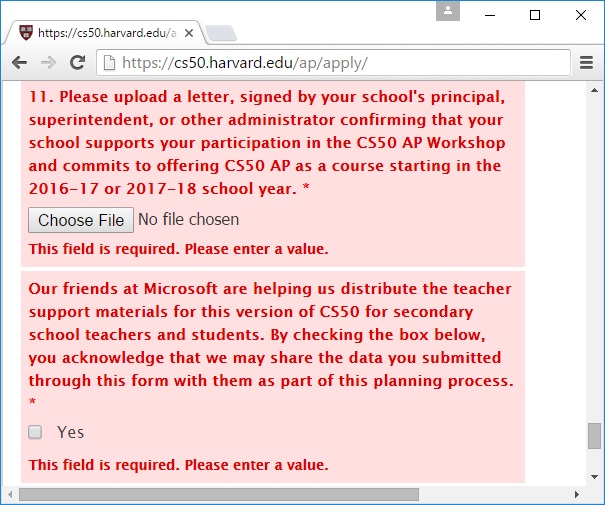
theodp writes: Did you know that Microsoft has supported Harvard in creating a new version [of its wildly-popular CS50 course] called CS50 AP, designed specifically for secondary school educators?" asks a Microsoft Born to Learn Blog post. "If you might like to teach CS50 AP (and, in turn, AP CS Principles) in your own classroom this year," Harvard informs prospective teachers, "you are cordially invited to join us at one of our teacher training workshops to be held in various locations around the country and the world!" But before applications can be successfully submitted, teachers are required to respond to the following statement, and Harvard won't take 'No' for an answer: "Our friends at Microsoft are helping us distribute the teacher support materials for this version of CS50 for secondary school teachers and students. By checking the box below, you acknowledge that we may share the data you submitted through this form with them as part of this planning process." Microsoft is certainly calling the K-12 CS education shots these days — heck, the White House even let Microsoft President Brad Smith brief reporters about plans to spend $4B in tax dollars on a new CS for All K-12 initiative before the President told taxpayers about it. By the way, the CS50 AP Wiki contains a CS50x/CS50 AP Authorization and Release form which, among other things, requires camera-shy CS50 AP students to agree to "sit in a 'no-film' zone" if they do not want photos or videos of themselves used by Harvard to promote the Microsoft-supported course." From the agreement: "I understand that my teacher will take reasonable steps, with my cooperation, to avoid including identifiable images of me in the Recordings. I understand that I am free to opt out of the Recordings in this way, and that doing so will not affect my grade or my ability to participate in course activities. Unless I opt out of the Recordings as described above and take the steps that will be outlined by the instructor to avoid being filmed, I authorize Harvard and its designees to use the Recordings. I understand and agree that the Recordings may include my image, name, and voice. I also understand and agree that, even if I opt out of the Recordings, my spoken name and voice may be picked up by microphones outside any "no-film" zone and may be included in the Recordings. -
K-12 CS Framework Draft: Kids Taught To 'Protect Original Ideas' In Early Grades
theodp writes: Remember that Code.org and ACM-bankrolled K-12 Computer Science Education Framework that Microsoft, Google, Apple, and others were working on? Well, a draft of the framework was made available for review on Feb. 3rd, coincidentally just 3 business days after U.S. President Barack Obama and Microsoft President Brad Smith teamed up to announce the $4+ billion Computer Science for All initiative for the nation's K-12 students. "Computationally literate citizens have the responsibility to learn about, recognize, and address the personal, ethical, social, economic, and cultural contexts in which they operate," explains the section on Fostering an Inclusive Computing Culture, one of seven listed 'Core K-12 CS Practices'. "Participating in an inclusive computing culture encompasses the following: building and collaborating with diverse computational teams, involving diverse users in the design process, considering the implication of design choices on the widest set of end users, accounting for the safety and security of diverse end users, and fostering inclusive identities of computer scientists." Hey, do as they say, not as they do! Also included in the 10-page draft (pdf) is a section on Law and Ethics, which begins: "In early grades, students differentiate between responsible and irresponsible computing behaviors. Students learn that responsible behaviors can help individuals while irresponsible behaviors can hurt individuals. They examine legal and ethical considerations for obtaining and sharing information and apply those behaviors to protect original ideas." -
How Melinda Gates Got Her Daughters Excited About Science (geekwire.com)
theodp writes: GeekWire reports that Melinda Gates concluded a Davos panel discussion about gender parity with a personal story about her own family, explaining how she originally became interested in computer science, and how she later played Lab Manager to Bill's Mr. Wizard to help pass along their passion for science and math to their kids. "On Saturday mornings," Gates explained, "I wanted to sleep late. So you know what I did? I made sure there were science projects available, and that's what he did with our two daughters and our son. And guess what my two daughters are interested in? Science and math." -
The President Wants Every Student To Learn CS. How Would That Work? (npr.org)
theodp writes: The very first proposal President Obama put forth in his final State of the Union address Tuesday night for his remaining year in office was "helping students learn to write computer code." While the President wants every student to learn CS, NPR notes that getting a new, complex, technical subject onto the agendas of our public schools is a massive challenge, prompting it to ask, How Would That Work? That Microsoft CEO Satya Nadella attended the SOTU address as Michelle Obama's guest suggests the President is counting on the kindness of tech titans to help make things happen. Microsoft and Obama have worked together to try to get CS in the schools since at least 2006, when Microsoft announced a $1 million donation to NCWIT, which it indicated would facilitate "taking the discussion to a national stage" at a Washington, D.C. Innovation and Diversity Town Hall co-sponsored by the NSF and keynoted by then-Senator Barack Obama. "Most of all, what inspires me about this program [NCWIT] are the prospects of my two daughters," Obama said at the time (video). "I want them to go as far as their dreams may take them. And, unfortunately because of long historic discrimination in the areas of gender, we can't be assured of that." -
Amazon Reveals New Delivery Drone Design With Range of 15 Miles (geekwire.com)
reifman writes: Amazon released new video of its futuristic drones (honestly, the thought of them buzzing around is the only thing that makes me want to join the NRA) but there's some hopefulness here. Prime Air vehicles will take advantage of sophisticated 'sense and avoid' technology, as well as a high degree of automation, to safely operate beyond the line of sight to distances of 10 miles or more. 'It looks like science fiction, but it's real: One day, seeing Prime Air vehicles will be as normal as seeing mail trucks on the road.' Amazon said its drones fly under 400 feet and weigh less than 55 pounds. -
Hour of Code 2015 Star Wars Tutorial: Spare the IF Statement, Spoil the Child?
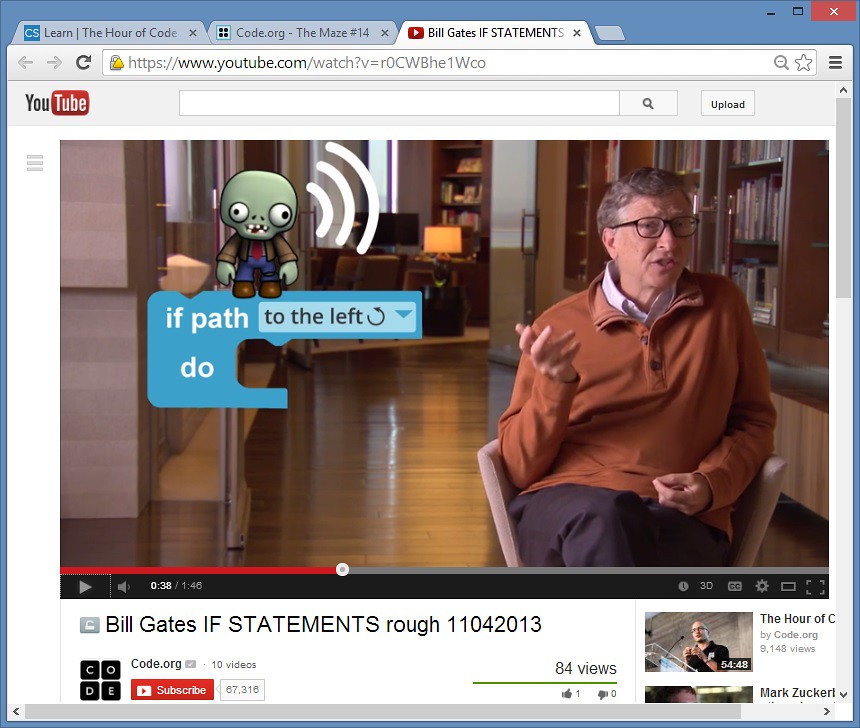
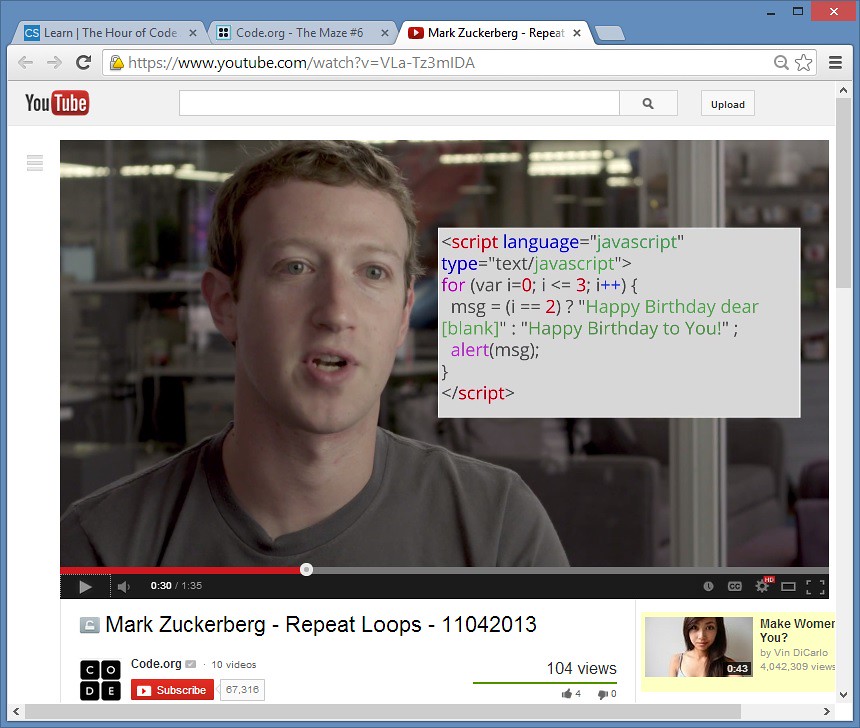
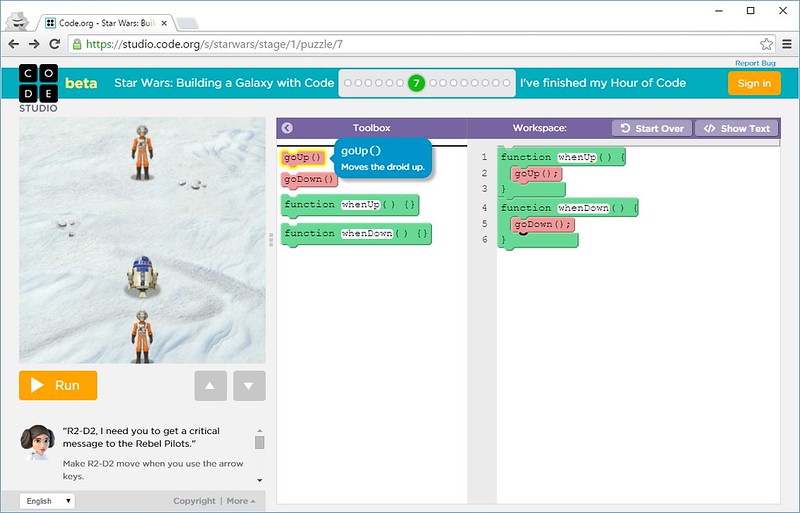
theodp writes: Teaching U.S. K-12 kids their programming fundamentals in past Hours of Code were an IF-fy Bill Gates and a LOOP-y Mark Zuckerberg. Interestingly, the new signature tutorial — Star Wars: Building a Galaxy with Code — created by Lucasfilm and Code.org ("in a locked room with no windows") for this December's Hour of Code, eschews both IF statements and loops. The new learn-to-code tutorial instead elects to show students "events" after they've gone through the usual move-up-down-left-right drills. With the NY Times and National Center for Women & Information Technology recently warning against putting Star Wars in the CS classroom ("Attracting more female high school students to computer science classes might be as easy as tossing out the Star Wars posters," claimed an Aug. 29th NCWIT Facebook post), the theme of the new tutorial seems an odd choice for Code.org, whose stated mission includes "increasing [CS] participation by women." But if Star Wars is, as some suggest, more aimed at boys, perhaps Code.org has something up its sleeve for girls (a la last year's Disney Princesses) with another as yet unannounced signature tutorial that it teased would be "just as HUGE" as the Star Wars one. Any guesses on what that might be? -
Amazon Warns Employees About 'Million Mask March' On Seattle HQ Today (geekwire.com)
reifman writes: Amazon is warning employees not to wear clothing with company logos, and telling them to keep their badges out of sight as hundreds of people loyal to the hacktivist group Anonymous plan to march on the tech giant's Seattle headquarters this afternoon. A Facebook message from the Seattle-based group reads, "On November 5th, we will be rallying at Westlake Park in Seattle at 2pm, and then marching to the Federal Courthouse at 3pm, and from there, we shall march to Amazon for some serious lulz!. Teach-ins and rallies will continue throughout the remainder of the day." -
Recalc Or Die: Excel 1.0 Developers Celebrate Their Baby's 30th Birthday
theodp writes: This weekend, reports GeekWire, many of the original Excel team members are getting together to celebrate the 30th anniversary of the software's release. "We certainly ripped some stuff off," acknowledged Microsoft Excel 1.0 lead developer Doug Klunder, "but we also did some things that nobody else had done at the time and probably hasn't done since — some of which are really insane, and some of which turn out to be pretty handy." Klunder, who was responsible for Excel's killer "intelligent recalc" feature, quit his job after Bill Gates decided to shift the original Excel project from MS-DOS to the Mac, but ended up coming back and finishing the project after an ill-fated stint as a farm worker in the lettuce fields of California. "Just imagine having this product where one of the key components of it is really only understood by this guy who will quit routinely and go be a migrant farm worker down in California," said Excel 1.0 program manager Jabe Blumenthal. "It was not necessarily the most traditional or stable of environments." Many of the original Excel team members still use the program today — the RSVP sheet for this weekend's party was an Excel Online document. Before a professional naming firm came up with "Excel," the software was known by its code name "Odyssey", and other product names considered by Microsoft included "Master Plan" and "Mr. Spreadsheet." By the way, "Mr. Spreadsheet" makes his MOOC debut next week in edX's free-to-audit Excel for Data Analysis and Visualization course. -
AT&T Says Malware Secretly Unlocked Hundreds of Thousands of Phones
alphadogg writes: AT&T said three of its employees secretly installed software on its network so a cellphone unlocking service could surreptitiously funnel hundreds of thousands of requests to its servers to remove software locks on phones. The locks prevent phones from being used on competing networks and have been an important tool used by cellular carriers to prevent customers from jumping ship. -
Amazon Stops Selling Fire Phone
An anonymous reader writes: Last June Amazon announced their Fire Phone, an Android device packed with interesting but questionably useful tech that left reviewers unimpressed. Now, just a few weeks after big layoffs in Amazon's Fire Phone division, the phone has gone out of stock globally and seems unlikely to return. GeekWire says it's "an indication that they've finally exhausted their supply and they don't have plans to manufacture anymore." -
Amazon Stops Selling Fire Phone
An anonymous reader writes: Last June Amazon announced their Fire Phone, an Android device packed with interesting but questionably useful tech that left reviewers unimpressed. Now, just a few weeks after big layoffs in Amazon's Fire Phone division, the phone has gone out of stock globally and seems unlikely to return. GeekWire says it's "an indication that they've finally exhausted their supply and they don't have plans to manufacture anymore."