Slashdot Mirror
Domain: gentoo.org
Stories and comments across the archive that link to gentoo.org.
Comments · 2,150
-
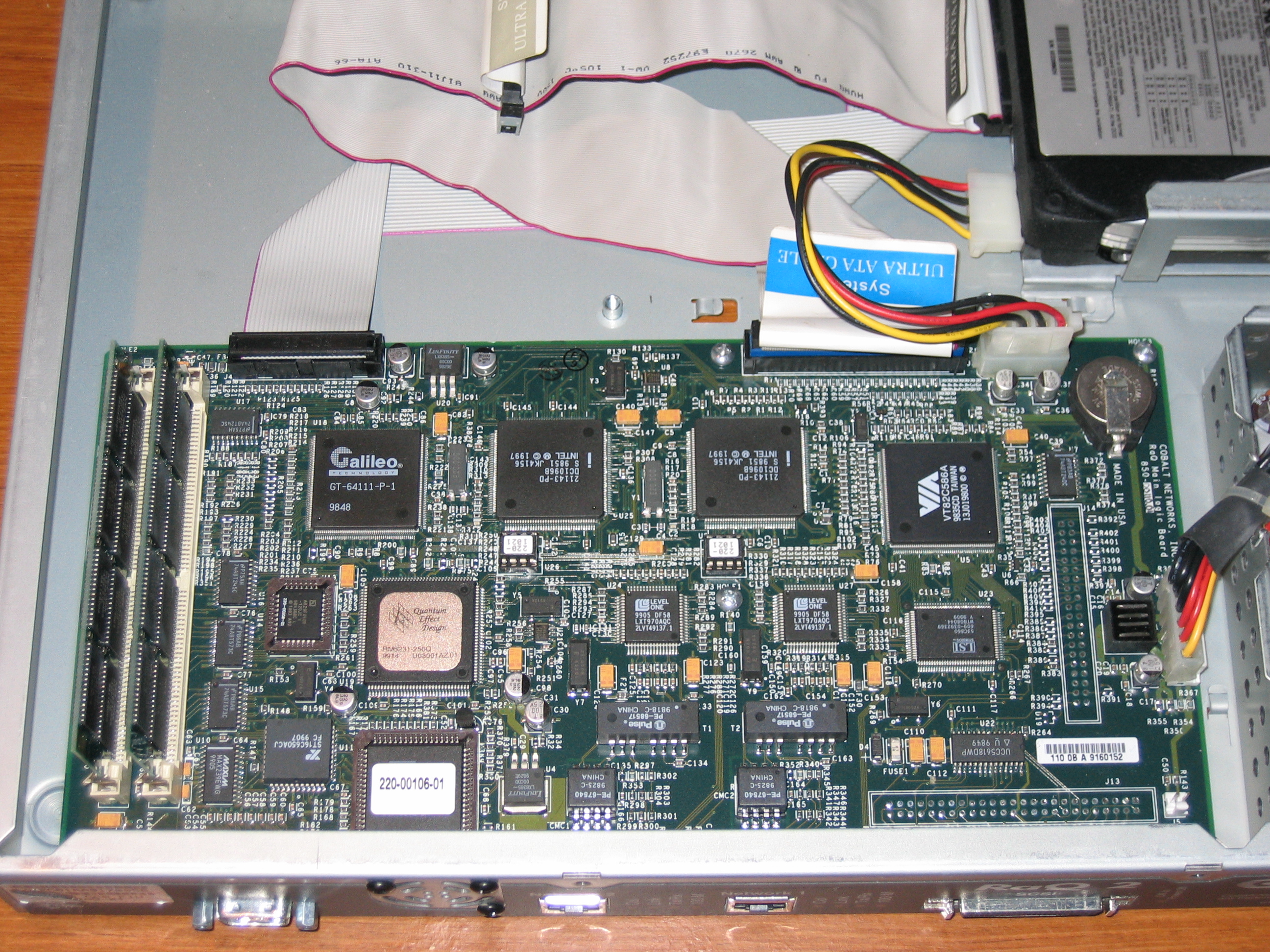
ARM, Acorn, RISC, x86, MIPS and RAQ2
Have run all of these, in anger, in production, at one point or another.
I still have an extremely soft spot for the RAQ2, 64 bit MIPS processor.
Image link - http://dev.gentoo.org/~vapier/pics/mipsel-raq2/inside-main-board.jpg
Nota Bene, NO HEAT-SINKS OF ANY KIND, and yet these puppies could saturate a 10 Mbit connection (of course this was the days before flash and stuff) and the whole mainboard used about 10 watts, most of which was the RAM, the biggest power eater was the IDE HD.
Downside was it was MIPS, which is a lot like the downside of the Acorn ARM based A series and Risc-PC series, eg not x86 compatible, ergo not mainstream.
Now that ARM is used is zillions of other devices, ARM is no longer the backwoods, everywhere except in "a computer" eg desktop or server.
Which means ARM on the desktop or ARM on the server won't suffer so badly for not being x86... it will still suffer, but not so badly.
RAQ3 went away from MIPS to x86, IMHO because of this accessibility and availability of x86 code, not because it was technically superior to MIPS... one RAQ3 wasn't more powerful than two RAQ2 in any sense except power consumption and thermal rejection.
In practical terms x86 has gone nearly as far as it can go, both in terms of light speed and die size, and thermal dissipation per cubic mm, so the alternatives are catching up, not so much because of sheer lifting power, but because of thermal dissipation per cubic mm they still have "development room" left to play around in.
The next 5 years or so are going to be interesting, as this "development room" is explored and used up, and especially so if anyone comes out with a robust cross architecture compiler / translator.
-
Re:Valve...
I'm not going to address all the things you said, but the last one struck me.
Pointing a customer to already existing documentation on how to get their GLX setup properly would cost far more than any revenue you could bring in? You are crazy. I can prove it..
Gentoo, my distro of choice.. google says the docs are here: http://www.gentoo.org/doc/en/nvidia-guide.xml and here: http://www.gentoo.org/doc/en/ati-faq.xml
Or lets pick Ubuntu, google says here: https://help.ubuntu.com/6.06/ubuntu/desktopguide/C/hardware.html#graphics-cards
How much revenue was that? less than a minute of googling.
I would like to address some of your other points but i feel you really haven't taken the time to look into them yourself.
-
Re:Valve...
I'm not going to address all the things you said, but the last one struck me.
Pointing a customer to already existing documentation on how to get their GLX setup properly would cost far more than any revenue you could bring in? You are crazy. I can prove it..
Gentoo, my distro of choice.. google says the docs are here: http://www.gentoo.org/doc/en/nvidia-guide.xml and here: http://www.gentoo.org/doc/en/ati-faq.xml
Or lets pick Ubuntu, google says here: https://help.ubuntu.com/6.06/ubuntu/desktopguide/C/hardware.html#graphics-cards
How much revenue was that? less than a minute of googling.
I would like to address some of your other points but i feel you really haven't taken the time to look into them yourself.
-
Because their middle name is security
Y'know, I'm really glad Google wants to provide a new API for managing security. We need somebody to do this for us - somebody who really knows security, somebody who may as well have security as their middle name, to come out with an API framework for Mandatory Access Controls, preferably built right into th operating system kernel of a major distribution.
Yes, I'm really glad Google took the initiative on this.
-
Download one
Luckily, numerous varieties of recovery disks are Freely Available on the internet, or you can build your own if you prefer.
-
Re:Good luck with that!
for me, i suggest Ubuntu to new people simply because for the most part their forums are very friendly to people new to linux. Also because the distro does try to make things be in similar yet different places than Windows XP. I don't use it for just those reasons, when I feel I want to try something that my distro packagers didn't allow for or don't feel need to be defaults or i want to add something as a service, there seems to be very little documentation on how to do that.
For example I have a laptop that works great apart form the fact the 10/100 Mbit networking card, will drop 90% of packets in 100mbit mode. If you use mii-tool to set it to "10BaseT-FD" it works great dropping not 1 packet. Now, my problem is this and i haven't looked in a while, how do I insert a command to run just after the network card with MAC=12:29:39:xx:xx:xx comes up, but before anything tries to go and get a dhcp address? i have the same problem with suse, redhat, debian(to a lesser degree, there is some doc out for that), but yet that is documented in the Gentoo networking handbook ( http://www.gentoo.org/doc/en/handbook/handbook-x86.xml?part=4&chap=5 ). So, some distros are better for some people than others. Also, anyone get the latest ubuntu CDs to work in virtualbox, or kvm?
-
Re:PPC Linux
I'd run gentoo on it but I run gentoo on everything, including my dead badger ( http://www.strangehorizons.com/2004/20040405/badger.shtml ) http://www.gentoo.org/doc/en/handbook/handbook-ppc.xml
-
Re:The abbreviated list"Unfortunately, most of them have either sold out (like SuSE) or succumbed to internal political quagmires (Gentoo). "
Really?
Pretty much all I've ever used at home over the past years has been Gentoo. I don't find any problems with downloading and installing it.
Their help forums, IMHO, still continue to be some of the most helpful and friendly ones I've ever encountered.
-
Re:Gentoo (Linux) not affected
Cool, you dont get to see this too often when windows version is safer than a linux one!
Hehe..
It also depends on the distributions. Gentoo Linux, for example, was not affected because the package maintainers at Gentoo digitally sign the source tarballs. In this case, the digest created by the Gentoo developer corresponds to the uninfected version. So, any Gentoo user trying to install UnrealIRCd from a infected mirror, would have a digest mismatch and the package manager would just refuse to install.
See https://bugs.gentoo.org/show_bug.cgi?id=323691Of course it things could still go wrong if the UnrealIRCd maintainer at Gentoo digitally signed the infected tarball. But developers at Gentoo have a lot of experience, so I suppose most everyone checks the hash of tarballs after download. At least I do..
-
Gentoo on Arm
-
Re:Sweet!
I still have some marginally useful PPC linux builds. FF won't release builds for PPC linux anymore, and iceweasel is way far behind, and to compile my own is rather
I use Gentoo on a Powerbook. Firefox 3.6.3 compiled just fine, which was better than my experience on x86. Openoffice is even better in that it provides a Linux PPC binary -- a collection of RPMs, but also possible to install in Gentoo.
-
Re:I heard the same about 8.10 and 9.04 and 9.10
For example, I first built a Gimp without jpeg support. Who the fuck would want Gimp without the ability to even open jpg files? That's stupid. This is the default unless you explicitly add jpeg to the USE variable.
This is what happens when you don't use the desktop profile. Run `eselect profile list` and then `eselect profile set NUMBER`, where NUMBER is the number of the desktop profile. Also, you need to recompile your packages if you want your new USE flags to take any effect. Try `emerge --ask --tree --verbose --update --newuse --deep world` next time.
I still haven't figured out how I'm supposed to keep track of what USE flags I want or do not want to use (these can affect other packages both now and in future).
USE flags are probably the main reason I use Gentoo. Are the 10 minutes needed to read the online portage documentation too much for you? Tip: see
Sorry, but you really need to RTFM if you want to get the most out of Gentoo.
-
Re:So this just shows, that you can't relax.
Just because you run Firefox, you can't relax about malware attacks. Not on Windows anyway. Imagine how quickly an exploit of this type could be integrated into a malware kit, already running on countless compromised sites? No one can relax about buffer/stack smashing, dangling pointers, etc..., until there's a bulletproof safeguard against them built into the OS/processor architecture.
Agreed. Personally I use Gentoo Hardened with PaX and Grsecurity in the kernel plus a hardened toolchain and userspace measures against buffer overflows. That includes things like address randomization, non-executable pages, mprotect() restrictions, etc. Further measures are also available, like capability systems. It's good, though I would not call it "bulletproof", not even if I thought it was.
Really none of this is any substitute for patching known vulnerabilities. What it does provide is a second line of defense against vulnerabilities you don't yet know about or cannot yet patch. Because I am building Firefox (really all my programs) from source with these features enabled, I benefit from some protection against flaws like this.
I think some of these measures are becoming increasingly common on more mainstream Linux distributions. That's a very good thing as well, since I realize that many users don't want to compile source code. For example, one of my friends is set up with OpenSUSE and it has AppArmor and other protections available by default. I can't remember whether they were enabled by default, but it's still a step in the right direction. You can arrange your systems so merely discovering that you run a vulnerable version is not good enough for the attacker. At least with Linux this is readily achievable, though still not commonplace.
I'd be interested in knowing what options are available for similarly hardening Windows. What I'd really like to see is for the average system to become difficult enough to compromise that there is no longer fertile ground for automated attacks and the botnets that follow. I think that's achievable too, if we really wanted to do it. -
Re:Is ugrading OpenBSD still kind of a mess?
With Gentoo Linux I just do:
emerge --sync && emerge -vuDN world
All done on rolling upgrades, no need to sit in and wait for that new CD in the post.
-
and there is no 64bit of 10.1beta2 yet
https://bugs.gentoo.org/show_bug.cgi?id=294003
Also, Adobe didn't bother fixing 6month old security bug:
http://flashcrash.dempsky.org/
Adobe suck really big. But why somebody would post such a stupid "news" in the slashdot?.. -
Re:Gentoo
Yeah, because a site, that contains not a single argument, but only out-of-context quotes, and idiotic ideals, is just oh so cool.
(..)
Frankly, you both can fuck right off.Don't get me wrong, I'm a *official Gentoo Developer*. You can check it here:
http://www.gentoo.org/proj/en/devrel/roll-call/userinfo.xmlHowever that doesn't prevent me of finding that website *extremely* funny.
Jesus Christ, can't people laugh anymore?
-
Re:g-cpan
After 8 years of hardcore gentoo usage on home desktops and production servers, I'm a bitter, shell-shocked ex-user taking refuge with ubuntu.
I love the idea of gentoo but I just don't think it can work in practice at scale.
I always refer back to this forum post because it captures all of the problems of gentoo in a lengthy snapshot. That post is 26 pages long and started in 2006.
I love gentoo. About a year ago I got fed up with gentoo and installed other distros certain I'd never go back. But soon I was missing gentoo so I got back onto it for a few months. Then it broke again as usual just doing routine updates. That was the straw that broke the camel's back. I'm now on ubuntu and I'll try anything before going back to gentoo.
-
g-cpan
As usual, Gentoo is a step ahead of the competition in this regard (and has been for a long time):
jps@karma ~ $ eix g-cpan
* app-portage/g-cpan
Available versions: 0.13.01 0.13.02 0.14.0 ~0.14.1_rc1 ~0.15.0 0.15.0-r1
Homepage: http://www.gentoo.org/proj/en/perl/g-cpan.xml
Description: g-cpan: generate and install CPAN modules using portageSince Portage is only a collection of installation instructions, any kind of vendor package is suitable for it; this is unlike the primitive package managers that come bundled with every other distribution that still have problems with vendor packages as well as software which they have no license to redistribute.
-
Re:It's the anti-apple
Or you can just release source packages and use a compiler which supports a vast number of architectures.
-
Re:What a load of crap
Your condescension is annoying. Have you actually read the Gentoo handbook?
I decided to install Gentoo two years ago, after using Fedora for quite some time and Ubuntu before that. (I have had no formal Linux/sysadmin training, and my degree is in aero engineering- not comp sci.) In the course of that first Gentoo install, so much about how a modern Linux system functions made sense to me that didn't before. Of course there's nothing stopping me from learning all that with another distro- but the Gentoo install showed me how it all (grub, parted, lvm, filesystems, kernel config, manual network config, syslog, X, kde, mysql, iptables, apache, etc, etc) fits together to achieve the goal of a usable system.
Once I was introduced to that framework, I could begin to make that crucial step when I stopped searching forums for the right commands to paste into xterm, and instead sought an understanding by reading official documentation and manpages.
To more directly answer your questions: yes, of course I could never go beyond `emerge some_package` and not reap any of the benefits of using a source-based distro (aside from walls of gcc output text that you think I wear as a badge of pride). But since the above framework was cemented in my head, the door to tinkering was placed within easy reach; this is true whether it be as simple as manually configuring some sysadmin-type function like apcupsd, or as complicated as editing kde 3.5 source code in a local overlay to achieve some crazy idea of usability that popped in my head.
Basically, don't knock it till you try it. Learning about what makes Linux tick from a textbook or some presentation is far inferior IMO to struggling with it on your own.
And definitely please don't berate those of us who are simply enthusiastic about teaching ourselves about random Linux nonsense and don't care about your distro wars or whatever. -
Plenty of documentation
I've always felt there was too much documentation. Information overload is very easy with linux.
I thought it was up to each Distro to maintain the relevant docs for their stuff? I've been using Gentoo for a long time now and they have great documentation. Here's the ATI howto/FAQ, for example: http://www.gentoo.org/doc/en/ati-faq.xml That wasn't cherry picked, look at the rest here: http://www.gentoo.org/doc/en/
If i can't find the info i need i check the software's homepage (probably from sourceforge) or search the forums. Lastly i search the web *shudders* but that is where info-overload comes from.. so much there from present day to decades old.
PS: i'm at work and IE is previewing this post as a super tall box only one word wide.. hope it doesn't post like that : /
-
Plenty of documentation
I've always felt there was too much documentation. Information overload is very easy with linux.
I thought it was up to each Distro to maintain the relevant docs for their stuff? I've been using Gentoo for a long time now and they have great documentation. Here's the ATI howto/FAQ, for example: http://www.gentoo.org/doc/en/ati-faq.xml That wasn't cherry picked, look at the rest here: http://www.gentoo.org/doc/en/
If i can't find the info i need i check the software's homepage (probably from sourceforge) or search the forums. Lastly i search the web *shudders* but that is where info-overload comes from.. so much there from present day to decades old.
PS: i'm at work and IE is previewing this post as a super tall box only one word wide.. hope it doesn't post like that : /
-
Re:What documentation?
Gentoo? I've found it to be rather good. Maybe you're not a ricer though and want to use something mainstream like redhat/centos? Have any of these people actually RTFM that they are saying is inadequate or lacking? What is the author's definition of "good" documentation? The docs I've found for linux have generally been superior to ones I've come across from Oracle, Novell, or Microsoft.
But when they spend more bandwidth on nettiquitte than actual content, its just not worth it.
-
What documentation?
Gentoo? I've found it to be rather good.
Maybe you're not a ricer though and want to use something mainstream like redhat/centos?
Have any of these people actually RTFM that they are saying is inadequate or lacking? What is the author's definition of "good" documentation? The docs I've found for linux have generally been superior to ones I've come across from Oracle, Novell, or Microsoft. -
Re:User-level package manager
I bet you can configure gentoo to do this on top of another distro. I used to have a gentoo tree built in my OS X home directory.
Yes, it would be similar to what is described in the chroot section of gentoo's quick install guide, but without needing to setup the kernel, grub, filesystems, etc. Basically: create a ~/gentoo directory, install a gentoo stage 3 tarball, chroot into ~/gentoo, emerge stuff. This would require root privileges though, and it doesn't sound like the grandparent has those.
-
Re:User-level package manager
Take a peek at Gentoo Prefix. It still requires you to build from source, but it will provide you with dependency resolution. I know people who have run it in $HOME on CentOS boxes.
-
Re:User-level package manager
Yes. Gentoo Prefix.
It has all of the functionality of Gentoo's package manager, Portage, but can be run by an unprivileged user.
-
Re:Am I the only one who cares?
It is still pretty much like you remember. The portage system is a lot better though. Gentoo use to have a lot of breakage during emerges but not any more. The last two years or so have been very stable (for me atleast).
My favorite part about Gentoo is their Docs section. Anything you need to know about, probably has a howto for installation/setup.
-
Re:Why is there never any stories...
about new gentoo releases?
According to the release engineering page, there was.
Someone should post a story everytime they emerge --sync && emerge world
No, otherwise people running Mandriva cooker should post every time they 'urpmi --auto-update', or people running Debian testing should every time they run 'apt-get upgrade', or users on Fedora rawhide every time they run 'yum update' (ok, for Fedora, maybe not *every* time
Just because you compiled it, doesn't mean you got it sooner than anyone else. (Note, the Mandriva build system is currently not accepting build submissions for "cooker" as cooker is still in freeze, the build system will be back to the usual 50+ packages per day by the end of the week).
-
Re:We Listened!
If Asus had used a decent distro it would maybe have still been installed on some of those netbooks.
I bought two EEE 4Gs, 701, just to support them in this endeavour.
As someone who uses Linux exclusively (Gentoo/Arch/openSUSE) I have to say that Xandros is crap. I believe that the choice of Xandros for those netbooks did Linux in general no favours at all. -
Re:Linux
Wouldn't be better to offer fast booting Linux (Moblin?) and dual boot with Win? Then users can access nice and quick Linux environment or wait for Win if they "really" need Office.
Android is good for phones, but that's how far it goes...
And from my perspective -- I don't care. Android to me hopefully means that the device comes with open specs, thus I can at any moment pick my own flavor. If it doesn't, well then it's just another netbook along the road. I don't use Linux for the name, there is a purpose behind my choice. I'm a brand turncoat and I always pick what I consider best for me, just like any non self-destructive consumer. In other words, flashing "Linux" infront of me isn't going to score you any points Acer, just like Netgear didn't score any points with their epic failure of an open router. If you do it right, I'll purchase your device. I've been waiting for a netbook worth purchasing to be honest. After so many recent disappointments from companies promising more than they delivered I'm still sceptical. Only time will tell.
-
Re:Compile it yourself!
It would surprise me to find that the kernel still fits on a floppy disk though.
Sure, look at this Linux build for an ARMv5 device. It is a regular build with all required drivers built-in (touchscreen, usb, framebuffer, GSM, bluetooth,
It is not even optimized for size (gcc -Os ).
http://dev.gentoo.org/~miknix/zImage-linwizard (1.3M)I believe that would fit more or less into a floppy disk.
-
Re:Stability
GIMP and Cinelerra under Linux are heaps more stable than Photoshop and Premiere under Windows
What!? Cinelerra is the least stable program I've ever used, it dies every couple of minutes.
It crashes so much that the tutorial starts off: "Cinelerra is not perfect. Before long you will be familiar with the tendency it has to crash. This usually takes the form of all the windows suddenly disappearing. Thankfully this is not often a big problem because Cinelerra can recover from a crash very well. Simply restart it and select Load Backup from the File menu."
It crashes so much that the OpenSuse page on it has a section devoted to crashing, and running it within gdb as a matter of routine so it won't crash every time you close the "tip of the day" window.
It crashes on Ubuntu. It crashes on gentoo.
Its support for codecs (that actually work) is so sparse that simply finding a single path from source material to product is like crossing a minefield.
Cinelerra is the perfect example of a program that never really converged to a useful state, it just slogs on like a zombie year after year, half dead, because there is no workable free alternative. Can I blame any of this on the fact that it's free and open? Not exactly, but if it were proprietary, it would have disappeared completely years and years ago.
-
Re:great news
-
Re:Do something about PHC for undevolting
The kernel developers enjoy breaking modules that aren't part of the kernel tree just to punish developers who write them; that fact is so obvious that regular contributor Alan Cox dubbed it the war on binary modules and Theodore Tso commented on how they even target open-source solutions with that tactic. I lose a virtualization software package or two quite regularly when trying to upgrade kernels, even when said packages are open-source like Virtualbox (example). The only solution that will work is to push the kernel developers to accept the modules everyone is working on.
-
Re:The REAL impact here
How can you trust that a user hasn't used a privilege escalation to install a rootkit already? You can't trust apt-get, or yum, or anything.
How do you know that the CD image doesn't contain hacked software?
How do you know that the compiler hasn't been hacked in with a hidden precompiled message?
How do you know that the website with the MD5 summaries isn't a Man-In-The-Middle?
At some point, you have to take a good look and decide that it's good enough. And the "compromise" position that you have to take with Linux is sooo much more secure than the Windows alternative. True, I don't know for *sure* that no local users have compromised the systems. But then, I never do, truthfully, anyway. But I do have some pretty strong assurances, and that's good enough for almost anyone.
All those simple problems were solved 10 years ago.
It is just a matter of downloading/printing/reading/compiling/done.
Oh, and yeah, I made my own compiler in assembler (one cannot be sure that those binary compilers do not inject bad code to the a.out !)
-
Re:NULL is a very useful pointer.
-
Re:Switch distros?
gentoo hardened. http://www.gentoo.org/proj/en/hardened/
you want. -
Re:Can't say I'm surprised....
Comparing something bad to something worse, does not make it good somehow. ^^
Oh, and my OS did cost me $0. And I got a free crash course in how the OS works internally.
I can even give you a copy: http://www.gentoo.org/doc/en/handbook/handbook-amd64.xml -
Re:Fedora doing this since F9..
So has Gentoo, at least unofficially.
NQS
-
Re:Fedora doing this since F9..
So has Gentoo, at least unofficially.
-
Re:Windows N versions; Linux other than x86
As far as I see it, ffmpeg is available for alpha, amd64, hppa, ia64, ppc, ppc64, sparc and x86:
http://packages.gentoo.org/package/media-video/ffmpeg
Which means it also runs on MacOSX.
It even runs on the iPhone, which has a ARM 1176 CPU:
http://www.wickedpsyched.com/ffmpeg
And of course there is ffdshow for Windows.Is that enough? ^^
-
Re:And CE isn't popular?
my windows mobile pda opens the phone app in under two seconds even while the turn to turn navigation software is working. so much for years you stated. even my parents, both having a windows mobile device, have no problems short of an occasional need to reboot every two or three months (the price for custom roms).
Device specifications please?
Mine is a HTC Wizard (TI OMAP850), it has ~200Mhz and 64Mb memory.
Linux on this particular device blows windows mobile away in speed, running from the SD card.For the others reading the discussion:
There is a team of people (which I belong to) porting Linux to the HTC Wizard. Project website is
http://linwizard.wiki.sourceforge.net/We are starting to have a fully supported device. Between the working devices is GSM and touchscreen.
Join us at #linwizard if would like to run Linux on your OMAP850 handheld.
Some pictures:
GPE running:
http://dev.gentoo.org/~miknix/gpe.png
And Illume:
http://dev.gentoo.org/~miknix/enlightenment/illume_bar.pnganyway, windows ce is a real multitasking operation system and allows the applications to multitask, too, which makes it pretty powerful.
it can happen, that a background process or a shitty written application eats all the cpu time causing a slight response delay.yes there is a shitty written application eating all the cpu, it is called activesync
if you are unpatient and click everywhere hunderds of times when an application doesn't response instantly all of your actions would be executed the moment the device starts responding again, thus slowing the system to a crawl.
device starts responding again?
The device shouldn't, in anyway, stop responding; much less the UI. The windows mobile scheduler is utter garbage.Just look at the iphone and be amazed how responsive the device is.
A preemptive Linux will also behave just fine under high load.the problem in this case is not the device, it is you, because you use the device wrong and shouldn't have bought it in first place.
True, I shouldn't have bought it. I didn't sell it yet just because I'm actually enjoying porting Linux to it.
a pda phone with windows mobile isn't a phone. it is a wearable handheld personal computer with a phone function - a complete different paradigm.
I certainly wouldn't call it a "personal computer", much less a "different paradigm", LOL.
Windows mobile is a very limited subset of win32 as you know.
IMHO, the closest you can get from a PC (personal computer) is running Linux on it. If you take a chance of learning a little more about it, you will realize that you can run most of GNU applications there without having to rewrite them (if the device has enough CPU and memory of course). For example: GCC (the compiler) runs just fine.if you need a device for listening to music, watching occasional movies, reading books, surfing the web, making some calculations, doing turn to turn navigation, full PIM and a lot more - all things you can do at home on your pc, but on the go and with a small device, then a windows mobile pda phone is the right thing for you. but only in that case.
Latest Nokias with symbian can do that too, without abusive delays and without crashing.
If you look better, symbian, android, and iphone's OSX they all have a purpose. They do very well what they are intended to do.
Windows mobile pretends to be something it can't be and it does very bad what it was meant to do (if any).if you are not a power user and if you cannot be bothered to learn how to use the device then keep your hands of windows mobile. it is not for you. it doesn't mean that it is bad, though.
When I grow up I want to be a power user too!
*Whoooosh!*
-
Re:And CE isn't popular?
my windows mobile pda opens the phone app in under two seconds even while the turn to turn navigation software is working. so much for years you stated. even my parents, both having a windows mobile device, have no problems short of an occasional need to reboot every two or three months (the price for custom roms).
Device specifications please?
Mine is a HTC Wizard (TI OMAP850), it has ~200Mhz and 64Mb memory.
Linux on this particular device blows windows mobile away in speed, running from the SD card.For the others reading the discussion:
There is a team of people (which I belong to) porting Linux to the HTC Wizard. Project website is
http://linwizard.wiki.sourceforge.net/We are starting to have a fully supported device. Between the working devices is GSM and touchscreen.
Join us at #linwizard if would like to run Linux on your OMAP850 handheld.
Some pictures:
GPE running:
http://dev.gentoo.org/~miknix/gpe.png
And Illume:
http://dev.gentoo.org/~miknix/enlightenment/illume_bar.pnganyway, windows ce is a real multitasking operation system and allows the applications to multitask, too, which makes it pretty powerful.
it can happen, that a background process or a shitty written application eats all the cpu time causing a slight response delay.yes there is a shitty written application eating all the cpu, it is called activesync
if you are unpatient and click everywhere hunderds of times when an application doesn't response instantly all of your actions would be executed the moment the device starts responding again, thus slowing the system to a crawl.
device starts responding again?
The device shouldn't, in anyway, stop responding; much less the UI. The windows mobile scheduler is utter garbage.Just look at the iphone and be amazed how responsive the device is.
A preemptive Linux will also behave just fine under high load.the problem in this case is not the device, it is you, because you use the device wrong and shouldn't have bought it in first place.
True, I shouldn't have bought it. I didn't sell it yet just because I'm actually enjoying porting Linux to it.
a pda phone with windows mobile isn't a phone. it is a wearable handheld personal computer with a phone function - a complete different paradigm.
I certainly wouldn't call it a "personal computer", much less a "different paradigm", LOL.
Windows mobile is a very limited subset of win32 as you know.
IMHO, the closest you can get from a PC (personal computer) is running Linux on it. If you take a chance of learning a little more about it, you will realize that you can run most of GNU applications there without having to rewrite them (if the device has enough CPU and memory of course). For example: GCC (the compiler) runs just fine.if you need a device for listening to music, watching occasional movies, reading books, surfing the web, making some calculations, doing turn to turn navigation, full PIM and a lot more - all things you can do at home on your pc, but on the go and with a small device, then a windows mobile pda phone is the right thing for you. but only in that case.
Latest Nokias with symbian can do that too, without abusive delays and without crashing.
If you look better, symbian, android, and iphone's OSX they all have a purpose. They do very well what they are intended to do.
Windows mobile pretends to be something it can't be and it does very bad what it was meant to do (if any).if you are not a power user and if you cannot be bothered to learn how to use the device then keep your hands of windows mobile. it is not for you. it doesn't mean that it is bad, though.
When I grow up I want to be a power user too!
*Whoooosh!*
-
Re:Who cares?
How about a linux distro where you get vanilla distro for free, but the distributor charges extra to unlock chocolate sauce and cherries?
That's why I run Gentoo. I simply enable the "chocolate" and "cherry" USE flags, disable the "neopolitan" USE flag, and recompile world, and then I have unlimited chocolate and cherry sauce, until I find out that gnome doesn't work so well with "chocolate" enabled, and kde's "cherry" functionality conflicts with the "cherry" functionality in cups. Then I have to tweak the USE flags on a case-by-case basis, recompiling until I get everything with sufficient sauce while still working.
Of course, being Linux, you need to enable CONFIG_SAUCE in the kernel.
-
Re:Gentoo
This may be completely contrary to what you meant, but there is a Gentoo/FreeBSD port.
http://www.gentoo.org/doc/en/gentoo-freebsd.xml
I've been meaning to try it. Maybe after I get around to playing with FreeBSD. I need more hours in the day, dammit. this is why the universe needs to be open source!
-
Re:Gentoo
-
Re:Gentoo
-
GWN had something similar a while ago
Assuming that you want to do the remote thing with SSH as suggested above (and not actually sit down at each desk), you might find the "Tips and Tricks" section here interesting: http://www.gentoo.org/news/en/gmn/20080930-newsletter.xml
-
Re:In other news
An unconfirmed rumor also developed this weekend of an OS that is so carefully and explicitly restricted that consumers interaction with it is limited to attempting to install it
Your article is way out of date!