Slashdot Mirror
Domain: gpo.gov
Stories and comments across the archive that link to gpo.gov.
Stories · 45
-
Department of Commerce Could Be the First US Entity To Broadly Regulate an Aspect of AI (qz.com)
Dave Gershgorn and Max de Haldevang, writing for Quartz: Artificial intelligence technology has the capability to be the most impactful software advance in history and the US government has no idea how to properly regulate it. The US does know that it doesn't want other countries using its own AI against it. A new proposal published this week by the Department of Commerce lists wide areas of AI software [PDF] that could potentially require a license to sell to certain countries. These categories are as broad as "computer vision" and "natural language processing." It also lists military-specific products like adaptive camouflage and surveillance technology.
The small number of countries these regulations would target includes a big name in AI: China. Donald Trump, who has placed tariffs on hundreds of billions of dollars of Chinese goods as part of a simmering trade war, has long railed against China's alleged theft of intellectual property. This proposal looks like a warning from US officials, just as Chinese president Xi Jinping aims to boost AI in his own country. "This is intended to be a shot across the bow, directed specifically at Beijing, in an attempt to flex their muscles on just how broad these restrictions could be," says R. David Edelman, a former adviser to president Barack Obama who leads research on technology and public policy issues at the Massachusetts Institute of Technology. -
US Puts Bumblebee On the Endangered Species List For First Time (npr.org)
For the first time for a bumblebee and a bee species in the U.S., the U.S. Fish and Wildlife Service has designated the bumblebee an endangered species. The protected status goes into effect on February 10, and includes requirements for federal protections and the development of a recovery plan. NPR reports: "Today's Endangered Species listing is the best -- and probably last -- hope for the recovery of the rusty patched bumble bee," NRDC Senior Attorney Rebecca Riley said in a statement from the Xerces Society, which advocates for invertebrates. "Bumble bees are dying off, vanishing from our farms, gardens, and parks, where they were once found in great numbers." Large parts of the Eastern and Midwestern United States were once crawling with these bees, Bombus affinis, but the bees have suffered a dramatic decline in the last two decades due to habitat loss and degradation, along with pathogens and pesticides. Indeed, the bee was found in 31 states and Canadian provinces before the mid- to late-1990s, according to the final rule published in the Federal Register. But since 2000, it has been reported in only 13 states and Ontario, Canada. It has seen an 88 percent decline in the number of populations and an 87 percent loss in the amount of territory it inhabits. This means the species is vulnerable to extinction, the rule says, even without further habitat loss or insecticide exposure. Canada designated the species as endangered in 2012. -
YouTube Is Guilty Of Criminal Racketeering, Grammy Winner Says (torrentfreak.com)
An anonymous reader cites a TorrentFreak report (edited and condensed): YouTube is guilty of criminal racketeering. That's the headline-grabbing claim of Grammy award winning musician Maria Schneider, who claims that the Google-owned site is abusing the Digital Millennium Copyright Act to siphon money away from musicians into its own pockets. Over the years, Google has transformed into the new bad guy and the pressure is mounting in a way never witnessed before. The U.S. Copyright Office's request for comments into the efficacy of the DMCA's safe harbor provisions has resulted in a wave of condemnation for both Google search and the company's YouTube platform, with everyone from the major record labels to the MPAA and back again attacking the technology giant. Grammy award-winning musician Maria Schneider really ups the ante by stating that YouTube is guilty of the same criminal acts that Megaupload is currently accused of. "YouTube is guilty of criminal racketeering," Schneider wrote in an open letter to the platform. "YouTube has thoroughly twisted, contorted, and abused the original meaning of the outdated DMCA 'safe harbor' to create a massive income redistribution scheme, where income is continually transferred from the pockets of musicians and creators of all types, and siphoned directly into their own pockets."Digital Music News has more information. -
Congressional Black Caucus Begs Apple For Its 'Trade Secret' Racial Data
theodp writes: In Silicon Valley this week, Rep. Barbara Lee called on Apple and other holdouts among the nation's tech companies to release federal data on the diversity of their work forces. She was with other members of the Congressional Black Caucus to turn up the heat on the tech industry to hire more African Americans. "If they believe in inclusion," said Lee, "they have to release the data so the public knows that they are being transparent and that they are committed to doing the right thing." Apple has refused to make public the EEO-1 data that it routinely supplies to the U.S. Dept. of Labor on the demographics of their workers. In the absence of the race and gender data, which Apple and others historically argued were 'trade secrets' and thus not subject to release Freedom of Information requests, tech companies were free to make unchecked claims about their Black employee ranks (Google's 2007 Congressional testimony) until recent disclosures revealed otherwise. The National Science Foundation was even convinced to redirect NSF grant money specifically earmarked for getting African American boys into the computer science pipeline to a PR campaign for high school girls of all colors and economic backgrounds. -
US Senate Targets Patent Trolls
New submitter jeffkoch writes: Last year, the United States Senate failed to pass bipartisan legislation to combat patent trolls when it was killed by then-Majority Leader Harry Reid of Nevada. Congressional-insider newspaper Roll Call reports today that, "Knowing Reid would no longer control the Senate's legislative schedule in 2015, staff for John Cornyn, (a Republican from Texas), and Charles E. Schumer, (a Democrat from New York)", began work in February to assemble a new bill and to build support among fellow members of the Senate. Patent law is usually not a partisan issue, and President Barack Obama has called for getting an overhaul to his desk on several occasions including in his 2014 State of the Union speech. The last overhaul of United States patent law, the America Invents Act, took several years to be developed. The U.S. Congress is likely to act on the proposed legislation before they recess in August. "Patent trolls are taking a system meant to drive innovation and instead using it to stifle job-creating businesses around the country. Main Street stores, tech startups and more are being smothered by the abuse that is all too common in our patent system, and it's time for that to end," Schumer said in a statement. "This bipartisan bill shifts the legal burden back onto those who would abuse the patent system in order to make a quick buck at the expense of businesses that are playing by the rules." -
MIT Professor Advocates Ending Asteroid Redirect Mission To Fund Asteroid Survey
MarkWhittington writes Professor Richard Binzel published a commentary in the journal Nature that called for two things. He proposed that NASA cancel the Asteroid Redirect Mission currently planned for the early 2020s. Instead, he would like the asteroid survey mandated by the George E. Brown, Jr. Near-Earth Object Survey Act of 2005, part of the 2005 NASA Authorization Act, funded at $200 million a year. Currently NASA funds the survey at $20 million a year, considered inadequate to complete the identification of 90 percent of hazardous near-Earth objects 140 meters or greater by 2020 as mandated by the law. -
DoT Proposes Mandating Vehicle-To-Vehicle Communications
schwit1 sends word that the Dept. of Transportation's National Highway Traffic Safety Administration has given notice of a proposal (PDF) for a new car safety standard that would require vehicle-to-vehicle communication equipment in all new passenger cars and light trucks. The NHTSA thinks this will facilitate the development of new safety software for vehicles. They estimate it could prevent over 500,000 crashes (PDF) each year. "Some crash warning V2V applications, like Intersection Movement Assist and Left Turn Assist, rely on V2V-based messages to obtain information to detect and then warn drivers of possible safety risks in situations where other technologies have less capability. ... NHTSA believes that V2V capability will not develop absent regulation, because there would not be any immediate safety benefits for consumers who are early adopters of V2V." The submitter notes that this V2V communication would include transmission of a vehicle's location, which comes with privacy concerns. -
Cell Phone Unlocking Is Legal -- For Now
On Friday President Obama signed into a law a bill allowing mobile devices to be legally unlocked, so that consumers can switch between carriers. The legislation was kicked off by a successful petition on Whitehouse.gov after the Librarian of Congress decided that cell phones no longer needed an exemption from the Digital Millennium Copyright Act's anti-hacking provision. The legislation (PDF) passed both houses of Congress and is now law. Unfortunately, the new bill doesn't guarantee permanent legality. It simply reinstates the exemption, and leaves the DMCA alone. For the next year, cell phone unlocking will certainly be legal, but after that, the Librarian of Congress once again has the ability to void the exemption once every three years. -
Compromise Struck On Cellphone Unlocking Bill
NotSanguine (1917456) writes The U.S. Senate has passed a bill (S.517) today, allowing users to unlock their phones when moving to another provider. From a recent article at thehill.com: "Consumers should be able to use their existing cell phones when they move their service to a new wireless provider," [Sen. Patrick] Leahy said in a statement. "Our laws should not prohibit consumers from carrying their cell phones to a new network, and we should promote and protect competition in the wireless marketplace," he said. [Sen. Chuck] Grassley called the bipartisan compromise "an important step forward in ensuring that there is competition in the industry and in safeguarding options for consumers as they look at new cell phone contracts." "Empowering people with the freedom to use the carrier of their choice after complying with their original terms of service is the right thing to do," he said. The House in February passed a companion bill sponsored on cellphone unlocking from House Judiciary Committee Chairman Bob Goodlatte (R-Va.)." Also at Ars Technica, as pointed out by reader jessepdx. -
New Federal Database Will Track Americans' Credit Ratings, Other Financial Info
schwit1 (797399) writes "As many as 227 million Americans may be compelled to disclose intimate details of their families and financial lives — including their Social Security numbers — in a new national database being assembled by two federal agencies. The Consumer Financial Protection Bureau posted an April 16 Federal Register notice of an expansion of their joint National Mortgage Database Program to include personally identifiable information that reveals actual users, a reversal of previously stated policy. The FHFA will manage the database and share it with CFPB. A CFPB internal planning document for 2013-17 describes the bureau as monitoring 95 percent of all mortgage transactions. FHFA officials claim the database is essential to conducting a monthly mortgage survey required by the Housing and Economic Recovery Act of 2008 and to help it prepare an annual report for Congress." -
HR Chief: Google Sexual, Racial Diversity "Not Where We Want to Be"
theodp (442580) writes "In 2007, Congress asked Google, "How many [Google employees] are African-American?" "I don't actually have that data at my fingertips," replied Google HR Chief Laszlo Bock. Seven years later, Google finally disclosed diversity data for the first time ever, revealing that 17% of its tech workforce is female, and only 1% is Black. "Put simply," wrote Google's Bock, "Google is not where we want to be when it comes to diversity." To put things in perspective, it looks like the 1947 Brooklyn Dodgers — commemorated in last year's Google Doodle of Jackie Robinson — put up better Black diversity numbers than Google was able to muster 67 years later. Things could have been worse, but the EEOC doesn't ask for and Google chose not to disclose anything about the age makeup of its workforce, aside from a mention of the existence of Greyglers, a group "for Googlers 'of a certain age.'"" -
Finding the Next Generation of Teachers With "Innovative Microsoft Ads"
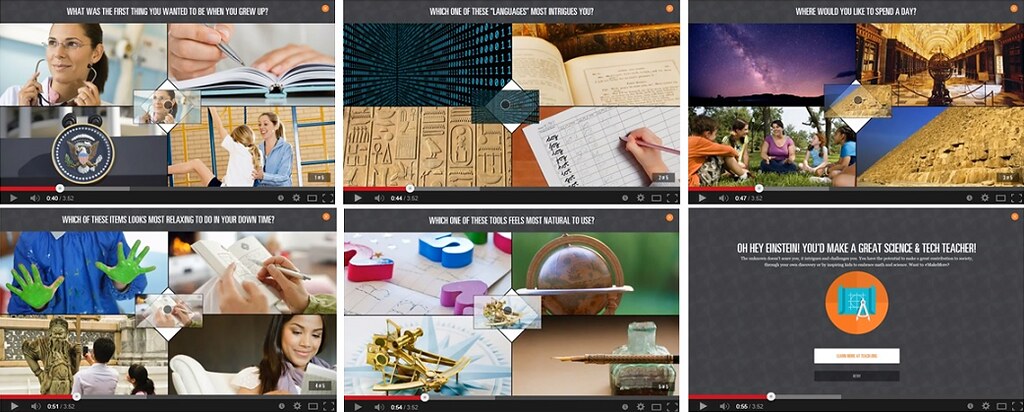
theodp (442580) writes "Back in 2011, the U.S. Dept. of Education delegated teacher recruitment to Microsoft (RFP, pdf). 'The decision to turn over TEACH to [Microsoft] Partners in Learning serves to expand the already outsized influence Gates and his fortune have on public education,' wrote the Washington Post at the time. So, 'what happens when a public institution in a democracy — the US Department of Education — outsources its goal of recruiting good teachers to a private industry?' Well, in addition to Teach.org and redundant social media efforts on Twitter, Facebook, Tumblr, Instagram, Linkedin, and YouTube, the U.S. is now relying on 'Innovative Microsoft Advertising to Recruit the next Generation of Teachers'. From the press release, 'The Ad Council and TEACH have formed a unique outreach campaign with Microsoft's Advertising team in an effort to recruit the next generation of teachers who will drive innovation and redefine teaching in K-12 classrooms. Microsoft donated over 125 million impressions across Xbox 360, Windows 8, and MSN in order to encourage consumers to rediscover teaching through interactive ad units. This media effort is an extension of the Ad Council and TEACH's public service advertising (PSA) campaign, Make More...Throughout March, consumers were able to engage with TEACH "NUads on Xbox", via gesture, voice or controller on their Xbox 360 consoles...Most recently, Microsoft leveraged their Windows 8 platform to provide a unique experience to consumers, enabling them to navigate through a series of questions to help "discover their true passion," along with the opportunity to play challenging mind and word games, such as a word scramble and tangrams.' Check out the demo of the Windows 8 platform experience [YouTube], in which a person is advised 'You'd Make a Great Science & Tech Teacher,' on the basis of a 'Personality Quiz' consisting of five dragged-and-dropped photos." -
IRS Can Now Seize Your Tax Refund To Pay a Relative's Debt
Hugh Pickens DOT Com (2995471) writes "Just in time for the April 15 IRS filing deadline comes news from the Washington Post that hundreds of thousands of taxpayers expecting refunds are instead getting letters informing them of tax debts they never knew about: often a debt incurred by their parents. The government is confiscating their checks, sometimes over debts 20—30 years old. For example, when Mary Grice was 4 (in 1960), her father died ... 'Until the kids turned 18, her mother received survivor benefits from Social Security ... Now, Social Security claims it overpaid someone in the Grice family in 1977. ... Four years after Sadie Grice died, the government is coming after her daughter. ... "It was a shock," says Grice, 58. "What incenses me is the way they went about this. They gave me no notice, they can't prove that I received any overpayment, and they use intimidation tactics, threatening to report this to the credit bureaus."' The Treasury Department has intercepted ... $75 million from debts delinquent for more than 10 years according to the department's debt management service. 'The aggressive effort to collect old debts started three years ago — the result of a single sentence tucked into the farm bill lifting the 10-year statute of limitations on old debts to Uncle Sam.'" -
Immigration Bill Passes the Senate, Includes More H-1B Visas
An anonymous reader writes "While the landmark immigration bill (full text PDF), which recently passed the U.S. Senate, is being hailed as bringing crucial reforms that will vastly improve the state of immigration in this country, there is a provision in it that is seeing relatively little discussion: section 4101, a 'market-based' increase in the amount of H-1B visas for skilled workers. 'The pitched arguments of both sides, which are likely to resurface in the House when it takes up its version of an immigration overhaul, cloud a complicated reality. There is little empirical evidence to suggest that foreign engineers displace American engineers as a whole. If anything, one recent study suggests, the growth of immigrant workers in American companies helps younger American technical workers — more of them are hired and at higher-paying jobs — but has no noticeable consequences, good or bad, on older workers.'" -
Unlocking New Mobile Phones Becomes Illegal In the US Tomorrow
Tyketto writes "Referencing a decision outlined in the Federal Register, Tech News Daily has published an article noting that the window to unlock your new mobile phone in the U.S. is closing. 'In October 2012, the Librarian of Congress, who determines exemptions to a strict anti-hacking law called the Digital Millennium Copyright Act (DMCA), decided that unlocking mobile phones would no longer be allowed. But the library provided a 90-day window during which people could still buy a phone and unlock it. That window closes on January 26.' While this doesn't apply to phones purchased before the window closes, this means that after 1/26/13, for any new mobile phone you purchase, you'll have to fulfill your contract, or break the law to unlock it." It will still be perfectly legal to purchase an unlocked phone, which many carriers offer. This change removes the exemption for buying a new phone under contract (and thus, at a discount) and then unlocking it. -
TSA 'Secured' Metrodome During Recent Football Game
McGruber writes "Travel writer Christopher Elliott touches down with the news that the U.S. Transportation Security Administration was spotted standing around outside a recent American football game between the Minnesota Vikings and the Green Bay Packers (picture). According to Mr. Elliott, the 'TSA goes to NFL games and political conventions and all kinds of places that have little or nothing to do with ... travel. It even has a special division called VIPR — an unfortunate acronym for Visible Intermodal Prevention and Response team — that conducts these searches.' He continues, 'As far as I can tell, TSA is just asking questions at this point. "Data and results collected through the Highway BASE program will inform TSA's policy and program initiatives and allow TSA to provide focused resources and tools to enhance the overall security posture within the surface transportation community," it says in the filing. But they wouldn't be wasting our money asking such questions unless they planned to aggressively expand VIPR at some point in the near future. And that means TSA agents at NFL games, in subways and at the port won't be the exception anymore — they will be the rule.'" -
A Free Internet, If You Can Keep It
Kethinov writes "My Congresswoman, Zoe Lofgren, a prominent opponent of the infamous Stop Online Piracy Act, has introduced two bills to the U.S. House of Representatives designed to protect the free and open internet, expand the protections of the Fourth Amendment to digital communications, and protect against the introduction of any further SOPA-like bills. Since these are issues Slashdotters care deeply about, I wanted to open up the bills for discussion on Slashdot. The bills are: ECPA 2.0 and the Global Free Internet Act. Is my Congresswoman doing a good job? Is there room for improvement in the language of the bills? If you're as excited by her work as I am, please reach out to your representatives as well and ask them to work with Rep. Lofgren. It will take a big coalition to beat the pro-RIAA/MPAA establishment politics on internet regulation." -
A Free Internet, If You Can Keep It
Kethinov writes "My Congresswoman, Zoe Lofgren, a prominent opponent of the infamous Stop Online Piracy Act, has introduced two bills to the U.S. House of Representatives designed to protect the free and open internet, expand the protections of the Fourth Amendment to digital communications, and protect against the introduction of any further SOPA-like bills. Since these are issues Slashdotters care deeply about, I wanted to open up the bills for discussion on Slashdot. The bills are: ECPA 2.0 and the Global Free Internet Act. Is my Congresswoman doing a good job? Is there room for improvement in the language of the bills? If you're as excited by her work as I am, please reach out to your representatives as well and ask them to work with Rep. Lofgren. It will take a big coalition to beat the pro-RIAA/MPAA establishment politics on internet regulation." -
SpaceX Is Studying Site For 'Commercial Cape Canaveral' Near Brownsville, Texas
New submitter RealTime writes "SpaceX filed a notice with the FAA (PDF) that it is preparing an environmental impact study in consideration of a site in Texas for use as a commercial spaceport. 'The site in question is in the southern tip of the state of Texas, just outside Brownsville in Cameron County, overlooking the Gulf of Mexico, over which SpaceX's launches would fly.' The proposed site would handle up to 12 commercial launches per year. 'There's plenty of red tape associated with Kennedy Space Center, and the center is often reserved for large blocks of time by other launchers. If SpaceX had its own pad, it wouldn't have to share.'" -
Congress May Permit Robot Calls To Cell Phones
TCPALaw writes "While many hoaxes have circulated in the past about cell phone numbers being opened up to telemarketers, it now may actually happen. A bill, HR 3035 (PDF), has been introduced in Congress, that would create numerous exceptions to the Telephone Consumer Protection Act, which banned autodialed and prerecorded robot calls to cell phone numbers. If passed, HR 3035 would permit a wide range of autodialed and prerecorded calls to cell phones that are currently prohibited, and would preempt practically all state laws providing similar protections. This is being applauded by debt collectors and banks (PDF) ... as if the bailouts weren't enough, now they get to make you pay for their calls to you." -
Senate Panel Backs Patent Overhaul Bill
mvar writes "A bill to reduce the likelihood of massive damage awards in patent disputes took a step forward with approval by the Senate Judiciary Committee. The committee voted 15-0 to back the legislation that would give judges a major role in determining how important a particular patent is to a product, so that infringing minor patents would not lead to huge damages. The bill (PDF) also gives patents to the first inventor to file, rather than the first to invent, making the patent application process easier for companies who apply for patents in multiple countries. This year, Microsoft, the Pharmaceutical Research and Manufacturers of America and the Biotechnology Industry Organization support the patent legislation, while Dell, Cisco and others oppose it." Microsoft's blog post in support of patent reform calls for a quick review period for newly-granted patents and the acceptance of prior art submissions from third parties. -
$4,400/Yr. Coders May Work On Dept. of Labor Project
theodp writes "To power the Tools for America's Job Seekers Challenge, the US Department of Labor tapped IdeaScale, a subsidiary of Survey Analytics, which is headquartered in Seattle with satellite offices in Nasik, India and Auckland, NZ (PDF). According to the Federal Register (PDF), an Emergency OMB Review was requested to launch the joint initiative of the DOL, White House, and IdeaScale to help out unemployed US workers. A cached Monster.com ad seeks candidates to work on the development and maintenance of ideascale.com, but in India at an annual salary of Rs. 200,000 to 300,000 ($4,4000 to $6,600 US). BTW, an earlier White House-sponsored, IdeaScale-powered Open Government Brainstorm identified legalizing marijuana as one of the best ways to 'strengthen our democracy and promote efficiency and effectiveness.'" There's no guarantee that Indian workers recruited by that Monster.com ad would work on US Department of Labor projects. -
DHS To Grab Biometric Data From Green Card Holders
An anonymous reader writes with this excerpt from Nextgov: "The Homeland Security Department has announced plans to expand its biometric data collection program to include foreign permanent residents and refugees. Almost all noncitizens will be required to provide digital fingerprints and a photograph upon entry into the United States as of Jan. 18. A notice (PDF) in Friday's Federal Register said expansion of the US Visitor and Immigrant Status Indicator Technology Program (US VISIT) will include 'nearly all aliens,' except Canadian citizens on brief visits. Those categories include permanent residents with green cards, individuals seeking to enter on immigrant visas, and potential refugees. The US VISIT program was developed after the Sept.11, 2001 terrorist attacks to collect fingerprints from foreign visitors and run them against the FBI's terrorist watch list and other criminal databases. Another phase of the project, to develop an exit system to track foreign nationals leaving the country, has run into repeated setbacks." Reader MirrororriM points out other DHS news that they're thinking about monitoring blogs for information on terrorists. -
Proposed Legislation Would Outlaw "Cyberbullying" in US
physman_wiu writes "We all remember the recent incident of 13-year-old Megan Meier. Now legislation is set to be passed at least in Missouri (and possibly through Congress) that would make cyberbullying illegal. The new legislation (PDF) reads: 'Whoever transmits in interstate or foreign commerce any communication, with the intent to coerce, intimidate, harass, or cause substantial emotional distress to a person, using electronic means to support severe, repeated, and hostile behavior, shall be fined under this title or imprisoned not more than two years, or both.' Now, this seems like a great piece of legislation — until I get put in jail for some kid on WOW calling the Feds on me." Eugene Volokh is not impressed. -
How To Sue the Auto Dialers
Bennett Haselton writes " Every year just before election day, I usually get a few phone calls from machines that dial numbers and play a pre-recorded message telling people to vote a certain way. I find these annoying even if I support the side I'm being asked to vote for, and most people don't realize that in most cases you can sue the organizations for making these calls, even if they are non-profits. So, you can make some money while advancing a good cause (i.e. stopping the bozos from doing it again). Here's how to file your case in Small Claims court, how to possibly negotiate an out-of-court settlement in advance, how to argue the case in court, and how to collect afterwards." His essay follows... Do you HAVE what it TAKES?Before proceeding, decide if you think the stress is worth it. You're almost certainly stepping outside your comfort zone here.
Small Claims can be frustrating because the rules and procedures vary so much from one judge to the next, and judges differ wildly in how they interpret the laws. Their own biases come into play as well: they usually deal with cases involving people who have actually lost money or have been wronged in a serious way, and they may resent someone coming to court just to sue over a phone call.
In one particular case that provides a good example of what I'm talking about, I sued a spammer who came to court and claimed he never sent the mails and didn't even know how. When the judge stopped berating me long enough for me to continue, I then produced a tape recording of a conversation between me and the spammer, in which I had pretended to be an interested customer, and he offered to send 5 million e-mails for me for $500, and explained how they were routed through China to hide the origin. The judge got extremely flustered for a minute and then started to accuse me of "entrapment" (even though the recorded phone call took place after I had received the original spam), and she never commented on the fact that the defendant had just been caught lying under oath. I hadn't really expected him to go to jail for that, but I thought I would at least win the case; I didn't.
If you go to Small Claims court you have to be prepared to deal with that kind of Twilight Zone / Franz Kafka stuff. But the worst that can happen is that you'll lose.
How the law applies to non-profitsTo clarify something important: In general, you can sue non-profits for $500 for calling your number and playing a pre-recorded message, unless in the recorded message they (a) identify themselves at the beginning of the message; and (b) give their return phone number (other than the number of the machine making the call) somewhere in the message. Most pre-recorded messages from non-profits do not meet these requirements, particularly the second one.
The federal law which states this is divided into two parts. The Telephone Consumer Protection Act, section (b)(1)(B), states:
"It shall be unlawful for any person within the United States, or any person outside the United States if the recipient is within the United States... to initiate any telephone call to any residential telephone line using an artificial or prerecorded voice to deliver a message without the prior express consent of the called party, unless the call is initiated for emergency purposes or is exempted by rule or order by the Commission under paragraph (2)(B)".
and part (b)(3)(A) states:A person or entity may, if otherwise permitted by the laws or rules of court of a State, bring in an appropriate court of that State... an action to recover for actual monetary loss from such a violation, or to receive $500 in damages for each such violation, whichever is greater.
Now, part (2)(B) says that the FCC is authorized to make federal rules and may grant certain exemptions to non-profits. The actual rules that the FCC came up with are in the Code of Federal Regulations as 47 CFR 64.1200. The complete text of 47 CFR 64.1200 is here, but the relevant sections that apply are:
-
(a) No person may: [...]
- (2) Initiate any telephone call to any residential telephone line using an artificial or prerecorded voice to deliver a message without the prior express consent of the called party, unless the call is initiated for emergency purposes or is exempted by Sec. 64.1200(c) of this section.
-
(c) The term telephone call in Sec. 64.1200(a)(2) of this section shall not include a call or message by, or on behalf of, a caller: [...]
- (4) Which is a tax-exempt nonprofit organization.
-
(d) All artificial or prerecorded telephone messages delivered by an automatic telephone dialing system shall:
- (1) At the beginning of the message, state clearly the identity of the business, individual, or other entity initiating the call, and
- (2) During or after the message, state clearly the telephone number (other than that of the autodialer or prerecorded message player which placed the call) or address of such business, other entity, or individual.
The wording is important. Section (a) prohibits parties from making phone calls using a pre-recorded voice. Section (c) says that non-profits are exempt from the blanket ban in part (a). But then section (d) says that "All artificial or prerecorded telephone messages" must include a return phone number -- in other words, even if a party is allowed to make pre-recorded calls at all, they still have to conform to the restrictions in part (d).
I think this clearly applies to non-profits as well, for two reasons:
- First of all, part (c) does not say that non-profits are exempt from the entire law, it only says that they are exempt from the blanket ban in part (a) -- it does not say anywhere that they are exempt from part (d).
- Second, there's a simpler way of looking at it: if part (d) doesn't apply to non-profits and other parties that are exempt from the complete ban on pre-recorded calls, then who does it apply to? It doesn't apply to commercial companies, because under part (a), commercial companies can't make unsolicited pre-recorded calls at all, so it would make no sense to have a separate section requiring them to include a phone number.
You probably don't need to keep a portable tape recorder by the phone just to record the call and prove that you received it. If you show up in court and claim that you received the pre-recorded phone call, it's unlikely that the non-profit's representatives, if they show up, will lie through their teeth and claim that it never happened. If they lose in court, all they lose is $500, but if they get caught lying under oath, they could in theory be convicted of a felony. (Although to tell the truth, sometimes the enforcement of perjury laws in Small Claims court is pretty lax.) The important things to note about the phone call are:
- Does the organization making the call identify themselves at the beginning of the message?
- Did they give their return phone number anywhere in the message?
Even if the pre-recorded message gives the name of the organization, that may not be the actual party that used the machine to make the call. For example I got a call with a message identifying the caller as "Bob Thurston, Washington State Patrol Troopers Association president", but when I found his number and called him, he said the calls were actually being made by a group called Taxpayers for R-51. If I'm doing legwork to find out who made the call, sometimes I say that I'm interested in running my own campaign using a machine to dial numbers and play a message, and I want to find out how they did it. It's not illegal to lie.
Once you're reasonably sure you know the name of the organization that did it, you need to find the address where you can serve the papers on them. There are two broad approaches to this:
- Go to the Secretary of State's website for the state in which the organization is located, go to "Corporations" search, and search on the organization's name. If they are listed as a corporation in the state, there should be an address given for their "Registered Agent" as well. You're done; that's the address you need.
- If that doesn't work, unfortunately the remaining methods are a lot less precise. Your best recourse is to try and find the group using Google, and see if you can locate their street address.
If you found the entity's address through their listing on the Secretary of State website, you're in luck, since companies are not supposed to list a P.O. Box or rented mailbox as their registered agent's address. But if you found the address through Google, it may not be a real street address. If it isn't, this is often where I hit a dead end, and with "only" $500 at stake I usually don't have the time to keep looking.
But if you think you've got their real address, keep going!
Filing in Small ClaimsAt this point you might be tempted to contact the organization first and negotiate a legal settlement as an alternative to suing them. What I've found however is that for cases this small, organizations usually won't take the threat of a lawsuit seriously until you actually serve them with legal papers, so I wouldn't bother negotiating until you've done that. (Also, if you try to negotiate in advance, this has the added disadvantage that once they know you're going to sue them, if they're a really underhanded bunch of people, they might try to make it harder for you to serve the papers on them.) If you think it's rude to just sue someone out of the blue -- well, shit, they called your house using a machine, didn't they?
So, in Washington at least, you can get a blank Notice of Small Claim form just by sending a self-address stamped envelope (should probably include about $1 worth of postage on the envelope since the forms can be heavy) to the local District Court and requesting the form. Then you can even file the case by filling out the form and mailing it back with a check for the Small Claims filing fee ($25 in Washington), plus another self-addressed stamped envelope. They'll mail you back the forms to be served. You never even have to go to the courthouse.
However, I'd recommend sitting in on part of a Small Claims calendar at the local courthouse to see how it usually works, and to make sure you wouldn't be nervous going through with it if the other side doesn't settle. Then while you're there, you can get the Small Claims form and file the case.
They will give you one copy of the Small Claims form for your records, and one copy that has to be served on the other party within a certain time frame (in Washington, 10 days before the court date). The clock is ticking, so now you have to serve the papers on the other party.
Serving the papersBefore having the Small Claims papers delivered to the defendant, you may want to attach a letter explaining that you're suing them for a phone call received on such-and-such a date. I tend to go that route, since I have nothing to hide anyway, and in any case the more you communicate, the more chance of getting a settlement. So, throw that in with the papers and then get ready to serve the papers on the defendant.
When you filled out the Small Claims form, it probably came with a pamphlet describing how to serve the papers on the other party. I'm describing the rules for Washington State; the rules in other states are similar.
There are two ways to serve the defendant: hiring a process server, or serving the defendant by mail.
-
Hiring a process server. This is the preferred method if you don't mind spending about $40. (If you win, the cost of service of process is added to the amount of the judgment, so you'll get it back if the defendant pays the judgment.) Using the online yellow pages, just search in and around the city where the defendant lives, for (a) private process servers, and (b) the sheriff's department. I've called process servers and sheriffs in many different cities, and they charge amounts ranging from $10 to up to $150 for substantially the same service, and I've never figured out why. Sometimes the sheriff is the cheapest, and sometimes it's one of the private process servers. But whoever you use, make sure to find out what they require you to send them. They always require a letter of instruction tell them where to serve the papers on the defendant. In addition, be sure to ask them:
- can they serve papers on behalf of a private individual, or will they only do it on behalf of law firms?
- do they require a money order or can they take a plain old check?
-
Serving the defendant by mail. Go to the post office and have the papers mailed to the defendant by certified mail with a return receipt. Here, you have to make a choice. IF you think the organization will actually show up in court (usually, if they're a well-established group and they don't want to be hit with a deluge of lawsuits because one person sued them and won), then certified-return-receipt is all you need. But if you think they might NOT show up and you want to have airtight evidence that you served the papers on them properly, you need to also send by restricted delivery to a person (i.e. a real human, not a company and not the organization itself) who is an officer of the organization. If you have their registered agent's name and address, that's the person to send to by restricted delivery.
If you send by restricted delivery, it goes out with a little green card attached to it, and if the postal worker is doing their job, they should deliver the envelope only to the person listed as the recipient, and require them to sign the card and write their name legibly above their signature. Then, the green card gets mailed back to you. However, very often I'd find that the cards would come back with illegible signatures and no names or the wrong names. If you use this method, try writing on the envelope: "Attention USPS! This envelope MUST be delivered to the person named as the recipient, they MUST sign for it and their name must be printed LEGIBLY above their signature." I never got around to trying this, since by that time I'd given up on serving papers by mail, and always used process servers.
Basically, the trade-off is that the stricter you want to be about how the papers are served by mail, the greater the chance that it won't work (e.g. if the mailman can't find the person), but the more solid your proof of service will be if they don't show up in court.
If you serve the defendant using a process server, you'll get back an affidavit of service in the mail. If you serve them by mail, you'll get a return receipt that (if the judge accepts it) will constitute your proof of service.
Negotiate with the defendantOnce you get your proof of service back in the mail, now the defendant knows they're being sued, so you can try to negotiate a settlement. This depends on your style, and theirs.
One thing to keep in mind: Don't worry if they threaten to tell the judge that you filed a lawsuit and then tried to "blackmail" or "extort" money from them or "shake them down". Judges encourage parties to settle lawsuits out of court. Unless the judge thinks your lawsuit is bogus to begin with, they're not likely to be swayed by the defendant claiming you tried to negotiate a settlement.
But assuming your efforts to shake down, extort, blackmail etc. the defendant were unsuccessful and they don't want to settle, the next step is your day in court.
Preparing for courtMake sure you bring all of the following:
- Your proof of service (see previous steps)
- A copy of the Telephone Consumer Protection Act with parts (b)(1)(B) and (b)(3)(A) circled.
- A copy of 47 CFR 64.1200 printed out from this link, which shows the text of the law with proper indentation and formatting and makes it easy to read. Circle parts (a), (c), and (d).
- A copy of 47 CFR 64.1200 printed out from the official government site. Just to prove that the stuff you printed out in the previous step wasn't something that someone made up and posted to the Web as a prank. However the way they have it laid out is harder to read.
- A transcript of the phone call that you're suing over, if it was left as a voice mail, or if you managed to grab a recording of it with a handheld tape recorder when you first got the call.
Before the judge appears, a mediator may ask if you want your case to be handled by mediation. If the other party is present, I'd recommend trying this option. The thing to remember about mediation is that if you and the other party can't reach an agreement, you can always go back before the judge. You're not giving up your day in court by agreeing to mediation.
If you can't reach an agreement, or the other party doesn't want mediation, or the other party isn't there, then when the judge calls you to present your case, show the judge your proof of service, your record of when you received the phone call, and the laws that make it illegal and specify $500 in damages.
What happens next varies wildly, depending on the judge. Some of them are polite and some of them yell at almost everybody. Some of them hate junk calls as much as you do, and some of them hate amateur wannabe lawyers clogging the court's time because they saw one episode of Law & Order and thought they could do it themselves. The future at this point is a fog that I can't predict, so I'm not going to try.
All that I can shout blindly into the fog is that judges do appreciate it if you stick to the law, and not try to make any emotional speeches about why you think the issue is so important. (All that happened to you anyway was that you got a phone call, which means you're not going to win the sympathy game anyway, so don't play!)
You're out of the fog? You won? Great, keep reading!
After you winIf the defendant doesn't pay after 30 days, call a local collection agency and ask them what you have to do for them to try to collect the judgment. Collection agencies normally don't charge any money up front, and only take a percentage of what they're able to collect. Unfortunately it can be as high as 40 or 50 percent. The upside though is that they don't get paid if they can't collect, so you know they're going to try.
From that point onward, the collection agency will be able to give you better advice than I can, so my narrative thread ends here, hopefully with you holding a judgment in your hands.
If enough people do this, maybe the problem will go away. Then again maybe all that will happen is that more non-profits will start putting the name of their organization and their phone number in the pre-recorded calls that they make, which means that you can't sue them. Then your only recourse is to call them up and chew them out, so make it good!
-
-
Senate Bill May Ban Streaming MP3s
Silverhammer writes "According to the EFF, a new Senate bill (S. 2644) sponsored by Senators Feinstein (D-CA) and Graham (R-SC) would effectively ban streaming MP3 for licensed music by requireing 'casters to use the most restrictive streaming format available (e.g., Windows Media or Real) rather than simply the most restrictive features of a chosen streaming format (e.g., Shoutcast or streaming MP3)." From the article: "The PERFORM Act would ... requir[e] webcasters to use DRM that restricts the recording of webcasts. That means no more MP3 streams if you rely on the statutory license. Under the bill, the statutory license would only be available to a webcaster if: [114(d)(2)(C)(vi)] the transmitting entity takes no affirmative steps to authorize, enable, cause or induce the making of a copy or phonorecord by or for the transmission recipient and uses technology that is reasonably available, technologically feasible, and economically reasonable to prevent the making of copies or phonorecords embodying the transmission in whole or in part, except for reasonable recording as defined in this subsection." -
Carnegie Mellon Resists FBI Tapping Requirement
roach2002 writes "Carnegie Mellon University is fighting back against a requirement that taps on campus internet access must be quickly obtainable. The technology that would allow the FBI to monitor internet access, after a court order, "at the flip of a switch" would cost at least $450 per student. MIT is also covering the story." From the article: "'The Department of Justice wants 24/7 access, whenever they need it, and they want remote access. We find that too extremely burdensome in terms of money, staff, and technology,' said Maureen McFalls, Director of Government Relations for Carnegie Mellon and the coordinator of Carnegie Mellon's response to this issue. According to an ACE press release, the cost to universities could be upwards of $7 billion, or at least $450 extra on each student's tuition bill." -
Exporting Knowledge Via Students
brainhum writes "SF Weekly reports that proposed Department of Commerce regulations will require foreign students at US universities to apply for export licenses to use dual purpose technologies in the classroom. From the article: 'Inherent in the new rules is a discriminatory contradiction: Students from India, which has cordial relations with the U.S., will need licenses to study, but students from Saudi Arabia -- home country for most of the participants in the 9/11 attacks on New York and Washington, and much of the financing and ideology behind Islamist terrorism -- will not.' The proposed regulations point out that current export license requirements are based on the person's most recent citizenship, which they believe, could allow a person born in Iran to avoid licensing if they held Canadian citizenship. More information is available in the SF Weekly story "Student of Concern"." -
FCC Asks For Comments On Internet Wiretapping
SECURITY GURU writes "Security Focus has posted a story about The Federal Communications Commission (FCC) launching a public comment period on its plan to compel Internet broadband and VoIP providers to open their networks up to easy surveillance by law enforcement agencies. The 1994 Communications Assistance for Law Enforcement Act (CALEA), a federal law that mandates surveillance backdoors in U.S. telephone networks, is what would allow the FBI to start listening in on Internet communications. The EFF, ACLU, and the Electronic Privacy Information Center all opposed the plan, and an ACLU letter-drive generated hundreds of mailings from citizens against what the group called 'the New Ashcroft Internet Snooping Request.' If you have a comment on why you don't want the governemnt reading your email please post it here. All comments are due by November 8th." -
Businesses Try to Gut Junk Fax Ban
An anonymous reader writes "The Telephone Consumer Protection Act prohibits junk faxes without first obtaining consent of the recipient but EPIC is reporting a bill is being proposed by congressman Fred Upton (R-Mich.) to allow junk faxes that are now prohibited and to undo new rules that go into effect January 2005 that would have further tightened the junk fax ban. In keeping with congressional truth in naming rules, this bill that will allow more junk faxes is understandably titled 'The Junk Fax Elimination Act of 2004.' There will be a hearing Tuesday in the Telecommunications and Internet subcommittee. I'll be faxing my concerns and opposition to this bill to Mr. Upton and the Committee several times today." -
Congress Sends Anti-Spam Bill To White House
sunbird writes "At just after 5 o'clock EST, the House concurred to the Senate's amendments to the Controlling the Assault of Non-Solicited Pornography and Marketing Act of 2003 (or "CAN-SPAM") (bill in PDF format: here or here). Although the bill will prohibit certain tactics (such as hiding return addresses), critics state that the bill does not go far enough (see this press release). The bill will provide criminal penalties for violations of its provisions (up to five years behind bars), but will not allow private parties to sue spammers. News reports indicate (SF Gate or Forbes) that Bush intends to sign the bill. Prior Slashdot articles are here: 1 2 3." -
Deliberation of "National Strategy to Secure Cyberspace"
An anonymous reader writes "Per the Federal Register the National Infastructure Advisory Council will have a public meeting (telephonically) from 3:00 pm to 5:00 pm EST on 1/8/2003 to deliberate on the National Strategy to Secure Cyberspace. 'Written comments may be submitted at any time before or after the meeting.' Details can be found in text format or in PDF." -
Commerce Dep't to Hold Public Workshop on DRM
ttyp writes: "The United States Department of Commerce Technology Administration (TA) announced a public workshop on digital entertainment and rights management. They're taking public comments here according to the announcement, but they sure have hidden it well. Can anybody find the form? The deadline is July 11!!" -
Space Exploration Act of 2002
orn writes "Rep. Lampson introduced a bill (pdf) (H.R. 4742) to the House on May 16th for a human space exploration initiative. I haven't heard a peep about it from the popular press, just a few articles on various space sites: SpaceRef's, the Planetary Society's, the Mars Society's. If you're interested in the sort of thing (and you live in the U.S.), contact your representative and let them know! While you're at it, figure out how to get the popular press aware of this..." On a related note is a story dicussing the controversy over whether the Moon should be developed, which seems a little premature to me. -
U.S. Penalizes Ukraine for Abetting 'Piracy'
The Politech mailing list has a note and follow-up on new trade restrictions levied against Ukraine, since they haven't complied with the U.S.'s demand for 'an optical media licensing regime.' John Gilmore's response puts the issue in perspective. Update: 01/03 23:08 GMT by M : The RIAA has a press release about the trade penalties and response to Gilmore. -
Responses from Consumer Advocate Jamie Love
We put up the original call for questions on September 5. Jamie's travel schedule (mentioned in one of his answers) is so hectic that it is amazing he found time to answer these questons at all. But answer he did, in detail. It's going to be interesting to see how Jamie's take on tech-oriented lobbying compares with that of "commercial" lobbyist Morgan Reed, whose interview responses we hope to see in the very near future.1) Politician's Reaction
by dexter1
From my perspective, it seems that all of the politicians in congress seem to be firmly in the grasp of big business ......... or intellectually aware of the issues and responsive to viewpoints other than those of big business? Are there any particular politicians that seem more receptive (that could potentially campaign and convince others)?Jamie Love:
Politics have gone downhill ever since the US Supreme Court decision in Buckley v. Valeo. By making campaign spending a constitutionally protected form of speech, and essentially legalizing bribery, we created a system where the average member of Congress spends most of his waking hours trying to raise money, just to compete with some other person who might do the same thing. Now the new members of Congress are people who excel at fundraising, or have money to begin with. Once they get on this treadmill, the spent all their time socializing and speaking with the lobbyists who can raise more money. It isn't so important that a politician be genius, or have deep insights of their own into problems, but if you hang out too much with lobbyists and make friends with people just to ask for money, you get a warped and fairly limited view of the world.That said, I have my own favorites. In the Senate I like John McCain, even though I hate what he does maybe half the time. Patrick Leahy is smart and has his moments. Paul Sarbanes is a decent guy, as is Byron Dorgan. All of these guys will make you mad part of the time, but not all of the time. In the House, Bernie Sanders, Sherrod Browne, Jan Schakowsky, Jessie Jackson, Jr. and some others have helped us a lot on our work on access to medicines in developing countries. I think Barbara Lee is very good, and independent -- she was the only member of the House that voted against the bill to give the executive branch a blank check in its war against terrorism. She is one of a small handful of members of Congress who are focused on the tragedy unfolding in Africa over AIDS.
2) Consequences for Patent Breakers?
by Bonker
I believe it was Brazil(? Please correct me) who recently ordered pharma plants to start manufacturing AIDS drugs in violation of U.S. patents. What are the consequences for countries who violate patents like this? Can we take this as a sign that violating a patent in this manner, 'for the public good' so to speak, is going to become more common and acceptable?Jamie Love:
The Brazil case was poorly reported. Yes, Brazil has threatened to issue compulsory licenses on some patents on AIDS medicine, which has forced the price down, and yes, Brazil manufactures a number of AIDS medicines itself. Brazil only included medicines in its patent Act in 1996, after considerable pressure from the US government, so the earlier AIDS drugs are not covered by patents in Brazil. Now what else has Brazil done? It spends more than $300 million per year to buy AIDS drugs, provides universal access to triple therapy for every person in Brazil who needs it, regardless of their income. Brazil is the only country in the developing world that makes triple therapy available to any significant number of patents. Without triple therapy, most HIV+ people will die within ten years.Brazil hasn't "violated" any patents. Brazil didn't issue patents on pharmaceuticals before 1996, and now it issues patents. Patents are a grant from the government. If the government wants to limit that right, it can, even here. We recently pushed a report that provides examples of compulsory licenses on patents in the United States, to provide a better understanding of how often this is done in richer countries. It makes no sense for the government to give unlimited power to patent owners. Patents are instruments of public policy, to achieve public purposes. People can't do whatever they want with regular property, and they can't do whatever they want with intellectual property.
We have global trade rules that determine what countries can and cannot do in terms of patents. The most important of these agreements is the World Trade Organization's TRIPS agreement on intellectual property. Articles 27, 30 and 31 of that agreement give governments the right to limit patents in important ways, including cases where governments can create either exceptions to patent rights, or step in and authorize third parties to use patents. In September of this year, the US Department of Justice required 3D Systems Corporation and DTM Corporation to license 178 patents to competitors. I didn't see screaming headlines all over the world announcing that the US was violating patents. Also in September, the US Federal Trade Commission announced it was considering a request for compulsory licenses on Unocal's clean fuel patents, at the request of Exxon. There are lots of circumstances under which the US government can limit patent rights in the United State. But there is often a big international trade crisis when a poor countries wants to issue a compulsory license for a patent on a pharmaceutical drug. This is the case for example in Africa, where infection rates are astonishing. We are working on a compulsory license application in South Africa. Right now more than half of pregnant women in their 20s are testing positive for HIV. They will all die without access to medicines. What type of government would put the interests of patent owners above the interests of half a generation of mothers?
The Clinton Administration was very friendly to the pharmaceutical industry in trade disputes involving medicines, having brought dozens of trade actions against countries all over the world. On January 11 this year, a few days before he left office, President Clinton filed a WTO case against Brazil, claiming their "local working" requirements in the Brazil patent law violated free trade rules. After a great deal of opposition by the public health community, the Bush Administration withdrew the case. Although Clinton actually filed the case and Bush ended it, Clinton is now touring developing countries as a champion of AIDS patients. For eight years Clinton and Gore placed incredible pressure on poor countries to adopt very high levels of intellectual property protection on medicines. President Bush started out with a fairly moderate policy on this, but seems to be increasingly captured by the big pharma companies, in terms of trade policy, and is opposing every effort the poor countries to make the WTO agreement more friendly to the poor, in terms of access to medicine issues.
3) How to communicate issues?
by Sinistar2k
Obviously, the big ticket item is getting the citizenry involved in making changes at a legislative level regarding the liberties that have been traded in the interest of corporate domination. The problem, however, is finding a way to communicate that without spending three days pointing out cases of encroaching corporate control.Do you have any tips/suggestions on how an average technology enthusiast such as myself can best go about conveying to the every-day public the sense of urgency surrounding technology issues and the reason such issues should be addressed?
Jamie Love:
The Internet is an amazing showcase for creative ways to call attention to various issues and causes. I would barely know how to start. But I can give what I think are some basics.- People who take the time to be informed are taken more seriously.
- It helps to have some idea of who the decision makers are, and how you can get in touch. Writing a member of Congress an email probably has some effect, but probably not much. Writing a Congressional staff member who is working on an issue is likely to have a much large effect.
- It is rather amazing how much impact public comments have on government bureaucrats, particularly in formal rulemaking and requests for comments. Something more interesting than you might think would be to spend some time searching the federal register on topics you find interesting.
- Letters to the editor in newspapers are underrated, particularly if you target key papers in a member of Congress' hometown. That's a letter they will read!
- If the issue is getting press attention, lobby the press. What reporters or columnists say and think is pretty important.
- For the non-amateur: during the 1996 Telecom debates, $1,000 apparently would buy about 10 minutes of face to face with the Chairman of a key subcommittee. I don't know the current price. We don't do this, but some small businesses might want to, it costs money to elect a Congressman, and it may make sense to support members who support you. I'm only half kidding.
4) Patent Issues
by michellem
It seems that the patent office has, in the last few years, lost their collective mind. Patents are incredibly broad, or amazingly misdirected, like in the case of the patents on human genes. They currently seem to protect only litigious patent holders, not the consumers or anyone else, for that matter. What is your organization doing to change this current patent landscape? Is there anything that can be done?Jamie Love:
Well, we are doing what we can. We spent a lot of time communicating with the patent office, and dealing in particular with the international dimensions of this. One issue that needs more work is documentation of the costs of the patent system in various industry sectors. It makes no sense to have patents issued for software or business methods. The American Medical Association (AMA) told Congress that "thanks but no thanks," they did not want patents on surgical methods, and Congress provided an exception. One problem here is Article 27.1 of the WTO TRIPS agreement, says thatpatents shall be available for any inventions, whether products or processes, in all fields of technology, provided that they are new, involve an inventive step and are capable of industrial application
The US government has been pushing a very aggressive interpretation on this, and some people at the World Trade Organization or the World Intellectual Property Organization claim that this requires every countries to patent software, business methods and just about anything else. So the USPTO isn't just issuing patents on everything under the sun, it is lobbying the whole world to do so. For example, Jordan is now required by the US government to issue patents on business methods and software.Another very important international fora concerns the proposed Hague Convention on Jurisdiction and Foreign Judgments. I have written a lot about this, and this is our main e-commerce project right now. I can't think of a bigger threat to the Internet than the Hague Convention. The Hague treatment of patents is a nightmare. Everyone would be liable for infringement of foreign patents, and the Hague Convention would give exclusive jurisdiction for both validity and infringement in the county of registration. Every country who signs the Convention would agree to enforce both money judgments and "protective and provisional" measures, such as injunctions, across borders. Companies like Microsoft can find or even rent member countries to adopt and enforce bad patents, and harass the free software community or competitors. In the end, every country will try to tax the Internet through overreaching patents. It presents a huge problem. The US government is actually the most progressive delegation on this issue, and the problem now is convincing Europe to take patents and other intellectual property out of the Convention.
On medicines, we are working with Representative Sherrod Brown, who has introduced HR 1708, a bill that would create a stronger compulsory licensing authority in the US, to deal with such issues as blocking patents, or refusals to license on reasonable terms. This bill is limited to public health, but could be expanded.
One thing the average hacker could do is to communicate more with the Judges who make policy, and by this I mean the U.S. Court of Appeals for the Federal Circuit (CAFC), which really makes patent policy in the US. These Judges hear from patent owners all the time, but not from the public.
5) Free Speech
by Nexus Maelstrom
As a University student currently involved with a student group called the Campus Democracy Collective, what is the best way to inform both my peers and government representative that the fight for speech, liberty and freedom from oppression will be fought over bits and bytes, and not how many miles per gallon their car will get?Jamie Love:
I would start by thinking a bit about what types of freedom you think are being threatened. Certainly you can find a lot of free speech on the Internet. What you may find less free are some other media, such as television, which features a remarkably narrow range of views, or the new limits on liberty by expanding concepts of intellectual property. I also think there is a big relationship between privacy and freedom, this is an area where the role of the government is complicated, because on the one hand, you want the government to protect the public from invasions of privacy by businesses and other institutions, and on the other hand, you want the government to leave you alone. After September 11, all of this has become much more difficult to manage. The world has changed, and we have to have a new strategy to protect privacy and human dignity and freedom in a world that wants more surveillance and less liberty, in order to be more safe. How do we enable the government to protect us, while having some protection against the government?6) Neverending Copyright
by oddjob
The entertainment industry appears able to get copyright protection extended as long as they wish. While not as directly related to technology as patent law, copyright law is becomming more of a concern, especially with the recent mess with the DMCA. Is your organization making any efforts to convice congress to return copyright duration to a sane limit, and if so, is there much hope for success?Jamie Love:
Our proposal is to have short terms for works for hire, where a corporate entity owns the right. This would put movies into the public domain much sooner, for example, as well as much of the archives of newspapers. More generally, we need to have a much stronger public domain lobby, and an international dimension too, to address the WTO requirements for copyright term.7) Patents and the cost of development...?
by tenzig_112
How does CPT balance fighting patents on drugs (and other technologies) with the cost of developing those technologies?Surely, the cost of life-saving medications should not be prohibitive. And dozens of ridiculous patent disputes cannot be good for any industry. But without some means of recouping the often crippling cost of development (for example, 1000s of drugs begin the development process and only a handful make it to the consumer) what incentive is there to investigate new ideas?
What will happen to the fields of medicine and information technology if the market for invention dries up?
Jamie Love:
I spend a lot of time on R&D issues, for example as a member of the MSF working group on Drugs for Neglected Diseases, and also proposing various approaches for R&D treaties. It does cost a lot to develop a drug, but not as much as one might think. If you look at the Orphan Drug Tax Credit, for example, you find that in 1998 drug companies spent only $8.6 million on clinical trials per approved orphan product, a major development cost. Of course for some drugs this can be much more expensive, running into tens of millions of dollars. The most difficult and risky part of drug development is the pre-clinical stage, where there is less data. In general, the US pharmaceutical industry spends about 7.5 percent of sales on R&D, according to its tax returns. This amounts to a lot of money, but even here, a lot of this is fairly low priority stuff, such as "me-too" drugs.We have proposed R&D mandates for the drug industry. Specifically, we think that every firm that sells drugs in the US market should make mandatory contributions into R&D funds, as a cost of doing business. Companies could manage all or part of this money, for their own benefit, under whatever conditions the government wanted to impose in terms of transparency or public health priorities. This would give the US government new policy tools to increase R&D, if other policy tools, such as compulsory licensing, reduced private incentives.
If you knew how much crap the drug companies get away with now, in terms of ripping off the public on government funded inventions, or "evergreening" patents beyond 20 years, you too would be looking for ways to avoid the constant blackmail over R&D that you get every time you try to introduce some fiscal discipline to the system.
The story on the information technologies side is different, and patents play a much lesser role in protecting investment. Software gets copyright, trademark, trade secret and contract protections. It doesn't need patent protection.
8) The public cost of copyright
by underwhelm
It seems to me that because copyright is intangible, that the public domain is immeasurable, and because expanding copyright takes no money out of the budget, that IP laws are the pork barrel legislation of the Digital Millennium. Senators and legislators see no problem with enlarging copyright beyond its traditional boundaries, past fair use and first sale, because there is no means of accounting for the theft. Is there a sense in Washington that wrapping new copyright restrictions with a bow and handing them to entertainment conglomerates has no downside politically or economically?If this is the case, how can we change the climate in Washington to make our representatives accountable for diminishing the public domain and enlarging copyright?
Jamie Love:
This is tough, because the entertainment companies really invest in Congressional campaigns. I would have to say that consumer interests are weak, as a movement, on the IPR issues. Larry Lessig and others are trying litigation, raising constitutional arguments. Maybe one exercise would be to ask members of Congress to estimate the loss to the public domain for all of these new claims for privatization. One of the issues is who will pay for the lobbying to protect the public domain? It helps to have money to fight these battles. We have to figure out where the money will come from. It isn't easy. I worked on various IPR issues for a long time before any foundation would fund this aspect of our work. No one understood what it was about. Very few groups work on these issues. We do. EFF has been doing some useful work. Public health groups have been doing a great job on the global medicines issues, and librarians are pretty well organized on issues that directly impact them. The ACLU is beginning to think more about IP issues. Sun Microsystems used to be more active on these issues, as did a few other firms, but really fairly minor. Bill Gates is very involved, but not on the side of the public domain. Richard Stallman seems to have engaged some lobbyists on issues more directly related to free software.I guess the best answer is to get organized. In 1996 we formed a group called the Union for the Public Domain (UPD). Richard Stallman, Mickey Davis, myself and several others are on the board, but due to my poor leadership, it isn't active at the moment, and we are looking for a new board chair. Suggestions would be welcome. The main problem was that I couldn't even raise the money for a single full time staff, which is really needed. If someone wants to pay for this, it would be a very good investment.
9) What's your job really like?
by Masem
Whenever I hear the word lobbyist, I think of someone carrying a bag of money to a Congressman, and expecting to get legislation passed; the image is most likely a result of hundreds of political cartoons and editorals. Obviously, this image isn't 100% true, but from what we as citizens hear on daily events in Washington, this doesn't seem like an overexaggration.Can you describe what a typical day is for you - for example, do you see Congressmen, how do you influence their voting (financial or otherwise), and what do you do when you are NOT on Capitol Hill?
Jamie Love:
I spend almost no time on Capitol Hill. I spent a lot of time outside of Washington, DC, and a lot outside of the United States. In August I was in Pakistan, the Dominican Republic, Zimbabwe and South Africa. Tomorrow I leave for Berlin. These face-to-face meetings are pretty important. We use the Internet a lot, but it is quite important to build some confidence first, particular when dealing with international issues, where cultural differences take some time to understand. I also spent a lot of time writing and sending email, managing email lists and posting stuff on our web pages. Our typical contribution is to get fairly technical on policy issues, and share information fairly widely, via the Internet, trying to build a broader movement on this or that. In terms of Capitol Hill, I personally talk with staff more than members, and the same is true with the federal executive branch agencies -- I talk with middle level staff quite a bit. Every once in a while I participate in a meeting with the President or a high level official, but not often, and rarely do I have much to show for it later. But if you do a good job convincing a few key staffers, or the general counsel of an agency, or a lead negotiator, you have really done well. As a practical matter, one of the main things you also need to do is talk to the press. When I travel a lot, reporters get a bit tired of trying to track me down. But you can always call reporters. They play a pretty important role in government.10) Why do you use Microsoft Windows
by Anonymous Coward
If you are so anti-corporation, and so anti-Microsoft, to the point of publically criticizing them and their practices, why does the Consumer Project on Technology, and specifically you, Mr. Love, choose to use Microsoft Windows on your office and home machines?Jamie Love:
Well, our office uses just about everything. We have Windows boxes, Linux boxes, Macs and Suns. For a while I moved the CPT unit entirely to Linux, to have a Microsoft free environment to see how that would work. We did this for more than a year for everything. Recently I switched some machines back, and now I use an IBM lap top with Windows as my main machine. I decided to switch back for several reasons. First, I had lost touch with what Microsoft was up too, and I needed to know that. Second, I wanted to use a large number of new devices that I couldn't get to work on my Linux box. Third, I was having trouble sharing my Linux documents with colleagues using MS Office, due to the typical Microsoft anticompetitive practices. And I was pretty unhappy with the progress in the various GPL office productivity tools, with the exception of the GNOME spreadsheet program, which was pretty good. I didn't see much work by AOL in improving the Linux version of Netscape, and wasn't happy when Microsoft invested in Corel and they seemed to be dumping the Linux apps. Recently I went back and tried a few current Linux distributions, and am deciding what to do on that front right now, wondering why Sun can't make Star Office an easier install. I've used lots of different computers over time. My first one didn't have a monitor, only a printer, and my first personal computer was a Commodore 64, which I used to dial into an IBM mainframe. I like computers and computing, and I like Linux a lot, but I am not that happy with the current state of client applications, and a bit frustrated tying to use various PDAs, scanners, cameras, printers, etc, with my Linux box.11) Outside the US of A
by bfree
I'm not American, but in recent years I have been boycotting many American corporations due to the influence they have on the US legal system and their seemingly inexhaustable ability to gain any IP law they require. I am seriously concerned by the aparently relentless push by US based coporations to bring an American style Intellectual Property regime to the rest of the world. As a Free Software advocate I find few ideas as repellent as "Software Patents"! My question to you is how do you see the International Intellectual Property arguments going, and ultimatley will we reach a system where everyone is under the thumb of software patents or where the US is forced to give up on this terrible idea?Jamie Love:
As I noted above, the most pressing current danger is the proposed Hague Convention. We have a lot of information about this on our web page. Also, by all means file comments in the EU consolation on the Hague Convention, which can be done by electronic mail.I think the second major issue is the WTO TRIPS Article 27.1 language, which is quite expansive in terms of what countries must patent.
The third area to watch out are the various bilateral and regional trade agreements, which are basically out of control. In the US, USTR is the lead agency, and is largely captured by a handful of large corporations. But things are really pretty bad elsewhere too. Some European trade officials and bureaucrats have patent envy, and can't wait to get Europe to become even more aggressive than the US. On the Hague negotiations it is the Europeans who want intellectual property in, and the US that wants it out. So sometimes the problem is in Europe more than here. Look too at the mess caused by the EU decision to create these rights in data under the database directive.
12) Effective technology lobbying and activism for DMCA
by melquiades
I'm part of the group that's organizing the DMCA protests in Minnesota. We're passing out fliers and staging protests, but haven't managed to get any press. We're also trying to get a face-to-face meeting with our senators...but no luck so far -- their offices haven't even called us back, despite both written and phoned requests for a meeting.The problem is, we're technology people, not activists, and we don't know how to lobby effectively. What's your advice? How can we get the attention of our senators? How can we attract media attention (in a respectful way, that is)? Are there other activities we should be undertaking that would be more effective than what we're doing?
Jamie Love:
What worked well in the struggle to change US policy on patents in AIDS drugs for Africa were people doing some brave things, like participating in demonstrations, chaining themselves to office furniture in government offices, getting arrested, and doing lots of civil disobedience. Today everyone seems a bit spooked by the September 11 events, and I don't know how well this will work. But I believe many of these older direct action tactics are quite effective. Why not just find out where the Senator is going to speak and disrupt the event? That seems to get attention. And maybe some good attention if you can show that he meets with the other side, but doesn't get your views. Does he take money from MPAA or RIAA members? And won't meet with his own constituents? Will the local papers take letters to the editor? There are ways that you can get a Senator's attention, and show him that it is in his interest to give you the time of day. Call me and we can talk about this.13) consumers and quality
by tim_maroney
Ralph Nader's consumer advocacy has always been first and foremost about quality, of which safety is a subset. Given that the commercial operating systems (MacOS and Windows) are much more user-friendly than the current slate of Linux offerings, and that even many Linux advocates have now come around to admitting that fact, how does Linux advocacy benefit the consumer? Isn't it strange for a consumer advocacy organization to be advocating a lower-quality product over a higher-quality one?Jamie Love:
I think you have to look at the longer run. Where is Microsoft taking us? Where is AOL/TW taking us? What will it take to get a paradigm shift away from Microsoft, and what would be the benefits?One thing that is unacceptable are actions to undermine the Linux or other alternatives. We think the USDOJ should stop Microsoft from undermining dual boot PCs. We think that remedies in the Microsoft case should make it easier for rivals to be interoperable with Microsoft products, that Microsoft should be restrained from using file formats as an anticompetitive weapon, particularly against its installed base, in order to force unwanted upgrades. Every OS has its strengths and weaknesses, and we favor more biodiversity in the OS space.
-
FCC Asks 'Opt-In, Or Opt-Out?'
FrankHaynes writes: "The U.S. FCC seeks comments on this proposed rule in which they seek 'to obtain a more complete record on ways in which customers can consent to a carrier's use of their CPNI (Customer Proprietary Network Information)'. They are debating an opt-in approach versus an opt-out approach. Commentors have until 1 November, 2001 to submit their opinions." Opt-out puts the burden on the victim; opt-in encourages a responsible, sustainable customer / company relationship. What am I missing here? -
Microsoft Verdict Vacated
Everyone and their brother sent in this unsurprising news: the Appeals Court handling the Microsoft anti-trust case has overturned the break-up decision. A few story URLs: CNet, BBC, ABC, AP, Reuters, MSNBC. The decision is available in .pdf format. A brief summary: the Findings of Fact (Microsoft's conduct, etc.) are still in place, but Judge Jackson's evaluation of those facts and the penalty he imposed are thrown out. A new District Judge will examine the case, starting from the Findings of Fact. Update 2h later by J : Dan Gillmor's analysis is good. So is this Washington Post column, which is insightful except it doesn't go far enough. It also shows MS CEO Steve Ballmer's attitude even before today's ruling: "Is there any limit to what you think you can put into the operating system at all?" "...as a matter of law, no, I don't think so..." -
Justice Department Decides To Break Up Microsoft
Well, it's official. The United States Department of Justice has called for the breakup of Microsoft into two separate companies: an applications company which will manage software like Microsoft Office and Internet Explorer, and an operating systems company that will manage products such as Windows NT. CNN coverage here. -
Do Patents Still Work?
mossmann asks: "With all the fuss over software patents lately, I thought it might be a good time to take a step back and address a more fundamental question: Do patents work? The United States Constitution (Article I, Section 8) states that 'Congress shall have power. . . To promote the progress of science and useful arts, by securing for limited times to authors and inventors the exclusive right to their respective writings and discoveries;' In other words: Congress is permitted, but not required, to grant patents so long as they promote progress. Patents are not intended to bestow upon inventors any of the qualities of material property but are granted only to encourage innovation and publication." Good question! Have patents become unnecessary? I wouldn't go as far as abolishing them, but I think it's high time the system was heavily revised. (Read More)"Here is my real question: What if we stopped issuing new patents in the United States: would 'the progress of science and useful arts' suffer? Prior to the advent of the Internet and the success of the Open Source movement, I would have said yes. Now I am not so certain. What do you think?"
Of course, these days, patents are used to prevent innovation more than anything else. I find this rather ironic.
More hilarous than ironic, this gem from Forge illustrates what can happen when the Patent system gets slightly out of control: "Hyperspace communications has been patented and is now my nominee for strangest patent. According to this story on the Register someone has not only "invented" hyperspace but has also figured out how to use it for transmitting data faster than light. My question is, does a fictional work count as "prior art"? To add to this concept Arthur C. Clarke is widely credited with having invented the communications satellite. The infamous band of space in which geostationary satellites orbit is known as "the Clarke Belt" in his honor. However he once said in an interview that he might have patented the idea if it had occurred to him that someone might actually build such devices such a short time after his story."
The big question here is how can you patent something that hasn't been invented yet? It seems that I can conjure up any flight of fancy that might just have a passing chance at becoming truth, patent it and make that idea mine forevermore?
const submitted a question that offers a potential solution: "I'm interested whether the patent madness may be stopped by restricting the number of patents in addition to shortening their time. If only 100 patents will be granted each year for the computing industry, only significant advances will be patented and things like the now infamous one-click patent will not get through the jury of experts in the field. The progressive scheme may be like the following: 1 patent - 10 years; 10 patents - 3 years; 100 patents - 1 year." which would make getting patents more of a competition between implementations, and to compete for the protections offered by patents sounds like a fair way to "promote the progress" in any given market.
-
Microsoft Loses
Jon Rochmis from wired wrote in to tell us that Declan McCullagh has a story up now: Microsoft Loses. There really isn't a lot of details, except that the news is officially out, and that the penalties (and of course many more lawsuits) will be forthcoming.Update: 04/03 09:08 by H :Check out the official government site for the ruling -- in excruciating detail. CNNfn also has got an analysis up. -
PTO's New DNA Guidelines
Robert Wilde writes "The National Law Journal has published an analysis of the PTO's new proposed DNA guidelines. The PTO will accept written comments until March 22. " I think this is one of the most important issues of the upcoming years - can company's patent genes that exist in all of us? What work should be done in genetics? What do you folks think? -
Microsoft == Monopoly says Judge
Judge Thomas Penfield Jackson has released his initial finding of facts - which appears to be very favorable to the government. Judge Jackson agrees with the government's assertions that Microsoft holds monopoly power in operating systems in the Intel world. Now, note of course, that is just an initial finding - now the two sides debate the penalties against Microsoft. Check out the government web site for the Findings of Fact - though it's running pretty slow there's a mirror as well. The info is all over the news as well. Thing sound grim - click below for a quote from the Judge:"Microsoft has demonstrated that it will use its prodigious market power and immense profits to harm any firm that insists on pursuing initiatives that could intensify competition against one of Microsoft's core products," Jackson wrote in his findings. "The ultimate result is that some innovations that would truly benefit consumers never occur for the sole reason that they do not coincide with Microsoft's self-interest."
Ouch. Pretty harsh words from the Judge. No one knows what the penalties will be, and the possibility for a settlement between the Government and DOJ are much more probable now, as Microsoft knows the way the judge feels about it. Things are gonna be different, though.
-
USvMS Ruling Expected Today
An anonymous reader noted that a website is up for the official release of Judge Jackson's findings in the MS/Doj case. The release will supposedly occur at 6:30pm Eastern on an "Undesignated Friday" which is rumored to be today. -
Alien Contact Illegal in US
Hard_Code writes "Apparently it is illegal for United States citizens to make contact with aliens and their vehicles. " This is bizarre as hell. Not much in the way of proof, but its still pretty interesting. I'll definitely be giving extra terrestrials the silent treatment next time they try to abduct me. Update: 10/30 05:55 by CT : several people pointed out that this is an Urban Legend. Pretty cool.