Slashdot Mirror
Domain: gsu.edu
Stories and comments across the archive that link to gsu.edu.
Comments · 508
-
Re:Get your affairs in order, people
Sorry to self-reply, but even once it got going, it wouldn't destroy us immediately. A black hole with the mass of the Earth still only has Schwarzschild radius of 1.5cm.
http://hyperphysics.phy-astr.gsu.edu/hbase/astro/blkhol.html
-
Re:Underwater telephony
water is quite opaque to light except for a narrow range of frequecies around the visual spectrum, where there is a sharp dip in the absorbtion spectrum. Look at the graph here:
http://hyperphysics.phy-astr.gsu.edu/Hbase/chemical/watabs.html
It's interesting that our eyes evolved to see light in just this narrow range where water is transparent.
-
Re:Time to moon: 9.2 years
Yeah, except that L1's pretty unstable.
Better at L4 or L5... none of this balancing a marble on a marble BS out there. Still doesn't solve the cosmic ray problem, but at least the thing would stick there.
Linky: Here -
Re:Green, Blue?
for the first part,
according to wikipedia, "the highest confirmed spectroscopic redshift of a galaxy isfor the second part, atoms emit across a wide range of wavelengths.
so it's more a matter of how much energy is driving the emission. -
Re:Seriously, WTF?
Well, here's a comparison
http://en.wikipedia.org/wiki/Heat_of_combustion
Gasolene - 47MJ/KG
Kerosene - 46.2MJ/KG
Diesel - 45MJ/KG
Atomic Fission (U235)
http://en.wikipedia.org/wiki/Uranium_dioxide
http://hyperphysics.phy-astr.gsu.edu/Hbase/nucene/u235chn.html
1KG of U235 has about 17.5KiloTons of Energy
17.5(4.184*10^12J) or
7.322*10^10MJ
Atomic Fusion p+B11 *now with less killing! (it's called Anutronic Fusion since it has no radiation) p +11Bâ'3(4He)+ 8.7 MeV (or 1KG of B11 can produce 17.7GWh of electricity)or 17.7(3.6*10^12J)which is about 63.7*10^10MJ
In terms of Energy:
1KG of U235 = 1.557*10^9KG of Gasolene
(that's 9 orders of magnitude better) 1KG of B11 = 13.55*10^9KG of Gasolene
So yes it's HORRIBLY efficent, not quite as efficent as Matter + Anti-matter however we haven't figured out how to build that kind of reactor yet, and we'd need a plentiful source of antimatter.
At $57/LB uranium is far cheaper than Gas. I'm pretty sure Borax is cheaper than Uranium. -
Fake Trade / CC, GPL / Asset Forfeiture / Enabling
Seems mostly aimed at what is discussed in the Fake Trade (http://www.channel4.com/video/the-fake-trade/index.html)
I think we can agree people manufacturing fake heart medicine is a bad thing; and that may have been the selling point.
However, "SEC. 511. LOCAL LAW ENFORCEMENT GRANTS." does the following:
"(a) Authorization- Section 2 of the Computer Crime Enforcement Act (42 U.S.C. 3713) is amended-- (1) in subsection (b), by inserting after `computer crime' each place it appears the following: `, including infringement of copyrighted works over the Internet';
I sure hope there aren't any congressmen who are violating the terms of CC or GPL. And can you imagine their outrage when their child downloads some songs and they have to forfeit that fancy new laptop? I mean, if enacted this will apply to congressmen, senators, even presidents, right?
Here are some links an asset forfeiture:
http://www.cjcj.org/pdf/civil_asset.pdf (PDF version)
http://209.85.173.104/search?q=cache:57xthSv8mJoJ:www.cjcj.org/pdf/civil_asset.pdf+%22asset+forfeiture+law%22+%22supreme+court%22&hl=en&ct=clnk&cd=1&gl=us (HTML version)
http://www.cato.org/testimony/ct-rp061197.html
http://law.gsu.edu/library/index/bibliographies/view?id=64
http://www.aclu.org/crimjustice/searchseizure/10303leg19990802.html
http://www.fear.org/hadaway.html
Also, aside from writing your congressperson and senator, stop supporting the RIAA/MPAA and the like. Stop enabling these people by refusing to watch, listen, pay or even discuss any of their products.
-
Re:Anyone sees the problem here?The energy required to liberate a proton from a water molecule is far less than is released from slamming it into a boron atom. Erm, no.
Electrolysis of water
2 x H2O + 1.25 eV => 2 x H2 + 1 x O2
Ionization energy of atomic hydrogen
13.6 eV
Proton-boron fusion
1 x p + 1 11B => 3 x 4He + 8.7 MeV
So you're only off by around 5 orders of magnitude.
The electrolysis is by far the lowest-energy part of the process. The bulk of the energy in fusion research is spent energizing and containing the plasma, and the difficulty of collecting that much energy from your reaction products is the reason that no fusion project so far breaks even. -
Re:What about those from the sun?
Plus you'd need about a light year of lead to make sure you didn't miss most of the message. Even Supernova 1987A didn't produce more than a few detection events. Any alien civilization able to produce more neutrinos than a supernova probably has better ways to communicate.
-
Doesn't this screw up lot of other things, too...
Aren't all astronomical distance measurements, which are fundamentally based on brightness (except for parallax), now subject to revision?
-
Why the hell aren't they using breeder reactors?
It seems France is using Fast Breeder Reactors. From "Science Magazine" dated 1980 "Breeder Reactors in France". Ok, Sciam says France shut down it's breeder reactor, but it doesn't say why. However the nuclear waste, or reprocessed fuel, wasn't the only problem the Spectrum article said the French had, they also had all the toxic chemicals left over from reprocessing.
I admit research may solve all the problems with nuclear power, but so can research with alternative energy sources, geothermal, solar, wind, and others. And with these others, whereas nuclear power requires massive centralized plants that when decommissioned can't be used for anything else, they can have distributed and decentralized electrical generation. I think the energy problem comes from centralized power generation. Another is waste, conservation measures can cut the US's energy needs down a lot as well as waste heat going up smoke stacks when it can be recovered. As more and more Off Gridders are showing simple conservation measures can go a long way to satisfying US energy needs.
Falcon -
Re:Leakage Current?
Closer to 200 atoms wide. Take a glance at http://hyperphysics.phy-astr.gsu.edu/hbase/solids/sili2.html and notice the arrangement of the crystal (face-centered cubic) and the cube size. Going along one face, we pass two atoms before reaching the other side (one corner and one face center), so we have two atoms per 0.5 nm. Now chips are being mass produced on a 45 nm scale. This is about 100 times the silicon crystal cube size, with two atoms linearly per cube.
-
Re:Great Blazing Colors
Don't think so. In fact, it's the opposite: you can detect green hues the worst.
No, I believe he's right. We see more green hues than anything else.
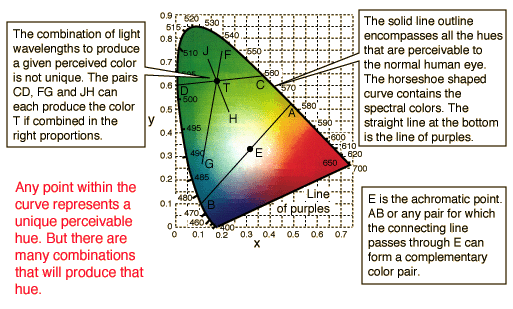
Take a look at a color gamut table, which is a visual representation of visible color space. Note how the distance from the neutral point to the edge of the green portion is much bigger, and how small the blue part is.
This is also why 16 bit colours almost always are arranged 5-6-5 (R-G-B), with the extra bit going to green. -
Re:Are they serious?
Gauss' law proves the absence of magnetic monopoles. Until they can find a problem with Maxwell's equations, they've got no case.
http://hyperphysics.phy-astr.gsu.edu/Hbase/electric/maxeq2.html -
Re:Powered by heat?
That depends on how they're getting power from the heat - if it's powering a heat engine and runs off heat flux, then yes, they would need a temperature gradient (which isn't that hard to get anyhow - put the cold sink near the epidermis and the hot sink near your heart/brain/etc.). If they're using the heat to run a small chemical reaction, then no, they probably wouldn't need a temperature gradient (e.g.: when using two dissimilar metals to generate a charge, the absolute temperature is directly proportional to the reaction rate). I'm currently studying the thermodynamics of the body for my master's, it's a very interesting subject.
Hopefully, since you're studying thermodynamics, you're aware that there are only two options: 1) It's using up some finite internal resource (e.g., internal energy) or 2) it's working by moving heat from a hotter reservoir to a colder one. If it's doing the first, then it's similar to a (possibly very effective) battery. If it's not doing either 1 or 2, then it's directly violating the second law of thermodynamics. I think the point made by earlier posters is that if it's deep in the interior of the body near the heart, as suggested in the summary, one would expect there won't be much of a temperature gradient. And remember that the efficiency of a heat engine at deriving work decreases as the temperatures of the two heat reservoirs become similar.
-
Re:Props for Big Black mention -old time fav
I can see a difference between 600 and 1200 DPI on a printed page, but I can't see any difference between 1600 and 2000 DPI.
But I don't think it's DPI that really defines the limit here;
According to http://hyperphysics.phy-astr.gsu.edu/hbase/vision/rodcone.html there are about 120 million rods in the human eye.
Even though they aren't evenly distributed, I'd hazard that a 12k x 10k display will be close enough to human perception that further "improvements" in resolution won't be discernible.
We aren't there yet, but it doesn't seem all that far off either.
-- Should you believe authority without question? -
Re:Awesome...
http://hyperphysics.phy-astr.gsu.edu/Hbase/tables/elabund.html
Aluminum makes up 8% of the Earth's crust. The earth's composition of carbon appears to be much lower, the same page shows it's 0.03% of the earth's total weight. That doesn't say much of how easy it is to collect either resource, but abundance doesn't seem to be the answer. I think it's the strength-to-weight ratio that makes carbon nanotube materials interesting, but it's still pretty expensive to make. -
Re:"Pull!" [ratchet] [BANG] [ping!]... "Pull!" ...
You point is quite well taken, but 12600 km is an incorrect figure.
For the sake of other readers (since you post was marked "informative"), GPS satellites orbit at an altitude (AGL or "Above Ground Level") of ~20,200 km. The orbital radius (from the center of mass of the earth) is of course even higher (~26,600 km), for those who want to check my numbers manually
GPS satellites orbit twice per sidereal day (or once per 11h 58m 2s) in order to repeat the same ground track. this Earth orbit period calculator confirms my approximation for an altitude (AGL) of 20,200 km -
Re:Why not use a spring?
I like the idea of gravitational batteries.
Suppose that solar cells get to the point where a few kilowatts of peak power can be put on the roof. That's a huge amount of energy, and the fatal problem is that you get it during the day when you're at work. Storing it in batteries would lead to a huge and expensive array. Even worse, that many batteries would mean that one would fail rather often.
But consider a hollow cylinder with a weight inside it. An electric motor would run from the solar cells during the day to lift the weight during the day. When you get home that same motor would run in dynamo mode. The weight would sink and you could use power. Once the weight hit the bottom you'd use the grid instead. A microprocessor would work out if you would be likely to have surplus power and sell it back to the grid if you live somewhere like Germany where this is worthwhile. Essentially you pay for the energy storage mechanism by exploiting the fact that power is more expensive in the evenings. And it would be if solar cells became economic. During the day, vast numbers of solar cells would push the price down.
My idea is that you sell a plastic cylinder containing a hollow tank. When it is installed, the installers would bury the cylinder and fill the hollow tank with concrete to increase the weight. Actually, you could build a shed sized storage device where a concrete cylinder is surrounded by concrete walls for safety. The whole thing would be sold hollow, you'd fill the cavities with concrete on installation.
Consider a 5m cube of concrete lifted 10m. That's 125m^3 of concrete, which weighs about 2300 kg/m^3. So 287000kg. Putting it into the equation for potential energy I get 28.175 MJ. Now 1kWh is 3.6MJ. So I can store 7.8kWh. Which is sufficient for storing energy from solar cells, even a sizable array. Done right it should have a much longer life than rechargeable batteries too.
Another possibility would be to build the house to weigh as much as possible, possibly around concrete weights, and on a mechanism that lets it rise a few centimetres when it was storing energy from the solar cells, then slowly sink back as the energy was used. I think I'd probably have a central chamber containing the weight though, and just move that.
Of course, you could build a huge storage device and attach it to a renewable power station too, to level out the varying power output from solar cells or wind generators. Or just attach it to the grid and buy power when it is expensive and sell it when it is cheap. People have actually built storage systems like this, using water as the weight -
http://en.wikipedia.org/wiki/Pumped-storage_hydroelectricity -
Re:Doesn't check out.
Yup, they say it emits 600-800 lumens.
Given that LEDs emit about 100 lumens/watt, that's say, 6 watts, * 4 hours = 86,400 joules They claim it's about 2m high.
Plugging those two values into the gravitational potential energy calculator at http://hyperphysics.phy-astr.gsu.edu/Hbase/gpot.html gives a weight of about 5000kg, slightly above the claimed 22kg... -
More on nonlinear magnetics
So I have been thwarted in understanding what "non-linear magnetic steel" is.
There are whole families of non-linear magnetic devices. Non-linear magnetic effects are used in saturable reactors for motor control, magnetic amplifiers, and other AC electrical devices. You don't see those things much any more, because power semiconductors are now used instead, but the physics still works. Also see this explanation of magnetic hysteresis, which is a related non-linear magnetic effect.
Consider a permanent magnet brake that relies on hysteresis effects to absorb energy. Reversing magnetic domains requires energy, which comes out as heat. Look at the figure "Variation in hysteresis curves" in this article. Maximum braking is achieved when the magnetic field is near the middle, wide parts of the curves. If you use a coil to apply a magnetic field that forces the material closer to saturation, or to cancel out the field from the permanent magnets, the braking effect decreases. That's probably what's going on with the "Perepiteia" device. Mild steels are in the midrange of magnetic materials; they are easy to saturate magnetically, which is why they make wimpy permanent magnets, but have moderate hysteresis, so they make inefficient transformer cores. For a magnetic brake, though, you want something in the midrange of magnetic materials, where the magnetic domains resist changing direction enough to generate heat, but don't resist so strongly that nothing happens, as in a strong magnet. I suspect that the "Perepiteia" device has coils wound on mild steel, and the braking energy is dumped into heating up those metal cores. (Here's more than you probably want to know about saturation and hysteresis in magnetic materials for transformer design.).
I'm still not clear on whether the magnetic connection to the motor in the "Perepiteia" device really has much to do with this. But there's nothing mysterious about an electromagnetic brake that turns off when you short the coils. It's unusual, but known.
This isn't really my field, but I do have a classical EE degree, so I had to learn this stuff once.
-
More on nonlinear magnetics
So I have been thwarted in understanding what "non-linear magnetic steel" is.
There are whole families of non-linear magnetic devices. Non-linear magnetic effects are used in saturable reactors for motor control, magnetic amplifiers, and other AC electrical devices. You don't see those things much any more, because power semiconductors are now used instead, but the physics still works. Also see this explanation of magnetic hysteresis, which is a related non-linear magnetic effect.
Consider a permanent magnet brake that relies on hysteresis effects to absorb energy. Reversing magnetic domains requires energy, which comes out as heat. Look at the figure "Variation in hysteresis curves" in this article. Maximum braking is achieved when the magnetic field is near the middle, wide parts of the curves. If you use a coil to apply a magnetic field that forces the material closer to saturation, or to cancel out the field from the permanent magnets, the braking effect decreases. That's probably what's going on with the "Perepiteia" device. Mild steels are in the midrange of magnetic materials; they are easy to saturate magnetically, which is why they make wimpy permanent magnets, but have moderate hysteresis, so they make inefficient transformer cores. For a magnetic brake, though, you want something in the midrange of magnetic materials, where the magnetic domains resist changing direction enough to generate heat, but don't resist so strongly that nothing happens, as in a strong magnet. I suspect that the "Perepiteia" device has coils wound on mild steel, and the braking energy is dumped into heating up those metal cores. (Here's more than you probably want to know about saturation and hysteresis in magnetic materials for transformer design.).
I'm still not clear on whether the magnetic connection to the motor in the "Perepiteia" device really has much to do with this. But there's nothing mysterious about an electromagnetic brake that turns off when you short the coils. It's unusual, but known.
This isn't really my field, but I do have a classical EE degree, so I had to learn this stuff once.
-
Re:Anyone spot the danger?You can't heat water to 600 degrees C because that's far above the boiling point of water Horse petunias. Just raise the ambient pressure. And I suppose someone actually built a container that can withstand that much pressure? Given that less than 400 degrees C requires over 200 atmospheres (and the relationship is definitely not linear---it seemed somewhat exponential, doubling every 50 degrees or so, but I'm not a chemist so I'm not the one to say), or that's about the pressure under 2km of water (for comparison, the deepest point in ocean is 11 km below sea-level).
I suppose that's not overly unimaginable (if not impractical---you are building something with structural integrity of a submarine (or much better) just to boil water), but the point stands. When someone says "heating up water to 600 degrees" without hesitation, that betrays a mind that's not attuned to scientific thinking (like so many Sci-Fi writers saying "100 million light years" or some such nonsense where that distance scale is not deserved). -
Re:a basic tutorial
"When you say "light output divided by the square inches of the screen" - that's what we call an inverse square law. On account, you see, of the light output being divided by the square - oh, never mind."
Except not. Inverse square has to do with the distance from the source, not the square area of the reflected surface. (An argument can be made that the area of the reflected surface has a relationship to the distance from the source, but it's not the same thing at all.)
Check this website for a more complete description.
http://hyperphysics.phy-astr.gsu.edu/hbase/vision/isql.html -
Re:Easy- a lot of it will go
Here's a good guide to American vs. British word use
The obvious ones are:
'o' vs 'ou' as in color/favorite/honor vs. colour/favourite/honour
'ze' vs 'se' as in analyze/criticize/memorize vs. analyse/criticise/memorise
'er' vs 're' as in center/meter/theater vs. centre/metre/theatre
More interesting, they have a list of irregular verbs. I tried writing down word I would use, and there no bias either way. Although I did try the word 'lept' for leaping, and 'stroved' for striving.
to dream dreamed vs dreamt
to leap leaped vs leapt
to learn learned vs learnt
to fit fit vs fitted
to forecast forecast vs forecasted
to wed wed vs wedded
to knit knit vs knitted
to light lit vs lighted
to strive strove vs strived -
Re:The bigger issue
"Hmm, the evidence is pretty strong that more CO2 leads to higher temperatures. If C02 was a symptom, please explain what you think would release more C02 as the temperature rises." - Mars vs. Venus. If more CO2 leads to higher temperatures; Venus could serve as pretty solid evidence: Approximately 96.5% CO2 by volume (+ 3.5% Nitrogen) averaging approximately 900F (480C). But Mars can throw a wrench into the whole theory with its 95.32% by volume (+ Nitrogen (N2): 2.7%, Argon (Ar): 1.6%, Oxygen (O2): 0.13%, Water (H2O): 0.03%, Neon (Ne): 0.00025%) with a maximum temperature of 68F (20C) and a minimum of -220F (-140C) - it starts to look like the CO2 rule of higher temperatures is pretty much doo-doo science. (Look it up here http://www.solarviews.com/eng/mars.htm and here http://hyperphysics.phy-astr.gsu.edu/hbase/solar/
v enusenv.html#c2 - Earth's atmosphere contains the following gasses (by volume): nitrogen: 78%, oxygen: 20.95%, argon: 0.93% and finally - carbon dioxide: 0.038% - wow, that's a pretty high concentration - I think we're all going to die. I'll reply to the other comment in my next post - because it's a little more difficult to compile that data and many sources contradict each other. -
"A threat to sue may constitute extortion under
the Hobbs Act"
United States v. Enmons 410 U.S. 396: "wrongful has meaning in the Act only if it limits the statute's coverage to those instances where the obtaining of the property would itself be wrongful because the alleged extortionist has no lawful claim to that property."
http://law.gsu.edu/library/index/bibliographies/vi ew?id=28
Remember scox sending out 1500 letters, which essentially said: "pay us for our UNIX code that's in Linux, or we'll sue you." -
Re:Heretic!... Dyson's Follies.
I'm not surprised by Dyson's scientific layperson viewpoints.
He's made similar mistakes before..
Dyson's sphere enclosing a star concept would have suffered from a fatal case of spheroid warming. (I.E. One has to dissipate all that energy at the same rate it's generated or you end up as an super sized plasma oven. )
Since their are no opaque surfaces on a Dyson sphere, that eliminates any losses in the RF, UV, and visible spectrum. Leaving only the Black body radiative path to dissipate the stars radiative energy. Remember it's a sphere, any energy reflected is going to end up on another part of the sphere, thus remaining within the overall system.
Stefan-Boltzmann's Law describes ideal black body radiation with the follow equation.
P = e * q * A * ( Tr ^ 4 - Tc^4).
Where,
P is power radiated per second in joules(watts).
e is emissitivity.. (1 = perfect radiator.)
q is Stephens constant == 5.6703x10^-8 watt/ m^2K^4
A is surface area in meters.
Tr is temperature of radiative surface in Kelvins.
Tc is temperature of surrounding area.ok.. let's plug in some earth type values.. and solve for Tr..
Let's see how hot it's going to get on the exterior of Dyson's sphere!!P == 1368watts/m^2 (solar flux @ Earth's outer atmosphere.)
A == 1 meter to dissipate that incoming solar flux.. For a relatively thin shell verses interior radii, the interior verses exterior surface areas will be roughly equal.
e == 1 (assume ideal radiator.)
Tc== 2.726 Kelvin (Current temperature of space, left over from big bang.)1368 = 1 * 5.6703x10-8 * 1 * (Tr^4 - 2.726^4)
dropping the 1's..
1368 = 5.6703 * 10^-8 * (Tr^4 - 2.726^4).
Expanding Tc and rearranging to solve for Tr.
(1368
which is just a bit too hot for most life.. 121C (250F)..121C (250F) exterior surface temperature translates into a interior temperature several orders higher since
all materials resist thermal energy transfer to some degree.For example adding 1" layer of wood (R==1 ) to the interior surface of the shell would increase interior temperature of a Dyson sphere by another 241K ! Whoa, that's another 465F added to the exterior temp @250F... damn that's hot.. ouch.. someone call the fire department..
One should not forget that the shell thickness of a Dyson sphere is going to be at least 100meters, if not thousands of meters thick. The R value of such a surface would be extremely high.. Resulting in interior temperatures that would vaporise any known material.
Summary.. Attempting to live inside a Dyson sphere isn't even remotely possible.
-
Re:Yeah, he *is* a victim
First of all, calculating braking distances isn't a "little math and physics." You say that as if any sixth grader should be able to churn out the numbers without any problem. It actually requires calculus and mechanics to figure out, something that even most smart people don't really know or care about. (But since I spent over two years as a physics major in college and took mechanics and second-year calculus my first quarter--and got A's in both--I might know a little about it.)
Second of all, I guess that means that technically, since the stopping distance-to-velocity equation holds even for very small values of velocity, we should really all just stay home. Anything else is just grossly unsafe.
Third of all, traffic fatalities have actually be steadily decreasing per miles traveled. I know, it's an inconvenient little statistic, given all those maniacs out there like me who apparently don't give a rat's ass about safety.
Fourth of all, if you're going to present yourself as some sort of authority on math and physics, at least know what the hell you're talking about. Increasing your speed doesn't give diminishing returns with regards to travel time. If car A's average speed is exactly twice what car B's is, car A will arrive at its destination in exactly half the time as car B, period. Obviously, on surface streets, there's a practical limit as to how fast you can drive, but if you're able to increase your speed over a distance by x times, you will reduce your time to cover that distance by exactly a factor of x, no diminishing returns.
Also, the increase in stopping distance isn't an "expotentional" increase. It's not even an exponential increase. If it were, the stopping distance would vary as some constant to the power of the velocity. It doesn't. It varies as the square of velocity, which is a quadratic increase, not exponential.
But don't let that from keeping you from driving 55 miles per hour and feeling good about yourself. Around here, people who do that aren't making the roads safe, they're a nuisance, a road hazard that needs to take the bus instead (which, incidentally, also drives faster than 55) so that normal people can actually get where they're going.
-
Re:Hmmm.... robotics?
Here's a couple of articles I read:
Facts about the brain
Rods and Cones
There are around 125 millions rods and 6 million cones in each eye, with the percentages of each color/wavelength (red = 64%, green=32%, blue=2%)
No Sense
The human eye has 100 million neurons per per eye of five types, but there are only around 1 million neurons per optic nerve (arranged in bundles of 1000). -
Re:Study is all wrong...
I wasn't going to go that far, because the amount of physical work that even a very active person does is trivial compared to the amount of calories in even a very constricted diet. Take, for example, a packet of Indo Mie Migoreng, an affordable and tasty snack. (Cmon Indo Mie, where's my shill cheque?! At least send me some, my box of 'em is nearly empty...
In terms of physical work required to work off one packet of noodles, given that I weigh 85kg, I'd have to make a vertical climb of two kilometers (85kg * 9.18ms^-2 = 833N, 1640kJ = 0.833kN * 1968m). That's the equivalent of climbing the tallest mountain on the Australian mainland. For four bikkies. Obviously we're nowhere near 100% efficient in converting chemical to mechanical energy, actually the figure is closer to 25% (Study here, see page 18). That's still a 500m vertical climb, the equivalent of climbing the Taipei 101. Twice.
Most energy expenditure, and hence weight loss, comes from resting metabolism, because it's ticking over all the time. Base adult metabolism ticks over at around 90 watts. That's 324kJ an hour, every hour, regardless of what you're doing. Raising this number (by having a higher muscle mass, or by having other maintenance work carried out, as happens after a workout when the torn muscles are healing) will raise your overall energy expenditure far more than any actual exercise you do.
But I digress. If the overall number of calories leaving a system (the body) is greater than the calories going in, then as you said, either that person is losing weight, or I'm going to patent them and be rich. RICH I TELL YOU!.
Random further reading with a scientific-sounding name: Thermodynamics of weight loss diets -
Fields are not aether
That sounds like Aether to me.
Nah, fields are mathematical formulations. Quantum field theory provides the virtual particles that more physically explain force interactions via probability amplitudes and so on. In fact, this is exactly what gave Feynman his quantum electrodynamics and subsequent Nobel prize (that he disliked). -
Re:This is not new...
Actually, superluminal expansion has nothing to do with time dilation (which operates in the other direction, anyway -- *slowing* time). In fact, one of the fundamental bases of relativity is that gamma (= sqrt(1 - v/c) the common factor in most relativistic phenomena -- and the addition thereof -- will not allow any sum of effects to exceed the speed of light. Velocities don't add linearly, for example, that's just a pretty good approximation of the actual equation when you are operating at a small fraction of c.
Superluminal expansion is just a known optical illusion one an astronomical scale.
Let's say that a mass of plasma exploded on Jan 1, 1707, from a star 300 ly away at
However, an Earth astronomer couldn't see the plasma at all until 2007, when the light from the explosion finally reached Earth (traveling 300 ly at c). That much is straightforward. The illusion arises as the astronomer continues to observe. For example: the light from the plasma reaching P-1857 (165 ly years away) would reach us in 15 years later in 2022 (165 years after 1857). Therefore it would appear (to someone who assumed the observations reflected an instantaneous truth) that the plasma covered 135 ly in 15 years at 9c!
This may seem more straightforward, if you imagine a continuous film of the plasma, starting with the explosion (seen by Earth in 2007) and ending with the plasma hitting the Earth in 2010 (after covering 3000 ly in 303 years, traveling
What's the difference? Well, for one thing, time dilation make time appear to move more slowly. The superluminal fireball appears to move *faster* than it can. On a more physical level, imagine that the explosion fired an asteroid made of 100% Fe-55, an iron isotope with a half life of 2.73 years. If it were a genuine time effect, rather than an illusion, the asteroid would "experience" a hair over 3 years, and would be a little under half Fe-55 when it hit the Earth. However, since it was an illusion, it would have experienced 111 half-lives, and even a star-sized mass of Fe-55 wouldn't (statistically) have a single Fe-55 atom left. It would be ~100% Mn-55, a stable manganese isotope
-
Re:Is this a story ?
> that would be one monstrous lava tube.
That's one monstrous volcano.
http://hyperphysics.phy-astr.gsu.edu/hbase/solar/m arsthar.html
Note that the summit of Olympus Mons, one of the four super-volcanoes
comprised by the Tharsis region, is over 20 kilometers above mean datum.
Dude, that's a 65-thousand-foot-tall volcano. -
Re:Spin one way, matter -- spin the other, antimat
While this is venturing into areas where I'm much less experienced, I believe that the antiparticle is related to the particle through charge conjugation, which inverts all the internal properties of the particle (e.g. quarks->antiquarks). The site I linked has some more detailed info if you're interested.
-
Re:Plants on other planets
And here, all this time, we thought it was all about Rayleigh scattering.
I guess the collective wisdom of -
Re:What else do you expect?
Well, the lack of an infinite supply of energy would be one piece of evidence for that. But don't let me stop your fantasy of everybody being able to live like we do in the first world. I also fail to see what that has to do with corporations failing to pay for the education of the skilled workforce that they consume as one of their primary inputs.
Do you fear stepping outside for fear of being hit by a meteorite? Ok. Yeah, we don't have an infinite supply of energy (although actually we do, I won't get into it). Anyway a system that can be projected to work for
How much energy is needed for a person to have current first world upper middle class quality of life? Have you calculated it? And let's multiply that by 10 billion. I assume you know for sure that power stations and solar panels, nucler plants etc. cannot possibly be built to harness the required energy? Never mind that it would only take a couple rhode islands (though we do have the whole sahara desert at our disposal) of solar panels
http://hyperphysics.phy-astr.gsu.edu/hbase/tables/ elabund.html
You won't change your mind -
Re:nuclear resonance is MRI without the "imaging"
Protons resonate at 2.4 GHz approximately
No they don't. Nuclear magnetic resonance requires a strong external magnetic field. The strongest superconducting magnet you can buy today induces a resonance (the Larmor frequency) in protons at 950 MHz... but it costs about ten million dollars and only does that over a tube about five centimeters wide. The absolute strongest MRI magnets today top out at about 1/3 of that magnetic field, and most are far less.
Microwaves heat food via RF heating, which is an electric effect, not a magnetic one. No relationship to the mechanism of NMR at all.
As for the article topic, nuclear quadrupole resonance is similar to NMR except that, instead of using a magnetic field to induce an energy splitting (which gives you the Larmor frequency), you take advantage of electric field splitting instead. This only works in atoms that have a quadrupole moment, and the only one of those that's present at high concentrations in explosives (and living things too) is nitrogen-14.
-
Here's the basic science
- CO2 absorbs infrared radiation. Absorbing infrared radiation results in a net increase in thermal equilibrium. That results in hotter temperatures. (I've had several physics courses in thermodynamics - I know what I'm talking about.)
- Historically, over the last 800,000 years (including several ice ages), CO2 levels have varied from approximately 180 ppmv (ice age) to 280 ppmv ("normal" temperatures). Currently we're at about 380 ppmv. Carbon isotope ratios of C13/C12 independently verify that the overwhelming majority (about 98%) of the increase in CO2 is due to burning fossil fuels.
AFAIK, there is no debate on either of these two issues. The only debate is over how much worse it will get. The few scientists who challenge global warming do not challenge these two points, to the best of my knowledge. The only thing I've gotten from reading the "challengers" is that they think that sooner, rather than later, hidden systems will kick in that will counteract our influence. Other than wishful thinking, I have no idea what they're basing this on (as I can't find any journal articles that support this idea).
-
The Fuddites have landed.
Pardon my
http://hyperphysics.phy-astr.gsu.edu/hbase/nucene/ nucacc.html#c1 -
"Supposedly" multiple degrees
Btw, since you seem to be doubting that statement, I'll provide a nice link to my thesis for my Master's in Astrophysics (from Georgia State) as well as a link to my project for my Master's in Computer Science. Naturally, I also have a BS in Physics (from Georgia Tech), and I'm working on a Ph.D. in Computer Science. If you like, you can also read my dissertation proposal for the dissertation I'm currently working on.
This is not meant to impress you - just to point out that your skepticism is ill-founded.
-
Re:Home PC/Mac Power ConsumptionAll the thermal energy created by your coloumputer in the winter, IS 100% efficient in that it is all heat.
Yeah, but alternatives such as a heat pump can do much better than 100% efficiency, as they use electricity to move heat from outside (where it is cold) to inside (where it is hot). 100% efficient isn't really very good for electrical heating.
See http://hyperphysics.phy-astr.gsu.edu/hbase/thermo/ heatpump.html
From that site:[Heat pumps] make good use of the high quality and flexibility of electric energy in that they can use one unit of electric energy to transfer more than one unit of energy from a cold area to a hot area. For example, an electric resistance heater using one kilowatt-hour of electric energy can transfer only 1 kWh of energy to heat your house at 100% efficiency. But 1 kWh of energy used in an electric heat pump could "pump" 3 kWh of energy from the cooler outside environment into your house for heating. The ratio of the energy transferred to the electric energy used in the process is called its coefficient of performance (CP). A typical CP for a commercial heat pump is between 3 and 4 units transferred per unit of electric energy supplied.
The same argument applies to those lightbulbs. It would use less power to use fluorescent lights and turn on your heat pump. Whatever article you read was describing science the author didn't understand - namely that using electricity to perform work is more efficient than using it to generate heat. The author probably saw "100%" and thought it was the best you could get. -
Re:mnb Re:This is the perfect time...
P.S. - all electric heaters have the same efficiency, assuming no energy is "wasted" as visible light. The difference between them basically comes down to radiant vs. convection heat. Which is more useful depends on your circumstances. Radiant heat has the advantage of heating you and not the air.
I'm not sure if you meant to exclude heat pumps from this statement, but if not, heat pumps can achieve 3-4 times the efficiency of resistance heaters. Here's a handy link that explains it in layman's terms.
But you're right, heat pumps may not work very well in his climate if it's too cold. -
Re:Sounds Insane:
Maybe you think you haven't broken any (non-trivial) laws, but how certain of this are you? Have you check the entire Criminal Code of your state (as well as the federal code) to verify your compliance? No, you haven't, I haven't and I'm pretty damn sure no one knows all the laws that exist in the United States. In Georgia, there was the ye old Fornication law, which was a Felony Punishable by up to 5 years in prison. All jokes about slashdot and sex aside, Until that law was repealed, it was used as a weapon by the police because they wanted to punish someone. (in the recent case that prompted the appeal, both people we're above the age of consent but the parole officer wanted the Female in question put back in jail, so had her arrested for having sex with her boyfriend (and the trouble included in violating parole by being arrested for a felony). http://www2.gsu.edu/~wwwrad/archive/politics/2003
/ sexlaw.htm Sure it is an extreme case, but now you have a choice, either you can say that 'well that law is seldomly enforced so I shouldn't worry about it' and accept that you break laws. Or you can treat that law with the same respect you would treat other, more commonly enforced, laws and simply not have sex.How about North Carolina and Florida, where it is illegal for members of the opposite sex to live together unmarried, (as roommates or lovers, it's the act of living together that is a crime) http://www.unmarriedamerica.org/News-About-Us/Ant
i -cohabitation.htm So, by definition I've commited literally hundreds of felonies. I'll probably never be charged with any of them. But if I piss of the wrong people, or someone decides to come after me. You can bet that I'm screwed. So, go on thinking that everything is about money. it's not, it's about power and control.Notice, I'm not even talking about the PATRIOT act, nor am I blaming a party. This is simply about the people in charge wanting to make sure they can enforce their control on the people who are not in charge.
And that, is why I am a libertarian.
-
Re:Not an issue...Wow, talk about denial. "It's not us, it's those damn russians. Our technology is safe, don't worry. These are the facts" .
Well, as you must know, there is a history of hundreds of examples of disfunctions, even in todays's most "modern" nuke plants.But you are right. These are not facts. Let's keep our eyes wide shut.
One could argue that the fact that we find these disfunctions is proof positive that the nuclear safety process is working, but the truth is that there is a hudge gap between the reality of the danger and the supposed nuclear safety : it's only because of various counter powers that these disfunctions are known. The nuclear industries are closely linked to the military industries and to say the least the field lacks in transparency
I should also point that if you sticked to a scientific and factual approach of the problem, you would certainly realize that defining something as safe once and for all clearly is not a good safety procedure. Err , let's just hope you are not in charge here !
Proliferation of nuclear power will lead to chernobyl like problems, if not only statistically then in the same way that the US power grid is failing : safety brings no short term profit.
But in all your arrogance and pride for your technology i doubt that you can stand back from this nuclear fiction, untill a disaster happens. In your backyard maybe ?
Security processes have no zero default, and you know it. Nuclear safety is a myth. What is the risk ? Don't ask. What are the benefits ? Trust us. The reality is that we shall leave our fate in the hands of the nuclear goons, despite the wastes, despites the risk, despite the damage already done but most of all despite the fact that this energy is over used and wasted in mainly illogicals and ineficient ways. Only the fake sense of safe and infinite energy that the nuclear industries promess permits such a waste of energy, and this has other dramatic effects. One simple example : excessive packaging. Very expensive energy wise, very destructive (plastics, heavy metals in paints, chemical tratement of paper et al), mostly useless.
And keep the insults to yourself, nuclear monger, because be it reason or unfortunately disaster, time is on my side.
-
Propagatin'
My physics teacher in high school referred to sound waves propagating. Here is an example. There are 5 million google hits for "propagate sound waves" so maybe it isn't as incorrect as you think. According to Princeton, propagate (travel through the air) "sound and light propagate in this medium" is the 2nd definition.
-
Problem from Maxwell's Equations
Hrm. But since Gauss' Law says that there can be no electric field on the inside of a conductor, whatever is on or in the inside layers won't feel any affect from a charge placed on an outside shell. Since there's no net charge on the inside layers, there's no field either.
Furthermore, charges aren't polarized-- fields are. Aren't you trying to set up some kind of polarized electric (or magnetic-- you say a material is polarizable, which seems to indicate magnetism) field? -
Re:Canadian teens?
No, that's just because you and practically every other American don't know English (British). Not that I'm any better.
http://www2.gsu.edu/~wwwesl/egw/jones/differences. htm
Oddly enough, even though Canadians use British English, most (that I know) use American object names - they'd say something like "I gave the pacifier to the kid in the stroller" rather than "I gave the dummy to the tot in the pram." -
Re:Holographic Physics
An adamant disbeliever in holograms! I salute to your obstinancy. It seems that I can't convince you; here are a few websites you might be interested in. http://www.rense.com/general69/holoff.htm That links to a site by Michael Talbot himself. He was the author of the book The Holographic Universe. http://hyperphysics.phy-astr.gsu.edu/hbase/optmod
/ holog.html All the rudimentary information you want for understanding holograms. http://en.wikipedia.org/wiki/Hologram http://en.wikipedia.org/wiki/Holographic_principle Hologram and holographic principle by Wikipedia. I also recommend that you read Michael Talbot's book The Holographic Universe. It's kind of old (1991) but the information isn't too bad. Also, check out (if you can) Scientific American November 2005 article "The Illusion of Gravity" and August 2003 article "Information in the Holographic Universe". Enjoy! -
Interesting Things Happen At Excessive Scales
For example, Ohm's Law is much more interesting at a sub-microscopic levels
-
Yeah, An american..
Americans have already started this with their spelling mistakes.
colour
favourite
honour
enrolment
fulfil
skilful
analogue
analyse
centre
Instead of "reform" of something that doesn't belong to them why don't they get thier own fucking language, then they can "simplify" it to a level where thier tiny little brains can handle it.