Slashdot Mirror
Domain: iastate.edu
Stories and comments across the archive that link to iastate.edu.
Comments · 580
-
Yes, but privacy and security a hard combination
Android rebuilds are great for privacy, but you end up having to sacrifice security of your data (if, for example, you lose your phone) by leaving the bootloader unlocked.
I ended up having to create my own rebuild -- works great and a bit of work, but the process only works for Pixel and Nexus phones that have build configurations that are part of AOSP.
Details at https://thermal.cnde.iastate.edu/aosp_build_instructions.xhtml
-
Security implications?
What are the security implications of letting web sites run arbitrary code on your GPU?
I bet they're more significant than you're expecting.
-
Re:"good business" but still slimy
It's also good business from Econ 101, where you adjust your price based on the ability to pay. Do a find on "price discrimination".
-
Re:Pushing towards any different than pushing away
These questions are addressed in endless studies. It's a shame people always mod links to them down.
Here is a very detailed study that answers the questions you asked, and offers solutions: http://www.jite.informingscien...
From there it is easy to find more information:
http://lib.dr.iastate.edu/cgi/... - problems in education
http://www.npr.org/sections/al... - work cultureAnd since someone always claims that the stats are wrong, here are some experts explaining that the gap is real: https://www.reddit.com/r/IAmA/...
It would be great if we could actually discuss this stuff for once instead of all the "we just don't know" hand-wringing.
-
I like my GM food made the old fashioned way
Modified over tens, hundreds, or thousands of years of selective breeding for the desired traits.
Just kidding, kinda.
I do wonder a bit though when we start putting arctic fish genes into plants to make them frost tolerant[1]
Or "insecticides" into food crops[2]
I do want plenty of testing before it starts showing up grocery store shelves.
[1] http://www.public.iastate.edu/...
[2] http://www.aces.uiuc.edu/vista... -
Re:Education is getting better
I disagree. In fact had the opposite effect: New Math as taught in the late 1970s/early 1980s was unsuccessful in teaching pre-college math.
Sorry, but I'm not sure we're talking about the same thing. The New Math in secondary education was developed in the 1950s and implemented in the 1960s. By the early 1970s, the New Math movement was largely dead.
By replacing basic Math education like algebra/geometry with the screwed up "New Math" they ruined math for those of us who actually had to take it in college for engineering. You can't learn Calculus without a solid understanding of Algebra and Geometry.
I'm not sure you know what you're talking about. In the mid-1950s, high school enrollment in Algebra was down to about 25% of all high students, and enrollment in Geometry was down to less than 12% of high school students. The New Math was about encouraging students to take such courses, by combatting an anti-intellectual populism in the previous generation of educational reformers. It also encouraged clarity in concepts and algorithms in these classes which would line up better with advanced math taught in college. Also, the very idea of teaching calculus in high school was a product of the New Math reform.
New Math didn't teach what we needed to know to be successful in college math.
Without the reform of New Math curricula in the 1950s and 1960s, you may not have even had the option of taking math like geometry or algebra in high school, let alone calculus. How would missing out on such things be better preparation for college math??
I think you're focusing too much on the reforms to primary education, and you don't seem to know what secondary New Math curricular reform was about. It was mostly about emphasizing the math you think claim it was jettisoning from curricula.
I'd suggest you read about what the New Math reform actually was about. Here's a short intro to curricular reforms over the 20th century, here's a longer history of the New Math movement, and here's an intro to the sorry state of secondary math education in the U.S. around 1950 -- which definitely included little decent prep in geometry or algebra. One of the main goals of the New Math reform was to incorporate "a solid understanding of Algebra and Geometry" into the U.S. high school. At times, the reformers did go too far into abstraction, but I'm really not sure what you're talking about.
-
Re: Surrounded?
Farmers don't make real money for anyone but the owner and few select ag services business individuals.
You nothing about agriculture if that's what you think. Most farmers are very well off. Especially after the commodity prices of the last 8 or 10 years.
I come from a farming community in the Midwest (mostly corn, soybeans, and livestock). The only farmers who are well off in my home town are those who inherited land. Farmland is incredibly expensive. According to Iowa State University the cost of growing corn is $887 per acre in 2015. This comes to $4.79 per bushel @ 185 bushels per acre.
Of that cost, $37 goes to farmers (4%) and $312 goes towards cash rent or equivalent (35%). Seed, fertilizers, and other additives make up another $386 (44%).
It is painfully obvious the only people making money off farming are the land owners and seed/fertilizer/herbicide/etc providers. Just like the GP said.
"The farmer is the man,
The farmer is the man.
Lives on credit 'til the fall,
With the interest rate so high, its a wonder he don't die,
And the middleman's the one who gets it all." http://sdpb.sd.gov/deadwoodson... -
Re: Surrounded?
Farmers don't make real money for anyone but the owner and few select ag services business individuals.
You nothing about agriculture if that's what you think. Most farmers are very well off. Especially after the commodity prices of the last 8 or 10 years.
I come from a farming community in the Midwest (mostly corn, soybeans, and livestock). The only farmers who are well off in my home town are those who inherited land. Farmland is incredibly expensive. According to Iowa State University the cost of growing corn is $887 per acre in 2015. This comes to $4.79 per bushel @ 185 bushels per acre.
Of that cost, $37 goes to farmers (4%) and $312 goes towards cash rent or equivalent (35%). Seed, fertilizers, and other additives make up another $386 (44%).
It is painfully obvious the only people making money off farming are the land owners and seed/fertilizer/herbicide/etc providers. Just like the GP said.
-
I have to wait again
A fedora size 23 still does not fit my head: I am eager to know when fedora 24 1/4 is released.
-
Re:there is no climate change ? who said that?
Sorry, one statement in particular just bugs me:
A small effect over a very long time will always have a bigger total impact than a large effect over a very short time.
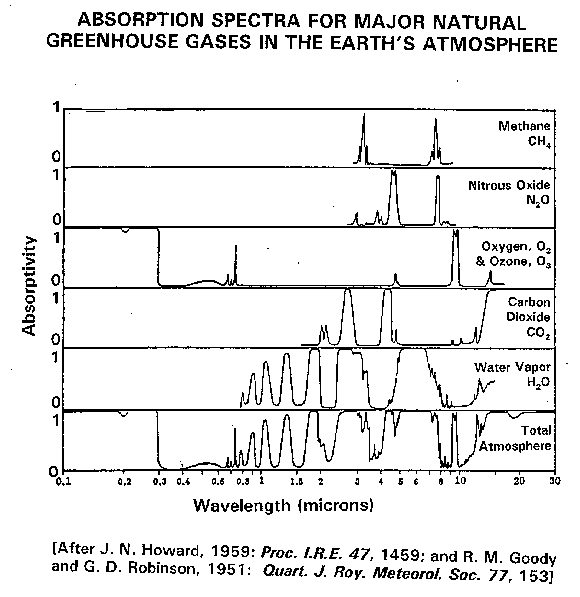
Sooo...once it rains there's no more vapor being generated? I'm not sure how you define water vapor in the atmosphere as short term. Luckily, water vapor also provides it's own negative feedback effect in the form of clouds, increasing the earth's albedo and thereby reducing incident energy at the source.
In my view, the comparison is more akin to tidal vs wave action in respect to ocean levels. Water vapor's broader range of wavelength absorption plus it's greater abundance in the atmosphere vastly overrides CO2's impact, so it can be likened to tidal forces, while CO2 and other greenhouse gasses may contribute to relatively minor local variations, essentially waves on the surface. Reducing the size of the waves will actually have very little effect on average ocean levels.
-
Re:Bash transgenic foods all you want
After cursory glance at that, it seems neither of the graphs in the EWG thing you linked to even mention GE. More widely accepted publications tend to say otherwise, depending on the situation.
I also like the part where no one ever explains how insect resistance is supposed to increase insecticide use, but only when that resistance is transgenic. No one would ever argue against conventionally bred resistances, and somehow, once genetic engineering is involved, then the genetic component of integrated pest management (which is to say, select varieties and/or species resistant to your local insect populations as a first line of defense against them, as opposed to chemical controls later) is suddenly a bad thing.
I do love that they mentioned the insects that have overcome the transgenic defenses. Typical anti-GE nonsense: deny the crops help pest problems, meanwhile say the crop resistances are creating selection pressure for resistance overcoming insects (which shows they slept through population genetics), then deny there are benefits, meanwhile say that the resistant pests are a huge problem. I mean, yeah they genuinely are a problem, but because they threaten the benefits we've already gotten.
-
Re:Bit to belabor the obvious
Who in their right mind situates an atmospheric sampling site in the middle of a chain of active volcanoes ?
People who understand CO2 better than you. Kilauea volcano emits a fair amount of it, but much less than the seasonal uptake and release of an entire continent's worth of trees growing in the summer and dying off in the winter. To minimize the effect of plant seasonal cycles, you want to be as far away from deciduous forests as you can get. In the middle of a giant lava field in the middle of the biggest ocean on the planet is a pretty good choice. South Pole would be a better choice, but Hawaii is cheaper to get to. Plus they serve mai tais.
-
Re:Here's a better idea
sorry, that's a fallacy.
Under siege might not be a good wordbut here are some examples of what I am trying to present
bananas ( we have no bananas today ) long modern history of food shortages
Potatoes, real good example of improper management lead to the Irish famine, blamed on the virus ( which is a factor ) but the restrictions of import / export from Ireland lead to it.
Corn as a stable product
production history variations and the market did respond well to it.
http://www.card.iastate.edu/io...Rice as a stable product
storms and percentage of damage http://environmentalresearchwe... ( I think it might be a tainted new source, but I feel the idea of damage of crops is presented properly )
panic and rumors caused http://en.wikipedia.org/wiki/2... -
Re:Not a cargo ship
You're numbers aren't even close:
3.6 million tonnes a year, projected.
http://www.bbc.com/news/scienc...1 million metric tons LNG = 52 trillion Btus
http://www.extension.iastate.e...3.6 * 52 trillion
that's about 175 trillion BTUs.Current price ~10 dollars per million BTU.
http://www.eia.gov/dnav/ng/his...1.75 Billion a year, BEFORE cost of operation.
Once again, when not using made up numbers, Green energies are the same.
-
Re:Q: Why Are Scientists Still Using FORTRAN in 20
Fortran has had "higher-order array operators" for _many_ years now (see FORTRAN 90), but even without this most Fortran code is written using simple iterative operations over arrays, with explicit multi-dimension indexing. This tends to make the auto-vectorizers job much simpler.
As the AC noted, Fortran has pretty much no aliasing issues at all, unless you go out of your way with COMMON blocks, this makes it far easier to optimize the code.
Terje
-
Re:BS
Well I'm glad you thoroughly debunked the idea that higher temperatures and higher crime rates are in fact correlated.
Of course, this study produced in 1989 before global warming alarmism was really ramped up suggesting this question has been around for a long time (especially considering it sites papers from 1899) includs the following quote:
The studies of geographic region temperature effects on aggression provide impressive support for the temperature-aggression hypothesis.
And are you in fact sure that no AGW supporters commented on the CNN anchor's comment? It didn't seem all that hard to find at least a couple of sites mentioning the topic and suggesting that Bill Nye was polite enough not to mention the absurd segue question.
-
Exciting, but long way to go...
I think Rift is in the right direction -- I've played with a few HMDs and many VR systems, and although the resolution of the Rift is extremely poor, the comfort is better than almost any HMD that I've tried.
The State of the Art in VR is not HMDs but systems like the CAVE (check out the C6 at Iowa State) where the user is in a room with head tracking and a 3D input device, and each wall (including the floor, ceiling, and the wall you entered through in the case of the C6) is a 16 megapixel rear-projected 3D display updated in real-time. The experience is very much like being in the alpha version of the Holodeck (the walls disappear for the head-tracked user wearing the 3D glasses, and any object can be walked around).
The problem with these systems, of course, is that they take up real physical space and have been prohibitively expensive for the last 2 decades. To get something equivalent to the human eye, you need close to 100 Megapixels (updated at >60Hz) with a 180 degree field of view (to avoid feeling like you're seeing the world through welding goggles). The CAVE gives you this experience, at a great price. The real problem is that it is used almost exclusively for demonstrations to visiting dignitaries and funding agencies at the places fortunate enough to have them. The genius of the Rift is that it will have a huge developer and user base (at least compared to current VR systems). What is created by this developer and user base will feed into State of the Art VR research (which has, unfortunately, stagnated horribly for at least a decade) and lead to the creation of something cool. (I'm hoping for a 100 Megapixel equivalent eye tracked VR helmet with vergence and accommodation compensation -- or true real-time digital holography -- or light field displays).
[Incidentally, 3DTV could have been the basis of home based VR systems if the game console companies had had the vision to add head tracking and embrace it for what it is -- a very affordable VR display. For those of you who have never tried it -- the experience of head tracked 3D is VERY different than just 3D. But the 3D hate is too strong -- primarily driven by people who don't see 3D, are too sensitive to the effects of current display tech, or those who have had the misfortune of having experienced badly calibrated 3D]
-
Re:Money climax
You're joking right? Most farms are actually barely making profit, the ones that do are largely owned by corporations and even then aren't nearly as profitable as you would like to think. Especially when you have companies like Monsanto bending them over a barrel over seed prices and lawsuits. The cost to produce crops has been steadily rising (Johnson, 2012) (USDA ERS)
-
Re:This is not news ... LMGTFY
there you go... one of many references to the same sort of study... http://www.psychology.iastate.edu/faculty/caa/abstracts/2000-2004/01A.pdf
-
this is a ridiculous recommendation
and because 'eat some bugs' gets clicks, slashdot cant stop peddling it.
full disclosure: im vegetarian
most bugs dont contain anything more than protein and a bit of fat, and the ones that do are hands-down unapproachable by a consumer whos traditionally a meat and potatoes person.
http://www.ent.iastate.edu/misc/insectnutrition.html
if you want some calcium, it would mean getting used to this guy in your mouth:
https://en.wikipedia.org/wiki/Belostomatidae
Its absurd, but hey so is the chicken nugget/finger/ring and its violent extrusion the KFC "double down."
Are we seriously so opposed to broccoli and other vegetables much loathed as children that we're going to eat bugs instead? we already have alternatives to meat that are cheaper, more nutritious, and widely available. The issue at hand is that we put meat in absolutely everything whether it needs it or not. Speaking for the midwest, even salads have cold-cuts liberally interspersed between the nutritionally devoid iceburg lettuce trucked in from new mexico and california. "lets eat bugs" is not a solution to the "meat is expensive" issue because it ignores the underlying problems of factory farming, monocultural foods, and a population of nutritionally ignorant and chronically obese adults and children. until we solve that shitstorm then no matter what we select as our meat methodone its just going to go down the same route. -
Law and Manners
Lord Moulton nailed it in his 1924 piece Law and Manners:
"I must ask you to follow me in examining the three
great domains of Human Action. First comes the domain of Positive Law, where our actions are
prescribed by laws binding upon us which must be obeyed. Next comes the domain of Free Choice,
which includes all those actions as to which we claim and enjoy complete freedom. But between
these two there is a third large and important domain in which there rules neither Positive Law
nor Absolute Freedom."The Westboro gang would have us believe that the third domain - Obedience to the Unenforceable - is meaningless.
They are barbarians.
Manners makyth Man.
-
MOD PARENT UP
-
Re:I'd buy it!
Actually here in Australia, they do make green tomato sauce (ketchup) from green zebra tomatoes, tastes fine. http://www.ipm.iastate.edu/ipm/hortnews/files/images/green%20zebra%20tomato%20copy.preview.jpg
-
Re:It's the oil.
The high price of oil is largely what is driving grain prices up.
Ethanol production (linked in some sense to oil prices, but partially subsidized) also played a significant role in recent corn price rises:
Using the 2004 corn price of $2.06 per bushel as a reference, actual corn prices
increased by an average of $1.65 per bushel from 2006 to 2009. Only 14 cents (8%) of
this increase was due to ethanol subsidies. Another 45 cents of the increase was due to
market-based expansion of the corn ethanol industry. Together, expansion of corn
ethanol from subsidies and market forces accounted for 36% of the average increase that
we saw in corn prices from 2006 to 2009. All other market factors accounted for 64% of
the corn price increase. -
Re:Not a problem
Yeah I am a knee-jerk Wikipedialoler, with it is treated as anything other than a good breadth first search in math*1, physic, chemistry, biology, so I clicked on some of the link provided.
The first link I check that was not a 404*1 was a link to a book about the violence problem in Russia I could not read the book but here is the abstract:
The United Nations Convention on the Rights of the Child states the right of children for information, but also for protection from information that might threaten their well-being and personal development. In societies that heavily expose children to media, the healthy development of democratic institutions and civil society can be greatly influenced by the impact of media violence on children's behavior and perception of society. An emphasis on this particular aspect of societal regulation of children's media viewing is strongly recommended by UN and UNESCO. Unfortunately, The UN Convention on the Rights of the Child has not succeeded in modern Russian society with regard to the media (television, cinema, video, PC-games) because scenes of hard violence persist on all Russian cinema and television screens. The infringement of the Rights of the Child on the Russian screen is a very important problem and Russian pedagogues should not only attract societal and governmental attention to it, but should also provide training and education about children and media violence.
the second was to a pdf that I was able to read, here is the abstract
Over the past 50 years, the average news report has changed from claims of a weak link to a moderate link and then back to a weak link between media violence and aggression. However, since 1975, the scientific confidence and statistical magnitude of this link have been clearly positive and have consistently increased over time. Reasons for this discontinuity between news reports and the actual state of scientific knowledge include the vested interests of the news, a misapplied fairness doctrine in news reporting, and the failure of the research community to effectively argue the scientific case.
1- there is a great deal of bad link*2 in the source of that pages, please someone fix that as I am lazy when unpaid or not arguing!
2- 302 redirecting from a GET $[paper].pdf to a generic error page served with a response code of 200 when it should be set to 404 -
Unsafe is safe
Let's stop protecting all our crops from pests and thieves and see how that turns out.
Protecting good, going overboard on protection bad. Makers of recombinant herbicide-resistant crop seeds have gone overboard; Roundup Ready soy just leads to Roundup Ready weeds. Everyone outside the entertainment industry realizes that copyright has gone overboard, and some people posting here claim that the concept of copyright itself is overboard.
Let's just accept that people are going to die in road accidents and ignore all traffic laws.
Taking away road signs has been shown to improve safety in some (I admit anecdotal) cases. See for example unsafe is safe.
-
Re:So You're a COMPLETE Idiot?
"The article explains NOTHING about how dangerous 2,3,4-T is, and simply replies upon "it's a part of Agent Orange" to assert the harmfulness of the chemical."
Well according to almighty wikipedia the oral LD50 of 2,4,5-T is 389 mg/kg in mice and 500 mg/kg in rats. That struck me as not being especially hideous, and on a whim I looked up the LD50 of aspirin: 250 mg/kg in mice and 200 mg/kg in rats. By this measure 2,4,5-T is less toxic than aspirin!. It's more complex than that however. It doesn't include low dose/persistent exposure effects of the compound and doesn't include degradation products or side products of synthesis, which could have different levels of toxicity. It's the synthesis byproducts that are a major issue with 2,4,5-T. As others have commented on, 2,3,7,8-Tetrachlorodibenzodioxin (TCDD) is a side product of synthesis, and according to wikipedia modern synthesis can knock its levels down to about 0.005 ppm (I've seen 0.1 ppm elsewhere in my quick search), but in earlier batches could be up to 60 ppm. The LD50 of TCDD is 1,000 times lower than 2,4,5-T; a few hundred micrograms ingested per kilogram of body weight was enough to kill rats (sorry about age of study). Nasty effects other than death naturally occur at lower amounts. Also keep in mind that we're just making rodents eat the stuff. I'm not a chemical engineer, but you do have to wonder what sort of waste products (TCDD included) were flushed out by that chemical plant and where it went, and how long TCDD and other nasties might persist in the environment. TCDD is unfortunately pretty resistant to biodegradation, one study in Italy I found gave a half-life in soil of 9.1 years. I've just spent a little bit of time working on insecticide development so these are some of the things I think about, although being a biochemist this is not a core area of expertise. -
Re:We're lucky
Your head is in the sand, I think. Here's a land use chart for Iowa, tell me how its only 1% developed.
-
Re:Dart or Dash?
So what is it going to be called? Dart or Dash?
Dart.
I cite the title of Lars Bak's upcoming talks on the language:
Dart, a new programming language for structured web programming
Designing the Dart programming language with a simple virtual machine in mind
-
CY-TAG at Iowa State
I went to CY-TAG at Iowa State (a spin off of CTY). Greatest experience of my life, I don't know if I would have made through junior high / high school without the friends I met there. It motivated me to become more intelligent that I was not getting from similar peers at home. I highly recommend sending you kids to nerd camp.
-
Brazil imports record amount of ethanol
Brazil imports record amount of ethanol
"So, where's Brazil getting all of this ethanol from? The United States. According to Platts, almost all of Brazil's imports were U.S. corn-based ethanol, as prices were deemed to be the world's most competitive".
-
Even plain wifi can be done wrong.
When I decided to go back to school, I started with a community college. Their wireless network was pretty much open, but for some perverse reason, it worked with the Windows DHCP client, and with udhcpc, but not with dhcpcd (used to be the default on Gentoo) or dhclient (default on Ubuntu/Debian). It seems fairly likely that this was a bug in their server software, and while I wasn't ridiculed, I never did get any help from the university -- I had to figure this out on my own. As much of a Linux geek as I am, I'm really not sure where I got the idea to just try other DHCP clients.
The university didn't really seem to care that I solved it, or how I solved it, and I don't think they ever put it into a FAQ or anything. The networking club did appreciate it, since a few of them were at least playing with Linux. I never tried it with a Mac, and never saw a single Mac while I was there, so I have no idea if that would work.
But it was because of this, and because the next two courses in their "computer programmer" degree (after Mainframe Assembly) were COBOL and Visual Basic, that I got out as soon as I could. After one term, I left for a real university. (Incidentally, one more factor validating my choice is the fact that the community college kicked me off their cyber defense competition team as soon as they realized I wouldn't be there next term, because "that's how it works in the real world" -- the guy running it is of the opinion that as soon as there's a hint you might leave, you get escorted out the door by security.)
So, that brings me to today. The university I'm at now does provide some amount of support for Linux, to the point where some of their FAQ pages include stuff about Linux, and if I ask a question, it's very possible I'll get an actual answer. The wireless uses MAC filtering, but there's no actual requirement that I use any particular software -- and, bonus, if I make sure to uncheck the "use NAT" box when registering my system, I get a real, Internet-routable IP address and dynamic DNS (with a little firewalling; obviously outbound SMTP and inbound Samba are blocked). I could, theoretically, run a webserver on my laptop that'd be accessible from http://serenity-xps.student.iastate.edu/.
The facilities provided are a genuinely heterogeneous mix of Windows, Mac, and Linux everywhere -- that's labs, remote access machines, etc, and they do point out things like rdesktop for the Windows machine. I've avoided getting a copy of MS Office by using rdesktop to connect to the comp sci Windows terminal server (which has a recent MS Office installed) whenever Open/LibreOffice won't work, I've had no issues printing with lpr on the commandline on the Linux remote machine (though sometimes it's easier to convert to a PDF and print from that Windows terminal server).
Individual courses are hit-and-miss, but mostly hit. I've had English classes which met in Mac-powered computer labs (one started on Windows and then switched to checking out Macbooks), an entirely-Java/Eclipse programming course which was just transparently cross-platform, and a programming course which required people to use gcc and graded you based on whether your code ran on a particular Linux machine you had ssh access to, and a Digital Logic course which was just switching to Linux machines in its labs. That last one was a little bumpy -- all the lab instructions were in
The most common per-course issue is people still sending doc and docx around (though most accept odf and all accept pdf for anything I write). There was a course which required people to produce a PowerPoint presentation with an audio recording of our narraiton included, which is a PITA even if you have Windows and PowerPoint -- here, I did something ridiculous and built an HTML5 presentation inst
-
Re:Answer:
> No.
Elaborating on that very informative answer, I offer the following two observations.
1. The current rise in fuel prices are due to political issues driving fear and speculation in the oil market, not due to a lack of adequate supply.
2. Global food prices are elevated because of ethanol subsidies and increased fuel prices. If the ethanol blender credit withers and oil politics settle down, then commodity food prices will decline significantly.
To avert the inevitable [citation needed], I offer the following.
1. http://www.reuters.com/article/2011/04/17/us-saudi-oil-idUSTRE73G14020110417
2. http://www.card.iastate.edu/publications/dbs/pdffiles/11pb5.pdf-eag
-
Re:Sounds like
http://pubs.acs.org/doi/pdf/10.1021/jf200456j This article debunks your article.
An article hidden behind a paywall. Very clever.
Other animals than mice have been exposed to RAI from transgenic peas. Rats, pigs, and chickens were fed raw, transgenic peas at around 30% or more of their diet in short feeding trials. The only effects on their health could be attributed to dose- dependent reductions of the digestion of starch due to amylase inhibition rather than immunological effects, diarrhea in the case of pigs, and a reduction of weight gain in the case of chickens.2022
We found no evidence for increased immunogenicity of the transgenic RAI, and we note that immunogenicity is not sufficient for allergenicity.So, some of the animals couldn't digest starch anymore, the pigs got diarrhea, and the chickens didn't gain as much weight as they should have.
Am I supposed to believe this was due to 'other causes'?
I wish someone would find some 'long feeding trials', not the short ones where any irregularity can be arbitrarily attributed to 'other factors' and dismissed.Conclusion some people are allergic to peanuts. This shows no concerns over GMO crops.
The example you quoted was about peas, not peanuts. Did you even read it?
Luck.
Lets see an advertisement for lecture of a guy that doesn't perform any current research anymore.
Oh yeah, let's forget about his 30 years of relevant research, and the fact that he was fired for bringing the issue with the GMO potatoes to the public's knowledge.
Ever heard of ad hominem attacks?http://www.sciencedirect.com/science?_ob=MImg&_imagekey=B6T6P-4C004D3-3-C&_cdi=5036&_user=409620&_pii=S0278691504000444&_origin=&_coverDate=07%2F31%2F2004&_sk=999579992&view=c&wchp=dGLbVzW-zSkzS&_valck=1&md5=ef423dc2441395950524ecce3b73afcc&ie=/sdarticle.pdf
Also hidden behind a paywall. How very nice of you.
As explained in previous chapters, crop breeding by both conventional means and by genetic modification has theoretically the potential to modify the plant com- position beyond that particular trait that was intended, thus resulting in ‘unintended effects’. To analytically determine all possibilities of unintended effects is a huge undertaking with many technical challenges. A further challenge is to determine the real significance of any unintended effect on consumer health. Unintended effects do not automatically imply a health hazard.
Unintended effects certainly do not either automatically imply, that there isn't a health hazard.
Hazards may be considered if the nutritional profile of the plant has been altered, if proteins have been altered in such a way so as to affect their allergenic potential, or if new or increased levels of potentially toxic secondary metabolites are produced. However, unintended effects may have absolutely no impact on health, or may even be beneficial by reducing potentially toxic substances.
.. or they may adversely affect people's health. Nothing new here.
Ever heard of the Precautionary Principle?
In case you're wondering how that would apply; let's say some GMO plant starts to be grown on a wide scale, and the modified genome transfers to wild plants.
Years later, it's discovered that the transgenic part leads to colon cancer, it just takes 8-12 years to develop. The modified genome has now spread to plants in all parts of the world - we can't get rid of it.
There's one option: We can grow non-GMO plants in greenhouses, taking extreme care not to get them contaminated with pollen from GMO plan -
Re:In their dreams!
You might be thinking of algorithmic self-assembly... and, sort of.
That class I mentioned spent most of our time working with an abstract tile assembly model. We had assignments to build programs and run them on one of these simulators, and otherwise spent most of the time proving stuff about them.
Unfortunately, while it's really easy to learn how to build these, I'm not sure there's a tutorial I can point you to.
The good news is that it is massively parallel. It's related, somewhat, to cellular automata, or Conway's Game of Life, except that it's strictly growth -- once a tile attaches, there's normally no way to detach it. But the idea is that anywhere a tile can attach, it eventually will, and fairly quickly -- while you do often have entirely sequential algorithms, your algorithm can theoretically scale with the number of locations tiles can currently attach. It's also Turing-complete, and kind of makes for a cool visualization of a Turing machine. You can also just make cool fractal patterns instead of trying to compute anything.
The bad news is that errors happen quite often, and there's no good way to correct or avoid them (yet). There are certain shapes which are impossible to build. The parallelization isn't by any means free -- one interesting example was a Turing machine with a binary alphabet which operates simultaneously on the entire set of natural numbers (or rather, spawned a new Turing machine for each natural number), with appropriate "output" to check for whether a given machine had halted, but each new machine runs at half the speed of the previous one, otherwise they'd run out of room. While tiles are cheap, tile types are not -- it's apparently expensive to synthesize DNA, but cheap to replicate it. And to do anything that isn't just compiling a Turing machine (which produces an impossible number of tile types), while technically algorithmic, is incredibly difficult and doesn't seem to benefit in any way from any of the languages or tools we've developed for programming.
This isn't just "parallel programming is hard." It's not just a different language or a different syntax. It's more like going back to drawing logic circuits by hand, only none of the components bear any resemblance to anything you've used before.
So, it's not likely anyone's going to be using these to mine bitcoins or crack RSA anytime soon. On the other hand, it's at the stage right now where you can still come in with a crazy idea that no one ever thought of before, and move the entire field by yourself. I suppose that's true of any field, but most fields, everyone's already thought of the more obvious crazy ideas.
-
Re:In their dreams!
If you're talking about your brain, that's not what this is. This is using actual DNA to perform computations.
Oh, by the way, last I checked, it's slow, and this is no exception:
Reif also pointed out a few downsides. One is the speed of calculation. The execution of a single gate can take anywhere from 30 to 60 minutes. Executing a four-bit square root could take up to 10 hours.
This isn't like quantum computing -- maybe they can make it faster, but I really don't see this having any inherent advantages over old-school tech like CMOS anytime soon.
What makes this interesting is the potential to do calculations inside living systems, or to actually interface our code with otherwise strictly biological processes. These "circuits" are just solutions of custom-designed DNA, and each "gate" takes small single-strands of DNA as input, and produce them as output, whether as a "wire" to another gate, or as the final output to be measured to check if the circuit is working. Now imagine putting that in a cell. (Oh, and this is why formal methods matter -- if someone's going to be putting code in your body, it's not enough to debug it, you want that shit proven correct.)
Disclaimer: While I did take a class (COM S 433 at ISU) which attempted to examine this stuff, this was covered at the very end of the semester, and no one (including the instructors) really had a good idea how these things actually work. I know enough to be dangerous, but there's a good chance I'm wrong about pretty much anything I say here. Read the papers yourself -- it's fascinating stuff.
-
Re:Sounds like
I would *love* to see you live on only or mostly GM foods for a year or so.
Then, if you're still alive, you can come back and tell your story.
Goodhttp://pubs.acs.org/doi/pdf/10.1021/jf200456j This article debunks your article.
From the linked articleOther animals than mice have been exposed to RAI from transgenic peas. Rats, pigs, and chickens were fed raw, transgenic peas at around 30% or more of their diet in short feeding trials. The only effects on their health could be attributed to dose- dependent reductions of the digestion of starch due to amylase inhibition rather than immunological effects, diarrhea in the case of pigs, and a reduction of weight gain in the case of chickens.2022
We found no evidence for increased immunogenicity of the transgenic RAI, and we note that immunogenicity is not sufficient for allergenicity.Conclusion some people are allergic to peanuts. This shows no concerns over GMO crops.
Luck.
Lets see an advertisement for lecture of a guy that doesn't perform any current research anymore.
Oh, and when you've got time for it, go see a movie called "The World According To Monsanto".
When you start posting articles from scientific peer review journals I might start to take you seriously.
http://www.sciencedirect.com/science?_ob=MImg&_imagekey=B6T6P-4C004D3-3-C&_cdi=5036&_user=409620&_pii=S0278691504000444&_origin=&_coverDate=07%2F31%2F2004&_sk=999579992&view=c&wchp=dGLbVzW-zSkzS&_valck=1&md5=ef423dc2441395950524ecce3b73afcc&ie=/sdarticle.pdf
This is real science.
Traditional plant sources of food with a long history of use have not been evaluated for safety in a systematic way. Typically, it was by trial and error where the plant was incorporated into the diet, often after some form of processing, e.g. cooking, to make it acceptable from both a taste and safety point of view. Traditional vari- eties of food crops are known to contain both beneficial components (nutrients and other compounds), as well as compounds with a toxic potential (natural plant tox- ins, allergens, and anti-nutritional factors, which reduce the availability of nutrients). However, the toxic poten- tial (hazard) will only be expressed (as risk) if the person consuming the foodstuff is exposed to amounts that are sufficient to cause toxic effects.
An additional consideration is the balancing of risk of possible harm against the known nutritional benefits of consuming the plant food (as part of a balanced and diversified diet). Such balancing for traditional foods has taken place over the years in a subliminal way (again by trial and error) and is more recently becoming enshrined in nutritional and dietary guide- lines. Therefore, with the introduction of a novel or modified plant into the food supply, it is essential to view its safety in the context of what is already safely used in food.
As explained in previous chapters, crop breeding by both conventional means and by genetic modification has theoretically the potential to modify the plant com- position beyond that particular trait that was intended, thus resulting in ‘unintended effects’. To analytically determine all possibilities of unintended effects is a huge undertaking with many technical challenges. A further challenge is to determine the real significance of any unintended effect on consumer health. Unintended effects do not automatically imply a health hazard. Hazards may be considered if the nutritional profile of the plant has been altered, if proteins have been altered in such a way so as to affect their allergenic potential, or if new or increased levels of potentially toxic secondary metabolites are produced. However, unintended effects may have absolutely no impact on health, or may even be beneficial by reducing potentially toxic substances. -
Re:Sounds like
-
Re:Ethanol is odorless ...
If there's a reputable scientific resource that agrees with his position he should cite it. So far it seems like the only reputable resource anyone has been able to cite (the MSDS) disagrees with him.
http://avogadro.chem.iastate.edu/MSDS/ethanol.htm
"
Physical State: Liquid
Appearance: clear, colorless
Odor: aromatic odor
" -
Re:Leaving it up to the parent works both ways....
Opinions don't matter. What matters is facts.
Opinions certainly do matter. Especially in the absence of universally understood "facts".
Your arguments against what you call censorship on the part of the parents would seem to imply that you believe children are capable of making rational decisions about their own welfare, and everyone else should just butt out. A major role of parents is and must be to train their children on socially normal roles and behaviors (if you want to call that indoctrination that's fine).
Video games do not cause violence. People who are detached from reality believe they do, however.
Violence is an extremely complex behavior. There is never a single solitary cause. Violent video games do contribute to the perception that violent behavior is acceptable, which reduces the perceived social cost for the individual engaging in such behavior. Violent video games facilitate and enabe violent behavior; read the articles at http://web.clark.edu/mjackson/anderson.and.dill.html and http://www.psychology.iastate.edu/faculty/caa/abstracts/2000-2004/01ab.pdf. To say that because they aren't the sole cause means they're totally safe for kids is overly simplistic.
-
Re:This is wrong.
No problem! I figure most of my comments disappear into the void so I'm excited to imagine that they're not all completely worthless!
As for Canada, I'm not from that area, but just got back and it was great! Of course the national parks are beautiful and stunning, but we ended up just north of them after another event in Willmore Wilderness Park. A slightly more subdued, intense beauty. It depends a lot on how avid you are and how far you want to go, but basing my advice only on the fact that you find topo maps valuable, I can't recommend it highly enough! In four days, we only saw two groups of two people on horses, and both within a couple miles of the parking lot. There are no permits or fees involved either, and as opposed to the national parks, traffic is low enough that the animals are still afraid of humans, which is a big plus where bears are involved. Just tossing the idea out there since my usual problem is not really knowing where to go in the first place. Normally I wouldn't be so quick to recommend my secret spot, but there's a lot of area out there and really, who browses the comments at +0 anyway?
-
Re:This is wrong.
No problem! I figure most of my comments disappear into the void so I'm excited to imagine that they're not all completely worthless!
As for Canada, I'm not from that area, but just got back and it was great! Of course the national parks are beautiful and stunning, but we ended up just north of them after another event in Willmore Wilderness Park. A slightly more subdued, intense beauty. It depends a lot on how avid you are and how far you want to go, but basing my advice only on the fact that you find topo maps valuable, I can't recommend it highly enough! In four days, we only saw two groups of two people on horses, and both within a couple miles of the parking lot. There are no permits or fees involved either, and as opposed to the national parks, traffic is low enough that the animals are still afraid of humans, which is a big plus where bears are involved. Just tossing the idea out there since my usual problem is not really knowing where to go in the first place. Normally I wouldn't be so quick to recommend my secret spot, but there's a lot of area out there and really, who browses the comments at +0 anyway?
-
Re:This is wrong.
No problem! I figure most of my comments disappear into the void so I'm excited to imagine that they're not all completely worthless!
As for Canada, I'm not from that area, but just got back and it was great! Of course the national parks are beautiful and stunning, but we ended up just north of them after another event in Willmore Wilderness Park. A slightly more subdued, intense beauty. It depends a lot on how avid you are and how far you want to go, but basing my advice only on the fact that you find topo maps valuable, I can't recommend it highly enough! In four days, we only saw two groups of two people on horses, and both within a couple miles of the parking lot. There are no permits or fees involved either, and as opposed to the national parks, traffic is low enough that the animals are still afraid of humans, which is a big plus where bears are involved. Just tossing the idea out there since my usual problem is not really knowing where to go in the first place. Normally I wouldn't be so quick to recommend my secret spot, but there's a lot of area out there and really, who browses the comments at +0 anyway?
-
This is ALREADY a problem.
I know it's cliche, but I have actually had a situation where I needed a Linux ISO ASAP on a college campus. BitTorrent was the fastest way to get it.
Fortunately, Iowa State University's current policy is somewhat sane -- they sent me an email that I should be aware I'm uploading, and did absolutely nothing else.
My guess is that this actually does curb piracy, but it does so without violating net neutrality or hampering legitimate, educational uses. More importantly, that system probably costs them way less to set up and maintain than anything pro-active, as it still lets the MPAA do the heavy-lifting. I assume they'd just pass any letters from the MPAA (including legal action) straight on to me, thus meaning they have no legal liability one way or the other.
This would reverse all of that. It'd make the school responsible for policing what students are doing on the school network, and thus, the school would be responsible if they aren't effective. In fact, it seems to be operating under the assumption that this is already happening. The University of Iowa, I'm told, functions this way, but any university which does anything to hinder piracy is not doing themselves any favors.
-
This is ALREADY a problem.
I know it's cliche, but I have actually had a situation where I needed a Linux ISO ASAP on a college campus. BitTorrent was the fastest way to get it.
Fortunately, Iowa State University's current policy is somewhat sane -- they sent me an email that I should be aware I'm uploading, and did absolutely nothing else.
My guess is that this actually does curb piracy, but it does so without violating net neutrality or hampering legitimate, educational uses. More importantly, that system probably costs them way less to set up and maintain than anything pro-active, as it still lets the MPAA do the heavy-lifting. I assume they'd just pass any letters from the MPAA (including legal action) straight on to me, thus meaning they have no legal liability one way or the other.
This would reverse all of that. It'd make the school responsible for policing what students are doing on the school network, and thus, the school would be responsible if they aren't effective. In fact, it seems to be operating under the assumption that this is already happening. The University of Iowa, I'm told, functions this way, but any university which does anything to hinder piracy is not doing themselves any favors.
-
Re:Absolutely
Yes, indeed, there is a huge untapped frontier in software, both for making discoveries (programs that find and fix their own bugs, for example), and for doing interesting research in other areas. One place to look is computational economics - building complex market scenarios and figuring out how they work. As far as I know, nobody did that before the big mess in California's energy market in 2000. See the Trading Agent Competition or Leigh Tesfatsion's summary of Agent-Based Computational Economics.
-
Don't forget GMOs
-
Re:We should keep an open mind about this.
From the TFA:
The study was published today in the March 2010 issue of the Psychological Bulletin, an American Psychological Association journal.
Unfortunately, it's not up on their website yet or I'd link you right to the paper.
Oh wait, actually he has a preprint up on his own website. For free. -
Re:"not huge effects"
Duh, aren't you clever. Actually I did study statistical research methods for more than a single semester, and furthermore it is very possible to make assumptions and mistakes in the research so that you create the illusion of causation when you haven't really found it yet. (Or do you blindly believe all the research you read?)
Someone else posted the preprint copy of the report, which is hopefully more enlightening than the news article, though I have not had time to read it.
-
Re:"not huge effects"
You should be able to find his methods in the preprint of this paper on his university website. I haven't had a chance to read it so I have nothing more to add.