Slashdot Mirror
Domain: illinois.edu
Stories and comments across the archive that link to illinois.edu.
Comments · 162
-
Try Some Astronomy
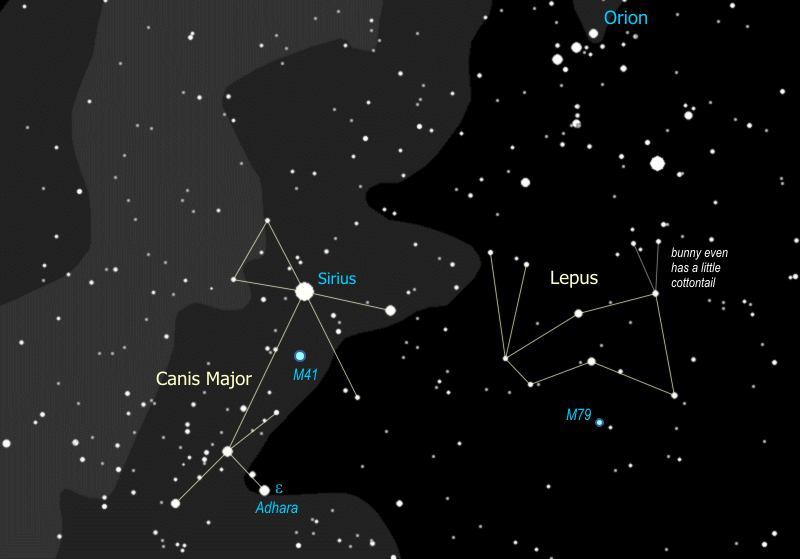
The relatively bright star Adhara (Epsilon Canis Majoris) is actually the brightest star in the sky in UV light. Of course you don't have pure UV vision but rather just a bit more UV bias.
However, since you seem to enjoy an experiment I suggest going somewhere where at least the brightest stars are visible, and comparing relative brightnesses between stars with a person with average vision.
Some background and a chart for Adhara below. It's close to Sirius which in turn is easy to find by using the belt of Orion.
http://stars.astro.illinois.edu/sow/adhara.html
http://www.rocketmime.com/astronomy/fig/CanisMajor_wAdhara.gif -
Re:When can I get one on my desktop?
The University of Illinois generates much of their own power, and has relatively low electric rates because of this. This year the rates are posted as $0.0754/KWh. Its also doubtful they will be operating continuously at peak capacity.
And on a related note, the building housing Blue Waters has been certified LEED Gold by the USGBC in an effort to minimize the energy and cost impact of operating the new facility. -
Re:Kinect Sensors?
Exactly -- it's not just a camera. Besides which, if "stereoscopic camera" gets a special name instead of just being called "camera", why doesn't this other camera?
The Kinect sensor works similarly to a stereoscopic camera, except:
1. It works in the IR spectrum instead of the visible.
2. Instead of making two recordings and correlating after the fact, one of them is actually fixed and projected (and this is the part that isn't a camera).For that reason I would expect the approach to fundamentally be more accurate than stereoscopic cameras, not less, under most circumstances, and particularly in low-light conditions. I tried to find comparisons online but mostly got qualitative university student reports on how the Kinect works without quantitative data before I got bored. Best one I found is:
A little over halfway down it compares pros and cons with natural light stereoscopic cameras.
-
Link to the research group doing this:
http://colloids.matse.illinois.edu/
Jennifer Lewis' research group here at the University of Illinois did this work.
They've got a link on that page to a youtube video that shows how to make and use this conducting ink, but it goes through Boing Boing and is down at the moment due to the SOPA protest.
Here's a direct link: http://www.youtube.com/watch?v=dfNByi-rrO4
Seriously cool work.
-
Speaking of US and Canada, I recommend:
I disagree. Camps are a about a lot more than just learning material - there is a huge social interaction component that goes along with them that you're just not going to get on a summer job. And frankly, the social skills are the more important aspect of the program than the academic material for many of the participants (myself having been one of them.)
I strongly recommend:
http://youthprograms.mtu.edu/explorations.php
Summer Youth Programs at Michigan Tech University. I suppose it's been 16 years since I've been, but they were excellent then and a quick perusal of their site leads me to believe they are excellent now, especially if you're interested in Engineering.
There are just not many opportunities for High School students to get exposure to real engineering, but this program definitely offers them.
Oh, and there are girls there.
Anyway, I went 2 or 3 summers and always had a great time. It's not just tech class stuff, there's a strong social program associated with it as well.
Great for those of you who are in HS, and those of you who now have HS-aged children yourselves. I'm honestly not aware of another program in the US like it.
I also did the Illinois Math and Science Academy program as an incoming freshmen or sophomore (it's been a while), but their program focuses more on straight math/science and not so much on practical engineering application, so I definitely preferred Tech. Then again, I don't remember much from the IMSA camp other than the girls and the pinball machine (much time spent on both, although probably more on the pinball machine) so take that as you will. Depending on your age, you could do both; IMSA as an incoming Freshman and Michigan Tech after that.
One other difference is the IMSA program was loaded with a lot more math/science nerds (I recognized a lot of people at IMSA from math competitions), while Tech had a more well-rounded group of people and programs (a lot of participants are Tech alum who just think it's a good idea to get their kids exposed to engineering), so I also liked Tech as an opportunity to work on social skills with non-nerds in a low-pressure environment (nobody knows you when you start and you're leaving in a week or two, so no permanent damage) - and I needed the practice.
Oh, one more I did:
http://engage.illinois.edu/entry/5785
Now called "Exploring Your Options", back in my day it was S.I.T.E., student introduction to engineering. I was pretty sure at that point I was going to Illinois though (summer prior to senior year) so it was double-helpful for me in just learning the engineering department and campus, and a lot of the people I met in the camp ended up attending Illinois as well so it was a leg up on meeting people. I'd say this is a good program if you're a Senior and did the others, but if I was picking ONE, I'd still probably go with Michigan Tech. IMSA vs. UofI will just depend on age. I think the UofI program would have been less interesting if I were not already sure I were goingto UofI.
Caveat: I was in high school 16-20 years ago, so my info is a bit dated.
-
Re:naysayers
What part of "coming out of an ice age" does not include a bit of natural increase in temperature?
The aberration in temperature seems unusual, but it's nothing compared to the little ice age that froze Europe in the 17th and 18th centuries.
If temperatures are naturally rising (as all data seems to indicate), then I have no doubt that we'll see articles like this multiple times a year until the warming trend ends. I just checked and the record high for my area was set in 1954. If we have news stories every time a new record high is set for any area, then it will be quite annoying. That's probably why most voices of reason have stayed out of this discussion.
-
Re:And the web...
U of I have had supercomputers for decades. Of course a lot of computation is needed for the Tevatron, from controlling the streams to analyzing the data. U of I is also home to the Tevatron.
Odd that people don't think of Illinois when they think of computing and physics.
-
Re:And the web...
U of I have had supercomputers for decades. Of course a lot of computation is needed for the Tevatron, from controlling the streams to analyzing the data. U of I is also home to the Tevatron.
Odd that people don't think of Illinois when they think of computing and physics.
-
Re:Great idea!
-
impressively small
Afaik, even considerably larger miniature heat engines have significant problems, which are only recently being solved, but most of the existing research is on things more in the millimeter to centimeter range. I suppose micrometer engines might face different problems entirely, but quite impressive.
For example, a discussion of difficulties in building a miniaturized combustion-based heat engine:
The problem being faced by micro-miniature heat engines is that, as the size is reduced, the surface-area-to-volume ratio of the combustor begins to dominate the combustion process. Both the chemical reactivity of the wall and the heat transfer to the wall affect the radical recombination and generation rates of the reactants. If important radicals such as hydroxyl or methyl are destroyed at or near the wall too quickly, the combustion process can be quenched. The thermal and chemical quenching pathways are strongly coupled, so that very small changes in temperature or chemical activity of the wall can lead to significant changes in radical concentration near the wall, making gas phase combustion using air as the oxidant difficult to sustain below a critical length scale (i.e. quenching distance) of a few millimeters (Kuo, 1986).
Source: This paper (PDF, 2005)
And a working-in-simulation model of a 65 x 22 cm Stirling engine: from a 2008 paper
-
It can work with an adder
Main problem with crowd sourcing or any other form of sourcing is, we can't (don't want to) look far enough into the future to understand implications of what we are doing now.
So if they add a mandatory re-validation of constitution periodically (say 20 years, ala TJ) into the constitution itself, then it just might work.
-
Re:University Owns It
Oh, and the second university I checked said something similar:
In submitting a thesis or dissertation to Stanford, the Author grants The Trustees of Leland Stanford Junior University (Stanford) the non-exclusive, worldwide, perpetual, irrevocable right to reproduce, distribute, display and transmit Author's thesis or dissertation, including any supplemental materials (the Work), . . . to sub-license others to do the same,and to preserve and protect the Work . . .
Now, you are right in that public institutions frequently have rules along these lines:
The copyright to a thesis belongs to the student, according to the University's General Rules. As a condition of being awarded the degree, however, the student grants the University the non-exclusive right "to retain, use and distribute a limited number of copies of the thesis, together with the right to require its publication for archival use."
So the copyright is yours but you are required to share some of those rights with the institution.
In general what I have seen is that if you used any money from them (grants, research assistantship, use of labs/equipment), the universities want the copyrights. If you did it all by yourself, you keep it. So it seems that you can typically only keep the copyright for some social science projects or purely theoretical stuff like that as it is close to impossible to carry out an applied scientific or engineering project without any help from the institution.
-
Exercise is good
I know we are geeks here and "supposed" to hate exercise, but exercise is great. It helps cognitive health(http://www.fi.edu/learn/brain/exercise.html, http://news.illinois.edu/news/04/0216exercise.html) and emotional health (http://news.illinois.edu/news/04/0216exercise.html). Increasing your agility and endurance can save your life in a dangerous situation.
It doesn't have to be boring either. You can practice martial arts or swordsmanship (and what helps you get into a Song of Fire and Ice better than being able to cook some of the dishes and work on swordplay in between books?). Sex counts too (http://www.fitnessmagazine.com/health/sex/better-sex-guide/sex-positions-that-double-as-exercise/), you can get pretty creative in the bedroom. You can grab a bunch of like minded friends, and invent games yourself.
-
Re:Why did IBM do this, and what next for NCSA?
Not that it changes your argument, but you should know that NCSA has a brand new Altix.
-
Re:Largest economy?
The studies show that early development is when it is easiest, with the most progress taking place from age 2-6. 2nd grade is far too late for the "automatic" learning that infants and toddlers enjoy. I have relatives that are raising their children bilingually. Anecdotally, the kids speak 2 languages fluently at ages 5 and 7 and learned them both without the kind of effort adults are required to make. If you are interested, you can read more about it here
-
Re:I'm just curious
That's a really interesting question. I don't really know anything about this, and have only done high school physics. But from first principles, and a quick google, it seems like photons would interact with antimatter in the same way as matter. So the antimatter would look the same.
-
Re:Smart Meters... dumb paranoia
I disagree. I think appliances have distinct and identifiable energy signatures, and depending on the detail the meter records this could easily translate to dependable information about you and your habits. See regular spikes over the year on weekdays, starting at 7am which end at 8am? Your routine involves waking up at 7am, and leaving for work at 8am. Regular spikes starting at 7am that last throughout the day (but level off at 8am)? Your routine is waking up at 7am, and working from home. 700 watt spike most mornings for 30 seconds? Your toast. Likewise, your water heater will have a particular wattage and they could use that to tell when you shower. Thing is, maybe they don't know what the specifics are for your appliances... until they care. Once someone cares, they can make a profile of energy signatures (1100 watt spike for
You basically just gave the summary for this paper: http://seclab.illinois.edu/wp-content/uploads/2011/04/BergmanJJTGW11.pdf
-
Re:Smart Meters... dumb paranoia
It's actually pretty easy to generate an appliance profile for a house and figure out which appliances are on at any given time, even for loads as low as 10W. Considering the time delays between running around to every device in your house, it's also possible to figure out in what order the appliances were turned on! Relevant papers: http://seclab.illinois.edu/wp-content/uploads/2011/04/BergmanJJTGW11.pdf http://www.computer.org/portal/web/csdl/doi/10.1109/MPRV.2010.71
-
Plato System?
That sounds like a Plato IV terminal. They had that system in front of an orange plasma panel display. It wasn't as high a resolution as this, but the idea was the same. Worked fairly well, too.
-
Physics Van!
The University of Illinois Department of Physics has a good site for their outreach program, the Physics Van: http://van.physics.illinois.edu/ It's good if kids want to ask questions of professors and students in the department, or read previous answers to questions. It's also good if you or the students want to learn about demonstrations, some of which can be done at home.
Currently, I pay the bills as a graduate student by going to elementary schools to do physics demonstrations on behalf of my department (not at U of I). I don't know where you teach, but there is probably an outreach group nearby (at a University, National Lab, or even a corporation that employs research scientists) that can come to your school. I realize you weren't asking about live demonstrations, and I certainly think you're doing the right thing looking for good, engaging online activities, but I still think this bears mentioning.
Another thought is that because clear and accurate representation of results is so important in science, you might consider doing an activity that involves a computer visualization of some kind of measurement taken by the students. You could even have them publish it on the web. It wouldn't need to be anything super-fancy, just something to encourage creativity and careful thinking about what the results mean and what's important about them.
Good Luck!
-
try Bugscope
you are welcome to try Bugscope, whose 12th anniversary was yesterday http://bugscope.beckman.illinois.edu/
-
Re:What about New Nadrid
A interesting RFI for Pre-Packaged Commercial Meals mentioned the New Madrid Fault System
https://www.fbo.gov/index?s=opportunity&mode=form&id=eaea338540a0aea155a48a650a077352&tab=core&_cview=0 (Jan 20, 2011)
"...FEMA request for Information is to identify sources of supply for meals in support of disaster relief efforts based on a catastrophic disaster event within the New Madrid Fault System for a survivor population of 7M...."
36 months of remaining shelf life upon delivery.
http://www.reuters.com/article/2008/11/20/us-earthquake-study-idUSTRE4AJ9EV20081120 from 2008
would cause "the highest economic losses due to a natural disaster in the United States."
New Madrid Seismic Zone Catastrophic Earthquake Response Planning Project (Statistics for Eight-State Region on page 28)
https://www.ideals.illinois.edu/bitstream/handle/2142/14810/Volume%20II_Part%201.pdf -
Re:IE6?!?!? Amateurs
This week I had to do a Win 98 install to test some software. My install came with IE4 and I had some fun trying various sites to see what would and wouldn't work. It was interesting to see how well (and not well) sites degraded to an utter crap view.
IE4? That's nothing. In my time...
-
Re:Doesn't sound that good.
I'm with you. It is definitely more "scam" than anything else. Everything I've read about using genetically modified organisms to produce fuel inevitably run into how to get the fuel out before the concentration kills the organism that produced it.
Technology like the Fischer-Tropsch method was proven viable using coal years ago. It isn't that big a step to use biomass. I'm watching companies like Range Fuels and research on plants like Miscanthus Giganteus. They have much more believable claims.
Inevitably, if it sounds too good to be true then it usually isn't true.
-
Re:Different kind of change
IANAAVN and I too can't be arsed to read the paper either and of course I've only skimmed your response. Now for my speculation:
The classic gorilla in the room http://viscog.beckman.illinois.edu/grafs/demos/15.html experiment is a far better demonstration of how our perception is rubbish.
Farting around with dots and rings just isn't going to get you on the news.
There are tons of static optical illusions which even when you know how they work, still work. This is probably a dynamic optical illusion.
Perhaps we both ought to do some reading so we can say something usefull. At least, you ought to read up on it seeing as its in your field!
Cheers
Jon -
Re:Reading level is useless
A reading index is just like a measuring tape. It can't tell you that you built a crappy house with crooked walls and a leaky roof; it can only tell you that something is 40 feet long by 30 feet wide.
No it isn't, and the difference is pretty basic. A measuring tape gives a direct measure of distance, a readability index gives an indirect measure of readability that is only as good as the model relating the measure to the thing you want to measure. And the model relating readability indexes to readability is really very poor indeed. They are widely used because of a near-religious obsession with supposed "objectivity", irrespective of whether what's being objectively measured is what actually matters. The result is that people write in such a way as to get the scores right instead of writing well.
The biggest problem is that few if any of the tests take sentence construction into account. A long sentence that is long because of a lot of coordinated clauses is usually easily readable. One that has a lot of subordinate clauses much less so, and even less if those subordinated clauses are embedded. Young children are particularly prone to producing long sentences that are perfectly readable at a low grade level. A child might well produce a sentence like "The man went to the bus stop and he got on the bus and he paid the driver and he went upstairs and sat down and he stayed on the bus until it came to the library and he went downstairs and he got off the bus and he went into the library and got the book he wanted then he got on another bus and went home and read the book." (Fleisch-Kinkaid grade index: 26.2.) Whatever is wrong with that sentence -- and there's a lot -- it's not that it's not readable by anybody without a postgraduate education.
Sure, measurement is a good thing if the measurement is right. Wrong measurements, though, push people into conforming with the measurement instead of doing the thing right. It's the sort of mentality that leads to buses not stopping to pick up passengers because the drivers are measured on adherence to timetables and hospitals abandoning patients that have waited more than a designated time because they've already lost their performance point for that patient. Indirect measures need a lot of care in their application, and very few people understand (or care) enough to take that care. And that makes them dangerous.
-
not inteneded for testing
Generally these sorts of "clicker" activities are not designed for testing (though of course they could be used for that purpose). Rather they are an attempt to engage to audience in some participatory activities that from an educational standpoint are hoping to encourage the participant to be in a more "active learning" mode rather than the "passive learning" mode that is common in a lecture situation.
Generally speaking, humans learn more efficiently when they actively participate in activities that incorporate newly desired knowledge into their existing frameworks. Thus the popularity among educators of "project based learning", "workshop" models of instruction and other hands-on types of programs. These types of programs however tend to scale linearly - twice as many students require twice as many instructors and other resources. A lecture format however scales fairly nicely - adding more students is as easy as adding more seats - instructor costs are constant since lecturing to 5 students is "no different" than lecturing to 5 thousand (for some values of "no different").
People who do learn a lot in a lecture do seem to be more actively involved in the lecture compared to those who learn less. They think about what is being discussed, they ask questions of the instructor, or their classmates, or just themselves about the material. They anticipate the future direction of the lecture and consider the implications of the material. All of these activities seem to correlate with increased retention and understanding. Thus the desire among instructors to assist more students in a lecture class to get into and remain in this more active mental mode. Specifically including these types of internal mental processes in the actual lecture material is one way ("With this new idea we just discussed, you might think that things would work like blah, but actually they work like bleck"). What seems to be even more effective is to encourage introspection ("What do you think will happen in this situation? Why?") and encourage collaboration ("What do the people around you think? Why?") It is difficult however to get students in a large group to all participate in these activities, so getting them to have some personal emotional investment in the outcome of the activities can be used as well ("Raise your hand if you think blah. How about bleck?")
Using a clicker type of device is thought to be even more effective to encourage student participation and "buy-in" compared to raising hands or voting ABC cards. Clickers can allow for completely anonymous reporting, or alternatively individual tracking of individual responses. It can allow presentation in graphical or numerical format in real-time of the student responses which might have an impact on students learning (hopefully positive, possibly negative). They certainly can give people doing research on learning and teaching some insight into how the students respond to different things.
Since at least the 1990s, Mazur (among others) has been a strong proponent of this in physics education: http://mazur-www.harvard.edu/research/detailspage.php?ed=1&rowid=8
As an aside, there does seem to be some research indicating that not all multiple-guess exams are crap from the point of view of evaluating student ability in comparison to evaluating them based on "work it out" problems. See for example the "previous projects" links at the UIUC Physics Education Research page: http://research.physics.illinois.edu/per/Research.html
Of course there is also the question of what we want our graduates of various programs to be able to do well. In most cases we do not expect our graduates to be answering exam questions in their final career activities, so there are legitimate questions about the value of almost any type of exam format.
-
Re:Adam Savage
Not exactly.
short answer about deflecting both electrons and protons in a magnetic field
Magnetic deflection is used quite regularly on very small things (electron beams in a CRT for instance, or protons in the massive Van Allen radiation belts around Earth). Anything with a charge, though, is a magnet. Any conductor can have a current and therefore an electric field induced in it by a magnet. If you have a strong enough magnet positioned just right and time the movements just right, you can induce a current into a metal and then repel the metal rather than attract it.
There are then the diamagnetic solids, of which lead is one. In a diamagnetic object, the induced magnetic fields actually repel the object from the magnet rather than attract it. All materials are to some extent diamagnetic, but most are also to some extent ferromagnetic or paramagnetic, and are classified by their net overall effect. The velocity of a bullet fired from a pistol or rifle would be much higher than you could readily produce via diamagnetism, since diamagnetism is a pretty weak force. Given a powerful enough magnet, though, you could theoretically repel lead, copper, or a few other materials in their solid state. Good luck overcoming chemical explosives for velocity, though.
-
Re:US becoming less superpowery
Don't worry, the Americans are working on the next one: 10 petaflops
Here's hoping I get to work on it
-
Re:Fastest supercomputer for how long?
Is this faster than Blue Waters at NCSA is going to be in 2011?
Nope, Blue Waters is supposed to be significantly faster. According to NCSA's page about Blue Waters, Blue Waters is supposed to have peak performance of 10 petaflops, and sustained performance at 1 petaflop. Tianhe-1A, according to the summary, peaks at about 1.2 petaflops.
-
After Mosaic
After Mosaic, it's been all downhill.
-
Re:ASLR more effective than DEP
It can easily be circumvented with a return-to-libc attack.
Hell, it's worse than that: read this 2005 Usenix security conference paper (PDF). It's been a while since I read it, so I can't remember exactly how they did it, but the gist the following. Pretty much all of these attacks require overwriting a return address or function pointer or something like that, so that control transfers to your injected code, to the function in libc that you want to execute (return-to-libc), etc. There are a variety of techniques to detect that sort of thing (especially return address clobbering) with relatively low overhead. The authors of that paper illustrate how you don't even have to do that: just overwriting program data suffices.
Now, that said, I don't not put on my seatbelt when I'm in a car simply because seatbelts don't prevent all deaths (to use an analogy of another poster). As long as people keep using unsafe languages like C, the goal is just going to be reducing the attack surface for even "dumb" attacks like buffer overflows. And DEP does that reasonably well.
-
Visuals
For visuals, UIUC's Airfoil Data Site is a good place to start.
-
Re:Impossible design
The research is targeted specifically at dedicated audio/video encoding/decoding blocks within the processors of mobile devices and similar error-tolerant applications. The journalist just didn't mention the fact that the idea isn't to expose the entire system to fault-prone components. When considered in the light that the most power-sensitive mainstream devices (cell-phones) spend most of their time doing these error-tolerant tasks, the research becomes quite interesting. They claim to have demonstrated the effectiveness of the technique to encode an h.264 video.
-
Re:Moving, not fixing, the problem
I did some digging and found some material by the researcher, unfiltered by journalists. I don't have any background in processor architecture but I'll present what I understood. The original publications can be found here.
The target of the research is not general computing, but rather low-power "client-side" computing, as the author puts it. I understand this to be decoding application, such as voice or video in mobile devices. Furthermore, the entire architecture would not be stochastic, but rather it would contain some functional blocks that are stochastic. I think the idea is that certain mobile hardware devices devote much of their time to specialized applications that do not require absolute accuracy.
A mobile phone may spend most of it's time being used encode/decode low resolution voice and video and would have significant blocks within the processor devoted to those tasks. Those tasks could be considered error tolerant. The operating system would not be exposed to error-prone hardware, only applications that use hardware acceleration for specialized, error-tolerant tasks. In fact, the researchers specifically mention encoding/decoding voice and video and have demonstrated the technique on encoding h.264 video.
-
Re:Lookit the shapes
A couple of hours isn't going to make much difference, especially if you aren't planning on storing what is left after that. This page seems legitimate enough, and it says below 70 F in 2 hours, below 40 F in 4 hours:
http://web.extension.illinois.edu/meatsafety/storing/holding.html
(I'm using meat as a simplification, I would think that the bread, cheese, sauce and other toppings will all be less of a problem...)
-
Re:DEC Alpha?
IIRC the Alpha 21264 was out of order actually, see http://courses.ece.illinois.edu/ece512/Papers/21264.pdf
I knew that, but I had misremembered that the 264 never actually saw silicon (it was the 364 and 464 that were cancelled during development, according to wikipedia)
Sort of underlines the point, though, doesn't it? Even Intel's latest "Tukwila" rev of Itanium is still in-order as far as I can tell (it does on-chip multithreading, but that's not at all the same thing as proper out-of-order execution)
-
Re:DEC Alpha?
...Both Alpha and Itanium were in-order...
IIRC the Alpha 21264 was out of order actually, see http://courses.ece.illinois.edu/ece512/Papers/21264.pdf
-
Re:Fuel?
Google holds the weight of milk at '4.5 lbs/gallon'.
For what it is worth, milk is more than 90% water, which weighs in at about 9 pounds per gallon. The rest of milk is mostly fats and proteins, which are not drastically different in density than water.
A little searching around yields the density of milk to be around 1.02-1.06 g/cc (or kg/L). This translates to, you guessed it, about 9 pounds per gallon.
Also, any farmer could tell you that a hundredweight of milk (a touch over 100 pounds - go figure) is about 12 gallons.
So there's a factor of two (or one half) to muddle into your calculations. -
POWER7 processor for Blue Waters supercomputer
The POWER7 processor is going to provide the computational power for the Blue Waters supercomputer scheduled to be online in 2011.
-
Re:Somebody Else's Problem
I find this kind of awareness experiment absolutely fascinating! -I think it is deeply related to many things in our reality, and the ability of people to ignore changes in order to exist within a logical continuum is what is meant by being Asleep versus Being Awake. There are SO many things in 'official' reality which don't add up and which take a form of cognitive dissonance, (the term people studying this stuff have come up with to explain the general insanity of people's lack of reaction to weirdness in the world), to live with.
Here's the study I think you are referring to. . .
And here's a treat: some videos of "Change Blindess" experiments.
-FL
-
Re:camoflage, not awareness.
I hardly saw it even after I was told it was there. Seriously just looked like a player on the black team. Here is a more interesting series of this type of video:
http://viscog.beckman.illinois.edu/djs_lab/demos.html -
Gorillas
-
Gorillas
-
Re:Alternative hypothesis : didn't care
The original classic test afaik;
http://viscog.beckman.illinois.edu/flashmovie/15.php -
Re:humane testing
http://vetmed.illinois.edu/petcolumns/showarticle.cfm?id=413 if you google around you'll see the links are very clear, especially with young children. once they become comfortable abusing animals, when they grow up abusing people become 2nd nature to them. Obviously people performing research aren't going to suddenly become killers, but i think as a society the attitude that it's ok to hurt animals needs to be fought, since it rubs off on the next generation. you don't want people to be detached from the suffering they inflict on other living things.
-
Re:Cramped cases...
It's known as "market forces". In case you haven't noticed, the computing needs of most people can be crammed into something the size of a paperback book or so. Larger computing devices are available, but the bigger you go, the smaller the market, and thus the larger the price. If you want something big, you might take look at a computer named "Jaguar". It has a big price, too.
As far as personal computers go, they tend to be designed around CPU strengths & limitations. Intel and AMD have figured out that the most efficient way to increase computing power is to put more and more processing power into a single chip, and have systems designed around a single CPU chip, as opposed to systems that put multiple CPU chips on the motherboard. Because of this approach, it became unnecessary to build systems larger than your typical ATX desktop.
If you needed more computing power than that, your best bet was to get multiple machines. Indeed, you can fill refrigerator-sized racks full of ATX (or other form factor) motherboards. For instance, check out: http://www.cse.illinois.edu/turing/Images/FrontView.html
Only recently have GPUs become recognized as an efficient way of adding lots of computing power to a desktop machine. As evidenced by the motherboard that made Fastra II possible, hardware is slowly becoming available to embrace this new computing paradigm. Perhaps in a few years, you'll get your 12-double-wide-slot motherboard and you'll be able to populate it with GeForce 28000 boards. But more than likely, it still won't be cheap, since few people seem to need this kind of performance.
-
Re:Moving beyond competition?
I had written: "Now that you have a reputation to protect, you may find [taking risks and accepting repeated failure] difficult." And that seems too negative a place to leave my previous remark, sorry.
To put that more positively, you have a choice. You can take that honor of winning in a major science competition and protect it, most likely freezing who you are right now as you become risk-averse, especially if you attribute that success to "intelligence" as opposed to mainly luck, hard work, previous conformity, access to assistance, and general affluence. Or, you can say it proves whatever you might want to prove to the world about your character and ability to do hard work (including perhaps negative things like a disposition to conform to arbitrary authority), and from that confidence, move on and focus more on doing things because they are fun or healthy or uplifting to yourself and those around you rather than because you have to prove anything to anybody (even to yourself), and so take all sorts of creative risks (whether with choice of classes, or travel, or new hobbies, new friends, or whatever).
From that perspective, what do you have left to prove at this point given your previous honors? Even if you fail at something, you can look back and say, yes, I'm OK. One of my most liberating moments was for this previous A student to take, and fail, a course which I had not had the preparation for or been willing to put the time into (plus disagreeing with some of the approach). I had previously taken another such random advanced course in a different discipline and done surprisingly well in it (and that later became a new direction in my life). So, the willingness to try, and fail, and move on, is really important.
From how you state there was essentially no "competition", I have some hope that you can loosen up rather than freeze up. I too did not really see competition around me, even though I can look back and see it, and see how, like water to a fish, it was so non-obvious because it was everywhere. The larger social context may not be so obvious to you right now out of high school (which is mostly what I comment on). One way to take some reasonable risks might be to do something out of the ordinary from your (presumably) science and technology coursework, like take some history courses on a wide range of topics from different perspectives. For example, to help explain why you may not have learned the historical and social context of such competitions:
"Introduction to Lies My Teacher Told Me"
http://sundown.afro.illinois.edu/content.php?file=liesmyteachertoldme-introduction.html
"""
African American, Native American, and Latino students view history with a special dislike. They also learn it especially poorly. Students of color do only slightly worse than white students in mathematics. Pardoning my grammar, they do more worse in English and most worse in history. Something intriguing is going on here: surely history is not more difficult than trigonometry or Faulkner. I will argue later that high school history so alienates people of color that doing badly may be a sign of mental health! Students don't know they're alienated, only that they "don't like social studies" or "aren't any good at history." In college, most students of color give history departments a wide berth. -
Re:not first, just big
We've had the Lincoln cluster online and offering processing time since February of 2009. 196 computing nodes (dual quad cores) and 96 Tesla units. That being said, congrats to the Aussie's for bringing a powerful new system online.
Someone later in thread asked if these GPU units would actually be useful for scientific computing. We think so. Our users and researchers here have developed implementations of both NAMD, a parallel molecular dynamics simulator and MIMD Lattice Computation (MILC) Collaboration that use the power of the GPU's. Both of these codes are freely available and widely used in the HPC community. We've had no lack of requests for time on the Lincoln cluster.
Are these GPUS for everyone? Nope. To disappoint all you gamers out there, the Tesla units have no graphics out ports. All the communication is done over the the PCIe bus. But for all of you budding scientists out there, these cards use the same freely available CUDA language that runs on all modern (8xxx and above) Nvidia hardware, so you may already have compatible GPU in your desktop now, even if it's just a single unit and slower.
One last note, while these units run really fast with single precision, they are capable of running in double precision, albeit much slower. For some problems, multiple initial runs can be done at the lower precision to localize the solution set, before doing a slower high precision run to find the final solution. This is similar to what Hollywood does when rendering animated movies- they first render a quick lo res version to see if the timing and characters are correct, then they run a hi-res version which takes longer to get a finished product. (Yes, I know, there's a lot more steps to it, but hey, this is just an analogy)
-
Re:What kind of fuel non-efficiency is he getting
It is high, but not out of the range of reality. Converting to units that I understand, I get 9 gallons of fuel per acre, assuming that he's talking about CO2, rather than carbon. That's got to be the total emissions per acre, rather than just for one or two operations, like discing his fields. And maybe his fuel calculation includes the fertilization that he's not doing anymore??? He is using a sizable machine, though. Maybe the number accounts for his total fuel consumption for a year's production.
It's been years since I worked on farms as a boy, and my memory has never been as good as the farmers that I worked for, so I spent some time with google after I wrote the preceding paragraph. The University of Iowa suggests that corn, a particularly fuel-intensive crop shouldn't need more than 5-6 gallons of fuel per acre. Also look to the University of Illinois for a shorter discussion.
I just can't get to 9 gal/ac, but maybe the farmer had an extra can of Fosters that day, or maybe he just wants to feel good about what he's doing.
(I used, 2.23 lb/kilo, 2.47 ac/ha, 22 lb CO2/gal diesel. Let me know if I've screwed up somewhere. 1.1 kg/ha, as suggested below, is low by more than two orders of magnitude, by the way.)/p>