Slashdot Mirror
Domain: ipcc.ch
Stories and comments across the archive that link to ipcc.ch.
Comments · 821
-
Re:Grab some popcorn
I'm not sure we actually KNOW that the current warming trend is entirely man made
We know to a high level of scientific certainty. In fact, the evidence strongly suggests the world would still be slowly cooling, if it wasn't for our greenhouse gas emissions.
Given that the science behind this specific part of the question is far from conclusive
It absolutely is; that's why every scientific institution on the planet endorses the conclusion that we're causing the warming we're seeing. We can even quantify it - the IPCC AR5 WG1 summary says our emissions of CO2 alone have caused a radiative forcing of 1.68 W m^2 (+/- 0.3), plus another 0.97 W m^2 from methane - which dwarfs the cooling effects of atmospheric dust and nitrates at about -0.42 W m^2 in total. We know it's our CO2 that's causing it because a) we can easily measure the CO2 levels rising rapidly, and b) isotopic analysis shows a match with carbon from fossil fuels (not to mention the observed levels happen to agree nicely with our calculated emissions, and that nothing else has been observed that could come close to causing the effect we're seeing).
None of this attribution has anything to do with our land temperature models (which btw are working just fine).
What's still uncertain is exactly how much warming we'll see, and when. Not what's causing it.
-
Re:Yes, propaganda
"Yea, the ocean hasn't warmed more than 0.1 degree in the past 50 years, way less than has happened in the past 10,000-100000 years"
Yea, you don't know what the fuck you're talking about
From IPCC AR5 Assessment - https://www.ipcc.ch/pdf/assess..."Ocean warming dominates the increase in energy stored in the climate system, accounting for more than 90% of the energy
accumulated between 1971 and 2010 (high confidence), with only about 1% stored in the atmosphere. On a global scale,
the ocean warming is largest near the surface, and the upper 75 m warmed by 0.11 [0.09 to 0.13] C per decade over the
period 1971 to 2010. It is virtually certain that the upper ocean (0700 m) warmed from 1971 to 2010, and it likely warmed
between the 1870s and 1971. {1.1.2, Figure 1.2}" -
Re:Someone said once...
Here's an article explaining why your "climate models are inaccurate" assertion is wrong.
Here's a paper for CMIP5 and here's the Chapter of the AR5 assessment on climate-model agreement.
I don't expect you'll actually read them, though.
-
Re:Seriously?
Science means you get to ask the questions and you don't get shouted down because you aren't with the hivemind
No, you only get shouted down if you a) keep asking the same questions that have been answered a hundred times already, and b) present zero new evidence to back your questions. Scientists don't have time to waste on foolishness like that. Come back with a study that can pass peer review, like the Berkeley Earth people did.
if you are defending a posture that you benefit from personally
Whereas postures that benefit the trillion-dollar fossil fuel industry are squeaky clean and unbiased, right?
It is totally unclear what the impact of human activity is.
No, it's very clear, and has been for decades.
they haven't been able to present a model that has been proven to be accurate
The models have proven surprisingly accurate, despite attempts to paint them otherwise. Learn what the models are for.
There has been plenty of "abrupt" changes in atmospheric composition and temperature in the past
Name one in the last few million years that's even close to the abruptness we're seeing today. There may not be anything like it in the entire record, short of a meteor impact.
Tactics employing vague statements and fear, uncertainty, and doubt should be very much familiar to old slashdoters
Indeed, you're employing them right now. No citations, no evidence, just vague accusations that attempt to cast doubt on established science.
The narrative has changed from "global warming" to "climate change"
Pure straw man. Both terms have been in use for decades, and both are even more true now than they were then.
-
Re:Global Warming news cycle
The 97% consensus is real and valid. Other studies have shown the same thing.
The 97% consensus was that
1) Global average temperatures have risen
2) Humans are significant part of the causeE.g. in th Zimmerman paper
https://en.wikipedia.org/wiki/...
This paper is an abridged version of the Zimmerman 2008 MS thesis; the full methods are in the MS thesis.[26] A web-based poll performed by Peter Doran and Maggie Kendall Zimmerman of the Earth and Environmental Sciences department, University of Illinois at Chicago received replies from 3,146 of the 10,257 polled Earth scientists. The survey was designed to take less than two minutes to complete. Results were analyzed globally and by specialization. Among all respondents, 90% agreed that temperatures had generally risen compared to pre-1800 levels, and 82% agreed that humans significantly influence the global temperature. 76 out of the 79 respondents who "listed climate science as their area of expertise, and who also have published more than 50% of their recent peer-reviewed papers on the subject of climate change", thought that mean global temperatures had risen compared to pre-1800s levels. Of those 79 scientists, 75 out of the 77 answered that human activity was a significant factor in changing mean global temperatures, a sample size which would result in a margin of error of 11 percentage points. The remaining two were not asked, because in question one they responded that temperatures had remained relatively constant. Economic geologists and meteorologists were among the biggest doubters, with only 47 percent and 64 percent respectively thinking that human activity was a significant contributing factor.
Most sceptics would agree with 1) and 2), including Matt Ridley and I. The thing they don't agree with is that if we don't stop emitting CO2 now the planet will turn into Venus. But even the IPCC doesn't say that.
Now you'll say that 'I don't believe the planet will turn into Venus but I do believe $(BAD_THING)'. Well good for you.
But that's not part of the above 97% consensus and you can't use the consensus to browbeat people into agreeing with you.
Because usually when people say 'I believe $(BAD_THING) will happen' the subtext is always 'unless everyone is forced to do $(POLICY_PROPOSAL)'. Where $(POLICY_PROPOSAL) is something like 'cut our CO2 emissions to zero, now'. I.e. not something people are going to do without the government forcing them.
Could you provide a more specific cite for the climate models being wrong? The IPCC wrote a lot of stuff, and I couldn't easily find it. It also seems odd that you rely on the IPCC for one thing and disregard their findings for other things.
Ridley says "IPCC Synthesis report 2014, p 43"
Go here. Head for page 60 in the PDF, which is labelled 43 and you can find
https://ipcc.ch/pdf/assessment...
For the period from 1998 to 2012, 111 of the 114 available climate-model simulations show a surface warming trend larger than the observations (Box 1.1, Figure 1a). There is medium confidence that this difference between models and observations is to a substantial degree caused by natural internal climate variability, which sometimes enhances and sometimes counteracts the long-term externally forced warming trend (compare Box 1.1, Figures 1a and 1b; during the period from 1984 to 1998, most model simulations show a smaller warming trend than observed). Natural internal variability thus diminishes the relevance of short trends for long-term climate change. The difference between models and observations may also contain contributions from inadequacies in the solar, volcanic and aerosol forcings used by the models and, in som
-
Re:Computers and computer modeling is infallible
Exactly. In 'An Inconvenient Truth he showed the affects of a 20 foot sea level rise on various bits of the UK
http://www.global-warming-trut...
Impact of 20 Foot Rise in Sea Level
In 1992 they measured this amount of melting in Greenland. 10 years later this is what happened. And here is the melting from 2005. Tony Blair's scientific advisor has said that because of what is happening in Greenland right now, the map of the world will have to be redrawn. If Greenland broke up and melted, or if half of Greenland and half of West Antarctica broke up and melted, this is what would happen to the sea level in Florida.
Global Warming induced sea rise fffect on Florida
This is what would happen in the San Francisco Bay.
A lot of people live in these areas. The Netherlands, the low-countries: absolutely devastating.
https://www.ipcc.ch/publicatio...
The instrumental record of modern sea level change shows evidence for onset of sea level rise during the 19th century. Estimates for the 20th century show that global average sea level rose at a rate of about 1.7 mm/yr.
Now at 1.7 mm per year 20 foot or around 6000mm of sea rise would take 3500 years! Not to mention he's being disingenuous with the Netherlands. The Netherlands isn't just 'low lying', big chunks of it are actual below sea level. They've built protective earthworks and sea walls to stop the sea coming in. If the sea level rises by 1.7mm per year they'll just need to plan to raise the height of the sea walls by on average that much plus some safety factor.
Al Gore is a lot of things, but he's not an idiot. He must know that showing Google Maps of NYC now mostly flooded by a 20 foot sea level rise when that rise will happen over 3500 years is dishonest. Presumably he thinks being dishonest about this is morally justified because it will get people to make changes he believes they need to make anyway. Still his motives are not pure. He bet big time by investing in a bunch of companies who'd benefit from things like emissions trading. If it doesn't happen, those companies will disappear. He'lll still be richer than Crassus of course, but not as rich as if people followed his policy recommendations.
The NYT is pretty pro Democrat but even they pointed out that he has a conflict of interest
-
Not every criticism is false
Those were predictions of absolute worst case scenarios. Few scientists took them seriously but of course the media would rather report on unlikely sensational worst case scenarios rather then the slow burning disaster that most mainstream models predict
Not all of the predictions listed are as you describe. One was from the original IPCC report. You know, that crowd of guys who rode Al Gore's coat tails to share a Nobel Prize with him. More than a few scientists took them seriously. In fact, it seems to me it has been described as enough to make up a 'consensus'. They also weren't predicting the worst case, but the expected business as usual scenario. Here's a link to the report and a quote of the claim made:
Under the IPCC Business-as-Usual (Scenario A) emissions of greenhouse gases, the average rate of increase of global mean temperature during the next century is estimated to be about 0 3C per decade (with an uncertainty range of 0 2C to 0 5C) This will result in a likely increase in global mean temperature of about 1C above the present value (about 2C above that in the pre-industrial period) by 2025...So, the IPCC's first report predicted we'd hit 2C above pre-industrial temps less than 10 years from now. We aren't on track for that, and we certainly haven't derailed our emissions away from the business as usual scenario.
-
Climate models ARE NOT predictive yet
uh-huh. You get to assume that the lone wolf is correct, but if I argue that knowledgeable people, who have studied the problem are correct i'm engaging in some sort of "if all your friends jumped in a lake" argument.
"my friends" believe CAGW because knowledgeable people who have studied the problem believe it.
GP parroted a claim by Roy Spencer that the climate models 'aren't all that good'.
Forget Roy Spencer because I've seen plenty of stuff from him that was cherry picking BS.
The claim though actually rings true. Even a dead clock is right twice a year and all.
Don't take somebody else's word for it though as some kind of my church leaders are better than yours contest. The IPCC looked at climate models, many, many different peer review climate models. Here is an excerpt from many eyes looking at many different models (and a link to the full article):
For instance, maintaining the global mean top of the atmosphere (TOA) energy balance in a simulation of pre-industrial climate is essential to prevent the climate system from drifting to an unrealistic state. The models used in this report almost universally contain adjustments to parameters in their treatment of clouds to fulfil this important constraint of the climate system (Watanabe et al., 2010; Donner et al., 2011; Gent et al., 2011; Golaz et al., 2011; Martin et al., 2011; Hazeleger et al., 2012; Mauritsen et al., 2012; Hourdin et al., 2013).So that's citing at least 8 different journal articles on the subject, somewhat reliable. The state of the art in climate modelling still doesn't get clouds correct, so they have to hand tune them to make the TOA energy balance right. If they don't, the models drift to an unrealistic state.
Now, the Top Of Atmosphere energy balance is the ONLY important thing to predict regarding CAGW. Increased CO2 ONLY affects the planet by swinging the TOA energy balance. The factor that the models aren't good enough to get right without hand tuning for unknowns...
We know the planet is warming. We know our CO2 emissions are contributing. We even know that the last time CO2 stayed at current levels temperatures were much higher. What we lack, is a good century level simulation or prediction of what our annual emission trends will do to swing things. The climate models are the only good tool we have for that, and they aren't up to that task yet, period.
We know qualitatively that reducing our emissions of CO2 is good, we are NOT able to quantify it though. Is halving CO2 emissions better than adapting to the changes in climate? We don't even know the change that halving has on the climate, so we don't know.
-
Re:Testable predictions
No, several feet of sea level rise was not predicted by 2010. The IPCC Second Archive report in 1995 projected a rise of around 5 cm (2 inches) by 2010 (just from eyeballing the graphs). Subsequent IPCC reports have raised that a bit but none of them predicted even a half foot of SLR by 2010.
IPCC Second Archive Report - Working Group 1 (It's a big PDF (51 MB) but the chapter on sea level starts on page 359.)
-
Slow, but real [Re: Runaway effect? Nope.]
Look, stop waving your hands and read the literature. The "basic physics" model is described by Manabe and Wetherald (1967), a widely accepted and respected paper. It models both water and carbon dioxide and calculates that every doubling of carbon in the atmosphere leads to a 2C increase in global average temperatures, i.e., a logarithmic dependence.
Right. That logarithmic dependence is what the earlier comments in this thread labelled "saturation". The effect doesn't actually saturate, but additional increases have very much less effect per amount added (2.4 degrees C per doubling, for the constant-humidity model of Manabe and Wetherald, turns out to be within the error bars of the current IPCC "best estimate" of 3 plus or minus 1.5 degrees C per doubling. Remarkably good job by Manabe and Wetherald over fifty years ago!)
It's consistent with measurements so far. When you extrapolate that to 1000 ppm, that means a temperature increase of about 2.6C. Of course, 1000 ppm is not realistically achievable even if we wanted to reach it. I believe there is 3x10^12 t of CO2 in the atmosphere
Looks about right.
and about 1x10^12 t of known fossil fuel reserves (not all of them recoverable;
Right on the number, wrong on the "not all of them recoverable". That number is the "proven reserves" of coal. Proven reserves are by definition extractable with today's technology; if they weren't believed to be extractable, they wouldn't be counted as reserves. (oil and natural gas add some to that, but not all that much-- there's a lot more coal known than oil and natural gas. Here's a link. https://knoema.com/smsfgud/bp-...)
The wild card, however, is that proven reserves refers to coal that's already been found and geologically mapped. (That's the "proven" part).
Here's a start, though, for an estimate of how much fossil fuel there is that we haven't found and mapped, if you like basic physics. According to what we know about planetary atmospheres, all of the oxygen in the Earth's atmosphere was produce by reduction of carbon dioxide. So, somewhere below the surface or sequestered in biomass, there's enough carbon to convert all of the oxygen in the atmosphere back into carbon dioxide.
I leave it to you to convert carbon to CO2).
multiply by 44/12. Carbon dioxide is 27% carbon by mass.
So, that's what basic physics tells us: if we even could burn all of our fossil fuels, global average temperatures would go up maybe 2.6C,
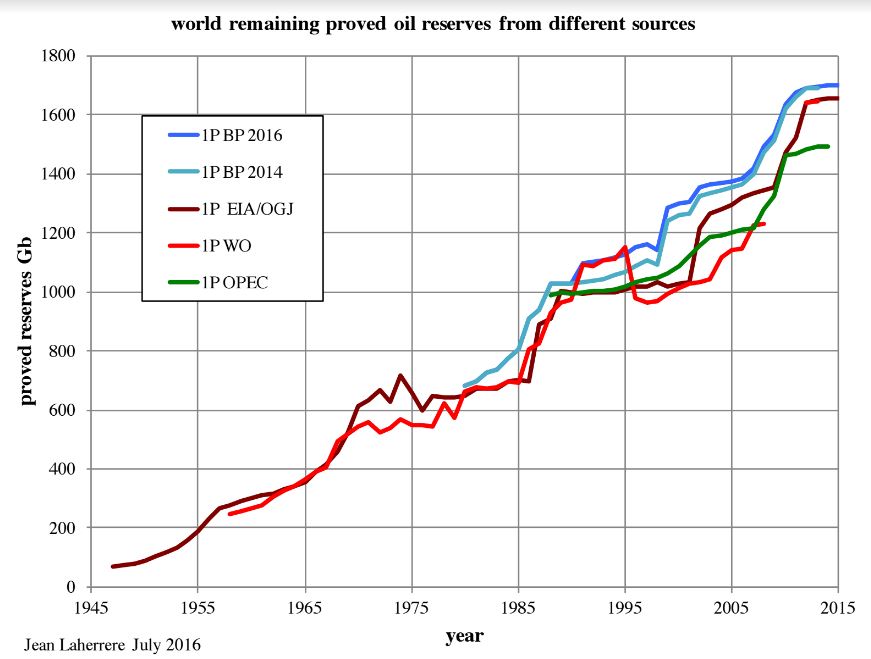
Again: all of the proven reserves. The amount of proven reserves increases as more geological prospecting is done. (Here's a nice graph of how the proven oil reserves changs with time: http://peakoilbarrel.com/wp-co... . Coal has a much shallower slope, though, since coal is less valuable than oil.)
and most of that increase occurs at high latitudes.
Careful there. That number is average over the surface. What you mean to say is "with more increase at high latitudes".
Pardon me for not panicking.
Panicking is unnecessary. It is nice, however, to understand the basic science.
You're welcome to propose more complex models, but if you assert that people should believe those more complex models because they are "basic physics", you are misrepresenting them.
No, more complex models give you some error bars, but the basic constant-humidity model is pretty close to the current best guess.
You're misattributing decreases in carbon emission growth to governmen
-
Re:I 3 Global Warming
You made a specific claim:
The highest food producing areas of Western North America in California, which by and large rely upon water from systems that are slowly but surely being effected by less and less rainfall on the mountains of West Coast
We have seen that that claim is false: overall, California's water systems will receive more, not less, water due to climate change. Your statement and fear mongering was false and based on an incorrect understanding of climate change.
As for the rest of your posting, I suggest you do some background reading because you operate under additional incorrect assumptions.
-
Re:Runaway effect? Nope.
Even the IPCC say there is virtually no chance of anthropogenic activities causing a runaway greenhouse effect a la Venus.
https://en.wikipedia.org/wiki/...
A runaway greenhouse effect is a process in which a net positive feedback between surface temperature and atmospheric opacity increases the strength of the greenhouse effect on a planet until its oceans boil away.[1][2] An example of this is believed to have happened in the early history of Venus. On the Earth, the IPCC states that "a 'runaway greenhouse effect'â"analogous to [that of] Venusâ"appears to have virtually no chance of being induced by anthropogenic activities."
-
Re:ceaseless
And none of those were mainstream positions that had scientific consensus. You've confused yourself by taking many different views and bundling them together as a single mind. It's entirely possible for there to be 10 different wrong views on climate change but still end up with climate change being real.
You want him to obey the consensus because it's a consensus but ignore the consensus because the people contributing to it are routinely proven to be hilariously incorrect?
I would call "scientific consensus" as incorporating "stuff that is said by actual scientists." So, yes, I'd indeed say "ignore the consensus" when by that you mean stuff not said by actual scientists in actual scientific publications. Not because it is "hilariously incorrect" but because it's not the scientific consensus, it's the result of people trolling the internet to find the most-wrong thing ever said by non-scientists so they can say "look at how wrong they were".
The IPCC reports are a good place to look for a summary of the actual consensus (with references to the actual scientific literature)-- try this one: http://www.ipcc.ch/report/ar5/
-
Re:Goes back to sleep...
New Science Suggests the Ocean Could Rise More -- and Faster -- Than We Thought
Maybe. Possibly.
But aren't we already suppose to be under ten feet of water?
I don't know what you suppose, but the first IPCC report, published 1990, said "For the IPCC Business-as-Usual scenario at year 2030 global-mean sea level is 8-29 cm higher than today, with a best-estimate of 18 cm. At the year 2070, the rise is 21-71 cm, with a best-estimate of 44 cm." (page 261) According to NASA satellite data, we are at ~8.5cm since 1990 (and the IPCC AR5 has similar results (SPM page 11)) We have 13 years at (currently) ~3.5mm/year left, so we probably will end up at about 14cm, well within the uncertainty interval, and not far from the best estimate - and very far from the 10 feet you have apparently heard from some crap source.
-
Re:Goes back to sleep...
New Science Suggests the Ocean Could Rise More -- and Faster -- Than We Thought
Maybe. Possibly.
But aren't we already suppose to be under ten feet of water?
I don't know what you suppose, but the first IPCC report, published 1990, said "For the IPCC Business-as-Usual scenario at year 2030 global-mean sea level is 8-29 cm higher than today, with a best-estimate of 18 cm. At the year 2070, the rise is 21-71 cm, with a best-estimate of 44 cm." (page 261) According to NASA satellite data, we are at ~8.5cm since 1990 (and the IPCC AR5 has similar results (SPM page 11)) We have 13 years at (currently) ~3.5mm/year left, so we probably will end up at about 14cm, well within the uncertainty interval, and not far from the best estimate - and very far from the 10 feet you have apparently heard from some crap source.
-
The predictions
New Science Suggests the Ocean Could Rise More -- and Faster -- Than We Thought
Maybe. Possibly.
But aren't we already suppose to be under ten feet of water?
Huh? Where did you get that? Nobody predicted ten feet-- over three meters!-- of sea level rise by 2017.
The very first IPCC report-- back in 1990--predicted "an average rate of global mean sea level rise of about 6 cm per decade over the next century (with an uncertainty range of 3 – 10 cm per decade), mainly due to thermal expansion of the oceans and the melting of some land ice. The predicted rise is about 20 cm
The most recent (5th, 2014) report (here https://www.ipcc.ch/pdf/assess... ) says 25 cm to 70 cm by 2100. (That's the one that this news item is reacting to).
Nobody predicted 10 feet by 2017-- you should look back and find who told you that had been the prediction and never believe them again.
-
The predictions
New Science Suggests the Ocean Could Rise More -- and Faster -- Than We Thought
Maybe. Possibly.
But aren't we already suppose to be under ten feet of water?
Huh? Where did you get that? Nobody predicted ten feet-- over three meters!-- of sea level rise by 2017.
The very first IPCC report-- back in 1990--predicted "an average rate of global mean sea level rise of about 6 cm per decade over the next century (with an uncertainty range of 3 – 10 cm per decade), mainly due to thermal expansion of the oceans and the melting of some land ice. The predicted rise is about 20 cm
The most recent (5th, 2014) report (here https://www.ipcc.ch/pdf/assess... ) says 25 cm to 70 cm by 2100. (That's the one that this news item is reacting to).
Nobody predicted 10 feet by 2017-- you should look back and find who told you that had been the prediction and never believe them again.
-
Re: Don't worry ...
Words like "confidence" and "Likely" have very specific meanings here: https://www.ipcc.ch/pdf/suppor... . Of course we want them to communicate the level of certainty on each item. Where there is uncertainty there is risk as things may be better or worse than we anticipate. If we know with certainty what we are in for then we can plan for it.
-
Re: Don't worry ...
Wait what? Hurricanes are caused by global warming now?
Here's what has happened over the last few decades: "it is virtually certain that intense tropical cyclone activity has increased in the North Atlantic since 1970."
Here's what we expect with global warming:
Although projections under 21st century greenhouse warming indicate that it is likely that the global frequency of tropical cyclones will either decrease or remain essentially unchanged, concurrent with a likely increase in both global mean tropical cyclone maximum wind speed and rainfall rates, there is low confidence in region-specific projections of frequency and intensity. Still, based on high-resolution modelling studies, the frequency of the most intense storms, which are associated with particularly extensive physical effects, will more likely than not increase substantially in some basins under projected 21st century warming and there is medium confidence that tropical cyclone rainfall rates will increase in every affected region. - http://www.ipcc.ch/pdf/assessm...
Rainfall is what caused most of the damage this year AFAIKT, so that seems in line with our expectations for a warmed world, though these are early days and large impacts are not anticipated until later in the century. Possibly this was just bad luck. Possibly the impact was enhanced by global warming. Either way it's probably it is something we should learn to get used to.
-
Re: Global warming and Atlantic hurricanes
How is my post a conspiracy theory? Do tell.
It's not clear that Atlantic tropical cyclone activity should increase as a result of global warming. That's not a conspiracy theory. It reflects the current state of climate science, based on NOAA research that has been included in recent IPCC assessment reports. In fact, here are some links to information about it:
https://www.ipcc.ch/publications_and_data/ar4/wg1/en/ch9s9-5-3-6.html
https://www.gfdl.noaa.gov/global-warming-and-21st-century-hurricanes/I didn't readily find a link to the IPCC AR5, but the AR4 is still credible science. And the NOAA link has been updated within the past year, so it reflects the current state of the science.
Climate predictions are done on a regional basis with climate models. They're integrated forward just like weather prediction models, just over much longer periods of time. While it definitely isn't possible to predict the weather on a day to day basis beyond a week or, perhaps at most, three weeks (the theoretical limit), the statistical moments of the climate models (averages and extremes) have merit. The models aren't perfect, but they do a good job, and they're the best tootool we have for making regional climate predictions decades in advance. Here's what the models predict for the tropical north Atlantic: warmer sea surface temperatures, but stronger vertical wind shear and less humidity. The warmer sea surface temperatures would be favorable for increased tropical cyclone activity. However, stronger vertical wind shear and a drier atmosphere will suppress hurricane activity. Climate science isn't able to make a definite prediction about Atlantic hurricane activity because some of the factors would favor increased activity while others would favor a decrease. This isn't a conspiracy. It's the current state of the science.
Why would you say that stronger Atlantic tropical cyclones be associated with global warming when the current understanding of climate science does not predict that global warming will increase Atlantic tropical cyclone activity? Your position is illogical.
If you said that stronger typhoons and more typhoons in the northwest Pacific were a sign of global warming, I'd have no problem with that. The models do suggest that tropical cyclone activity will increase in that region, and I believe the science. But that's not what's currently being predicted for the north Atlantic basin.
I'll go a step further and say that making claims about global warming that aren't supported by the science is irresponsible and undermines the credibility of the scientists. If you're going to make claims about global warming impacts and insult people, make sure your posts are factually correct.
By the way, there are typically six factors cited as being necessary for tropical cyclone formation, unlike your list:
1) Warm water temperatures, typically at or above 26 degrees C
2) Non-zero Coriolis (you don't get hurricanes at the equator; you need to be several degrees north or south)
3) Weak vertical wind shear
4) Weak static stability
5) High low- and mid-level humidity
6) Low-level convergence (like a tropical wave)Those are the six ingredients for tropical cyclone formation. It is predicted that some of those factors will become less favorable for tropical cyclones in the north Atlantic despite the increase in sea surface temperatures.
My post wasn't a conspiracy theory or denying climate change. It reflects the current state of the science, that it isn't certain whether global warming will increase tropical cyclone activity in the north Atlantic.
-
Re:Stolen from twitterWhere did this "more frequent" thing come from? The claims that I've seen have always been, "Climate change will probably not make more storms, or not many more, but the storms which we do get will be stronger, on average."
Just to humor you, and all of the other people here who keep talking about frequency, I went looking for an article from 2006. I didn't find one, but the IPCC did a report in 2007. I figure that's close enough:While overall numbers of tropical cyclones worldwide have shown little variation over the past 40 years (Pielke et al., 2005), there is evidence for an increase in the average intensity of tropical cyclones in most basins of tropical cyclone formation since 1970 (Webster et al., 2005) as well as in both the number and intensity of storms in the Atlantic (Emanuel, 2005), the basin with the highest volatility in tropical cyclone numbers (see Trenberth et al., 2007, Sections 3.8.3 and 3.8.3.2).
-
Re:Leaked Political hit job masquerading as "scien
He doesn't have to prove it. The scientific method states the AGW hypothesis (it has not met the definition of a theory) assumes the burden of proof is on those who make the claim human activity affects the weather (i.e., the hypothesis is not null). How can this be tested while excluding all natural factors? Where is the control? Take a look at the IPCC carbon balance and prove convincingly beyond reasonable doubt that the small fraction of carbon humans add seriously disrupts the carbon balance. Not to mention the energy balance in the ocean.
As a practicing scientist, it is frustrating to see the conclusions get a pass, where areas where I work have extremely detailed criticisms about one extra degree of freedom.
Posting AC because the politics of this is detrimental to careers.
-
The IPCC discusses climate models
More processing power, models refined over the decades for more accurate forecasting.
...And they *STILL* can't get the computer climate models to even somewhat-accurately track *PAST* climate changes!
WTF makes anyone think that their predictions about *future* climate changes are any more reliable?
Strat
For anyone wanting something more than the parent's word on this, the IPCC backs him up on it in their 5th assessment report you can read about here:
For instance, maintaining the global mean top of the atmosphere (TOA) energy balance in a simulation of pre-industrial climate is essential to prevent the climate system from drifting to an unrealistic state. The models used in this report almost universally contain adjustments to parameters in their treatment of clouds to fulfil this important constraint of the climate system (Watanabe et al., 2010; Donner et al., 2011; Gent et al., 2011; Golaz et al., 2011; Martin et al., 2011; Hazeleger et al., 2012; Mauritsen et al., 2012; Hourdin et al., 2013).One of the referenced papers comments on the reason tuning is desirable:
The choices we make naturally depend on our preconceptions, preferences and objectives. We choose to tune our model because the alternatives - to either drift away from the known climate state, or to introduce flux-corrections - are less attractive. Within the foreseeable future climate model tuning will continue to be necessary as the prospects of constraining the relevant unresolved processes with sufficient precision are not good.So, our inherent understanding of some processes is still not accurate enough for the job and tuning is a necessary evil. Regrettably, the corrections we tune for are bad enough that they are "essential to prevent the climate system from drifting to an unrealistic state".
The challenges still faced from tuning are outlined in another of the referenced papers:
CM3w predicts the most realistic 20th century warming. However, this is achieved with a small and less desirable threshold radius of 6.0 m for the onset of precipitation. Conversely, CM3c uses a more desirable value of 10.6 m but produces a very unrealistic 20th century temperature evolution.
So the tuning process means using less realistic values for parameters just to make sure the TOA energy balances.That same paper ends with the following note:
Furthermore, in order to predict a realistic evolution of the 20th century, models must balance radiative forcing and climate sensitivity, resulting in a well-documented inverse correlation between forcing and sensitivity [Schwartz etal. 2007; Kiehl, 2007; Andrews etal. 2012]. This inverse correlation is consistent with an intercomparison-driven model selection process in which “climate models’ ability to simulate the 20th century temperature increase with fidelity has become something of a show-stopper as a model unable to reproduce the 20th century would probably not see publicationSo, as even the IPCC and many jumping on after me here will be liable to observe, the published climate models out there all more or less are able to recreate the historical temperature record. Of course, as noted this isn't necessarily a comment on inherent merit to the models as the authors note their own model tuning meant the choice between picking a parameter value that better fit the known data, or the parameter that would yield a better hindcast and unless you choose the hindcast you don't get published. If the only models that can get published are tuned for hindcasts, it's less surprising that a sampling of published models manages to do that. The question of HOW they manage to hindcast is key, and the inability to properly control TOA energy without hand balling things is huge.
-
Re: Lack of specifics
Perhaps you should, I dunno, read the fucking report he linked?
Have you read it? Have you even looked at it?
Telling me that "somewhere" in a hundred-page document there is one or more statements that were inaccurate-- but not stating which statements, or where in the document they are stated--is not an example of "specifically stating what is inaccurate."
I just read it again, though and I will repeat: what specifically was inaccurate, and how and when was it shown not to be justified?
Here it is again, if you would like to point out the specifics: https://www.ipcc.ch/pdf/assess...
-
Re:Global warming makes ice!
The ice becoming more mobile to the point of becoming a hazard to navigation was something I've never seen predicted before.
Well maybe you never saw it, but...
I took statistics in college and one thing they teach is that not everything has to line up to show a trend.
Except that this point does fit the trend. Does it really not make sense to you that higher temperatures would make the ice break up into smaller pieces and become mobile? Have you ever seen a lake melt in the spring? It doesn't just melt down into a single little ice cube and vanish; it begins to crack and break up into pieces long before the ice completely melts.
Except it could also be explained by the expanded ice extent (more ice) extending into water or currents of warmer temperatures.
-
Lack of specifics
I'd be interested in seeing your citation for "much past climate alarmism was not justified."
The 2007 IPCC Report contains numerous wildly inaccurate statements.
My question-- the part you failed to quote--said "who said it, when, what exactly did they say, and in what way was it shown not to be justified?"
You didn't answer my question. You asserted that the IPCC synthesis report was "alarmism" with "numerous inaccurate statements," but didn't point out a single inaccurate statement.
So, I repeat: what specifically was inaccurate, and how and when was it shown not to be justified?
-
Re:And yet people continue the Warming Alsrmism
I'd be interested in seeing your citation for "much past climate alarmism was not justified."
The 2007 IPCC Report contains numerous wildly inaccurate statements. It was written to scare people into action rather than dispassionately present facts, and it backfired rather spectacularly by tarnishing the general credibilty of climate scientists. A decade ago, the denialist movement was diminishing and increasingly marginalized. Today, it is mainstream. The 2007 IPCC report deserves a lot of credit for that.
-
Re:Global warming makes ice!
The ice becoming more mobile to the point of becoming a hazard to navigation was something I've never seen predicted before.
Well maybe you never saw it, but...
I took statistics in college and one thing they teach is that not everything has to line up to show a trend.
Except that this point does fit the trend. Does it really not make sense to you that higher temperatures would make the ice break up into smaller pieces and become mobile? Have you ever seen a lake melt in the spring? It doesn't just melt down into a single little ice cube and vanish; it begins to crack and break up into pieces long before the ice completely melts.
You failed to read the IPCC article. Here's the relevant quotes from it:
Increased calving of icebergs from the Antarctic Peninsula may, however, affect navigation and shipping lanes north of the Antarctic Convergence.
There is no clear consensus, however, about whether the frequency of icebergs, and their danger to shipping, will change with global warming (IPCC 1996, WG II, Section 7.4).
Less river ice and a shorter ice season in northward flowing rivers of Canada and Russia should enhance north-south river transport. Combined with less sea ice in the Arctic, this development would provide new opportunities for reorganization of transport networks and trade links. Ultimately, those changes could affect Northern Hemisphere trading patterns (IPCC 1996, WG II, Section 7.5.1).You need to read your own references better. On the expected results, GP was correct. There was no consensus about what effect warming would have on the threat of icebergs to shipping. There was a consensus that increased ice berg calving was likely in Antarctica. There was a consensus that a shorter ice season and reduced river ice would not only happen in the Arctic, but would make sea travel there change notably for the better.
Your response is about as terrible as you can get.
Take the example of when someone says it's cold in August in Florida this week, looks like climate change is disproven. Your response is akin to declaring that the IPCC expected Florida to be colder in August, and pointing to an article by the IPCC saying they expect it to be warmer. The better response is exactly as the GP observed. Statistically anomalies are going to happen, and you shouldn't be going around embracing the exceptions as the signal.
-
Re:Global warming makes ice!
The ice becoming more mobile to the point of becoming a hazard to navigation was something I've never seen predicted before.
Well maybe you never saw it, but...
I took statistics in college and one thing they teach is that not everything has to line up to show a trend.
Except that this point does fit the trend. Does it really not make sense to you that higher temperatures would make the ice break up into smaller pieces and become mobile? Have you ever seen a lake melt in the spring? It doesn't just melt down into a single little ice cube and vanish; it begins to crack and break up into pieces long before the ice completely melts.
-
Re:Do you trust lasers? Carbon dating?
Since you're keen on ditching corporate welfare, you'll agree we need to make fossil fuel companies cover their external costs too, which for coal alone in the US comes to hundreds of billions annually. Not only would this free up huge amounts of public and taxpayer money, it would nearly double the price of fossil fuels - the situation you just agreed was cool - with the notable point that carbon-neutral alternatives would now be obviously better value, meaning we could drastically reduce our CO2 emissions and actually save a large chunk of that money.
With hidden energy costs dealt with, we could then tackle the external costs of CO2 emissions from other industries, which also has many, well-studied public costs.
-
Re:Oh, this is going to be great
Good or bad, what proof is there, this is indeed "human-caused"?
You can at least start with the IPCC report for a round-up of the science, then look at the scientific journals that have been published since then for any updates that have been made.
-
Re: Not our problem. We'll be dead by then.
Here's the fifth IPCC report. It was published in 2013 and hasn't changed since - let alone every six months. The next report is due in 2022 (> 2013+6 months). You are talking nonsense.
-
Re:Hmmm
Then unfortunately, you thought wrong.
http://ar5-syr.ipcc.ch/topic_o... does describe solar irradiance and even puts a figure on the estimated amount it provides to the total radiative forcing. So solar (and other natural forcings) do have something to do with climate change, its just that they are swamped by our activity.
Feel free to use hyperbole, but because this is a site for nerds, when you do, it just makes you sound like a bit of a pillock.
-
How often do you reinvent the wheel?
why isn't there more recent material published showing the proven change?
For the same reason physics journals are not filled with recent papers investigating whether falling objects move towards or away from Earth. The human contribution (established not only by the C12/C13 ratios but also by estimates of rates of fossil fuel consumption) is no longer a matter of serious dispute. The argument has moved on to issues of climate sensitivity; just what the actual effect will be on tropical storm formation &c. If you want to see the original work establishing the human fingerprint you would need to look at papers from last century, when this was still a live issue. You are better off going to the most recent IPCC summation of the science (which will link you through to original papers), which in this case would be Chapter 8 and Chapter 10 of the 2015 WG1 report of AR5.
In the meantime that link provided gives a very nice concise summary of one of the lines of evidence by which the human fingerprint was established.
I would think that
... you would have thanked OP for that informative link. Or were you not the AC who wanted to know how we know about the anthropogenic contribution to observed warming?
-
How often do you reinvent the wheel?
why isn't there more recent material published showing the proven change?
For the same reason physics journals are not filled with recent papers investigating whether falling objects move towards or away from Earth. The human contribution (established not only by the C12/C13 ratios but also by estimates of rates of fossil fuel consumption) is no longer a matter of serious dispute. The argument has moved on to issues of climate sensitivity; just what the actual effect will be on tropical storm formation &c. If you want to see the original work establishing the human fingerprint you would need to look at papers from last century, when this was still a live issue. You are better off going to the most recent IPCC summation of the science (which will link you through to original papers), which in this case would be Chapter 8 and Chapter 10 of the 2015 WG1 report of AR5.
In the meantime that link provided gives a very nice concise summary of one of the lines of evidence by which the human fingerprint was established.
I would think that
... you would have thanked OP for that informative link. Or were you not the AC who wanted to know how we know about the anthropogenic contribution to observed warming?
-
How often do you reinvent the wheel?
why isn't there more recent material published showing the proven change?
For the same reason physics journals are not filled with recent papers investigating whether falling objects move towards or away from Earth. The human contribution (established not only by the C12/C13 ratios but also by estimates of rates of fossil fuel consumption) is no longer a matter of serious dispute. The argument has moved on to issues of climate sensitivity; just what the actual effect will be on tropical storm formation &c. If you want to see the original work establishing the human fingerprint you would need to look at papers from last century, when this was still a live issue. You are better off going to the most recent IPCC summation of the science (which will link you through to original papers), which in this case would be Chapter 8 and Chapter 10 of the 2015 WG1 report of AR5.
In the meantime that link provided gives a very nice concise summary of one of the lines of evidence by which the human fingerprint was established.
I would think that
... you would have thanked OP for that informative link. Or were you not the AC who wanted to know how we know about the anthropogenic contribution to observed warming?
-
Re:What precentage caused by man?
As the climate is always changing, and Mr. Hockey Stick says it's man doing it.
Women have to take their share of the blame too.
how much is man [sic] doing it and how did he prove that? If climate change is accelerating because of what man [sic] is doing, how much acceleration can they account for? In what way did they come up with their numbers? Rather than telling me all about the end of days, tell me about real science and hard numbers please.
I see that you have very recently arrived on our planet. All this is quantified to the nth degree, and has been reviewed and published in a highly digestible manner (allowing you to go whatever depth you can understand). You can start here.
-
US Weather Warfare Against World
US AirForce connections are needed. Correct information needs to get to those who are unknowingly leading an arial spraying assault which will wipe most of humanity from the surface of the Earth.
For nearly a decade I've paid some attention to the skies where certian non-commercial jets which don't show up on the commercial maps of current traffic are filling the skies with particulate matter.
One of the best explanations I've seen for this behavior is found at (0) http://geoengineeringwatch.com...
Apparently out catastrophic severe weather is being geo-engineered in part by these jet trails.
Another source of useful information is http://theglobalreality.com/ where Josh Reeves has mentioned one of the payload disbursments is sulferhexaflouride. This payload has 23,900 times the effect of CO2 gas (1) (2)
It appears that the US is desperately trying to keep this information un-reported by the main stream media. It appears that the US is trying to hold the rest of the world hostage to their demands using horrible weather, earthquakes as threats.
I would appreciate any tips that can lead to finding those in charge of of the chemtrail campaign in the skies. jb@joebitcoin.org and PGP key ID (4).
There is little time to effect change, in fact it may be too late already.
Add to all this that US employees in the weather forcasting industry are under a gag order (3).
(0) Weather Engineering watchdog site http://geoengineeringwatch.com...
(1) SulferHexaflouride https://en.wikipedia.org/wiki/...
(2) Aresol spraying of SulferHexaflouride 23,600 times more than CO2 http://www.ipcc.ch/publication...
(3) Gag Order http://www.geoengineeringwatch...
(4) What can I do http://www.geoengineeringwatch...
(4) PGP Public key ID for jb@joebitcoin.org https://sks-keyservers.net/pks... -
Re: s/drug trials/climate change/g
Shifting the goal posts, are we? I'm pretty sure there's no falsified predictions about hurricanes in the Atlantic specifically before 2020, so I'm not sure what you're getting at. As we get further into the red zone, there's some evidence to suggest that hurricane intensity might increase, though frequency is less certain.
Maybe you should skim through the IPCC AR5 WGII impacts summary, to see what we're actually expecting. There's much more to be concerned about than just hurricanes, and the risks and damages far outweigh any small plant growth benefit we might expect from boosted CO2 (which is discussed in Chapter 7 - studies suggest that food production will see a net negative effect).
-
Re: s/drug trials/climate change/g
Shifting the goal posts, are we? I'm pretty sure there's no falsified predictions about hurricanes in the Atlantic specifically before 2020, so I'm not sure what you're getting at. As we get further into the red zone, there's some evidence to suggest that hurricane intensity might increase, though frequency is less certain.
Maybe you should skim through the IPCC AR5 WGII impacts summary, to see what we're actually expecting. There's much more to be concerned about than just hurricanes, and the risks and damages far outweigh any small plant growth benefit we might expect from boosted CO2 (which is discussed in Chapter 7 - studies suggest that food production will see a net negative effect).
-
Re:It's not that we deny climate change
But ACTUAL SCIENCE calculates only 1.2C of warming for every doubling of CO2.
I'm not sure where you're getting your science. Your claim presents a logarithmic response of temperature on CO2, which appears to be pulled out of your ass.
Take a look at Figure SPM.5 (b) in the IPCC report. Looks like the effect is a linear increase in temperature as a function of total CO2 emissions.
-
Be uncertain about things that are uncertain
Because when a topic is really, really complicated the most important thing is not to be uncertain about it.
The desired response is to be uncertain about things that the science is uncertain about, and to not be uncertain about things on which the science is pretty clearly not uncertain.
If you actually read some of the review articles summarizing the science-- the IPCC Working Group 1 report, for example-- you will notice that there is extensive discussion of uncertainties: what we know, how well we know it, what we don't know, and what the error bars are.
One interesting thing about the real science: the uncertainty goes in both directions. The denier community says "but look at the uncertainty: maybe the warming is on the low side of the range that the best science we currently have is predicting." But the opposite uncertainty is also there: "look at the uncertainty: maybe the warming is going to be much higher-- it could be on the high side of the range that the current science predicts."
-
IPCC figure (Re:Where are the error bars?)
The reason why I ask this is when you peruse Figure 6.1 of the IPCC Carbon and Other Biogeochemical Cycles report, the listed errors of natural carbon sources far exceed those of anthropogenic origin.
I think you're mis-reading the numbers on that figure. The numbers in red aren't error bars, that's the change since 1750. (each individual element is listed in the form "123= 108.9+14.1", where the first number is the total, the second number is the estimated value in 1750, and the third number is the change since 1750 (printed in red). Note that all that matters from photosynthesis is the difference between the input and output (labelled "net land flux"), which they point out is known to a better accuracy than the component parts.
-
Where are the error bars?
There is a time-series of global average temperature, but there is not a description of the error. I'd like a full statistical treatment, including the number of measurements varying as a function of time, as well as an assessment of the quality of the measurements (I'm sure the thermometer technology has changed in the last 100 years).
The reason why I ask this is when you peruse Figure 6.1 of the IPCC Carbon and Other Biogeochemical Cycles report, the listed errors of natural carbon sources far exceed those of anthropogenic origin. They are doing quality work there; however, the reporting of their efforts leave a lot to be desired.
-
Re:Look at the data
By "equivalent temperature increase", I imagine you're looking only at surface temperatures? (not that you've ever cited anything for these assertions you regularly throw out)
Have you considered where else that energy might be going? Because scientists have:
Ocean warming dominates the global energy change inventory. Warming of the ocean accounts for about 93% of the increase in the Earth’s energy inventory between 1971 and 2010 (high confidence)
The real data is all there, fully sourced and cited - if you can bring yourself to face it. But if you think have an equally reputable source that says otherwise, you should probably cite it, else we all may laugh at you just like we do the other religious extremists trying to justify nonsense with faith.
-
Re:No we can't agree on a thing that is unprovable
Rather than linking to a selectively-quoting blog, just cite the source directly (assuming you actually want to hear what it says). I suggest Section 2.6, or at least the Extreme Events executive summary on page 162.
While there is a lack of sufficient data in some areas, the executive summary cites increases in heatwaves and heavy precipitation events, and significant changes in droughts (more in some areas, less in others). Tropical cyclones are stronger in the North Atlantic, though trends elsewhere are not so certain. These are all "meteorological events".
But hey, your link's selective observation about thunderstorms specifically is about right - with the important caveat that we don't actually know what the trends really are because we haven't studied them closely enough yet.
-
Re:instrumentally homogeneous temperature records
1) How big is the effect of human greenhouse emissions compared to natural temperature variation?
The latest IPCC report has a whole chapter on that:
Chater 8: Anthropogenic and Natural Radiative Forcing (PDF)
The upshot is that without human greenhouse emissions there would be a slight cooling trend.
My beef with the climate change people is the attitude of omniscience about a complex topic that nobody actually understands.
How do you know nobody understands? It's true that the climate system is very complex and I'll admit that nobody completely understands it but that's not the same as having no understanding at all. In studying an area of science you generally start off with the big things. For climate the big things are the energy coming in from the Sun, the greenhouse gases in the atmosphere that keep the planet warmer than it would otherwise be and the geophysical state of the Earth*. After that you start getting into details that just modify things without changing the general direction. I think we have a pretty good handle on the big things and a lot of the more important details. Usually if you're studying something and you're missing something important it will show up as a hole in your work. I'm not aware of any such holes in climate science.
* The geophysical state of the Earth includes things like the amount of water on the surface, the location of continents and mountain ranges, the topology of the ocean basins and a myriad of other things. It generally doesn't change fast enough to be a significant factor on century time scales but a supervolcano eruption or asteroid strike can change things rather suddenly.
-
Re: we saw that the science was falsified by the C
So the mountains of scientific evidence and the confirmation by every major climate institution on the planet, and every major scientific organisation are all meaningless to you - but the science-free claims in a youtube video by a TV personality with no experience or credentials in climatology convinced you completely?
Sorry, I can't help anyone so doggedly determined to ignore all the inconvenient parts of reality.
-
Re:Because
And it also isn't producing endless pronouncements of The End Of Days with no concrete solutions for avoiding it. With AGW/GCC, we get an endless string of:
THE END IS NIGH!
What do we do about it?That's an utter lie. Do you have no shame?
Have you heard anyone mention carbon taxes, emissions trading schemes, incentives for industry to reduce their carbon footprint, the move to cleaner power sources like wind/solar/nuclear, international agreements to cap carbon emissions, creation of carbon sinks to offset emissions, reducing meat intake to avoid all those farting cows, promoting the construction of sustainable buildings including homes with eaves and intelligent ventilation to reduce the reliance on artificial heating & cooling, the use of locally produced goods to avoid transporting them over long distances, etc.
There is an entire third of the IPCC report devoted to the Mitigation of Climate Change. Here is what the report says that means:
Climate Change Mitigation is a "human intervention to reduce the sources or enhance the sinks of greenhouse gases" (GHG) (See Glossary (Annex I)). The ultimate goal of mitigation (per Article 2 of the UNFCCC) is preventing dangerous anthropogenic interference with the climate system within a time frame to allow ecosystems to adapt, to ensure food production is not threatened and to enable economic development to proceed in a sustainable manner.
-
Re:another variable that effects weather
AMOUNT or degree of climate change is not capable of establishing that a cause of a change is due to humans. You think that CO2 is the only thing released into the atmosphere, and Humans are the only things affecting the composition of the atmosphere and dissipation of sunlight/energy?
Really? On one had we have mountains of theories and studies filled with facts & figures, tables & graphs, predictions & observations; all of which are summarised in the IPCC reports. On the other hand, we have an unverified claim based on.... what, your gut feeling??
Large volcanic eruptions are completely natural and can have a huge impact for centuries.
What makes you think that scientists haven't thought of the influence of volcanoes? Oh wait, they have:
Volcanoes produce abrupt climate responses on short time scales. The surface cooling effect of the stratospheric aerosols, the main climatic forcing factor, decays in one to three years after an eruption due to the lifetime of the aerosols in the stratosphere. It is possible for one large volcano or a series of large volcanic eruptions to produce climate responses on longer time scales, especially in the subsurface region of the ocean (Delworth et al., 2005; Gleckler et al., 2006b).
As you see, the main climatic forcing factor of volcanoes is to cool the surface, and it usually dissipates relatively quickly. That is because it prevents the heat from the sun hitting the surface, which is the opposite of the greenhouse effect. Of course, volcanoes also release greenhouse gases like CO2, but human emissions dwarf those of volcanoes. A few years ago when that volcano in Iceland erupted and shut down airline flights across Europe, it actually have a positive effect on the climate because the amount of greenhouse gases emitted were offset by the savings caused by shutting down all the airlines. Also, from the link above:
Scientists tracking the effects of the major 1991 eruption of the Philippines' Mt. Pinatubo found that the overall effect of the blast was to cool the surface of the Earth globally by some 0.5 degrees Celsius a year later, even though rising human greenhouse gas emissions and an El Nino event caused some surface warming during the 1991-1993 study period.
First of all by default the assumption should not be No man-made factor at all; the assumption should be No major new man-made factor, or No conclusively man-made major influence.
That is a good assumption, and it was one that the scientists had when the idea that our emissions could enhance the natural greenhouse effect was first proposed 120 years ago. It was either dismissed or assumed that this would be a benefit. As the decades went by, the accumulation of evidence and our understanding of the scientific principles have convinced those experts that not only is this happening, but it will not be an overall benefit. If you want to come in now and assume that it isn't happening, then you are 120 years late.
Over that period, our technology has progressed so that much of our lives is dependent on using power that generates greenhouse gases. Over that period, the human race has nearly quadrupled in size. We went from just under 2 billion to 7.5 billion people. Is it really so hard to believe that all those people using all that power would be unable to affect the environment in which we live?
Skepticism against some theory which has been inadequately proposed does not require proof.
When that skepticism goes against established scientific understanding then yes, it does require proof. You might think that the theory has been inadequately pr