Slashdot Mirror
Domain: ipcc.ch
Stories and comments across the archive that link to ipcc.ch.
Comments · 821
-
Re:Deniers
Ah, sharing the science of your gut feelings is it? Very rigorous. Your gut doesn't beat scientific models which make predictions which have so far agreed with the data (and are also tested by making sure they can predict past changes in the climate too). http://arstechnica.com/science... http://arstechnica.com/science...
" Oh by the way, more CO2, more for plants to breath, better crops."
This is hopelessly naive. Yes, crops can photosynthesise more, but there are other implications on crops and the environment more generally. Specifically, nutrient levels are reduced in tests:
"Effects on human nutrition are likely as well. In FACE experiments, protein concentrations in grains of wheat, rice and barley, and in potato tubers, are decreased by 5â"14% under elevated CO2 (Taub et al. 2008). Crop concentrations of nutritionally important minerals including calcium, magnesium and phosphorus may also be decreased under elevated CO2 (Loladze 2002; Taub & Wang 2008)."
http://www.nature.com/scitable...
so it's a mixed picture. But that isn't the real issue with crops. Some regions may have gains in production, but a larger share will lose production: http://www.ipcc.ch/pdf/assessm... pg 488A major issue for crops is that an increasing frequency of droughts etc is having and will have an increasingly major impact on food supplies:
http://www.epa.gov/climatechan... http://www.ipcc.ch/pdf/assessm...
and those areas affected by droughts will be hit even more (particularly Africa) http://www.epa.gov/climatechan... . Of course, this is still one narrow area of the impacts from climate change."We WANT the greenhouse effect."
The greenhouse effect is the warming that follows an increase in the concentration of greenhouse gases. You managed to balls that up and confuse it with the increase in CO2. -
Re:Deniers
Ah, sharing the science of your gut feelings is it? Very rigorous. Your gut doesn't beat scientific models which make predictions which have so far agreed with the data (and are also tested by making sure they can predict past changes in the climate too). http://arstechnica.com/science... http://arstechnica.com/science...
" Oh by the way, more CO2, more for plants to breath, better crops."
This is hopelessly naive. Yes, crops can photosynthesise more, but there are other implications on crops and the environment more generally. Specifically, nutrient levels are reduced in tests:
"Effects on human nutrition are likely as well. In FACE experiments, protein concentrations in grains of wheat, rice and barley, and in potato tubers, are decreased by 5â"14% under elevated CO2 (Taub et al. 2008). Crop concentrations of nutritionally important minerals including calcium, magnesium and phosphorus may also be decreased under elevated CO2 (Loladze 2002; Taub & Wang 2008)."
http://www.nature.com/scitable...
so it's a mixed picture. But that isn't the real issue with crops. Some regions may have gains in production, but a larger share will lose production: http://www.ipcc.ch/pdf/assessm... pg 488A major issue for crops is that an increasing frequency of droughts etc is having and will have an increasingly major impact on food supplies:
http://www.epa.gov/climatechan... http://www.ipcc.ch/pdf/assessm...
and those areas affected by droughts will be hit even more (particularly Africa) http://www.epa.gov/climatechan... . Of course, this is still one narrow area of the impacts from climate change."We WANT the greenhouse effect."
The greenhouse effect is the warming that follows an increase in the concentration of greenhouse gases. You managed to balls that up and confuse it with the increase in CO2. -
Re: DeniersYou cherry picked one of the few scientist with this opinion. Most experts are saying otherwise: http://www.ipcc.ch/pdf/assessm...
Warming of the atmosphere and ocean system is unequivocal. Many of the associated impacts such as sea level change (among other metrics) have occurred since 1950 at rates unprecedented in the historical record. There is a clear human influence on the climate It is extremely likely that human influence has been the dominant cause of observed warming since 1950, with the level of confidence having increased since the fourth report. IPCC pointed out that the longer we wait to reduce our emissions, the more expensive it will become
-
Re:Similar to choosing an OS
My first thought is Malthus is into his third century of being wrong, but still people think it makes them look intelligent to wring their hands and repeat what he said.
Where did I say anything about Malthus? Malthus argued we'd run out of food, and that's proved to be wrong consistently for the majority of humans. I never said or argued that reaching 10 billion people will cause large amounts of people to die, but there's no doubt it'll cause issues. Increased need for energy and the rising standard of living across the globe present new challenges environmentally and economically.
To equivocate any such argument to Malthus and just waive it off is dishonest. It's not just about food or water - although both have their challenges in certain parts of the world - it's about trying to provide a decent standard of living for 10 billion people when we cannot even properly do it for 7. I'm not saying it's impossible, not by a long shot, but it's definitely a challenge.
As someone else commented the "Ozone Hole was there before we were using CFCs" We have cut our use down to nearly nothing and it is still there.
Someone who was objective, would have to come to the conclusion that it is a natural phenomena independent of CFC use.This is just wrong. Certainly there are natural causes contributing to ozone depletion as well, but we know for a fact these chemicals increase the depletion. This is something that can and has been prioved in a lab, which is what lead to the ban to begin with. The reason it's still there is because it takes time for the chemicals we managed to pump into the atmosphere to clear out. But the depletion itself has largely stopped, and the situation is estimated to improve over time. Quoting the appropriate section of wiki:
"A 2005 IPCC review of ozone observations and model calculations concluded that the global amount of ozone has now approximately stabilized. Although considerable variability is expected from year to year, including in polar regions where depletion is largest, the ozone layer is expected to begin to recover in coming decades due to declining ozone-depleting substance concentrations, assuming full compliance with the Montreal Protocol.
A 2005 IPCC review of ozone observations and model calculations concluded that the global amount of ozone has now approximately stabilized. Although considerable variability is expected from year to year, including in polar regions where depletion is largest, the ozone layer is expected to begin to recover in coming decades due to declining ozone-depleting substance concentrations, assuming full compliance with the Montreal Protocol."
Source:
The IPCC ReportYou obviously have done little to no reading on the actual science behind ozone depletiona nd CFS if you think they have no connection.
Well why yes.
I'm well ware of the different processes and methods to manufacture oil from different sources, and those are certainly something to look into, but again, it doesn't negate the fact that natural deposits of fossil fuels are limited and we cannot ignore this. If anything it backs up my point: if we didn't need to worry about running out of oil, technologies such as this would not be investigated or needed.
-
Re:Seems he has more of a clue
All this can be found in the IPCC reports (link). They have a section "For policy makers" which explains in laymens terms exactly (with probabilities and all) what will happen most likely, how big the risks are (and how certain we are of these risks) and what is the best course of action (and why). And yes doing nothing is more costly (damage to argriculture, building higher dikes, more storms, more deseases, people on the run) than actually doing something about it.
So, there you have it. All your questions answerd...by science. -
Re:Seems he has more of a clue
Allow me to quote from your link:
"Scientific evidence for warming of the climate system is unequivocal. - Intergovernmental Panel on Climate Change"
Ok, great... how much of that is man-made change?
You could read the report
for yourself or you can look at a pretty graph that summarizes the findings.
What can we do about it if so?
There are a variety of strategies that we could try but the simplest, easiest, and cheapest solution is to apply a price to carbon emissions. Any economist can tell you that charging for emissions will reduce them.
What does that cost?
Very little, many of the economies with carbon emission taxes are outperforming their neighbours, who don't have emission taxes.
What does it cost to adapt to it rather than try and change it the other way?
Generally speaking, estimates of adaptation costs that have them running around 2-4 times as much as mitigation are considered to be low-balling the costs.
-
Re:Confused much?
...doesn't climate change count as a glaringly obvious moral issue under all but the very, very, most optimistic models of its expected effects?
Not according to the IPCC. Go through the IPCC's latest projections in Chapter 11 and Chapter 12 of the fifth assessment report. In Chapter 12 Figure 12.5 they project temperatures out to 2300 and Secnario 2.6 and the low end of Scenario 4.5 are both under 2C increases by 2300(referenced to 1986-2005). Scenario 4.5 is used by the IPCC as the expected case. Earlier in chapter 12 they show the main basis for the Scenarios in the radiative forcing expected in Figure 12.4. If you are to map the instrumental observations of energy imabalance(net forcing) from 1980 through today based on Sat observations the line falls between scenarios 4.5 and 2.6. The ocean heat content observations(check out work by Levitus) corroborate the Sat observations within errors, and also extend the overall trend back to the 1950s. The observed forcing trends have been linear rather than accelerating and fit between Scenario 2.6 and 4.5 so that should be the expected, rather than "very, very optimistic".
Call that out as my own interpretations of the evidence if you want. The scientific papers and evidence are exactly as I've described. A basic litmus test could be used to see if I'm way off or not. If I'm right about comparing observed energy imbalance to the IPCC projection scenarios, forcing trends should follow somewhere in between scenario 2.6 and 4.5, so either the high end of 2.6 or the low end of 4.5. Now go look at Figure 11.9 in Chapter 11 linked above, observed trends track right on the bottom error limits of the Scenario 4.5 projections.
Things aren't great, that's plenty of warming coming. What is not clear though is what is our moral standing on that level of impact 200 years from now. How much do we sack our economy and progress today to fend that off, and what is worthwhile? Those are hardly questions that are cut and tried science says X.
-
Re:Confused much?
...doesn't climate change count as a glaringly obvious moral issue under all but the very, very, most optimistic models of its expected effects?
Not according to the IPCC. Go through the IPCC's latest projections in Chapter 11 and Chapter 12 of the fifth assessment report. In Chapter 12 Figure 12.5 they project temperatures out to 2300 and Secnario 2.6 and the low end of Scenario 4.5 are both under 2C increases by 2300(referenced to 1986-2005). Scenario 4.5 is used by the IPCC as the expected case. Earlier in chapter 12 they show the main basis for the Scenarios in the radiative forcing expected in Figure 12.4. If you are to map the instrumental observations of energy imabalance(net forcing) from 1980 through today based on Sat observations the line falls between scenarios 4.5 and 2.6. The ocean heat content observations(check out work by Levitus) corroborate the Sat observations within errors, and also extend the overall trend back to the 1950s. The observed forcing trends have been linear rather than accelerating and fit between Scenario 2.6 and 4.5 so that should be the expected, rather than "very, very optimistic".
Call that out as my own interpretations of the evidence if you want. The scientific papers and evidence are exactly as I've described. A basic litmus test could be used to see if I'm way off or not. If I'm right about comparing observed energy imbalance to the IPCC projection scenarios, forcing trends should follow somewhere in between scenario 2.6 and 4.5, so either the high end of 2.6 or the low end of 4.5. Now go look at Figure 11.9 in Chapter 11 linked above, observed trends track right on the bottom error limits of the Scenario 4.5 projections.
Things aren't great, that's plenty of warming coming. What is not clear though is what is our moral standing on that level of impact 200 years from now. How much do we sack our economy and progress today to fend that off, and what is worthwhile? Those are hardly questions that are cut and tried science says X.
-
Re:Adaptation versus Mitigation
If you want to argue for 'playing things safe' that's exactly my point. With what we currently don't know, we could spend billions on reducing CO2 emissions, and make little noticeable difference to future conditions. We could spend those same billions on dykes, irrigation and water management to deal with the warming that we DO know is coming. You seem to think we should gamble on being able to make a difference with reducing our CO2 emissions, I'm saying let's have some better info before risking wasting dollars we could really use to deal with changes.
Do you seriously expect future conditions to remain the same if CO2 in the atmosphere continues to rise and oceans continue to acidify? We may not know exactly what's going to happen but it will be very different than the relatively stable climate we've built our civilization on over the last 6,000+ years. Are you willing to bet the farm it won't be that bad?
I'm willing to rely on the scientific method and data collection to make best guesses at what impact it will have on the future. Then from that data making decisions that are sensible based on that data. Right now, catastrophe is strongly counter to observations and so your desire to panic is uncalled for. The cost/benefit of reducing our contribution is still very, very poorly known, but we do know that preparation measures are called for so we should start that before pouring dollars at 'solution' we know neither the cost nor value of.
You need to read more closely, the numbers for total radiation coming into the atmosphere and leaving are in the hundreds, and the net difference is near zero.
Yes, the insolation at the top of atmosphere (where they measure the imbalance) is around 1360 W/m^2. With a 0.58 W/m^2 energy imbalance the energy exiting the Earth is 1359.42 W/m^2. Doesn't sound like much but the area of the disk of the Earth facing the Sun is 128 trillion m^2 so the total imbalance is about 74 Terawatts (or 74 million Megawatts). A Watt is defined as 1 joule/second so that's 74 Terajoules/second. And that continues 24/7/365, it's going to add up.
That is meaning without the 2.9W/m^2 from our human emissions we'd be facing a much bigger imbalance, but in the opposite direction around -2.5W/m^2.
If that 2.9 W/m^2 dropped to zero then the energy imbalance would also drop to zero once the Earth was again in energy balance. It wouldn't go negative. If we just held the additional forcing at 2.9 W/m^2 instead of increasing it by adding more CO2 the Earth would eventually reach a new equilibrium (at a higher temperature) and the imbalance would drop to zero again.
That's not how physics works. With a human contribution of 2.9 @/m2 and net imbalance when including natural forcings of 0.6W/m2, the natural system already has balanced all but 0.6W/M2 of our 2.9W/m2 contribution at current temps.
Reality would appear to dictate that our actual influence on the energy budget isn't nearly that extreme, as I've pointed out twice already. The entire time our contribution (forcing from human GHGs) has been rising steadily, the energy imbalance has remained oblivious to that, or at least hasn't changed to an extent that we have the precision to measure yet
As long as the energy imbalance is greater than zero temperatures will continue to rise.
Correct, that's the 101 portion. The next question is at what rate should we expect the rise to be. From a constant energy balance as we've seen since 1980 in Sat observations we should expect a linear increasing temperature. If you go look at the IPCC's fifth assessment report, you can look at the models long term projections all the way to 2300 in Chapter 12. If you go to the section on energy budget, you can see where each of the
-
Re:Energy balance over temperature
IPCC Synthesis report (link) P.4 (very first chapter): "Ocean warming dominates the increase in energy stored in the climate system, accounting for more than 90% of the energy accumulated between 1971 and 2010 (high confidence), with only about 1% stored in the atmosphere. "
So there IS an increased energy storage in the climate system according the IPCC. Which stands to reason: temprature increase (where before there was none) without a higher energy absorbtion is termodynamically nonsense.
There has absolutely been an energy increase. The energy imbalance I was talking about is the net energy gain at the edge of space, that is how much more energy in/out was there in a year. The satellite results show us that the earth has been gaining more energy than it bleeds off for the entire satellite record. The rate at which energy has been accumulating is where there has been no trend. From 1960 through to today, what little trend there has been in more/less energy being gained has been dominated by volcanic activity and NOT the major increases to CO2 concentrations. Since 2000, the IPCC notes the imbalance has had no trend at all from volcanoes, CO2 or anything, we've just had an overall balance of more energy still coming in than out, but a decade and a half of increasing CO2 emissions have had no observable increase to the rate energy is being trapped.
-
Re:Energy balance over temperature
IPCC Synthesis report (link) P.4 (very first chapter): "Ocean warming dominates the increase in energy stored in the climate system, accounting for more than 90% of the energy accumulated between 1971 and 2010 (high confidence), with only about 1% stored in the atmosphere. "
So there IS an increased energy storage in the climate system according the IPCC. Which stands to reason: temprature increase (where before there was none) without a higher energy absorbtion is termodynamically nonsense.
-
Re:Let's see
Remember this Synthesis report (Summary for Policymakers
It's a 30 page document that is a simple and clear exposé of the current state of climate science on global warming. You can read what the current observations on climate change are, what it's causes are, how this will affect us, what the risks are, how we can mitigate these risks.
On every statement there is a confidence level and every statement refers to a longer more elaborate report that explains the science behind it in more detail. And if that is not enough: this second report (about 100 pages) refers to the reports of the different workgroups (physical evidence, impact of climate change and how to mitigate the impact). These reports of those workgroups are often more than 1000 pages and refer directly to actual publications and scientific studies.
So either you read the first part and you are convinced, or keep reading...
-
Re:This is interesting....
Here it is with no spin. IPCC AR5 WG1 Chapter 9 - "Evaluation of Climate Models". [PDF] Search for "Box 9.2 | Climate Models and the Hiatus in Global Mean Surface Warming of the Past 15 Years" and you get it straight from the horses mouth.
-
Re:incredulity != evidence
He shows he hasn't read an IPCC report when he says IPCC will "consider only the human causes of global warming". IPCC outlines scientific consensus on all sources of climate change from solar cycles to milankovitch cycles.
Honestly, there's a whole chapter on it. He could have figured this just by reading the headers.
-
Re:wait what?
We're all dumber for having read your post. What you wrote shows willful ignorance of what science has taught us.
Read this]. The reasons why we know the current warming trend is not cyclical are covered in excruciating detail.
-
Re: Models compared to reality
Just checked and it is in a different chapter. The IPCC 5th assessment has the observed energy balance discussed in Chapter 2: Observations: Surface and Atmosphere. The summary is as follows:
Satellite records of top of the atmosphere radiation fluxes have
been substantially extended since AR4, and it is unlikely that
significant trends exist in global and tropical radiation budgets
since 2000.Given the significant increase in measured anthropogenic GHGs over that same time frame and the estimated forcing(greenhouse effect), we should be a little surprised at this result. More importantly, we should be seriously expecting the energy imbalance to track more closely over time in the future and in the long term. If the non trend stretches into a second decade, I expect a whole lot of new research into that to dominate. Our modelling exercises will be rather irrelevant if the primary input(forcings/energy imbalance) stops matching with observations.
-
Re:"Linked/tied to climate change"
Unfortunately there have been a lot of papers on global warming. If you mean http://www.ipcc.ch/pdf/assessm... I've just downloaded it to study. If you *do* mean something else, a link would be best.
-
Re:Models compared to reality
Bullshit. The chart came from one Dr. Roy Spencer, who is not only a climatologist who has made a career out of claiming he's right and most scientists are wrong, but is also a noted creationist ("intelligent design, as a theory of origins, is no more religious, and no less scientific, than evolutionism" is my favorite quote from him on the topic).
Here's a nice summation of how he fudged numbers in order to come up with that bogus chart: http://blog.hotwhopper.com/201...
To your point of "I may be wrong", let me say, yes.... yes you are.
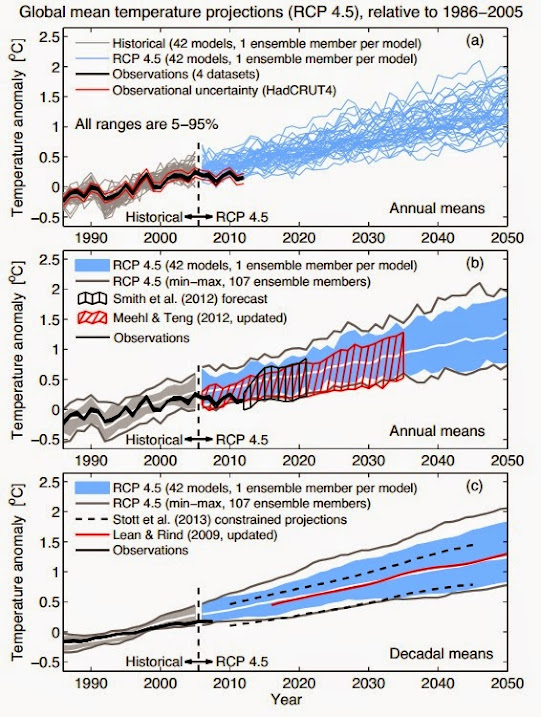
For those wanting a similar graph of models versus measured there is a graph from the IPCC AR5 report here. It shows models aren't as bad as the grandparent, but it DOES clearly show the last decade or more trending at the very low end of the models.
-
Re:Models compared to reality
Which is a graph that has been lampooned as grossly inaccurate for calibrating against a 5 year temperature average instead of a 30 year temperature average which shifts things a good deal.
To bypass that controversy compare a graph from the IPCC itself then instead, you can verify it in their AR5 report here. Not nearly as bad, but very clearly showing the last decade or more trending at the very low end of the models.
-
Re:Models compared to reality
It's an interesting graphic. But there's no clear attribution. Even for the couple of lines where there is explicit attribution, it's not clearly defined what the attribution means. Were it the part of a larger article in which the missing data were provided, and with links so it could be verified, it would be very interesting. (I'd still wonder exactly what it meant and, I admit, I might not follow up. But that graphic is so cryptic that it could mean many different things. And it's not clear that the predictions are even predicting the same thing (measured feature) as the measurements are measuring.)
How about a graph from the IPCC itself then instead, you can verify it in their AR5 report here. Not nearly as bad, but very clearly showing the last decade or more trending at the very low end of the models.
-
Re:Models compared to reality
Bad graph. Explained here:
http://blog.hotwhopper.com/201...How about a graph from the IPCC itself then instead, you can verify it in their AR5 report here. Not nearly as bad, but very clearly showing the last decade or more trending at the very low end of the models.
-
Re:1100-1300 eh?
Crappy and totally uninformative graph. Try some high resolution ones.
Then understand that follows temps
Even the Skeptical Science people agree but they try to dismiss it with a bunch of speculative "Ya...but...".
Even the IPCC admits this.
Facts are facts no matter where you find them. Don't be a Face Painting Homer cheering "my team rules, no matter what the score!"
-
Misleading summary
The IPCC was formed in 1988 as an expert panel to guide the drafting of the United Nations Framework Convention on Human-Induced Climate Change, ratified in Rio de Janeiro in 1992.
FTFY. The IPCC will not accept any submissions unless they show human-induced climate change.
From the IPCC Charter:
The role of the IPCC is to assess on a comprehensive, objective, open and transparent basis the scientific, technical and socio-economic information
relevant to understanding the scientific basis of risk of human-induced climate change, its potential impacts and options for adaptation and mitigation. -
Re: Science... Yah!
Really ?
I don't seem to be under water yet.
Of course somewhere along the line that prediction got changed to this
http://www.ipcc.ch/report/grap...Florida hasn't been scourged by hurricanes.
The Midwest isn't a dustbowl.What I do see are lots of models that make very accurate predictions about things that happened before they were created but don't do so well with post creation events.
-
Re:Science by democracy doesn't work?
Show it then. Where is this evidence? I'll show as evidence of considerable positive externalities, the synergistic effects of cheaper energy and transportation on everything we do and make.
These are not externalities. That's the benefit to the user/customer. The evidence of the negative externalities is global warming. http://www.ipcc.ch/report/ar5/... An other one is lower air quality in cities.
And I was talking about a way to make those reports more accurate in fact than merely in appearance.
That's your opinion. Thankfully no one will consider it. If you think your opinion/method is valuable, have the guts to publish it and get it peer reviewed.
-
Re:A question for all the"deniers".
The whole thing is based on flawed computer simulation.
False. It's based on simple radiative physics.
Saying climate science is wrong because the models don't produce the right answers is like saying Relativity is wrong because Kerbal Space Program doesn't get the precession of Mercury right. You have the dependency backwards and you're ignoring the actual evidence.
But besides that, you seem to have the idea that if a computer model is at all inaccurate then it is completely worthless, which is not so. A zero-atmosphere climate model will allow you to calculate Earth's black-body temperature. A single-slab model will get you within spitting distance of the Earth's measured global average temperature. Modeling a layered column of air will let you see how heat and radiation are transferred from the ground to the upper atmosphere or space, and this can be used to predict that CO2 actually cools the upper atmosphere (which has been observed).
The question isn't whether these or any models are completely accurate, it's whether they are accurate enough for the domain they're trying to model — and the answer either way has nothing to do with the validity of the science involved.
-
Re:More proof
"The IPCC predicts a 30cm change in sea levels by
-
Re:They already have
First, warm, but not the hottest dozen in history. Do you even realize when you're being absurdly hyperbolic?
http://c3headlines.typepad.com...
(from the 1990 IPCC report: http://www.ipcc.ch/ipccreports...)Second: Climatologists have been scrambling for an explanation of why their models predicted constant warming, but it seems to have vanished for much of the past 15 years.
http://www.reuters.com/article...
This has led to the current theory that the oceans have absorbed far more warming than modeled previously. Could be science, or could be desperately shifting goalposts. Your mileage will vary based on your politics, most likely. -
Re:Trends versus Data Points
I'm sorry, your claim is incorrect.
The IPCC AR5 ( http://www.ipcc.ch/pdf/assessm... makes it clear that if you don't cherry pick date ranges, the models are spot on.
A lot of people like to quote the following:
Most simulations of the historical period do not reproduce the observed reduction in global mean surface warming trend over the last 10 to 15 years.
Let's put that in context
There is very high confidence that models reproduce the general features of the global-scale annual mean surface temperature increase over the historical period, including the more rapid warming in the second half of the 20th century, and the cooling immediately following large volcanic eruptions. Most simulations of the historical period do not reproduce the observed reduction in global mean surface warming trend over the last 10 to 15 years.
Now, the details (emphasis mine)
During the 15-year period beginning in 1998, the ensemble of HadCRUT4 GMST trends lies below almost all model-simulated trends (Box 9.2 Figure 1a), whereas during the 15-year period ending in 1998, it lies above 93 out of 114 modelled trends (Box 9.2 Figure 1b; HadCRUT4 ensemble-mean trend 0.26C per decade, CMIP5 ensemble-mean trend 0.16C per decade). Over the 62-year period 1951–2012, observed and CMIP5 ensemble-mean trends agree to within 0.02C per decade (Box 9.2 Figure 1c; CMIP5 ensemble-mean trend 0.13C per decade).
There is hence very high confidence that the CMIP5 models show long-term GMST trends consistent with observations, despite the disagreement over the most recent 15-year period.The take away is this - don't cherry pick date ranges. Instead, look at the effectiveness of the models over the long term. When you do, you'll see they are quite accurate.
-
Re:Trends versus Data Points
Earth's weather is almost entirely determined by Solar activity (or lack of same in the Maunder Minimum)
The link between solar activity and weather is discussed in great detail in the IPCC Working Group 1 report, with voluminous references to the literature; have you read it? You can find it here: http://www.ipcc.ch/pdf/assessm... The analysis is chapter 2.7, Natural Forcings, section 2.7.1 "Solar Variability."
and large volcanic eruptions.
Another effect discussed in the same report: section 2.7.2 "Explosive Volcanic Activity"
The key point is that we measure the sun, and we record volcanic activity. There haven't been changes in the sun or in volcanic eruptions that are sufficient to account for the temperature trend.
Krakatoa is the last big eruption which caused a large drop in northern hemisphere temperatures as I recall.
The 1991 Mt. Pinatubo eruption was an important event, because its effects were well measured.
-
Japan Society of Energy [Re:Simple and complica...
On topic, I'd like you to look at something:
http://www.theregister.co.uk/2... This is the sort of thing that throws up ugly red flags in my mind and tends to make me a bit dubious about AGW in general.According to the link, this is from "The report by Japan Society of Energy and Resources (JSER)
This is something I've noticed. While climate scientists mostly agree with the physics models, whenever you see a headline about a group of scientists who disagree, when you look at the details, you usually find it's commissioned by the energy industry. There was a headline article in Forbes a year or so back, similar: the headline was "here's a poll of hundreds of scientists who aren't sure about global warming," and when you looked at the details, it was a survey of the people working in the Alberta coal and petroleum extraction industry.
When you look at the details here, nothing seems to be new. People have been looking for a connection between solar activity and climate for a hundred years; this has been studied a lot, and as far as I know, nobody has found a correlation large enough to drive climate. At a top level, the issue is summarized in the IPCC WG-1 report: http://www.ipcc.ch/pdf/assessm... (There's a fifth assessment report out now, but the one I'm familiar with is the fourth, so that's what I link to.) A summary is in section 1.4.3, (Solar Variability and the Total Solar Irradiance); and the more detailed analysis is chapter 2.7, Natural Forcings, section 2.7.1 "Solar Variability."
(I'll also note that solar forcing tends to have a different signature from the greenhouse effect warming. Solar forcing tends to increase day/night temperature differences; the greenhouse effect tends to reduce them).
On the subject of the Japan Society for Energy and Resources critique, this is the page from the Japan Meteorological Agency: http://ds.data.jma.go.jp/tcc/t...
So the 2009 criticism by the Japanese Society for Energy and Resources doesn't seem to have made any influence to the actual people in Japan studying climate. -
Re:Stop trying to win this politically
no, its an inter-governmental panel which is different. Read their website, "the IPCC is an intergovernmental body, review of IPCC documents should involve both peer review by experts and review by governments". - here is something to read that might clarify their stance https://www.ipcc.ch/pdf/ipcc-p...
-
Re:Stop trying to win this politically
I'll complete your statement of their role.. " The role
You could also read this, https://www.ipcc.ch/organizati... - its an inter-governmental organisation rather than political, to me Political implies a single government.
It was set up by the World Meteorological Organization (WMO) and the United Nations Environment Program (UNEP) to prepare, based on available scientific information, assessments on all aspects of climate change and its impacts, with a view of formulating realistic response strategies. -
Re: noooo
Considering that back in the 1920s world population was less than 1/3 of what it is now and the use of fossil fuels was probably well less than 1/3 of what it is now. CO2 levels didn't pass 320 ppm until around 1960 (from starting at 280 ppm in the early 1800s) so there wasn't that much forcing back then.
If you want to understand what the majority of scientists think about the subject you can't go wrong reading the IPCC AR5 Working Group 1 report.
-
Re:noooo
The problem I have with global climate change "debate" is not that climate is changing, but that there is an assumption that the net effect will be negative. Some regions will surely become less hospitable, and some will become more hospitable. I'm disappointed that more studies haven't shown which will prevail (or if there will be a net neutral effect). Instead we just get fear mongering about famine and war.
How can you say this when an entire third of the IPCC report (Working Group II) was dedicated to the "Impacts, Adaptation and Vulnerability" of climate change? They show the positive and negative affects (both direct and indirect).
Here is a quote from the introduction of the Summary for Policymakers:
The assessment of impacts, adaptation, and vulnerability in the Working Group II contribution to the IPCC's Fifth Assessment Report (WGII AR5) evaluates how patterns of risks and potential benefits are shifting due to climate change. It considers how impacts and risks related to climate change can be reduced and managed through adaptation and mitigation. The report assesses needs, options, opportunities, constraints, resilience, limits, and other aspects associated with adaptation.
-
Re:Science is on the skeptical side of this debate
There you go: http://www.ipcc.ch/report/ar5/...
-
Re:How about a straight answer?
Here is a graph from the IPCC AR5 that summarizes the different sources of radiative forcing since 1880. It's from Chapter 8 of the IPCC AR5 Working Group 1 report.
-
Re:How about a straight answer?
Here is a graph from the IPCC AR5 that summarizes the different sources of radiative forcing since 1880. It's from Chapter 8 of the IPCC AR5 Working Group 1 report.
-
Re:Quite the poker player
Oh, this is a brilliant line of reasoning from the crowd that brought us the "have scientists considered the sun, yet?" argument.
No. It's never been an existential crisis. There are 2 kinds of people claiming that, 1. A few non-scientist ultra-enviornmentalists attempting to make over-the-top rhetorical arguments and 2. Idiots on the right wing who find that strawman easy to take apart.
The actual analyses of climate changes effects show an unpleasant, but not extinction level, result that's far more economically expensive than changeover to renewables would ever be.
So, why bother if we're not jumping immediately and completely? Because 3 more degrees C by 2100 is a lot better in terms of consequences than 5 more degrees C by 2100.
-
The IPCC is required to find a human cause
Of course the IPCC finds a human cause, it's in their basic principles to study human-caused climate change.
"The role of the IPCC is to assess on a comprehensive, objective, open and transparent basis the
scientific, technical and socio-economic information relevant to understanding the scientific basis of
risk of human-induced climate change, its potential impacts and options for adaptation and mitigation."However, their method of proof is to find that their computer models can't explain the warming, so they claim that the unknown part must be due to humans. They can't explain the recent plateau, so humans must be causing the lack of warming also.
-
Re:Obviously.
Here's proof that the IPCC has been uncritically promoting AGW ever since the IPCC was created solely to promote AGW:
IPCC 1990: "... The unequivocal detection of the enhanced greenhouse effect from observations is not likely for a decade or more..."
IPCC 1995: "... Our ability to quantify the human influence on global climate is currently limited because the expected signal is still emerging from the noise of natural variability, and because there are uncertainties in key factors.
See? The IPCC hasn't ever been assessing AGW. Ever since it was created, the IPCC has just been uncritically promoting AGW because that's the entire reason the IPCC exists. Exactly like alien abduction organizations uncritically promoting belief in alien abductions.
-
Re:Your clam is a lie.
You'll find the relevant IPCC First report here. You're looking for page 336 of the PDF for the temperature predictions. If you go the USGISS sources you can get the measured global average's and see temperature has gone up about 0.4C from 1990 till now. The IPCC report from 1990, even with a freezing of emissions at 1990 levels predicted 0.5C. Regrettably no error bars on the work back then though. The 2001 IPCC third assessment though is almost 15 years old now so a reasonable test as well. It additionally has error bars on the predictions. Thus far 2014 falls at the very bottom end, but still just barely warm enough to stay within the error bars. Although, we would need to have had nearly 0 temp increase through till 2020 to actually get outside the error bars. Observation though clearly shows that even the more recent 2001 predictions are so far very, very much on the high end.
Don't just wave your arms around and claiming I'm lying. The data's plain as day there you just have to be sure to watch that temperature anomalies are constantly being referenced against different years so you have to make sure you adjust correctly for that linear shift to the predictions/measurements.
-
Re:please no
Your facts are not what you claim.
Here's the projections from the IPCC First Assessment Report in 1991. You''ll find projections of future warming based on CO2 emissions remaining at 1990 levels by the best models suggested today would be warmer globally by 0.5C. More over, the scenarios with increased CO2 emissions that more closer match whats actually happened that predicted warming of over 0.5C by today. Actual measured warming though is sitting at about 0.2C warmer than 1990.
Verifying against historical and past temperatures is good, but it leaves room for bias in your corrections if you have a lot of variables and just end up matching them to the mere 100 years of instrumental record we have. Predicting future temperature trends though, hasn't been as conclusive and solid as you suggest.
Oh, the IPCC report also projected nearly a 10cm rise in sea level from 1990 to today, in reality the measured amount is less than half that.
-
Re:Time for new terminology
Great post!
What I often do is refer to the IPCC's documents website. They have 3 major workgroups. WGI is about the physical science. In their 5th Summary for Policymakers (SPM) they explain in 28 pages what the evidences for global warming are how the climate models stack up against the prediction.
In WG II they discus the impact of the global warming on our planet and our way of life (economie, argriculture, sea level rising, storms...)
In the WGIII they try to see what we could do to limit the damage.
Each of the WG has a fifth SPM document (available from the main page of the website) of about 30 pages that give scientifically founded answers in laymen terms to the most common denier question: are we sure there is global warming? Are we sure it is man-made? Are we sure there will be a big impact? -
Some thoughtsIANACS (I am not a climate scientist). However, some things to think about. Much of the Antarctic ice is on land. I can think of three reasons why there would be more sea ice.
1.The land Ice is moving to the sea (due to warming, increasing sea level).
2. Fresh water run off and/or higher precip cause the sea to be slightly fresher, causing it to freeze at higher temperatures (still warming caused, and if from runoff still increasing sea level).
3. It is colder, causing more sea ice.We know for a fact that on average it is not colder ( http://www.ipcc.ch/publication... ), so my money is on some combination of the first two.
More sea ice does increase albedo and thus reduce infrared absorption, which is a negative feedback, but is it enough to reverse the trend locally or globally? That is beyond my ability to predict.
-
Re:Meanwhile in the real world...
Stop capitalizing Groups of People You Don't Like. It looks stupid as hell.
At any rate, honest, scientific analyses* of the costs and harms have been done, and it doesn't really endorse this lukewarm attitude.
*These are just summary versions, the actual details of how all these issues are computed requires more than just a 76 page picture book, and you'd have to peruse to the full version, and not only that, the couple hundred of reference citations of each of the chapters.
Now, if you actually did that, it's more effort than I've put into this particular question, which would actually justify these "You don't know what you mean" rants that are so common.
You're going to have to acknowledge you don't actually have any evidence of what you, personally, and not Some Capitalized Group That's Magically Uniform, are saying.
-
Re:Science creates understanding of a real world.
I respond to your post because it seems to me you are still suseptible for reason-based arguments.
If you look for evidence or as the GP states a 'textbook' you could simply start with the latest IPPC reports. Start with the SPM (Summary for Policymakers) (find the 5th report of WG1 the physical science basis, WG2 Impacts, Adaptation and Vulnerability and WG3 Mitigation of Climate Change here, here and here respectively. All these links can be found on the main page of the IPPC http://www.ipcc.ch
In it you will find the answers to the most common questions asked by deniers: how big is the evidence for global warming? How sure are we that the warming is the result of human activity? What are the consequences? And last but not least: what can we do to reduce the impact?
If you are unconvinced by the figures, maps, graphs and plain language of these documents: they copiously refer to the full report (also available from the main page) where you can readup on the background for each and every conclusion they make. Still not conviced? The full report refers on it's turn to underlying publications etc. And if you're this deep down into the matter that you feel you can question the validity of individual publications: contact the authors and put forward you questions to them.
-
Re:Science creates understanding of a real world.
Show us *evidence* for human made global warming, or shut the fuck up!
The evidence has been nicely summarized for you in the IPCC WG1 report. You may have to do some work to educate yourself enough to understand it though.
-
Re:Combat climate change by changing the climate.
Ok, so there is still scientific debate if man-made climate change is even significant compared to natural climate change
Are you typing this via a time machine from 1988? If you still have the portal open, I've got some bad news for you.
-
Re:So.. what?
The climate sensitivity specifically due to CO
2 is often expressed as the temperature change in C associated with a doubling of the concentration of carbon dioxide in Earth's atmosphere. Climate sensitivityEquilibrium climate sensitivity is likely to be in the range 2C to 4.5C with a most likely value of about 3C, based upon multiple observational and modelling constraints. It is very unlikely to be less than 1.5C. {8.6, 9.6, Box 10.2} TS.6.4.2 Equilibrium and Transient Climate Sensitivity
So if the 2C for is correct for Equilibrium climate sensitivity, and CO2 level is 400 ppm, for there to a temperature increase of 2C, CO2 has to increase to 800ppm, for 4 degrees 1600ppm; that's settled science, what's not settled is whether the equilibrium climate sensitivity 1.5 or 2.5