Slashdot Mirror
Domain: ipcc.ch
Stories and comments across the archive that link to ipcc.ch.
Comments · 821
-
Re:Hell, yes!
I like to get my science from papers and reports, not emotion-provoking film documentaries. If you actually want to understand climate change, start here (warning: pdf).
-
Re:B..b..but...You said in a previous thread "Look, I'm not arguing in favor or against, but once again, here every argument you make is "against" the science.
That's not a coincidence.
So, let's look at your latest claims.
1. Yeah, popularization bullshit. You know what? Gravity actually is settled. If you want to argue what "settled" means, and make it a point to say "gravity isn't settled science!"--well, fine, but it's pretty clear you're really obfuscating. That is philosophy, not science.
2. It doesn't matter what politicians say. A fucking shit-ton of Republican politicans are telling me climate change isn't real. You know what? The science is what it is regardless of what the politics are.
3. Why don't you ignore the stuff presented to congress, and look at the actual science which is very well documented in many, many, many papers?
4. Nope. You're reading denialist websites, which cherry-pick both data and predictions. Read the actual IPCC reports, and it turns out the predictions so far are matching the data to well within error bars.
Summary, you're mostly either obfuscating, or saying "I don't like politicians". What politicians say isn't science.
-
Re:Who is still predicting a 4C rise at this point
Even the IPCC is targeting a 1.5C rise... Not 4C.
The IPCC's "target" is an absurd fantasy. There is absolutely no way we are going to limit GW to 1.5C, or even 2C.
Even a 3C rise will require some big technological breakthroughs.
-
Re:Who is still predicting a 4C rise at this point
Even the IPCC is targeting a 1.5C rise... Not 4C.
The IPCC's targets all rely on massive deployment of carbon capture / sequestration (CCS) technologies. Diverting enough money to deploy CCS on the scales suggested (larger than the entire current oil & gas industry) would crash world economies. So nobody is going to do it, therefore the IPCC targets are fiction. I suggest you plan accordingly!
-
Who is still predicting a 4C rise at this point?
Even the IPCC is targeting a 1.5C rise... Not 4C.
-
Re:Geothermal
And nuclear would not. Nuclear generates a lot of CO2 due to the need to mine, transport and store fuel.
-
Re:Remember Comrade
The temperature is nowhere near what they predicted
Strange, are that the reports from this web site: https://www.ipcc.ch/reports/ ??
Or are you talking about a different IPCC? -
Re:Bad approach
between 2C-4C is fine
Lol, if you say so. Yes we can "deal with it" - at the cost of hundreds of billions annually in adaption costs, not to mention displacing billions from coastal areas, threatened sea ecologies from CO2 acidification, famines from shifting agriculture in undeveloped nations, etc etc. Better to avoid those costs wherever possible, don't you think?
If you want to believe that fine
I believe the research. Linear kinetics models suggest an atmospheric lifetime of 30-95 years. Equilibrium models tell us that even after equilibrium is reached once more, it will be at a higher atmospheric concentration than today, meaning some of that CO2 will be keeping our temperatures high for thousands of years.
We can precisely measure solar irradiance (with the SORCE satellite among many other methods). We know that average solar irradiance has not increased, yet our temperatures have. Your assertions that CO2 is not much of a factor are entirely unconvincing. The planet will of course deal with all that CO2 in the much longer term (past CO2 pulses have taken hundreds of thousands of years to fully stabilise), but the issue is all the costs to us, in dollars and human suffering, that we'll experience along the way.
it's the only thing that can literally destroy our species
Heh, it's not even in the top 12. We've already proved we can keep the planet warm without even trying.
That's just common sense
Your "common sense" is contradicted by reality. The negative effects are already outweighing the positives, and we're now observing significant net decreases in yields for staples like wheat, rice and maize (and corresponding price hikes, reversing the historical trend). Cited there are numerous studies showing "large negative sensitivity of crop yields to extreme daytime temperatures around 30C", for example, and that's not likely to improve anytime soon. And far from being "nonsense", the research is showing substantial aridification for a massive 32% of the planet's land surface, for the mid-range RCP4.5 scenario.
It's past time you re-evaluated those firmly-held beliefs of yours, and took a hard look at the actual science.
-
Re:Bad approach
between 2C-4C is fine
Lol, if you say so. Yes we can "deal with it" - at the cost of hundreds of billions annually in adaption costs, not to mention displacing billions from coastal areas, threatened sea ecologies from CO2 acidification, famines from shifting agriculture in undeveloped nations, etc etc. Better to avoid those costs wherever possible, don't you think?
If you want to believe that fine
I believe the research. Linear kinetics models suggest an atmospheric lifetime of 30-95 years. Equilibrium models tell us that even after equilibrium is reached once more, it will be at a higher atmospheric concentration than today, meaning some of that CO2 will be keeping our temperatures high for thousands of years.
We can precisely measure solar irradiance (with the SORCE satellite among many other methods). We know that average solar irradiance has not increased, yet our temperatures have. Your assertions that CO2 is not much of a factor are entirely unconvincing. The planet will of course deal with all that CO2 in the much longer term (past CO2 pulses have taken hundreds of thousands of years to fully stabilise), but the issue is all the costs to us, in dollars and human suffering, that we'll experience along the way.
it's the only thing that can literally destroy our species
Heh, it's not even in the top 12. We've already proved we can keep the planet warm without even trying.
That's just common sense
Your "common sense" is contradicted by reality. The negative effects are already outweighing the positives, and we're now observing significant net decreases in yields for staples like wheat, rice and maize (and corresponding price hikes, reversing the historical trend). Cited there are numerous studies showing "large negative sensitivity of crop yields to extreme daytime temperatures around 30C", for example, and that's not likely to improve anytime soon. And far from being "nonsense", the research is showing substantial aridification for a massive 32% of the planet's land surface, for the mid-range RCP4.5 scenario.
It's past time you re-evaluated those firmly-held beliefs of yours, and took a hard look at the actual science.
-
Re:Bad approach
between 2C-4C is fine
Lol, if you say so. Yes we can "deal with it" - at the cost of hundreds of billions annually in adaption costs, not to mention displacing billions from coastal areas, threatened sea ecologies from CO2 acidification, famines from shifting agriculture in undeveloped nations, etc etc. Better to avoid those costs wherever possible, don't you think?
If you want to believe that fine
I believe the research. Linear kinetics models suggest an atmospheric lifetime of 30-95 years. Equilibrium models tell us that even after equilibrium is reached once more, it will be at a higher atmospheric concentration than today, meaning some of that CO2 will be keeping our temperatures high for thousands of years.
We can precisely measure solar irradiance (with the SORCE satellite among many other methods). We know that average solar irradiance has not increased, yet our temperatures have. Your assertions that CO2 is not much of a factor are entirely unconvincing. The planet will of course deal with all that CO2 in the much longer term (past CO2 pulses have taken hundreds of thousands of years to fully stabilise), but the issue is all the costs to us, in dollars and human suffering, that we'll experience along the way.
it's the only thing that can literally destroy our species
Heh, it's not even in the top 12. We've already proved we can keep the planet warm without even trying.
That's just common sense
Your "common sense" is contradicted by reality. The negative effects are already outweighing the positives, and we're now observing significant net decreases in yields for staples like wheat, rice and maize (and corresponding price hikes, reversing the historical trend). Cited there are numerous studies showing "large negative sensitivity of crop yields to extreme daytime temperatures around 30C", for example, and that's not likely to improve anytime soon. And far from being "nonsense", the research is showing substantial aridification for a massive 32% of the planet's land surface, for the mid-range RCP4.5 scenario.
It's past time you re-evaluated those firmly-held beliefs of yours, and took a hard look at the actual science.
-
Re:Or the UN climate report
The UN climate report was written by the IPCC. You can use that website to review the credentials of all of the authors and editors of that report. Let me know which ones of them are politicians.
-
Re:Or the UN climate report
The UN climate report is a scientific publication, put together by scientists. It is not a "manifesto", a "manifesto" would do more than suggest we're pumping too much CO2 into the air, it would propose solutions.
-
Re:Or the UN climate report
Yeah, we all know that Al Gore and Alexandria Ocasio-Cortez personally wrote every word of the UN report.
Seriously, how fucking stupid do you have to be to claim that the UN climate report, whose authors are on it, was written by politicians, presumably just because the UN, as a neutral agency that provides independent research and arbitration to ensure the world's governments do not make stupid, dangerous, decisions due to politics, commissioned it?
-
Seas are rising - Stop lying
1. Seas are rising.
2. That Wikipedia page doesn't show shit. You can't "plainly" see anything. -
Re: It's Called Science
We can control how we deal with the effects even if we can't control the effects. Ie, put in earthquake codes for new buildings even if you can't prevent earthquakes.
Fully agree! You can work to mitigate the damage from the event. But if prevailing wisdom was that sacrificing virgins would stop earthquakes, yet we don't know what really causes earthquakes, should be up our sacrifice rate?
But we know that human activity is indeed contributing to the climate, no one with a brain should be denying that, the disagreement should only be over how much we are affecting it. Which means that limiting greenhouse gases is a good idea even if it is only a small contributor to the overall warming.
Yes, how much. Is 2% more going to be catastrophic? Do we know that more CO2 will actually increase the temperature? Because that is what the models assume but the models don't track reality, probably because the IPCC and the models don't have a clue about how to accurately model the effects of clouds. Maybe CO2 doesn't drive the temperature change we're seeing, meaning focusing on it is wasted effort. That would also explain why we see the same temperature changes in the late 1800s and late 1900s, even though the rate of change and magnitude of CO2 in the atmosphere was radically different.
-
Re:Stop lying
First off, the IPCC models are quite sound. I have no data to post because I haven't done any experiments. I've read other peoples' experiments, but I haven't read all ~20-30k and neither have you. That's why the IPCC exists.
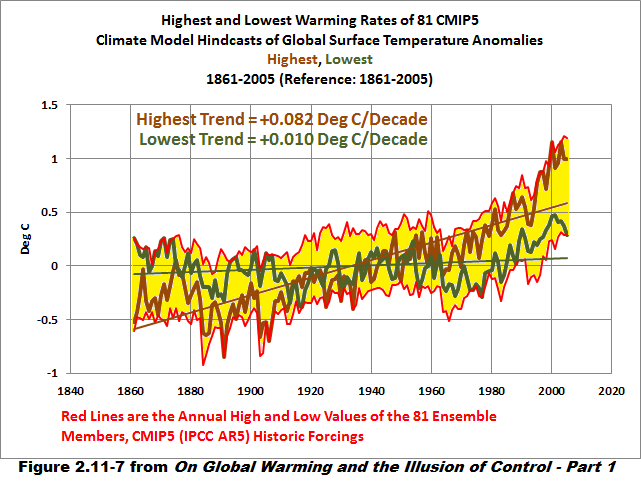
Which model? Because they scatter all over the place, from 0.1 deg C/century to 0.8 deg C/century. And the actual data is well down near the 0.1 deg C/century models. Furthermore, not a single IPCC model has any inclusion or calculation of the amount of global temperature change that is natural; they ALL assume that 100% of all change is man-made, and yet we know that is NOT the case. So if we're down around 0.1 deg C/century, and natural climate change is at that same level - how much is from man?
The reality is that the IPCC doesn't know how much warming is natural, and its own models do not reflect or support the extremist claims made, NOR do they match the actual data. Furthermore, the IPCC even has fudged the definition of today's climate! The IPCC now considers today's climate to be:
Present level of global warming is defined as the average of a 30-year period centered on 2017 assuming the recent rate of warming continues.
Do you see that? They have now redefined today's climate to include their own future projections at a measure equal to past data. Future model results are considered as reliable and important as actual data - even though I have shown you that the models are all over the place and do NOT match past data. But somehow they are "good enough" to use to determine today's climate as well as the future climate - data be damned!
If you choose to ignore the actual facts, and you refuse to think critically, then there's nothing to be said. You really are going on simple faith at that point - not science. Science requires skepticism, science requires logic and reason, and right now - the IPCC is showing none of that, and your blind acceptance of their statements shows the same. Faith, not science.
-
Re:Bueno! Excellente'Does science use projections as the baseline of what is happening? Because if you look at page 4 of the IPCC report, you'll see this interesting footnote:
5 Present level of global warming is defined as the average of a 30-year period centered on 2017 assuming the recent rate of warming continues
Essentially, the climate today is the 30 year period centered on today, which means the last 15 years and the forecast coming 15 years, meaning that modeled results are as important to the definition of climate today as actual measured data from the past. I did not realize that science was founded on projections and potentials rather than actual data... If your model says it will be 3 degrees warmer in 15 years, then we can assume that today is 1.5 degrees warmer than it is - because the model is allowed to contribute half of today's actual data.
-
Re:You're lying
You have linked to a youtube video, Wikipedia, and have referenced a scientific article that doesn't exist. You've presented nothing worthy of arguing intelligently about. If you have something of any scientific merit to discuss, I haven't seen it yet. I'll again suggest that you start here: http://ipcc.ch/ and read some of the tens of thousands of real scientific studies.
Or just stick to youtube: https://www.youtube.com/watch?... -
Re:Stop lying
You're 100% wrong (or simply lying). They're pretty damned accurate, actually. If you have any real interest, you should look into the IPCC. Here's a high level overview: http://report.ipcc.ch/sr15/pdf...
-
Re:NOOOOOO\
Us. Human civilisation is harmed. So are a lot of animal and plant species. If you want a full list of the main ways in which things on the Earth are harmed (and occasionally benefited) by greenhouse gases, see here.
Nitric oxide is present in human blood at concentrations of around 2 ppm - but exposure above 25 ppm is considered dangerous, and above 100 ppm will harm you in minutes. Also undesirable is how contact with water forms nitric acid, i.e. acid rain. And particulates are just as bad. Air pollution in general is still responsible for nearly a third of lung cancers and other respiratory diseases - we have a lot more improving to do.
-
Re:The environment has too little CO2
Thank you for providing citations. It's worth noting that the study actually says photosynthetic rates were boosted by an average of 40% (at 475-600 ppm), not plant volume. Dry matter gains were more modest, at 17% for above-ground plants and 30% for below-ground plants. Harvestable yields of wheat, rice and soybean all showed increases of 12–14%.
I agree that increasing CO2 levels are likely to enable greater food production in the long term, all else being equal, but in the shorter term the changes to rainfall patterns and optimal farming locations will have a more negative effect, with growing adaption costs, and drops in crop yields already being evident. For example, reports are showing that as of 2010, maize yields have dropped 7-8% in China and Brazil, with 14% drops in wheat yields in Russia. Other mitigating factors include high daytime and nighttime temperatures, and increased ozone production associated with CO2 emissions that has also harmed crop yields.
-
Re:Nuclear power and hydrocarbon synthesis
That's a non-answer as it tells me nothing on how to act. If this means we can't have nuclear power then you are by default kicking the problem down the path hoping for a solution to present itself before the problems of global warming are upon us.
Surely it's the exact opposite. Nuclear takes so long to build, and you have to dedicate yourself to maintaining the supply of fuel and the processing of waste for many decades, it's a long term commitment to emit more CO2. Depending on where you get your fuel from nuclear can be up to 110g/kWh.
On the other hand we have proven low emission technologies that can be built up much faster than nuclear. Best of all they provide a decent return on that investment, rather than being a money sink. People are lining up to build them, unlike nuclear where the UK has to pay the Chinese and French to do it for us.
-
Re: Getting sick of climate change hyperbole
Not a lie - a series of reports that only look at one part of the equation. The IPCC:
is to assess on a comprehensive, objective, open and transparent basis the scientific, technical and socio-economic information relevant to understanding the scientific basis of risk of human-induced climate change, its potential impacts and options for adaptation and mitigation.
By its own charter, it cannot consider non-human-induced climate change. Natural effects are discounted. When you have an equation, W = N + H, and you want to limit W to a certain value, you must know both N and H. Looking only at H is irrelevant, and tells you nothing. But that is exactly what the IPCC does.
They are not lying - they are just following a bad charter and are ignoring half (or, as it is increasingly turning out, more than half) of the actual issue - what would Nature do on its own?
-
Re:I'll take this one!
Those same models (page 34) show that it may, in fact, never actually become ice-free, and that is assuming that the climate sensitivity to CO2 is at least 3 deg C/doubling. And there is data to suggest it's actually down around 1.5 deg C/doubling of CO2. Meaning - we'd never have an ice-free summer.
-
Maybe
But it'll be a race to see if that dystopia arrives before the planet melts. http://www.ipcc.ch/
Pass the popcorn.
-
Re:I say this on every nuke thread
https://www.ipcc.ch/pdf/assess...
Lifetime emissions of a nuclear plant are around 100g/kWh. Better than coal but considerably worse than wind/solar+battery.
I just read your linked pdf... Table A.III.2 | Emissions of selected electricity supply technologies shows that nuclear is much much better than solar. Lifecycle emissions are 2x or 3x less than solar. Closer to wind and hydro. According to that chart, only onshore wind and hydro beat out nuclear in terms of CO2 emissions. But both onshore wind and hydro are very limited by geography.
-
Re:I say this on every nuke thread
https://www.ipcc.ch/pdf/assess...
Lifetime emissions of a nuclear plant are around 100g/kWh. Better than coal but considerably worse than wind/solar+battery.
Every once in a while I see a citation and a fact that challenges what I know. I follow the source. 9 times out of 10 the "fact" is a misleading representation of the citation. This is one of those misleading representations. The document has a table that provides the assessed minimum/median/maximum carbon emissions for a power source. This table gives following values for nuclear (in gCO2eq/kWh):
minimum: 3.7
median: 12
maximum: 110Suffice it to say that the parent post, by approximately citing the maximum number, is quite misleading.
In comparison, here are a few other sources (in terms of min/median/max gCO2eq/kWh):
Nuclear: 3.7/12/110
Coal: 740/820/910
Gas (Combined Cycle): 410/490/650
Geothermal: 6.0/38/79
Hydropower: 1.0/24/2200
Concentrated Solar Power: 8.8/27/63
Solar PV—utility: 18/48/180
Wind onshore: 7.0/11/56Based on these numbers (purely considering lifetime CO2 emissions--from your source), nuclear appears to be pretty competitive with wind/solar, etc.
Please help keep
Don't have mod points at the moment but I will quote you.
-
Re:I say this on every nuke thread
https://www.ipcc.ch/pdf/assess...
Lifetime emissions of a nuclear plant are around 100g/kWh. Better than coal but considerably worse than wind/solar+battery.
Every once in a while I see a citation and a fact that challenges what I know. I follow the source. 9 times out of 10 the "fact" is a misleading representation of the citation. This is one of those misleading representations. The document has a table that provides the assessed minimum/median/maximum carbon emissions for a power source. This table gives following values for nuclear (in gCO2eq/kWh):
minimum: 3.7
median: 12
maximum: 110Suffice it to say that the parent post, by approximately citing the maximum number, is quite misleading.
In comparison, here are a few other sources (in terms of min/median/max gCO2eq/kWh):
Nuclear: 3.7/12/110
Coal: 740/820/910
Gas (Combined Cycle): 410/490/650
Geothermal: 6.0/38/79
Hydropower: 1.0/24/2200
Concentrated Solar Power: 8.8/27/63
Solar PV—utility: 18/48/180
Wind onshore: 7.0/11/56Based on these numbers (purely considering lifetime CO2 emissions--from your source), nuclear appears to be pretty competitive with wind/solar, etc.
Please help keep
-
Re:I say this on every nuke thread
https://www.ipcc.ch/pdf/assess...
Lifetime emissions of a nuclear plant are around 100g/kWh. Better than coal but considerably worse than wind/solar+battery.
-
Re:Data matches observations
well-verified models that have been vetted and analyzed
The models have consistently over-predicted temperatures.
to the contrary, the models have fit the data to well within confidence limits, and continue to do so.
(links [1] [2] [3] [4])False. They don't even fit the "adjusted" data very well.
This is the typical way deniers argue: I post a links to data, and the deniers simply deny. That's it, no data, no nothing. Whatever it is, just deny it.
That's why they're called deniers. If they had any actual information, they'd be skeptics, but the deniers don't even care about actual information. Whatever it is, they'll just deny it.
-
IPCC projections
In 2007 IPCC FAR projected 0.2C/decade over the next two decades. So far we've seen 0.3C/decade since 2007, but it's early yet.
-
Re:Nice Scaremongering
The write-up claims, the 3.5 degrees is the current projections by some unspecified researchers. There no "ifs" about that write-up's claims — SuperKendall is correct, while your narrative falls apart.
SuperKendall's own reference shows scenario A2 which projects ~3.5C by the end of the century. See table SPM.3: A2 scenario best estimate = 3.4, likely range = 2.0 – 5.4. The A1FI scenario has a best estimate of 4C by end of century.
How much we warm depends on how much we emit. Warming will not stop at the end of the century unless emissions cease, so it is only a matter of time before we reach 3.5C. We've warmed about 1.2C since the 1850s. Two thirds of that has happened in the last 50 years. At the current rate of warming since the 1980s - even assuming no further accelleration - we will hit 2.5C by the end of the century. Again, where we end up will depend on how much CO2 we emit.
-
Nice Scaremongering
Even the IPCC says that likley heating will be around 2C, not 3.5C as the summary claims.
And as always, worth pointing out that pretty much no estimates take into account the rapid uptake of solar energy / electric cars that is inevitable at this point.
-
Re:But can it find criminals in plain sight?
Not sure who the alarmists are, but maybe look to the scientific literature instead. The IPCC report at the time suggested that we shouldn't expect 2 feet of sea level rise until 2100 (and certainly not by 2020!) , but may only get 1 foot by 2100. See figure 12 of the IPCC FAR WG1: https://www.ipcc.ch/ipccreport...
So maybe fuck the alarmists (whoever those folks are) but trust the science?
-
Re:Memo [Re: Lock Him Up]
Does the fact that there has been a for-profit campaign at misrepresenting the truth surrounding this topic make you question the path you took to come to the exact outcome they were aiming for?
Not for a second.
Then you're a true believer that won't question the dogma you've been fed. Good luck with that. It's great you're appealing to science. It's a good path. But part of science is re-examining your preconceived notions.
sigh, the irony. I've already pointed to the data you ask for later now and that you imply I refuse to. This is the last I'm gonna bother with responding as you seem disinclined to read anything that disagrees with your own preconceived notions.
I started out by pointing out the difference between global warming and climate change. Then I dug into the text you regurgitated from the IPCC report. I found what you were bitching about, and pointed out the text that followed in the very same report. Then I questioned where you actually got the values you were complaining about.
That's a lovely dump of some paper.
Now cough it up the actual values. SCIENCE. You've stated:
Uncertainty of the energy imbalance in climate models is GREATER than the energy imbalance caused by that CO2 increase, and by quite a lot.
1) What is the uncertainty of the energy imbalance in climate models? (The uncertainty for the factor for cloud feedback was +-0.7 W m–2 C–1)
From the IPCC AR5, Chapter 9 on evaluation of climate models. You'll find this on page 763 as I already pointed out.
Both the CMIP3 and CMIP5 model ensembles reproduce these patterns with considerable fidelity relative to the National Aeronautics and Space Adminsitration (NASA) Clouds and the Earth’s Radiant Energy System (CERES) data sets (Pincus et al., 2008; Wang and Su, 2013). Globally averaged TOA shortwave and longwave components of the radiative fluxes in 12 atmosphere-only versions of the CMIP5 models were within 2.5 W m–2 of the observed values (Wang and Su, 2013). Comparisons against surface components of radiative fluxes show that, on average, the CMIP5 models overestimate the global mean downward all-sky shortwave flux at the surface by 2 ± 6 W m–2 (1 ± 3%) and underestimate the global downward longwave flux by 6 ± 9 W m–2 (2 ± 2%) (Stephens et al., 2012).Now, if you care enough, you can go to the previous post and read the excerpts I gave you from Mauritsen on model tuning. From his setup, we know that modellers universally hand tune the TOA imbalance to the satellite record, and the above IPCC ranges are AFTER tuning, so the true uncertainty is going to be higher still as tuning is compensating for unknowns(uncertainty). For the purpose of my claim though, we can even assume ALL the unknowns and uncertainties being tuned for don't exist or cancel themselves out. The inter model average deviation from observation of 2.5 W m-2 is plenty.
2) What is the energy imbalance caused by CO2 increases?
This is the main thrust of your argument, yet you've HAVEN'T ACTUALLY STATED WHAT THEY ARE. Other than.... "A lot".
The energy imbalance causing the recent warming is 0.5-0.7 W m-2. I already again pointed this out up thread referencing NASA's direct satellite observations. You then waved it away as irrelevant to whether or not climate change is happening, despite the fact we never disagreed on that...
Here's a different reference then for the same from Mauritsen(one of the papers the IPC references) while discussing the tuning process for their model, although one of his references for the imbalance they target is the same team under Hansen at NASA I referen
-
Re:Not Enough!
Unless I'm reading the ipcc report wrong, nuclear's carbon emissions are not huge amounts more than solar, wind, and geothermal. Nuclear is comparable to wind and much less than solar.
https://www.ipcc.ch/pdf/assess...
page 1335
If I am mistaken, show me the actual numbers. -
Re:Not Enough!
Yes, it's the total emissions including all the mining and fuel transport and storage and air conditioning for the control room etc. etc.
Don't take my word for it though, ask the IPCC: https://www.ipcc.ch/pdf/assess...
Page 1335. Lifecycle emissions. Depending on who you ask and what measurement you use, Nuclear is at best about the same as Wind, but it depends a lot on where it is and where the fuel comes from and where the waste ends up.
First of all, good link, thanks
Page 1335 of the document has the values for many modes of generation.
Table A.III.2 | Emissions of selected electricity supply technologies (gCO2eq / kWh)
Lifecycle emissions
(including albedo effect)
Min/Median/MaxGeothermal 6.0 / 38 / 79
Hydropower 1.0 / 24 / 2200
Nuclear 3.7 / 12 / 110
Solar PV — rooftop 26 / 41 / 60
Solar PV — utility 18 / 48 / 180
Wind onshore 7.0 / 11 / 56
Wind offshore 8.0 / 12 / 35I'm thinking that the median value for all these would be the most appropriate number to quote.
Nuclear: 12 gCO2eq / kWh
Note that this is about the same as wind, and is significantly less than solar, geothermal, and hydropower. -
Re:Not Enough!
Yes, it's the total emissions including all the mining and fuel transport and storage and air conditioning for the control room etc. etc.
Don't take my word for it though, ask the IPCC: https://www.ipcc.ch/pdf/assess...
Page 1335. Lifecycle emissions. Depending on who you ask and what measurement you use, Nuclear is at best about the same as Wind, but it depends a lot on where it is and where the fuel comes from and where the waste ends up.
-
Re:Memo [Re: Lock Him Up]
Yeah dude, which one of those bullet points DOESN'T sound nefarious to you? Because each one of those is a blatant FUD campaign. Fear, UNCERTAINTY, and DOUBT. ok, so not so much fear. The last bullet is literally planned character assassination.
Get your head out of the sand, declaring the Kyoto treaty as badly flawed is "planned character assassination"? Come on, it used the Russian depression as the emissions benchmark for nations to meet, so Russia could actually increase it's emissions while everyone else had to pull back. Nope, nothing but good solid science there, no politics at all...
we have
Minus all the spin, bias, and weasel words... this is true. Don't get me wrong, the current debate is:
- How bad it will be?
- What can we do about it?
The fact that these are debatable means there is uncertainty. Science is about removing uncertainty leading to better understanding. Speaking on the science of "error margins in the global energy imbalance that are GREATER than the actual imbalance driving climate change(that is directly from the IPCC", Put up or shut up. Pics or it didn't happen.
So how's our uncertainty doing? You want IPCC's views on climate models? Boom.
There is very high confidence that models reproduce the general features of the global-scale annual mean surface temperature increase over the historical period, including the more rapid warming in the second half of the 20th century
I'm glad you linked to the IPCC AR5 section on Climate models, that was my source too, seems you didn't read it all though as you clearly left my claim untouched, that the energy imbalance is badly modelled. If you look to page 749 of the report you'll find this:
Model tuning aims to match observed climate system behaviour and so is connected to judgements as to what constitutes a skilful representation of the Earth’s climate. For instance, maintaining the global mean top of the atmosphere (TOA) energy balance in a simulation of pre-industrial climate is essential to prevent the climate system from drifting to an unrealistic state. The models used in this report almost universally contain adjustments to parameters in their treatment of clouds to fulfil this important constraint of the climate system (Watanabe et al., 2010; Donner et al., 2011; Gent et al., 2011; Golaz et al., 2011; Martin et al., 2011; Hazeleger et al., 2012; Mauritsen et al., 2012; Hourdin et al., 2013).Referencing a lengthy list of peer reviewed articles on climate modelling, it summarizes that models must hand tune parameters, like clouds, because if they don't the energy imbalance causes the model to drift "to an unrealistic state".
Now let's remember that the driving force of greenhouse gases on climate change is 100% through changing the TOA energy imbalance. I HAVE read each of the referenced articles too, and they confirm the summary, without tailoring clouds by hand(not simulating them) the models uncertainties in the TOA energy imbalance outweigh the signal and they CAN NOT reproduce the past warming trend.
-
Re:Memo [Re: Lock Him Up]
Yeah dude, which one of those bullet points DOESN'T sound nefarious to you? Because each one of those is a blatant FUD campaign. Fear, UNCERTAINTY, and DOUBT. ok, so not so much fear. The last bullet is literally planned character assassination.
we have
Minus all the spin, bias, and weasel words... this is true. Don't get me wrong, the current debate is:
- How bad it will be?
- What can we do about it?The fact that these are debatable means there is uncertainty. Science is about removing uncertainty leading to better understanding. Speaking on the science of "error margins in the global energy imbalance that are GREATER than the actual imbalance driving climate change(that is directly from the IPCC", Put up or shut up. Pics or it didn't happen.
So how's our uncertainty doing? You want IPCC's views on climate models? Boom.
There is very high confidence that models reproduce the general features of the global-scale annual mean surface temperature increase over the historical period, including the more rapid warming in the second half of the 20th century
-
Re:Never taken into account by alarmists
This inevitable increase in use of alternative energy is never taken into account by climate models that assume an ever increasing generation of CO2.
This is just false. For example, the IPCC reports have a variety of different scenarios each based on different levels of CO2 https://ipcc.ch/pdf/special-reports/spm/sres-en.pdf is a good place to start. Unfortunately, even given these emissions levels, the damage is going to be severe. We need to do a lot more than we're doing.
-
Re:This isn't good
No, these are BUSINESSES, and several Chinese businesses are being clean. The vast majority are NOT.
OTOH, The western ones are almost all above average for how they handle toxic chemicals which is what that was about.
As to the ORIGINAL conversation that you decided to troll on, it was about ENERGY EMISSIONS. The Carbon intensity of China was 80% more than the wests back then.
As to intensity of nat gas vs coal, it is mostly a simple issue.As I have tried to educate you on this, nat gas emits a fraction of coal. Nat gas is 56 g / MJ, while coal is around 98-100 -
Re:Proof that CO2 does not cause warming
Huh? The IPCC says the range of 2.1 to 4.4 deg K is too low, yet the data (as empirically calculated by Curry and others) shows the sensitivity to be less than half of that. And the actual models all run hot as confirmed with actual data (see the earlier link to Spencer et al). Current trends are well below what the IPCC models estimated.
-
Re:Proof that CO2 does not cause warming
IN FACT, your OWN link proves you are flat-out wrong - look at the first graph, it confirms exact this. It shows the Curry model as covering ~1 to ~2.5 - much different than you claim (1.1 to 4.45). Furthermore, reading the summary at Curry's site, you'll see that Curry estimates ~1.8 deg K sensitivity if we allow for unknown heat entrapment in the ocean by a mechanism that we don't understand. Using actual Argo (buoy) data and models which we do know, the sensitivity is ~1.6 deg K.
Now, you want to know how "Real Climate" is lying to you? They claim the models use values around 1 to 2.5 (from their misleading graph and supporting text); yet the IPCC itself says:
The current generation of GCMs[5] covers a range of equilibrium climate sensitivity from 2.1C to 4.4C (with a mean value of 3.2C; see Table 8.2 and Box 10.2)... The equilibrium climate sensitivity estimates from the latest model version used by modelling groups have increased
Yes, the IPCC says the range of 2.1 to 4.4 deg K is too low and needs to be higher! Clearly "real climate" is simply shilling and effectively lying to cover the facts. I linked straight to the IPCC itself - it in no way says what "real climate" says. And the IPCC models simply do not correlate with actual real-world data.
So at the end of the day, what do you trust? Data or models?
-
Re:Proof that CO2 does not cause warming
http://www.ipcc.ch/pdf/assessm...
A bunch of graphs, data and projections say otherwise.
-
Re:Clueless about fields of study
The claims to watch are the official ones of the IPCC, and you can see in detail what claims they're willing to make and how confident they are in them, as well as references to how they got the claims. Your cite was of a scientist who made a claim that probably looked reasonable eighteen years ago, and which was reported on in the general press. There is no apparent way to go from that claim to the process behind it, which means that it's really scientifically useless. Very likely he spoke off-the-cuff, and whatever models he used have doubtless been examined to death and improved. Possibly, his idea of "a few years" is different from yours, or he was misquoted. You need to stop confusing science journalism with science.
So, you picked a claim out of the past twenty years from the popular press that proved to be wrong. That's not a valid attack on the science. Check what the actual supported claims are, not the speculations, and see how those turn out.
-
Re:Check the THD plots
You are the problem.
Source of your sig: https://www.ipcc.ch/ipccreport...
Full quote of Exec summary bullet point quoted:
"Improve methods to quantify uncertainties of climate projections and scenarios, including development and exploration of long-term ensemble simulations using complex models. The climate system is a coupled non-linear chaotic system, and therefore the long-term prediction of future climate states is not possible. Rather the focus must be upon the prediction of the probability distribution of the systems future possible states by the generation of ensembles of model solutions. Addressing adequately the statistical nature of climate is computationally intensive and requires the application of new methods of model diagnosis, but such statistical information is essential. "
One bullet point of 8, summarizing a mission statement for a working group. Further quoted:
"Further work is required to improve the ability to detect, attribute, and understand climate change, to reduce uncertainties, and to project future climate changes. In particular, there is a need for additional systematic observations, modelling and process studies. A serious concern is the decline of observational networks. Further work is needed in eight broad areas:"
I say again, You Are The Problem. -
Climate models are pretty accurate so far
...by the Scientific calisthenics required derive a working AGW theory, that hasn't been show to be true by any empirical evidence.
The basic global circulation model incorporating the effect of anthropogenic carbon dioxide (what you call "AGW theory") has been around for fifty years now (the peer-reviewed publication was in two papers by Manabe and Wetherald, in 1967). That's long enough for the predictions to be compared with measurements.
Guess what? Over fifty years, the theory is pretty well matching measurements.
https://www.forbes.com/sites/startswithabang/2017/03/15/the-first-climate-model-turns-50-and-predicted-global-warming-almost-perfectly/
https://climategraphs.wordpress.com/2017/11/06/evaluating-the-prediction-of-manabe-and-wetherald-1967/
https://www.theguardian.com/environment/climate-consensus-97-per-cent/2014/mar/19/global-warming-accurate-prediction-1972Anytime some authority insist that you give up freedom or money and the best they can do to justify it is to say, "It's complicated and you wouldn't understand, Trust Us", you know that something isn't right.
As it turns out, climate scientists have published extensive explanations of what they do, how they do it, how the models work, and all of the source code for their models. They don't say "trust us", they say "here's all the work we did, take a look at it."
As a starting point, look here: http://www.ipcc.ch/report/ar5/wg1 and then for the actual details, start reading some of the thousand references cited.
-
Re:Grab some popcorn
The IPCC Working Group 2 report covers that.
Yes, there are certainly some positive benefits from climate change (which are indeed described in the WG2 report), and in the long term (hundreds/thousands of years), once the pace of change has settled down, some (mostly higher) latitudes will likely be significantly better off. However lower latitudes will likely be significantly worse off, and as more energy is pumped into the climate system then extreme weather events are likely to increase too.
But in the short term, the impacts are almost all negative, some massively so. The main reason for this is the rapid pace of the changes - our infrastructure and agriculture are all designed and located for our current climate, so as the climate changes (and we can already see it changing), then we will have to move/fix/protect/upgrade/relocate large amounts of our society along with it. Coastal cities will need levees to deal with higher storm surges, large areas of farmland will need more irrigation or flood protection, etc etc - and any countries or communities that can't afford those adaption costs (or have nowhere to move agriculture or population to) will suffer. The worst off will have to leave, creating refugees that will worsen international tensions - leading the DoD and NATO to class climate change as a "threat multiplier" that is already having visible effects.
Estimating the net monetary costs from these impacts is not easy, but some studies have been done, and they've all concluded the costs of later adaption far outweigh the costs of earlier action to mitigate climate change.
-
Re:Grab some popcorn
I'm not sure we actually KNOW that the current warming trend is entirely man made
We know to a high level of scientific certainty. In fact, the evidence strongly suggests the world would still be slowly cooling, if it wasn't for our greenhouse gas emissions.
Given that the science behind this specific part of the question is far from conclusive
It absolutely is; that's why every scientific institution on the planet endorses the conclusion that we're causing the warming we're seeing. We can even quantify it - the IPCC AR5 WG1 summary says our emissions of CO2 alone have caused a radiative forcing of 1.68 W m^2 (+/- 0.3), plus another 0.97 W m^2 from methane - which dwarfs the cooling effects of atmospheric dust and nitrates at about -0.42 W m^2 in total. We know it's our CO2 that's causing it because a) we can easily measure the CO2 levels rising rapidly, and b) isotopic analysis shows a match with carbon from fossil fuels (not to mention the observed levels happen to agree nicely with our calculated emissions, and that nothing else has been observed that could come close to causing the effect we're seeing).
None of this attribution has anything to do with our land temperature models (which btw are working just fine).
What's still uncertain is exactly how much warming we'll see, and when. Not what's causing it.