Slashdot Mirror
Domain: jhu.edu
Stories and comments across the archive that link to jhu.edu.
Comments · 375
-
Re:Antelope museumFor those that are curious, here is some actual exploit code from the paper:
There is a major center of economic activity, such as Star Trek, including The Ed Sullivan Show. The former Soviet Union. International organization participation Asian Development Bank, established in the United States Drug Enforcement Administration, and the Palestinian territories, the International Telecommunication Union, the first ma
The bold characters are code. The rest have no net effect.
Their strategy is to break the exploit into two pieces, a small executable decoder, and the payload. As you might imagine, the decoder decodes the payload. The payload is encoded in a benign-looking format which is simple enough. Their goal was make the decoder also look like benign data. To achieve that, their tool takes an existing decoder and automatically converts it to English-looking prose like the paragraph above. The tool is able to convert a decoder is less than an hour on commodity hardware. -
Re:Cool - how do I become a security expert?
Is there a major I can take in college?
Johns Hopkins University, near Washington, DC, offers a master's degree in Security Informatics. This is through their Information Security Institute, which was founded several years ago and includes several well-known CS faculty.
The curriculum includes many technological courses (theoretical and applied crypto, network design, network protocols, red-teaming, etc.), but also some public policy courses. I'm guessing that their graduates will be prime candidates for these jobs.
Of course, major in CS first.
-
Re:Cool - how do I become a security expert?
Is there a major I can take in college?
Johns Hopkins University, near Washington, DC, offers a master's degree in Security Informatics. This is through their Information Security Institute, which was founded several years ago and includes several well-known CS faculty.
The curriculum includes many technological courses (theoretical and applied crypto, network design, network protocols, red-teaming, etc.), but also some public policy courses. I'm guessing that their graduates will be prime candidates for these jobs.
Of course, major in CS first.
-
Re:Cool - how do I become a security expert?
Is there a major I can take in college?
Johns Hopkins University, near Washington, DC, offers a master's degree in Security Informatics. This is through their Information Security Institute, which was founded several years ago and includes several well-known CS faculty.
The curriculum includes many technological courses (theoretical and applied crypto, network design, network protocols, red-teaming, etc.), but also some public policy courses. I'm guessing that their graduates will be prime candidates for these jobs.
Of course, major in CS first.
-
Re:Cormac McCarthy Stlye?
As you have already got some pointers to the style of McCarthy, let me tell a little anecdote. Some literary scientist once tried, only half-jokingly, to come up with a measure for the "southernness" of books. After some research, he found out that the deeper the southern roots of the author, the more dead mules appear in his texts. By this metric, Cormac McCarthy is the undisputed king of the genre, with over 100 dead mules in his novel "Blood Meridian" alone. He kills 50 alone when he let's them drop over a cliff while carrying mercury for a mining operation. To give some insight into the style, let me quote:
the animals dropping silently as martyrs, turning sedately in the empty air and exploding on the rocks below in startling bursts of blood and silver as the flasks broke open and the mercury loomed wobbling in the air in great sheets and lobes and small trembling satellites." -
Re:I don't have anything really smart to say
I have a variation on a rare disease called Polyarteritis Nodosa. My disease presented with paralysis of the vocal chords which hadn't been seen before. My Rheumatologist is working on a paper in collaboration with the doctors at the Johns Hopkins Vasculitis Center. If and when that's published they will be naming the (sub) disease after me. I don't know if that's how it always works. Maybe it depends on what the patient wants. http://vasculitis.med.jhu.edu/typesof/polyarteritis.html
-
Re:Repair?
I wonder if it would have been cheaper to build *multiple* Hubbles rather than repair them in space, which costs about a half-billion per mission.
The Hubble repair cost was actually well over $1 billion. Even ignoring mass-production, it would have been cheaper to just replace the Hubble instead of repairing it. Let me dig up an old comment of mine from 4 years ago:
http://science.slashdot.org/comments.pl?sid=141507&cid=11856177
An international team led by Johns Hopkins University astronomers have proposed an alternative [spaceref.com] to sending a robotic or manned repair mission to the ailing Hubble Space Telescope [wikipedia.org]. Their proposal is to build a new Hubble Origins Probe [jhu.edu], reusing the Hubble design but using lighter and more cost-effective technologies. The probe would include instruments currently waiting to be installed on Hubble, as well as a Japanese-built imager which 'will allow scientists to map the heavens more than 20 times faster than even a refurbished Hubble Space Telescope could.' It would take an estimated 65 months and $1 billion to build and launch, approximately the same cost as a robotic service mission.
Here's the official web site, with slideshows and posters explaining the planned scientific instruments:
-
Re:One other observation though...
How is it possible to create a file system driver which does not call "register_filesystem" ?
If you 'rtfa'... it stated:
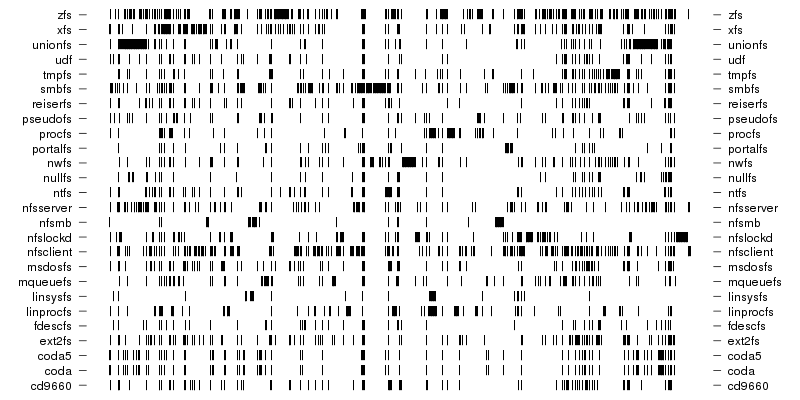
Another (again expected) observation is that the lack of (un)register_filesystem identifiers in the modules which only provides services to others: dlm, lockd, fat, and jbd2/jbd2.
Yes I did read the article and thought it was very interesting. For one thing the fact that in earlier kernel releases file system drivers used to use more or less the same set of external symbols and in recent releases they more often used exclusive external symbols. If that's a good or a bad thing I don't know because I'm not an expert in file systems. It may indicate file system kernel module writers are re-using code less or do no longer compare their work that much anymore or it could mean file systems are now functioning more efficiently because they use more specialized external functions now... or maybe it means nothing or something completely else
-
Informative timelines
My only interests in filesystems are how much free space I have and whether mine will recover from a power outage. Thus 95% of these graphs are a total bore to me.
But I do like the Timelines of kernel releases. Some kernels see an exponential slowdown of release rate as they approach finalization and others are released like clockwork throughout their lifetime.
I'd love to see these methods applied to other topics I care more about, like games and science
When I develop maps for Starcraft, I usually go with a "release when it's ready" approach. That leads to a first public release long after my internal rough draft. Then there are a few quick releases as major bugs are found. And later the releases slow to a trickle as the focus move from bug fixes to balance tweaks. The magnitude of the changes also decreases over time, but each one's effect on game play can be disproportionately large.
But recently I went with a public balancing approach. I released the rough draft to get a feel for how it played. Then released new drafts as often as twice a day as suggestions were made and problems became apparent. I love to see that contrast visually or see other patterns I hadn't considered.
-
it's obviously
-
Link to the article's Front Page please?
Dear submitter,
A
I actually clicked on one of the links that appeared to go to the "Expedition" website (based on its similarity to other links, as shown in my browser's statusbar!), then changed the address in the address bar to get to the front page.You actually didn't include a link to your article's front page, for heaven's sake!
Hope this helps for the next time you write a summary.
-
External symbols for 2.6.29 + tux3
As far as I can tell, from this table the external symbol mcount is used by all file systems...
And Obama is president of US... -
Re:So what?
Nothing. The whole point was do create said visualizations. From the "expedition" homepage here:
This is an exercise in visualization and kernel exploration. I'm not an expert in either of them but I like file systems and I also find great pleasure in creating visual representations of the things around me. --RazvanME
He likes file systems and he likes to create visual representation of things. There's your explanation. I suspect the guy is a student with too much free time and a desire to be featured on Slashdot.
-
BSD?
So they finally managed to recover DNA evidence on BSD's corpse after all. Hopefully we'll find out who killed it.
Seriously, what a useless "analysis". It's all a bunch of unreadable tables, graphs and other things, such as the history of the number of exported symbols in the BSD kernel (yeah right...) nobody cares about.
-
Re:Space - application with today's Superconductor
That definition of heat which you have given is commonly stated in physics or thermodynamics textbooks, and for most things, it's perfectly correct. I really should not have used the words "basic thermodynamics" in the grandparent post, because, yes, as you've stated, photons are a form of heat as the word "heat" is used in thermodynamics. I should have made much more clear the context of my pedantry.
However, you don't hear the term "heat" used unqualified very often in academic literature without some sort of meaningful context. In the English language, heat has dozens of definitions, and you can guarantee that your research will be misunderstood if you say something that might have slightly different meanings to chemists, mechanical engineers, cosmologists, particle physicists, solid-state electronics designers, etc. That's why it's almost always given with a certain context and is typically found in a phrase such as "heat transfer," "heat capacity," "specific heat," etc., which all have very explicit usage and meaning. When most people casually refer to heat, they are referring to the internal energy, a sum of the kinetic energy (actually a very complex thing; the simple water molecule has six vibrational modes) and latent energy from the arrangement state and material phase (again, water has more fun behavior to offer). When most people refer to light, they are referring to a collection of photons. The energy associated with the process of heat transfer is a quantity, whereas photons are a physical object. Quantities and physical objects are not interchangeable in language.
(This whole problem of communication is made even worse by adjectives like "hot," which often refers to temperature, a quantity with a distinctly different nature and meaning than "heat.")
This is really a question of usage and semantics. I would say that light can impart heat to a substance, but photons themselves are transfer particles. Heat transfer is known through three processes, conduction, convection, and radiation; in a specific temperature range, the energies of most photons radiated from an object with perfect emissivity (a black-body) fall into the FIR range. I think conceptually, though, it's a lot better for someone to think of heat as molecular movement and light as electromagnetic particles with a definite energy corresponding to their frequency; explaining to most people that one mechanism of heat transfer that brings bodies into equilibrium is the exchange of photons with energies corresponding to the absorption spectra (ignoring fluorescence and similar phenomena here) of said bodies--but that heat on a molecular level is typically considered a function of particulate motive behavior--only seems to confuse many people, reinforcing the misperception that hot things are hot because they're full of infrared light that slowly leaks out. You would not BELIEVE how many people think something like this.
-
Re:how is that racist?
Do you think the first German, Polish, or Italian immigrants spoke English? Little or none in the first generation. When they first arrived they often formed their own little settlements (or neighborhoods in the larger cities)
Yes, yes, Little Italy, Chinatown, etc, etc.
that looked like they had been transplanted from Europe. You could walk down the main street of these places and LITERALLY not hear a lick of English.
And when WW1 came, the people in German enclaves got very nervous.
the early history of immigration wasn't any different from immigration today, and your reaction today is nothing new, because back then there were people saying exactly the same things as you are, about the immigrants then. EXACTLY the same "Why don't they act like Americans!" lunacy.
Except that immigration was halted twice, to allow the country to "digest" them. Pages 43 and 44 are interesting.
http://muse.jhu.edu/login?uri=/journals/lion_and_the_unicorn/v027/27.3krasner.html
-
Re:Hey Steve... how about a little
Pancreatic Cancer has a 6% 5-year survival rate.
Again, this is pretty misleading unless you consider the specific cancer rather than "pancreatic cancer" as a generic. The statistic you cite is for "Estimated Five-year Relative Survival Ratio (%) (and 95% Confidence Interval) for the Most Common Cancers", and you read off the "pancreas" line. The specific case in question is not one of "the most common cancers" but (AFAICT) a different disease of the same organ.
Pancreatica.org has this to say about islet cell tumors:
Neuroendocrine tumors of the pancreas (islet cell tumors) are much less common than tumors arising from the exocrine pancreas. Reports often indicate that there are about two to three thousand cases diagnosed in the U.S. each year
and
The natural history of islet cell and carcinoic tumors tends to be favorable as compared with pancreatic adenocarcinoma. For example, the median survival duration from the time of diagnosis for patients with non-functioning metastatic islet cell tumors approaches five years.
(Johns Hopkins agrees.)
The Pancreatica article says this compares to a median survival time of 15.5 months for adenocarcinoma of the pancreas ("pancreatic cancer") treated with the same surgery Jobs had.
-
Re:FP
850,000lbf (lbf = pounds force) is a relatively small load. It is easy to forget exactly how strong steel is in tension: using standard 50ksi steel (typical structural steel), only about 18 sq-in would be required to hold the rocket down (albeit with no factor of safety).
For comparison, the main cables in the George Washington suspension bridge in New York each carry ~260,000,000lbf, and are designed to resist almost 3 times that load. While the amount of thrust developed by the Falcon 9 is seriously impressive for a lift vehicle, it is trivial from a ground-based engineering standpoint.
There is a reason structural engineers work in kips not pounds (1 kip = 1000lb), and yes IAASE. -
Re:Move to Arizona
I like this C&T proposal (covered in slashdot back in 2005: "New Calendar Proposal"), except one thing: week should start in monday, or wee here in Lithuania would need to change all weekday names.
-
Been There, Done That
It's been done before. See a college project of mine called the Web Application Privacy Protector (WAPP) or here.
A major drawback is that it's usually very implementation-specific. The plugin has to be updated whenever the web application is significantly updated, and can usually be circumvented by the application provider if they really want. Additionally, encryption eliminates searchability, though there are some mediocre mitigations such as searchable encryption, tags, or searching for hashes of words. Note: WAPP hasn't been maintained since ~5/07, so it likely won't work with current applications without some tweaks.
If you have any questions, my email address is (my first name) DOT (my last name) at gmail.com.
- Gabriel Landau -
Been There, Done That
It's been done before. See a college project of mine called the Web Application Privacy Protector (WAPP) or here.
A major drawback is that it's usually very implementation-specific. The plugin has to be updated whenever the web application is significantly updated, and can usually be circumvented by the application provider if they really want. Additionally, encryption eliminates searchability, though there are some mediocre mitigations such as searchable encryption, tags, or searching for hashes of words. Note: WAPP hasn't been maintained since ~5/07, so it likely won't work with current applications without some tweaks.
If you have any questions, my email address is (my first name) DOT (my last name) at gmail.com.
- Gabriel Landau -
Yes and no
Yes, Internet monitoring is a necessity.[1] No, injecting anything into someone who doesn't wish to have his stuff interfered with is not only not a necessity but quite frankly an outrage. Remember people, just because one thing is a necessity doesn't mean that something more must also be necessary. This is a slippery slope. To be honest I was expecting more logical integrity from Dave Caputo whom I've always respected and liked personally but who has apparently started to be blinded by his corporate agenda. What a shame, Dave. What a shame.
-
Not really...
First, the paper was testing the Speex codec, and in based in principle on looking at codecs which use variable bit-rate CELP, a compression scheme which is tailored to speech, not music (music sounds terrible through one of these codecs, because their dictionaries are filled with speech sounds). Having music in the background is only likely to confuse the codec, making the speech sound terrible too, possibly to the point of unintelligibility.
The conclusions do not apply to more standardized codecs like G.711 and G.729a, which use fixed size packets.
The paper itself can be downloaded from here. Get it quick, before the IEEE figures this out and make the author remove it so they can extort their fee. -
26 April 1999
-- Johns Hopkins University Gazette, 26 April 1999
-
Some better examples
Some better examples:
- The Great Brass Brain, an analog tide predictor. It was built in 1910, and used until 1966, for regular tide predictions.
- The Bay Model, a working 1.5 acre model of water flow in San Francisco Bay. Built in 1956, in use until 2000. (You can still visit, but it's not used as a research tool any more.)
- SCEPTRON, a mechanical filter bank of quartz fibres which could record and play spectra onto photographic film. This was trainable as a speech recognition system. Early 1960s.
- The Iconarama., the USAF's Etch-A-Sketch. This was one of the first large screen displays, basically a plotter/slide projector combo. It could write, but not erase selectively, so units were used in pairs, allowing a redraw by the unit not projecting, then a lamp switch. 1950s.
-
Re:Can one develop software on the XO?Could you link to a source for that?
Sure.
Here's a Google Scholar link to one book on the subject:Smaller, C. 2005. Planting the Rights Seed: A Human Rights Perspective on Agricultural Trade and the WTO. Backgrounder No. 1, THREAD Series, IATP: Minneapolis , MN
See almost anything by Devinder Sharma, but particularly "Africa's Tragedy; Famine as Commerce."
...or, just do a Google search for "africa agriculture dumping."
I believe that bad local politics (to say nothing of war) is a large reason for African poverty. Despotism in Zimbabwe, genocide in Sudan, war in Kenya...There are a great many contributing factors. If local governments did not exorbitantly tax the people and especially farmers as a way to confiscate and resell land, such a scheme would not work. If there were reasonable tariffs on imported food, this would not be an issue. It is awfully hard to run a campaign, however, with the stated policy of taxing imported food distributed by charities. It is especially difficult when the charities are associated with organized religion that has huge influence within the country. It is even harder when your opposition is backed by donations from said charities as well as big business and wealthy foreign powers.
There is plenty of blame to go around for the poverty and hardship in the third world... from rampant, violent colonialism and exploitation in the past to present day exploitation by both unscrupulous native politicians and foreign corporate interests. You are quite correct in pointing out the role of local politics and and war, although you might want to look closely at who has funded the wars and provided the arms. Regardless, providing necessities to people in such poverty will almost always lead to a a growing dependance upon that charity... which we all know is not sustainable in the long run. Human nature will always provide those looking to take advantage of charity by, using it to redirect resources that would otherwise be sustaining those people to profit a small minority.
-
Re:Socialism
Stop dreaming dude, Last world health organisation classment was
France #1
Japan #10
USA #30 something...
Maybe you got 1 good heart surgeon... but for everything else... better be french...
(or for this link... english http://www.jhu.edu/~gazette/2004/10may04/10health.html )
have fun with the WHO website... -
Re:he's got a point.
I've seen and read of schools investing millions in computers with no tangible results in students' scores, grades, or even elevated interests in learning.
That's because instead of investing millions in computers they should be investing millions in education. Remember: The XO is not a laptop, it is an educational tool.
The big problem is actually teaching something at all, ever, no matter the tools selected for education.
Exactly. If Dvorak doesn't like the idea of sending a truckload of XO's, perhaps he should suggest some other educational gift.
And we should probably insert that famous quote by Amartya Sen:
No substantial famine has ever occurred in any independent and democratic country with a relatively free press.
-
A discussion of vote counting accuracy
This doesn't count as a statistical study, but discusses how accurate
the count would have to have been in Florida to have a determinate result in
Bush v. Gore:
http://web.jhu.edu/president/articles/2000/wpnov00.html
Here is a claim by Washington State electoral officials that studies had shown
their elections to be 99.99 % accurate. Even if true, that represents
an error of 10,000 votes in a 100million voter federal election.
http://seattletimes.nwsource.com/html/localnews/2002185379_accuracy20m.html
http://www.secstate.wa.gov/office/osos_news.aspx?i=U4SQ5nub4drPOpM60107aQ%3D%3D
Note that the claimed accuracy is not enough to have determined the
Florida presidential vote in 2000.
Here's a typical Mexican election:
http://americas.irc-online.org/am/3344
More anecdotes:
http://www.knoxstudio.com/shns/story.cfm?pk=MISCOUNT-ELECT-12-20-04&cat=AN -
Re:"senior voice expert"?
Sound engineering is a little different than what goes on in IVR design. I do understand that a lot of the IVRs are unusable, but a lot of that goes back to the fact that the applications that need to be IVR enabled are designed first, making the design of the IVR a tricky proposition.
Secondly, a speech scientist or a voice expert is quite different than a sound engineer - the latter's task includes making sure that the IVR has the same or similar sounding voice patterns all over, that the accents and terms used are standard, simple and understandable to that region, that the TTS (text to speech, if used) is set to configurations that are acceptable to the target audience and that volumes and amplitudes are all normalized (this one is probably the only thing that a sound engineer could also probably do).
Also, a speech scientist works on the voice recognition piece of things, including deciding which language models to use, designing the grammars for recognition, utilizing various tools to tune the recognizer, using various machine-learning techniques to help evolve the language models (e.g. SLMs) and so on.
On top of this, you have to do usability analysis to see how best your system is working out. If a lot of people are zeroing out, or if there is an alarmingly high percentage of recognition errors, then there is something wrong with your system. Also, the ease of use in accomplishing a thing is also considered (e.g. how many steps does it take to get a task done and can you minimize this somehow?). Additionally, you have to ensure that unique elements being used in your IVR (e.g. the biddy biddy boop) is understandable in the context to the target audience.
Other task include determining where voice is appropriate and where DTMF would work and finding ways of notifying the user of what's going on at the background without resorting to Beethoven's Moonlight Sonata for the 37th time (which could be a challenge in its own way).
So, no, I doubt if you could equate a sound engineer with a speech scientist. Most of the speech scientists that I work with would probably feel insulted by that term. -
Re:History teaches once again...
An extremist "laissez faire" freemarket ideology was used at the time to explain the situation (especially by the eminent philospher Burke) similar to the approach taken across several centuries of famines in India by the English Imperialists). These market experiments on millions of starving people were directly justified by Adam Smith's ravings in _The Wealth Of Nations_ "famine has never arisen from any other cause but the violence of government attempting, by improper means, to remedy the inconvenience of dearth".
Hm. I don't read your Adam Smith quote as justification of the economic policies of the time- it's rather an indictment of them. There was nothing laissez-faire about the situation. Ireland was occupied, its citizens subject to the Penal Laws, which were intended to make life hard on them, and did: Most Irish could not legally hold office, practice law or serve in the judiciary, become educated at home or abroad, vote, buy or lease land for a period of more than 31 years, inherit land, or own horses valued at over £5. By law, if when a Catholic died, his estate was divided equally among his sons, unless the eldest son converted to the protestant faith whereby he could inherit all the land. This policy was intended to reduce the size of catholic landholders, and in concert with the rest of the penal laws, created a perfect storm in which the Irish Catholics were simultaneously disenfranchised, denied access to education, wealth, opportunity, and squeezed onto smaller and smaller parcels of land. Basically, these laws made it virtually impossible for most Irish to obtain wealth.
Is this somehow what laissez-faire capitalism looks like?
I rather imagine Adam Smith would be horrified to hear himself cited in defense of such policy- indeed, in his lifetime he vigorously attacked the sorts of governmental regulations that hindered economic freedoms (which the Penal Laws certainly did). Moreover, he advocated in his lifetime for public education of poor adults and institutional systems that were not profitable for private industries. In his seminal works he made it clear that he regarded selfishness (as distinct from self-interested, a term used in the context of buying and selling) to be more or less immoral, and that the self-interested actor has sympathy for others.
Thus, any indictment of the economic policies in place at the time of the Irish Potato Famine as "laissez-faire" are sadly inaccurate. They might have been intended to be such, and perhaps the occupiers themselves thought so, but given the punitive conditions in occupied Ireland, they were not, by any stretch of the imagination, consistent with what Adam Smith had advocated some 70 years prior.
Per nobel laureate Aymarta Sen, in Democracy as a universal value, the common thread behind famine is not just food insecurity or even the kind of market system- it occurs only where freedom and empowerment are absent:in the terrible history of famines in the world, no substantial famine has ever occurred in any independent and democratic country with a relatively free press. We cannot find exceptions to this rule, no matter where we look: the recent famines of Ethiopia, Somalia, or other dictatorial regimes; famines in the Soviet Union in the 1930s; China's 1958-61 famine with the failure of the Great Leap Forward; or earlier still, the famines in Ireland or India under alien rule. China, although it was in many ways doing much better economically than India, still managed (unlike India) to have a famine, indeed the largest recorded famine in world history
Whenever you want to blame famine on where the food is going... look at the politics of the situation. Don't let the fact that some may have cited Hume or Smith in defense of such atrocities make you think that either would have approved. -
Re:It's official. The terrorists have won.
None of your links seem to work, but here are a few of mine:
Not a bomb.
Not a bomb.
Not a bomb.
Not a bomb.
Not a bomb.
Not a bomb.
Not a bomb.
Bombs tend to have an explosive payload of some kind, and they also tend to be too heavy to simply dangle from a shirt without some means of securing them. I'm surprised AIRPORT SECURITY doesn't know this. I am also alarmed at the "assume something is a bomb until proven otherwise" mentality.
It was a bunch of wires sticking out of a breadboard. I know people in general aren't that bright, but come on. We aren't talking about a to-scale gun replica here. -
Re:Speed in options parsing?
Writing code that writes code--now we're thinking!
But what could we call this code, a compiler? Nah, I think we need to think of another word for it.
How about "macro"?
-
Re:Just to deconfuse things
Cancer is immortal because the tumor cells have lost their chromosomal integrity; some of them are missing parts of chromosome arms that have the genes for triggering apoptosis. Part of an arm of chromosome 3 in particular seems to confer certain superpowers of cancer on cells that lose it; without it the cells can't recognize intercellular signals, but in general these genes do not aid cancer cells in their competition with one another. So as the population starts to evolve as a gene pool of individuals with distinct genotypes (variations on your original) that compete with each other to dominate the tumor, the cells that survive are the ones that lose the ability to control themselves for the greater good of the entire population (i.e. you).
If taken care of, cancer cell populations can easily be kept alive for decades. HeLa cells were first cultured from a cervical tumor in a patient named Henrietta Lacks. There must be tons of HeLa cells in labs all over the world; all together they probably weigh hundreds of times as much as Henrietta ever did. -
Neat kernel code
Some recent, low-level, high-quality kernel code I've seen: http://vmhack.acm.jhu.edu/source/xref/vmhack/linu
x -2.6.20.1/vmhack/resolve_page_fault.c
This was from a project that someone posted about in #mm, to rewrite the Linux memory manager. -
Re:Pretty hypocritical
Only in civilized societies. In Africa, and much of the middle east, a human life is worth less than a bullet. Don't be so quick to attribute your own moral judgements to the rest of the human race.
What's your point? Are you calling for moral relativism? That one person/one culture and its values is equally as good as another? It's nice that other societies care about life less. It's also irrelevant.A soldier who kills a terrorist before the latter is able to trigger an explosive device in a crowded marketplace has just SAVED lives.
You can't tell me that all 60+k additional dead in Iraq post invasion were all enemy combatants about to blow up a marketplace. Suicide bombers are a tiny minority of the population, but the deaths there haven't been terribly discriminatory. The definition of a civilian is someone who is not involved in the fighting and posing no threat. The topic is civilian deaths, which compose the vast majority of violent deaths in Iraq right now. I have no problem with killing a suicide bomber to prevent him from carrying out his plans. I do have a problem with killing non-combatants just trying to get on with their lives.If you blame every single Iraqi death on the US presence...
I don't. If you had read the two sources I put in the OP, they both are limited to counting civilian (i.e. no-combatant) violent deaths. The death rate has gone wayy up since the invasion. I quote from another source: Key points of the study include the following:- An estimated 654,965 additional people died in Iraq between March 2003 and July 2006.
- A majority of the additional deaths (91.8 percent) were caused by violence.
- The proportion of deaths attributed to coalition forces diminished in 2006 to 26 percent.
- Between March 2003 and July 2006, households attributed 31 percent of deaths to the coalition.
Right now, our part is in setting into motion these events by choosing "invade" as the best option. That makes us partially (not totally) responsible for its effects. The way it's supposed to work is for the expected benefits to outweigh the costs that we'd be responsible for. I don't think it's working out that way.
If you want to go back further in time, wasn't it the US government that put Saddam in power, and gave him those evil weapons of mass destruction? Isn't the US govt. (at least partially) responsible for the people it puts into power?
Yeah, there's plenty of blame to go around. It's easy to lay it all on "them". Unfortunately, things aren't that simple or clean. Warring never is. Is it all worth it in this case? -
No Data
I can't see anything linked from the ext3cow.com site, save for the near-silent mailing lists. I'm tagging this 'slashdotted'. There's not even a huge amount on the Wayback Machine: http://web.archive.org/web/*/http://ext3cow.com
I guess that this is a fork of the ext3 code with Copy On Write functionality and userland tools to make snapshots and time-travel the snapshots. Wikipedia's article on Ext3cow names Zachary Peterson, the submitter of the article, and links to an ACM Transactions on Storage paper at http://hssl.cs.jhu.edu/papers/peterson-tos05.pdf. -
Re:No, half the world is not starving.
I don't think jobs are the problem, but the supply of food.
Actually, famine nowadays is rarely a function of food supply alone. per Wiki:Modern famines have often occurred in nations that, as a whole, were not initially suffering a shortage of food. The largest famine ever (proportional to the affected population) was the Irish Potato Famine, which began in 1845 and occurred as food was being shipped from Ireland to England because the English could afford to pay higher prices. The largest famine ever (in absolute terms) was the Chinese famine of 1959-60 that occurred as a result of the Great Leap Forward. In a similar manner, the 1973 famine in Ethiopia was concentrated in the Wollo region, although food was being shipped out of Wollo to the capital city of Addis Ababa where it could command higher prices. In contrast, at the same time that the citizens of the dictatorships of Ethiopia and Sudan had massive famines in the late-1970s and early-1980s, the democracies of Botswana and Zimbabwe avoided them, despite having worse drops in national food production.
According to Nobel-peace prize winning economist Amartya Sen quoted here, there is without exception a political component involved that allows the food shortage to progress beyond food insecurity:I have discussed elsewhere the remarkable fact that, in the terrible history of famines in the world, no substantial famine has ever occurred in any independent and democratic country with a relatively free press. We cannot find exceptions to this rule, no matter where we look: the recent famines of Ethiopia, Somalia, or other dictatorial regimes; famines in the Soviet Union in the 1930s; China's 1958-61 famine with the failure of the Great Leap Forward; or earlier still, the famines in Ireland or India under alien rule. China, although it was in many ways doing much better economically than India, still managed (unlike India) to have a famine, indeed the largest recorded famine in world history: Nearly 30 million people died in the famine of 1958-61, while faulty governmental policies remained uncorrected for three full years.
-
Re:Why Apple gains little from DRMMost of what you say is both interesting and correct but
I'll set forth my own opinion: Apple gains nothing from DRM. Apple makes its money selling hardware, like iPods and Macs. Nobody credible believes that Apple is making much, if any, money from the iTunes music store. Instead, it seems the iTMS exists for the convenience of Apple's customers--that is, so Apple can sell more iPods.
that's a little silly don't you think. Using these statistics http://cmichae.acm.jhu.edu/blog/articles/apple-itu nes-sales-statistics/ and saying that iTMS makes about 35 cents per download equates to roughly $1,000,000 PER DAY. But lets just short change them quite a bit and say they make just 10 cents per download. that's still $300,000 per day and $9,000,000 per month and that's without any sort of physical store to take care of, and low balling them quite a bit. So to say they don't have a vested interest in having DRM in their music or trying to create vendor lock-in is a little short sighted. -
Robot-assisted surgery
I underwent robot-assisted surgery in 2003. A thoracic surgeon used Intuitive Surgical's daVinci robot to remove my thymus. The surgery was very successful. It was a minimally invasive procedure and the recovery was easy (compared to traditional open surgery).
http://www.intuitivesurgical.com/
Computer Integrated Surgical Systems and Technology
http://cisstweb.cs.jhu.edu/
Forbes article: Robo-docs
http://www.forbes.com/free_forbes/2006/0904/100.ht ml -
Re:Sheet music only?
There are a number of other programs as well, including PhotoScore, part of the Sibelius suite... As well, I've had a great deal with the roll-your-own-OCR suite Gamera. Granted, you have to cobble together your own stuff, but you can mostly rely on pre-existing code. The advantage to Gamera is that you have a huge amount of flexibility, as you write your own processing scripts using Python.
In reference to this particular set of online music, I'm not sure how helpful a music OCR program would be though, as from what I've seen, they're mostly sub-100 dpi images, and most music OCR software recommends upwards of 300 dpi for accurate recognition.
However, if someone's just after Mozart midis, it's a heck of a lot easier to just go to ClassicalArchives.com. They have a huge amount of midi there. Granted, it's not likely based on the NMA, but if you're just after a midi, you probably don't care...
-
Mixed Bag
I wrote a short paper concerning RFID technology about a year ago, it mostly concerned the hardware and systems architecture. There was no shortage of reports and studies of RFID keys being cracked like the mobile speedpass http://www.jhu.edu/news_info/news/home05/jan05/rf
i d.html.
http://www.ti.com/rfid/shtml/news-releases-rel02-1 0-05.shtml. Some of these passive rfid tags have no access control whatsoever. Meaning one take a small RFID programmer into their favorite store and start changing prices, or worse, write a virus to the RFID tag so the next time it's polled it'll get injected into their SQL DB. Possibly compromising their entire POS system. Ironically, this sort of stunt if done well enough could result in a jackpot of creditcard numbers so it wouldn't matter if you used an RFID enabled card or not at that point
Some random RFID links.
http://www.schneier.com/blog/archives/2005/03/rfid _security_a.html
http://www.rfidgazette.org/2004/06/rfid_101.html
http://www.rfidjournal.com/article/articleview/133 9/2/129/
http://www.technovelgy.com/ct/Technology-Article.a sp?ArtNum=20
http://www.enigmatic-consulting.com/Communications _articles/RFID/Link_budgets.html
A nice article on RFID virus attack
http://www.cbronline.com/article_news.asp?guid=B96 0208D-9ECF-4F0B-B964-4DD779BFF905
http://www.computerworld.com/securitytopics/securi ty/story/0,10801,100459p2,00.html
From which comes a nice quote, this is from 2005.
"The TI technology is vulnerable to attack because it uses a decade-old, 40-bit cryptographic key to encrypt communications between the RFID DST tags and readers, the researchers found. TI also used an unknown and proprietary encryption algorithm on its DST devices. But Rubin's team reverse-engineered the secret algorithm by observing how DST tags responded to specially crafted challenges. Once they guessed the algorithm, researchers created a software program that could be used in so-called brute-force attacks on DST devices to recover the secret cryptographic keys, Rubin said."
The site, http://rfidanalysis.org/ that hosted these findings no longer exists but you could probably find it cached on the net somewhere, wayback machine maybe.
Remember that RFID represents a system and not one piece of technology. The implementation of the system is dependent on the deployment plan. I could make an "RFID system" with 2 933Mhz radios and a pair of 8-bit microcontrollers from digikey for around $150. Sure, you could pull my data out of the air, but technically speaking I'm using RFID. I could also build my own RFID key system with 2048-bit encryption to act as the keys to my car. It's not that difficult to develop, really just assembling existing technologies. RFID can be done "right" and it is a promising technology. I wouldn't shun it for alot of commercial applications but for personal applications, well ask yourself the question. Is this thing a necessary part of your life?
Peter -
Re:do these people go outside ?Do these people go outside in the daytime ? Do they not realize that they are being bombarded with radiation if they do ? Radiation that, unlike wifi transmissions, has been proven to cause cancer in humans! This has been your irrational minute.
This is a clever argument, but it does suffer from a significant flaw; none of the wavelengths the Earth's atmosphere allows through fall into the gigahertz range. --Although, interestingly, they do fall into the same bandwidth at which the human brain resonates; human brain waves occupy the 1-35 htz range.
There are only two spots on the EM spectrum where solar energy penetrates the Earth's atmosphere; visible light and the low end where the human brain resonates.
I would find it curious if evolution would create an adaptation in creatures to the visible light spectrum but ignore the low htz range. In fact, I strongly suspect the low htz range is linked to the patterns we see in astrology.
Curiously, most cell phones modulate their microwave frequencies down to that range as well.
-FL -
Re:I really don't understand how people ...
This is why people prefer global climate change rather than global warming, because it gives people who read only headlines the wrong idea.
Yeah, "people prefer." People who can't make up their mind on what the "end of humanity" disaster will look like. Grow up with your 'end of the world, fire and brimstone' religion already. Your story changes daily.
What that article refers to is thermohaline inversion and the stopping of the Atlantic conveyor belt, which is responsible for a good chunk of the nice coastal temperatures in Europe. For more details, and just because I can, I'll point you to alink that is in the same article you just quoted.
Bzzzt. The Arctic conveyor belt is the result of the isthmus of Panama and the reason we have Ice Ages.
The Clean Air act is supposedly responsible for this nice little event.
Just like increased CO2 is supposedly going to bring an end to all mankind and doom for planet Earth. Spare me.
Nice little effort at cherry-picking your events. For an actual event, you can go to Greenland and see how their farming efforts are a little easier now.
Really? Because the last time I checked, the ice in Greenland is only getting thinner around the edges due to North Atlantic Oscillation, but is getting thicker in the middle and growing to the tune of a 54 cm net gain in the last 11 years.
However, the bad events far outweigh any positives we've gotten so far, primarily because it takes time to profit from change. Until we learn to take advantage of what Global Climate Change can do for us, we'll have seniors dying in droves from heat waves, pipelines and houses buckling due to vanishing permafrost and crops dying in areas that are getting too hot for comfort.
Gee... really? I haven't witnessed the mass heat waves wiping out humanity. Where are those exactly? Thousands dying a day must warrant news coverage somewhere, no? Ohhhhhh, you said "We'll" As in we will. Meaning hasn't materialized. Meaning pure conjecture. Meaning more fire and brimstone bogey men. Woooo, repent ye Excursion driving sinners and ye may yet be saved!
I'll pass on replying to your last paragraph since it is more religious non-sense. You've supplied no facts worth mentioning. Here are a few facts your brainwashed little mind may be unaware of:
- The largest carbon sink on Earth by far is limestone and dolomite. You see, when plankton die, their little CaCO3 shells get deposited on the ocean floor making lots and lots of it
- The burning of all fossil fuels combined only contributes an estimated 4-5 billion tons of CO2 to the atmosphere each year
- Soil decomposition/erosion is the single largest contributor of CO2 to the atmosphere. It dwarfs the burning of all fossil fuels combined by greater than one order of magnitude.
- CO2 can be pulled out of the atmosphere quite easily and cost effectively with iron sulfate fertilization of plankton. In the first year alone, an estimated 8 billion tons of CO2 could be sequestered in the oceans.
- Finally... and this may really break your brain... Has it ever occurred to you that the observed increase in CO2 is the result of our current cooler temperatures? -- "If global temperature cools as a result of some astronomical forcing or tectonic/ocean circulation effect, the lower temperatures will result in lower rates of chemical weathering. Decreased weathering means less CO2 being drawn from the atmosphere by weathering reactions, leaving more CO2 in the atmosphere to increase temperatures."
We are between Ice Ages right now. The planet itself is producing the vast majority of the CO2. I suggest you enjoy the weather while it lasts.
-
Re:10 reasons why the US is hated all over the worI guess it depends on whose numbers you believe:
Volunteering and giving as a share of GDP by country, including gifts to religious worship organizations where available, ca. 1995-2002
http://www.jhu.edu/~cnp/pdf/comptable5_dec05.pdfAll private philanthropy
The Netherlands 4.95%
Sweden * 4.03%
United States 3.94%
Tanzania 3.78%
United Kingdom 3.70%
Norway 3.42%
France 3.21%
Germany 2.56%
Finland 2.43%
Canada 2.40% -
Mirror
I've mirrored the English PDF.
-
Hubble Origins Probe
The Hubble Origins Probe is the cheapest, easiest, and fastest way to replace the Hubble. And it doesn't even require the shuttle.
http://www.pha.jhu.edu/hop/
It's not that hard people. Call your senators and ask them why in the hell this isn't already in orbit. -
Re:Think that's bad?
Current news, eh? Seems there are a lot of sites reporting on that. CNN (or any general-audience media) would not be my first choice for accurate reporting of hard science.
I'd recommend going to a science-specific magazine, or even a direct source.
And in any case, even the CNN article still doesn't say what you claim. For starters, there's nothing in there remotely close to "they're finding less than 1/25th of what they're expecting". -
Re:Hmm
I do not know what to make of this. I just thought it needed to be shared. 16872638 incest father encourage touch penis 2006-03-26 20:04:02 http://muse.jhu.edu/ 16872638 incest father encourage touch penis 2006-03-26 20:04:02 http://nasw.org/ 16872638 incest father encourage touch penis 2006-03-26 20:04:02 http://www.fhi.org/ 16872638 list drugs interact with each other 2006-03-29 01:02:06 http://www.centerfordrugsafety.org/ 16872638 list drugs interact with each other 2006-03-29 01:02:06 http://www.fda.gov/ 16872638 list drugs interact with each other 2006-03-29 01:41:37 http://www.personalmd.com/ 16872638 ohio senate bill 17 2006-03-29 01:45:09 http://www.hslda.org/ 16872638 ohio senate bill 17 2006-03-29 01:45:09 http://www.ohiosenatebill17.org/ 16872638 ohio victim counseling service prosecute 2006-03-29 01:46:34 http://www.usdoj.gov/ 16872638 victim witness coordinator in columbus ohio 2006-03-29 01:50:26 http://www.sexualassaultresources.org/ 16872638 victim witness coordinator in columbus ohio 2006-03-29 01:50:26 http://odmrdd.state.oh.us/ 16872638 victim witness coordinator in columbus ohio 2006-03-29 01:50:26 http://www.drc.state.oh.us/ 16872638 victim witness coordinator in columbus ohio 2006-03-29 01:50:26 http://www.odvn.org/ 16872638 victim witness coordinator in columbus ohio 2006-03-29 01:50:26 http://www.ag.state.oh.us/ 16872638 victim witness coordinator in columbus ohio 2006-03-29 01:50:26 http://www.drc.state.oh.us/ 16872638 victim witness coordinator in columbus ohio 2006-03-29 01:50:26 http://www.drc.state.oh.us/ 16872638 victim witness coordinator in columbus ohio 2006-03-29 01:50:26 http://www.drc.state.oh.us/ 16872638 victim witness coordinator in columbus ohio 2006-03-29 01:50:26 http://www.usdoj.gov/ 16872638 victim witness coordinator in columbus ohio 2006-03-29 01:50:26 http://www.usdoj.gov/ 16872638 multiple drug interactions paroxetine 2006-03-30 12:57:21 16872638 multiple drug interactions safety 2006-03-30 12:57:56 16872638 drug interaction checker safety 2006-03-30 12:58:47 16872638 dictionary words that start with 2006-03-30 14:05:03 http://dictionary.reference.com/ 16872638 dictionary words that start chu 2006-03-30 14:06:58 http://www.hyperdic.net/ 16872638 case history woman abuse childhood rape 2006-03-30 17:58:32 http://www.womanabuseprevention.com/ 16872638 case history woman abuse childhood rape 2006-03-30 17:58:32 http://www.survivorinfo.org/ 16872638 case history woman abuse childhood rape 2006-03-30 17:58:32 http://www.musc.edu/ 16872638 case history woman abuse childhood rape 2006-03-30 17:58:32 http://www.thedoctorwillseeyounow.com/ 16872638 case history woman abuse childhood rape 2006-03-30 17:58:32 http://escapinghades.pandys.org/
-
Re:Save your configuration?
No kidding. I happen to be of the opinion that most modern UNIX variants do this wrong as well... back when I was doing UNIX sysadmin stuff at Rice University, we had a beautiful software installation convention called
For example, say
Each app is installed in a directory
There's a directory called
Rather than putting executabels in
Same thing for
The app is compiled to refer to use the install prefix as
The beauty of this sytem is that you can easily have multiple versions of an app installed simultaneously. Need to put a new version into production? In most cases, all you need to is change
This is actually a slightly simplified version of what we used, since it can be extended to "do the right thing" in environments where you're supporting multiple processor architectures off a single
-R