Slashdot Mirror
Domain: kk.org
Stories and comments across the archive that link to kk.org.
Comments · 81
-
Ah! Complexity!!
Think on this: What if the order you watched the episodes changed the content of the subsequent episodes? Would you have to start over again and make different choices in your order?
What if the order you watched the episodes changed the content of the episodes you already watched?
These questions are important to many different disciplines such as Biology, Economics, Mathematics, Robotics, and many, many more.
I usually recommend two books that touch on the subject: For Economics I recommend, "The Origin of Wealth" by Beinhocker https://www.amazon.com/dp/B077... . It is very readable and will stretch the mind. For Technology I recommend, "Out of Control" by Kevin Kelly. It is also very readable, and will also stretch your mind https://kk.org/kevinkelly/out-... . I recommend the PDF version because Kelly added more illustrations, annotations and footnotes.
In Economics, Frederich Hayek proved, back in about 1929, that this type of complexity made true command and control Economics implausible, and probably impossible. Marxists, Socialists and Stafford Beer (before he bankrupted Chile) https://en.wikipedia.org/wiki/... , should have taken notice.
-
Ban airtravel, boycott Boeing!
The multi-billion corporations want you to travel by air, however damaging it is — or may be — to your health and that of the planet. Oh, you say, it is a traveler's choice? No, it is not — though it was once an option, is now a necessity.
Bad for you, bad for the planet, bad for mom-and-pop operated vacation spots. Let's ban airtravel and boycott Boeing for enabling it!
-
Premise is absurd...
Stafford Beer tried this in Chile and almost ruined the country completely. The original article is taking an absurd assumption about Economics and building it into a completely ridiculous conclusion.
The first two problems: 1. Economics is a dynamic system. It is non-linear and not deterministic, because:
2. Economic behavior is a complex system and unpredictable emergent behavior spontaneously arises from strange places.Even the most ignorant of
If you would like to read a book that covers similar subject matter but is specifically oriented to Economics, try, "The Origin of Wealth" by Beinhocker: https://www.amazon.com/Origin-... This is actually an incredible book, and techies will relate well to it.
-
Brother?
Didn't Brother do one of these printers a good long while ago? I heard about it years back.
In addition, aren't mods for Epson printers to use these systems pretty common? They're called something like Continuous ink mods or somesuch?
(Ninja edit: Yeah, I found the old Cool Tools article talking about it. Apparently a company called Cobra Ink Systems will take a new Epson printer and retrofit it with a Continuous Ink System for you.)
Seems that Epson is just trying to follow the grey market.
-
Re:Does This Make Sense?
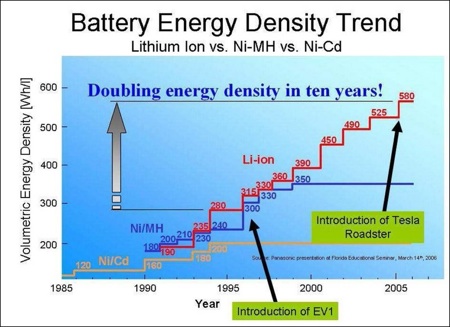
Battery evolution has been moving along at a fairly steady pace averaging around a 5-8% improvement in capacity per year. In addition, the longevity has been steadily increasing and charge times have been steadily decreasing and cost have been dropping fairly rapidly, much faster than predicted.
If you compare today's batteries used in cars compared to those a decade ago there is really no comparison. Today's batteries have much higher capacities, much longer life and at a much lower cost.
http://www.carbonbrief.org/blo...
Here's a chart from 2012. Tesla is selling their grid storage battery packs at around $250/KWh and with the gigafactory the prices will be further reduced. This is the price point where BEVs start to become price competitive with gasoline cars.
http://www.mckinsey.com/insigh...
Battery prices are already at or below where they were predicted to be in 2020 just a few years ago.
http://theenergycollective.com...
On average, battery energy doubles every ten years.
http://kk.org/thetechnium/2009...
http://electronicdesign.com/po... -
False Premise
Older technologies (almost) never actually go away.
For instance, there is a working telegraph within a block of my house. It is a fire alarm call box, and as far as I know it is still working.
-
False Premise
Older technologies (almost) never actually go away.
For instance, there is a working telegraph within a block of my house. It is a fire alarm call box, and as far as I know it is still working.
-
Simple Elegan Solution
How about this? http://kk.org/cooltools/archives/13786
-
Re:Well maybe there will be some time to fix thing
See here's the deal: Just because one person discovers something, it doesn't magically mean that everyone else can figure it out right away. It might be the person who discovered it is pretty clever, and has done a lot of work in that field.
History proves you wrong. Usually all it takes is the notion something is possible and vague explanation, or merely advances in other fields that make new discovery feasible. Look up parallel invention.
http://www.kk.org/thetechnium/archives/2009/08/progression_of.php -
How is this different than Torque Pro
Sounds like it does same thing.
-
Re:Easier way to fix it
-
Some Specific Places on the Internet
I agree with reading about it on the Internet. I like RSS, but I've found it homogenizes my content so that things don't jump out at me and the really interesting stories get buried with all the mediocre ones. So I keep the following list of bookmarks to check on a weekly basis:
ABC (Australia) Science, ABC (US) Science, Air & Space Magazine, ARKive, Ars Technica, BBC SciTech News, CBS Sci-Tech News, Chet Raymo, Cosmos News, Current: Science, Discover, Discovery News, Edge, Economist Science, EurekAlert!, Flyp media, Futurity, h+, Inkling Magazine, LiveScience, Massimo Pigliucci, Mother Jones Environment, MSNBC Science News, National Geographic News, National Public Radio (US), Natural History Magazine, New Scientist, New York Times Science, New Yorker Science, Newsweek Science, Orion, PhysOrg, Popular Mechanics, Popular Science, R&D Magazine, Ripley's Believe It or Not!, Science Daily, Scientific American, Seed Magazine, Science Cheerleader, Science News, Schrodinger's Kitten, Slashdot Science, Smithsonian, Space.com, The Technium, Time Magazine Science, USA Today Science, US News & World Report Science, Wired News, World Changing
-
Re:Power Miracle
Except guess what, battery density actually has improved steadily over time, and dramatically overall. It's not automatic, it's the result of many improvements just like this one.
-
Re:Corrections of factDear Anonymous Coward:
You are correct. There is an error in the story I submitted.
The original story said that:Joe Konrath has an interesting interview with independent writer John Locke who currently holds the coveted #1 spot in the Amazon Top 100 and has sold just over 350,000 downloads on Kindle of his 99 cent books since January 1st of this year which with a royalty rate of 35%, is an annual income well over $500k. Locke says that 99 cents is the magic number and adds that when he lowered the price of his book "The List" from $2.99 to 99 cents, he started selling 20 times as many copies - about 800 a day, turning his loss lead into his biggest earner. "These days the buying public looks at a $9.95 eBook and pauses. It's not an automatic sale," says Locke. "And the reason it's not is because the buyer knows when an eBook is priced ten times higher than it has to be. And so the buyer pauses. And it is in this pause - this golden, sweet-scented pause - that we independent authors gain the advantage, because we offer incredible value." Kevin Kelly predicts that within 5 years all digital books will cost 99 cents. "I don't think publishers are ready for how low book prices will go," writes Kelly. "It seems insane, dangerous, life threatening, but inevitable."
The story should have read:
Joe Konrath has an interesting interview with independent writer John Locke who currently holds the coveted #1 spot in the Amazon Top 100 and has sold just over 350,000 downloads on Kindle of his 99 cent books since January 1st of this year which with a royalty rate of 35%, is an annual income well over $500k. Konrath says that 99 cents is the magic number and adds that when he lowered the price of his book "The List" from $2.99 to 99 cents, he started selling 20 times as many copies - about 800 a day, turning his loss lead into his biggest earner. "These days the buying public looks at a $9.95 eBook and pauses. It's not an automatic sale," says Locke. "And the reason it's not is because the buyer knows when an eBook is priced ten times higher than it has to be. And so the buyer pauses. And it is in this pause - this golden, sweet-scented pause - that we independent authors gain the advantage, because we offer incredible value." Kevin Kelly predicts that within 5 years all digital books will cost 99 cents. "I don't think publishers are ready for how low book prices will go," writes Kelly. "It seems insane, dangerous, life threatening, but inevitable."
In spite of the error, this particular submission is very thought provoking as evidenced by the number of comments it received and is one of my personal favorites. Please accept my apology for my mistake in attributing the statement about "The List" to John Locke, the subject of the interview, when the statement was actually written by Joe Konrath, the man who conducted the interview. I assure you that the mistake was completely inadvertent on my part.
Best Regards,
Hugh Pickens -
Re:Corrections of factDear Anonymous Coward:
You are correct. There is an error in the story I submitted.
The original story said that:Joe Konrath has an interesting interview with independent writer John Locke who currently holds the coveted #1 spot in the Amazon Top 100 and has sold just over 350,000 downloads on Kindle of his 99 cent books since January 1st of this year which with a royalty rate of 35%, is an annual income well over $500k. Locke says that 99 cents is the magic number and adds that when he lowered the price of his book "The List" from $2.99 to 99 cents, he started selling 20 times as many copies - about 800 a day, turning his loss lead into his biggest earner. "These days the buying public looks at a $9.95 eBook and pauses. It's not an automatic sale," says Locke. "And the reason it's not is because the buyer knows when an eBook is priced ten times higher than it has to be. And so the buyer pauses. And it is in this pause - this golden, sweet-scented pause - that we independent authors gain the advantage, because we offer incredible value." Kevin Kelly predicts that within 5 years all digital books will cost 99 cents. "I don't think publishers are ready for how low book prices will go," writes Kelly. "It seems insane, dangerous, life threatening, but inevitable."
The story should have read:
Joe Konrath has an interesting interview with independent writer John Locke who currently holds the coveted #1 spot in the Amazon Top 100 and has sold just over 350,000 downloads on Kindle of his 99 cent books since January 1st of this year which with a royalty rate of 35%, is an annual income well over $500k. Konrath says that 99 cents is the magic number and adds that when he lowered the price of his book "The List" from $2.99 to 99 cents, he started selling 20 times as many copies - about 800 a day, turning his loss lead into his biggest earner. "These days the buying public looks at a $9.95 eBook and pauses. It's not an automatic sale," says Locke. "And the reason it's not is because the buyer knows when an eBook is priced ten times higher than it has to be. And so the buyer pauses. And it is in this pause - this golden, sweet-scented pause - that we independent authors gain the advantage, because we offer incredible value." Kevin Kelly predicts that within 5 years all digital books will cost 99 cents. "I don't think publishers are ready for how low book prices will go," writes Kelly. "It seems insane, dangerous, life threatening, but inevitable."
In spite of the error, this particular submission is very thought provoking as evidenced by the number of comments it received and is one of my personal favorites. Please accept my apology for my mistake in attributing the statement about "The List" to John Locke, the subject of the interview, when the statement was actually written by Joe Konrath, the man who conducted the interview. I assure you that the mistake was completely inadvertent on my part.
Best Regards,
Hugh Pickens -
Not a good article, source is a lot better
This blog post which was linked by the ridiculous times article is significantly better than the article itself. http://www.kk.org/quantifiedself/2009/10/the-false-god-of-coffee.php
-
Re:Where do the authors live?
Services? Revenus streams? These people have -nothing- to sell. If they did it would get stolen fast...
There are no goods, there are no services. Begging and theft are the only income streams.
The statistics say otherwise. From TFA:
"The traditional stereotype of the Indian pavement-dweller is a destitute peasant, newly arrived from the countryside, who survives by parasitic begging, but as research in Mumbai has revealed, almost all (97 percent) have at least one breadwinner, and 70 percent have been in the city at least six years..." Slum dwellers are often busy with low paying service jobs in nearby high rent districts; they have money but live in a squatter city because it's close to their work. Because they are industrious, they progress fast. One UN report found that households in the older slums of Bangkok have on average 1.6 televisions, 1.5 cell phones, a refrigerator; two-thirds have a washing machine and CD player, and half have a fixed line phone, video player and a motor scooter. In the favelas of Rio, the first generation of squatters had a literacy rate of only 5%, but their kids were 97% literate."
There are no goods, there are no services.
From TFA:
"The 4bn people at the base of the economic pyramid—all those with [annual] incomes below $3,000 in local purchasing power—live in relative poverty. Their incomes are less than $3.35 a day in Brazil, $2.11 in China, $1.89 in Ghana, and $1.56 in India. Yet they have substantial purchasing power... [and] constitute a $5 trillion global consumer market."
Is digging though human waste and burning plastic off electrical cables for a few cents of copper a 'dymanic and growing economy'? I don't think so.
60% of the residents of Mumbai live in slums. Are all of those 60% "digging though human waste and burning plastic off electrical cables for a few cents of copper"? No. Some of them are, but there are many who have real, wage earning jobs.
-
Re:Where do the authors live?
You can't extrapolate a data point from a single racially segregated and politically isolated country to the rest of the world. Did you read the second article from the summary? It makes the point that every major economic center in the world was once a slum, and expanded over time, pushing the slums away from the center, until they became the cities that we now know.
-
Re:Why wasn't Monsanto required to reveal this inf
Even the amish uses it
http://www.kk.org/thetechnium/archives/2009/02/amish_hackers_a.php
-
Re:Nobel-peas prize (green)
The problem is battery tech simply hasn't kept up with the pace of technology in other sectors.
To you and the grandparent I ask, where are your expectations coming from, and how aware are you of the progress that has been made?
Battery technology absolutely has improved, and quite steadily, for years. Don't you remember cellphones from the 80s with NiCad batteries?
Second, which "other sectors" have grown at a rate anything like Moore's Law over that time period? Moore's Law does not hold for technology in general, just transistors, and even there its days are numbered. (Aerospace and medicine (life expectancy) also shot up astronomically rather early on, then progress slowed).
-
Re:Obligatory!!
Speaking of Obligatory, one can't make the post above without giving credit to its grandfather.
-
Re:Pandora's blog has been opened
Your post advocates a
(X) moronic ( ) Totalitarian (X) consumer-driven (X) Charles Brosonish ( ) Governmental
approach to humor. Your "OMGPonies!" will not work. Here is why it won't work. (One or more of the following may apply to your particular post, and it may have other flaws which used to vary from state to state before a bad federal law was passed.)
(X) Your post was simply unfunny. (X) Mailing lists and other legitimate websites would not bother stealing it from you (X) Monkeys simply can't aim that well. ( ) It is defenseless against brute force attacks (X) Slashdot will attempt to use this as an unfunny meme (X) Users of email will not put up with it (X) Linus Torvalds did not even chuckle (X) The police will tour again (X) Requires the attention span of a gnat (X) Requires immediate total cooperation of God in Heaven (X) The meme is tired and worn out and I'm just as likely to get a -1 troll as a +5 funny.
Specifically, your plan fails to account for
(X) Asshats (X) Asshats (X) Asshats (X) Asshats (X) Asshats (X) Technically illiterate politicians (X) Extreme stupidity on the part of people in general (X) Outlook (X) Asshats
and the following philosophical objections may also apply:
(X) Ideas similar to yours are easy to come up with, yet none have ever been shown funny (X) We should be able to talk about Viagra without being censored ( ) Incompatibility with open source or open source licenses (X) unfunny jokes do nothing to solve the problem (X) Temporary/one-line jokes are cumbersome ( ) I don't want the government thinking your lame (X) Killing them that way is not slow and painful enough
Furthermore, this is what I think about you:
(X) Sorry dude, but that is simply unfunny. (X) Once you go OMGPonies! you can never go back. (X) This is a stupid idea, and you're a stupid person for suggesting it. (X) Nice try, assh0le! I'm going to find out where you live and burn your house down! (X) What you've just said is one of the most insanely idiotic things I have ever heard. At no point in your rambling, incoherent response were you even close to anything that could be considered a rational thought. Everyone on this site is now dumber for having read it. I award you no points, and may God have mercy on your soul.
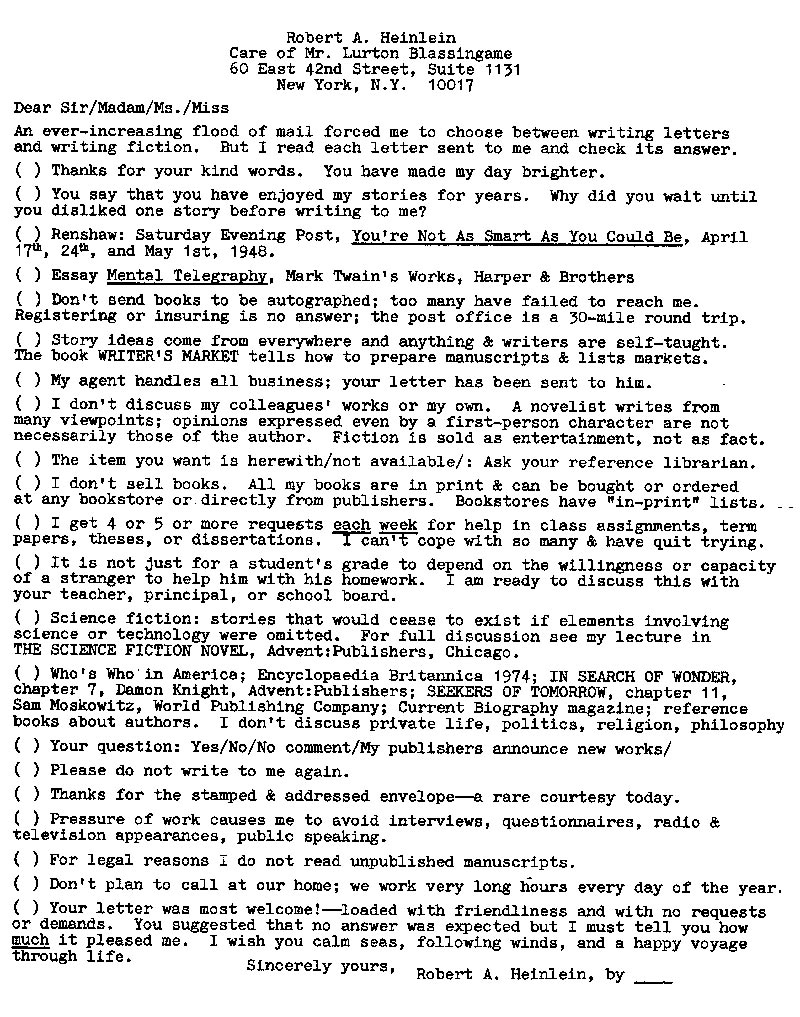
That's a response worthy of Robert A. Heinlein, as was mentioned here a while ago.
-
Re:Form response
Perhaps it drew some inspiration from this one.
-
Cool Tools
A good review of the Generac Guardian Automatic Standby Generator
-
I was on auto-standby for 53 hours with mine.
Take a look at this write up:
http://www.kk.org/cooltools/archives/003428.php
That's the updated version of mine. They sell them now for $3500 installed with the transfer switch.
12KW will pretty much run your house.
It turns on and runs automatically. Even if you're not home.
It turns off when power comes back.
I've had mine nearly 10 years, and its been great.
-
Generac Guardian ReviewI know nothing about generators, but the post reminded me that I'd seen a review that almost made me wish I needed one. It's from the regularly reliable Cool Tools site. Costs around $3000 for 10-12kW standby power. Sounds as simple as it gets and might be just what you're looking for.
Generac Guardian Automatic Standby Generator
Right now, the electrical power I'm using to submit this entry as I watch television in my warm home is being supplied by my Generac Guardian 12kw generator. It's been running continuously for more than 40 hours now since the latest ice storm left 250,000 people in Maine without power. I've had this unit for nearly ten years now, and it has reliably provided power whenever the grid fails, which can happen a few times a year in this pretty rural part of the country.
The exact model I have is a 04456-0 which is 10kw when used on Natural Gas or 12kw when used with LP (Liquified Petroleum) Gas. Ours sits on a small pad in the backyard hooked up to the same buried LP gas tank I use to heat the house, provide hot water, etc. Since the unit is air cooled, there's no radiator or water pump to worry about. No fan belts. And very little maintenance. Essentially, you have a 5-year battery to replace and an oil change every six months. It "exercises" once a week for 20 minutes and will indicate if there is a problem. The most that's ever gone wrong with it in all these years was a bad spark plug that I fixed in minutes. Mostly, you ignore it until the power goes out. I test mine in the fall or if I hear a big storm is coming; I do that by walking over to the master breaker switch from the power company and shutting it off. Like clockwork, 45 seconds later the house is lit back up as the generator is up and running.
-
Re:From Cool Tools - URL
Answered my own post - the link is here.
There was a typo in the original. -
Generac Guardian Automatic Standby Generator
A blog I frequently read had a recommendation of this automatic natural gas fired system. http://www.kk.org/cooltools/archives/003428.php As for regular generators Honda is one of the most reliable in the business. I see more and more fire stations using their power equipment. My Mom's house lost power for two weeks during the Maine ice storm of 98. It was a pricey choice but in those situations you can not skimp on something that needs to be nearly 100% reliable.
-
From Cool Tools
Kevin Kelly's Cool Tools recently had a write up at http://www.kk.org/cooltools/archive/003428.php regarding Generac Guardian Automatic Standby Generator. It is more detailed than I could be on the subject. The most import thing is making sure that the generator output (kW/hr) is greater than your probable consumption during a blackout. When determining which systems will run off the generator, consider other creature comforts, such as running the hot-water heater and some/all of the electrical outlets in the kitchen (for charging cell phones, making coffee, etc.); however, such additions will add to consumption calculation.
-
Re:Ask Slashdot AGAIN
That's the value of digital. Copies are perfect. Make lots.
This is similar to the answer that a lot of people interested in data preservation have come to over the years, including archivists and Kevin Kelly, one of the people behind the Long Now Foundation.
However, one thing that people might not think of from your advice is to keep things hot, to keep them moving. You can't tell when a bunch of burned DVDs start to go bad. Knowing whether your data is good requires constant integrity checks, to make sure that you can still get your data back.
Personally, the way I handle this is by running two hot servers in different locations with all of my critical data on both, with rsync updating nightly. With continuous checksumming turned on, that forces reads, so I know all the data is still safe.
But for those who aren't quite that geeky, then I think a service like Amazon's S3 is the way to go. You keep one local drive hot, and one set of data in the cloud. And you regularly verify that all the data you want is still there. Yes, this costs more money than another local disk. But S3 data sits in at least two spots in a secure data center on an infrastructure designed by people who really get reliability.
-
Fascist DOJ? They're freedom fighters for peace!
Evil has no border and they'll chase everyone down, because they don't need no stinkin' Constitution as long as a war is declared. War negates all social contracts and bonds to their oaths. War has nothing to do with duty, it is ordered dissociation from civil authority and seizure by minority. What may be known as justice in civil aspect could be looked upon as legalized barbary in military. This is typical in a change of regime for a country.
Go to Google and search for information on all the assassinations of civil-authorized Generals before and after September 11 2001. It is linked to the British Crown having groomed their New World representative Bush and company, to remove the former authorities to install theirs. All you can do is return to the Holy Bible and make pact to nearest kin for successors and accord to good neighbors for fellowship.
-
Very Long Term BackupAs seen at Kevin Kelly's Life Stream:
This problem of long-term digital storage seemed a crucial hurdle for any civilization trying to act generationaly. How could a society think in terms of centuries unless there was a reliable way to transmit and store its knowledge over centuries? This puzzle was the focus of a conference hosted by Long Now in 1998, dedicated to technical solutions for Managing Digital Continuity. At this meeting Brewster Kahle of the Internet Archive suggested a new technology developed by Los Alamos labs, and commercialized by the Norsam company, as a solution for long term digital storage. Norsam promised to micro-etch 350,000 pages of information onto a 3-inch nickel disk with an estimated lifespan of 2,000 -10,000 years.
See also the link to the Norsam Company Note that metal CD's and DVD's are also available.
The only concern is the cost of this 25 year archive
-
Re:who do advertisers think they are?
Read "Better Than Free", and realize that the advertising model is a serious bubble right now. If you run an ad-supported website, you need to be seeking alternate revenue streams _ASAP_.
http://www.kk.org/thetechnium/archives/2008/01/better_than_fre.php
(captcha: imminent)
-
But will Toyota's...
... come with guns?
-
Re:But what about...
Artifacts are coming:
http://www.kk.org/cooltools/archives/002750.php
Just a watch and not indestructible, but no battery changes. -
Internet finishes what media consolidation started
The consolidation of Big Media over the last few decades put newspapers on this path. Americans bitch and moan about how the media is either too liberal or too conservative, but that misses the point. Americans may have allowed our government to loosen ownership rules, but we're mistrustful of a handful of companies controlling access to all news and opinions. When the mass-market Internet arrived, people realized they could find news and opinions that weren't being provided by the news oligarchs.
People want to hear independent voices, even though those voices are often screwed-up, looney, and unprofessional. We've all grown used to sifting the wheat from the chaff online.mThe really good newspapers that are providing high-quality reporting and are well-managed will still survive. The rest of them won't, but new forms of news will continue to germinate on the Internet.
-
Re:Some things are better than freeWhile the license allows you to obtain from another source, the $5 download option offers to the listener Immediacy, Authenticity, Findability and Patronage: four things which are Better than Free.
Personally, I consider Patronage to be the most valuable in this instance, as I greatly respect what Reznor and friends have done with this album/project and would like to show that I support the work. I downloaded the free Ghosts I collection last night, and after enjoying it I paid the $5 for the full download. I want to see more artists release work like this, so it's worth my money to prove that it is a viable model for those who dare to test these new waters. I agree but as an experiment, both combined together makes any results much harder to analyze. If they only did one or the other, it would make more sense. The combination of the two is somewhat odd. -
Some things are better than free
While the license allows you to obtain from another source, the $5 download option offers to the listener Immediacy, Authenticity, Findability and Patronage: four things which are Better than Free.
Personally, I consider Patronage to be the most valuable in this instance, as I greatly respect what Reznor and friends have done with this album/project and would like to show that I support the work. I downloaded the free Ghosts I collection last night, and after enjoying it I paid the $5 for the full download. I want to see more artists release work like this, so it's worth my money to prove that it is a viable model for those who dare to test these new waters. -
Re:Why shouldnt we do this?Im serious. If we find a way to enforce copy right again, why shouldnt we?
Umm, because it's totally unrealistic? You're living in a fairy tale world, Duncan. Please read Kevin Kelly's essay, Better Than Free and pay particular attention to the first few paragraphs, where Kelly lays out basically that the Genie is out of the bottle, and it can't be put back in.
After that please take some time to consider what he calls "8 Generatives" which provide value in an economy where bits are free.
-
How to get paid for things that are free
Truth Happens recently posted a link to an article that proposed ways that artists could be paid for their work in a world in which everything's free. In brief, they are
1. Immediacy -- You want something now, and you're willing to pay the artist to speed production of a work.
2. Personalization -- You want something tailored to your needs specifically, like an art request, or a piece of Free / Open-Source Software that does what you need it to do.
3. Interpretation -- Or consultation. Like what Red Hat does, in providing paid support for free software.
4. Authenticity -- Like an artist's seal of approval, it lets you know that your recording is of the actual artist's work (and is certified virus-free).
5. Accessibility -- You could pay clearinghouses of data to keep track of all your songs and such for you. At its lowest level it's paid storage, but it could be more than that.
6. Embodiment -- Anyone can download the
7. Patronage -- You know you could download that
8. Findability -- Not everyone knows how to use P2P networks, or even wants to learn how.
Some of us get everything from the P2P networks. But others, who may not object to borrowing CDs or books from their friends, may still find getting copies of people's work anonymously to be somewhat disquieting. Moreover, they may not know how. These are often the people who buy songs from iTunes and Amazon, because $1 seems like a reasonable price to them for the service they receive.
If you think about it, part of the reason that iTunes is so successful in this age of free downloads is because it combines just about everything on the list. You get authentic recordings immediately, which are automatically sorted on your PC or Mac complete with cover art. You can find songs easily on their store, and you get personalized recommendations as to what other songs you might like. Yes, I know iTunes has DRM, but I also know a lot of people don't even think about it. It's true that we need to educate them about it, but I'm just saying it doesn't factor into their decisions.
I found the article extremely relevant, because I hope to make a living as a content creator selling e-books and physical copies thereof. Maybe what we need is more widespread awareness of how to make money? At any rate, the world I see this evolving into is one in which large, "gateway" institutions like TV stations and book publishers are fewer and farther between, but one in which large numbers of individual content creators can make a living off of their work, and have thriving microcommunities built up around each of them. -
The basis of these ideas
has been around for a while. See for example discussion in the book Out Of Control, http://www.kk.org/outofcontrol/contents.php . Kinda brings to mind the matrix movies.
-
Re:Correlation, not causation?
There has long been research suggesting that total heartbeats in a lifetime is constant for a large number of animals (and plants!).
-
Re:It's official. The terrorists have won.
-
Re:Fermi's Paradox = Fermi's Blunder
Fermi's blunder, indeed.
Yep, even on the basis of a 'science-based' analysis (perfectly in tune with the current overemphasis on technology - this link given only as an example) that I totally agree with.
Thinking a little ahead (along the lines of Rucker, perhaps), one might ask how relevant 'sub-gaian' species might be for more developed entities.
CC. -
Re:In other news...
They already have the Ford Pickup truck of Doom, and the GMC Truck of Doom, so a tricycle of doom won't be out place.
Do wings come extra? -
Re:In other news...
They already have the Ford Pickup truck of Doom, and the GMC Truck of Doom, so a tricycle of doom won't be out place.
Do wings come extra? -
Digital natives and librariesHere's some digital natives information and to quote Wikipedia:
The term digital native is being applied to individuals who have grown up immersed in technology.
There is also an interesting page re: libraries in science fiction:That introduces the concept of the ultimate library, the computer. So far, at least, librarians know the computer largely as a replacement for the card catalog, but the computer as a library in itself sits in the future like the Sphinx demanding the answer to its riddle. And if you don't give the right response it will bite your head off--or at least sit there blocking the way to all the information it contains.
Also, Kevin Kelly of Wired magazine fame has previously written on civilizations as creatures where the libraries are the self-replicating centrality or nucleus. From video game interfaces, perhaps information scientists and librarians will get some clues and help make fast-paced content retrieval, just as quickly as we can run our virtual spaceships over virtual terrains. I have made some scripts and extensions in the past to illustrate, and I am terribly sorry for the following WMV formatted video. The joltiness in the following video is in fact Firefox and not CamStudio: video clicky. -
Re:Cool possibilities for architects
-
Re:They still have no clueCINTIQ!
It is a heck of a lot cheaper and is used by graphic artists already... No reason it couldn't be used for CAD/CAM either.
Z. -
Re:Credit where due departmentFor Graphic artists there is already something out there...
Sure it's not cheap (but it's cheaper than this MS coffee table) but the Cintiq is highly recommended for graphic artists.
Z.