Slashdot Mirror
Domain: linux.com
Stories and comments across the archive that link to linux.com.
Comments · 933
-
There is also dummynet for the BSD based systems
http://www.linux.com/feature/46616
BSD systems of course include OS X http://www.afp548.com/article.php?story=20060214081244545
-
Re:Microsoft Begs Win 7 Testers To Clean Install
Windows is as secure
http://news.cnet.com/8301-13860_3-10156617-56.html/ Windows UAC flaw
http://www.istartedsomething.com/20090204/second-windows-7-uac-flaw-malware-self-elevate/ Windows UAC flaw
http://www.linux.com/feature/131059/ Only Ubuntu survived Pwn to Own contest.has more products
http://stommel.tamu.edu/~baum/linuxlist/linuxlist/linuxlist.html/ Linux software encyclopedia
There are literally millions of unix scripts, programs, and utilities for Linux.
I will concede that there are several 3rd party tools that are windows-only, and limit the adaptability
of some business's switching, but you'll never win the "more products" argument in windows favor.Easier to install
This will vary with the flavor of linux. Some are definitely more challenging to get functional. If
you compare the installation / setup time for 50 computers, with ease of installation being a priority in your
choice of distributions, then you can have them up & running quicker, and more consistently with Linux than
with windows. -
Desktop Search?
Since you only have one person that needs to access the files I would just use Desktop Search. Personally I like Google Desktop ( http://desktop.google.com/ ) & Copernic Desktop Search ( http://www.copernic.com/en/products/desktop-search/index.html ). Here is an article reviewing some of them - http://lifehacker.com/400365/five-best-desktop-search-applications.
The main thing that you need to do is OCR the documents when you scan them in (You can convert non-OCR PDFs into OCR PDFs but I don't know anything that can search them before you put text in them). On Linux the two mains ones that I know of are Tracker and Beagle (http://www.linux.com/feature/143259).
I know these are not all open source or have ewb interfaces but they are really easy to use. You just put the files in folders and point the desktop search at them. Great for someone that doesn't know a lot about computers. -
A little tale of an epic Linux fail
Some couple of years ago, Brazil's government cut taxes for "popular" computers - low-end machines that came with Linux out-of-the-box. The idea was to create a competitive atmosphere and offer a cheap alternative to Windows XP.
This was an epic fail. The UI was so badly done - obviously by a Linux nerd who spent too much time in his life with fluxbox, that Linux looked, 2 years ago, something out of the stone age.
Massive uninstalls was what happened. A great time for computer technicians to install XP.
You talk to people who used those out-of-the-box Linux and they shudder just to hear about it. They describe it as something terribly outdated. The other day I was talking to a sales guys at the audio/video section at FNAC (a French chain also present in Brazil). I told him he should install Linux on one the PlayStation 3 units and show people how flexible the PS3 is - you get a BluRay DVD player, a video game that's the best on the market AND a nice operating system for the home. Do you know what he said? "Oh, but isn't Linux kinda old - it looks very old." Of course, I was thinking about gorgeous Englightement TerraSoft used on PS3's, but he was thinking about the pathetic thingies he saw.
Now, you might not care about killing a niche for Linux on a big market, but many people do. But when linux developers act like autistic nerds (when they're not autistic), then it's suicidal.
-
Re:I'd go further than that
They say that one of the benefits, if not an outright goal, of some Linux distributions is to be a great platform to develop software on.
At one time Linux looked downright competitive as a platform (if certainly not market,) so what happended since 2002?
I do think one thing that would help is for OSS games to have much better tools. Make it easy for people to add assets, build levels and so on. Maybe more people would be willing to do so.
Well, games are not just software. The software is simply there to make the game go.
Perhaps the reason that there are so few (or in some opinions no) good games on Linux is that for developing games, Linux sucks?
Perhaps it is time to admit that OpenGL is a not the only kid on the block and start providing another popular API that other developers want to use?
Perhaps it is time to stop throwing away all that boatload of artwork with each release and start saving anything under a usable license to an appropriate gathering spot?
Perhaps it is time to put down that cumulative-xml2pd-custom-package-colored-pretty-printer patch and answer some basic questions in such a way that new people don't hate us?
What happened to those Open Source game engines that were going to let you MOD your way for WoW 2.0? Perhaps they are still there, waiting for content.
Perhaps what Linux Gaming needs is a little less CompSci and a little more Bachelors of Arts?
-
Re:I'd go further than that
They say that one of the benefits, if not an outright goal, of some Linux distributions is to be a great platform to develop software on.
At one time Linux looked downright competitive as a platform (if certainly not market,) so what happended since 2002?
I do think one thing that would help is for OSS games to have much better tools. Make it easy for people to add assets, build levels and so on. Maybe more people would be willing to do so.
Well, games are not just software. The software is simply there to make the game go.
Perhaps the reason that there are so few (or in some opinions no) good games on Linux is that for developing games, Linux sucks?
Perhaps it is time to admit that OpenGL is a not the only kid on the block and start providing another popular API that other developers want to use?
Perhaps it is time to stop throwing away all that boatload of artwork with each release and start saving anything under a usable license to an appropriate gathering spot?
Perhaps it is time to put down that cumulative-xml2pd-custom-package-colored-pretty-printer patch and answer some basic questions in such a way that new people don't hate us?
What happened to those Open Source game engines that were going to let you MOD your way for WoW 2.0? Perhaps they are still there, waiting for content.
Perhaps what Linux Gaming needs is a little less CompSci and a little more Bachelors of Arts?
-
Re:been said already...
If it's a Dell, something on the order of $50. YMMV.
-
Don't use Gnome, use KDE/Kiosktool
For starters, use KDE (kubuntu). If the users are migrating from a windows world the transition will be much easier. Quite frankly gnome is garbage anyway.
In the KDE world there is kiosktool, see http://www.linux.com/feature/114306.
-
Re:Why doesn't someone write
Why doesn't someone write a story about being a long time Linux/Unix user and going back to Windows for 2 weeks?
They have. In fact there have been several such articles in recent years.
-
Re:What do you think should be on Linux.com?
gnu-linux.com instead of gnu_linux.com (i dislike underscores in general).
gnu.linux.com should be what it is. www.linux.com and http://linux.com/ should just redirect to gnu.linux.com -
linux.com needs some direction
Linux.com was one of the very first sites I used to frequent on a daily basis. But I quickly lost interest as I found the site ugly and Slashdot together with other sites did a better job.
I hope the new owners can put some serious work into the site.
By the way, Slashdot too needs some love. Details like number of comments submitted to date are missing or are deliberately hidden from non subscribers like me! Heck, we need to know all sorts of statistics. I appreciate the need for cash but I thought that's why we began to see ads especially among comments at Slashdot.org.
-
Re:What do you do with carp?
We still have an issue if we lose the equipment in front of our servers, but I don't control that so I can't do much about it and it has never died (touch wood!). My explanation will never be as good as this so have a read of that. Carp still uses a type of "heartbeat" mechanism, though it is actually less than windows broadcast traffic (at least on our network). Pound supports its own redundancy for servers, including load sharing if you want it and fail over.
-
Re:Well, if Bruce Perens, legal expert said that..
Second link on "gpl court germany". Harald Welte, of course, kicking D-Link's arse.
-
Owned
Sorry to say this, but Microsoft will own you. They may well destroy your career and attack members of your family:
I was sitting on the XML Working Group and co-editing the spec, on a pro bono basis as an indie consultant. Netscape hired me to represent their interests, and when I announced this, controversy ensued. Which is a nice way of saying that Microsoft went berserk; tried unsuccessfully to get me fired as co-editor, and then launched a vicious, deeply personal extended attack in which they tried to destroy my career and took lethal action against a small struggling company because my wife worked there.
Only take Microsoft on if you don't care about your family, they will get personal, and everything they do is legal, as the state generally agrees with them. See the Mass. ODF affair for example, they've also been allowed to attack charities and bribe officials. Frankly, it seems their strong-arm tactics mean most legislators are scared of Microsoft.
Good luck. You'll need it.
-
Re:Rock and a Hard Place
The compatibility issues are due to them having non-standards compliant code in the first place. Who is Microsoft to tell the world to use something different then what the W3C defines, and further, who are web developers to listen to them? (Other then the largest software company in the world, of course). I'm thinking the list is designed to be a shock list, to make (uninformed) people think that standards compliance is a bad thing, and the evil W3C needs to be stopped (similar to Microsoft-backed SCO claiming GPL was unconstitutional? http://www.linux.com/feature/32357). Most likely, it's a bluff. I can't imagine Microsoft releasing a browser that doesn't fully work with their own website, nevertheless Google and the others. That would piss off more people then just releasing a non-standard browser would. In the end, they will probably keep their non-standard technology like Active X and the like. It's going to be up to the website developers to tell Microsoft to RTFM (the one published by the W3C) - by not using their archaic functions and making websites that follow standards, and not just Microsoft imposed rules.
-
making a profit on GNU/Linux ..
"While others debate whether GNU/Linux is ready for the desktop, Userful is quietly proving that it is -- and making a profit while doing so"
"By combining a mixture of proprietary administrative tools with a modified Red Hat distribution and a GNOME desktop, Userful has updated the concept of timesharing by adapting it to a personal computer. The result is DiscoverStation, a hardware and software solution that connects as many as 10 terminals to a single computer" -
Re:Can we not just get fully open specifications?
As I recall, ATI opened the source and specifications for their drivers on September 10, 2007. How do you figure that ATI is still a closed standard?
-
Re:Loki
You had to go and bring them up. Might as well get the full story. Posting to Slashdot for the umpteenth time:
-
A hack off?
Organize to have you and these vendors each bring along a system and a hacker. Their hacker tries to compromise your Free Software system, your hacker tries to compromise their windows system. That should settle it rather efficiently. Just to put a little doubt into anything the "I"SVs may say make sure your client reads this first http://www.linux.com/feature/131059
-
Already Done?
As is often the case, the key advantage that would flow from the creation of such a "national OS" is the control that it would give the Russian government - something it doesn't have with Windows, say, or even generalised free software produced elsewhere:
Not only is ALT Linux already around, but ASPLinux has been certified by the government. Are we re-inventing the wheel here?
-
Already Done?
As is often the case, the key advantage that would flow from the creation of such a "national OS" is the control that it would give the Russian government - something it doesn't have with Windows, say, or even generalised free software produced elsewhere:
Not only is ALT Linux already around, but ASPLinux has been certified by the government. Are we re-inventing the wheel here?
-
Re:Woah
I am still not sure what it is an example of, seeing how it's not 1.0. As for being a troll, I don't mind: what's karma good for if I don't burn it?
The One True Versioning Practice, of course. You release a new major version when it's done. The FOSS community does not have external deadlines to ship, so we can take our time, and make sure a major release is a quality one. Read this as well, it's pretty interesting. If you never heard about KDE, and they tell you the two latest versions are 3.5.9 and 4.1.0, which one would you think was worth installing?
Of course, the primary source of confusion may have been that the KDE devs were saying Framework, while the users heard Desktop Environment...
-
Re:Now unveiling...
Apparently it's not that easy: http://www.linux.com/articles/42031
Stupid Linux.. not letting me run viruses. -
Re:Instead of asking Slashdot
I agree completely with this approach. The feedback from your users could provide you the insight on technical aspects not thought of before.
If you do decide to take the plunge, googling transition to open office yields a few articles:
Author Solveig Haugland offers a "virtual guide" to switching
http://www.fanaticattack.com/2008/switching-office-suites-from-microsoft-office-to-openofficeorg.html
Difference between Impress and Powerpoint
http://www.linux.com/articles/40736
Five principles of a successful OO transition
http://www.k12opentech.org/solveig-haugland/2008/02/24/five-principles-successful-openofficeorg-transition
There is probably a slew of articles on this topic out there, just do the research. -
PSPP/SPSS and Wine.
All good examples. FYI you may be interested in trying PSPP, a SPSS like statistics package, although the current version (0.6.1) seems very limited. I use the R/CRAN statisical package myself, although retraining is unlikely to be worth it. Running through wine is problematic. VirtualBox or buying the Linux version should work I also find the lack of a decent PDF editor annoying... again there are many PDF ediors for Linux, though none that I really recommend, see e.g. http://www.linux.com/feature/113907. At least the foxit pdf editor apparently runs under wine.
-
Den of paranoia?
Some people think so. Paranoia is what leads to things like these (make sure you read the comments there), and makes that blog a rather annoying cesspool which occasionally plops out a useful bit of information.
Stay away from extremists, and get your news from people other than Slashdot's resident joke.
And kudos to ScuttleMonkey, who had to remove all the creative spelling and grammar errors from the submission.
-
Re:Why is it soaring?
And its use only ended after BitMover pulled the free version because someone was reverse engineering it.
-
Re:Keygens
http://www.linux.com/articles/42031
Infect? no. It would have to be a custom targeted virus. You're fine as long as you don't have that exact setup, and run random
-
Thanks, but no thanks
Given the amount of links you posted from that website, you should probably mention that you are quite the star over there, complete with things like these:
Appended below is the IRC log from just minutes ago. As regular readers are probably aware, our reader "twitter" has abusive stalkers ('witch hunters') in this Web site. They followed his footsteps all the way from Slashdot just to discredit him personally wherever he goes, whatever he does. Speaking from experience, "twitter" is intimately aware of Microsoft's dirty secrets and he talks about it in public.
Aw, shucks. This is also where you confessed to your massive sockpuppetry of Slashdot:
They also identify my accounts on the first few posts. They got my GNUChop today and replied to it by cut and pasting a brlug comment.
I understand your activities here are quite the topic of conversation over there.
Worthy of mention also is the fact that you have done nothing but paste links to the Schiestowitz blog for the past year or so. Anyone looking at your comments and journals can attest to that. That blog is of course what some people call a den of paranoia, and other choice things. As for the operator, this is one of the better summaries I've read.
All of this of course pales in comparison to your nymshifting, sockpuppetry, trolling and massively obnoxious behavior that has made you the joke of the day around here. All of that is documented here.
So please, don't pretend that you're some FOSS hero on a mission bringing enlightenment down from the Schestowitz heaven for us poor Slashdotters to gape at in awe. You are a troll, an extremist, just like your friends, and I wish that none of you were involved with free software in any way. You are the worst of the worst. If I need references on OLPC or anything else, I'm sure there are more dependable sources for them than your best friend's "I hate everything" blog. Seriously, this is a man that insults and questions Linus Torvalds' way of life and the amount of children he has because he didn't march to step on a software license. What the fuck. You all should be put in a mental institution. You are worse than the worst shit you've ever tried to make up about Microsoft, as if they didn't do enough actual bad things.
Go away.
-
Re:At the risk of sounding like a freebsd fanboi
Nobody in BSD land gives a shit who does what with code. That is one of the nicest features found in BSD systems--the ecosystem is pretty much free of open-source politics.
Nobody give a shit if you wrote your patch on a windows system and mailed it to the ports maintainers using outlook. Nobody cares if Apple, Tivo, or Cisco "locks up the code".
Oh yes, what a charming little statement. Absolutely nobody from BSD land cares if companies like Cisco run away with BSD's code and never give anything back in return. Not a single grudge at all. Well, except from people like Theo de Raadt. From a Theo de Raadt interview from 2006:
NF: Lots of hardware vendors use OpenSSH. Have you got anything back from them?
TdR: If I add up everything we have ever gotten in exchange for our efforts with OpenSSH, it might amount to $1,000. This all came from individuals. For our work on OpenSSH, companies using OpenSSH have never given us a cent. What about companies that incorporate OpenSSH directly into their products, saving themselves millions of dollars? Companies such as Cisco, Sun, SGI, HP, IBM, Siemens, a raft of medium-sized firewall companies -- we have not received a cent. Or from Linux vendors? Not a cent.
Of course we did not set out to create OpenSSH for the money -- we purposely made it completely free so that the "telnet infrastructure" of the 1980s would die. But it sure is sad that none of these companies return even a fraction of value in kind.
If you want to judge any entity particularly harshly, judge Sun. Yearly they hold interoperability events, for NFS and other protocols, and they include SSH implementation tests as well. Twice we asked them to cover the travel and accommodation costs for a developer to come to their event, and they refused. Considering that their SunSSH is directly based on our code, that is just flat out insulting. Shame on you Sun, shame, shame, shame.
That does sound like somebody in the BSD camp does give a shit. In fact, it sounds like the BSD camp does get right out pissed off from the lack of contributions. So, care to retract your statement?
-
Re:eat my shorts, slashdot !!
i know replying to yourself is bad form, but i forgot to link to this video of Bruce Perens talking about how he got started with Linux & FOSS (he once worked at Pixar) and why he continues to be involved. i think the video provides some great insight into the kind of person Bruce is and the mentality a lot of FOSS authors/contributors share.
-
Again?
January 04, 2001 (8:00:00 AM) - 7 years, 11 months ago
Bruce Perens: "Well, it's been about a year and a half, and unfortunately Technocrat.net has not flourished. I take the blame, I've not had enough time to run the site, and plans to fund a professional staff for the site fell through. Readership has gone low enough that there's no longer much reason to keep the site alive. Thus, I will no longer be accepting new articles or comments, and will take the site down in a week or so."
-
Re:Install Ubuntu
Another vote for Ubuntu. I wrote about my experiences of moving my mother over to Linux at the beginning of the year. It's gone swimmingly and I'm writing the follow-up now. What possible advantage could there be in setting up a non-expert, non-gamer with Windows? For one thing, Windows XP seems to go wrong in places when you attempt to set a large font.
-
Re:LaTeX
Another vote for Lyx. The learning curve is steeper than Open Office but if you can get along with its approach, it's worth investing the time, IMO. Version 1.6 has just been released.
I like to use it alongside some other open source software such as Freemind for mind maps and Jabref for managing references. For graphics, it works well with the usual subjects such as Inkscape for vector drawing and GIMP for bitmaps. Personally, I prefer the graph and spreadsheet facilities of Gnumeric over OO Calc.
I suspect that LyX is a love it or loath it app, but I love it, baby!
The biggest let down with LyX was that customising the LaTeX proved to be surprisingly difficult. You have to get your hands a bit dirty in order to change things like the style of section title headers. I had never tangled with LaTeX before, and I found the syntax to be less than intuitive. In fact, I'd go as far as saying that this aspect of using a LaTeX front end brought back memories of Linux circa 1998. In other words, you could waste a day searching through loads of conflicting docs in order to do something that would take a few minutes in something else.
I used the Koma book class and I think that I'm going to switch to the Memoir class (google for it) for the next book. The main reason for this is that often when I was trying to customise Koma, I stumbled onto tips for how to do things in Memoir.
Finally, I can't claim that I pushed the envelope or that mine is a shining example of a good book, but if you go to the book page on my site, you can download the pdf version and the LyX file that is needed to build it.
-
Re:That's my laptop!
NTFS support on Ubuntu is really pretty good. The performance is not quite as good as native, but I think saying that "neither works particularly well in their non-native environments" is going to far, as functionality and stability is very good. You can even run Ubuntu easily on NTFS with wubi. Check out this review: http://www.linux.com/feature/130713
-
Re:Keep Linux out of defense
Given the fact that Linux is built mostly by anonymous contributors, kept on servers which are hacked every now and then (Fedora Signing Key Server Hacked in August - Red Hat Infrastructure Servers recently Hacked, Cracked & Compromised) what guarantee is there that Linux - God's gift to nerds - doesn't contain sleeping trojans written by Russians or Chinese ?
The same way the Russians make sure that Linux doesn't contain sleeping trojans written by Chinese or Americans - by performing a full security audit of the source code of specific kernel & userland versions, and standardizing on those versions for military purposes. Russian result is called MSVS, and is used by the military today.
-
Getting a Windows refund, post-Vista?
So buy it with Windows and get your refund.
Consider the refund as a payment by Microsoft for you installing Linux.
Nice. But many times the OEM will try to badger you into signing an NDA, which is one reason you don't see any magazine columns dedicated to getting Windows Refunds. Another thing is that MS has adapted.
Earlier Windows Refunds were possible, because the end-user got a screen with the choice to reject or accept the bend-you-over-the-desk EULA. From there it was a simple, though tedious, matter of documenting the rejection and following all the steps. Now, the OEMs often start up the computer and 'accept' all the licensing conditions in advance, eliminating specifically that path.
So, what now is the correct procedure for getting a Windows refund where the OEM has pre-installed and pre-accepted MS Vista?
-
Re:It's right for you. Will you be allowed to buy
-
If it's true I bet I can guess who it is...
-
Re:Short lifespan? I don't think so.
Is there some reason the version under Linux would be so comparatively fragile?
My understanding is that Silicon Graphics (now SGI) wrote XFS specifically for their hardware which was designed to handle power failures, and would maintain enough power to finish it's current I/O operations. Since almost none (if any) x86 hardware has this built-in feature, XFS isn't as robust as it was on native SGI hardware. I can't find the references for this tibit, though. So take it with a grain of salt. It's just what I remember being told when XFS was first appearing on the Linux scene.
Although, some of the issues that people see on XFS may be due to modified files that haven't been flushed to disk before the system loses power. XFS intentially zeros any unwritten data blocks to avoid possible security issues arising from residual data [1]. I believe XFS also uses out-of-order writes for both meta-data and data so a loss of power could mangle some data.
There are a couple of slightly older, but still well-written, roundups about file system comparions. One here and one here.
-
Re:The Gates Are Now Open
What, you think getting a refund for a Windows license is new?
-
Re:XFS
interesting. i'd never heard of these flash media filesystems before. i wonder how they compare to conventional filesystems, or why they weren't used in the Linux.com SSD benchmarks.
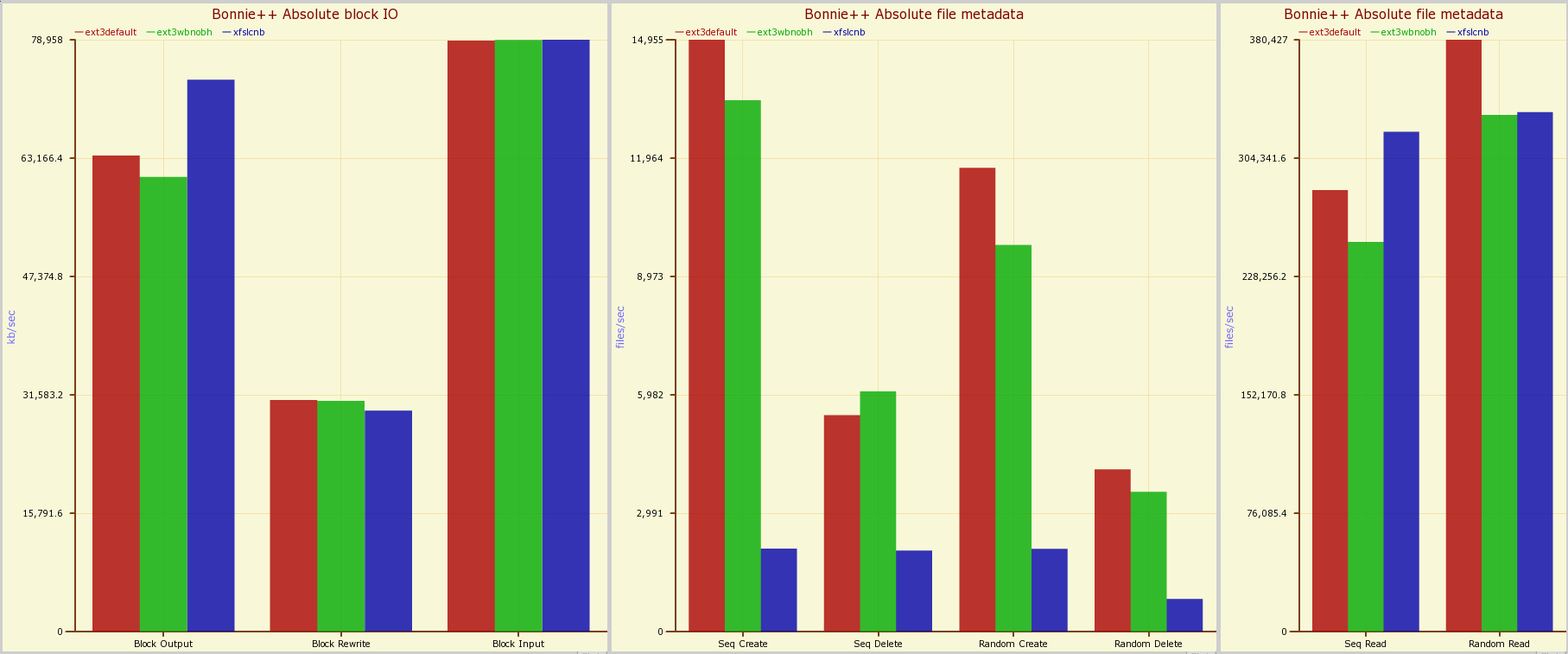
from these graphs it seems like ext3 performs quite well on SSD. but i can't find any benchmarks comparing any of the filesystems you listed. i did, however, come across this PDF released by Samsung, which shows some pretty interesting benchmark results for ext2, ext3, ext4, reiserfs, xfs, btrfs and nilfs. and in these tests nilfs comes out on top in almost all of the tests.
-
Re:XFS
interesting. i'd never heard of these flash media filesystems before. i wonder how they compare to conventional filesystems, or why they weren't used in the Linux.com SSD benchmarks.
from these graphs it seems like ext3 performs quite well on SSD. but i can't find any benchmarks comparing any of the filesystems you listed. i did, however, come across this PDF released by Samsung, which shows some pretty interesting benchmark results for ext2, ext3, ext4, reiserfs, xfs, btrfs and nilfs. and in these tests nilfs comes out on top in almost all of the tests.
-
Re:Short lifespan? I don't think so.
Well I found this http://www.linux.com/feature/119025
If the information is accurate then I would say pretty good. -
Why proprietary software is dangerous for business
If I were starting a business tomorrow, I can't think of a single piece of commercial software I'd standardise on.
Partly because I'm stingy when it comes to software. Partly because I don't want license management to become a headache as the business grows.
/.'s very own Roblimo gives another very good reason in this article: Why proprietary software is dangerous for business-critical applications
-
Re:That's the issue Byfield Misses.
Your hatred of Bruce Byfield is well-documented, so no need to go there. Your attacks on other Slashdot users are more worrisome, as is your massive gaming and disruption of this community.
-
Re:throughput IS NOT most important parameter
the Micron video shows a 2-drive setup performance of 200,000 I/Os per second. (2KB) random read = ~400MB/sec.
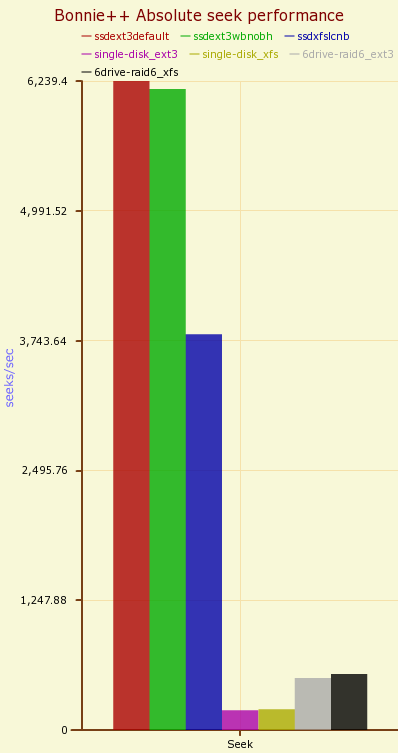
a benchmark performed by Linux.com also shows that SSD absolutely creams SATA, even 6 SATA drives in RAID 6, in terms of random seek. in other tests a single Mtron 16GB SSD gave 111 MB/s sustained read with
-
Re:throughput IS NOT most important parameter
the Micron video shows a 2-drive setup performance of 200,000 I/Os per second. (2KB) random read = ~400MB/sec.
a benchmark performed by Linux.com also shows that SSD absolutely creams SATA, even 6 SATA drives in RAID 6, in terms of random seek. in other tests a single Mtron 16GB SSD gave 111 MB/s sustained read with
-
BoycottNovell - the sad truth
Look, zealous protesters on private property and zealous policemen aside, Roy Schestowitz is just a kid with massive amounts of time on his hands and a grudge the size of Ireland. He's an unemployed college dropout who lives with his parents (I'm not kidding here) and his credibility level is less than zero. Occasionally he'll write up something interesting, but with his seemingly 24/7/365 posting activity (just head on to COLA to get an idea) most of what he writes is just self-referential gobbledygook of no value whatsoever. Six or seven thousand-word-plus posts per day? No way.
Anyone who thinks Microsoft made Hans Reiser kill his wife, claims he turned down a "six figure" job because they asked him for a Word document or posts things like these shouldn't be taken seriously. Even a broken clock is right twice a day, and that's what he banks on. The rest is really just his inexperience, insane hatred and child-like demeanor showing through.
That blog is nothing more than an endless stream of misrepresentations, thinly veiled lies, witch hunts and weird "THIS IS WHAT YOU SHOULD BE SCARED OF" prose, accentuated by what I suppose he thinks are "funny" photoshopped images of people and things he thinks are out to get him. A few days ago he wrote up a storm about all the journalists he estimated had been "bribed" by Microsoft because they got evaluation laptops with Windows 7, and a few of those people actually humoured him by stopping by and explaining why they wouldn't throw away decades of journalistic experience and reputation for a $2,000 laptop, but he just ignored them. Hey, he's right and he knows it.
Linux.com featured an article by Bruce Byfield on this. Roy has a retinue of about half a dozen hanger-ons why post up a storm whenever and wherever anyone criticizes his abrasive "advocacy", which can be seen clearly there... don't miss the fact that our very own favorite troll is also chummy with him (I mean if you needed an excuse). It seems he does these days is post links to Schestowitz's blog with his fourteen accounts anyway.
I'm sure it's important to keep an eye out for Microsoft and all, but by god, this guy is just bad news for the FOSS community. He brings out the worst of the "OMG I HATE MICROSOFT, I AM ANGRY AND I'M GOING TO DO SOMETHING ABOUT IT!!!" crowd. On purpose, I'm sure. Because the more abrasive he becomes, the more people dislike him and the more he can claim he's being "stalked" and "targeted" by the Evil Empire (TM). That kid is trapped in a vicious circle he built for himself. He needs to take a deep breath, go outside and play or something. He's so desperate and impatient to make a name for himself but he goes about it with such incompetence (volume != quality) that sometimes I think he must be sponsored by someone or something like that. Hell, he's already claiming Microsoft and Novell are directly responsible for all this.
Anyway, teh internet is serious business and all that...
-
OCR plugins?
There are many open source OCR tools available. Write a script to capture a JPG or PNG image every day from your camera and run it through one of the command-line OCR tools..
As long as your web cam doesn't get moved, you can set static cropping on the image so only the numbers are in the jpg file without a huge complicated border than might confuse the OCR engine.