Slashdot Mirror
Domain: mit.edu
Stories and comments across the archive that link to mit.edu.
Comments · 7,673
-
Re:More technical discussion
Wow, your numbers are even more insane than the Iraq body count data.
Studies vary between 655,000 and 1.4 million so I went for the average.
Of course it is about oil, why shouldn't it be?
It's this kind of aggression that shows how uncivilized governments are. Why do we need oil from the Middle East so badly? Are we dying without it? Canada has plenty of oil and they want to build a pipeline directly to the US. What's wrong with Canada's oil? Can't the US trade peacefully instead?
The US dollar is on the brink of collapse. The only thing keeping its value is OPEC. See Currencies used to trade oil
From WikipediaSince the agreements of 1971 and 1973, OPEC oil is exclusively quoted in US dollars. This created a permanent demand for dollars on the international exchange markets.[2][3] As of 2005, OPEC continues to trade in US Dollars, but some OPEC members (such as Iran and Venezuela) have been pushing for a switch to the euro.
-
MyAutomatedConversationCoachThe MIT site: http://web.media.mit.edu/~mehoque/MACH.htm for the project has a bit more content in the form of before and after vids. The site links to http://web.media.mit.edu/~mehoque/SignUpForMACH.htm if you are interested in try MACH out.
Is MACH available for me to use?
We would love to make the system available to the general mass for free. Here are the caveats.
MACH was developed as part of a PhD thesis consisting of more than half a million lines of code. The current prototype works on a personal laptop. However, it is an extremely complicated system that we were able to put together with 2 years of effort.
In order to make a public release with seamless interaction experience, we would need to do more testing.
It is possible to make MACH work in a computer browser and make it widely accessible. However, that will require hiring 2-3 full time software engineers with 6-12 months of development and test period. Currently, we are looking for resources to make that happen. If you are in a position to support our work, or know of any funding agencies who might be interested to fund us, please do get in touch (mehoque at media dot mit dot edu) with us. In the mean time, please feel free to write/tweet to AutismSpeaks, NLMFF, Autism Science Foundation
I am remote and I would like to participate in your studies.
Recruiting participants is the most challenging part of our research and we appreciate your interest. However, with our current experimental set up, it makes it very difficult for us to recruit participants unless they are local. We hope to address this issue by developing an online version of our system.
I would like to be notified when the system becomes available to public.
Please sign up here. http://goo.gl/LDwb8 -
MyAutomatedConversationCoachThe MIT site: http://web.media.mit.edu/~mehoque/MACH.htm for the project has a bit more content in the form of before and after vids. The site links to http://web.media.mit.edu/~mehoque/SignUpForMACH.htm if you are interested in try MACH out.
Is MACH available for me to use?
We would love to make the system available to the general mass for free. Here are the caveats.
MACH was developed as part of a PhD thesis consisting of more than half a million lines of code. The current prototype works on a personal laptop. However, it is an extremely complicated system that we were able to put together with 2 years of effort.
In order to make a public release with seamless interaction experience, we would need to do more testing.
It is possible to make MACH work in a computer browser and make it widely accessible. However, that will require hiring 2-3 full time software engineers with 6-12 months of development and test period. Currently, we are looking for resources to make that happen. If you are in a position to support our work, or know of any funding agencies who might be interested to fund us, please do get in touch (mehoque at media dot mit dot edu) with us. In the mean time, please feel free to write/tweet to AutismSpeaks, NLMFF, Autism Science Foundation
I am remote and I would like to participate in your studies.
Recruiting participants is the most challenging part of our research and we appreciate your interest. However, with our current experimental set up, it makes it very difficult for us to recruit participants unless they are local. We hope to address this issue by developing an online version of our system.
I would like to be notified when the system becomes available to public.
Please sign up here. http://goo.gl/LDwb8 -
Re:Pseudoscience debunked?
"A theory that doesn't ultimately accept its inputs and provide its outputs in terms of human experience is not only untestable, but also incomprehensible"
That is so utterly and completely wrong it is pathetic. To believe what you say I would have to be arrogant enough to believe that humans are the only sentient beings in the universe that could ever apply the scientific method. I would also have to already have ruled out the possibility that AI is possible. I suppose you might be smarter than this guy, or the many other people who reject your claim out of hand. Is it still your claim, or would you like to go back and rethink it?
-
Re:Annoying
Ahem. Let's revise that with some specifics and references, shall we?
-
Re:so besides all that
ps - why is one a "motor" and another an "engine?" What's the difference?
According to MIT, not really anything these days.
They both came to describe the same thing from two different linguistic directions. It seems the only distinction between the terms these days is more rooted in nomenclature within a specific discipline and less on overall semantic accuracy.
-
Re:Why a suit at all?
Another solution might be a force field to stop radiation and a method to trap air around a person like some ants do when going underwater. We can in theory also do wireless power transfer, so maybe this could provide the juice to keep a system like this going on a backpack like device you could use in space, Mars, titan, or any other sufficiently low g environment that you could move on. Wonder why sci-fi doesn't do this much?
-
Re:Probably pointless
Technically he was arrested for breaking and entering, as he had to gain physical access to networking equipment to download JSTOR's documents in bulk.
He was later charged with wire fraud and computer fraud. He didn't just try to download stuff, he actively worked around being blocked when they detected him... over a period of several weeks. He would get blocked and then modify his MAC to get a new IP and start again. He bought a throw away computer and named it Gary Host (GHOST). They eventually blocked entire chunks of the MIT network to stop him... thus he resorted to directly accessing some networking equipment in a restricted area and was filmed doing so while trying to hide his face.
What he did is wrong. Read the indictment.
Of course, the overreaction of charges and potential sentences were also wrong. But there is no doubt that he was doing illegal things and he KNEW they were illegal and actively took measures to avoid being identified or caught.
-
Re:Android had something like this
Android had something like this, and I believe it went the way of the dodo.
Not quite. It went to MIT: http://appinventor.mit.edu/
-
Re:Correct Me If I'm Wrong...
IIRC MIT took it over. I believe this is its current incarnation.
-
Re:So what ever became of public key escrows?
So you haven't found key servers yet?
Why not try on line at http://pgp.mit.edu/
Yes there are manual plances to cache keys. But the point is, this is manual. one needs the e-mail client to do this invisibly or it can't become the default.
-
Re:So what ever became of public key escrows?
So you haven't found key servers yet?
Why not try on line at http://pgp.mit.edu/
-
Re:They can both be right
There's also another way to interpret the data—that the negative effects of using the phone more after 9 P.M.
Or that phone usage has not actually dropped, it's only the law that has changed.
It's like when speed zones change. A council on my route recently changed a speed zone from 60 KPH to 70 KPH after the completion of a new roundabout, however 90% of drivers are still doing 60 because they wont change their habits. People have always done 60 down that road, so they'll keep doing it.for fully awake drivers are cancelled out by the positive effects of ongoing interaction with another person helping keep sleepy drivers more alert. If this is the case, then banning cell phone use might actually cost lives....
This is utter bollocks.
A tired driver has already had their abilities reduced. Fatigue is the thrid biggest killer behind speed and drugs and alcohol and the biggest cause of accidents after drugs and alcohol. The problem with using a mobile phone whilst driving is that it distracts the driver. The driver has their attention taken off the road and put onto another task, what is worse is that the driver prioritises this other task over driving.
Talking on the phone will just inhibit a driver further. So not only will they be tired, they will be tired and distracted. If you're too tired to drive, you need to pull over and get out of the car. Fatigue wont be fixed by distracting the driver even more, stop, have a cup of tea and stretch your legs.
Distracted driving has always been the problem and being on the phone distracts drivers even more, this has been proven in multiple tests, so the study in the article can easily be explained by people ignoring the law. -
Nmap didn't fail, Hakin9 did
Hakin9 is a magazine that's not exactly too reputable.
It looks like someone took a paper "written" using SciGen and submitted it to them. Because they didn't read the paper at all, they didn't notice it was absolute bullshit courtesy of finest context-free grammars people could code.
Brilliant work - not only is SciGen great for busting less than reputable scientific publications that don't exactly value this "peer review" thing, but now it has busted security magazines too.
-
Nice try
But UCLA doesn't get to claim the credit. MIT was first to present homomorphic encryption: http://web.mit.edu/newsoffice/2013/algorithm-solves-homomorphic-encryption-problem-0610.html
Roughly speaking, homomorphism is a map which preservers the properties pertinent to a category. Now think of data as acting on code instead of code acting on data. Since "acting" is a mapping, acting in a homomorphic way would produce program results which are equivalent but without the decrypting step.
-
Re:good high wage jobs
living wage
I keep this site bookmarked: http://livingwage.mit.edu/
-
"Beginner's" Calculus
An introduction to Calculus from an MIT video series.
The first video requires so much previous knowledge to follow. The average person would have no idea what they were saying. And this is "Introductory" to the basics for what is being discussed in the article.
-
Re:Back to BASIC
There are also thousands of failed projects in C, C++, Java, Perl, Python, and Ruby. There are two separate questions to debate - whether Lisp is a good language to use, period, and what obstacles there are to widespread adoption. Obviously if Lisp sucks, then that can be a big obstacle to widespread adoption.
But there's a famously quoted statement by Guy Steele, who wrote some of the Lisp language specs and Java language specs. "we were not out to win over the Lisp programmers; we were after the C++ programmers. We managed to drag a lot of them about halfway to Lisp." ( http://people.csail.mit.edu/gregs/ll1-discuss-archive-html/msg04045.html )
Going from C to C++ is easy, I did that. Going from C++ to Java is easy. I did that too. Going from Java to Lisp is damn difficult, at least for me. But the fact that teaching mainstream C, C++, and Java developers Lisp is difficult merely makes it unlikely Lisp will be popular. It does not prove Lisp is a poor language. -
Re:America the beautiful
middling: moderate or average in size
thats minimum wage where i live. if you dont make 20 or more, you are no where near average.
Not sure what the minimum wage at the unnamed place you live at has to do with Chattanooga.
-
Re:Front page sucks too.
Code to learn foundation shows two black boys in the classic, "This is all going over my head." pose (head leaning on hand). But hey, at least the confused-looking children are not pasty white boys.
This photo is from MIT's Scratch site and it is the Scratch editor you see on the screen.
Scratch 2.0 was released for editing within a browser on May 9 and is alleged to be somewhat unresponsive. The off-line 2.0 editor remains in limbo. That said, I am reluctant to read anything significant in a pose when I cannot see a face.
-
Guy Steele
The old adage is always applicable: Those that do not use LISP are condemned to reinvent it. Badly.
Not that I totally disagree with you, but that's an amusing statement given that Guy Steele helped to write the implementation of Java per invitation of Bill Joy.
One must also remember the historical context when Java was created. A quotation from Steele on ll1-discuss: "We were not out to win over the Lisp programmers; we were after the C++ programmers. We managed to drag a lot of them about halfway to Lisp. Aren't you happy?"
Given how mainstream Ruby, Python, and even JavaScript are now for "real" development, back in the day "real" programmers only used native binaries for "real" applications. Java managed to pull a lot of people towards the dynamic-ish side of things. Certainly Perl (and shell) was around for use by sysadmins and the like, but those guys weren't "real" programmers.
IMHO, without Java being pushed as an alternative to C/C++, I don't think we would have gotten the renaissance of dynamic languages we have today; or, at the very least, it would have taken longer to get to the same point we are today. I say this as someone who has no great love for the language, but I have no trouble accepting its place in the evolution of languages in terms of technology and culture.
-
Correlations
I'm no statistician, but I ran quick-and-dirty linear correlations on the rankings from the MIT site with Excel (shut up; I'm at work). Oddly, the strongest correlation was a negative one between Safer and Depressing -- stronger even than Wealthier/Safer. Here are my results, if anyone's curious. (Some repeated for readability.)
Wealthy/Boring: -.32
Wealthy/Depressing: -.79
Wealthy/Livelier:
Wealthy/Safer:Safer/Wealthier:
Safer/Boring: -.15
Safer/Depressing: -.84
Safer/Livelier:Livelier/Wealthier:
Livelier/Boring: -.61
Livelier/Depressing: -.22
Livelier/Safer:Depressing/Wealthier: -.79
Depressing/Boring:
Depressing/Livelier: -.22
Depressing/Safer: -.84Maybe an actual statistician can tell us something more interesting.
-
Re:Awesome.
The ol' Archimedes death ray.
-
Re:Spread Awareness
You do realize that YOU are breaking the law by not moving over when you are driving in the left lane?
Probably not. It's a common myth that "the law says the left lane is for passing only!", but this is true in only a handful of states.
-
Re:Norwegians are already on it
Off-topic: Why did you link to that book in your sig?
Just think it's an interesting book, and might be interesting to some folks here. It's an analysis of a particularly simple Commodore-era maze generator, like the kind that got pushed much further by later work in procedural level/terrain/etc. generation, and especially in demoscene stuff. Here's what the code looks like when run. The book's a bit "academic" at times (it's an MIT Press book after all), but I think quite interesting. Two of the co-authors also wrote a book on the Atari 2600.
-
Re:Three Cheers for Amash
How about Representative Thomas Massie? He has a bachelor's in EE and a Master's in Mechanical Engineering. Both degrees from M.I.T. He was endorsed by Ron Paul during the last election.
Also, how many congressmen can claim they competed on Junkyard Wars?
-
Re:Lesson not learnt
You don't do contingency planning to plan for likely events -- some of the real risks are the things that "never" happen, so you don't know how likely they are, which happen more often than you would like to think - are the reason for DR planning.
Remember the Chicago CO fire in 1988? That incurred massive telephone service outages.
It's also possible some 128 count fiber gets cut by some errant backhoe, and makes internet in an area unavailable.
Providers often maintain protected paths ---- over time, their transport redundancy often eventually gets inadvertently groomed so the redundant link goes over the same physical cable; the ISPs often don't have a clue they aren't redundant anymore - or their two upstream ISPs or their providers have physical infrastructure in common (available single points of failure).
There's no question that many ISPs that could on the surface appear to be unrelated, separate, and independent; in an area, often in effect share subtle points of failure with each other, so that all ISPs could be caused to fail simultaneously by certain shared pieces failing (whether the ISPs actually know those pieces are shared or not).
-
Re:Is there evidence that profiling is not effecti
Is there evidence that profiling passengers based on appearance and behavior is not more effective than randomized screening?
Yes. MIT published a paper entitled "Carnival Booth" that demonstrated that random screening is more secure than profiling, essentially due to the latter's vulnerability to probing:
Carnival Booth: An Algorithm for Defeating the Computer-Assisted Passenger Screening System
A Lay Explanation of the MIT Research Paper [Carnival Booth]
Schneier on Security: Profiling
Proxy bombs are also difficult to screen for with profiles.
-
All Science is Computer Science
All Science is computer science nowadays, and I'm not even a computer scientist. So yes, there are many fields that are in great need of computer scientists and/or programmers. For example this guy, who popularized the term "connectome":
http://hebb.mit.edu/people/seung/
And BTW, his excellent TED talk:
-
MIT Open Courseware
The SQL book on this course is good http://ocw.mit.edu/courses/electrical-engineering-and-computer-science/6-171-software-engineering-for-web-applications-fall-2003/readings/
-
Security record
One thing that does stand out in Oracle's favor is the security record.
Oracle has real good internal processes for secure software design, implementation review, and emergency response. (I know this from people who have actually worked there and were subject to these processes– it's not just marketing fluff).
Postgres developers, on the other hand, willfully ignore security issues in their code on flimsy grounds.
-
Re:Was this publicly funded research?
- If so, why the fuck am I prompted to pay/log in to download the full text?
- And if so, why the fuck are these parasite website like Springer and ACS still allowed to paywall publicly funded research??
Because you only funded the research, and they're publishing the results?
Or perhaps because they need to pay for staff, keep the website alive, and send prints to the handful of universities. You know, logistics, distribution.
Oh, and they admittedly need to make boat loads of money, too. Publishing is still a great business to be into -- there probably wouldn't be any copyright laws without them.
Whichever it is, methinks it's less noteworthy than public research ending up as patent applications. (Especially when they're filed by drug companies, which rarely fund more than the last round of tests for things that public research has proven to work for all intents and purposes, the patent application, and the marketing.)
By the way, researchers with a sense of decency will post a late draft somewhere on their site. Just google its title:
-
Re:Depends on the energy source duh!
Okay, either A: you are so convinced of your viewpoint that you did not look at the links and try to learn a little more, B: you think wikipedia is a massive conspiracy out to deceive you, or C: you're a troll who is just pretending that either A or B are true. I'm really hoping it's A, because otherwise we seem to agree, and it would be relatively simple for you to just learn a little more about the subject.
In "real live" we do _not_ have superconductors, not that we can use in day to day applications at any rate. "High temperature" superconductors currently top out at about -140 C, or about -220 F. I assure you, the wires transmitting electricity from power plants to where it is used are not being cooled by liquid nitrogen (the birds that perch on the power lines are certainly not freezing their feet off) thus they are not superconductors, thus they are losing energy to heat, thus they are following the laws of thermodynamics. (Actually, superconductors follow the laws of thermodynamics too, since they aren't doing any work.)
Electicity being transmitted over our current power lines experiences loss due to resistance. "Transmission and distribution losses in the USA were estimated at 6.6% in 1997 and 6.5% in 2007." Those loses end up as heat, so it's a thermodynamic system. When the power arrives wherever it's going it is used to perform work, therefore it's a thermodynamic system.
Thermodynamics is not just volume/pressure/temperature. It sounds like you're thinking of the Ideal gas law, which is an important thermodynamic concept but not the whole of thermodynamics. Look, if you don't want to trust wikipedia, here's a dictionary definition: "the science concerned with the relations between heat and mechanical energy or work, and the conversion of one into the other: modern thermodynamics deals with the properties of systems for the description of which temperature is a necessary coordinate." It's not just PV=nRT, work and energy are involved too.
Or maybe you trust MIT? Here's a webpage from one of their courses. The bottom part has a lot of the PV=nRT stuff you think is what thermodynamics is all about, but the top part is about how work and electricity are involved.
If we _did_ have superconductors we could use to transmit all our electricity _and_ we never did anything useful with that electricity but just let it go around and around in circles, _then_ it wouldn't by a thermodynamic system, but why would we do that? Except for storing it for short periods like a battery there's no reason to produce tons of electricity but never use it to do anything. The whole purpose of generating power is to do work, and thus create/influence thermodynamic systems.
In real life, there is thermodynamics in the generation of the electricity, there is thermodynamics in the transmission of the power to the destination because of losses due to resistance, there is thermodynamics in the battery of the car (batteries do not hold charge indefinitely, they lose charge over time, even if very slowly, and those losses result in either the generation of heat or the generation of work by rearranging chemicals in the battery, thus thermodynamics) there is thermodynamics in the transmission from the battery to the engine (though admittedly the loss over such a short distance is very small) and there is most definitely thermodynamics involved in converting that electricity into mechanical force to rotate the wheels and make the car go.
If heat is generated or work is done thermodynamics is involved. Saying something has "absolutely nothing to do with thermodynamics, even if heat is produced as side product" is ignoring the very fundamentals of thermodynamics. -
Re:its called radar
MIT has already been doing some nice experiments with WiFi/microwave oven/ISM band radars. I wonder if this isn't an extension of their previous projects. Using unmodified WiFi electronics seems to be a neat trick, though.
-
Re:Code source or it didn't happen
-
25% are in the business school
The 2012 survey, the most recent from the MIT career office, has 25% of SB grads entering finance, investment banking or consulting
Not exactly shocking. That is roughly the percentage of the student body that is enrolled in MIT's Sloan School of Management (their business school). 819 / 3389 graduates = 24.16%. One would expect most of them to do something in the world of finance.
-
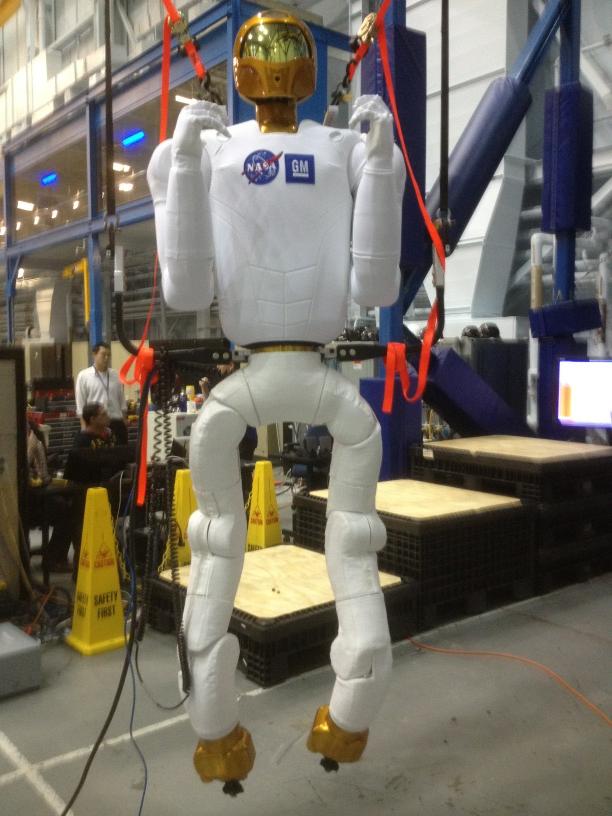
I hope they do science with it too
I hope they are able to do some cool science with it too. It'd be great if they could teach it to autonomously do zero angular-momentum maneuvers, IE reorientate itself the same way a cat does. Or see if they can get it to do
zero gravity jump "walking." Think Ender's Game.The former should be easy to accomplish with what they are up-porting, while the latter could probably be done if they send up a motion capture set up.
At the very least, it should help cancel out the creepiness of Robonaut's new slenderman space legs. Robonaut is going to be 'walking' around the space station SOON.
-
Makes absolute sense, technically.
For those of us who worked with Kinect, we know very well all of it's limitations. It's a promising technology but it's still very green and far from what it is advertised as. It pretty much only works if you are looking to the camera and waving your hands and legs. Any attempt to turn sideways or even put your hands together completely confuses the heck out of it (check their technology demo videos, such scenarios are all purposely avoided).
There's even open source implementations of the pose recognition that work better (though they need calibration).
By making it XB1 only hackers will not be able to see how much it really improved (likely not much judging by their videos). So far from what I can tell, only the APIs improved so it's easier to get data from it (full matrices, motion vectors and strain, which you could easily compute yourself anyway), and some stuff was added to detect heart and blood rate (likely based on this MIT stuff. That's pretty much it. -
Re:Misleading title
If you see fewer women than men presenting at conferences, there could be many reasons for that. For example, is the ratio of women to men presenting at top conferences different from the ratio of women to men receiving doctoral degrees from top universities?
There could be filtering mechanisms in place at many stages in an academic career that favor one gender over another. In chronological order: admission to undergraduate degree program, graduation from undergraduate programs, admission to graduate degree program, awarding of research funding to graduate students, primary authorship of papers, acceptance of papers, presentation of papers, awarding of graduate degrees, postdoctoral fellowships, awarding of research grants, tenure-track faculty appointments, awarding of tenure, etc., etc.
So these authors picked one of those stages out of the approximate middle of the professional chain I just outlined and found the number of women is less than the number of men. I could have guessed that. The researchers say only "there are many potential contributing factors," which is not much of a causal explanation.
I am beginning to understand why some men get a bit defensive when headlines like this appear. It sounds like more than a hint of accusation, yet without enough evidence to actually accuse anyone with. So let's not forget how frustrating the lack of causal explanation can be to men. (Disclaimer: I am a man.)
If you're actually interested in the causes and effects of gender imbalance in academe, I would recommend the MIT Gender Equity Project. Its methodology was more comprehensive than just counting Y chromosomes in one sub-field.
I don't really blame the biologists who did this study for failing to pin down the root cause of the gender imbalance they saw. If the root cause were easy to find, academics would either have fixed it (if inequity exists) or stopped caring (if the reason is simply fewer girls than boys want to study science). Even the MIT study concluded this is a complex issue.
-
Re:Zebra mussels?
"Any chance Zebra mussels would do as well? We got lots of them\."
You'd get striped batteries that way.
-
Re:A conspiracy...I believe you are referring to the accidents with the THERAC-25? http://en.wikipedia.org/wiki/Therac-25
The Therac-25 was a radiation therapy machine produced by Atomic Energy of Canada Limited (AECL) after the Therac-6 and Therac-20 units (the earlier units had been produced in partnership with CGR of France). It was involved in at least six accidents between 1985 and 1987, in which patients were given massive overdoses of radiation, approximately 100 times the intended dose.[2]:425 These accidents highlighted the dangers of software control of safety-critical systems, and they have become a standard case study in health informatics and software engineering.
Much more detailed write-up on the accidents. http://sunnyday.mit.edu/papers/therac.pdf
-
Re:I hate them both
As they are the harbingers of the new age, post dotcom world
Except that Java was started in 1991 (with Oak) and was released in 1995. Would you prefer C++, which was the mainstream alternative during that time period? As Guy Steele has said: "And you're right: we were not out to win over the Lisp programmers; we were after the C++ programmers. We managed to drag a lot of them about halfway to Lisp. Aren't you happy?"
Personally I think that Java made "non-native" code much more acceptable, which allowed Python, Ruby, and even JavaScript, to become more mainstream. Perl has/had been around for a while, but it was generally squirreled away in the background with the sysadmins. "Real" developers compiled code.
In a perfect world we'd probably only be using Smalltalk/Lisp/Scheme, but as alternatives go, Java and
It got people halfway to actually-good languages, which isn't a bad accomplishment. You now have the option many more languages, so don't poo-poo it just because you don't like coding in it.
I'm sure Guy Steele wants/wanted to do certain things differently, but given his language experience (C, Fortran, Java, Lisp, Scheme, 'ECMAScript'), I think Java could have been a lot worse, and we should be content with what it allowed to happen with regards to what's acceptable in the mainstream. And even if you don't like the language, the JVM is a pretty good place to run other dynamic languages nowadays as well.
-
work for hire
If a school is offering online classes as part of their "normal" curriculum, and if you use the university's resources to produce something while being paid by the university - does this become a work for hire situation?
in the economics of running a college (in the United States at least) "academics" isn't at the top of the "income generating list" - my "traditional big college university" income list = 1. housing, 2. alumni donations, and sometimes 3. athletics/research. Which means actually "educating" students isn't the primary mission for a lot of schools - so it follows that the professors/instructors become a necessary evil - i.e. a "cost" to be constrained or a "resource" to be utilized.
(of course at smaller schools student tuition - and government grants/loans - are the main source of income but that is a different subject)
online classes are great for actually educating people, and can enhance a school's "brand" (which is the approach I'm seeing with a lot of coursera classes) - so I don't see free mooc's as a huge threat to the acdemic status quo - but "ownership" probably leans towards the university.
of course nothing is stopping an enterprising instructor from creating mooc's on their time, with their resources, and with their name attached...
in the "I don't work at the MIT admissions office" category - I don't think 12 years of OpenCourseware has had a negative impact on M.I.T.'s admissions numbers
-
Re:Ways to help
One technical point: Tor does not provide strong anonymity, it provides a good trade-off between anonymity and efficiency. Mesh networking is a fabulous idea. I'm not sure if a global mesh works (as opposed to a bunch of meshes linked over Tor/I2P/...), but here is a resource that might help.
-
Re:MIT Hacks
At MIT, the word "hack" means something very specific, and not criminal or unethical. It is a impressive, creative, and clever achievement.
The word hack at MIT usually refers to a clever, benign, and "ethical" prank or practical joke, which is both challenging for the perpetrators and amusing to the MIT community (and sometimes even the rest of the world!). Note that this has nothing to do with computer (or phone) hacking (which we call "cracking").
So, the president of MIT was urging MIT students to pull clever practical jokes? That's stupid or he meant something different. Presumably he meant "hack" in the same way that people who have been actually involved with computers understand it: exploring the possibilities of a system (often including some that the inventor never intended) for the sake of discovery and in some cases using those discoveries to create unique and innovative outcomes. I get that you are trying to make a distinction between "hacking" and "cracking" but "hacking" has a meaning that transcends the special case of practical jokes that are a part of MIT folklore and if the president of MIT did not have the broader meaning in mind, then his comments are almost comical.
-
MIT Hacks
At MIT, the word "hack" means something very specific, and not criminal or unethical. It is a impressive, creative, and clever achievement. From http://hacks.mit.edu/ The word hack at MIT usually refers to a clever, benign, and "ethical" prank or practical joke, which is both challenging for the perpetrators and amusing to the MIT community (and sometimes even the rest of the world!). Note that this has nothing to do with computer (or phone) hacking (which we call "cracking").
-
Re:Fixing the problem
Good points. I'd add lobbying for a "basic income" and also possibly greatly expanding the House of Representaives by 10X so money is less of a factor in elections.
By the way, the link in your sig to 5ttt.org may be broken; interesting idea though:
http://pdos.csail.mit.edu/~petar/5ttt.org/
"Tonika is an administration-free platform for large-scale open-membership (social) networks with robust security, anonymity, resilience and performance guarantees. -
Re:This isn't a mystery
And yes, I'm a neuroscientist FWIW.
A neuroscientist that's at least 20 years out of date.
http://en.wikipedia.org/wiki/Neurogenesis#Occurrence_in_adults
http://www.ncbi.nlm.nih.gov/pubmed/8338665
http://pubs.niaaa.nih.gov/publications/arh27-2/197-204.htm
http://web.mit.edu/9.013/www/lectures/07_PG_Neurogenesis_Migration.pdf -
Re:Nukes are not economically viable without taxat
Yes, we can build safe reactors, just not water-cooled reactors. Fission reactions are "just getting warmed up" by the time water starts boiling. That is a bad combination. This is why water-cooled reactors have to operate at 100+ atmospheres of pressure. Just taking water out of the equation makes fission several orders of magnitude simpler and safer to use.
That's why we should be working on new designs based on molten salt coolingWater is a popular cooling medium because its specific heat is higher than just about anything else. If you want to transport a large amount of heat energy from one place to another, heated water is about the best way to do it.
The fact that water vaporizes when overheated or depressurized is a safety mechanism too. When water vaporizes, it absorbs nearly 7x as much energy as it takes to heat water from room temperature to boiling (2260 kJ/kg vs 4.19 kJ/kg*C). Or nearly 2x the energy it takes to heat water from room temperature to the operating temp of a pressurized water reactor. So a leak or depressurization of the water automatically and instantly results in cooling.
The large volumetric change when water vaporizes is also ideal for driving a generator. Volume change = mechanical work, which is easily captured by a turbine. Without a volume change, you're left trying to capture energy via an inefficient and bulky Stirling engine.
So yeah molten salt reactors have a lot going for them. But the use of water for cooling isn't because of some grand conspiracy. Water is just an extremely good medium for cooling and converting thermal energy into mechanical work, and was the obvious choice when reactors were being designed ~50 years ago. -
Roke Manor
Branching from an idea from over a decade ago. http://tech.mit.edu/V121/N63/Stealth.63f.html