Slashdot Mirror
Domain: mit.edu
Stories and comments across the archive that link to mit.edu.
Comments · 7,673
-
Re:Scratch
My kids have used 'Scratch'. I've no idea how this compares on details, but they were having a lot of fun with it, and from what I can see, it certainly creates an understanding of structured programming techniques.
Scratch, +1. Turtles all the way down. Totally Object Oriented, however, not structured;)
-
Scratch
My kids have used 'Scratch'. I've no idea how this compares on details, but they were having a lot of fun with it, and from what I can see, it certainly creates an understanding of structured programming techniques.
-
Re:you see those drawings?
This MIT class on the shuttle is very interesting. It appears that if done today the shuttle would have been able to perform much closer to its promises because they could have put diagnostics into the engines and saved themselves from having to take them out after every launch.
-
1991
I was a fresh-outta-college CS major working at the then-aerospace behemoth Hughes Aircraft Company. We had been connected to Usenet mail and newsgroups using the very highfalutin' and expensive Telebit Trailblazer modem, one of the first 9600 BPS modems to hit the market.
The first evidence I can find of my former self is at the Telecom Digest archives, on a thread about phone repair service in the September 9, 1991 digest. I'm quite certain I was active on that list prior to our office's conversion to Internet mail, but it was a very big deal at the time.
-
Re:Lessons from the Old and Wise
Perl is nice, I program whole days in Perl, but my real productivity boost (with Perl) came from this book.
If you have finished it, you will never look in the same way at programming.
After you have finished it, you should be able to start with this book, which will still give you a deeper insight. Make the exercises, try especially to grasp the parts about writing a Scheme interpreter and the register machines.
-
Re:Sounds... awesome...
http://ocw.mit.edu/index.htm
http://www.wikipedia.org/
http://www.khanacademy.org/
http://www.ted.com/Standford isn't first to this game, but I still applaud them.
-
Re:first
Interesting question. There are several different kinds of possible multiverse (see Tegmark). What this is looking for is type one, possibly type two. They're the most "boring" in some ways because the "other versions" of you exist simply because of statistical imperative and are also a very, very long way away. It's like proving two identical snowflakes have existed, but not knowing where or when. Still, I love the fact that people are trying to test ideas that were thought to be untestable at one point.
-
Re:Evidence?
In the actual Nature article, the authors mention that a test of their model would be to find evidence that material with a different composition accreted on the far side. They also say that evidence for accreted material should show up in the gravity measurements of the upcoming GRAIL mission. But these would be pretty subtle distinctions.
-
SRBs: all kinds of nasty stuff
On one of MIT Open Course lectures, http://ocw.mit.edu/courses/aeronautics-and-astronautics/16-885j-aircraft-systems-engineering-fall-2005/lecture-notes/lecture-2/ where Aaron Cohen (orbiter project manager in 1972) discussed history of the Space Shuttle, professor Jeff Hoffman said on one launch with family members 3 miles from launch pad had to get in the busses to leave the area 5 minutes after launch. Hoffman's brother was a "space nut" and wanted to watch the vehicle go over the horizon (and he was not happy about leaving early). Reason they moved everyone because afternoon launch had smoke from the SRBs drifting toward the viewing site. There's all kinds of nasty stuff and they didn't want people to get exposed to the smoke.
Thanks to Tekfactory for bringing these MIT courses to my attention.
-
Re:A bit ironic ...
I found Lecture 1 (The Origins of the Space Shuttle) at http://ocw.mit.edu/courses/aeronautics-and-astronautics/16-885j-aircraft-systems-engineering-fall-2005/lecture-notes/lecture-1/ (and looks like it is on Youtube, length = 110 min). PDF notes at http://ocw.mit.edu/courses/aeronautics-and-astronautics/16-885j-aircraft-systems-engineering-fall-2005/lecture-notes/myers_shtl_orign.pdf
-
Re:A bit ironic ...
I found Lecture 1 (The Origins of the Space Shuttle) at http://ocw.mit.edu/courses/aeronautics-and-astronautics/16-885j-aircraft-systems-engineering-fall-2005/lecture-notes/lecture-1/ (and looks like it is on Youtube, length = 110 min). PDF notes at http://ocw.mit.edu/courses/aeronautics-and-astronautics/16-885j-aircraft-systems-engineering-fall-2005/lecture-notes/myers_shtl_orign.pdf
-
Re:A bit ironic ...
another link of open courseware on Shuttle history, http://ocw.mit.edu/courses/aeronautics-and-astronautics/16-885j-aircraft-systems-engineering-fall-2005/lecture-notes/lecture-2/
-
Re:A bit ironic ...
I think I've found what I asked for, http://ocw.mit.edu/courses/#aeronautics-and-astronautics
-
Re:just tried it; not sure its a great idea
Yeah, I definitely agree with this. This seems to be a solution to the problem "how can I make illegible and amateurish schematic drawings more readable without learning anything?"
Use a frame that limits the total schematic size to a standard paper size. Use named nets and labels on nets instead of actually connecting wires between parts (except for trivial connections like capacitors). Put lines in your schematic that separate logical blocks of your schematic. Label logical blocks with a title (AC Rectifier, Boost Converter, Control System, ADCs, Filters, etc). This makes it trivial for someone to look at your schematic and rapidly identify errors. It makes it simpler for *you* to rapidly identify errors!
Just follow these four simple rules and your schematics (pretty much regardless of software used to make them) will suddenly appear to be fairly professional (if not perfect). For examples, take a look at this. I'm not an EE by any means, but the more you separate functionality into logical blocks and limit your size with frames, the closer it looks to "professional".
http://saikoled.com/lightshield/
http://saikoled.com/lightbrick/
http://web.mit.edu/neltnerb/www/artwork/design.html(for the last link, some fairly complex schematics are shown in the "New Schematics and Diagrams" section. The ones near the top are duplicates of what I published on the other website.)
-
Re:It's ok we have "permisison"
Here's how they went about it:
http://senseable.mit.edu/backtalk/
Now you can provide a deeper explanation about how it was unethical, rather than accusatory hand-waving.
-
Re:Biased summary
Wire Fraud, Computer Fraud, Unlawfully Obtaining Information from a Protected Computer, and Recklessly Damaging a Protected Computer. The charges that the state will try to prove in it's case, along with the probable cause, are all in the indictment.
COUNT 1 Wire Fraud 18 U.S.C. 1343 & 2
34. The Grand Jury realleges and incorporates by reference the allegations in paragraphs 1-33 of this Indictment and charges that:
From on or about September 24, 2010, through January 6, 2011, or thereabout, in the District of Massachusetts and elsewhere, the defendant,
AARON SWARTZ,
having devised and intended to devise a scheme and artifice to defraud and for obtaining property — namely, journal articles digitized and distributed by JSTOR, and copies thereof — by means of material false and fraudulent pretenses, representations, and promises, transmitted and caused to be transmitted by means of wire communication in interstate commerce writings, signs, signals, and pictures — namely, communications to and from JSTOR’s computer servers — for the purpose of executing the scheme, and aided and abetted the same.
All in violation of Title 18, United States Code, Sections 1343 and 2.COUNT 2 Computer Fraud 18 U.S.C. 1030(a)(4) & 2
35. The Grand Jury realleges and incorporates by reference the allegations in paragraphs 1-33 of this Indictment and charges that:
From on or about September 24, 2010, through January 6, 2011, or thereabout, in the District of Massachusetts and elsewhere, the defendant,
AARON SWARTZ,
knowingly and with intent to defraud, accessed a protected computer — namely, a computer on MIT’s network and a computer on JSTOR’s network — without authorization and in excess of authorized access, and by means of such conduct furthered the intended fraud and obtained things of value — namely, digitized journal articles from JSTOR’s archive — and aided and abetted the same.
All in violation of Title 18, United States Code, Sections 1030(a)(4) and 2.COUNT 3 Unlawfully Obtaining Information from a Protected Computer 18 U.S.C. 1030(a)(2), (c)(2)(B)(iii) & 2
36. The Grand Jury realleges and incorporates by reference the allegations in paragraphs 1-33 of this Indictment and charges that:
From on or about September 24, 2010, through January 6, 2011, or thereabout, in the District of Massachusetts and elsewhere, the defendant,
AARON SWARTZ,
intentionally accessed a computer — namely, a computer on MIT’s computer network and a computer on JSTOR’s network — without authorization and in excess of authorized access, and thereby obtained from a protected computer information whose value exceeded $5,000 — namely, digitized journal articles from JSTOR’s archive — and aided and abetted the same.
All in violation of 18 U.S.C. 1030(a)(2), (c)(2)(B)(iii) and 2.COUNT 4 Recklessly Damaging a Protected Computer 18 U.S.C. 1030(a)(5)(B), (c)(4)(A)(i)(I),(VI) & 2
37. The Grand Jury realleges and incorporates by reference the allegations in paragraphs 1-33 of this Indictment and charges that:
From on or about September 24, 2010, through January 6, 2011, or thereabout, in the District of Massachusetts and elsewhere, the defendant,
AARON SWARTZ,
intentionally accessed a protected computer — namely, a computer on MIT’s computer network and a computer on JSTOR’s network — without authorization, and as a result of such conduct recklessly caused damage to MIT and JSTOR, and, during a 1-year period, caused loss aggregating at least $5,000 in value and damage affecting at least 10 protected computers, and aided and abetted the same.
All in violation of Title 18, United States Code, Sections 1030(a)(5)(B), (c)(4)(A)(i)(I),(VI) & 2. -
Re:The Doomsday Scenario
... too many people keep saying that tidal and wave power will "run out" if we try to harness it.
Technically true, but not because extracting tidal energy will cause the Moon to move closer to the Earth. In fact, the Moon would recede from the Earth even faster, resulting in an imperceptibly small decrease in tide heights, because lunar tide heights are proportional to the inverse cube of the distance between the Moon and the Earth.
Thanks for reminding me that i had things wrong - but at the same time mind doing the math for the correct answer?
Extracting tidal energy would cause the Moon to move away faster, so one could ask "how much potential energy would the Moon gain by moving away from the Earth by 1 km?" Well, G = 6.67x10^(-11) m^3 kg^(-1) s^(-2) and m1 = mass of Earth = 6x10^24 kg and m2 = mass of Moon = 7.3x10^22 kg.
The (current) average distance from the Earth to the Moon is r = 384,399 km. So the potential energy of the Moon in its current spot is -7.60007x10^28 J. (Gravitational potential energy is negative.) Moving the Moon 1 km away from the Earth raises its potential energy to -7.60005x10^28 J, an increase of 2x10^23 J.
But, as I pointed out, the Moon's gravitational potential energy isn't the source of tidal energy. The rotational kinetic energy of the Earth is. The Moon's ascent from Earth would be a byproduct of extracting tidal energy, not the source of that energy.
The lunar ocean tide M2 currently dissipates ~2.4 TW of power. The Moon is receding at a rate of ~3.8 cm per year which is slowing the Earth's rotation by ~2 ms per century.
Knowing that the rotational kinetic energy of the Earth is the source of tidal energy, we can approximate the Earth as a solid uniform sphere which has a moment of inertia of I = 2/5 m1 a^2, where a = mean radius of Earth = 6371 km. So the Earth's moment of inertia is 9.74x10^37 kg m^2. Since KE = 1/2 I omega^2, and omega = 2*pi/sidereal_period (currently 23 hours, 56 minutes, 4.091 seconds), the Earth's rotational kinetic energy is currently 2.59001833x10^29 J. In 100 years, the Earth's sidereal period will be ~2 ms longer, at which point the Earth's rotational kinetic energy will be 2.59001821x10^29 J, a decrease of 1.2x10^22 J.
The lost rotational kinetic energy is converted into frictional heat on the ocean floor and continental boundaries, and some of it goes into raising the Moon's orbit. Thus we can perform a sanity check by verifying that the energy gained by the Moon is smaller than the lost kinetic energy of the Earth. If 1 km of lunar recession is worth 2x10^23 J, then using a linear approximation 3.8 cm of recession each year is worth 7.6x10^18 J of additional potential energy each year, or 0.24 TW. Each year, the Earth's rotational kinetic energy drops by 1/100 the amount it does each century, which means 1.2x10^20 J are lost each year, or 3.8 TW. (Note that this is close to the 3.7 TW reported by Munk and Wunsch.)
So the Earth's rotational kinetic energy is the source of tidal energy. It's decreasing faster than lunar potential energy is increasing, which is physically plausible. Roughly 6% of the lost rotational kinetic energy goes into raising the Moon's orbit. The rest is converted to heat by friction and turbulence.
-
Re:Right to read
welcome
-
Re:what happened to information wants to be free
Because those corporate whores are the ones who publish the books that hold the information.
If you really want to support the freedom of information, petition your university to use OpenCourseWare.
-
Uh, What About Research-Based Methods?It is great to see this interest in learning, but too bad that methods that careful research have shown to increase learning haven't received the same publicity (my understanding is that research based on the Khan Academy has yet to come out). I have in mind: Improved Learning in a Large Enrollment Physics Class," Deslauriers, Schelew, and Wieman, Science, May, 2011 (a postdoc and grad student, using research based methods, get 2 standard deviations more learning in a physics class than an experienced prof with high student evaluations who lectured). . Note that Wieman is a both a Nobel Laureate and a U.S. Professor of the Year (given for teaching). Another article is Interactive-engagement versus traditional methods: A six-thousand-student survey of mechanics test data for introductory physics courses, which again shows a 2-standard deviation increase in learning by not lecturing.
There is even evidence that watching Khan videos leads to a false sense of learning. See Khan Academy and the Effectiveness of Science Videos" It basically shows that while students think they're learning a lot by watching videos, their actual learning is minimal.
A great into to all this is Wieman's Why Not Try a Scientific Approach to Science Education?" As he puts it, to increase learning, we need to use- Practices and conclusions based on objective data rather than—as is frequently the case in education—anecdote or tradition. This includes using the results of prior research, such as work on how people learn.
- Disseminating results in a scholarly manner and copying and building upon what works. Too often in education, particularly at the postsecondary level, everything is reinvented, often in a highly flawed form, every time a different instructor teaches a course. (I call this problem “reinventing the square wheel.”)
- Fully utilizing modern technology. Just as we are always looking for ways to use technology to advance scientific research, we need to do the same in education.
At best, Khan Academy only does the third of these.
-
Optical is taking a long time...
There is as yet no interplanetary communication by Laser. It's all done by radio at present. The first flight demonstration of Laser communication will be on the LADEE Lunar Orbiter. That's scheduled to be launched in 2012. I am sure that optical communications will eventually be used, though. Using reasonably sized telescopes, gigabit per second communication across interplanetary distances should be possible using conventional techniques, even if OAM is not actually practical. (Of course, the weather would be an issue, as laser signals can't go through clouds.)
Given that more or less the same thing could have been and was said about deep space optical communications in the mid-1980's, all I can say is that it sure is taking a long time to implement it.
-
Re:Your cellphone is in a drawer...
I, too, wonder about the usefulness of the camera. There's also the issue of power, which on mobile devices is a major issue. You might be willing to spend power if spatial precision is why the device exists, but I suspect that most people have other uses for their cellphones.
That said, there are other useful sensors on the phone, namely the accelerometer, the microphone, the wi-fi antenna, and in some cases, a magnetometer. These folks used those sensors, especially the accelerometer which has a negligible effect on battery life, in combination with a hidden Markov model in order to accurately predict a person's position. Not sub-centimeter, but good enough for regular people. Of course, the model had intimate knowledge of the surrounding area and transit schedules, but it's a neat idea. I especially liked the idea of using a DFT to differentiate between walking and riding the bus.
Anyway, point is: a coat pocket may not be an obstacle. Don't forget that modern phones have a surprising amount of processing power and memory. -
A long way from SICP
While MIT used Scheme as an introductory programming language, as seen in the legendary Wizard Book, in 2011 Stanford have dumbed down CS introductory classes to
-
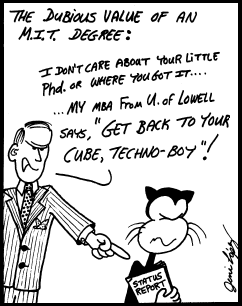
MBA/engineer cartoon
This comes to mind:
-
Build a mouse brain first.
OK, a mouse brain has about 1/1000 the mass of a human brain. So build a mouse brain with 1000 ARM CPUs, which ought to fit in one rack, and demonstrate the full range of mouse behavior, from vision to motor control.
I read the paper. It's a "build it and they will come" design. There's no insight into how to get intelligence out of the thing, just faith that if we hook enough nodes together, something will happen.
About 20 years ago, I went to hear Rodney Brooks (the artificial insect guy from MIT) talk about the next project after his reactive insects. He was talking about getting to human-level AI by building Cog, a robot head and hand that was supposed to "act human". I asked him why, since he'd already done insect-level AI, he didn't try mouse-level AI next, since that might be within reach. He said "Because I don't want to go down in history as the man who created the world's best artificial mouse".
Cog turned out to be a dead end. It was rather embarrassing to all concerned. As one grad student said, "It just sits there. That's all it does."
-
Cool! A plug for Sadoway:
One of the links is to Donald Sadoway's research group at MIT. His group works on the very topics that will make or break the shift to better energy sources and greater efficiency.
He's also a wonderful teacher who's put up a course at MIT open course ware. It's Solid State Chemistry 3.091 and it utterly rocks. If you want to understand how chemistry impacts energy efficiency and the properties of materials, this is the course for you. And, it's in a format that is great for self teaching.
I know it's a shameless plug, but give me a break. I work in a chemistry department that does a lot of work on improved energy related materials and methods.
-
Re:Why was my post down-moderated?
Can the hero who down-modded it state why on TECHNICAL GROUNDS, "computing-wise", I wonder?
Maybe because your post reads like the ravings on the label of Dr. Bronner's soap.
http://web.mit.edu/afs/athena.mit.edu/user/d/r/dryfoo/www/Spritz-yule/bronner.html
-
The Right to be Left Alone
Stalking as a degree got defined by law at the cost of blood. We literally stacked up too many bodies of women until it could no longer be ignored. It wasn't a natural consequence.
Speaking of the law, here's what Warren and Brandeis thought of technological surveillance:
The Right to Privacy
Warren and Brandeis, Harvard Law Review, December 15, 1890
Recent inventions and business methods call attention to the next step which must be taken for the protection of the person, and for securing to the individual what Judge Cooley calls the right "to be let alone" [10] Instantaneous photographs and newspaper enterprise have invaded the sacred precincts of private and domestic life; and numerous mechanical devices threaten to make good the prediction that "what is whispered in the closet shall be proclaimed from the house-tops."Warren and Brandeis were worried about technologial advances destroying privacy in 1890. Just how big of a heart attack do you think they'd have at the idea of the police warrantlessly tracking citizens 24/7?
And how far do you think our liberties have slipped?
-
Re:Forget that, go OCW and GPL book
Sorry, jumped the gun and I didn't post a link: http://ocw.mit.edu/courses/electrical-engineering-and-computer-science/6-00-introduction-to-computer-science-and-programming-fall-2008/
-
Re:PROFILED
Clearly she fits the terrorist criminal profile.
This community seems to have forgotten the MIT paper showing that profiling is more easily defeated than random screening.
Article: http://tech.mit.edu/V122/N48/48secure.48n.html
Paper: http://groups.csail.mit.edu/mac/classes/6.805/student-papers/spring02-papers/caps.htmShort version: An organized adversary could probe, model, and defeat a profile, while random screening maintains a constant success/failure rate.
Disclaimer: I'm in favor of minimal pre-"9/11"-style security, combined with reinforced cockpit doors. Refuse to be terrified.
-
Re:PROFILED
Clearly she fits the terrorist criminal profile.
This community seems to have forgotten the MIT paper showing that profiling is more easily defeated than random screening.
Article: http://tech.mit.edu/V122/N48/48secure.48n.html
Paper: http://groups.csail.mit.edu/mac/classes/6.805/student-papers/spring02-papers/caps.htmShort version: An organized adversary could probe, model, and defeat a profile, while random screening maintains a constant success/failure rate.
Disclaimer: I'm in favor of minimal pre-"9/11"-style security, combined with reinforced cockpit doors. Refuse to be terrified.
-
Try MIT Open Courseware
MIT Open Courseware offers (for free) CS, including video lectures, assignments, exams etc. http://ocw.mit.edu/courses/electrical-engineering-and-computer-science/6-00-introduction-to-computer-science-and-programming-fall-2008/video-lectures/
-
Re:It's too bad NASA doesn't do anything anymore.
-
Re:Cowards
LulzSec made some headlines and embarrassed a few major organizations. Going to jail isn't worth a few more headlines.
"LulzSec" already earned waiting spots in prison with what they've already done. Not doing anymore doesn't constitute "take back".
Know your objective, how what you're willing to invest to achieve it, and exit when you've reached your goal or exceeded your costs.
That sort of rationality doesn't really fit with doing it for the "lulz", does it? If so, things will become much more boring at MIT. If you are suggesting cold blooded calculation on their part, then that will only add to their misfortunes when they are prosecuted.
-
Scratch -- the latest from MIT for kids...
You should definitely look at Scratch, which is designed for kids, even (especially?) kids who don't type very well yet, yet it teaches them programming skills. This is the same crowd who initially did Logo all those years ago, and they think this is better...
-
Scratch got my 6 year old started
MIT's Scratch ( http://scratch.mit.edu/ ) has gotten my kids started with programming. It's fun, and teaches all the fundamentals necessary for learning programming logic.
-
You can do this yourself with your own camera
You just need to open up your lens and put in a coded aperture, and the rest is all software. See the paper Image and Depth from a Conventional Camera with a Coded Aperture, and especially check out the last several slides from the supplementary file where they take a single picture and refocus it at a new focal length.
-
You can do this yourself with your own camera
You just need to open up your lens and put in a coded aperture, and the rest is all software. See the paper Image and Depth from a Conventional Camera with a Coded Aperture, and especially check out the last several slides from the supplementary file where they take a single picture and refocus it at a new focal length.
-
Re:Global Warming alarmists
Hmmm... that's not what the scare-mongers over at MIT say:
-
Re:MIT?
Oh, you know, things like this:
http://hacks.mit.edu/Hacks/by_year/1994/cp_car/ -
Re:Would I have to be a fanboy...
No, but it would help if you enjoyed MIT style pranks. This is one of my favorites. Unlike the typical MIT prank, this one caused damage, though (they used screws). The coolest part of this one, to me, was that they did it in plain daylight.
-
Re:MIT?
This. MIT students have a long and storied history of similar pranks.
-
Re:Hey Republicans:
[...] while taking the government numbers at their face value, [...]
The last refuge of the delusional liar: "your numbers must be wrong!".
Here go check the data of an independent inflation tracking project, the Billion Price Index: a daily updated price index derived from literally millions of online prices published not by the government but by thousands of businesses.
The BPI confirms the CPI metrics.
So this confirms once again that you are a serial liar.
Here is what you need to do: stop reading my comments. bye bye.
The last refuge of the fake libertarian: "go, go, go away, I do not want to read your comments, I'm unable to counter them!".
This is Slashdot, not Fox News
-
How To Design Programs
Seriously, whatever you end up doing in more advanced or more applied courses (if that's the right word for homeschooling), start with "How To Design Programs". It teaches you how to *think* about just about everything else in computing. There's a second edition in progress. Both the original book and the draft second edition (which is probably much better) are available for free downloads. The original can also be purchased on paper.
The software system that goes with it is also free: Dr. Scheme, now renamed as Racket.
-- hendrik
http://www.cs.rice.edu/CS/PLT/Teaching/Lectures/Released/Companion/index.htm
http://www.ccs.neu.edu/home/matthias/HtDP2e/
http://mitpress.mit.edu/catalog/item/default.asp?ttype=2&tid=3879
-
Re:Functional programming
Oh, and the wizard book is free online: http://mitpress.mit.edu/sicp/full-text/book/book.html
-
MIT Open CourseWare
http://ocw.mit.edu/courses/electrical-engineering-and-computer-science/ would be a good starting point. Advanced? Yes. The beauty of home schooling is that the curriculum can meet the needs of the student, not the lowest common denominator.
-
Re:programming practice
Don't Forget MIT's OpenCourseWare Intro to Computer Science lectures. It might move at a faster pace than for a high school student, but it should give your mother some idea as to how to structure the lessons and concepts.
http://ocw.mit.edu/courses/electrical-engineering-and-computer-science/6-00-introduction-to-computer-science-and-programming-fall-2008/video-lectures/ -
Re:Osama Bin Laden
And yet, places with taxes (or even with "high" ones) generally lead in positive societal factors, are most pleasant to live in, most "free", and so on (overall the "nice" ones, where you'd certainly prefer to live). There is very clear correlation between one and the other. Also, somehow, pretty much all nice societies / civilisations (!= "tribal groups", or those of similar size), have some way of assigning value (aka money). Maybe it makes fair cooperation a bit easier?
Sweat isn't the best as an element here - you're under Just World illusion if you think it's not pretty much universal among all our "fore-bearers"... and the amount of it (and blood) not clearly pointing to future prosperity in a given place (more in places which export its suffering there). And let me guess, maybe also the myth of "past middle class glory" or Lake Wobegon Effect? (while the US is in fact the lowest (together with few others of course, not being alone) in social mobility among developed places? (the highest being in "nanny states" such as Canada or Nordic ones); so much for "Land of Opportunities" / "American Dream"); NVM other cognitive biases, for example how we merely convince ourselves into reliability of our memory, don't remember how little we remember (via "old times were always better" this gives tiresome political results) -
Re:I agree
I'd be very surprised if "slower yields to faster" is actually written ANYWHERE in the US Highway Code.
Umm in many states it does say something similar.
Most states follow the Uniform Vehicle Code and require drivers to keep right if they are going slower than the normal speed of traffic (regardless of the speed limit; see below)
http://www.mit.edu/~jfc/right.html
Some states didn't allow left-lane lingering but didn't enforce the law. Now they are.
At the start of the summer, the Washington State Patrol began pulling people over for violating the state's left-lane law, which prohibits "impeding the flow of other traffic."
For shits and giggles I pulled a few states laws on the matter
Nebraska: http://law.justia.com/codes/nebraska/2006/s60index/s6006131000.html
Upon all roadways, any vehicle proceeding at less than the normal speed of traffic at the time and place and under the conditions then existing shall be driven in the right-hand lane then available for traffic, or as close as practicable to the right-hand curb or edge of the roadway, except when overtaking and passing another vehicle proceeding in the same direction or when preparing for a left turn at an intersection or into a private road or driveway.
Arizona: http://www.azleg.state.az.us/ars/28/00721.htm
B. On all roadways, a person driving a vehicle proceeding at less than the normal speed of traffic at the time and place and under the conditions then existing shall drive the vehicle in the right-hand lane then available for traffic or as close as practicable to the right-hand curb or edge of the roadway, except when overtaking and passing another vehicle proceeding in the same direction or when preparing for a left turn at an intersection or into a private road or driveway.
Virginia: http://leg1.state.va.us/cgi-bin/legp504.exe?000+cod+46.2-804
1. Any vehicle proceeding at less than the normal speed of traffic at the time and place and under the conditions existing, shall be driven in the lane nearest the right edge or right curb of the highway when such lane is available for travel except when overtaking and passing another vehicle or in preparation for a left turn or where right lanes are reserved for slow-moving traffic as permitted in this section;
These three states all imply that you must move over if they are driving at less then the "normal speed of traffic". Of course other states have different laws, but a large number of them have laws with wording similar to these. The mit page says this at the bottom of it.
Note that this law refers to the "normal" speed of traffic, not the "legal" speed of traffic. The 60 MPH driver in a 55 MPH zone where everybody else is going 65 MPH must move right. Contrast Alaska's rule, 13 AAC 002.50, allowing vehicles driving at the speed limit to use the left lane, and Colorado rev. stat. 42-4-1103, prohibiting blocking the "normal and reasonable" movement of traffic.
-
Re:I agree
I'd be very surprised if "slower yields to faster" is actually written ANYWHERE in the US Highway Code.
The Uniform Vehicle Code in section 11-301 says in part that "Upon all roadways any vehicle proceeding at less than the normal speed of traffic at the time and place and under the conditions then existing shall be driven in the right-hand lane then available for traffic [...]", but in the end almost all traffic laws are handled at a state level. In my home State of Washington, it is illegal to go under the speed limit if there are more than 5 cars behind you and none in front. That driver must pull off the road and let the cars pass. (RCW 46.61.427) While not so much enforced in the urban areas, on the rural highways it's rather a big deal. There is a fair amount of state-by-state info here: State 'keep right' laws.