Slashdot Mirror
Domain: monash.edu.au
Stories and comments across the archive that link to monash.edu.au.
Comments · 279
-
Re:What about plain French? Or Russion?
How about classical Latin?
-
Re:Absolutely
At my uni, the student association has a beer-drinking olympics... In fact I think most australian uni's do...
I think the one missing factor in the original comment is competition; it is the competition which converts a skill (like driving) into a sport (like car racing). That's where sex fails to make sport status. But socializing (politically-correct term for picking up hot chicks), now that can get competitive... and it can involve sex... -
Re:The 9/11 terrorists also used cars
The notion of anonymity in one's reading habits reeks of someone who is too afraid of their peer group, and not the government.
In this case, the notion of anonymity reeks of someone who is concerned that what they read will be used as evidence against them.
You obviously didn't pay attention in history class when they defined "McCarthyism". It's not so far in the past that being seen reading a "questionable" book by the wrong person could get you blacklisted (Orson Welles), finish your career (Charlie Chaplin), or even serve toward your imprisonment (Alger Hiss).
Given the right circumstances, say the Red Scare or the hysteria surrounding terrorism, your comment, "... most citizens are smart enough to know that just because..." is irrelevant. Reading "Mein Kampf" doesn't make you the next Hitler, and that is the point. -
Jurassic technology
"This is a UNIX system! I know this..."
-
Translation doesn't help you learn.May I suggest that for language learning what you want is not translation to your own language, but something to help you read. In Japanese, that's particularly hard because of the kanji.
But there are a couple of open-source mozilla plugins that may be of some help:rikaixul, my own project which was functional a year ago but noone's touched in some time.
Jim Breen runs a really great list of online resources for Japanese, most of which are at least free-beer if not free-speech.
While you're on-line, there's the free-beer Rikai, which, like those mozilla plugins, should help you get through Japanese pages (try asahi.com or 2chan.net for a laugh)
Anyway, presumably the mozilla plugins would let one have a working solution on higher-end palmtop devices. -
open source french
er, if you mean by open source in this context, something available on the net freely, here are a few links for french.
wiki french
french villas
ielanguages
french phrases
tiscali french phrases
yet another french phrases page
ask oxford
naciente
----
but then, there is this wacky page - use at your own risk:
courteous french -
PIC's
You've already found gputils its a great place to start...
For the pic16f and 18f series also check out the small device c compiler (works with other MCU's too).
There is a related GNU pic site at www.gnupic.org it lists pretty much everything you might need.
You asked about development tools for platforms other than windows - but in true
winpicprog - i've found is quite good, i've yet to find anything in linux or bsd quite as complete...
-----------
As far as programming resources go since I'm actualy focusing on compiling c code for the pic using sdcc i've found that:
Nathan Hursts page on sdcc and the pic14 port (for pic 16 series)
and
Martin Dubuc's pic16 port
have been invaluable resources. -
Re:Perl ...
Completely without letters? Slacker. How about a method for removing all those unsightly printable characters?
SYNOPSIS
use Acme::Bleach;
print "Hello world";DESCRIPTION
The first time you run a program under use Acme::Bleach, the module removes all the unsightly printable characters from your source file. The code continues to work exactly as it did before, but now it looks like this:
use Acme::Bleach;
And if that's too much for you, and you just want to smoothe over all those confusing operators, you may want to have a look at Acme::DWIM, which just Does What I Mean:
Acme::DWIM - Perl's confusing operators made easy
SYNOPSIS
use Acme::DWIM;
my ($x) = +("Hullo " x 3 . "world" & "~" x 30) =~
$x =~ tr/tnv/uow/;
print $x;DESCRIPTION
The first time you run a program under use Acme::DWIM, the module replaces all the unsightly operators et al. from your source file with the new DWIM operator:
The code continues to work exactly as it did before, but now it looks like this:
use Acme::DWIM;
my ($x)
$x
print $x;Share and Enjoy! If you thought these were fun, thank Damian Conway -- he's a veritable fountain of this kind of inspired Perl silliness.
-
Perligata
How does Latin Perl sound to you?
The Sieve of Eratosthenes is one of oldest well-known algorithms. As the better part of Roman culture was ``borrowed'' from the Greeks, it is perhaps fitting that the first ever Perligata program should be as well:
#!
use Lingua::Romana::Perligata;
maximum inquementum tum biguttam egresso scribe.
meo maximo vestibulo perlegamentum da.
da duo tum maximum conscribementa meis listis.
dum listis decapitamentum damentum nexto
fac sic
nextum tum novumversum scribe egresso.
lista sic hoc recidementum nextum cis vannementa da listis.
cis.
The use Lingua::Romana::Perligata statement causes the remainder of the program to be translated into the following Perl:
print STDOUT 'maximum:';
my $maxim = <STDIN>;
my (@list) = (2..$maxim);
while ($next = shift @list)
{
print STDOUT $next, "\n";
@list = grep {$_ % $next} @list;
}
Note in the very last Perligata statement (lista sic hoc...da listis) that the use of inflexion distinguishes the @list that is grep'ed (lista) from the @list that is assigned to (listis), even though each is at the "wrong'' end of the statement, compared with the Perl version.
Actually, Perligata is more serious than it may seem.
On one level, it uses Latin -- which packs much of the meaning of sentences into word endings rather than word order -- as a case study for a programming language that doesn't enforce a particular mandatory word order on language statements. That is, in English, "boy chases dog" has a much different meaning than "dog chases boy", but in Latin you could write it either way because the inflection on the words controls the meaning. Likewise, in most programming languages, x = y has a different meaning than y = x, but if you had a language that was agnostic about "sentence order" then you could write it either way. Using Latin allowed him to demonstrate this in practice.
Why would anyone care? Well, when Perligata was written, Perl6 was just starting to be considered, and Damian was wondering what core concepts had to be maintained and which were open to revision. Among the assumptions he wanted to consider was word order, and Perligata is a case study in how you can throw it out the window without breaking anything.
Coming down to Earth, this technique could have other applications as well. For example, the techniques used in Perligata could be applied in a source filter to convert VBScript to Perl at run time. There are issues to consider, of course, but it could work, if you wanted it badly enough. To cite a real example, one of the core plans for Perl6 is that it should be able to run existing Perl5 code, and the techniques demonstrated in Perligata will probably be used to make that possible.
Likewise, the object framework for Perl 6 is very flexible, allowing people to hand-roll almost any style of OO programming they are comfortable with. If you pair this with things like the built in Unicode support (and, allegedly, no obstacles to using Unicode symbols directly in Perl6 code for things like variables, functions, overridden operators, etc), there's no reason why people couldn't prepare "localized" versions of Perl6. It'll be interesting to see if this ends up happening, but I wouldn't be surprised at all if
-
Programming in Latin
Not a language per se but a Perl dialect, Lingua::Romana::Perligata allows you to program in something that strongly resembles Latin (that is, if you don't know real Latin to tell the difference).
-
Perl in Latin
I realize it's not an entirely new programming language, but Damian Conway wrote a Perl module that allows one to program Perl in Latin. Since Latin relies on inflection of words instead of word order to convey meaning, it eliminates a lot of the normal syntactical issues involving positioning. Although you're unlikely to find very many native speakers of Latin, it certainly won't hurt Perl's readability.
-
Latin
It is actually a module for Perl to let you write Perl in Latin:
Perl in Latin
I guess it was intended as a toy but it could be used as a model for other languages. -
Re:Uh...
I believe this BOFH chapter is appropriate here.
-
Re:Akerue MomentsActually, I looked up Akerue on a japanese dictionary because I thought it sounded like it might be a japanese word, and here's what I got.
(v1) to dawn; to become daylight
Not to far from the feeling of that 'eureka' moment at all.
-
AFS doesn't work at my uni
Monash University is using AFS on its Linux desktops. Whenever the connection to the file server goes down, everyone's sessions hang, which is clearly unacceptable.
It's quite possible that it has been incorrectly set up, but in this situation AFS hasn't delivered what it promised.
-
AFS doesn't work at my uni
Monash University is using AFS on its Linux desktops. Whenever the connection to the file server goes down, everyone's sessions hang, which is clearly unacceptable.
It's quite possible that it has been incorrectly set up, but in this situation AFS hasn't delivered what it promised.
-
One that can even make ice
Here is a link to research being done using a similar approach, but more efficient evaproration (not water), and a vacuum, so it can actually produce 2kg of ice a day. (Not in production yet, due to deterioration of the system after a couple of years, but doesn't sound too far off.)
-
First Person Browser
I want an OpenGL FPS usenet newsreader, with posts on billboards and reply-networks as connecting gates, and a racecar GUI. I want the same for a Web browser, precaching the links in parallel as I approach. But for now, I'd settle for a browser that just showed my following a link as the link anchor swinging open like a door, then the view swallowing my monitor as the next page zooms in through/behind it, filling my window.
"This is a Unix system. I know this." - Lex, _Jurassic Park_ -
I Know This!This is Unix!
/Obscure?
-
Re:3721?
Apparently the game is called "oichokabu" - the deck of cards used to play it is called "hanafuda".
-
Re:Insert standard joke
Was that `ping' command implemented in perl?
-
Re:"Professor" Allan Fels?
Astoundingly this "mystery" can be solved by reading his biography :
"Professor Fels was appointed as Professor of Administration at Monash University in 1984 and was the Director of the Graduate School of Management, Monash University from 1985 until 1990 and is now an Honorary Professor in the Faculty of Business and Economics at Monash University."
A statement that is confirmed here.
Perhaps his credentials aren't so "totally bogus" as you claim.
- J
-
Re:Idiot.
Actually, Neon Genesis Evangelion isn't a cartoon for kids. Average kids don't have the intellectual capacity to understand it. And maybe some adults.
References to the Dead Sea Scrolls, the Sephiroth Tree of Life, lots more religous references than the Matrix...
Unlike most anime, NGE leaves you to draw your own conclusions.
It's definitely one of the most influential anime of all time considering how much people it drove into therapy
For those NGE fanboys, Girlfriend of Steel 2 (the manga) is being scanslated by Studio ADTRW. I'm not direct-linking them in case I slashdot them. Use the BT links. 3 chapters have been released so far. And no, I don't work for them -
SynchronicityFunny coincidence, today I just happened to be reading Fooled By Randomness , and came across a discourse almost exactly like this one. For example:
"...One conceivable way to discriminate between a scientific intellectual and a literary intellectual is by considering that a scientific intellectual can usually recognize the writing of another but that the literary intellectual would not be able to tell the difference between lines jotted down by a scientist and those by a glib non-scientist."
He goes on to reference other works including one by Sokal. Here's a useful (er, funny) item I found by reading the book: The Postmodernism Generator , based on the Dada Engine (a tool for generating random texts based on specified grammars).
This all reminds me of architecture school (shiver) -
Re:providing material benefit to "terrorists."
-
Re:Get a Zaurus SL-C760
Well, I won't call myself authoritative, but having spent a month in Japan with people who needed their denshijisho rather often in order to communicate with me, I didn't hear "denshijiten" a single time... (though this was indeed in the Kansai area) I suspect that jisho is in fact more common usage in spoken language, jiten being more formal and the "correct" term for the product.
As for stroke order, don't go around scaring prospective japanophiles please.
I'm rather sure you could precisely learn Kakijun in a year or so - I haven't even had the luxury of a full-time university education in Japanese (as a lowly Information Science second-year I have 35-hour weeks). As a reference, I've been using Hadamitzky and Durmous' "Kanjji and Kana", which by the way has an excellent introduction.
As for online dictionaries, for the beginner to intermediate, Jim Breen's WWJDIC is an invaluable resource, with example sentences and (yes) stroke order for most all the joyo kanji.
Oh and just to nitpick, Tokyoben does exist as a dialect distinct from standard Nihongo, as far as my humble knowledge goes. -
Re:Let;'s live in the world of proof, not speculat
HEY DID THE MATH while the rest of the world was still thinking
With a little help from Lawrence Hargrave
Face it, powered flight was invented by a group of people, using each others work. -
Excellent Solution
On my Japanese-model Clie, the following applications make an excellent solution.
KDIC)
Shareware dictionary front-end.
WWWJDIC
Free Japanese-English/English-Japanese dictionaries
Radic
Look up kanjis by radical, for when you don't know the pronunciation.
PocketKanji
Draw simpler kanjis in a box and have them recognized.
All of these together make for a pretty great and complete solution whenever I am reading or writing Japanese.
It boggles my mind that people are saying "you should learn the language instead of using a dictionary". One of the best ways to learn a language is by reading, and no matter how many hours you spend in a classroom, you WILL eventually run into a word you don't know and can't intuit. -
Re:also...
Clement Ader, of course, in 1890...
-
Re:fist flight?
-
Even closer : Clement Ader
Oct 9th 1890...
-
And for Linux...
Not really on topic, but Linux (and other free Unix-like systems) users learning Japanese I recommend
gjiten + kanjipad + im-ja for a good dictionary system (you just have to convert Jim's dictionary files to UTF-8, iconv(1) is your friend).
What other Japanese-related software slashdotters like? -
Make your own!
Here's a pretty popular web based dictionary. I used it for a while but became dissatisfied with the interface. The dictionaries it uses are avaible and pretty much free to use as you wish. I wrote my own front end for the dictionaries in a weekend and I am very happy with how much more useful it is.
-
Make your own!
Here's a pretty popular web based dictionary. I used it for a while but became dissatisfied with the interface. The dictionaries it uses are avaible and pretty much free to use as you wish. I wrote my own front end for the dictionaries in a weekend and I am very happy with how much more useful it is.
-
Re:Dumont beat them too it...
And Clement Ader beat Santos-Dumont to it. Don't believe the Wright hype either.
-
Your gramp was late, Ader was firstMaybe your gramp should have traveled to Europe. There, he would have found that the first powered flight occured in France on October the 12th, 1897. Clement Ader flew his steam-powered (!) Avion on about 150 ft in front of his military patrons.
The French army brass, disappointed that they couldn't already have a B-52, cancelled the funding, and a bitter Clement Ader stopped his aeronautical experiments.
The real innovation introduced by the Wright brothers was an effective way of controlling the plane. The Avion was using a crude wing-warping system that didn't prove efficient. However, the Wright machine was just as unbalanced as Ader's Avion.
The steam engine was the only available motor at the time of Ader's design, and its shortcoming prevented the Avion from flying for more than a few minutes because of the water and fuel weight.
However, flight historians should say that the Wright brothers made the first powered, guided flight, wereas Ader made the first powered flight.
-
Re:How about an investigation
MS has admitted that they used BSD code in windows. Since the BSD derived tree is immune to the SCO lawsuit since the AT&T/BSD ruling in the early 1980s, what more could MS have to hide? They still retain rights to use the Xenix codebase. It seems to me that most new Unix type development that MS could have appropriated that would get them in hot water is Linux code.
You don't suppose that their security sweep in February may have turned up stolen code and they are now trying to wrangle their way out of a huge, embarrasing and expensive mess do you. -
Re:My opinion
It is usually possible to tell there's something wrong with a post when someone starts ranting and raving about GIMP. Yep, it's free, and no, it's no patch on Photoshop. In fact, GraphicConverter is in many ways better than GIMP.
It entirely depends on what you're doing with it. It's true that it's not a replacement -- GIMP is designed for output intended for computer display, and makes a very poor publishing tool. For example, I'd like to see you do this with Photoshop.
How about, say, Final Cut Pro? Hmm, I feel like a game of Diablo. Oh, what's that? You can only run it in emulation?
The point is, it comes down to quality, not quantity. Professionals use professional tools, not some I'm-a-CS-graduate-and-know-how-to-program-stuff.
Both you and the original poster are full of it (on opposite sides of the fence). The Mac has a number of content creation programs and games that Linux does not, and the 13k packages claim is pretty irrelevant. The "professional tools" claim you're making is also ridiculous. I'm a professional software developer. I am *far* better served by Linux than Mac OS X. A publishing professional would probably be *far* better served by Windows or Mac OS X than Linux. The Mac OS is hardly "more professional" than Linux.
1. It has the honour of being the first OS to do this, I suppose?
No, but the Mac OS is designed around a binary distribution mechanism. Linux is designed around a source distribution mechanism. If the FSF decides to change glibc so that all the functions now have a tiz_taz_ prefix and take an extra parameter, *then* Linux folks would be ticked off.
2. Can't make omelette without cracking a few eggs etc. GCC 3.3 broke shit. Get over it.
GCC 3.3 broke the C++ ABI. Aside from the fact that essentially nobody tries to package Linux binaries across distributions (or releases of distributions) because the library set available differs, much less the ABI, C++ is a tiny minority on Linux, nothing like it is on Windows. The main place C++ is used is in the Qt/KDE project. Outside of that, C is by far the dominant language. Besides all this, Linux runs on a ton of platforms (unlike OS X), and you can't package a binary that runs on ARM, PowerPC, and x86.
Yeah, and with every point release adds more features than Linux gets in a full digit release.
I'm going to assume that you mean "time" rather than "major point releases", since either one could do a major point release each day, and still be producing more goodies, though less per release. If you're talking about the kernel, ridiculous. If you're talking about a distro, I'm very, very, very doubtful. A Linux distro has *far* more developers working on software in it than a Mac OS CD does.
It's also the reason so many people continually pine for OS X on Intel. The hardware's kinda cool, but the software kicks hind tit.
Bullshit. Apple is a hardware company. They make their money with hardware. Their hardware is competitive with the best of the best out there. Their software (*currently*, not back in the golden days) is decidedly not competitive.
"Down hill". Hmm, I can think of all the
The stability of the OS has improved since OS 8. I think the UI has taken a hit -- and this has traditionally been Apple's biggest selling point.
Linux certainly has it's place in areas where organisations can develop a full system, but where you want to go out and buy something and have it all work, intuitively, and stable-y, and without spyware, and without MS groping your HD, you go buy a mac. Simple.
While there's something to what you say, when was the last time you were using Linux? I remember installing Red Hat 5.2 on a computer, and remember installing Red Hat 9 on a computer, and the difference is...quite significant. -
Re:how about a secret handshake instead?
1) it needs color
2) doesn't need the grid lines, looks too much like tic-tac-toe. keep just the dots.
You mean like this (from a 2001 conference)?
Some ideas just happen spontaneously, I suppose.
-
Re:Intelligence isn't that simple.....
Roger Penrose has suggested that human thought cannot be simulated by any computation in his book Shadows of the mind. There was even a symposium on this book.
-
Bill Sux
Reminds me of those Intel engineers who got canned for putting bill sux on the Pentium microchip.
-
Shattered World.I don't play -- I wiz on Shattered World. One of the oldest still-running MUDs on the 'Net, it started as a research project at Monash University, way back in 1990. It's still going strong, over thirteen years later. (I'm a relative newcomer -- didn't get involved until 1994 or 95.)
New players are always welcome, but note that older players tend to get narky if you're always whining for help. PK is somewhat frowned upon, especially where newbies are involved, but if you're both experienced players, go for it. Player run legal system; several guilds; lots of quests (including three that I can think of offhand that are pure or almost pure intellect, rather than hack-n-slash).
telnet to shattered.org -- no port needed (it's the standard telnet port, 23.)
-
Re:For the record
The knowledge of Richard Pearse's flight was never lost, nor is it seriously disputed. Are you suggesting that history should be written by those that "crow the loudest" or have the largest marketing department?
-
Re:Wright brothers didn't invent the airplane
The first controlled flight was made several months earlier. In New Zealand by Richard Pearse.
Here
"By the end of July 1903, Pearse had achieved flights of around one kilometre in length, and perhaps even more amazingly, some of them included turns ! An absolutely fantastic achievement for the time. Pearce also built the engine, which was estimated at about 15 - 22hp, but hampered by a much cruder propeller than the Wright's machine.
He didn't realise the historic importance of the event, and so didn't bother to have any photographs taken of his machine flying, though [as mentioned above], there is extensive evidence from witnesses describing his flights. -
Burrell Cannon
Yep, this was on PBS a few weeks ago and also as the subject of a Paul Harvey "Rest of the story".
http://www.ctie.monash.edu.au/hargrave/cannon_ezek iel.html -
First Recorded Flight in New Zealand
Man's First Powered Flight Richard Pearse, Waitohi, New Zealand, March 31, 1902.
HERE -
Re:Another Linux 3D file manager
My site has been collecting 3D UIs for some time.
Here are links to some of the 3DUIs that are available today:
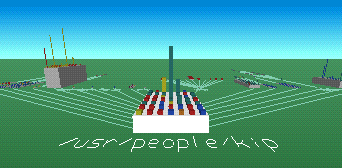
- FSN (pronounced "fusion") produces a cyberspace rendering of a file system. This was the original 3D file system navigator shown in Jurassic Park ("Hey, this is UNIX. I know this!").
[Screenshot] | [Download] (IRIX)
- FSV is modelled after FSN, but runs on Linux. FSV lays out files and directories in 3D, geometrically representing the file system hierarchy to allow visual overview and analysis.
[Screenshot] | [Download] (Linux)
- Xcruise lets you fly through a filesystem in 3D as if it were interplanetary space. Directories are represented as galaxies, files are represented as planets (whose mass is determined by the file size), and symbolic links are represented as wormholes.
[Screenshot] | [Download] (Linux)
- TDFSB is a 3D filesystem browser for Linux. Take a walk through your filesystem!
[Screenshot] | [Download] (Linux)
- Visual File System is a 3D file system visualizer for Windows. The tool scans a drive selected by the user, and then models the contents of the drive in 3D, based on the directories that are selected in a tree browser on the side of the display.
[Screenshot] | [Download] (Windows)
- 3Dtop is an extension for Windows that represents desktop icons in 3D, letting you to fly around your desktop. You can create coloured spotlights, background and floor textures, "paintings" (bitmaps), clocks, and "flags" that represent shortcuts.
[Screenshot] | [Download] (Windows)
- ROOMS turns a Windows desktop into a 3D world. You can see the world either through a first person perspective or with a map view, and you can populate the world with sounds, animated images, and 3D icons.
[Screenshot] | [Download] (Windows)
- CubicEye organizes windows into a navigable cube. Cubes can be arranged by thematic or functional subject matter, and can be explored either individually or collectively as part of a more comprehensive structure of multiple cubes representing various areas of interest.
[Screenshot] | [Download] (Windows)
- Vizible WorldViewer distributes windows across the exterior and interior surfaces of spheres, providing the means to visualize and navigate large numbers of web pages and data sources simultaneously.
[ -
Re:Another Linux 3D file manager
My site has been collecting 3D UIs for some time.
Here are links to some of the 3DUIs that are available today:
- FSN (pronounced "fusion") produces a cyberspace rendering of a file system. This was the original 3D file system navigator shown in Jurassic Park ("Hey, this is UNIX. I know this!").
[Screenshot] | [Download] (IRIX)
- FSV is modelled after FSN, but runs on Linux. FSV lays out files and directories in 3D, geometrically representing the file system hierarchy to allow visual overview and analysis.
[Screenshot] | [Download] (Linux)
- Xcruise lets you fly through a filesystem in 3D as if it were interplanetary space. Directories are represented as galaxies, files are represented as planets (whose mass is determined by the file size), and symbolic links are represented as wormholes.
[Screenshot] | [Download] (Linux)
- TDFSB is a 3D filesystem browser for Linux. Take a walk through your filesystem!
[Screenshot] | [Download] (Linux)
- Visual File System is a 3D file system visualizer for Windows. The tool scans a drive selected by the user, and then models the contents of the drive in 3D, based on the directories that are selected in a tree browser on the side of the display.
[Screenshot] | [Download] (Windows)
- 3Dtop is an extension for Windows that represents desktop icons in 3D, letting you to fly around your desktop. You can create coloured spotlights, background and floor textures, "paintings" (bitmaps), clocks, and "flags" that represent shortcuts.
[Screenshot] | [Download] (Windows)
- ROOMS turns a Windows desktop into a 3D world. You can see the world either through a first person perspective or with a map view, and you can populate the world with sounds, animated images, and 3D icons.
[Screenshot] | [Download] (Windows)
- CubicEye organizes windows into a navigable cube. Cubes can be arranged by thematic or functional subject matter, and can be explored either individually or collectively as part of a more comprehensive structure of multiple cubes representing various areas of interest.
[Screenshot] | [Download] (Windows)
- Vizible WorldViewer distributes windows across the exterior and interior surfaces of spheres, providing the means to visualize and navigate large numbers of web pages and data sources simultaneously.
[ -
Re:The problems of British industry
Don't fret. It's not an English invention but actually another (along with powered flight) New Zealand invention.
-
More about "Adam in Eden"
I read all the comments about this story.
First, if you want a direct access to my report, click here.
Then, even if I agree that's the code behind and the robot itself don't look *very complex*, I think the idea of a robot recharging its batteries from pseudo-flowers is pretty refreshing -- if I might say so.
And, finally, you need to read what Andy Russell, Professor at Monash University in Australia, says on his homepage: "For me this is a new area of research and so there are no publications as yet."
A last note: the small videos available on his site are really fun to watch.