Slashdot Mirror
Domain: msoe.edu
Stories and comments across the archive that link to msoe.edu.
Comments · 41
-
Re:From the open source world
While not chemistry class, students can and do make use of tools like this in high school. For instance, the SMART program.
-
Re:The real problem...
Actually most standard transistor radios, including some early ones, had six transistors.
The Regency TR-1 had four, using only one transistor in the audio section.
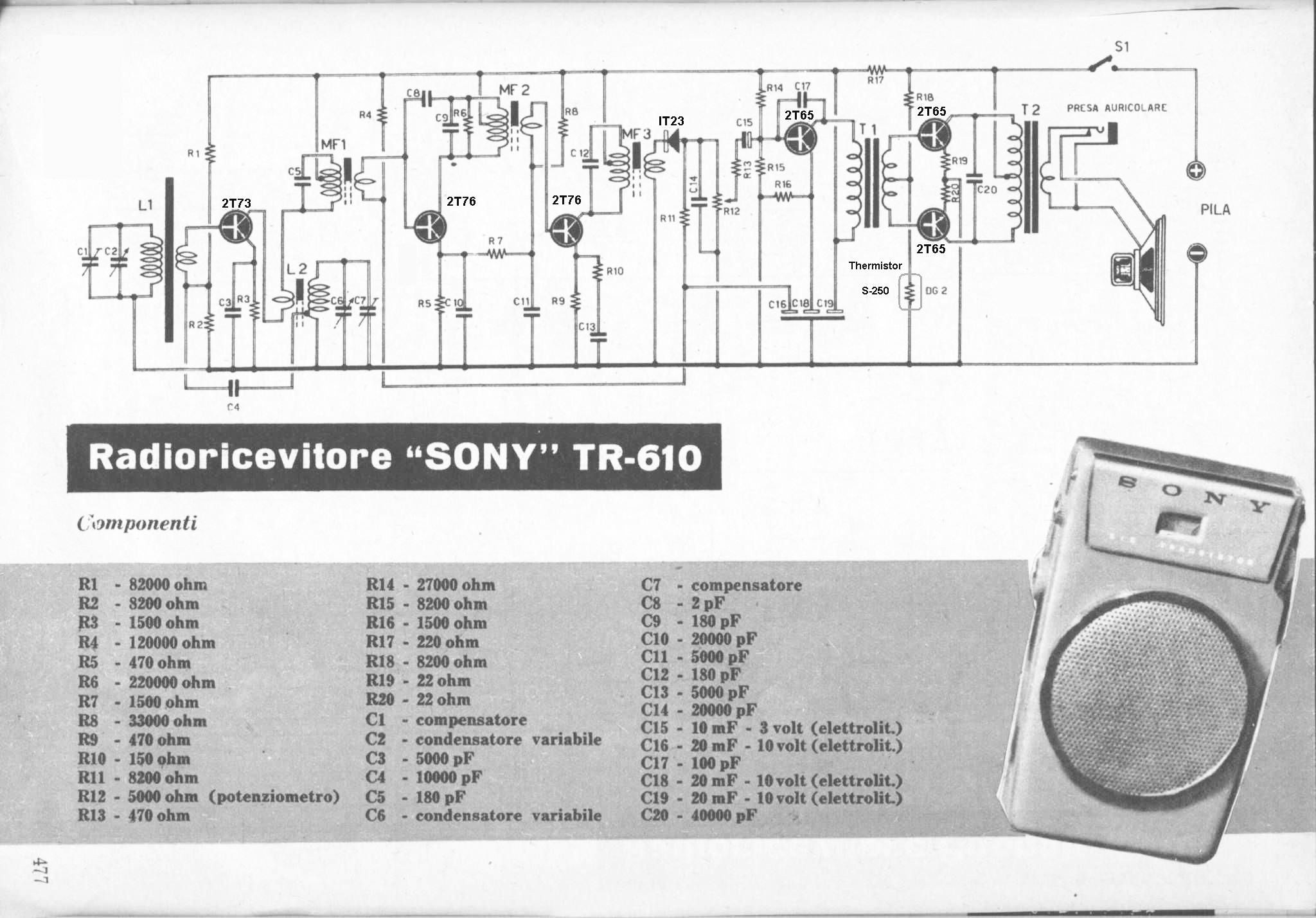
I just fixed an old 1958 vintage Sony TR-610 the other day. The schematic shows a converter transistor (oscillator that also performs mixing function), two I.F. (intermediate frequency) amplifiers, an audio preamp stage and a push-pull audio power amplifier. Although many later radios had the PNP variety of germanium transistors, early ones like the Regency and Sony used NPN. Some weird design variations were attempts to trim costs or weight. I recall some R.C.A. radios having a center-tapped voice coil on the speaker so the output stage could be push-pull without an output transformer.
It was probably close to 1970 when I noticed radios with an inflated transistor count. A pocket radio that listed 12 comes to mind. At least three functioned as diodes - one for the detector, and a couple for in the bias network for the output stage. I'm not sure if the others were even wired to do anything.
The inflated count just made me laugh. How cheated can one really feel when spending $1.97 (K-Mart price) for a radio? It was able to pick up WLS Chicago at night (then a fun pop station, much like the old 93 KHJ Los Angeles). I was in California, so I was impressed to get that station so well. It was a good year for skip, and the band wasn't as cluttered then. Listening now is a sad experience. There's hardly anything worth listening to, and most of what one can get on a distant station is identical to a local broadcast.
Some radios with more than 6 transistor were better. Those with a tuned radio-frequency amplifier stage added at the input often had better sensitivity and image-rejection. Image-rejection is the suppression of the signal 455 KHz above the oscillator frequency, normally the desired signal was 455 Khz below the oscillator frequency.
Of course I'm speaking of AM-only radios. Those with FM typically added a separate front end section, but managed to use the I.F. transistors for both frequencies (455 KHz and 10.7 MHz). The FM input section normally couldn't use just one transistor because with the oscillator and desired signal frequencies only about 10% apart there wasn't enough selectivity in the input tuning to prevent the oscillator signal from radiating excessively. Most F.M. receivers still leak some signal, which is why they were a problem on airplanes. With the oscillator running 10.7 MHz above the desired station it falls in the aircraft band if one is tuned on the top half of the F.M. broadcast band. Take an F.M. radio and tune it to a quiet spot in the top part of the band, then when you tune another FM radio nearby around 10.7 lower, you'll pick up the oscillator signal on the first radio. That can be useful. I once knew someone that ran a pirate F.M. station and went around tracking down listeners to say hi. Having various oscillator signals leak is one way those in countries requiring licenses for receivers can tell they are running.
There were a few radios with perhaps 2 transistors. They generally had poor sensitivity. I think the first transistor acted as a combo detector/audio stage, and the second as audio power amplifier. (That ran the amplifier in Class A mode, so battery life was poor even with only two transistors).
These radios were not the real superhet type an "adult" would normally have, and were sometimes called Boys Radios.
A low transistor count is possible with a super-regenerative receiver. Basically a tuned R.F. amplifier
has positive feedback which brings the gain up a great deal, and being at the point of os -
Re:Its Software Programmer!
Hate to burst your bubble, but there are universities with ABET accredited curriculum that produce Software Engineers. MSOE, RIT, University of Michigan and many others.
Engineering has nothing to do with engines, and everything to do with a methodology of design and implementation. -
Re:Its Software Programmer!
Hate to burst your bubble, but there are universities with ABET accredited curriculum that produce Software Engineers. MSOE, RIT, University of Michigan and many others.
Engineering has nothing to do with engines, and everything to do with a methodology of design and implementation. -
Generally not the case....
I attend school at MSOE Where Laptops are not just required, you have to lease the damn things from the school (they're HP/Compaq laptops). There IS a decent amount of theft, but generally it's one of two things
Either it's some random person from the neighborhood (not a student) who wanders into a school building, finds a laptop someone left ungaurded, yoinks it, and then runs (with no time to turn the laptop off, let alone the wireless).
Or, it's students who need their laptops repaired. The tech-support guys tend to need your laptop for a week or two for even the simplest repairs, so students tend to wait until between quarters (think short semesters, with pathetically small breaks in between them, oh and there's three of them, not four) to turn in their laptop for repair. What happens? The student's grades come back during the break and the results are bad. They have to leave the school. So this angry, bitter, ex-student now is SUPPOSED to return the LOANER laptop they got when they turned in their regular laptop. Instead, a lot (apparently) simply keep the loaner whilst giving the school a one-finger salute.
I wouldn't really care about the theivery (especially the first kind, as I only leave my laptop alone in LOCKED labs with security cameras pointing at it.. and I back-up my stuff
My point of this post is that Theiving of a students' laptops are almost always done by non-students (If you are a student, you've already got a laptop -
My school does this...I am a student at the Milwaukee School of Engineering. All full time students (~2500) are required to participate in the school's 'technology program' where part of your tuition pays for a laptop (that I am typing on now) to use and then own once graduated. You get your first one as a Freshman and then a new model once a Junior. It costs 1,400 each year. Students have tried many-a-time to get exempt from this and just use thier own computer- all have failed.
The idea behind it is that there is always the needed resources for students to get the most out of their educations. However, most usage of the laptops in the classroom is used for the instant messaging app of your choice.
As far as managing this from a support side: I know there are specific images for different degree's (i.e. Engineering degrees would get AutoCAD, etc. While business students would not.) I am not sure how the licenses are managed but I know people with expensive licensed software MUST get a factory image before receiving a diploma.
More reading --> http://www.msoe.edu/notebook/
-
Re:C++ has its place
And besides, compare apples to apples... cocoa is "Cocoa is an object-oriented application environment" (from Cocoa's web site, MFC/.NET are the equivalent under Windows. (MFC sucks but
-
Re:Batteries
i saw something about that here, comparing duracell and energizer. but what i really want to know is how do those store-brand batteries compare? they're like half the price, and i wish i knew if there was much of a power tradeoff.
-
Re:Why I'll buyI now work 50-80+ hours a week, free time isn't exacltly what it was in college. So only one next gen console will make it into my house.
Yes, I know this is off-topic. I just thought it was odd... My situation is exactly the opposite. When I was in college I dedicated 50-80 hours each week to school, between classes, projects, and other homework. Plus about 20 hours of paid-internship work each week. And outside school, I was usually worrying about some aspect of school.
Now that I'm working at my first "real" job, I put in 40-50 hours per week. And when I'm at home, I make it a point not to think about work at all. So not only do I have way more free time, but I enjoy it more too.
-
$343.45 in 2005 Dollars
The inflation calculator reports that the TR-1 would have cost $343.45 in 2005 dollars (it cost $49.95 according to a flyer on the TR-1 site).
-
Re:Not as many problems, though...
That would be an AM shuffle. Look at the dial.
-
Re:Drivel
They've already done that at universities that care about the craft, its "Comp Sci" vs. "Software Engineering"
http://msoe.edu/eecs/se/
http://www.se.rit.edu/ -
Re:numbers??
Yup, the University that I attended has flowscan up and running for all the public to see. Look here: http://flowscan.msoe.edu/p2pgraphs.html
It doesn't look like anything has slowed down. They have an OC3 by the way. (Small university ~2500 students) -
Missed School
Well they didnt bother with my school (MSOE) which is a shame. Every full-time student must get a "technology package" which includes a laptop which gets replaced every 2 years. Mine is a compaq hw8000. Granted it's not the largest school, but it's what we do. Even smaller colleges are included. So how did they choose their selections?
-
Re:I thought the TR-1 had 3 transistors
where is the 4th transistor located then? http://people.msoe.edu/~reyer/regency/clear1024.j
p g -
Real Time
QNX is put in places where failure cannot happen. At all.
Not quite! QNX is a Soft Real Time Operating System - situations that need to fulfill "hard deadlines", for instance a medical monitoring device, will use a Hard Real Time Operating System.
Clicky - QNX is Soft Real Time
Clicky - Different Real Time concepts
-
Re:Interesting
Video Mirror
-
Re:The trouble with isolated environments
Io?
It's highly unlikely that there's any life on Io. It appears to be too extreme for extremophiles. Perhaps you are thinking of Europa. Europa's the icy moon. Io's the volcanic one covered in sulfur. -
UML
-
Mirror
-
Re:Arrogance
Actually, their new scheduler (SCHED_ULE) for example was copied almost verbatim from Linux's O(1) scheduler. Sure, change words around and claim its only vaguely based on Linux, but believe me as someone who has read both sources - its a blatant rip off.
Wrong. Linux ripped the ULE from FreeBSD. Proof Here NOT the other way around.
I'm QUITE sure the code you read on your Linux box is very nearly identical to that of the code in FreeBSD, BECAUSE IT WAS RIPPED FROM FREEBSD BY Francesco Sportolari.
Jeffrey Roberson wrote FreeBSD's ULE, and I'M QUITE sure he'd be rather bothered by your accusations. ULE was designed as an improvement for SMP based systems, yet FreeBSD's scheduler is, and has been 0(1). Perhaps read This sometime. Also ULE is *NOT* the default scheduler, it's still SCHED_4BSD, atleast up until 5.1.(I don't run any 5.2 boxes, my only 5.x boxes are non-production)
Be sure you get your facts straight before you go off making false accusations against FreeBSD, and it's extremely talented and hard-working developers.
I love Linux for what it's accomplished, and I love *BSD for the same reason.
My personal preferance is FreeBSD, trying to change that is like trying to tell me that Chocolate Ice Cream is better than Vanilla.
-mpf
and quit marking me off-topic, I'm not! -
Mirror
-
Re:The missing pieces
-
Re:sounds usefulhere is one case the happened a few years back where part of a skull was found and the entire skull was rebuilt using rapid prototyping. In this one hoever they rebuilt the face using "low"-tech (clay I think) methods. Still pretty cool.
-
Typing of Fury
Typing of Fury (the keyboard-based version of this game) is an interesting take on the whole DDR thing. I had an opportunity to try out an unreleased beta of this that the developers allowed us to borrow for an annual convention that the gaming student org at my college runs. I'm not sure I like it, however. Yes, it's a good way to get typing practice in, but it just seems a bit strange . . . Perhaps it was just the keyboards, but occasionally, it seemed as though I'd hit the proper key at the proper time, but it wouldn't register (and I've got fairly good rhythm, having played classical piano for about 9 years). Of course, at this point, the game wasn't completely finished (one of the songs (I can't remember the title . . . something with noodles . .
-
As a legal term
To call yourself an "engineer" in several of the states in the U.S., you must pass two licensing exams. Texas in particular has been known to come down hard on people who use that title without taking the exams and being a licensed engineer. That's why I call myself a "software developer" instead of a "software engineer" if I can help it.
First, a software engineer must be an engineer. I have a bachelor of science degree in physics and master of science degrees in mathematics and computer science. In most states, I cannot even take the licensing exams and never will be able to unless I go back to college and get a bachelor's degree in some engineering field from an ABET-acredited school. (In some states, anybody can take the exams. Either way, my "liberal arts" degrees don't count for anything. Some other states consider math, physics, and chemistry bachelor's degrees acceptable, but not computer science degrees.) At any rate, the exams cover general engineering: electrical, chemical, civil, mechanical, industrial. The goal is to ensure you're a well rounded engineer.
Second, some states (at the urging of the local professional engineering societies) think any "engineering" effort must have at least one licensed engineer. This is a bigger deal than it might first appear.
Sure, I'd like to see someone who knows civil engineering involved with every non-trivial bridge that's built, and if Union Carbide built a chemical plant next door, I'd like a chemical engineer to be checking things out. (See also below.)
However, sometimes (Texas again) embedded software development projects are considered close enough to "engineering" to require, under law, at least one licensed engineer to be involved. Those civil and chemical engineers are considered qualified; with a master's degree and twenty years of experience, I am not.
There are a handful software professionals who are licensed engineers. (Want to guess what state they're in?)
Having said all that, let me say this. All the traditional engineering fields have universally understood, univerally accepted bodies of knowledge, usual captured as some kind of code (as in "building code"). That's why I feel the way I do about bridges and chemical plants. On the other hand, while most individual software engineers think they have such a body of knowledge, no two agree on what it is. There is an effort to define this; a draft version "is ready for field trials for a period of two years."
Even a school that offers a "software engineering" degree says, "There is no universally accepted definition of software engineering, though there are elements of a forming consensus."
My humble opinion? Engineering disciplines have with good mathematical foundations: here's the equation for the tensile strength of steel, here's the formula for voltage as we increase power. Software development efforts do not have such a foundation. Some attempts have been made to provide one, but they're almost never applied.
P.S.: I do not live or work in Texas. -
Re:No Internet2
theres a few reasons they don't have I2 connectivity....
1) they're new
2) old engineering schools (The Milwaukee School of Engineering, approaching their centenial) don't have them
3) what the heck does i2 give to undergrads? (yes, its good for researching really damn fast internet connections, but i'd imagine thats more better for grad students, which i don't think this school has yet) -
Where the linkage? :-(
For it being the 'holy grail' in software development, it seems like the poster could have dug up some sort of linkage for those not hip with exactly what STL truly is all about...
For the ill-informed, please see the following links concern the C++ Standard Template Library (STL):
*** Mumit's STL Newbie guide
*** Standard Template Library Online Reference Home Page
*** Another Informational Link
There, I feel much better.... and hopefully you do, as well!!!
-
one of the cdroms
As much as I hate to admit it, I think I would be interested to read some of the comments that people had to say on this matter. Does anybody know how the CD-ROM's that they speak of in the article could be obtained? This might even be good for my school's library.
-
Go to MSOE for college if you want team projects
I am a software engineering student at MSOE. Our program is extensively team based. We do get graded quite well because we provide feedback on our peers and because our class size is really small. (There are only 15 in most of my SE-related classes). When I get out of college, I will have skills that many do not. So, if you like programming and would like to learn how to "engineer" software (not simply write it), check us out.
-
Summer project openings!!
This project was originally a senior design project in the Rapid Prototyping Center of Milwaukee School of Engineering. Since the graduation of the involved students (two years ago) the project has gone inactive.
Undergraduates interested in summer research in SFF and other rapid prototyping technologies can find more information at www.msoe.edu/reu
General information on the Rapid Prototyping Center is available at www.rpc.msoe.edu
-
Summer project openings!!
This project was originally a senior design project in the Rapid Prototyping Center of Milwaukee School of Engineering. Since the graduation of the involved students (two years ago) the project has gone inactive.
Undergraduates interested in summer research in SFF and other rapid prototyping technologies can find more information at www.msoe.edu/reu
General information on the Rapid Prototyping Center is available at www.rpc.msoe.edu
-
Rapid Prototyping Machine
I used to goto Milwaukee School Of Engineering (MSOE) they have one of the top research labs for rapid prototyping. You can do more than make replacement parts. Molecular models and biological models can also be made. Once they recreated a human jaw bone to help solve a crime.
Here is an overview of how rapid protyping works. here -
Rapid Prototyping Machine
I used to goto Milwaukee School Of Engineering (MSOE) they have one of the top research labs for rapid prototyping. You can do more than make replacement parts. Molecular models and biological models can also be made. Once they recreated a human jaw bone to help solve a crime.
Here is an overview of how rapid protyping works. here -
Re:Computer Engineers
From the eyes of a computer engineer...
The difference, in my opinion, is in the non computer courses. As an engineer you take tons of physics and tons of math and all those other classes that we love to hate. Like it or not, you'll have an engineer's degree, which means you'll have all the hard classes. But you also take some pertty cool classes. My curiculum (at Milwaukee School of Engineering) was split down the middle with half going for software and half going to hardware. This was nice because our electives finished our choise. So don't think that you have to work with hardware if you're a computer engineer.
In addition to the above, you gain an advantage in programming if you know how the hardware works. That fact has helped me many times.
There were some other comments in this thread about making sure you take C/C++/Java and I can't second that enough. I would also try to get some assembly just to know what that's all about. A software design class wouldn't hurt because most larger companies will ask if you know UML.
The engineering path is definetly the harder one. Another side bonus to picking the engineering degree is that if you flunk out you can always switch to Computer Science.
Just my two cents,
L8Knight Programmer -
Compare curriculums
Something that may help you decide would be to compare the curriculums of those two programs at a couple schools. I am a 3rd year CE student at Milwaukee School of Engineering. In addition to CE, MSOE offers a software engineering degree (CS on steroids). You can look at the courses you would be taking for CE and SE on their respective department web pages. The biggest difference in programs comes in junior and senior year. This is when the SE's start spending 20 hours a day in the programming lab, coz they have 3 labs to do
-
Compare curriculums
Something that may help you decide would be to compare the curriculums of those two programs at a couple schools. I am a 3rd year CE student at Milwaukee School of Engineering. In addition to CE, MSOE offers a software engineering degree (CS on steroids). You can look at the courses you would be taking for CE and SE on their respective department web pages. The biggest difference in programs comes in junior and senior year. This is when the SE's start spending 20 hours a day in the programming lab, coz they have 3 labs to do
-
Cancer in lab rats
Besides, what causes cancer in rats doesn't necessarily cause cancer in humans.
Indeed, scientists have known for years that laboratory testing causes cancer in rats.
-
My Software Engineering Course was Very Good!I think I learned a lot from my software engineering course.
Maybe you had a bad professors for your courses. Mine really knew his stuff. In fact, he recently started a Software Engineering major at MSOE.
There were a few good things about my SE class. (I only had one). One thing was that we were split into teams (not of our choosing). This simulates the real world. We also had project to work on where the professor was the client. And we did the project in 2 phases. (We only had 10 weeks!) The 2nd phase added some requirements and we got to see how good our design from the first phase was. We got to use Rational Rose, which is a pretty nice CASE tool. Once you put your model in as UML, you click the "Generate" button, and Bam! Out comes the skeleton code in either C++ or Java. We used C++ and put a MFC based front end on our app. Doing the actual programming was the easy part!
Then as an outside project I took the back end code and wrote a KDE front end for it!. And I did it in you a couple of hours!! I think this shows the importance of creating a design that is as non interface-specific as possible. (Depending on the purpose of the app, of course). One thing I like to do is think of what the back end code would have to look like so that the interface could be either text mode or GUI. It makes you think! Perhaps a good example of this is Linuxconf, with a text, X, and web interface, but I haven't looked at the code at all.
The SE course I took was probably on of the hardest (most work) courses I had in my four years, but it was also the most interesting.
I do agree that SE is a young field. Compare it to something like Architechtural Engineering. Architechture has been around for thousands of years. Computers have only been around for, what, about 50. And the idea of actually doing software engineering is even younger.
Hopefully the good ideas (I hate the phrase "best practices") in Software Engineering will stick and we will have better software to show for it soon. I agree with another poster though in that market pressures make this difficult for commercial software development.
-
My Software Engineering Course was Very Good!I think I learned a lot from my software engineering course.
Maybe you had a bad professors for your courses. Mine really knew his stuff. In fact, he recently started a Software Engineering major at MSOE.
There were a few good things about my SE class. (I only had one). One thing was that we were split into teams (not of our choosing). This simulates the real world. We also had project to work on where the professor was the client. And we did the project in 2 phases. (We only had 10 weeks!) The 2nd phase added some requirements and we got to see how good our design from the first phase was. We got to use Rational Rose, which is a pretty nice CASE tool. Once you put your model in as UML, you click the "Generate" button, and Bam! Out comes the skeleton code in either C++ or Java. We used C++ and put a MFC based front end on our app. Doing the actual programming was the easy part!
Then as an outside project I took the back end code and wrote a KDE front end for it!. And I did it in you a couple of hours!! I think this shows the importance of creating a design that is as non interface-specific as possible. (Depending on the purpose of the app, of course). One thing I like to do is think of what the back end code would have to look like so that the interface could be either text mode or GUI. It makes you think! Perhaps a good example of this is Linuxconf, with a text, X, and web interface, but I haven't looked at the code at all.
The SE course I took was probably on of the hardest (most work) courses I had in my four years, but it was also the most interesting.
I do agree that SE is a young field. Compare it to something like Architechtural Engineering. Architechture has been around for thousands of years. Computers have only been around for, what, about 50. And the idea of actually doing software engineering is even younger.
Hopefully the good ideas (I hate the phrase "best practices") in Software Engineering will stick and we will have better software to show for it soon. I agree with another poster though in that market pressures make this difficult for commercial software development.
-
My Software Engineering Course was Very Good!I think I learned a lot from my software engineering course.
Maybe you had a bad professors for your courses. Mine really knew his stuff. In fact, he recently started a Software Engineering major at MSOE.
There were a few good things about my SE class. (I only had one). One thing was that we were split into teams (not of our choosing). This simulates the real world. We also had project to work on where the professor was the client. And we did the project in 2 phases. (We only had 10 weeks!) The 2nd phase added some requirements and we got to see how good our design from the first phase was. We got to use Rational Rose, which is a pretty nice CASE tool. Once you put your model in as UML, you click the "Generate" button, and Bam! Out comes the skeleton code in either C++ or Java. We used C++ and put a MFC based front end on our app. Doing the actual programming was the easy part!
Then as an outside project I took the back end code and wrote a KDE front end for it!. And I did it in you a couple of hours!! I think this shows the importance of creating a design that is as non interface-specific as possible. (Depending on the purpose of the app, of course). One thing I like to do is think of what the back end code would have to look like so that the interface could be either text mode or GUI. It makes you think! Perhaps a good example of this is Linuxconf, with a text, X, and web interface, but I haven't looked at the code at all.
The SE course I took was probably on of the hardest (most work) courses I had in my four years, but it was also the most interesting.
I do agree that SE is a young field. Compare it to something like Architechtural Engineering. Architechture has been around for thousands of years. Computers have only been around for, what, about 50. And the idea of actually doing software engineering is even younger.
Hopefully the good ideas (I hate the phrase "best practices") in Software Engineering will stick and we will have better software to show for it soon. I agree with another poster though in that market pressures make this difficult for commercial software development.