Slashdot Mirror
Domain: multinationalmonitor.org
Stories and comments across the archive that link to multinationalmonitor.org.
Comments · 39
-
Re:This is just an attempt by the Republicans...
Well, let's see...
- The Chernyobyl accident, which shouldn't need further explaining.
- The Aralkum, a desert created by the USSR out of the Aral Sea.
- Lake Karachay, which the USSR used as a dumping ground for nuclear weapons.
- The Bitterfield Chemical Combine's deliberate destruction of of the surrounding area.
- A study by an Ralph Nader (hardly a Republican) organization, about environmental devastation in the USSR.
- The USSR dumping worn-out nuclear reactors into the ocean.
That's from one quick search (obviously not needed for the Chernobyl item). And beyond those, the contrast in the level of pollution between democratic, capitalist West Germany and authoritarian, Marxist East Germany at the time of unification is well-documented, the subject of many studies and articles. It's about as close to a lab comparison as you could ask for.
Are there, and have there been, environmental problems in the free world? Certainly. But the idea that they're worse than in undemocratic countries is ludicrous, especially since the Marxist countries had their problems even with the benefit of hindsight, since most of them industrialized long after the free world had.
-
Re:So what?
No one has a right to Internet access, and it's not even essential to life like food is
One, food isn't a right either. And two, life isn't essential. Oh, and you don't pay the full cost of food either. Large corporations like Cargill get billions of US taxpayer dollars a year in subsidies. The Free Markets CATO Institute published a policy analysis about Archer Daniels Midland, A Case Study In Corporate Welfare. ADM like Cargill get billions of dollars in subsidies a year. I don't know about you but I'd rather choose who I hand money to, either as a trade or a donation. Government doesn't give that option though.
Falcon
-
Re:Universal service.
Maybe the rest of the world is tired of the American sense of entitlement, your tendency to export really bad laws onto everybody else, and the fact that
You decry the "American sense of entitlement" and "Run Paul" one sentence later. If you meant Ron Paul then there wouldn't be an "American sense of entitlement". Nor would the US export bad laws as a President Ron Paul would try to get rid of as many victim-less crime laws as he could. The US has the world's largest prison population and the biggest set of crimes prisoners were found guilty of is drug laws. People who don't harm or steal from others are in gaol simply because they dealt in or possessed illegal drugs. By getting rid of laws that make possession and use of drugs a crime not only can the prison population be cut substantially but the people could actually boost the economy by working and paying taxes. The government's budget, what it spends would be much smaller too. And wouldn't be partially hidden, like the billions of dollars spent on stupid and unconstitutional wars. No war on liberty, which is what the war on drugs is, no Afghan war, no Iraq war. There would also be no subsidies to large corporations, like the billions of dollars in subsidies Cargill gets for exporting food, driving farmers in third world nations off their own farms because they can't compeat against US government largess.
Falcon
-
Re:Farm subsidies?
And tax breaks for the rich? They pay all the taxes (the top-5% pays almost 68% of the taxes!), so they are likely candidates for tax breaks.
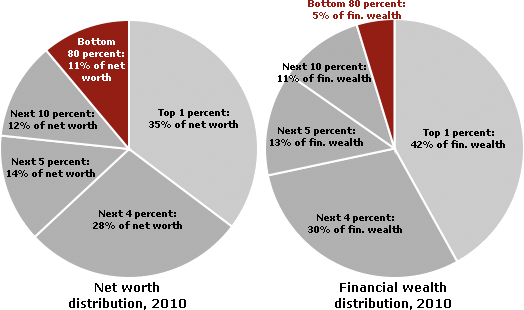
A quick search reveals statistics that the top 5% also have about 60% of the total wealth - and while that figure may be somewhat inaccurate and the merits of using wealth vs. income are also debatable, I think that indicates that within an order of magnitude the top 5% are pretty much just paying what they should be paying in a linear tax system relative to their wealth.
And that's before we start discussing progressive tax systems, the cost necessities, cost of living, etc.. Those might not be up your economic-political street but if you're trying to find the ephemeral "fair" balance should be considered.
Remark though that I personally, as a citizen of the Commie Pinko European Union, believe that nomatter how much the lower 95% would like to get their hands on more of the top 5%'s money, they'll never get it without bloodshed (and even then they might lose), because that top 5% has access to any and all means of keeping their money away from the masses. Most of those means are perfectly legal, but even if the legal means do not suffice that top 5% has the best chance of pulling the more nebulous ways off with impunity. -
Re:You can't have your cake and eat it too...
They're one and only job is to make money for their shareholders.
No, the one and only job of a corporation is to benefit the common or public good. In return for doing they are given limited liability. The first two corporations granted charters were the Dutch East India Company in 1602 and the British East India Company in 1604 just for this reason. The Dutch and British believed trade benefited the public yet shipping was risky. Both companies were shipping companies shipping cargo like tea from India to Europe, however ship owners were liable for the loss of cargo as well as crew and passengers. If any cargo was lost due to hurricanes or pirates the shipping company was liable for that loss. So government gave their investors limited liability with the understanding that if a company no longer serves the public good it's charter can be revoked. Of course as Thomas Jefferson foresaw and warned about the corporate aristocracy that "would dare already to challenge our government to a trial of strength and bid defiance to the laws of our country." Corporations no longer have to fight government, they write laws now.
Also capitalism is not the enemy, the corporate aristocracy is the enemy. Do you really think you'd be sitting there surfing the web with enough to eat if not for capitalism?
Falcon
-
capitalism and corporatism
a Capitalist system is an unstable social construct that tends to slide into Corporativism.
Only if the rules for granting corporate charters are not observed. Corporate charters, which grant limited liability, were only granted when it served the common or public good. That is why the Dutch East India Company in 1602 and the British East India Company in 1600 were granted their corporate charters. They were both shipping companies and it was understood that international trade was positive, however shipping was a risky business. Ships, their cargo, crews, passengers, and the ships themselves were frequently lost due to bad weather or pirates. Without limited liability people did not want to risk everything they owned, including their homes, by investing in shipping. Those charters can be revoked though.
Thomas Jefferson warned about the Corporate Aristocracy, saying "I hope we shall... crush in its birth the aristocracy of our moneyed corporations, which dare already to challenge our government to a trial of strength and to bid defiance to the laws of their country." Corporations no longer have to challenge our government, instead they buy the politicians who make the laws and the bureaucrats who enforce them. With a smaller, limited, government they wouldn't be able to do so.
I postulate that, given the way Politics (the rule setters), Power and Money interact, it is impossible to have a situation where the Players do not influence the Rules and furthermore, the bigger the player the more influence they have in setting the Rules.
That's true because of the size of government and it's regulations grows. Corporations use regulations, and often take part in writing those regulations, to limit their competition. For instance lawn care businesses like TruGreen lobby local governments to regulate lawn care businesses going so far as to require licenses. Hell, some places even regulate yard sales.
Falcon
-
Re:Money for Something
The vast majority of American capital is owned by the middle class.
No. First, the top 5 percent own more than half -- i.e., the majority -- of all wealth. Second, most of those stocks in middle-class retirement funds are not owned by those middle-class people, they're owned by the Wall Street financial services corporations, and so are controlled by the boards of those corporations. The account holders are customers, not owners.
Nobody controls "economic resources" except the forces of supply and demand.
Uh, no. The resources used for economic production -- land, natural resources, factories, money, ideas (copyrights and patents) -- all are privately owned and controlled.
Presumably, you are whining that only a small minority of people are responsible for very large investments. But nothing is stopping you from joining them.
I'm not "whining" about anything, I'm pointing out that a system of centralized power is good for those who have the power, and not for the rest of us.
But several things are stopping me from being ultra-rich. First, I cannot afford to waste my time collecting dollars: I have little desire to be rich. (Prosperous, yes, of course.) But more than that, as a person of strong ethical character I see few ways to accumulate large amounts of wealth that don't involve unethical behavior. Finally, to become rich in our society it's pretty much necessary to start that way -- the U.S. has very poor intergenerational class mobility.
All they ask is that they get a cut, for their trouble.
What trouble? They provide no labor. They take some risk of not getting their money back, but so do people at the blackjack table. We don't consider them virtuous.
And they take more than a cut: in our capitalist system, the majority of the value created by labor is skimmed off by the investment class.
The U.S. GDP is about $14 trillion. Our workforce is about 150 million people. The average American worker creates about $93,000 worth of value a year. Do they receive a salary that reflects that? Nope. Most of that amount goes to interest, dividends, and rents paid to various investors, people who didn't do the work but reap the benefit -- and most of it goes to the aristocracy.
-
shipping
in the old days it was tough to stay in the shipping business after your ship sank.
This is why corporations were created, because shipping was a risky business. Way back when, before 1600, if a cargo ship or any of it's cargo was lost the ship's owners were liable. They were also liable for the crews. If a ship sank because of a hurricane or was attacked by pirates too bad for the owners. So in 1600 the British crown granted a corporate charter to the East India Company. The corporate charter gave the owners of the corporation limited liability. Whereas someone who owned a ship could lose everything, including their home, the most a share or stockholder in a corporation can lose is the amount they paid for the shares. Corporations also allow the pooling of a lot of people's money for a business. The next corporate charter was granted to the Dutch East India Company by the Dutch crown in 1602.
However something has been lost in the years since. Corporations were only granted charters if they served the common or public good, and shipping was considered a good. If a corporation no longer did serve the good it's charter could be revoked. Those charters aren't revoked in the US anymore.
Falcon
-
corporate responsibilities
a commercial enterprise's primary concern is profit. they're obligated to their shareholders
Actually a corporation's primary responsibility is to improve the public good. The first two businesses granted corporate charter were the Dutch East India Company in 1602 and the British East India Company in 1604. Both were shipping businesses and shipping was a risky business to be in. The British and Dutch thought shipping was a common good, so to encourage shipping these companies were granted limited liability. If a ship sank because of bad weather or was attacked by pirates the ship owners were liable for the loss. The owner could lose everything including their home. So liability was limited to just what the corporation owned. A person could own stocks in the corporation and the most they would loose is the amount they paid for the stocks. If a corporation no longer served the public good then it could have it's corporate charter revoked.
However generally corporations are no longer held accountable to the public good. Instead as Thomas Jefferson warned of we now have a corporate aristocracy.
Falcon
-
You tell a coporation to not grow?
Yes I do.
Growth is the sole raison d' être for a corporation.
No it isn't. The sole purpose of a corporation is to serve the common good or pubic good. The first corporations granted corporate charters were the Honourable East India Company in 1600 and the Dutch East India Company in 1602. Both India Companies were shipping businesses, the Honourable company shipping goods between Britain and India and the Dutch operating between India and the Netherlands. Shipping was a risky business, a ship could be attacked by pirates, the crew could mutiny, or the ship could run into bad weather. And the ship's owner was liable for any and all cargo lost as well as for the lives of the crew. If for whatever reason a ship was lost that could bankrupt the owners. So the British and Dutch governments granted corporate charters to these companies which gave them limited liability. With limited liability the most an owner could lose is the amount they invested.
But because of this limited liability corporations were only granted charters if they served the public good. Once a business no longer served it it could have it's corporate charter revoked. Unfortunately as foreseen by Thomas Jefferson corporations became too powerful so they are no longer held to the standards of serving the public good.
Falcon
-
corporations
even if you don't give a corporation a corporate charter (Something I am pretty much against ANYWAY)
Corporations do have their place, though not like they are now. The first two corporations were the Honourable East India Company, granted it's corporate charter in 1600, and the Dutch East India Company, granted a charter in 1602. Both companies were shippers, they shipped goods between England, for Honourable, and the Netherlands for the Dutch company and India. Shipping was a risky business. The crew could mutiny, the ship could sink because of a hurricane, or it could be attacked by pirates. When cargo was lost for any of these reasons, or others, the ship owner was liable to the owner of that cargo and had to pay them back. The ship owner was also liable for the lives of the crew. These liabilities made shipping a bad business so the British and Dutch crowns granted corporations limited liability, all investors could lose is the amount they invested in the corporation. The increased trade benefited many people not just a few. However it could also harm people, so corporate charters were only granted if the corporation improved the common good or public good. If a corporation no longer served the common good it could have it's charter revoked. Today revocation doesn't happen but if it did then corporations would have to change.
Big Brother sucks, but sometimes you need him. And I say this as someone who refuses to vote democrat or republican, so I take govt with a grain of salt
Agreed but I distrust businesses less than I distrust government. In the 20th century alone governments killed, exterminated, more than 70,000,000 people. European governments did a pretty good job in the Americas, the NAZIs exterminated 600,000 Jews and I don't know how many others, Stalin massacred 20,000,000 and it's said Mao massacred 50,000,000. Then there was Pol Pot during the '70s in Cambodia, Saddam Hussein in Iraq, what happened in Rwanda with genocide there in the early '90s, and the genocide started in the later '90s in Darfur.
No business, except possibly the tobacco industry, has killed as many people as government has. And chewing, dipping, or smoking tobacco is voluntary.
Falcon
-
Re:We are not in the dark.
Does a former corporate securities attorney with 23 years experience qualify as a reputable source?
http://www.commondreams.org/views02/0119-04.htm
http://www.multinationalmonitor.org/mm2002/02july-aug/july-aug02corp4.html -
Re:Rule of Law.
One of the problems with the historically-high capital gains tax, is that 2/3rds of the investment shares are held by middle-class folks, NOT by the very rich.
Could you post a link to that statistic, because from what I've read the wealthiest five percent of Americans hold 59% of the wealth. and roughly 68% of investment wealth. Expand that to the top ten percent and those numbers become 71%(net worth) and 80%(investment) of the wealth respectively. -
Local farming to suffer?
Too bad their farming self-sufficiency will once again, be at the whims of foreign multinationals because, that's what freedom is all about. Freedom to buy foreign goods and services.
http://multinationalmonitor.org/hyper/issues/1994/11/mm1194_06.html -
Re:Why not fire them all?
-
Msft ran a tax scam in the USA also
-
Msft ran a tax scam in the USA also
-
Re:kind of like a series of tubes
It has nothing to do with technology. It's about acceding to the demands of an entirely different industry.
-
BP history
BP seems to have a history of environmental callouses, just watched a prgogram on the history channel scrutinizing them for an explosion at a factory that killed a bunch of the workers, they put the trailer for worker breaks right next to a potential explosion. Found an interesting website about it link link2
-
Re:The real pointIn the United States, in the last survey year, 1998, the richest 1 percent of households owned 38 percent of all wealth.
3 interviewswolff.html -
Are you aware of msft's history and reputaion?
We are talking about a company that outright lied the USA-DOJ, and the EU, A company which has been caught red-handed in numerous scams, and outright theft. A company with a very well documented history of numerous mis-information campaigns.
Msft is funding the scox-scam, stold stacker technology, hires bloggers to post msft propaganda, hires shill journalists like Enderle, files dozens - if not hundreds - of bogus patents, and creates fake think-tanks. Msft is currently running a enormous fud campain against ODF - and ruined the career of Peter Quinn along the way. Msft has been caught secretly sponsoring fake TCO studies, and fake benchmarking studies.
Not to mention tax scams and racketeering.
Msft astroturfing:
http://lxer.com/module/forums/t/24514/
Fake TCO:
http://os.newsforge.com/print.pl?sid=05/06/23/2027 229
Microsoft Tax Scam
http://multinationalmonitor.org/hyper/mm1297.08.ht ml
Bestbuy rackteering
http://consumerist.com/consumer/lawsuits/best-buy- attorney-admits-to-falsifying-emails-in-racketeeri ng-case-266395.php -
Re:I've read the book...
Math was never my strong suit, especially after I first wake up. Here are more coherent statistics:
http://multinationalmonitor.org/mm2003/03may/may03 interviewsbernstein.html -
Re:Oh Please
"you do know that 79% of the tax burden is carried by the top 20% of income earners, right?"
You mean those folks that hold the vast majority of the assets? Sure just cherry pick a single statistic from a single source and proclaim 'look what I know, you dip shits didn't know this did you, huh, huh?'. Look the issue here is just how out of balance things can get EITHER way before it breaks the system. The balance right now grossly favors those at the top of the economic food chain. If it continues to the point of breakdown just what do you think the fate of the top x% will be? In the end it is in everyones interest to not break the frickin system.
"Maybe for once we should stop being partisan"
Yea, thats rich, considering the drivel to from the "conservative" party I have listened with great restraint, and admittedly often with amusement, for most my life. Can you make a clear argument just using common sense instead of falling back on a single cherry picked statistic form BillO's list of "facts" to throw at a liberal---remember you have to use this word in with a dirty slur pretext or voice. Don't take this to mean I am a just another sheep in the Democratic flock, which in contrast to the Republican flock, is actually more like a herd of cats anyway. I will say I like many others are sick of the "good cop - bad cop" routine the two parties have used so successfully for so many years. So exactly whose drivel is it you like best? Oh thats right you like to quote the "fiducially conservative ones", hehehe, yea.
Wabi-Sabi
Matthew
read...
http://www.federalreserve.gov/boarddocs/speeches/2 007/20070206/default.htm
http://www.ft.com/cms/s/f5e905ce-69d8-11db-952e-00 00779e2340.html
http://neweconomist.blogs.com/new_economist/povert y_and_inequality/index.html
http://www.chicagofed.org/economic_research_and_da ta/wp_abstract.cfm?pubsID=732
http://multinationalmonitor.org/mm2003/03may/may03 interviewswolff.html
http://www.economist.com/world/displaystory.cfm?st ory_id=7055911
http://ideas.repec.org/a/ecj/econjl/v112y2002i478p c68-c73.htm
http://dollarsandsense.org/archives/2004/0704tilly
http://www.nybooks.com/articles/18995
http://online.wsj.com/public/article/SB11418244330 8492484.html
http://www.ft.com/cms/s/71954e1a-ad43-11da-9643-00 00779e2340,Authorised=false.html?_i_location=http% 3A%2F%2Fnews.ft.com%2Fcms%2Fs%2F71954e1a-ad43-11da -9643-0000779e2340.html&_i_referer=http%3A%2F%2Fne weconomist.blogs.com%2Fnew_economist%2Fpoverty_and _inequality%2Findex.html
http://ksgnotes1.harvard.edu/Research/wpaper.nsf/ -
bad ads?
Ford shouldn't be allowed to run ads for Chevy cars that make them look bad, for example. Why not?
Because society is better served by requiring companies to be truthful in their advertising
And what if the ad is true? Wouldn't it serve the public for Ford to let people know that GM refuses to do the right thing - recall its dangerous C/K pickup trucks?
Falcon -
Re:alarmist bullshit
I tried to find you an online source but failed.
This story, and other stories mentioning recyled waste being shipped abroad, has been in all the major UK newspapers this week. The parent poster is telling no lies.
These links talk about that. They mostly talk about waste coming from the US, but I imagine what's piling up in the 3rd world is coming from everywhere.
http://multinationalmonitor.org/hyper/issues/1992/ 06/mm0692_10.html Plastics: Trashing the Third World
http://www.usatoday.com/tech/news/2002/02/25/compu ter-waste.htm Much toxic computer waste lands in Third World -
military industrial complex
U.S. weapons contractors have
1) exaggerating the threats faced by the United States;
2) marketing their weapons systems as the answer to national security problems
3) exploiting well-cultivated relationships with Pentagon officials
Profits of War Feb 2004
Boeing, Lockheed Martin, and Northop Grumman -
Well...
Based on what we know about government contractors today (Halliburton, Bechtel etc.) if anything, this is going to increase spending (http://multinationalmonitor.org/mm2004/04march/m
a rch04corp3.html). On top of that, the money will probably be funneled into offshore accounts without due tax.
NASA needs to practice some interpreneurship instead - motivating managers and engineers to choose cost effective solutions to problems instead of buying into the privatization scam which will do nothing to help the economy and everything to strengthen the position of a few megacorporations. -
Re:Spoken like a true idiot.Your argument, and I quote, "...but they are derelict in their duties if they do not do everything in their power to make obscene amounts of money for their "tremendously rich" stockholders." implies that the "tremendously rich" are the only reason corporations exist. As I pointed out, the public at large has a majority interest, and eliminating such ownership reduces their participation in the matter and in the process.
Yes, you made up some statistics and then didn't back them up. When I challenged you on that you said:
As to the stats, Google your own research and add up your own numbers for a change.
No. You are the one making these claims, it's your responsibility to back them up. As for me, I did do some googling and I came up with this interesting tidbit:
The wealthiest 1 percent of shareholders currently own just under 45 percent of all stocks, by value. That's over seven times more than the combined value of the shares held by the entire bottom 80 percent of people who own stock. This bottom 80 percent owns just 5.8 percent of the nation's total stock value.
So, basically, you're just wrong. You live in fantasy-land, where poor people are rolling around in Microsoft stock. Keep dreaming. Oh, and here's the link. I'm still waiting for your link, but somehow I doubt it will arrive since your numbers and your beliefs are based on fantasy. You desperately wish that the current system was fair, but it is not. What I find interesting is that the bottom 80% are people who actually own stock. There are many people out there who don't own stock in a single company. To try and find out what percentage of people owned stock I did some more research since you are too lazy and dishonest, and I found this:
What did happen is that the percentage of households with some ownership of stocks, including mutual funds and pension accounts like 401(k)s, did go up very dramatically over the last 20 years. In 1983, only 32 percent of households had some ownership of stock.By 2001, the share was 51 percent. So there has been much more widespread stock ownership, in terms of number of families.But a lot of these families have very small stakes in the stock market. In 2001, only 32 percent of households owned more than $10,000 of stock, and only 25 percent of households owned more than $25,000 worth of stock. So a lot of these new stock owners have had relatively small holdings of stock. There hasn't been much dilution in the share of stock owned by the richest 1 or 10 percent. Stock ownership is still heavily concentrated among rich families. The richest 10 percent own 85 percent of all stock.
So, only around 50% of the population actually owns any stock. That seems to directly contradict what you wrote earlier, and I quote: "public at large owns about 60% of all the stocks in this country." The only thing I wonder is whether you were mistaken or lying.
And just to return the favor, you sound like a common, garden-variety anarchist, forever ranting against the "system", and always advocating the destruction of that which he's unable to understand, to be replaced by a uptopian... something, that he's always not quite able to elucidate.
For the record, I am not an anarchist, but being called one is a refreshing change from being called a commie. I guess it's clear that you are totally wrong by now, even to you. You are the one who does not understand the system. The fact is, I do understand the system, and that's why I want to change it. Your ignorance (and others like you), appalling enough as it is, results in the perpetuation of an unfair and unjust system that could be either scrapped completely or radically reformed. I would prefer we start over, but that does not seem feasible at the moment. I think we should at least try to g
-
Re:It fell on its own?
I ran into an article which discusses part of the issue (although not the entire issue).
In a 1982 letter to congressional investigators, June Gibbs Brown, NASA's Inspector General, revealed that a large portion of Rockwell's work on the fixed-price GPS project was being charged to open projects like the space shuttle. A few months earlier, in November 1982, the Justice Department agreed to a $1.5 million civil settlement with Rockwell after investigating similar allegations. According to Brown's letter, the settlement may have been too easy on Rockwell. NASA audits revealed that Rockwell's cost-plus government contracts, had huge cost overruns, some as high as 400 percent. Rockwell's fixed-price contracts, underwritten by the company when costs exceed projections, had no over-runs.
That's not the whole story, though. They also got in trouble for the same thing on all sorts of projects, like the B1. They had all sorts of messed up billing practices back then that they ended up getting busted over. -
Re:Great. Now what?
Condi Rice also had an oil tanker named after her. Great pick as Secretary of State -- really shows where America's priorities lie.
-
ADM link...
d'oh! i forgot to add this link: http://multinationalmonitor.org/hyper/mm1296.04.h
t ml#corp1 it's a reference to Archer Daniels Midland who are pretty fucking evil. i learned about them because they always sponsored PBS shows like nova. but then i learned more about them. they do some insane amounts of lobbying and fixed a bunch of prices on things that they produced. some call it smart business, i call it mother fucking. -
Re:Now we know nothing will ever be done about spa
I think you are right on about lost causes getting booted to the UN, but
Long-established commercial activity such as farming, mining, agriculture, retail, insurance, medical practice, etc. have equally long-established, effective laws that protect us from the abuses of their worst practitioners.
Congratulations on saying that with a straight face, corporate behavior in those areas have had some of the worst abuses in the history of business. agriculture, medical practice, mining you are kidding right? The same people, people who have power, control the industries and the governments paying lip service to controlling those industries, so the laws have never been effective.
Laws haven't ever been effective against the rape of the environment and populace by these industries. - Esp. not during this administration and never before either:
One huge Bush example -
Strategic Metal Mining is not supposed to be owned by the Russians but in a elaborate back room deal to make Halliburton money on Platinum and Palladium, the US govt allowed a "private Russian company" aka the Russian mafia aka the Russian govt by the largest US Platinum mine and then had Monsanto hook up with Halliburton for a joint venture - unfortunately, some (supposedly effective as you say) US laws were going to get in the way, so what does Halliburton do?
The same thing that all is available to all wealthy, powerful individuals and corporations - they move to a jurisdiction that is more convenient, law-wise for what the want to do. Halliburton pays a couple hundred bucks for a PO Box in Liechtenstein and gets a part of a multi-billion dollar pie:
Bush allows Russians to own US strategic metals so that Halliburton can make money
It is hard to know where to start when you have mining and agriculture as targets...
But given just tobacco, pesticides, GM plants, mine tailings, "hydro" mining techniques, oil exploration and processing (considered in terms of laws often is the same vein as mining), the history of abuse is mind boggling.
Multinations
railroads and clear cutting
Big money cabinet
Corp Agribusiness
And I imagine someone from AU would have plenty of examples of mining abuses, including clear evidence of support and/or complicity of the Australian government in those abuses (But they are brown people and a third world country we are raping, so it doesn't really matter)...
Excuse me, I'm off to get in a single vehicle rollover accident on a clear, dry road and then have the authorities find lots of pr0n on my computer instead of the live-CD linux isos that I have on there now. I understand exposure of the links in the Stillwater Mining/Halliburton deal is really pissing off some people. -
Re:Sure, if you say so
The amount of money being sought is the maximum amount allowed by law. This is for punitive and compensatory damages. It seems to me that $150,000 per song is rediculous, but this number came out of Washington, not out of the RIAA.
It is especially ridiculous when you consider that Bush wants to set the maximum compensatory damages for victims of medical negligence to $250,000.
One life, $250,000. One song, $150,000. Incredible. -
Re:The American worker loses.
The truth is we import 68% more from Canada than from Mexico. What a spectacular failure for your theory.
You've obviously ignored importing cheap services due to illegal immigration. You obviously don't live in Texas or Southern California if you don't see what I mean. Last time I read an economics textbook, services rendered rank up there with durable goods in terms of contributing to the economy. Therefore, your conjecture is invalid. Next.
The reason wages are so high in the United States and that we can afford the niceties of pollution and safety regulations is that we are so much more productive.
Try because corporations are exporting pollution and move factories to more forgiving countries to work around safety regulations.
Hint: read in an economics textbook about wages and productivity.
Um... Yeah.
-
Background of SimDesk
The Chairman and CEO of SimDesk, Mr. Waters, is "responsible for the strategic direction and management of SimDesk".
Mr Waters was founding chairman and CEO of Browning-Ferris Industries, Inc. (BFI) and served BFI from 1969 until 1997, when BFI was sold to Allied Waste for $9 billion in cash. During the 1980s, BFI pleaded guilty to charges of price fixing. More details:
In 1987, a group of commercial business customers filed a national class action lawsuit against Houston, Texas-based BFI and Oak Brook, Illinois-based WMI, alleging the highest echelons of both companies had orchestrated a nationwide price-fixing conspiracy. In one important document, the business customers detailed a number of antitrust cases across the nation and the involvement of key corporate officers from both firms. In 1990, both firms agreed to settle the case for a total of $50 million plus $13 million in attorneys fees, while denying any wrongdoing. All evidence in the case, including some "4 million pages of documents," was sealed.
They would seem to have the makings of a worthy successor to Microsoft.
-
Here's 10
http://www.multinationalmonitor.org/mm2002/02decem ber/dec02corp1.html
That list is an eye-opener!
Ali -
Bechtel: Poor Safety Record
The project design consortium is headed by Bechtel. We should perhaps be concerned:
"Although Bechtel did not build the ill-fated Three Mile Island (TMI) nuclear power plant, as co-manager of the cleanup operation at TMI it did help make a bad situation worse. The NRC's Office of Investigations found that Bechtel schemed to avoid making the necessary repairs and that the company "improperly classified" modifications to the plant as "not important to safety" in order to avoid safety controls. When workers such as Senior Safety Start-up Engineer Richard Parks complained that Bechtel and TMI's owner were deliberately circumventing safety procedures, they were harassed and intimidated. In 1985, the NRC fined the two companies for this abuse. Bechtel also disregarded the health and safety of the cleanup crew at TMI. A 1985 series in the Philadelphia Inquirer revealed the details of the neglect: workers were sent into radioactive sections of the plant without adequate protective clothing or respirators; workers were routinely given clothing that was already contaminated; and equipment intended to detect radiation hazards often malfunctioned. Contamination incidents have been routine since the accident, averaging two a week.
Source: http://multinationalmonitor.org/hyper/issues/1989/ 10/mm1089_08.html -
The Cradle of Totalitarianism
Now you, and others, keep claiming this, but the fact remains that every single government which has described itself as communist has been murderous and totalitarian. Every single one. And every single one has said, as you say, that `what went before was not really communism. We are the true communism.'
So, while you may say `trust us, we'll be different this time, we mean it', you'll have to forgive us if we're not willing to take that chance.
You believe that because you've only read the history that tells you about the totalitarian ones. Read "Rogue State" by Philip Blum. When you've finished that, try "A People's History of the United States" by Howard Zinn, and "Heroes" by John Pilger.
The fact is that there have been many attempts at democratic socialist and communist states, e.g. Kerala state in India, Jacobo Arbenz in Guatemala, and they have been mostly been stamped down hard by murderous, totalitarian right-wing regimes, usually assisted by the United States gov't. I'm talking about murderous, totalitarian right-wing regimes like Indonesia, Peru, Chile and Colombia, with murderous totalitarian dictators like Batista in Cuba, Pinochet in Chile, Stroessner in Paraguay, Somoza in El Salvador, the Shah of Iran, etc. President Reagan once described Gen. Efrain Rios-Montt, the butcher of Guatemala, as "totally dedicated to democracy", and complained that he'd had a "bum rap" on human rights.
For that matter, the US is happy enough to support China, which is about as "Communist" today as it has ever been, to the point of extending them Most Favored Nation trading status, regardless of their brutal totalitarian practices. It's not the ideology that the US objects to you, you see, it's the money. So long as the money flows, so long as there's oil, or chromium, or bauxite, or new markets for Nike and Microsoft, or whatever else the US govt is after that week, "Communist" or "Capitalist", it makes no difference.
I was raised to believe the same right-wing propaganda as you were, pal. It never occurred to me that my teachers and parents could have got it so completely wrong. Go read the history for yourself, and decide for yourself whether ideology has any connection with totalitarianism. -
Re:ITMS (It's the Market, Stupid!)Normally I wouldn't bother replying to someone who considers me stupid for having a different opinion but WTF...
From an article on solar power:
"...By the late 1970s, Exxon, Mobil, Arco, and other oil companies had bought out many patents for the photovoltaic cells that collect sunlight and convert it to electricity, prompting consumer watchdogs like Ralph Nader to sound the alarm that companies with vested interests in "hard" energy were in position to smother "soft" innovations. An investigation by the Center for Renewable Resources, an environmental advocacy group, found no evidence of a systematic oil industry effort to suppress solar power, but those involved in the alternative energy movement knew the energy industry was worried about the sun's potential..."
http://www.motherjones.com/mother_jones/MA00/solar . tml
Tell me that Big Oil wasn't trying to stifle anything...
From the same article:
"Even after the oil crisis, most federal research targeted nonrenewable energy sources. According to a recent analysis by the Congressional Research Service, 77 cents of every energy research dollar from 1973 to 1997 went to nuclear and fossil fuels. Only 14 cents went to alternative energy, and the remaining 9 cents supported energy conservation."
Another article states:
"Despite being relegated to the back burner by both government and industry, small-scale technologies are viable and continue to develop."
Read more...
http://multinationalmonitor.org/hyper/issues/1992
/ 04/mm0492_07.html.
"Although many congressional leaders are now calling for immediate action to reduce gasoline prices, they have blocked efforts to increase energy efficiency and reduce oil consumption. In the last two years, Congress has significantly under-funded the Administration's proposals to:
- Fund research for energy conservation, solar and renewable energy, by 20% less than requested in FY 2000,or $273 million for FY' '99 and 2000;
- Provide tax efficient vehicles and other products, the use of renewable energy, and clean renewable electricity production, by 98% less than requested in FY 2000, and by 100% less than in FY '99, when Congress provided no funding. Those decreases represent $7.1 billion for the two years, and;
There was an effort made in the Senate last year led by Sen. Jim Jeffords (R-VT) to add $62 million to solar and renewable energy programs, but it was defeated."
http://www.sierraclub.org/wildlands/arctic/crudebe havior.asp
I could supply more but I don't want to do anymore research for you.