Slashdot Mirror
Domain: nasa.gov
Stories and comments across the archive that link to nasa.gov.
Comments · 16,365
-
Re:I want it!Remember, water on Mars?
Of course I remember Water on Mars! I think the existence of water on Mars is pretty well documented, as the photo proves. -
Re:Lead?
Lead free solder is a bit of a nightmare when making electronics at home. I've been going through soldering iron tips at a furious rate since starting to use it - you have to use a hotter bit temperature, and any slight wear on the tip's plating, and the lead free solder just starts dissolving the tip (and it then erodes amazingly fast).
The problem with lead free solder (and why I won't use it) is the problem of "tin whiskers". Tin tends to "grow" these crystalline "whiskers", which can and do bridge connections in electronic circuits, particularly high-density PCBs (printed circuit boards). There have been large industry-wide problems with whisker growth arising from lead-free solder use causing failures.
Here's an interesting list assembled by NASA of some notable failures attributed to the "tin whisker" phenomenon.
http://nepp.nasa.gov/whisker/failures/index.htm
As to the personal risks of using regular lead-containing solders, simply wash your hands after using or handling. I've soldered as part of my employment for decades, and have experienced no health problems that I could attribute to using lead-containing solder.
Cheers!
Strat -
Re:nice
good thing that there are still people at NASA that realize the great return for dollars spent that robotic missions bring
Well, this sucker got into orbit in 2006, and seems to have been initiated around 2002.
I'm sure the engineers realize the huge value they get from the robotic missions. Though, it's not entirely obvious that anyone in the administration of NASA still gets it. I certainly don't think we're anywhere near actually being able to focus on a manned mission.
However, I couldn't agree more. These cheaper/faster missions they sent to Mars have had a huge ROI in terms of the sheer amount of basic science they've accomplished.
Cheers -
Re:We did use robots to scout landing sites
Yep, they returned (among other things) the video camera and the sample scoop.
Here's the report: Surveyor III Parts and Materials/Evaluation of Lunar Effects -
Re:Something I don't understand
It didn't just take a telescope. There was all kinds of robotic reconnaissance, both Soviet and American, of the moon before the human landings. See this for example. As for Mars, there is no telescope, even the Hubble, that can come close to seeing the local details needed to pick the very best spots.
-
Re:Shovel instead of a spoon?
Maybe not....
Study Predicts Trillions Of Planets http://dsc.discovery.com/news/afp/20030922/universe.html
NASA estimates the number of terrestrial planets to be as high as 30 Billion: http://astrobiology.arc.nasa.gov/news/expandnews.cfm?id=1227
(And both articles are several years old...) -
Plants grown on ISS, with pictureThe *reality* of what happens when you to try grow crops in low gravity is totally unknown, and all arrogance in the world is not going to change that. http://liftoff.msfc.nasa.gov/shared/news2003/plants/plants4.jpg
Expedition Five Science Officer Peggy Whitson examines plants on the International Space Station.
Mission 15 and 16 include multi-generation plant experiments in low-gravity simulations in centrifuges.
The fact that actual plants have actually been grown in actual micro and low gravity situations is reality which I, for one, do not ignore.
Now, again, tell me why it is obvious that a clinostat cannot be used to grow plants, only unicellular organism. I know why you said that: Because the page I linked only talked about cells, not plants, you had to click deeper in the site to find out about plants. But do go on, tell me why it's obvious that what has been done (unbeknown to you) for hundreds of years cannot be done. -
Juno mission planned for 2011
A mission is now being planned to orbit Jupiter and study its weather and other features over a sustained period: http://www.jpl.nasa.gov/news/news.cfm?release=2005-090
-
Re:A really strange moon in multiple ways
The ridge is looking more and more like a tectonic structure. If you have red-blue 3D glasses, you can look at the topography around the western end of the "ridge": http://photojournal.jpl.nasa.gov/catalog/PIA08379 In this area, the ridge is not continuous, but is broken up into a series of mountains. These mountains resemble mountains seen elsewhere in the solar system that are formed from thrust faulting, again suggesting that this feature is tectonic, rather than something depositional, as per the ring theory. Another issue with the ring theory is that the ridge appears to be a competent structure, a feature with some strength to it. A ridge made up of deposited ring particles would likely have slopes near the angle of repose [the angle of slopes formed by loose material under the force of gravity], whereas many parts of the ridge have slopes greater than the angle of repose.
-
Black on White or White on Black?
This picture shows a bright field with dark material down in the craters. That suggests to me that the impacts excavated a bright veneer to uncover dark material beneath, which is at odds with the image caption and the idea that the dark material is debris from other satellites. But I guess that's why I'm not a surfaces person.
-
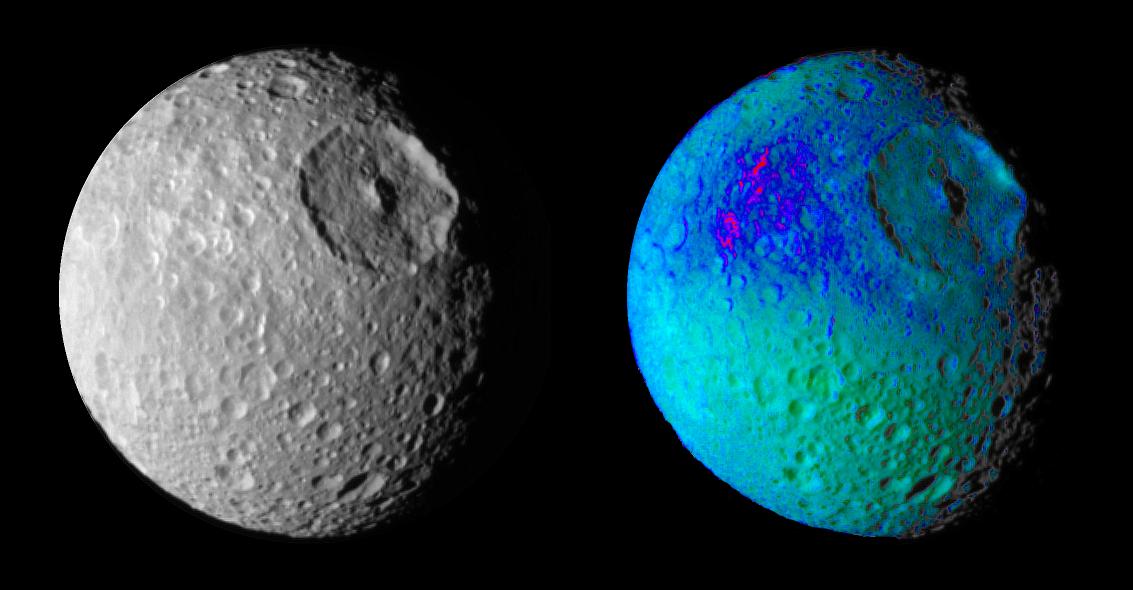
He's heading towards that small moon
obiwan> That's no moon...
http://saturn.jpl.nasa.gov/multimedia/images/image-details.cfm?imageID=2763 -
Or you intentionally web-publish the genotype
From: http://ic.arc.nasa.gov/projects/esg/publications/lohn_papers/gptp2004.pdf
Figure 1.6. Genotype for evolved antenna ST5-3-10.
The lameness filter is obstacling my path, so I'm tootling my google notbook page with vigor.
http://www.google.com/notebook/fullpage?hl=en#b=BDRqeIgoQi4a_oq4i
-theGreater. -
Evolved antennas at NASA
Efficient antennas 'designed' by evolution are already in use on spacecraft.
-
Re: Not that hard when you look at the size
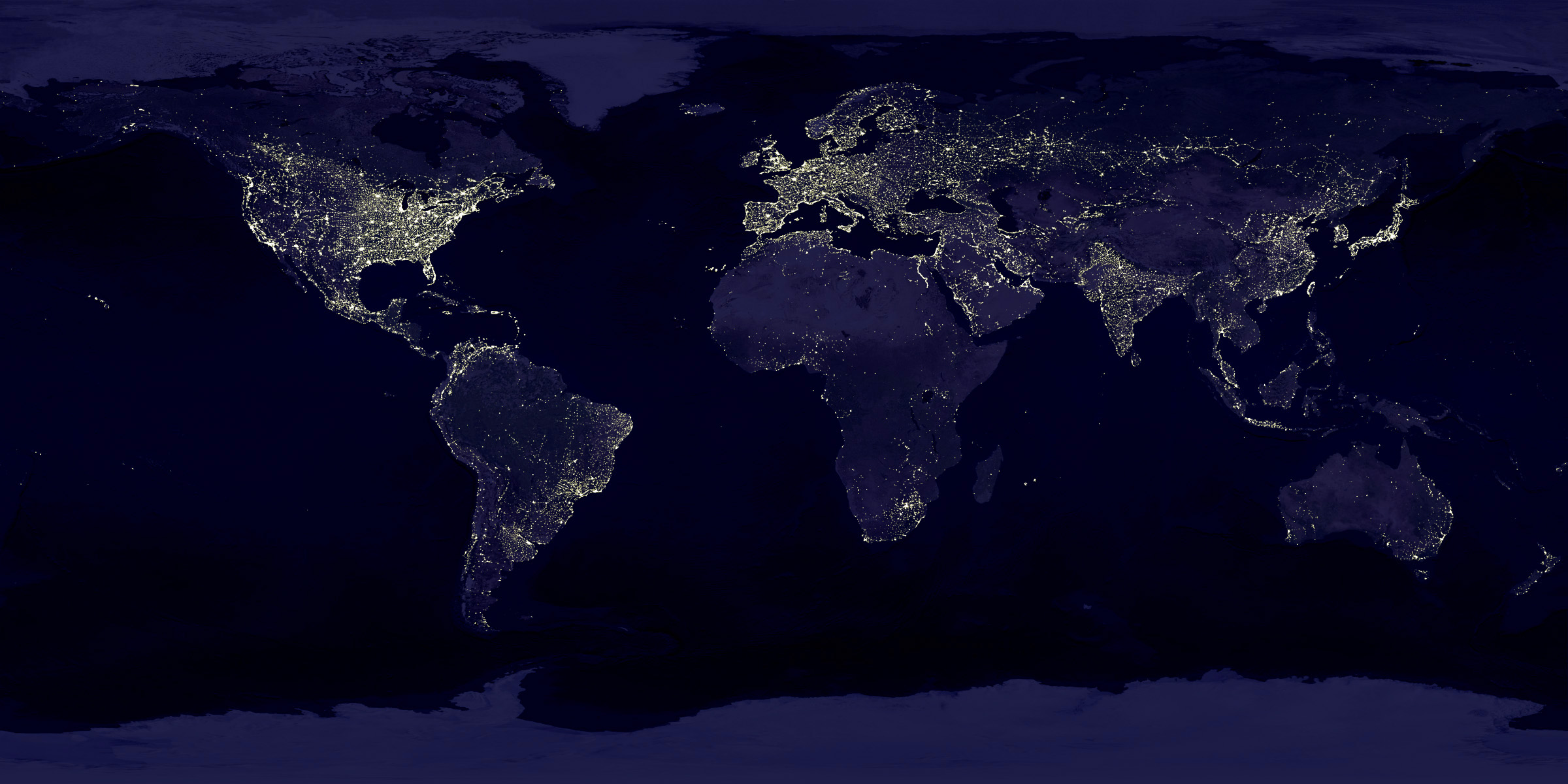
I think Americans are using the population density as a bad excuse for their horrible connections.Check out the following map from NASA showing light density which correlates to population density.
http://nssdc.gsfc.nasa.gov/planetary/image/earth_night.jpg -
Re:Good
I'm pretty sure NASA exploded the keys, dude.
-
Kinda looks like this
-
You take what you can get...
99942 Apophis doesn't have the once-reported 1-in-36 chance of hitting us in 2029 anymore... now it's odds of hitting us in 2036 are pretty slim as well. It was a Torino scale 4, now it's zero.
-
Re:A precedent for private space explorationFirstly, it was phrased as a proposition, not a statement. In addition, it was rhetorical. The launch vehicle alone will be way more than $500M, probably by a factor of 2 or more. The Mars Pathfinder mission cost approximately $265 million including launch and operations. Development and construction of the lander cost $150 million and the rover about $25 million.
That was in 1996.
Maybe "actual" research is overrated, but I would suggest that you do some before you propose baseless project costs. -
You've got your numbers reversedbut what the article states is "Antarctic ozone hole is 30% smaller than it was during the previous RECORD year". My emphasis. 5-10% beyond a record year would be acceptable. 30% beyond a record year (which yields 60-70% beyond the average) is a BIG DEAL. 30% beyond the record year is not 60-70% beyond the average: you're confusing the signs. The current hole is 30% SMALLER than last year's LARGEST size — i.e., closer to the average size.
We've seen interannual jumps of 30% in ozone hole size before (e.g., here); it's within the range of natural variation, and as such, does not indicate some total failure of the models. -
[citation needed]Just sticking to the subject of TFA: The prophets of 1970 said: [...] The ozone hole will get larger and eventually allow kill 80% of life on the planet Really? "Kill 80% of life on the planet"? Who said that in 1970? Hell, it wasn't until 1985 that the ozone hole was even measured.
As for saying that the ozone hole would get larger -
Re:Anticlima(c)tic Rush to Judgment (Day)
human output of CO2 is the cause, when it's about 1% of natural output
Only when you ignore the absorption side of the natural carbon cycle.
Humanity's 2004 CO2 emissions: 7.9
Oceanic CO2 outgassing: ~90
Terrestrial CO2 outgassing: ~120
(gigatons carbon - GtC)
Based solely on those numbers: 7.9 / 210 ~= 3.8%
Yes - insignificant. However...
Oceanic CO2 absorption: 92
Terrestrial CO2 absorption: 121.3
(GtC)
The oceans and land surface are net CO2 sinks. Since 1751 roughly 315 billion tons of carbon have been released to the atmosphere from the consumption of fossil fuels and cement production. Half of these emissions have occurred since the mid 1970s.
http://earthobservatory.nasa.gov/Library/CarbonCycle/carbon_cycle4.html
http://cdiac.ornl.gov/trends/emis/tre_glob.htm -
Re:Conspiracy theory
When then in YOUR universe, you haven't been paying much attention to ozone hole research. They have been predicting that the hole would take 30-100 years to recover. BUT, more importantly, their models don't predict this kind of behavior. Which DIRECTLY brings into question their models in most if not ALL areas of ozone hole research. We, as scientist/engineers/etc, don't expect perfect models, but this kind of errant behavior signals a huge OOPS to the other scientists. Look at the 1st chart here: http://earthobservatory.nasa.gov/Newsroom/NewImages/images.php3?img_id=17436 (NOTICE this is a NOAA chart) and see that the average and the hardly vary by 30%, but what the article states is "Antarctic ozone hole is 30% smaller than it was during the previous RECORD year". My emphasis. 5-10% beyond a record year would be acceptable. 30% beyond a record year (which yields 60-70% beyond the average) is a BIG DEAL. At least some of the models are suspect, end of story (unless you doing politics, then make up your own story).
-
See for yourself
See the ozone hole in near realtime thanks to NASA:
http://ozonewatch.gsfc.nasa.gov/ -
How clever research proposals are rewarded ...
National Aeronautics and Space Administration - Small Business Technology Transfer (STTR) Program
PROPOSAL NUMBER: 06 T5.02-9832
Have a try
CC. -
Re:Won't this attract unwanted imperial attention?
Erm, you're forgetting where the Empire is based. "So this is how Democracy dies - to the sound of thunderous applause!"
You know that's no moon!
-mcgrew -
Re:Seems Like a Cool Idea
But can't we just view how much light there is in space from satellite photos and guess what the light pollution would be (like in http://upload.wikimedia.org/wikipedia/commons/archive/8/86/20040921144929!Usa_night.gif
Pfffft! That's not a map, THIS is a map!
Notable sights to observe:
The first and foremost site to see is the Nile river (solid white line in the dark desert of top-right Africa)
Trans-Siberian railway (connecting Eastern Europe to the Pacific)
The ~4000 year old Silk Road trade route (arch from the Mediterranean to China, below Trans-Siberian railway and above India)
North Korea (black hole above) South Korea (white box left of Japan)
The all-roads-lead-to-rome effect web centered on Moscow (Moscow being the bright central white dot east of Europe)
The (in my opinion amusing) almost perfect square grid tiny dots of apparently pre-planned development in the very center of America
And of course the game counting how many blobs you can pin down as specific named cities.
- -
Re:Here ya go:
Self Correction, Here is the FULL 16384 x 8192 39.6MB TIFF image: http://veimages.gsfc.nasa.gov//1438/land_lights_16384.tif Sourced: http://visibleearth.nasa.gov/view_detail.php?id=1438
-
Re:Here ya go:
Self Correction, Here is the FULL 16384 x 8192 39.6MB TIFF image: http://veimages.gsfc.nasa.gov//1438/land_lights_16384.tif Sourced: http://visibleearth.nasa.gov/view_detail.php?id=1438
-
Re:Here ya go:
That's My Favorite Desktop Wallpaper! http://photojournal.jpl.nasa.gov/catalog/PIA02991 Original Caption Released with Image: Global city lights. The Eastern U.S., Europe, and Japan are brightly lit by their cities, while the interiors of Africa, Asia, Australia, and South America remain (for now) dark and lightly populated. (Image by Craig Mayhew and Robert Simmon, NASA GSFC. Based on data from the Defense Meteorological Satellite Program). FULL RESOLUTION IMAGE: http://photojournal.jpl.nasa.gov/tiff/PIA02991.tif
-
Re:Here ya go:
That's My Favorite Desktop Wallpaper! http://photojournal.jpl.nasa.gov/catalog/PIA02991 Original Caption Released with Image: Global city lights. The Eastern U.S., Europe, and Japan are brightly lit by their cities, while the interiors of Africa, Asia, Australia, and South America remain (for now) dark and lightly populated. (Image by Craig Mayhew and Robert Simmon, NASA GSFC. Based on data from the Defense Meteorological Satellite Program). FULL RESOLUTION IMAGE: http://photojournal.jpl.nasa.gov/tiff/PIA02991.tif
-
Here ya go:
-
Re:Spaceweather.com has...
Calm down there skippy. I provided a link because NASA's "video" is an animation, which was already provided as a link in the post. The link that I provided was actual video capture from the actual encounter and not an artist's rendition! It was probably submitted to SpaceWeather by someone working at the STEREO project, but I don't really know.
-
Re:Spaceweather.com has...
From TFA: NASAs video. WTF? Shouldn't NASA be showing your video?
-
Re:Early universe stages matter?
I'm not quite sure I understand what you're asking since it seems already inline with the mainstream theory, but assuming I get the gist of your question, the answer is yes.
-
Re:Defeating repressive government censorship
Would it be possible for the open source community to launch a project to essentially make it impossible for a government to cut off its own people from the outside world?
Until recently a charity called Information Without Borders was developing a promising-looking project called Sneakernet: basically an encrypted delay-tolerant network using epidemic routing between Bluetooth-enabled handheld devices. Messages would hop from person to person across the social network until they reached an internet gateway device. The project wasn't perfect - its goal was to ferry messages to a single trusted server in the "free world" rather than to establish an autonomous underground communication system - but it would have been useful for getting photos and eyewitness reports out to the press in a situation like this.Unfortunately the website seems to have died so I guess the project has been abandoned. If anyone's interested in working on a replacement, please Google my username plus "censorship" and email me.
-
Re:Fujitsu
I have a Thinkpad T23 and it's really excellent (made in Mexico), but a 1.13 GHz PIII, but good enough for NASA. But since they went down in quality from the T40 onwards, remember that Lifebooks are made in Japan and they're Nuckin' Fice.
-
Re:So why not...
I don't know about an MIT ion drive test, but Dawn is scheduled for launch tomorrow. First non-experimental ion drive spacecraft, which is supposed to orbit Vesta and Ceres.
http://dawn.jpl.nasa.gov/ -
oil in orbit
Yes there is:
Solar Power Satellite
Reinventing the Solar Power Satellite -
Re:The trouble is cost.
there isn't a chance that we'll return our atmosphere to Mars-like conditions
True. There's the pressure differences, to start with, & the observation that we haven't had an electrical hit like Valles Marineris to blow billions of cubic kilometers of rock into the sky. Oh, yes, & the factor that Mars is a tad smaller than Earth. & has oceans. & is warmer. & so on. (-:
-
Re:it almost sounds like a blame gameI said: Free unlimited energy, it's out there too, in the form of solar energy
You said: Free unlimited energy. The principles of physics regarding conservation of energy, among other things, dictate that there is no such thing. Besides, I'm not sure what planet you are on, but Earth is floating around in this same universe that you believe is filled with "free energy" yet we still pay.
Now, now, you know that I put a comma after "unlimited energy," not a period as it appeared in your quote. I'm not trying to break the conservation of energy laws, the rest of that sentence points out that I'm referring to the potential of solar power generation in space. Using Light from the Sun that we don't have to pay the Sun God for. Yes the equipment costs money to produce and use, but the end result is that the energy that could be produced would outweigh the costs of the equipment, resulting in 'free energy' . Unlimited in the sense that as long as we orbit the sun it's going to be putting out energy that can be utilized. It's the kind of project that could use funding, and could have used it 20 years ago. - look here for info on where this tech sits today.To people interested in Space the ISS is a shadow of what should be going on in orbit, a very expensive shadow. I love the space station, it's really cool, but seriously it's got mold issues, people have been trapped up there because the shuttle program can not provide reliable service, and the ISS required enormous maintenance efforts - principally EVA in nature. More investment in the ISS doesn't necessarily mean matching benefits from the investment. A lot of criticism of the US space program has been it's focus on big ticket items that yield little or no return and consume all of the shrinking NASA budgets, like the ISS.
-
Maybe. But it would be irrelevant.
NASA, and the United States in general, can see no benefit in a manned mission to the moon without a specific purpose. Seriously, what would be the point? To show that the U.S. can do it? Well, the U.S. already has, wayback in 1969.
What NASA is more interested in at the moment is the possibility of using the moon as a launching point for missions to Mars; perhaps building a lunar base of some kind and also to explore the moon and Mars using automated methods. Just look at the NASA SBIR (Small Business Innovation Research) requirements http://sbir.gsfc.nasa.gov/SBIR/sbirsttr2007/solicitation/Chapter_912.html and look at the topics. Exploration systems and space operations are a huge topic of interest, far surpassing any need for a current manned mission.
(Disclosure: The author worked recently on a NASA SBIR Grant under the Exploration Systems category.)
-
Re:What about manned?Using uranium prices as a stand-in, that's about $300 million in fuel. That's an awful big price tag for just getting a larger probe to Mars faster. For reference, it costs an average of $450 million to launch the space shuttle. The fuel for the trip to mars would be a lot less than the cost of getting it into orbit in the first place.
-
Re:Ok, but is it eye safe?
> It may cause pain now, but increase your chance for cancer, much like sunburn.
Sunburn causes cancer because the frequency of UV light is extremely high, approximately 10^17Hz. The energy available in a photon is directly related to frequency by Planck's constant, so the higher the frequency the more energy one photon has. Right around the frequency of UV light, electromagnetic radiation becomes ionizing radiation, which means that there is enough energy to knock electrons off important things (like your DNA), and cause mutations, which lead to cancer, as Dr. Tyrell explained to us in Bladerunner. -
Re:Ok, but is it eye safe?
> It may cause pain now, but increase your chance for cancer, much like sunburn.
Sunburn causes cancer because the frequency of UV light is extremely high, approximately 10^17Hz. The energy available in a photon is directly related to frequency by Planck's constant, so the higher the frequency the more energy one photon has. Right around the frequency of UV light, electromagnetic radiation becomes ionizing radiation, which means that there is enough energy to knock electrons off important things (like your DNA), and cause mutations, which lead to cancer, as Dr. Tyrell explained to us in Bladerunner. -
Re:Funny how "Tech Industry Issues"
You know, I hate to be anal, but continental drift is NOT a fact. It's a theory.
I'm almost sure you're trolling here, but come on. Continental drift is a measurable phenomenon. That's about as close to "fact" as one can meaningfully be.
And there are quite a few people who disagree with it.
Yes, and we call those people crazy. Fortunately, I don't think any of them are working as professional geologists, so I guess we're OK. Alternately, I suppose you could be posting this from the 1970s.
Or are you referring to the mechanism behind it? -
As a job, it sucks.
Being an astronaut isn't all that great. There are few flights, and you spend years waiting to be assigned to one. Meanwhile, NASA sticks you in make-work jobs, like "Lunch with an Astronaut. You spend a big chunk of your life on hold. That's the basic frustration of the job.
The most successful astronauts are ones who work the system effectively to get good assignments during their downtime. One of the current astronauts spent a tour as an Undersecretary of State. It's a great career move for military types. Most astronauts are pilots; even those who aren't "pilot-astronauts" tend to be flyers. NASA encourages its astronauts to fly (the Original Seven lobbied for this), and has aircraft for astronauts to use. The astronaut corps is a pilot's club.
NASA has 92 active astronauts right now. But they're getting older, and NASA needs some younger people.
-
Re:What? No computer science degrees?
You seriously should, if returning Mars samples or exploring water flow on Mars are on your priority list.
Space exploration is probably the greatest interdisciplinary field that we can pursue. Nearly every field will be essential to some part of it. -
Re:What? No computer science degrees?
I totally agree.
Computer By the way, Computer Scientists who are interested in getting involved with NASA should apply for an internship or co-op with the JPL. -
Re:Just like the polygraphDon't kid yourself. NASA has already proven the ability to "hear" what you're not saying, just through collecting nerve impulses in the vicinity of your throat. Add to that information about heart and respiration rate, skin temperature, and loads of other biometric data, and yes, a well-equipped government agency will be able to form a fairly accurate picture of what you're thinking.
I suspect the next ten years will be a little about refining the process of synthesising the gleaned biometric data and a lot about improving remote/covert collection.
Go ahead and debate the reliability of conclusions drawn from biometric data, but if it's already admissible in court then you can be very sure that this kind of data is "legal tender" (paradoxical use intended) in the law enforcement grey market.
db
-
Remember ICESAT?
http://icesat.gsfc.nasa.gov/
http://science.slashdot.org/article.pl?sid=07/02/19/1319228
observing:
http://www.satobs.org/seesat/Oct-2003/0064.html
Icesat is looking at this ice. This UAV is looking under the ice. I wonder if these folks should be working together?