Slashdot Mirror
Domain: nasa.gov
Stories and comments across the archive that link to nasa.gov.
Comments · 16,365
-
Re:running through my head
"That is exactly what was running through my head the last time I flew from Seattle to LA. Right Over St. Helens." St. Helens only did count for 0.2C cooling, not alot on the global scale. Only a eruption larger then VEI=4 can create global cooling that leaves it marks on the planet and halts the global warming. Here is a good info on that subject, this is however more on the effect of ozone but it gives the idea.
-
Re:Tip for browsers -- RIGHT CLICK SAVE AS
Yup, our server is having issues. Now I'm going to have to spend tomorrow pulling all the 5400 by 2700 and 21600 by 10800 pixel links off
In the meantime, http://www.nasa.gov/vision/earth/features/blue_mar ble.html has small samples. -
NASA World Wind
NASA's open source world viewer project World Wind will have support for next generation Blue Marble on the 20th. In fact developers today got the beta xml with coverage of all thirty six new blue marble layers.
-
Earth FirstEarth First!
Slashdot Saturn later!
-
Blame the volcanoes
The author must realize that having record low eruptions in 1998 and 2005 is the cause of the temperature hike.
See what happened in 1816. -
It's getting pretty hot on mars too!
Those irresposible Republicans! They're screwing things up across the entire galaxy.
Article
And for three Mars summers in a row, deposits of frozen carbon dioxide near Mars' south pole have shrunk from the previous year's size, suggesting a climate change in progress. -
Re:I really don't think thats it
The "life came from comets" statement is just a theory, like many other things in science. However, a lot of scientific ponderings and observations have taken place and are taking place about this theory. Therefore, there exists some possibility that it might be true. No scientific organization or any Govt is saying that life happened ONLY this way and NO other way.
Many scientists accept the possibility that comets MIGHT have had a role in evolution or life because of certain observed phenomena that agrees with hypothesis (and vice versa). That is science. OTOH, religious freaks refuse to consider any other point of view except the 'interpretation' of their religious text even if it flies in the face of observable evidence. That's faith. Like those who say dinosaur bones are a Test From God or some shit. While scientists regularly disagree with each other, they atleast have some observations, deductions or calculations to show for it. Religious freaks who fight among each other have nothing to say except "My interpretation r0x0r!!" or "My god is better than yours !".
If scientists could assemble non-living material into a living organism it would certainly help the theory of evolution.
Thats not a very smart argument. It's like those people who refused to believe that the earth is round unless they saw a photo of it from space, even when scientists, astronomers, sailors had known for centuries that the earth was spherical, purely through observation of natural phenomena and calculations... which some people are too stupid to understand or too bigoted to accept. Anyone who needs that kind of 'proof' to 'believe' in evolution... its like talking those people in the US who still belive the Sun moves around the earth. -
Re:1/r^2 kills this
That doesn't sound quite right. Why would free neutrons (half life 15 minutes) be an issue coming from the sun?
Sun's only about 8 light-minutes away, so even a moderate-energy neutron - say, 1 GeV - is going to reach us well before it decays. (*) A higher-energy neutron - say, tens of GeV - with a time dilation of about a factor of 10 - won't have decayed appreciably at all before it reaches us.
This is of course akin to atmospheric muons - with a lifetime of 2.2 microseconds, they shouldn't reach the surface of the earth at all. But atmospheric muons typically have an energy of ~1 GeV, and with a rest mass of ~150 MeV, this is a gamma of ~10, and so they have plenty of time before they decay.
Besides, fusion does not occur to any appreciable degree in the corona
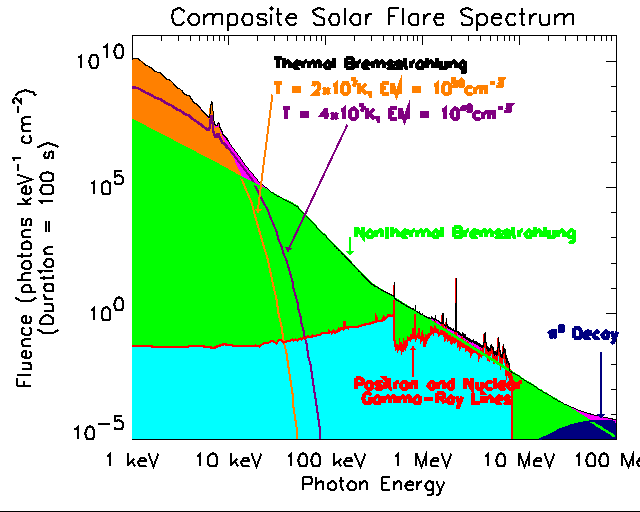
Shock acceleration produces neutrons during a solar flare, through several mechanisms, including spallation and fragmentation of nuclei.
Also gamma rays from the sun are not an issue, the moon is brighter than the sun in gamma rays.
Not during a solar flare. -
Re:1/r^2 kills this
That doesn't sound quite right. Why would free neutrons (half life 15 minutes) be an issue coming from the sun?
Sun's only about 8 light-minutes away, so even a moderate-energy neutron - say, 1 GeV - is going to reach us well before it decays. (*) A higher-energy neutron - say, tens of GeV - with a time dilation of about a factor of 10 - won't have decayed appreciably at all before it reaches us.
This is of course akin to atmospheric muons - with a lifetime of 2.2 microseconds, they shouldn't reach the surface of the earth at all. But atmospheric muons typically have an energy of ~1 GeV, and with a rest mass of ~150 MeV, this is a gamma of ~10, and so they have plenty of time before they decay.
Besides, fusion does not occur to any appreciable degree in the corona
Shock acceleration produces neutrons during a solar flare, through several mechanisms, including spallation and fragmentation of nuclei.
Also gamma rays from the sun are not an issue, the moon is brighter than the sun in gamma rays.
Not during a solar flare. -
Re:Except that...
"Solar flares dump huge amounts of energy into the Earth's magnetic field. The more engergy, the further south the Aurora Borealis appears, as the magnetic field pulls particles from the solar wind to larger circles further away from the poles."
Not exactly. What happens is that with the increased solar wind pressure the magnetosphere becomes distorted, the auroral oval expands equatorwards, and electric currents start flowing. "Magnetic reconnection" events in the magnetotail energize magnetospheric (not solar wind) particles and inject them into the auroral zones resulting in the visible aurora.
Whether or not astronauts are exposed to auroral zone radiation depends on the location of the auroral oval (it expands equatorwards during high geomagnetic activity induced by solar disturbances) and the inclination of the spacecraft orbit. I have satellite (X-ray) images of the auroral oval as far south as Washington DC during one large storm.
For a view of the current "space weather" conditions, see:
http://sohowww.nascom.nasa.gov/spaceweather/
The ACE satellite sits upstream of earth in the solar wind and monitors the solar wind ram pressure and the interplanetary magnetic field Bz component. The NOAA/POES satellite shows images of the current auroral oval (now in its quiet phase).
An excellent article on galactic and solar cosmic rays is here:
http://www.research.ibm.com/journal/rd/421/ziegler .html
If you're wondering why companies like IBM are interested in this, it's because cosmic rays penetrate semiconductor chips and cause "single event upsets" in computers. Or they can knock out an entire satellite. Computer chips need to be "hardened" against radiation before they are space-qualified.
In case you're wondering, I have a PhD in space science lying around here somewhere -
NASA source
NASA Science News for October 7, 2005
Another source:
Strange, but true: Solar flares can be good for astronauts. -
More info
The NAIC website has a smidgen more info on it -- namely that there were four other research projects funded as well.
There's a PDF on this project that may contain more info, but my copy of Acrobat (6.0) declines to render the entire thing (or the PDF is junk, dunno which).
There's also an article on Astrobio.net that gives little more detail than the CU link... but it does have links to other sources that may be informative. Really though, this concept seems to be in such an infancy stage that "simple" questions like "so how do you turn it?" haven't been answered yet (in fact, in this NASA link how to keep the two craft in alignment is listed as a "main technological hurdle"). -
Re:As usual...
I'm not against it, but it seems to be taken on faith that the universe should be simple and elegant.
Please look at this image. This has been possible only because we live in an universe that is apparently regulated by very few and relatively simple laws.
And apparently we are able to understand them.Yes: this is a surprise to many that think about it.
-
Re:My question:
Those "signals" are the gravitational waves and the Smart 2 and Lisa (ESA/NASA) missions will search for them and measure their speed, among other things.
More informations from the Wikipedia: gravitational radiation and speed of gravity.
-
The US has ICESat
The US put ICESat (Ice, Cloud, and land Elevation Satellite) into orbit in January, 2003. It uses laser ranging to map topography. While it has had its own difficulties, it has been collecting data.
We were looking forward to having CryoSat data to compliment what we've collected, for data verification, additional accuracy, and for extended lifespan of observations. This is a true loss.
For more information on ICESat:
http://icesat.gsfc.nasa.gov/
http://www.csr.utexas.edu/glas/ -
the US already has an ice observing satellite
http://icesat.gsfc.nasa.gov/
It has been operational since January 2003. -
Space debris awareness
It's also one of the only pieces of space sci-fi that recognizes that a loose screw flying around in orbit can totally fuck up your spaceship. Which is why the heroes are debris collectors.
-
Space debris awareness
It's also one of the only pieces of space sci-fi that recognizes that a loose screw flying around in orbit can totally fuck up your spaceship. Which is why the heroes are debris collectors.
-
Space debris awareness
It's also one of the only pieces of space sci-fi that recognizes that a loose screw flying around in orbit can totally fuck up your spaceship. Which is why the heroes are debris collectors.
-
Shrinking ice? On Earth or Mars?
Because ice caps on Mars are shrinking:
http://www.newscientist.com/article.ns?id=dn8029
http://www.nasa.gov/vision/universe/solarsystem/mg s-092005-imagesc.html
Of course, shrinking ice caps on Mars kinda kill the "ohmygodmankindiscausingglobalwarming" leftist groupthink crowd, doesn't it? -
Comment + Google Earth games
Yeah. I too wish for a MacOS X port for Google Earth. Same with NASA's worldwind, Windows only. Ports will eventually come, I'm sure.
Meanwhile we wait, three games involving Google Earth, Earth Contest, GoogleEarthing and GEwar. (plug) Taken from the new slashgisrs.org, which can be of interest to you if you're interested with Google Local/Earth and anything GIS+RS. (/plug) Cheers -
Moon Exploration would be Ideal for thisTechnology
If there was some way for NASA scientists to acquire and expand upon this unmanned vehicle technology, it would be very interesting if there was some way to send an unmanned Hummer/Truck to the Moon.
Equipped with a full array of IMAX, video and picture cameras (w/mult. backups,) it would photograph and transmit Moon exploration data in real-time. Control it by remote, and have it run on solar energy. You would basically just get it on the Moon and then drive the thing until it completely fails or malfunctions.
Just a spaced-out thought...
http://icb.nasa.gov/2003_Annual_Report/lunar_rover _II.jpg -
Re:Don't they have to be damn close?
Neutron stars and other things like them do wierd things: Objects that dense and massive, spiraling around each other that fast, create gravitational waves like moving a stick through a pond. Energy is needed to create gravity waves, and it comes from the orbital motion of the neutron stars. Their existing orbits slow down; They fall closer and orbit even faster, generating more gravity waves than before.
-
Re:The Science Channel
One of the reasons that comes to mind is the launch of a new satellite for observing GRBs SWIFT. And the fact that GRB's are intrinsically intriguing - being the huge balls of energy (if you will) in the Universe
-
Re:Where's the market?
You were lucky. I tried to buy some air from NASA the other day but they said they didn't have any!
Well, considering that NASA standa for the National Aeronautics and Space Administration, I'm not surprised. -
Re:Needs to be Updated!
As another post says, use a coral link. Just add
So if you have an URL like this http://stardust.jpl.nasa.gov/photo/aerogel.html coral link would be http://stardust.jpl.nasa.gov.nyud.net:8090/photo/a erogel.html -
If Santa Clara County isn't interested ...
If Santa Clara County isn't interested in having Google co-located with NASA, I'm sure other communities with NASA locations would be delighted to have Google as a member of the community. Here for instance.
-
Re:What is that?
Not to me in this image. The line looks more like a merging of the surrounding material with an external source of stuff, kinda like a weld. It doesn't seem to be raised or depressed, just disturbed. -
Misinformation from Slashdot (as always)
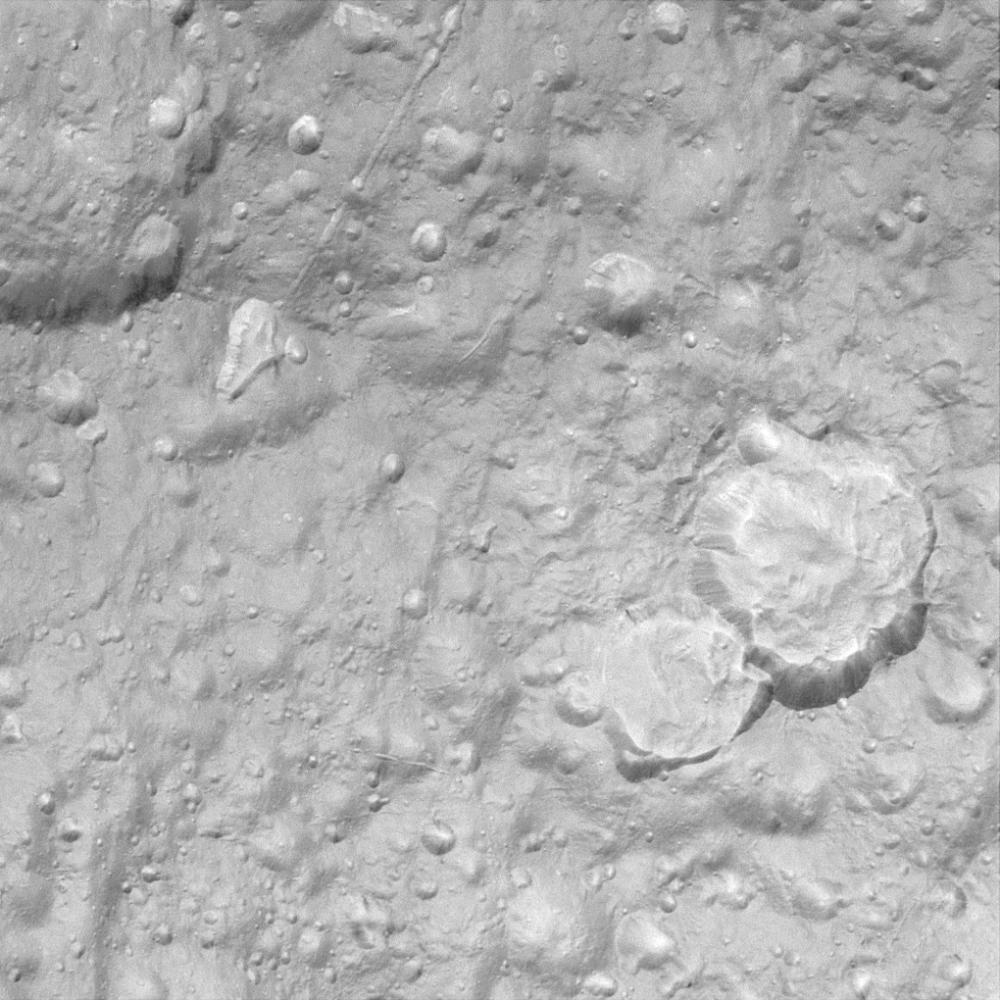
The image linked to as 'nothing else in the solar system' is an image of the Saturnian moon Tethys, not Hyperion. Misinformation from Slashdot, as always.
-
Misinformation from Slashdot (as always)
The image linked to as 'nothing else in the solar system' is an image of the Saturnian moon Tethys, not Hyperion. Misinformation from Slashdot, as always.
-
NASA SEL
NASA is extremely specification oriented in its programming tasks. The SEL maintains a website with online documentation on their process.
Specifications are useful when the "theory" is down and the execution must match. Examples are anything aerospace, underwater (read: submarines), nuclear reactors. For OS development, this would stifle it by never being able to respond to a changing environment. -
Re:What is that?
Here's a better photo:
http://saturn.jpl.nasa.gov/multimedia/images/raw/c asJPGFullS14/N00040104.jpg -
It's not a visible image
If you RTFA you'll note that the image posted here are not of visible Light. "Images taken using infrared, green and ultraviolet spectral filters were combined to create this view..." http://photojournal.jpl.nasa.gov/catalog/PIA07740 I wonder what it really looks like? Perhaps not enough light?
-
Re:What is that?
Try this image.
Suddenly, it looks absolutely not "artificial" and a whole lot like a fault line. You can even see a bunch of other smaller/thinner lines in the image. The "buried" object looks irregular, with absolutely no sharp definition or straight lines at all. Looks like just an oddly eroded area. -
Re:What is that?
The JPL page says the straight line is probably a fault or other geological feature, but the absence of any others in that area is a little suspicious.
Actually, if you look at the Hi res TIFF version you can see several more of them. None as large and obvious, but I found at least five or so linear formations in that picture. There is a cluster of three at the bottom beneath the obvious one. -
Re:What is that?
The greyscale clear filter image I mentioned in another post is better for this work, and has less compression artifacts.
The line really looks like a depression in that one, whereas in the false colour image it could be a protrusion.
I blew it up considerably in Photoshop and increased the contrast to see details better. There are a number of smaller craters directly in the path of the line. If it were a rock impact, to my (non-astrophysicist/geologist) eye it looks like it behaved like a skipping stone - There are some bigger craters near where the top of the image cuts off the line, and about halfway along there's a pair on opposite sides of what appears to be a hill, as if it were skating along, used the hill as a jump, landed, and continued its movement.
The bigger feature at the end of the line seems more symmetrical in this version. It looks kind of like a Concorde... or a giant bird footprint. Watch out Tethys, Colonel Sanders is too far away to save you. -
Re:What is that?
http://photojournal.jpl.nasa.gov/tiff/PIA07736.ti
f gives a much better view of it. If you look further down you can also see some straight lines that look just like impacts of objects at odd angles. Nothing to see here, move along. -
Re:Uhmmm. We sure about these?
I think there are two factors at work:
- In space, the lack of atmosphere gives things an "unreal" look in photographs. See if you can dig up the movie that was done by Messenger as it left Earth. It actually looks less "believable" than a modern Hollywood movie in some ways.
- The images are false colour. This is useful for conveying more information, but it does make them look a little "wrong."
For comparison, here's another version of the Tethys shot. It looks a lot less surreal, because it's greyscale. -
The artificial object in the Tethys photo...
Doesn't that linear object in the upper left of that image look like a mass driver of the type that we plan to put on our own moon someday? Perhaps someone's been there before...
<music="xfiles.mid">
Perhaps we've been there before!
</music>
Just kidding, I'm sure it's just an image-processing artifact...
<music="twi_zone.mid">
maybe...
</music>
-
Ive scene this.
http://saturn.jpl.nasa.gov/multimedia/images/moon
s /images/PIA07737-br500.jpg Iv'e scene this in the toliet bowl after a hard night of drinking and Taco Bell. -
Re:What is that?
Interesting, I didn't notice it before. Could be something tectonic. Plus, that picture is of Tethys, which has already been noticed for having a more obvious peculiar feature. That's no moon that's a...no wait, it is a moon, otherwise we'd be dead by now.
-
Re:Wrong moon.
I'm not trolling!
One of the links in the post is of Tethys, not Hyperion. Look for yourself!
http://saturn.jpl.nasa.gov/multimedia/images/image -details.cfm?imageID=1759
Someone should correct the post. -
As usual, slashdot editing leaves a bitUm, I realize that typing up an article takes work, but perhaps some thought and energy might be used to make things a bit more comprehensible....
The two pictures are from different moons, Tethys (second link), Hyperion (first link). Perhaps reading a caption from the real article at http://www.jpl.nasa.gov/index.cfm would help
-
Wrong moon.
The image in the post http://saturn.jpl.nasa.gov/multimedia/images/moon
s /images/PIA07737-br500.jpg is of the moon Tethys and not Hyperion.
It was a double flyby, hence the confusion. -
Re:Smaller object orbiting a larger...
By definition, a moon/satellite doesn't have to be orbiting a planet. Check out Ida and Dactyl, an asteroid/moon combination. Anything out there that's massive can have a moon, it doesn't need to be a planet or even the size of a planet. Ida is only 31 km in diameter (on average), and its moon is only 0.7 km in diameter. By 2002, there were over 30 discovered asteroid/moon systems. As far as I'm concerned, the fact that it has a moon shouldn't have any bearing on whether or not it's a planet. We have planets (Mercury and Venus) which have no moons at all, and we have non-planets which do have moons.
-
No more 'moon', unless the def. is clear enoughhttp://en.wikipedia.org/wiki/3753_Cruithne agreed with you, so yes, that object is not a moon. BUT I encountered a http://antwrp.gsfc.nasa.gov/apod/ap010127.html link that called Mir a moon.
Point is: the word 'moon' should be abandoned, or only applied to Earth. 'Satellite' is sufficient for the other major orbital things.Thát's what I meant to say.
-
Re:so...
what is it? Some kind of giant space station?
Cheese.
A giant luffa sponge! -
Re:Autopilot
There are very few aircraft that can take off OR land purely automatically, and to my knowledge, they are all model aircraft, the largest being a miniature helicopter used for observing volcanoes.
The Soviet Space Shuttle Buran flew entire missions unmanned on autopilot, even landing in a 34 mph crosswind, about 20 years ago.I don't think takeoff and landing are "very difficult"; if they were there would be more crashes. Now landing on a pitching carrier deck, that's difficult. And there are wave-offs and accidents despite the extreme levels of expertise of the pilots who do it.
-
Re:The Burt Rutan Wing of the Smithsonian?
It took me a second to figure out which record-setting Voyager you were talking about: the first plane to fly non-stop around the world (although it took 9 days!) or the one that left our solar system (depending how you define it) a couple months ago. That would've been a really fast return trip!
-
Informative links
- Technical description of the interferometer.
- A detailed paper (PDF file) on the nuller.