Slashdot Mirror
Domain: nasa.gov
Stories and comments across the archive that link to nasa.gov.
Comments · 16,365
-
Re:Commercial use?!?!
http://www.nasa.gov/vision/earth/lookingatearth/f
r ances.html VAB already been hit by a hurricane, and been damaged but still standing. -
Analysis of "Star Trek" TechnologiesVisit a unique web site maintained by an engineer at NASA. He discusses the reality and practicality of various technologies mentioned in "Star Trek".
Unfortunately, the problem for humankind is not the lack of power. Rather, the problem is overpopulation. It seriously destroys the environment. Each person contributes a bit of pollution. Multiply that person by 6 billion, and you have some serious damage to the ecosystem.
Antimatter purports to solve the alleged energy shortage. However, what is the solution to lack of breathable air, drinkable water, etc.?
-
Star Trek Science...
Of course, making the antimatter can be expensive.
Shouldn't that be explosive? Or did I missed something when learning my Star Trek science? -
Re:SGI's Linux is for Itanium not MIPs
While Linux is available for practically anything, including old SGI MIPs hardware, SGI never suggested people use anything other than IRIX on MIPs.
If you want to bitch to SGI about how well Linux runs on platfroms they don't support it for, while we're at it, let's give Microsoft a hard time about what a pain it is to run Linux on the xBox.
SGI's change to Linux is to support SGI's Altix line of Itanium based systems which inlcude the fastest commercially available supercomputer in the world (Number 2 on Top500 list - #1 one is a specialized IBM design that's not based a commercially available product like the SGI Altix)
Also, there are many spook agencies all over the world using SGI gear that you don't get very much publicity about. While these, unfortunately, are not changing the bottom line for SGI, I doubt that certain gov'ts - esp the US - will let SGI go into bankruptcy.
-
Re:Some more info...
Dennis is early. Mr. Wilson isn't scheduled to fly until September.
-
Re:butterfly effect
Now there's a concept with some intresting consequences... if more than one body shares the same orbit, that too is "unstable to anything"
Nope. They probably won't collide. Consider a body starting in the L3 point of the Earth and the Sun, and perturbed slightly. If it's perturbed outwards, it will orbit slightly slower, inward, slightly faster, and so it will rotate around the Sun, toward the Earth. But in doing so, it may pass through L4 and L5, which are both stable Lagrange points, and will tend to reverse the path of the asteroid (in the rotating frame). There's a semi-large asteroid called Cruithne which is in such an orbit. You can see a drawing of its orbit in the corotating frame here. As you can see, when it approaches L4 and L5, the potential turns them around, so Cruithne is well protected against colliding with Earth.
It's a little hard to understand such an orbit, but the gist of it is this. It's important to remember that when you move inward towards the Sun, you speed up, and so end up moving counterclockwise in the corotating frame. When you move outward, you slow down, so you end up moving clockwise in the corotating frame. So if you push an object towards the Sun from L3, it'll go faster, moving counterclockwise, towards L5. As you approach L5, though, you're getting closer to the planet (Earth). It pulls you outward (since you're inward from it), which slows you down, which moves you back clockwise, and away from the planet. Repeat for L4.
L4 and L5 tend to "sweep up" all the material in the orbit between them (i.e. on the other side of the planet). There's a nice discussion on the behavior of objects near the Lagrange points here. It even mentions the timescale over which the Lagrange points are unstable. L1 and L2 are unstable on periods of ~23 days. L3 is unstable on periods of ~150 years, which means you could conceivably have a manmade body there with relatively little effort. Not much reason for anything there, though, as it is constantly out of touch with Earth, being on the opposite side of the Sun and all. -
That's the part I find funny
It's not like the comet was going to stay pristine. Comets travel through very harsh environments
Yup. If you'll look here, you'll see an image that the impact probe captured on approach. That is, before it hit the comet.
Notice something rather distinctive about that comet?
It's covered in impact craters already -
Re:Did it change the comet's pathThey don't think it'll have any effect. They likened it to a gnat hitting a truck. In any event, if you look at tempel's orbit you'll see that itt doesn't ever come anywhere near the earth. Tempel has a better chance of hitting Mars than us.
During the press conference, they also said that the outgassing could go on for quite awhile, as in possibly months. The thinking is that the comet was in equilibrium and the impact has excavated sufficient material to allow the comet to sublimate over an area somewhere between that of a house and a stadium. How much mass leaves the comet as a result of the impact will affect what happens to the comet's orbit and rotation rate.
-
Did it change the comet's path
Since you are talking about the earth being possibly endangered by a comet sometime in the future, I thought I'd ask.
Does anybody know if the comet's path was changed?
I think it would be an important consideration with all those people worried about near earth objects.
(Link to NASA site for near earth objects.)
http://neo.jpl.nasa.gov/risk/
I didn't see any considerations of this in the official announcements from NASA. -
Re:JPL Media types, please read this
You mean this stupid picture from NASA TV?
http://deepimpact.jpl.nasa.gov/gallery/jpg/confirm ation-516.jpg
Someone needs to mirror that because they will probably take it down. The media outlets edited it now so you don't see how lame the source is. What an embarrassment.
It's still the "front page" picture used by all the media, shame on you NASA public relations.
-
Re:Where are the Stars in the pictures?Simple answer - "Its dead, Jim".
Pedantic answer: orbit == complete circuit. It didn't do even half an orbit http://deepimpact.jpl.nasa.gov/mission/factsheet-
t ext.htmlTo say it was orbiting around the sun when it didn't even go half-way would be like me saying I walked around the block when I just went to the corner, or that Alan Shepards sub-orbital flight was an "orbit". What it did was sub-orbital.
Definition http://www.answers.com/orbit&r=67
1. The path of a celestial body or an artificial satellite as it revolves around another body.
Now, it might be nit-picking, but it didn't "revolve around" any body - its "orbit" was really just an arc that started and completed in under 1 revolution. If it had taken 1 or more revolutions to complete the mission, then you could have said it had, in fact, orbited the sun. Pedantic, but wtf, this is slashdot, and this is the sort of "angels on a pinhead" argument that gets people to bite
2. One complete revolution of such a body. -
Aliens Really Mad
So did anyone else notice the building at the edge of the crater near the top of this image?
The owners of that comet research facility have got to be seriously torqued about us blowing it away. -
Re:Distance?
-
Re:Distance?
-
Banana?
I think you'll find that's a picture of the comet's nucleus in the crescent type phase... here's a better view of it.
-
Banana?
I think you'll find that's a picture of the comet's nucleus in the crescent type phase... here's a better view of it.
-
Re:Wasn't there a plaque on that thing?
Yes, I guess, if you are referring to this?
-
Cosmocide
http://news.bbc.co.uk/1/hi/world/south_asia/46477
1 5.stm
>An air strike by US forces in eastern Afghanistan
>killed 17 civilians including women and children
http://www.jpl.nasa.gov/news/news.cfm?release=2005 -109
>A strike by US space forces in the upper
>right asteroid belt has killed 17x10**9
>little green and grey people of all the six
>sexes, including developing, declining and
>errenously functioning entities. -
Re:4.5Kt, surely?
btw: The pictures are just breathtaking... on them it really looks like 4.5kt (which is a testemony of the amazing light collection power of current telescopes and quantum efficiency of CCD arrays)
I wouldn't be surprised if a lot of the apparent 'explosion' visible in the images is due to sunlight illuminating the plume of dust produced by the impact. Comet nuclei are pretty dark, so I suppose the exposure times were probably cranked right up to see anything of the nucleus itself.
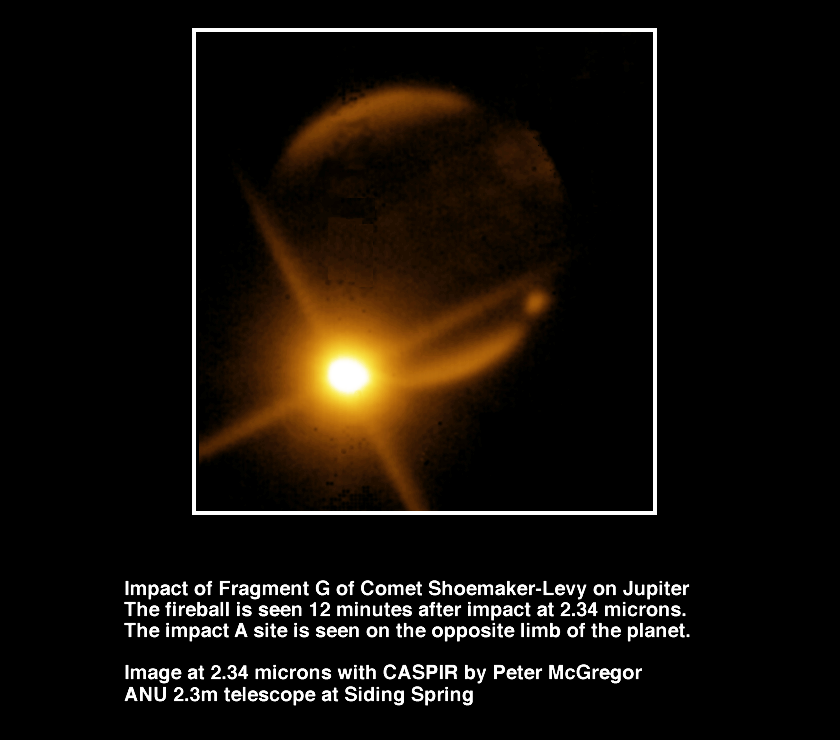
This is all guesswork, of course, but I remember a similar explanation of the 'explosions' visible when the Shoemaker Levy 9 comet fragments hit Jupiter. Mankind has kind of built our own tiny version of that!
Of course, the above could all be utterly incorrect... -
Re:A mini-animation
Also a pretty cool, official NASA Quicktime movie from the impactor's camera - kind of wobbly and jerky, but nifty nevertheless.
I think it contains what are by far the best, and closest pictures of a comet nucleus - and I've no idea if it's from 'final' data yet. I gather there's a lot left to download from the flyby probe, but was it a Huygens-Cassini style relay setup or was impactor data received directly on Earth? If it's the latter, I suppose there isn't much chance of retrieving any more of the close-up data, as the delicate hardware stuck to the impactor's copper mass must have made quite a splat... -
I am scared
Just look at this picture and then compare it with this one
This really needs more investigation.
here they are together. -
Spectrograph already disproves these crackpots
Apparently the Electric Universe doesn't believe in Spectroscopy, which has already shown the object to be an icy snowball ejecting gas.
-
Deep Impact on dirty snowball theory
Proponents of the Electric Universe theory have gone out on a limb ahead of Deep Impact. They're predicting it will show comets are just rocks and not dirty snowballs.
Controversially they assert comets are highly negatively-charged asteroids on eccentric orbits. As they travel further into the Sun's radial positive electric field, they discharge into space, expelling material at supersonic speed. -
Herschel
Herschel Photo
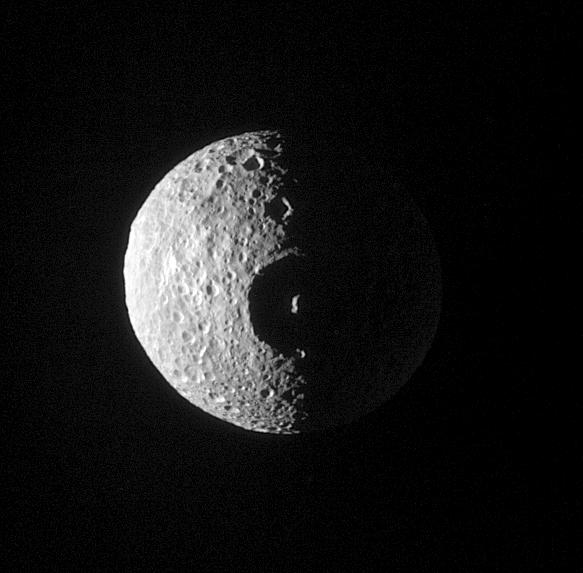
http://saturn.jpl.nasa.gov/multimedia/poll/index.c fm?pollContentID=12&getDetails=Yes&indexPage=No
I must be tired.... when I first saw this I thought it was the "Death Star" -
Re:Titan volcano image is cool too
The Solar System Exploration Strategic Roadmap lays out NASA's current plans/wishlist for robotic exploration in the next 20+ years. Basically, they foresee one Discovery class (NEAR, Mars Pathfinder, Deep Impact, etc) mission every two years or so; two or three more expensive New Frontiers missions per decade such as the Pluto New Horizons probe or the newly announced Juno Jupiter Polar Obiter; and one or possibly two $1 billion+ "Flagship" missions. The first flagship mission will be the much delayed Europa Geophysical Orbiter. The second Flagship mission, slated for 2013 or therabouts, will most likely be a Titan Explorer, an RTG-powered blimp to cruise around the surface for an extended period.
Keep in mind that this is obviously subject to political whim, but it shows that Titan is a really high priority for future exploration.
-
Re:O2 Atmosphere + Water
I personally like this one.
Kinda has the whole Death Star look to it... -
Re:Seeing as it's a vote...
I think that's just an edited version of this.
-
Re:True, but...If they impacted on lunar dayside, the whole event would probably have been lost in the glare.
According to NASA, the Apollo 14 S-IVB impacted in an area that would have been relatively dark at impact. I say "relatively" because the impact was west of the Apollo 14 landing site and since landings were always performed in the lunar dawn to take advantage of shadowing (the 3D effect), it was probably pretty dark in that area when the S-IVB came plowing in at 6,000+ MPH.
On an unrelated note, I've always thought it would be cool to collect a bunch of cash and then go scouting for an S-IC laying on the bottom of the Atlantic. I'm not quite sure how you'd recover it, but it sure would be a collector's item.
-
Best picture not in list, unfortunately
Of the pictures they have to choose from, I have to go for the pic of Iapetus. It's by far the most shocking of the pictures -- the girdling ridge around Iapetus' equator is just too weird to believe.
But, my favorite Cassini picture is this one, of the rings edge on. Here you can see a perfectly straight line, almost a quarter of a million miles long. Where else in the universe can you see such a thing?
Thad Beier -
Re:O2 Atmosphere + Water
Agreed, I still find it amazing that we can send these probes out into space, take some photographs, send the images back to planet earth and see the beauty of our solar system whilst sitting in a comfy chair.
I also find it amazing that no matter where we travel nowadays we always find the need to take photographs and there is always one picture with a fingerprint blocking the view. -
Re:Seeing as it's a vote...
-
Titan volcano image is cool too
The Titan landscape has proven to be so fantastic I hope NASA considers sending a long lived rover back soon. I think the recent Titan volcano VIMS image belongs on this list.
-
Kowabunga!
-
Re:Death Star!
-
Re:Death Star!
-
Seeing as it's a vote...
Inevitably, whenever there's a vote some fucker'll complain about their own personal choice not being there. My choice - not cowboyneal - is for the shot of Mimas against the rings.
Still, well done to all concerned for giving us a years worth of desktop pictures. Oh, and some science. -
Can't wait for the video.
I hope one day we get high-definition video from these missions.
Imagine something like the the descent panorama but in the IMAX and later on your big fat TV. -
The Death Star
aaah the death star
-
Re:The second round into the same hole...Those are not lessons. They're not solutions to problems. They're solutions to symptoms of deeper problems.
To say that the only useful thing we learned from Challenger is that everything should be inspected more thoroughly on the ground before launch is missing the point. Perhaps the most illuminating writing on that particular incident came from Richard Feynman in his appendix to the Rogers Commission report, where he noted that NASA already knew about the problem of ring erosion from inspections performed on hardware from earlier flights. What NASA screwed up was fixing problems that they had already found. According to Feynman, it was the blind, irrational confidence that NASA management had in its hardware combined with a poor understanding of statistics and developing models from experimental data on the engineering side that led to disaster.
I have not read the report and analyses of the Columbia accident, but I imagine it also has deeper, more useful lessons in it than that which you are listing.
-
Re:oh no!
Wanting to put a good light on a July 13th Launch, here is an item I came across:
First lighter-than-air transatlantic flight. The British dirigible R-34, commanded by Maj. George H. Scott, left Firth of Forth, Scotland (July 2, 1919), and touched down at Mineola, L.I., 108 hr. later. The eastbound trip was made in 75 hr. (completed July 13, 1919)
There is an image of the dirigible in the link, and they have a large version of the image, clearly showing that it has 4 engines and other interesting features. The link refers to the R-34 as a Navy dirigible, the year of 1919 is correct, so I guess it is the same one that made the trip ending on July 13th.
Of course the STS-114 flight will not end on the 13th, but I wanted to show that aviation pioneers are not at all afraid of the 13th. They just do it. -
Re:Please tell me they at least have the ability
They did run an experiment with the AERcam sprint on Columbia in '97. I believe the RF link only worked within the cargo bay so a belly insection would be out of the question.
It appears that they have a new model AERcam in development for use on ISS and shuttle inspections though. -
Re:Please tell me they at least have the ability
They did run an experiment with the AERcam sprint on Columbia in '97. I believe the RF link only worked within the cargo bay so a belly insection would be out of the question.
It appears that they have a new model AERcam in development for use on ISS and shuttle inspections though. -
porting to linux...
I am certain that many people here would gladly "take the time to code all that", for free even, if they only could. But this is not an open source app, so that is not possible.
So how about joining the effort for porting NASA's World Wind, instead? (Also check out this thread, with comments from the World Wind developer)Come to think about it, this could make a great project. GPL'ed clone of Google Earth, anyone?
-
Look in the volcano
Sunlight breaks down methane, so to have it in Titan's atmosphere (particularly at such high levels) it has to be continually replaced. You can make methane on Titan via either life or some sort of weird chemical process. So the methane is a hint at possible life.
Titan's atmosphere is also full of a haze of complex organic molecules that continually rain down on the surface... leaving deposits of hydrocarbons on the surface hundreds of meters thick.
Now if only these complex organics could get mixed in with water. (And it has to be water, because you need the oxygen). Guess what 'rocks' on Titan are made out of
So you might have something happening in this methane lake with methane being the liquid and oxygen coming from ice... but this would be completely different from life as we know it...
My own bet is on the volcano to look for life (The volcano on Titan erupts molten water). Also there might be life in Titan's mantle (it's made of liquid water + ammonia mixture).
(This website: http://saturn.jpl.nasa.gov/multimedia/products/pro duct-presentations.cfm has lots of good inside information about the science results... the end of the "Titan: First Views of an Alien World" discusses where to look for life on Titan) -
Re:What would be the significance of this?
Although I probably should have just googled it before replying. Looks like you were right, and there is evidence of geological hot spots.
-
awesome
The feature lies in Titan's cloudiest region, which is presumably the most likely site of recent methane rainfall. (from nava.gov)
nothing like a big ol lake about the size of Lake Ontario of methane sitting around. kinda rules out the thought that life is sitting in there. unless its a new breed of methane breathing fish -
Re:If we wait
The people who want to fly understand the risks.
No, they don't. Some engineers may understand some risks, but no single individual understands them all, and there is lots of evidence that NASA is not very good at synthesizing all the risks. Instead, further unrealized risks occur, such as those introduced by schedule pressure:
During the course of this investigation, the Board received several unsolicited comments from NASA personnel regarding pressure to meet a schedule. These comments all concerned a date, more than a year after the launch of Columbia, that seemed etched in stone: February 19, 2004, the scheduled launch date of STS-120. This flight was a milestone in the minds of NASA management since it would carry a section of the International Space Station called "Node 2." This would configure the International Space Station to its "U.S. Core Complete" status.
At first glance, the Core Complete configuration date seemed noteworthy but unrelated to the Columbia accident. However, as the investigation continued, it became apparent that the complexity and political mandates surrounding the International Space Station Program, as well as Shuttle Program managements responses to them, resulted in pressure to meet an increasingly ambitious launch schedule.
[...]
After years of downsizing and budget cuts (Chapter 5), this mandate and events in the months leading up to STS-107 introduced elements of risk to the Program.
If you haven't read the Columbia Acident Investigation Board report, you shouldn't make such claims. And if you have read it, you wouldn't.
-
Re:Shuttle safer than it's ever been...
little irony: originally the shuttle was supposed to be launched horizontally from piggyback position on what would be similar to a 747. The risks were lower, and the shuttle would be far more capable than the current system using a giant tower of cryo-o2 and 2 giant solid-boosters strapped on. This hybrid space-plane design was scrapped near the end for essentially design conflicts, the army wanted something it could use for different purposes without needing the piggyback launch facility, and considered using a hybrid launch vehicle too technologically backwards, also, the design costs were lower though the per-launch costs were much higher, and eventually they decided that they could make it fly again by just strapping a whole lot of rockets to it and lighting the fuse.
Both of the shuttle losses were caused by failures in the launch system and not the orbiter itself, but that's to be expected when you strap rockets that big to something that was never designed to be launched that way. Sad too, launch stresses were much lighter in the original design, and the entire design was reusable.
http://history.nasa.gov/rogersrep/v1ch1.htm -
Feynman: "nature cannot be fooled"
The last sentance in Dr. Feynman's Appendix F on the Challenger Shuttle Accident Report: For a successful technology, reality must take precedence over public relations, for nature cannot be fooled.
-
Re:Debate?!?
There is no stronger evidence that we have trouble than exponentials appearing in the temperature curves, CO2 levels etc, and is just as good an indication of clear and present danger as a gun.
Yes, this is evidence. If you ignore all other evidence, it's pretty compelling. I linked to this page above, and I'm linking it again because it addresses exactly this - even though the linked article is arguing for the existance of global warming, they point out that "some of the topics focused on by the skeptics are recognized as legitimate research questions". Therefore, you're presenting evidence before the research is complete. We know we don't have all the facts.
If we cut back on our CO2 emissions, we may slow the warming effect if it exists. I'm not against this. I'm against flying a big ring into space for trillions of dollars without knowing all the facts.
If there isn't any global warming, can you predict the effects of a big ring that'll cool down the earth? Couldn't those effects be far more devestating then, say, the damage done while we wait to be sure? Wouldn't it be much worse to reverse a giant space ring then it would be to wait until we know the facts?