Slashdot Mirror
Domain: nasa.gov
Stories and comments across the archive that link to nasa.gov.
Comments · 16,365
-
Big revelation!! Read the lines!!"In my judgment, we can go to the moon. We can go to Mars. We can't do them quite as quickly as we did during Apollo, but we can do it."
We never sent anyone to the moon. Michael Griffin has all but admitted the Apollo missions were a big hoax. Here's the science.
I usually write-off the "moon landing was a hoax" crowd as nuts and crackpots. But lately I've realized, those nuts do not have to prove we did not go to the moon. The scientific method is never about proving something hasn't or can't be done. Quite the opposite, it's the other party that has the burden of proof to back up and assertions.
Say you've got a cold fusion reactor giving off 10 times as much energy as it takes in? I don't have to prove you don't; it's your burden to prove it works--repeat your experiments, publish in a peer review journal so others can test your claims, etc. Say you've concocted a serum that cures any cancer with no side affects? I don't have to prove you haven't; it's your burden to run the clinical trials, document the treatment, etc.
Say you've not only sent people to the moon but gotten them back alive? I don't have to prove you didn't; it's your burden of proof.
Now think about it, when developing our new moon mission, not only do we have all the advances in technology in the last 30 years--huge advances in computers, sensors, materials, physics, all the biological data on how people react to extended time in space--but we have all the practical experience of the Apollo missions.
If we've done nothing, if we've had no advancement in technology, worse case scenario would be it takes just as long to get to the moon now as it took to get to the moon then. Add in just the barest advantage of having done it before, and with the most meager goal of just repeating what has already been done, you'd at least have the blueprint of what worked last time.
Then consider all the incredible developments in all those different areas of science and technology, and there is no farking way it takes longer to get to the moon in the 2000s than it did in the 1960s.
If the head of Sony came out and said they can repeat the glory of the Atari 2600, but it would cost more and take longer, you'd rightly say, "bullshit." If the head of Ford came out and said they're coming out with a new Pinto, but it will cost more and take longer to design a car that good, you'd rightly say, "bullshit."
Well, the head of NASA just came out and said they are going to try to reproduce technology they supposedly had 40 years ago, but it will cost more and take longer to develop. I say, "bullshit."
-
Some bits of information
Once the 64-node machine is built, the designers will try to transfer several existing supercomputer programs onto the new hardware using these tools. "If we can get these [programs] to work, we'll know that we have a general purpose solution," Parsons says.
[Emphasis added]So, this is still vapourware.
LARC, at NASA, built an FPGA supercomputer. Here's a link to a related paper from 2002. Note, its a PDF.
Additionally, Cray builds an FPGA using supecomputer in its XD-1. It's definitely a nonvapourware project since they've sold over 15 of them. Yes, yes, it also uses Opterons, but they're paired with FPGAs.
Additionally, prior to Seymour Cray's death at the hands of a drunk driver, he was looking into FPGAs as his next stab at supercomputing.
-
Some bits of information
Once the 64-node machine is built, the designers will try to transfer several existing supercomputer programs onto the new hardware using these tools. "If we can get these [programs] to work, we'll know that we have a general purpose solution," Parsons says.
[Emphasis added]So, this is still vapourware.
LARC, at NASA, built an FPGA supercomputer. Here's a link to a related paper from 2002. Note, its a PDF.
Additionally, Cray builds an FPGA using supecomputer in its XD-1. It's definitely a nonvapourware project since they've sold over 15 of them. Yes, yes, it also uses Opterons, but they're paired with FPGAs.
Additionally, prior to Seymour Cray's death at the hands of a drunk driver, he was looking into FPGAs as his next stab at supercomputing.
-
Re:Better uses for my tax dollarsInterestingly, I have absolutely zero interest in your spending priorities. None. And yet it's likely that I'll pay even more next year to support the programs I don't approve of. This is how nations work - we all chip in for the common benefit, even if we don't individually profit from it.
Going to Mars would be cool. Just don't use my money to get there.
Fair enough. However, since it's widely accepted that investments in the Apollo program gave ridiculously high returns, then we'll need to also find a way to keep the money I willingly paid to our space program from coming back to you.
NASA wants to spend 16.5 billion dollars in 2006, or
-
What about...
NASA's FLOSS World Wind (which I've used and looks really good).
-
Re:Nasa has one also
However, if you are curious and want to try out the NASA version, there is a torrent available from their server.
http://opensource.arc.nasa.gov/torrents/ww131.torr ent -
Try Wold Wind
http://worldwind.arc.nasa.gov/ it's free and comes w/source
-
NASA's World Wind is another alternative
Check out NASA's World Wind software (Windows only). From their main page:
World Wind lets you zoom from satellite altitude into any place on Earth. Leveraging Landsat satellite imagery and Shuttle Radar Topography Mission data, World Wind lets you experience Earth terrain in visually rich 3D, just as if you were really there.
Virtually visit any place in the world. Look across the Andes, into the Grand Canyon, over the Alps, or along the African Sahara.
Be nice and use the BitTorrent link for the download if you are interested.
-
Nasa has one also
Nasa has a pretty cool mapping program as well.
World Wind 1.3
http://worldwind.arc.nasa.gov/
The servers are a little slow but its still a handy program. -
Google Earth vs. NASA Worldwind
How does Google EArth compare to NASA's excellent Worldwind application http://worldwind.arc.nasa.gov/ ?
-
Re:What percent can prove it?
Except that space isn't infinitely large, and doesn't actually have an infinite amount of matter in it.
In fact, recent data from the WMAP mission argue that the Universe is flat, and, so, infinite in extenent. It's not clear to me if we can rule out the possibility that the universe is actually finite but just very large, however. Either way, it's fair to say that current data suggest the universe is possibly (or even likely) infinite in extent.
Now, of course, the speed of light is finite, so even if the Universe IS infinite you can only ever see a finite extent of it (though that amount grows in time). People still sometimes talk of the "radius" of the Universe, but they're generally talking about the size of the observable portion.
(There was a brief disscussion of the possibility of a "soccer-ball shaped" Universe right after WMAP data came out, but that has since been largely dismissed. It seems the analysis that led to that conclusion was flawed.)
-
Re:What percent can prove it?
Except that space isn't infinitely large, and doesn't actually have an infinite amount of matter in it.
In fact, recent data from the WMAP mission argue that the Universe is flat, and, so, infinite in extenent. It's not clear to me if we can rule out the possibility that the universe is actually finite but just very large, however. Either way, it's fair to say that current data suggest the universe is possibly (or even likely) infinite in extent.
Now, of course, the speed of light is finite, so even if the Universe IS infinite you can only ever see a finite extent of it (though that amount grows in time). People still sometimes talk of the "radius" of the Universe, but they're generally talking about the size of the observable portion.
(There was a brief disscussion of the possibility of a "soccer-ball shaped" Universe right after WMAP data came out, but that has since been largely dismissed. It seems the analysis that led to that conclusion was flawed.)
-
Re:Why?
NASA has a large fleet, included in that fleet are a B-57 Canberra bomber, a B-52 for large aircraft drop tests and 2 747-100s for carrying the Shuttle.
http://www.nasa.gov/missions/research/index.html
http://www.nasa.gov/centers/dryden/news/FactSheets
http://www.nasa.gov/news/special/747_Shuttle_Carri ers.html
http://www.dfrc.nasa.gov/Gallery/Photo/ -
Re:Why?
NASA has a large fleet, included in that fleet are a B-57 Canberra bomber, a B-52 for large aircraft drop tests and 2 747-100s for carrying the Shuttle.
http://www.nasa.gov/missions/research/index.html
http://www.nasa.gov/centers/dryden/news/FactSheets
http://www.nasa.gov/news/special/747_Shuttle_Carri ers.html
http://www.dfrc.nasa.gov/Gallery/Photo/ -
Re:Why?
NASA has a large fleet, included in that fleet are a B-57 Canberra bomber, a B-52 for large aircraft drop tests and 2 747-100s for carrying the Shuttle.
http://www.nasa.gov/missions/research/index.html
http://www.nasa.gov/centers/dryden/news/FactSheets
http://www.nasa.gov/news/special/747_Shuttle_Carri ers.html
http://www.dfrc.nasa.gov/Gallery/Photo/ -
Re:Why?
NASA has a large fleet, included in that fleet are a B-57 Canberra bomber, a B-52 for large aircraft drop tests and 2 747-100s for carrying the Shuttle.
http://www.nasa.gov/missions/research/index.html
http://www.nasa.gov/centers/dryden/news/FactSheets
http://www.nasa.gov/news/special/747_Shuttle_Carri ers.html
http://www.dfrc.nasa.gov/Gallery/Photo/ -
Re:Real-life crash
as AC pointed it out, he did lose an eye.
And to the moderator who modded me down, WTF?! It does look similar
Ok, well maybe except for the big holes in the hull. -
Re:Real-life crash
as AC pointed it out, he did lose an eye.
And to the moderator who modded me down, WTF?! It does look similar
Ok, well maybe except for the big holes in the hull. -
Re:Hardly X-Rated. Maybe R-Rated...
"...It happens *often* that some passenger drinks too much / ha..." Just as a point of FYI... this is why Pilots are prohibited from allowing anyone under the influence of any drug (excpet under medical care and supervision) from boarding an aircraft. look here for an example and an excerpt from the FAR (Federal Aviation Regulations) http://asrs.arc.nasa.gov/callback_issues/cb_261.h
t m -
Re:cool
Here is our solar system at 4 billion miles away, or about 43AUs which was about half of where Voyager is now
-
Re:I dont quite grasp how this generates energy
i drool at the thought of unlimited energy
That, by itself, is not something worthy of drool. To date, energy has been used merely to facilitate larger populations of people. If you haven't already noticed we appear to have enough of those already. At the moment we're supporting 6 giga-people and growing, fast. How many are possible with free power and, thus, free fresh water providing more arable land?
Drool over Space. That's where our species is headed (or else.) That's why this is so important. -
Re:Power source
An accident at launch could have released highly toxic materal from the plutonium batteries.
While this is true, my basic problem is that most people opposed to RTGs can't understand this statement in context. The environmental impact statement of this project is particularly useful. Its in this PDF on page 19. But let's analyze that statement anyway, piece by piece.
1) An "accident" could have released material, but it was unlikely. The containers were tested under explosions, fires, shrapnel, reentry heat, and impact. The RTGs were tough enough that they could hit concrete at terminal velocity and release only a minscule amount of fuel (0.22 grams).
2) Yes, Plutonium is "highly toxic". But most people complaining about the RTGs don't worry about "toxic". They worry about "nuclear explosion" or "fallout". Of course, none of those can result from the failure of an RTG. 10kg of toxic material (only a fraction of which would actually be released in a failure) is hardly your biggest worry. I'd be more worried about the thousands of pounds of very nasty fuel in solid rocket boosters.
3) The fuel in the RTG's isn't plutonium, its plutonium dioxide. This is an important difference, because the latter is very stable, almost inert (it was believed to be completely inert until 1999), and is insoluable in water. It also has a very high melting temperature and an even higher vaporization temperature. The net result is that the mechanisms through which it can enter the environment in the event of an accident are very limited. Basically, it would have to be bulverized and become airborne. Pulverizing 10kg of a hard material encased in a strong, unrestrained container, with just a single explosion is non-trivial. The physics of the situation tend to make the container just fly away and land in the dirt.
So basically, an accident was exceedingly unlikely, and even if it did happen, release was unlikely, and even if that happend, you had bigger things to worry about at that point.
You can operate on a basis of reasonable risk management
It's not "reasonable risk management". It's "not caving in to complete paranoia".
assuming the general public is entirely ignorant of physics
The general public *is* ignorant of physics.
I'm sure there are plenty of people in the "general public" who have studied more physics and bio/chemistry than you have.)
Well that's fine and good, and I don't doubt that biology and chemistry can tell you that plutonium will cause poisoning and cancer. However, biologists and chemists are not engineers or environmental scientists. They cannot tell you the probability of an RTG failing in an explosion, nor can they tell you the environmental mechanisms through which plutonium could spread even in the case of a failure. Nor can they tell you what sort of population impact such a spread would have anyway. Finally, they are not trained to make risk assessments of this nature. Engineers build bridges (and planes and cares and buildings), that thousands of people trust their lives too every day, without a second thought, using the exact same risk assessment mechanisms the NASA folks used. If you're going to question the NASA folks, the intellectually honest thing to do would be to grill the guy who designed your car about what risks he took with your life.
I agree that people sometimes go way overboard with their resistance to anything nuclear, but that attitude was instilled in them, or their parents, pretty forcefully.
Most parents are people, and most people are stupid, therefore most parents are stupid. Is having stupid parents supposed to be an excuse for being ignorant?
And it doesn't help the situation one bit, when the only response when concerns are raised is "go away, you are ignorant"
What if "you are ignorant" is the correct answer? I do not buy the idea that it is the du -
Re:This really makes me
Yeah, it's so much more important than sustainable food production so most humans have enough to eat and drink; so much more important than shelter and sanitation; so much more important than renewable non-polluting energy sources. Yay US.
Unfortunately I've already modded this topic, so I'm posting anonymously.
I think a lot of people don't understand just how much benefit they get from the space program. Things they have to develop to get something to work in space trickles into everyday life later on. Probably the biggest is that in order to get a craft into space, computers needed to be scaled down. So anything computerized that fits in your hand or your car got it's start in that miniaturization drive.
For other things we have because of that, check here and here.
Having spent an entire day in the front seat of an old chevy on bad roads, probably this is my favorite development: Memory foam came from the space program. (Originally called T-foam.) It was used in seats on the shuttle. It was later used in wheelchairs because it could be molded to fit the individual's form, thus preventing problems from pressure points that people with twisted frames suffered from before.
I'm just waiting for them to put it in replacement truck seats now.
-
Re:This really makes me
Yeah, it's so much more important than sustainable food production so most humans have enough to eat and drink; so much more important than shelter and sanitation; so much more important than renewable non-polluting energy sources. Yay US.
Unfortunately I've already modded this topic, so I'm posting anonymously.
I think a lot of people don't understand just how much benefit they get from the space program. Things they have to develop to get something to work in space trickles into everyday life later on. Probably the biggest is that in order to get a craft into space, computers needed to be scaled down. So anything computerized that fits in your hand or your car got it's start in that miniaturization drive.
For other things we have because of that, check here and here.
Having spent an entire day in the front seat of an old chevy on bad roads, probably this is my favorite development: Memory foam came from the space program. (Originally called T-foam.) It was used in seats on the shuttle. It was later used in wheelchairs because it could be molded to fit the individual's form, thus preventing problems from pressure points that people with twisted frames suffered from before.
I'm just waiting for them to put it in replacement truck seats now.
-
Re:That Voyager is out there
The correct terminology for this is superalphonic(sp?) There is a similar phenomena with solar wind and the earth's atmosphere, a bow shock is created, much like a rock in a stream. The solar wind is superaphonic in the reference frame of the earth. Very interesting stuff. http://www-istp.gsfc.nasa.gov/istp/outreach/ has some good info.
-
Distances, etcActually, I am an advocate of using the earth's lunar distance as a measure of interplanetary diastance. It has the advantadge of seeming to be more intuitive. People think they know how far away the moon is. It is somewhat intuitive. After all, they see the Moon out there in the sky many nights.
The Nasa Near Earth Object site includes this unit in their online data since newspapers used to freak out on a regular basis when they were using only decimal AU for distance measurements. A lunar distance = about 384 kilometers and 1 au = 150 million kilometers.
Thus typical distances can be rendered in LD
- Sun to Mercury = 97 LD
- Sun to Venus = 273 LD
- Sun to Earth = 390 LD
- Sun to Mars = 585 LD
- Sun to Jupiter = 2,028 LD
- Sun to Saturn = 3,700 LD
- Sun to Uranus = 7,400 LD
- Sun to Neptune = 11,700 LD
- Sun to Pluto = 15,400 LD
- One Light Second = 0.78 LD
- One Light Minute = 46.8 LD
- One Light Hour = 2,811 LD
- One Light Day = 67,453 LD
- One Light Year = 24,636,644 LD
- 1 au = 390 LD
- 90 au = 35,100 LD
- 100 au = 39,000 LD
- Voyager 1 from Sun = 36,997.4 LD
- Voyager 2 from Sun = 29,596.4 LD
With apologies for rounding errors
-
Distances, etcActually, I am an advocate of using the earth's lunar distance as a measure of interplanetary diastance. It has the advantadge of seeming to be more intuitive. People think they know how far away the moon is. It is somewhat intuitive. After all, they see the Moon out there in the sky many nights.
The Nasa Near Earth Object site includes this unit in their online data since newspapers used to freak out on a regular basis when they were using only decimal AU for distance measurements. A lunar distance = about 384 kilometers and 1 au = 150 million kilometers.
Thus typical distances can be rendered in LD
- Sun to Mercury = 97 LD
- Sun to Venus = 273 LD
- Sun to Earth = 390 LD
- Sun to Mars = 585 LD
- Sun to Jupiter = 2,028 LD
- Sun to Saturn = 3,700 LD
- Sun to Uranus = 7,400 LD
- Sun to Neptune = 11,700 LD
- Sun to Pluto = 15,400 LD
- One Light Second = 0.78 LD
- One Light Minute = 46.8 LD
- One Light Hour = 2,811 LD
- One Light Day = 67,453 LD
- One Light Year = 24,636,644 LD
- 1 au = 390 LD
- 90 au = 35,100 LD
- 100 au = 39,000 LD
- Voyager 1 from Sun = 36,997.4 LD
- Voyager 2 from Sun = 29,596.4 LD
With apologies for rounding errors
-
Distances, etcActually, I am an advocate of using the earth's lunar distance as a measure of interplanetary diastance. It has the advantadge of seeming to be more intuitive. People think they know how far away the moon is. It is somewhat intuitive. After all, they see the Moon out there in the sky many nights.
The Nasa Near Earth Object site includes this unit in their online data since newspapers used to freak out on a regular basis when they were using only decimal AU for distance measurements. A lunar distance = about 384 kilometers and 1 au = 150 million kilometers.
Thus typical distances can be rendered in LD
- Sun to Mercury = 97 LD
- Sun to Venus = 273 LD
- Sun to Earth = 390 LD
- Sun to Mars = 585 LD
- Sun to Jupiter = 2,028 LD
- Sun to Saturn = 3,700 LD
- Sun to Uranus = 7,400 LD
- Sun to Neptune = 11,700 LD
- Sun to Pluto = 15,400 LD
- One Light Second = 0.78 LD
- One Light Minute = 46.8 LD
- One Light Hour = 2,811 LD
- One Light Day = 67,453 LD
- One Light Year = 24,636,644 LD
- 1 au = 390 LD
- 90 au = 35,100 LD
- 100 au = 39,000 LD
- Voyager 1 from Sun = 36,997.4 LD
- Voyager 2 from Sun = 29,596.4 LD
With apologies for rounding errors
-
Re:What does it look like?
Another example pic is here
http://antwrp.gsfc.nasa.gov/apod/ap031120.html -
What does it look like?
For those who want to know what a termination shock looks like: Clicky.
-
Re:Update wiki with new information
That belief appears to be old and busted. The new hotness is that Voyager 1 has recently passed through the termination shock into a new region called the "heliosheath". Here's more info, pictures, and even movies, straight from the source (a much, much better link than the article provided).
-
Re:The Trick Is.......The birds just flew around them..... Since when do planes and satellites move anywhere but in predicted ways?
Well here's is one exampleUS Congress Evacuated
And another... Radar operators will sometimes find dead birds lying below a Radar dish. (atleast birds can see and hear windmills).
And when it comes to aiming things at other celestial bodies
The Earth rotates... the moon moves around the Earth... Aiming this type of thing requires realigning flawlessly automatically all the time, Plus your target is only visible half the day.
Nuclear power is far safer and more reliable than this
-
Re:What I'm looking for.
What I can't believe is that no one has mentioned World Wind. It's yet another example of Microsoft "innovating" something that exists already and is one of the coolest thing ever.
See it at nasa.org (yeah, the space people):
http://worldwind.arc.nasa.gov/ -
NASA World Wind
Satellite imagery is becoming ubiquitous. Forget Google and MSN, use a free solution:
http://worldwind.arc.nasa.gov/
I wonder if NASA's budget woes weren't imposed by our legislature because they give away their goodies for free, instead of trying to generate revenue with their technologies like good little capitalists. Ugh, what a thought for 8am... -
NASA's World Wind
Has anyone tried World Wind from NASA? http://worldwind.arc.nasa.gov/
-
Re:Sample material?
Only the cost of shipping:
http://ares.jsc.nasa.gov/HumanExplore/Exploration/ EXLibrary/DOCS/EIC050.HTML -
Re:not really
Mars' atmospheric pressure is MUCH lower than Earth's though. This is due to a couple intertwined factors.
Mainly, Mars' lower gravity combined with the lack of a significant protective magnetosphere has allowed the solar wind to strip Mars of most of its atmosphere. What remains is what little Mars can hold onto. Some fun reading if you're up for it.
-
Re:NASA's budget cuts are starting to show
Extracting O2 from soil is done all the time on Earth, we just tend to treat the oxygen as an unnecessary byproduct while we keep the useful things (e.g. most metals);
And on this contest it sounds like the byproducts will be aluminium and silicon... and those will be discarded. Which is why I think the contest is poorly worded, and will lead to an inferior 'winning entry'.
Why throw away ultra pure silicon and aluminium just to get oxygen? With a slight increase in complexity you get a sweet refinery that can produce O2, Si and Al, as well as iron and titanium in much smaller quantities.
Sample rock break down, I figure this is *fairly* representative, but I just picked a random rock from the below link (by weight %):
SiO2 - 44.94
Al2O3 - 35.71
CaO - 20.57
Na2O - 0.384
MgO - 0.53
Fe - 0.2
Ti - 0.018
Here is a page on the moon rock samples:
http://www-curator.jsc.nasa.gov/curator/lunar/lsc/ index.htm
Each link is a PDF which contains, amoung other things, a breakdown of the mineral composition of the rock in question. -
Re:Pounds?
From wikipedia:
If neither "avoirdupois" nor "troy" is specified, the international pound (avoirdupois) is meant and is by law the only proper definition in the United States
So the answer seems pretty clearly to be mass. It's even more clear if you read the actual NASA page about it, which gives it in kilograms, rather than blaming NASA for Wired's use of a marginally ambiguous unit.
-
this looks too easy...
this seems pretty easy to do. according to a published paper (http://ares.jsc.nasa.gov/HumanExplore/Exploratio
n -
Re:That's nice
It's amazing to see the news (and especially slashdot) making such a big deal over the dune. The only reason that it took so long was because the NASA team, cautious as they were, were spending their time recreating possible scenarios in an oversized sandbox with an Opportunity replica, and trying them out. If you follow the mission, the scientists never sounded particularly concerned.
Following missions in detail, by the way, is a good way to get an idea of how overcautious these people generally are, even on missions where stuff ends up going wrong. Getting a craft to Mars and making it function there isn't easy, and following a mission (and craft design) in depth really pushes that home.
Plus, lets not forget that Mars is protected by a Galactic Ghoul that ate 4 out of 5 Soviet craft launched at it. -
NASA "has", not NASA "have".
Seriously, what is it with Slashdot and this common grammatical error? It seems as if the majority of people on this site use the wrong form of verbs when referring to a company or organization.
My take on it is that they're trying to sound proper, but they aren't really that familiar with the proper rules of grammar.
When referring to the company or organization as an entity, it is a singular noun. Rarely will it be a plural noun. I see this incorrect usage in nearly every thread. Simply looking at the company's webpage and seeing how they refer to themself would give you a pretty good idea of the proper usage.
In NASA's case:
http://www.nasa.gov/about/highlights/index.html
NASA is, NASA has, etc. Singular. -
Viper?
Does anyone else think the "satellite" in that image looks like a Viper from Battlestar Galactica?
Mars Odyssey
Viper
Good to know Mars is protected from the Cylons! -
NOT the first -Cassini did it with Huygens alreadyPhoto of Huygens probe from Cassini
Cassini did this just last year... I can't believe NASA forgot already
-
Didn't Cassini photograph Huygens?Yup, right here...
http://saturn.jpl.nasa.gov/news/press-release-det
a ils.cfm?newsID=522So I don't think that's exactly the first instance.
Well, I guess you could quibble.
-- ac at work (quibble, what a great word)
-
Re:Look, Ma, there are two of them!
The picture they posted here
http://photojournal.jpl.nasa.gov/figures/PIA07941_ fig1.jpg
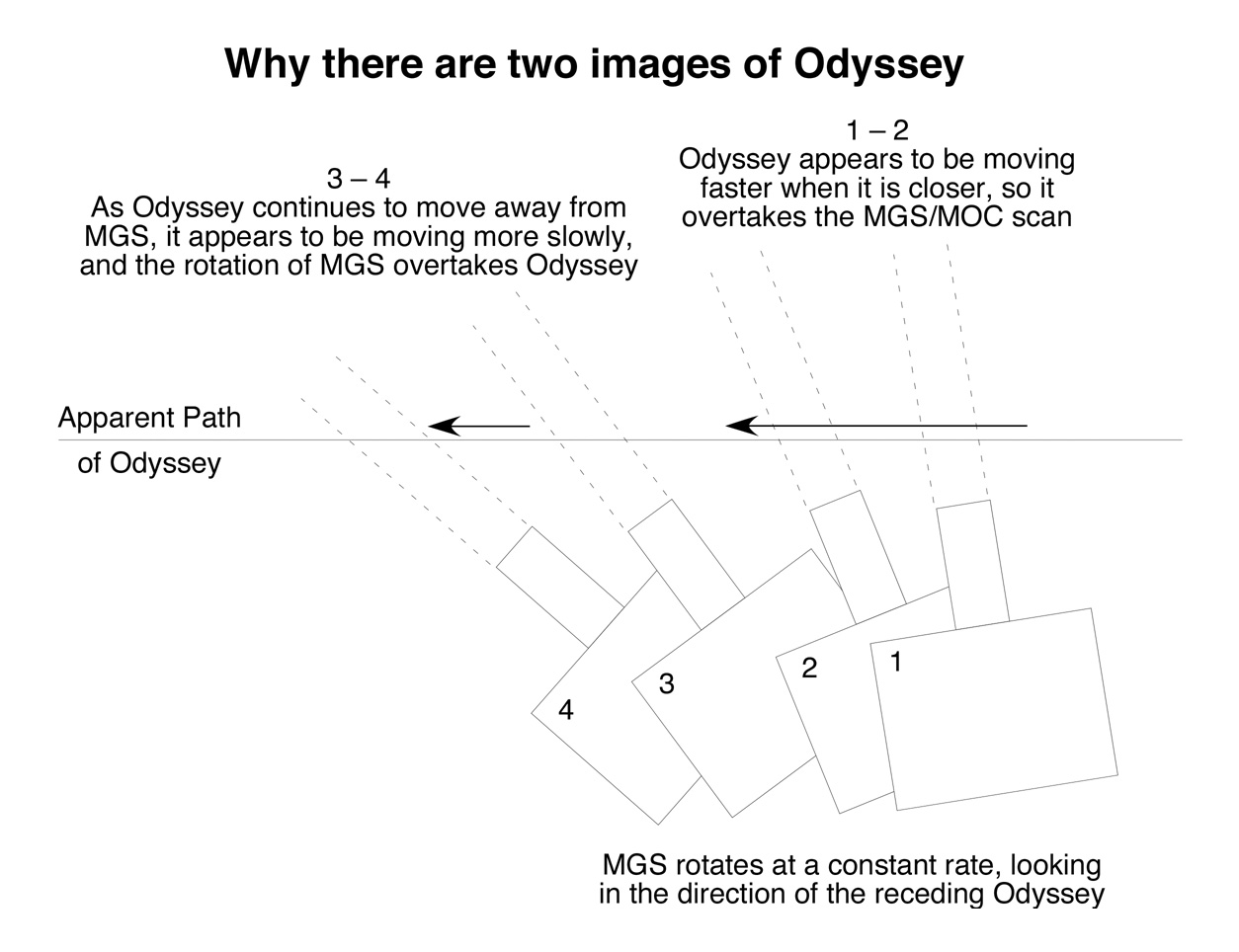
does help a bit- the camera is rotating and because it builds up the image over time it sees (the relatively near by) object twice.
I guess when imaging the surface they have to rotate the orbiter/camera to account fo the fact the orbiter is moving relative to the planet surface faster than they can take the picture. -
Mars Express was photographed first
If you RTFA, you will see it mentioned that this picture and one other picture taken by the Mars Global Surveyor were the first, not that this particular photo was the first. The European Space Agency's Mars Express was the first extraterrestrial satellite imaged in this method. The Mars Express was imaged April 20, 2005, and it seems Mars Odyssey was imaged this month (can't see a date, I've looked several places).
-
Re:Look, Ma, there are two of them!
Ok so the explanation is pretty clear to most everyone... if you believe that propaganda!!!
Clearly the larger so-called "satellite" is a Romulan Bird of Brey that has come to hunt down the Odyssey satellite before it either A) discovers the Romulans cloaked mission control base for Earth domination (by crashing into it) or B) becomes sentient like "V---ger" did. -
RTFA... - Re:Look, Ma, there are two of them!Not sure how what they wrote doesn't help. It's like TV where the image displayed is scanned line by line. Just in this case, the scanning is much slower.
"The two views of Mars Odyssey in this image were acquired a little under 7.5 seconds apart as Odyssey receded from a close flyby of Mars Global Surveyor. The geometry of the flyby (see Figure 1) and the camera's way of acquiring an image line-by-line resulted in the two views of Odyssey in the same frame. The first view (right) was taken when Odyssey was about 90 kilometers (56 miles) from Global Surveyor and moving more rapidly than Global Surveyor was rotating, as seen from Global Surveyor. A few seconds later, Odyssey was farther away -- about 135 kilometers (84 miles) -- and appeared to be moving more slowly. In this second view of Odyssey (left), the Mars Orbiter Camera's field-of-view overtook Odyssey.
-
The myth about solar cycles/
I see someone didn't bother to actually RTFA
Link for idiots that can't RTFA