Slashdot Mirror
Domain: nasa.gov
Stories and comments across the archive that link to nasa.gov.
Comments · 16,365
-
Re:Move along nothing to see here...Yes, 8-5 ka was a warm period (and the evidence is not definitive whether that period was warmer than today). The issue is the fast rate of change. See the Marcott wheelchair.
the rates of global warming from 1860-1880, 1910-1940 and 1975-1998 were identical
What Phil Jones said was, "Temperature data for the period 1860-1880 are more uncertain, because of sparser coverage, than for later periods in the 20th Century. The 1860-1880 period is also only 21 years in length. As for the two periods 1910-40 and 1975-1998 the warming rates are not statistically significantly different (see numbers below)."
The temperature record of the 19th century is not considered particularly precise among experts who study it, nor is a 20-year trend considered important by climate experts because ocean fluctuations lasting several years can affect the trend over such a short time.
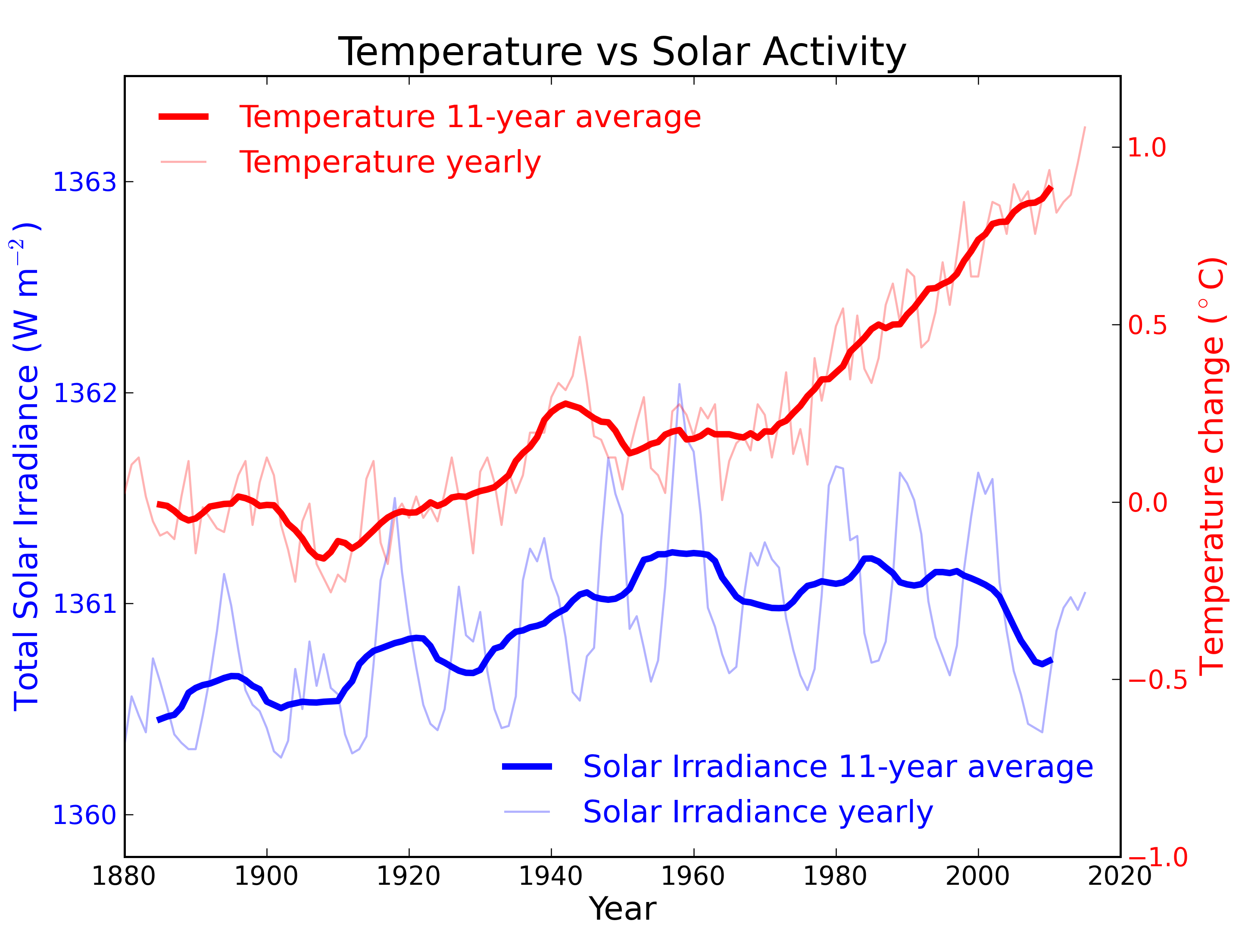
But if we assume the early records are accurate, the temperature increase from 1910-1940 can be explained as a combination of (1) human greenhouse gas emissions, as we were indeed burning them before 1960, (2) volcanic activity much lower than average (stratospheric aerosols from volcanoes cause cooling, thus their absence causes warming), (3) increasing average solar irradiance in that time frame, and (4) internal variability, such as differences in ocean currents. -
That's nothing!
We all remember NASA's best announcement of findings on Mars: https://apod.nasa.gov/apod/ap0...
-
Re:Move along nothing to see here...
Ocean currents are not generally been part of the climate models... sigh this is not the place to debate science anymore.
Dude, you are so wrong; wrong enough that I've wasted quite a few mod points to post this.
5 seconds with Bing and the search term 'gcm that includes ocean currents' had Evaluation of the GISS GCM ModelE in the top few results. This article is dated 2002 and talked about how ocean currents are included in the GISS GCM. Ocean currents have been part of GCMs (General Circulation Models) for at least that amount of time.
Now, I am skeptical of the robustness of GCMs. Their predictive power appears to be weak over time (look at how accurate the CFSV2 is over a three month period, for example); and probably because their resolution is quite low; GCMs typically having a horizontal resolution of between 250 and 600 km, 10 to 20 vertical layers in the atmosphere and sometimes as many as 30 layers in the oceans. But that will change as computers get faster or more massively paralleled.
Disagree with GCSs all you want. But at least try and do some rudimentary research on why you disagree with them..
-
Re:To Infinity and Beyond!
I'm speculating that the operational costs of the program are the prohibiting factor. In other words, it costs too much just to keep it running.
I speculate it's something else entirely. https://planetaryprotection.na...
-
Making up for lost time due to defects?
It seems little or no data was collected during a major portion of it's first orbit due to a software problem that escaped test, so maybe they are trying to make up for lost time.
If so, I'm not to happy about more of my tax money being spent. I'd prefer to see it taken out of Lockheed profits.
Posting anonymously because I work for Lockheed, but don't drink the kool aid.
-
Re: No
For that matter, the atmosphere of Mars alone is a good equivalent for Earth's magnetic field, giving a human naked on the surface better radiation shielding than someone on the ISS:
https://www.jpl.nasa.gov/space...
Obviously, someone naked on the surface would have a short life expectancy for other reasons, but the same is true of most of the Earth's surface. There are only a few locations where humans can survive without technological assistance. The idea that we are somehow so super-specialized for Earth that we can't possibly survive elsewhere is simply not realistic, and in fact is contradicted by the fact that humans were able to travel to and walk on the moon just 12 years after they first managed to lob something into orbit.
-
Re:Population
Increased temperature increases the rate of natural greenhouse gas stores - there's far more ecologically sequestered carbon and methane than humans would use in centuries - if our emissions warm the planet sufficiently, those reserves start being released faster than anything we've done. Same thing appears to have happened with every icehouse to greenhouse transition. Global climate is a bistable system - push it far enough and you hit the tipping point where the process becomes self-accelerating until it reaches the opposite state.
>And during that time, we have experienced massive climate change and temperature swings.
Not compared to the greenhouse transition we haven't. That's the point - everything our species has seen is variation within one extreme, switching to the other extreme has just as much variation - from jungle to planet-spanning desert, but the distance between the two is sufficient that normal variations are insufficient to "toggle" the global climate.A greenhouse world *might* be more hospitable, assuming we could avoid the global deserts, but the transition is going to be murder - literally. Adapting over the course of centuries is one thing - adapting from year to year because the weather is increasingly unpredictable, not so much. As for taking thousands of years to melt the ice caps - no. Just watch how much the arctic cap melted last year: https://www.nasa.gov/feature/g...
-
Re:Corals have been around
No, the question is. Will be be around to see these recover?
Unless we kill ourselves with a bioweapons or nuclear war, more than likely, yes. As a species, we are supremely capable of adaptation. And despite all the hysteria around climate change, the most likely scenario is a few feet of sea rise over a century. If we wanted to, we could take steps now to prevent that, steps that wouldn't rely on re-engineering the world's economy.
The article hints at it, but we as a species have been through much worse without our modern technology. Sea levels rose about 400 feet in the last 10,000 years after massive glaciers that covered the northern hemisphere retreated. Now that's climate change!
-
Open source climate models
I once strongly believed in this, but to my left is a computer that is entirely capable of doing nuclear bomb simulation. I'm curious why there's never any models given that I can simply run.
There is.
http://theconversation.com/mak...
https://opensource.gsfc.nasa.g... -
Re: commentary grossly misleads readers
Good thing that Antarctica is gaining ice overall... Less non-floating ice to melt!
-
I love sciency stuff
Astronomers Discovered the Fastest-Growing Black Hole Ever Seen
Oxymoron that.
Scientists can't directly observe black holes with telescopes that detect x-rays, light, or other forms of electromagnetic radiation. We can, however, infer the presence of black holes...
https://science.nasa.gov/astrophysics/focus-areas/black-holes
-
Re:ESXi, busybox, emacs, or PGP?
Here is Margaret Hamilton standing besides a printout of the Apollo 11 guidance computer source code, not really something that you could fit in your head: https://www.nasa.gov/sites/def...
-
Re:timing?
NASA has already proved there is water on Mars: https://apod.nasa.gov/apod/ap0...
-
Re:The future of fishing is video games
Here's your tiny areas, ignorant truth denier.
-
Re:Jobs not important?
Whoosh. Is your problem with reading comprehension or retention? The greater Chicago area is the cause of much of the pollution in surrounding areas, including coastal Wisconsin and Michigan. Lacking the windborne pollution originating in Illinois and Indiana, there's no reason to believe Racine county would have any sort of issue. No reason to force Racine to mitigate Chicago's pollution. And it's disingenuous and hypocritical for Illinois to sue claiming Wisconsin might cause more pollution.
Supporting document:
"- Elevated ozone levels are confined to an extremely narrow band that follows Wisconsin's shoreline, with air quality improving dramatically just a few miles inland;
- Ozone concentrations measuring above the level of the 2015 ozone NAAQS at the state's lakeshore monitors occur almost exclusively when the wind is coming from over the lake, not from over Wisconsin;
- Ozone concentrations at Wisconsin's lakeshore monitors are primarily due to emissions originating from outside the state;
More: "Upwind states (primarily Illinois and and Indiana) and emissions from commercial shipping on the Great Lakes contribute 2-3 times as much as Wisconsin. [pollution to a site in WI]" -
Re:When ideology clashes with evidence
Except that is not the only task of CMS: https://carbon.nasa.gov/cgi-bi...
-
Actually a geeky method - proven by NASA
Nitrogen is an interesting gas for this for a bunch of reasons, but primarily this: Nitrogen is such a large part of the air we breathe that we are wired not to reject it or get panicked by it. If you take in a big lung full of nitrogen, you will not feel ANY distress of note any odor etc. Your body will not want to reject it. If you take a full inhale of it with no oxygen, you will simply not get the benefits of the missing O2 (which means you will go hypoxic like an airman whose oxygen fails at altitude).
Here's the geeky NASA link:
NASA pumped the tail section of each shuttle orbiter full of nitrogen while on the pad for launch. This was done to reduce the risk of any dangerous build-up of Hydrogen and Oxygen in that part of the vehicle. That tail section was the large volume behind the payload bay where all the plumbing was for the LOX and Hydrogen went from the external tank to the engine turbopumps. Summary: In March 1981 (Shortly before the very 1st launch), with the vehicle on the pad in that condition for a rehersal, the tests were concluded and a pad crew was sent into the aft section of the orbiter but somebody forgot to vent the nitrogen. The first people in passed out too rapidly to help themselves. Some of their coworkers entered without breathing gear to help them and they too passed out before being able to render aid. Three died. It was fast, lethal, and the people dying were not criminal thugs, they were trained technical people and they nevertheless fell victim.
Here's a good NASA summary
-
Re:Well well
Pluto is a dwarf planet, although I guess in our hyper-sensitized culture we should call it a little planet.
-
Re:Flat Sun Society
You mean that thing which has such a consistent output that we refer to the "solar constant"? The thing that varies less than
You cherry-picking piece of shit.
Solar Variability and Terrestrial Climate
...
One of the participants, Greg Kopp of the Laboratory for Atmospheric and Space Physics at the University of Colorado, pointed out that while the variations in luminosity over the 11-year solar cycle amount to only a tenth of a percent of the sun's total output, such a small fraction is still important. "Even typical short term variations of 0.1% in incident irradiance exceed all other energy sources (such as natural radioactivity in Earth's core) combined," he says.
Of particular importance is the sun's extreme ultraviolet (EUV) radiation, which peaks during the years around solar maximum. Within the relatively narrow band of EUV wavelengths, the sun’s output varies not by a minuscule 0.1%, but by whopping factors of 10 or more. This can strongly affect the chemistry and thermal structure of the upper atmosphere.
The solar cycle signals are so strong in the Pacific, that Meehl and colleagues have begun to wonder if something in the Pacific climate system is acting to amplify them. "One of the mysteries regarding Earth's climate system
-
Re:I want to see
John Tyndall was among the first to measure the greenhouse gas characteristics of various gases in the 1850s.
In 1862 Tyndall wrote this:
As a dam built across a river causes a local deepening of the stream, so our atmosphere, thrown as a barrier across the terrestrial [infrared] rays, produces a local heightening of the temperature of the Earth's surface.
-
Re:Irresponsible
"If you'd maximize safety in every case, it wouldn't be able to lift off."
Or you could just not fuel it -- ever. That'd be pretty safe
But the real problem was described by Richard Feynman in 1986 in his Appendix F to the Rogers Report on the Challenger Disaster. https://science.ksc.nasa.gov/s...
" It appears that there are enormous differences of opinion as to the probability of a failure with loss of vehicle and of human life. The estimates range from roughly 1 in 100 to 1 in 100,000. The higher figures come from the working engineers, and the very low figures from management. What are the causes and consequences of this lack of agreement? Since 1 part in 100,000 would imply that one could put a Shuttle up each day for 300 years expecting to lose only one, we could properly ask "What is the cause of management's fantastic faith in the machinery?
Well worth reading and still applicable I think.
-
Re:Proof that CO2 does not cause warming
Here you go - same as I linked above. Look at the "Annual mean temperature change for hemispheres". You'll see it shows up in both hemispheres. Much like the Little Ice Age, and the Medieval Warm Period - worldwide phenomenon.
-
Re:Proof that CO2 does not cause warming
One data set hasn't completely smoothed it away, and still shows the spike during the 30s for the Northern and Southern hemispheres... That would be global, yes?
-
Re:Proof that CO2 does not cause warming
The 1930's peak was local to the US.
Even more accurate: the heatwaves in the 1930's were mostly limited to the month of July, and only really severe in a small portion of the US.
You can experiment with global maps here: https://data.giss.nasa.gov/gis...
Pick a range of years and months, and make a map.
-
Re:Unexpected Costs
Buy-to-fly ratio:
https://www.wired.com/2012/10/..."And your material loss is maybe 10 percent, just for trimming the edges. Instead of a ratio of purchased to flown material-what they call the 'buy to fly' ratio-of maybe 10 to 20, you have a ratio of 1.1, 1.2 tops."
A practical example is in this video.
https://archive.org/details/NA...This is the backshell for the Orion spacecraft. It's machined from a
A reasonably skeptical person would say "but that's just the backshell. It has to be {strong, lightweight, seamless, etc}. In this picture you can see many other structural panels manufactured the same way.
https://blogs.nasa.gov/orion/w...
If, and it is a non-trivial if, they manage to pull 10 flights out of a Block 5 booster without refurbishment that's another order of magnitude.
-
Re:Not a priority for science.
Maybe you should read up on what real science is.
-
Re:Unexpected Costs
Translated: SpaceX thought they needed to charge a premium to deal with bureaucracy but wildly underestimated just how much bureaucracy is required to interact with a multi multi billion dollar internationally operated property.
Not really. SpaceX were cheap only if you ignore the truckload of money that NASA paid them to develop their rockets and the fact that NASA bought 12 flights to carry supplies to the ISS, but the first two were basically test launches with very light payloads (CRS-1 and CRS-2).
SpaceX was only expensive if you can't do simple arithmetic.
For the first round of 20 flights, SpaceX is 20 * ($262.6M - $152.1M) = $2.2B cheaper than ULA. Subtracting out the $454M up-front investment, that still leaves a net savings of $1.75B. Even if you consider the time-value of the money by adding, say, 6% compound interest on the initial outlay all the way through 2020 (which is ridiculous), NASA will still have saved $1.18B vs ULA. And that's assuming ULA didn't get any development funding, which is false since both Boeing and Lockheed Martin built their spacegoing capability largely on NASA dollars, mostly under the old cost plus model (vastly more expensive).
NASA's own analysis looks even better for SpaceX, estimating the cost savings of launch system development alone (not considering operational savings) at over $3.5B. Of course, they were comparing to their traditional model.
And, frankly, continuing to undercut the competition by such a large margin would just be bad business. If your price is 42% lower than your nearest competitor's -- for the same quality of service, etc. -- you're leaving money on the table. Moreover, since NASA refuses to contract only a single supplier, it's not necessary to beat everyone, only to beat enough of them to stay in the group of contract recipients. This higher price will provide more capital to fund Musk's real goal: building a Mars transport system. Or to generate larger returns for its investors, which is totally fair since they put up as much as NASA did, and while we don't know how much they've taken out (if any), it can't be very much so far. Certainly far less than NASA's "profit" as compared to other launch options. But I think most of it will go into funding the Mars plans.
-
Re:Unexpected Costs
Yeah, or not. NASA invested $454M up-front in SpaceX, less than what they spent on the space shuttle in a year, and as a result got dramatically cheaper per-flight costs - saving billions:
The most significant improvement, beyond even the improvements of 2-3X times reviewed to here, was in the
development of the Falcon 9 launch system, with an estimated improvement at least 4X to perhaps 10X times over
traditional cost-plus contracting estimates, about $400 million vs. $4 billion -
Re:LOL!
didn't Nasa just launch a WSUS server up there
https://www.nasa.gov/directora... -
Re:Why do you right wing nutjobs hate the Earth?
Start reading here: https://phys.org/news/2015-02-...
If that's not enough, read all the good science referenced here: http://iopscience.iop.org/arti...
If you've gotten this far and still are unconvinced, you must not believe in the scientific method of thought or are in the extreme minority, more here on that topic: https://climate.nasa.gov/scien...
One does not have to be a scientist to know that something is terribly wrong.
Happy earth day. -
Re: The Best People
Good question: does NOAA do its own satellites?
The answer is clearly no. No part of atmospheric science has anything to do with engineering. Just like airlines don't build their own planes. Just like the US military doesn't manufacture their bombers and fighters.
I don't know if NASA just provides launch services them (as it does for some) or actually builds the instruments.
Woah, woah, woah. So what you are saying is that you didn't already know this answer but you feel like you can adequately suggest a course of action based on your ignorance of the subject matter?
My only point is that its OK to separate NOAA and NASA functions as long as the functions are still funded and done.
Having established that you didn't research the simple question of what NASA does and NOAA does with weather satellites, maybe you should research your point about "separating" NOAA and NASA functions before you post them again.
-
Trump is saving the agency
NASA languished under Obama, Trump has much more interesting goals than Obama could ever dream of - after all, to Obama any agency that was not funneling money directly to friends was rather a waste.
-
Re:Human Caused Global Warming?
Sea levels at the last ice age were about 120 meters lower than they are today. Most of the reef has a depth around 35 meters. Thus most of the reef - as we see it today - was about 85 meters above the tide line just 15,000 years ago. If it was laid down 2 million years ago, then the reef has migrated up the continental shelf as the water levels increased.
-
Re:Human Caused Global Warming?
Citation Required. The data record seems to say otherwise, with greater, faster changes happening in the past. And if you look at the longer term data you'll see that it's also happened back in the 1890s-1940s as well.
-
Re:Human Caused Global Warming?
See this paper, specifically figures 4 through 6. Look at the time from ~1890 to ~1940 - it's about the same level of change as we've seen from ~1970 to today (both about 50 year periods).
You can also check this graph and see we have had periods of much greater - and more rapid - temperature increses AND decreases, back in 1986-1988, 1997-1999, and 2009-2011.
-
Re: Truly sad...
The pattern of the environmental movement somehow continues to go unnoticed by the public: Environmentalists start paying attention to X, notice that their expectations for what X is like were wrong, then suggest that X is in danger from humans. But, in each case, the decision to announce a catastrophe can be shown to either be technically questionable, or simply premature.
Here's an example:
1979: First satellite measurements of ozone
"On September 17, 1979 (top left), the first year in which ozone was measured by satellite
1983: Ozone hole first detected
"... a compilation of monthly averages in a suggestive sequence of time-lapse stills, also from Cambridge’s Centre for Atmospheric Science, reveals the expansion of the violet blotch almost appear from nowhere in about 1983, when it was first detected
1985: Ozone hole declared a threat to the world
"When was the hole in the ozone layer discovered?
The discovery of the Antarctic 'ozone hole' by British Antarctic Survey scientists Farman, Gardiner and Shanklin (first reported in a paper in Nature in May 1985) came as a shock to the scientific community, because the observed decline in polar ozone was far larger than anyone had anticipated."
In terms of process, it is historically important to observe that the ozone hole was declared an emergency before a full solar cycle was observed with satellite.
Similar critiques have been made about these coral claims:
Professor Ridd
James Cook University"I have published numerous scientific papers showing that much of the 'science' claiming damage to the reef is either plain wrong or greatly exaggerated. As just one example, coral growth rates that have supposedly collapsed along the reef have, if anything, increased slightly.
Reefs that are supposedly smothered by dredging sediment actually contain great coral. And mass bleaching events along the reef that supposedly serve as evidence of permanent human-caused devastation are almost certainly completely natural and even cyclical. These allegedly major catastrophic effects that recent science says were almost unknown before the 1980s are mainly the result of a simple fact: large-scale marine science did not get started on the reef until the 1970s.
By a decade later, studies of the reef had exploded, along with the number of marine biologists doing them. What all these scientists lacked, however, was historical perspective. There are almost no records of earlier eras to compare with current conditions. Thus, for many scientists studying reef problems, the results are unprecedented, and almost always seen as catastrophic and even world-threatening."
Similar arguments can be made about climate change arguments, because the Sun itself is still not well understood, and in particular, we do not even know what happens to the solar plasma which enters into the Earth's ionosphere. In fact, Piers Corbyn's successes at predicting long-range extreme weather events is highly suggestive that environmentalists have failed to understand certain crucial solar, plasma and magnetic parameters which may be externally altering climate parameters in ways that are difficult to untangle:
Could gambling save science? Encouraging an honest consensus
Robin Hanson"Consider the example of Piers Corbyn, a London astrophysicist who has been unable to get academic meteorologists interested in his unusual theory of long-term
-
Re:Not a perfect circle
Interestingly.... https://www.nasa.gov/content/g...
Maybe not perfect all the time. -
Re:You do realize it was going to change anyway?
NASA shows that the change from ~1920 to ~1940 is about the same as we've seen from ~1980 to current. About 1 deg C in both cases. So we have a rather recent, pre-big-CO2 release record of the same kind of quick rise in temperature.
Nonsense. Assuming you are referring to Figure 4, first, why do you use a 20 year old study? Secondly, 20 years is too short a period for climate - just for one data point you usually need a 30 year average. And thirdly, have you done a statistical analysis of the rate of increase? If so, do you have the data sets? If not, and your just eyeballing the graph, or, equally bad, just compare two isolated points, your statement has no substantial basis.
Also, there is a massive dissonance between your signature and the source you are citing...
-
Re:You do realize it was going to change anyway?
Per Hansen et al. (figure 4), we had the same rise from ~1920 to ~1940 as we've seen from ~1980 to present. We had a pretty strong rise from ~1890 to ~1940, and that would cover a HUGE section of time pre-CO2 emissions issue. The rate of change is, in fact, not unprecedented.
-
Re:You do realize it was going to change anyway?
NASA shows that the change from ~1920 to ~1940 is about the same as we've seen from ~1980 to current. About 1 deg C in both cases. So we have a rather recent, pre-big-CO2 release record of the same kind of quick rise in temperature.
-
Re:Victors
It is a victory for consumers, who would otherwise be forced to pay much higher prices for automobiles.
In the spirit of Good Friday, I'm not going to call you a dumb sonofabitch.
http://time.com/money/4702421/...
The extreme warming predictions have proven wrong. We are heading into a solar grand minimum. The only people who need to worry about global warming are the alarmists who have staked their careers on it.
OK, you're a dumb sonofabitch.
-
Information on the Software
There have been multiple public presentations about the software on this mission.
http://flightsoftware.jhuapl.e...
http://flightsoftware.jhuapl.e...Goddard also has the interesting framework Core Flight System (cFE/cFS) which is available as open source. Again multiple presentations on it but a nice presentation by Dave McComas on it is here:
-
Re:Everything is possible!
The ozone hole kills hundreds of thousands of people every year.
The ozone hole that has been closing up again ever since AC refrigerant was refurmulted?
https://www.nasa.gov/feature/g... -
Re: Genetic Algorithms
The actual problem here is "simulate the wind". Doing so requires a FOSS fluid Dynamics package that runs fast, and to my knowledge this doesn't exist. NASA opened up theirs a few years ago seeking speedup:
https://www.nasa.gov/aero/nasa...
But there's physics stuff computers can't simulate fast, else we'd have AI's designing robots now.
-
Re:Refueling system?
That's exactly what NASA and at least one commercial space company are doing at the moment.
-
Not unexpected.
Yes, it's running out of fuel but it's also been operating for about a decade. "In 2013, Kepler’s primary mission ended when a second reaction wheel broke" which means this won't really be a big loss since it's been minimally functional for good while. The good news is that the James Webb Space Telescope is on track to be operational in about 18 months.
-
Re:Replace it
NASA has a page with frequently asked questions about Kepler's fuel status. From that page:
Why wasn’t Kepler designed to be refueled?
NASA decided to put Kepler in an orbit around the Sun that is well beyond the influence of the Earth and Moon to simplify operations and ensure an extremely quiet, stable environment for scientific observations. Well beyond our reach, Kepler compensated by flying considerably more fuel than was necessary to meet the mission objectives.To summarize, the location of the spacecraft makes a refueling mission impractical and expensive.
-
Re:An epic failure in science journalism
Re: "To answer the is it even worth considering question, though- of course it is. And it has been, at great lengths. And plasma physics play a huge role in even standard cosmology. They just don't play a huge role in large-scale cosmology."
Let me give you a very simple example which I hope you will recognize as an earnest attempt to demonstrate how difficult it is to judge vindications when we are not actively tracking scientific controversies.
Today, for the first time, I noticed that a couple of galaxy artists were suddenly drawing the Milky Way's galactic bulge as a pair, as if a memo went out (which I missed). I had never before noticed this, but having learned about Anthony Peratt's galactic simulation as a pair of rotating Birkeland currents, I immediately tuned into this pattern.
To somebody who has not paid any attention to Peratt's simulation, the explanation offered in a July 2016 article would seem good enough to assume the issue is basically settled:
Many disc galaxies, including our own Milky Way, have a central bulge that resembles either a box or an unshelled peanut. This bulge may form when the circular orbits of stars become elongated, creating a “bar” of stars that runs through the centre and tilts out of the disc’s plane. The combined effect makes the once-flat galaxy look like it has buckled under enormous pressure.
But, hold on just a second. This is a completely ad hoc explanation. Although I have no doubt that somebody somewhere can generate a tweak to the original galactic models -- perhaps involving dark matter -- which can explain with actual numbers why this may occur in the conventional model, the fact of the matter is that this is a completely expected feature when you are modeling a galaxy as an interaction of two Birkeland currents. -- and the choice to refuse to systematically track the Electric Universe controversy has left everybody failing to recognize that this actually vindicates the against-the-mainstream claim.
You think that's just a coincidence? Okay, let's go back a few days to the release of these new pictures from the Juno spacecraft of one of Jupiter's poles in infrared. The article states:
Jupiter’s poles are a stark contrast to the more familiar orange and white belts and zones encircling the planet at lower latitudes. Its north pole is dominated by a central cyclone surrounded by eight circumpolar cyclones with diameters ranging from 2,500 to 2,900 miles (4,000 to 4,600 kilometers) across. Jupiter’s south pole also contains a central cyclone, but it is surrounded by five cyclones with diameters ranging from 3,500 to 4,300 miles (5,600 to 7,000 kilometers) in diameter. Almost all the polar cyclones, at both poles, are so densely packed that their spiral arms come in contact with adjacent cyclones. However, as tightly spaced as the cyclones are, they have remained distinct, with individual morphologies over the seven months of observations detailed in the paper.
“The question is, why do they not merge?” said Adriani. “We know with Cassini data that Saturn has a single cyclonic vortex at each pole. We are beginning to realize that not all gas giants are created equal.”
Once again, I sprung into action because I have tracked Peratt's work sufficient to understand the inherent geometry of electricity over plasma. In his efforts to explain petroglyphs as z-pinch instab
-
Re:An epic failure in science journalism
Re: "You need to make testable predictions that differ from the current model."
There are many examples of observations at the level of planetary --> intergalactic scales which are expected in an electrical cosmology, but not in a gravitational one (and realize that it is acknowledged that gravity dominates at the smaller scales). To give a few examples
1. The failure of the solar wind to appreciably decelerate even as it passes the Earth's orbit. In the laboratory, we accelerate charged particles with an electric field. Basic physics is suggestive of the idea that the Sun is the center of an electric field, and it extends outwards to the heliopause.
2. The fact that galactic rotation curves are easily produced by modeling the cosmic plasma as laboratory plasma. The reason it is so is because the spiral arms trace out electric currents. Very simple physics compared to the dark matter conjecture. In fact, Winston Bostick produced spiral galaxy forms in the plasma laboratory many, many years ago, and Anthony Peratt created his supercomputer simulations as a reaction to that former experimental work.
3. The CMB itself can be argued to be evidence for electric currents in space, because
As for the unexpected bell-curve shape of this signal, it could very well result from the signal passing through the heliopause, but even if that proves to be problematic, it's not at all scientific to rush to judge that this is evidence for a creation event.
4. The layering of the ionosphere is evidence that the Earth has a net charge to it. Why? Because we can do the experiment in the laboratory: Set up a metal sphere in a vacuum, and pump it full of charge until the charge density becomes very high. What happens? Layering of charge. These are actually called double layers in the plasma laboratory, and they are recognized as electrodynamic phenomena (which is likely why astrophysicists have so far refused to catalog double layers as astrophysical entities, even though they've been observed in the Van Allen radiation belts).
5. The Earth is observed to electrically interact with the Sun every 8 minutes. You didn't recognize this as an electric current because the scientists called it either a "magnetic portal" or a "flux transfer event", but it is obvious that the magnetic field is caused by an electric current. What we've yet to see any acknowledgement of from mainstream scientists is that these discharges every 8 minutes might be acting as a feedback which stabilizes our solar system.
during a 2005 flyby of Saturn's moon Hyperion, the spacecraft was briefly bathed in a beam of electrons coming from the moon's electrostatically charged surface
The scientists referred to it as an "electrostatic shock", but this was an obvious violation of Debye screening, which should have limited the electrostatic discharges in this region to 10 meters. Incidentally, the researchers sat on the news of this event for a full 9 years before reporting it to the public.
In each case, we see something happening which is expected for electricity in space, but u
-
Re:An epic failure in science journalism
Re: "You need to make testable predictions that differ from the current model."
There are many examples of observations at the level of planetary --> intergalactic scales which are expected in an electrical cosmology, but not in a gravitational one (and realize that it is acknowledged that gravity dominates at the smaller scales). To give a few examples
1. The failure of the solar wind to appreciably decelerate even as it passes the Earth's orbit. In the laboratory, we accelerate charged particles with an electric field. Basic physics is suggestive of the idea that the Sun is the center of an electric field, and it extends outwards to the heliopause.
2. The fact that galactic rotation curves are easily produced by modeling the cosmic plasma as laboratory plasma. The reason it is so is because the spiral arms trace out electric currents. Very simple physics compared to the dark matter conjecture. In fact, Winston Bostick produced spiral galaxy forms in the plasma laboratory many, many years ago, and Anthony Peratt created his supercomputer simulations as a reaction to that former experimental work.
3. The CMB itself can be argued to be evidence for electric currents in space, because
As for the unexpected bell-curve shape of this signal, it could very well result from the signal passing through the heliopause, but even if that proves to be problematic, it's not at all scientific to rush to judge that this is evidence for a creation event.
4. The layering of the ionosphere is evidence that the Earth has a net charge to it. Why? Because we can do the experiment in the laboratory: Set up a metal sphere in a vacuum, and pump it full of charge until the charge density becomes very high. What happens? Layering of charge. These are actually called double layers in the plasma laboratory, and they are recognized as electrodynamic phenomena (which is likely why astrophysicists have so far refused to catalog double layers as astrophysical entities, even though they've been observed in the Van Allen radiation belts).
5. The Earth is observed to electrically interact with the Sun every 8 minutes. You didn't recognize this as an electric current because the scientists called it either a "magnetic portal" or a "flux transfer event", but it is obvious that the magnetic field is caused by an electric current. What we've yet to see any acknowledgement of from mainstream scientists is that these discharges every 8 minutes might be acting as a feedback which stabilizes our solar system.
during a 2005 flyby of Saturn's moon Hyperion, the spacecraft was briefly bathed in a beam of electrons coming from the moon's electrostatically charged surface
The scientists referred to it as an "electrostatic shock", but this was an obvious violation of Debye screening, which should have limited the electrostatic discharges in this region to 10 meters. Incidentally, the researchers sat on the news of this event for a full 9 years before reporting it to the public.
In each case, we see something happening which is expected for electricity in space, but u