Slashdot Mirror
Domain: nature.com
Stories and comments across the archive that link to nature.com.
Comments · 2,953
-
Re:Bias: but for them - not me!
Clearly they are not making any use of them. Oh wait, they are.
"Sixteen years into the mysterious ‘global-warming hiatus’, scientists are piecing together an explanation." http://www.nature.com/news/cli...
Maybe you should explain to the journal Nature why they should have ignored the margin of error and claimed a warming trend.
-
Re:They already have
I appreciate you working hard to get through to me. However, in this case, the facts are on my side. Learn to research.
Example 1.
Example 2.
Example 3.
You can see scientists are looking for explanations, rather than denying that the hiatus exists. Also, it's an honor to have a conversation with Bruce Perens. -
Re:Holy Carp!
More on this: http://www.nature.com/news/201...
-
Re:call me skeptical
wow. and you wonder why people like me (skeptics, not deniers) find it hard to take you seriously when you resort to lambasting people for asking questions. I didnt know nature was fox news..... http://www.nature.com/ngeo/foc... As I said. im not saying that nothing is happening. im saying that making the claim that it has been going on for 30 years... when you can find information that , if I am reading it correctly, states it has not been warming for the past 20 years causes concern on the believably of such claims.
-
Re:Stone Age ended, not for lack of stones
The math seems to back this up. http://www.nature.com/nature/j...
-
Mistaken View
A high price would allow using the resource more slowly, but it does not support keeping it in the ground, in fact, just the opposite. It is clear that the only oil we can still burn is oil that cost very little to produce, so a cap on the price of oil is what is really what would work to keep from burning too much. http://www.nature.com/nature/j...
-
Re:Stop trying to win this politically
Hmm... As I suspected you don't really understand climate models and their limitations. Climate models aren't expected to predict a 10 year period. That's more akin to a weather prediction than a climate prediction. As I have said the standard period for climatology is 30 years.
In fact it's impossible at the present time and may never be possible to produce a climate model that would accurately (to your standards) predict a 10 year period. That's because it's impossible to predict ahead of time the natural variability of things like ENSO and volcanic activity (to name a couple of the big ones). If no one can predict ahead of time the phases of ENSO and volcanic activity how can you expect a climate model to factor them in to its predictions.
The thing about natural variability is its mostly quasi-cyclical stuff (with the possible exception of volcanic activity). That is natural variability factors like ENSO and other ocean oscillations cycle from one extreme to the other over time periods that are not precisely predictable but in the long run their effects net out to near zero. 30 years is the minimum time period for that to happen for the most part.
A note on terminology: Climate models make projections, not predictions. I used "predictions" above to avoid confusing you. They are called projections because many of the real world factors that affect climate like natural variability are not predictable ahead of time and how the level of CO2 in the atmosphere rises depends on what we may or may not do to reduce emissions. So they feed realistic simulations of them to the model and the output is a projection of what will happen if the real world matches the simulation. They run the model many times with different realistic simulations to capture the full range of possibilities of the evolution of climate and what the public mostly sees is graphs of all of the model runs averaged together with uncertainty bars that cover the range and variability of the different runs.
Which brings up a scientific study that was published in Nature last year. Nature is paywalled but here is an article on it by one of its authors.
The gist of the study is that when they selected individual model runs where the realistic simulations of ENSO coincidentally happened to match well with real time observations of ENSO the models temperature output matched up well with real world observations of temperature (maybe even good enough to satisfy you). When they selected model runs where the realistic simulations least matched the real world the temperature projections were way off.
AGW is not based on temperature observations at all. It's based on the radiative absorption characteristics of carbon dioxide and the expected side effects of that. It started at the dawn of human industrialization in the late 1700's although the effect was small enough until some time in the early 1900's to hardly be noticeable.
-
Re:Ref:Telomerase
What about this article in Nature which directly contradicts your snide presumption?
http://www.nature.com/news/201...Given how we don't really understand if coffee and eggs are good or bad for us, and every month it seems to switch, it seems more than a little arrogant to condescend to someone who is basing their opinion on alternate though legitimate scientific theory.
Also, considering your GP post about telemeres, he was just asserting that the reduction of the telemere by DNA transcriptase can be reversed using mechanisms which already exist in our body. If you meant something different, you should have written it in your post, rather than let people guess the obvious implication.
So stop posting like an asshole, no one really KNOWS anything for sure about what will or will not stop or reverse aging, so stop acting like you do.
OR
Enlighten us and share your knowledge rather than beating us up with it. Since I am not a microbiologist, I can't rip apart the article from Nature I posted, but you surely must know what they got wrong given the confidence with which you derided that same information as being misunderstood when Wikipedia was linked. -
Re: What exactly do you mean by
But the temperature rise it predicted has not occurred.
The hockey stick was a reconstruction of past temperatures.
You are quite mistaken in your belief that it made predictions.His model and those which corroborated it are at the edge of the error bands, if the temperature does not start rising rapidly the models will fail soon.
Who is making up these claims about something that doesn't exist. MBH 1998 did not study future temperatures. It will not fail, because it has been corroborated by over a dozen more recent studies, with more data.
(But since you're here, the world is warming:
2014 was the hottest year on record Global temperatures hit new high with no boost from El Niño.)It is unlikely that his model is adequate.
He doesn't have a model that does prediction. If he did in 1998 we would do prediction with one of today's models, as we have made advances in the past 17 years. Interpreting some proxies does require modelling, but that information doesn't allow what you wrote to make sense.
-
Re:What exactly do you mean by "Fraud"?
It isn't corroborated by reality since global average temperatures have not followed the predictions of that model.
You seem to think that MBH 1998 made predictions. What they did was a reconstruction of past temperatures. As you can see from the paper.
They are now too busy coming up with theories for where the missing heat went and saying it went down a whole (literally).
I'm not aware of work by any of the authors of MBH that look at energy balance. Dr Trenberth is an important researcher in that field.
This Nature news article might be as good a place as any to start reading about that. Note that 2014 was the hottest year on record when you read the end: “You can’t keep piling up warm water in the western Pacific,” Trenberth says. “At some point, the water will get so high that it just sloshes back.” And when that happens, if scientists are on the right track, the missing heat will reappear and temperatures will spike once again.Well why didn't it go down a hole before too?
If you mean why haven't the oceans changed temperature before, or ice melted, then the answer is that they have.
A lot of us think this is much more easily explained by solar activity but of course what matters to these people is an insignificant amount of CO2 in the atmosphere.
I suspect that you're over-counting if you think that "a lot" of people think a lower solar activity, and particularly the current very weak solar cycle would cause a warming.
But there are other reasons why it is obviously not the sun.
The current warming is greater at night and winter, in line with greenhouse warming, but the opposite of what you would expect from solar activity, as the sun warms things when it is shining.
The current warming is accompanied by a cooling of the stratosphere, an obvious consequence of trapping the heat below, but impossible to explain with solar activity.
The spatial distribution of the warming, being greater at the poles and less at the tropics, also aligns better with the greenhouse effect than the sun.Do you know there is some evidence that if global temperatures went up the world's deserts would actually recede?
I know that rainfall requires evaporation or transpiration, so it will generally be heavier in a warmer world. This is not generally true on a regional scale, where changes to wind patterns have a dominating effect on precipitation.
Even if the temperature wouldn't rise as much the arctic would become navigable just like it was in the Middle Ages when the Novgorod Republic was a major trading power and Iceland was colonized. That's what the scaremongerers won't tell you.
A navigable Arctic is of some economic benefit. But there are many economic disbenefits, that greatly outweigh the benefits plus the cost of moving to a low carbon economy.
-
Re:Predictions have been pretty good, actually
In the first place 18 years is not long enough to invalidate a climate model. In the second place observations are still within the ranges projected by models. Most of the graphs you see on climate model output are from the Coupled Model Intercomparison Project (CMIP) that takes the results hundreds of individual runs from about 30 different coupled* models and produces a weighted average and spread** of them. That smooths out the effects of natural variability so it's expected that observations will be under model projections part of the time and over them part of the time.
*Coupled means they have an atmospheric model and an ocean model coupled together.
**By spread I mean how big the range is when individual model runs differ from each other.
Yes, there are other factors at play and they are the subject of much study. To the extent possible they are included in climate models. A number of those factors such as ENSO, other oceanic cycles and volcanic activity are not predictable ahead of time so models have to simulate realistic scenarios for them. A recent paper "Well-estimated global surface warming in climate projections selected for ENSO phase" by Risbey, et. al. found that when you selected the model runs that were largely in phase with with the real world ENSO they matched observations pretty well.
Considering that CO2 increase has been constant, but temperatures have not significantly risen in the last 18 years.
Yet the oceans where more than 90% of the energy goes have continued to warm and major ice sheets have continued to melt. It doesn't take much of a shift in the amount of heat absorbed by the oceans to significantly affect the atmosphere.
-
Re:These people scare me
Ah, I see, your objection is informed by your ideology more than science.
Here are some papers that examine the changes in outgoing longwave radiation spectra over time that support the increase in greenhouse forcing:
* Increases in greenhouse forcing inferred from the outgoing longwave radiation spectra of the Earth in 1970 and 1997 – John E. Harries, Helen E. Brindley, Pretty J. Sagoo & Richard J. Bantges; Nature 410, 355-357 (15 March 2001) | doi:10.1038/35066553.
* Comparison of spectrally resolved outgoing longwave data between 1970 and present, J.A. Griggs et al, Proc SPIE 164, 5543 (2004).
* Spectral signatures of climate change in the Earth’s infrared spectrum between 1970 and 2006, Chen et al, (2007)
* Radiative forcing – measured at Earth’s surface – corroborate the increasing greenhouse effect, R. Phillipona et al, Geo Res Letters, v31 L03202 (2004)
* Measurements of the Radiative Surface Forcing of Climate, W.F.J. Evans, Jan 2006
* A method for continuous estimation of clear-sky downwelling longwave radiative flux developed using ARM surface measurements, C. N. Long and D. D. Turner, Journal of Geophysical Research, vol 113, D18206, doi:10.1029/2008JD009936, 2008
* Satellite-Based Reconstruction of the Tropical Oceanic Clear-Sky Outgoing Longwave Radiation and Comparison with Climate Models, Gastineau et al, J Climate, vol 27, 941–957 (2014).
-
Re:The hard part is yet to come
You didn't read the paywalled article, did you?
The antibiotic blocks the bacterial cell wall synthesis. Animals don't have this particular cellular component, so the drug is essentially inactive against humans. This was shown by doing tests on mice. There is the possibility that the drug may elicit allergic response in humans (penicillin often does), but this will be tested in clinical trials.
The more exciting part of the work that did not get any mention in the summaries is how they found the antibiotic. They developed an approach to grow on a large scale microorganisms that were previously impossible to culture in lab conditions. They capture the microorganisms on a chip and then put the chip back into the environment from which the samples was isolated. This means that they did not need to guess what kind of nutrients each microorganism will need (they tested ~10,000 different microbes). The approach allowed them to grow 50 fold more microorganisms compared to what was possible using the current state of the art. To me this is the big news, because antibiotic discovery has been limited by our ability to grow microorganisms in the lab.
-
Re: Money quote
Mass extinctions are only briefly bad for biodiversity. It's still a topic of debate, but mass extinctions might well be good for biodiversity in the long term.
-
Drought [Re:be accurate, if you can...]
And relevant to the discussion, here's a nice article on 538 today, talking about the current California drought, and saying (with detailed discussion) that even though climate warming may exacerbate drought, it's nearly impossible to attribute this particular drought to climate warming:
The complex, dynamic nature of our atmosphere and oceans makes it extremely difficult to link any particular weather event to climate change. That’s because of the intermingling of natural variations with human-caused ones.
http://fivethirtyeight.com/fea...And a link to a (2 year old) Nature editorial saying the same thing about extreme weather: http://www.nature.com/news/ext...
-
May not be a practical drug.
The original paper for this was discussed yesterday on In The Pipeline. The point was raised that the mechanism involved, the JAK-STAT signalling pathway is used quite broadly throughout the body in the control of cell growth and differentiation. There are several Janus Kinase (that's JAK) inhibitors already on the market or in development, and they are powerful immunosuppressants indicated for the treatment of things like rheumatoid arthritis or leukemia. They tend to be the sorts of drugs whose advertisements say stuff like, "Xeljanz may increase your risk of serious infection." Notably, Xeljanz (tofacitinib) popped up in the news a few months ago when it was used to grow hair in a patient with alopecia universalis (who was already taking the drug for an autoimmune disease) and the headlines exclaimed that a cure for baldness was on the horizon. Now, a single drug that burns fat, grows hair, and relieves psorasis sounds like a miracle, but the reality is that's a sign that these compounds act more broadly than is desirable.
As the paper's authors themselves put it:
The utility of JAK inhibition as a therapeutic strategy for obesity is complicated by the well-described role of this signalling pathway in the immune system. In fact, tofacitinib is approved in the United States to treat rheumatoid arthritis. Thus, if one were to imagine targeting adipose tissue by in vivo administration of an IFN–JAK–STAT inhibitor or similar compound it would almost certainly need to be delivered locally and prevented from spreading systemically or alternatively targeted selectively to white adipocytes. One could also conceive of a cell-based therapy wherein JAK inhibition of patient-derived adipocytes ex vivo is followed by transplantation to treat obesity, but this therapeutic modality would need to overcome numerous and significant obstacles before becoming a reality.
-
Re: "Expected" to release methane
The problem with this is that climate changes, whether or not humanity is involved. [Anonymous Coward, 2014-12-11]
Once again, I've tried to point out that the scientific community who's warning about human-caused climate change is the same scientific community who discovered and named many of these modes of natural variability.
I've tried to point out that NASA's been measuring the Sun's brightness (etc.) for decades and concluded that natural variation can't explain the warming since 1950.
I've tried to point out that if the natural climate hadn't changed before, that would imply that it hadn't ever changed so we couldn't possibly change it now.
I've tried to point out that 420 million years of natural climate change support the idea that we are changing the climate, precisely because it has varied before.
I've tried to point out that some of the closest natural analogues to modern human-caused climate change, like the PETM and end-Permian, just reinforce my concern about treating the atmosphere like a free sewer.
I've repeatedly failed to communicate, and considering the stakes involved the weight of all these failures is becoming unbearable. I wish I could effectively counter the asymmetric strategies of the merchants of doubt.
The article you linked is now 5 years old, the cited studies even older, and I've been told by meteorologists that work for NOAA that some of these are tending in the opposite direction now. [Anonymous Coward, 2014-12-11]
Oh, some anonymous NOAA meteorologists told an anonymous coward that "some of those are tending in the opposite direction now"? Even if we humor this vague unverifiable anecdote, how could we figure out if it paints the whole picture accurately?
One way would be to skip the anonymous anecdotes, and see what NOAA actually says. NOAA runs www.climate.gov which has a number of educational resources for topics like the greenhouse effect and causes of climate change. Anyone who learns science from these NOAA resources will understand that the globe is warming, and humans are primarily responsible. And, of course, dozens of large scientific societies agree. That seems like a more accurate way of painting the whole picture.
But what about even more recent publications? In 2014, the U.S. National Academy of Sciences and The Royal Society (U.K.) wrote a joint publication (PDF). Anyone who learns science from this NAS/Royal Society publication will understand that the globe is warming, and humans are primarily responsible.
You can appear to “prove” almost anything you want if you restrict your study to relatively isolated phenomena, and ignore the bigger picture. [Jane Q. Public, 2014-05-12]
I know my argument is anecdotal vs. Yours which has very nicely laid out citations, but my overall point is simply this: you can get these studies to show just about anything you want if you work the numbe
-
Re:Life Everywhere out there?
Even if true, it is still basically life as we know it, but since on-one else has been able to replicate the findings...
Besides Mono lake is not a volcanic vent under the ocean. I think the poster was just thinking about how some life has different means of acquiring energy.
http://www.nature.com/news/ars...
http://news.nationalgeographic... -
Re:This should be a given..
The base-pair sequence of DNA determines its biological function. As you say, this sequence determines what kinds of proteins get made, including their exact shape (and more broadly how they behave).
But TFA is talking about the conformation (shape) of the DNA strand itself, not the protein structures that the DNA strand is used to make.
In living organisms, the long DNA molecule always forms a double-helix, irrespective of the base-pair sequence within the DNA. DNA double helices do actually twist and wrap into larger-scale structures: specifically by wrapping around histones, and then twisting into larger helices that eventually form chromosomes. There are hints that the DNA sequence itself is actually important in controlling how this twisting/packing happens (with ongoing research about how (innapropriately-named) "junk DNA" plays a crucial role). However, despite this influence between sequence and super-structure, DNA strands essentially are just forming double-helices at the lowest level: i.e. two complementary DNA strands are pairing up to make a really-long double-helix.
What TFA is talking about is a field called "DNA nanotechnology", where researchers synthesize non-natural DNA sequences. If cleverly designed, these sequences will, when they do their usual base-pairing, form a structure more complex than the traditional "really-long double-helix". The structures that are designed do not occur naturally. People have created some really complex structures, made entirely using DNA. Again, these are structures made out of DNA (not structures that DNA generates). You can see some examples by searching for "DNA origami". E.g. one of the famous structures was to create a nano-sized smiley face; others have 3D geometric shapes, nano-boxes and bottles, gear-like constructs, and all kinds of other things.
The 'trick' is to violate the assumptions of DNA base-pairing that occur in nature. In living cells, DNA sequences are created as two long complementary strands, which pair up with each other. The idea in DNA nanotechnology is to create an assortment of strands. None of the strands are perfectly complementary to each other, but 'sub-regions' of some strands are complementary to 'sub-regions' on other strands. As they start pairing-up with each other, this creates cross-connections between all the various strands. The end result (if your design is done correctly) is that the strands spontaneously form a ver well-defined 3D structure, with nanoscale precision. The advantage of this "self-assembly" is that you get billions of copies of the intended structure forming spontaneously and rapidly. Very cool stuff.
This kind of thing has been ongoing since 2006 at least. TFA erroneously implies that this most recent publication invented the field. Actually, this most recent publication is some nice work about how the design process can be made more robust (and software-automated). So, it's a fine paper, but certainly not the first demonstration of artificial 3D DNA nano-objects. -
Movies!
http://www.nature.com/ncomms/2...
http://www.nature.com/ncomms/2...I gotta figger out how to make screensavers......
-
Movies!
http://www.nature.com/ncomms/2...
http://www.nature.com/ncomms/2...I gotta figger out how to make screensavers......
-
Related paper: Oversimplifying quantum factoring
Here are links to my paper in Nature and to the arXiv version which explains why all such results are very silly.
http://www.nature.com/nature/j...
http://arxiv.org/abs/1301.7007 -
Strong AI taking over science research
Maybe Hawking's real concern is how strong AI will put scientists out of business, as in this wonderful short story from Nature Futures: http://www.nature.com/nphys/jo...
-
Re: You can often Google them
The journal "Nature" is indeed very likely. The various Nature Publishing Group journals, though, are a much longer list and a much more expensive one; and some of those are also pretty prominent and likely to contain things of interest that Nature the journal doesn't.
-
Some details from the paper
For those fortunate enough to have institutional access, the research paper is here.
Quickly picking some highlights:
The atmospheric transmission window is between 8 and 13 microns. They achieved 4.9C below ambient in direct sunlight at 850 watts per square metre. Cooling power was 40.1 watts per square metre. Emissivity (equivalently absorptivity) averages about 70% in the 8-13 micron window (estimated from a plot.)Here's a quick back-of-the-envelope calculation
90% reflective white paint: absorbs 85W/m^2
97% reflective foil: absorbs 25.5W/m^2, an improvement over white paint of ~60W/m^2
This film: emits 40W/m^2, an improvement over simple foil of ~60W/m^2.
So in this scenario, the special film gives twice the benefit compared to just going for something simple and reflective. (The 90% for white paint is guess-work. The 97% for 'foil' is just matching the special film. Perhaps someone can update the calculations with better founded values.)The summary title is highly misleading.
It is not paint, it is a manufactured film. It cools buildings, not planets. Yes, with enough you could cool the planet, but if you wanted to take that route, it would be much more cost effective to just use aluminium foil and use a marginally larger area of it (or, indeed, white paint.) Back in the real world, the way this invention cools the planet is by reducing electricity demand for air conditioning. (I saw another article about this in which one of the authors makes exactly this point.)
-
Jane/Lonny Eachus goes Sky Dragon Slayer
I cited Llovel et al. because of their conclusion regarding the deep ocean. I have already stated what research I would have to do before I could responsibly make a claim that the globe was warming. [Jane Q. Public, 2014-11-25]
No, you stated this:
... One thing I would have to check, just for example, is what those confidence intervals are given the multidecadal variability, which is not -- at least not uncontroversially -- known to any precise degree yet. What has been claimed to be a newly discovered variability in the Atlantic has turned up, for example. Not to mention that we know during La Niña periods of ENSO there tends to be storage, while during El Niño, more of a release. All these factors would need to be considered. Until I do, I neither agree or disagree. [Jane Q. Public, 2014-11-24]
Jane, that's not research you'd have to do before claiming that the globe is warming. You'd only have to do that research before attributing the warming to a particular cause. The only research you have to do before claiming that the globe is warming is to read the last sentence in the Llovel et al. 2014 abstract, and ask yourself if the bottom edge of their confidence interval is positive. Is it?
I cited Llovel et al. because of their conclusion regarding the deep ocean. I have already stated what research I would have to do before I could responsibly make a claim that the globe was warming. [Jane Q. Public, 2014-11-25]
Once again, the Llovel et al. 2014 conclusion regarding abyssal ocean temperatures depends on the globe warming. I've already explained why. If you didn't understand the equations I wrote down, just ask for help. Once you understand those equations, you'll finally see why you can't cite Llovel et al. 2014 regarding abyssal ocean temperatures while also claiming that the globe isn't warming.
I have frequently been astounded by your ability to find past information that suits your purposes, but when it comes to information that may serve to contradict your position, you suddenly appear to have never heard of Google. It is SO ridiculously easy to find references to issues with GRACE that I'm not going to bother to do it for you, and only an idiot would call that confirmation of a contrary position. [Jane Q. Public, 2014-11-25]
Sadly, that's exactly the response I expected.
I've written about many issues with GRACE, and released my source code. Here’s a quick link to browse the “control panel” of my code, followed by the top level of the program itself. All the functions used in that file are declared here and defined in full here.
So Jane will have to be more specific. I've written about many issues with GRACE, but none that qualify as "rather huge problems".
Past experienc
-
Re:Problem?
Why do people keep referencing a propaganda site? Rather than point out all the fallacies present in their arguments, I'll just point you to some more current research showing how poorly climate models have been doing: Overestimated global warming over the past 20 years.
And even that paper acknowledges that there was warming in that period. Why don't you?
WTF are you going on about? "There was warming in that period." Happy? Am I on the list now?
The warming does not fit the models, nor is there a correlation with the increase in CO2. Can you acknowledge that??
-
Re:Problem?
Why do people keep referencing a propaganda site? Rather than point out all the fallacies present in their arguments, I'll just point you to some more current research showing how poorly climate models have been doing: Overestimated global warming over the past 20 years.
And even that paper acknowledges that there was warming in that period. Why don't you?
-
Re:We've been doing it for a long time
@ProfBrianCox Having said all that, this particular evidence has been based on data from the GRACE satellite, which in the past has turned out to be something of a DISgrace... but they say they have the problems worked out now. [Lonny Eachus, 2014-10-20]
Assuming the rather huge problems with GRACE's accuracy have been fixed. It is claimed they were. Perhaps they have been. [Jane Q. Public, 2014-11-24]
At the risk of provoking this response, could you please link to evidence of these rather huge problems with GRACE's accuracy which in the past has turned out to be something of a DISgrace?
... how could I be "reflexively dismissing it" if my own statement, which you quoted, was "THOSE temperatures are no surprise and have already been accounted for"???
Only if you suggested that some blog summary of sea surface temperatures contradicted the Llovel et al. 2014 claim of significant warming down to 2000m.
... As for other depths, this paper contradicts the other one I cited earlier. Are you telling us that you get to decide which one is correct? [Jane Q. Public, 2014-11-22]
... The Llovel paper contradicts other papers in regard to stored heat in the upper ocean. I linked to a summary of some of them earlier. According to THEM, there has been no observed upward trend, so my position that there is no significant warming is quite defensible. [Jane Q. Public, 2014-11-23]
But it's worse than that. For some reason, Jane seems to think that he can cite Llovel et al. 2014 regarding abyssal ocean temperatures, while also claiming their upper ocean temperatures aren't correct.
Except I did not do that. You have had a very nasty habit of twisting what other people say. That's dishonest. I've pointed that out to you many times, over a period of years. You really need to start reading what people actually say rather than interpreting so heavily. [Jane Q. Public, 2014-11-24]
You seemed to suggest that some blog summary of sea surface temperatures contradicted the Llovel et al. 2014 claim of significant warming down to 2000m. Since we now seem to agree that there is significant warming down to 2000m, there's no reason to accuse anyone of dishonesty.
... are you now claiming, as you seem to be, that the "missing heat" cause of the pause in surface warming is actually hiding in the UPPER ocean, rather than the lower? [Jane Q. Public, 2014-11-24]
I'm claiming that Llovel et al. 2014 concludes: "The net warming of the ocean implies an energy imbalance for the Earth of 0.64 +/- 0.44 W/m^2 from 2005 to 2013."
I'm claiming that this conclusion is inconsistent with your claims that the g
-
Re:Problem?
Why do people keep referencing a propaganda site? Rather than point out all the fallacies present in their arguments, I'll just point you to some more current research showing how poorly climate models have been doing: Overestimated global warming over the past 20 years.
The evidence, therefore, indicates that the current generation of climate models (when run as a group, with the CMIP5 prescribed forcings) do not reproduce the observed global warming over the past 20 years, or the slowdown in global warming over the past fifteen years. This interpretation is supported by statistical tests of the null hypothesis that the observed and model mean trends are equal, assuming that either: (1) the models are exchangeable with each other (that is, the 'truth plus error' view); or (2) the models are exchangeable with each other and with the observations (seeSupplementary Information). Differences between observed and simulated 20-year trends have p values (Supplementary Information) that drop to close to zero by 1993–2012 under assumption (1) and to 0.04 under assumption (2) (Fig. 2c). Here we note that the smaller the p value is, the stronger the evidence against the null hypothesis. On this basis, the rarity of the 1993–2012 trend difference under assumption (1) is obvious. Under assumption (2), this implies that such an inconsistency is only expected to occur by chance once in 500 years, if 20-year periods are considered statistically independent. Similar results apply to trends for 1998–2012 (Fig. 2d). In conclusion, we reject the null hypothesis that the observed and model mean trends are equal at the 10% level.
-
Re:We've been doing it for a long time
The “pause” (political doublespeak) is 18 now. And a recent study showed “missing” heat is NOT in the ocean. [Lonny Eachus, 2014-10-14]
... the Argo array has been measuring the upper-level sea temperatures since 2005. THOSE temperatures are no surprise and have already been accounted for. [Jane Q. Public, 2014-10-22]
Did you see my comment about Argo, or not? The ISSUE here was precisely the deep ocean (> 2000m depth). Upper temps were known. [Lonny Eachus, 2014-11-06]
Jane/Lonny Eachus used to agree that temperatures above 2000m depth were known and were no surprise while simultaneously claiming that the globe isn't warming. When he realizes the contradiction, which path will he take? Will Jane/Lonny realize this means that the globe is still warming? Or will Jane/Lonny just reflexively dismiss the temperatures above 2000m depth?
... As for other depths, this paper contradicts the other one I cited earlier. Are you telling us that you get to decide which one is correct? [Jane Q. Public, 2014-11-22]
... The Llovel paper contradicts other papers in regard to stored heat in the upper ocean. I linked to a summary of some of them earlier. According to THEM, there has been no observed upward trend, so my position that there is no significant warming is quite defensible. [Jane Q. Public, 2014-11-23]
No, that blog summary discusses sea surface temperatures. How could that possibly contradict the Llovel et al. 2014 study of ocean temperature data down to 2000m?
But it's worse than that. For some reason, Jane seems to think that he can cite Llovel et al. 2014 regarding abyssal ocean temperatures, while also claiming their upper ocean temperatures aren't correct.
Perhaps Jane simply hasn't read Llovel et al. 2014. Their conclusion depends on the fact that:
total sea level rise = thermal expansion + land ice melting
Total sea level rise can be measured using satellite altimetry, and land ice melting can be measured by using the GRACE satellites. The remaining sea level rise is due to thermal expansion. Since ocean temperatures have been measured down to 2000m depth using ARGO, only the abyssal thermal expansion below 2000m is unknown.
Llovel et al. 2014 basically re-arranged that equation:
thermal expansion below 2000m depth = total sea level rise - thermal expansion above 2000m - land ice melting
That's why Jane can't cite Llovel et al. 2014 regarding abyssal ocean temperatures, while claiming that their upper ocean temperatures aren't correct. Their abyssal ocean temperatures are obtained by subtracting the ARGO upper ocean temperatures and GRACE non-steric sea level rise from the total sea level rise revealed by satellite altimetry.
So if Jane claims that ocean temperatures above 2000m depth aren't warming, that means the steric sealevel rise must be due to abyssal warming below 2000m depth. Physics says that Jane can't have his cake and eat it too.
Oh, and once again: ocean temperatures down to 2000m are different than sea surface temperatures. Seriously. There's like 2000m of difference between the two
-
Re:Riiiight.
Best to read the source article http://www.nature.com/nature/j...
They are looking at the seasonal swing of CO2, it goes down in Summer and up in Winter. They are not saying it causes a net CO2 gain. It agrees with the book chapter you linked.
Cutting down trees which grow slowly and only few die each year, does increase the seasonal swing as you replace them by fast growing plants that die off every year.
-
Re: Single-year does not make a decadal trend.
I'm sorry, you're full of shit and don't have a clue what you're talking about. When you disagree with NASA and CERN and the fossil record you better be able to also drop an SUV on mars from a rocket powered skycrane and hold all the worlds antimatter.
The IPCC has not been right about anything, ever, and if you don't think 75% error is meaningful then 2+2=7 is for you.
You wouldn't happen to be the recipient of a climate grant would you?
"The problem is we don't know what the climate is doing. We thought we knew 20 years ago. That led to some alarmist books – mine included – because it looked clear-cut, but it hasn't happened,” Lovelock said.
“The climate is doing its usual tricks. There’s nothing much really happening yet. We were supposed to be halfway toward a frying world now,” he said.
“The world has not warmed up very much since the millennium. Twelve years is a reasonable time it (the temperature) has stayed almost constant, whereas it should have been rising -- carbon dioxide is rising, no question about that,” he added.
"'I made a mistake'As “an independent and a loner,” he said he did not mind saying “All right, I made a mistake.” He claimed a university or government scientist might fear an admission of a mistake would lead to the loss of funding."
Oh fuck. The F word. F-f-f-f-f-uding.
https://web.archive.org/web/20...
"Warming" -> http://www.nature.com/nclimate...
http://www.nature.com/nclimate...
http://www.climate.gov/news-fe...
http://www.nasa.gov/press/2014...
http://www.theregister.co.uk/2...
http://blog.nj.com/njv_paul_mu...
http://opinion.financialpost.c...
http://www.populartechnology.n...
http://tigger.uic.edu/~pdoran/...
http://www.climatechangedispat...
http://news.ku.dk/all_news/201...If you have some other explanations of all these or proof of a warming world this might be a good time to drag it out.
-
Re: Single-year does not make a decadal trend.
I'm sorry, you're full of shit and don't have a clue what you're talking about. When you disagree with NASA and CERN and the fossil record you better be able to also drop an SUV on mars from a rocket powered skycrane and hold all the worlds antimatter.
The IPCC has not been right about anything, ever, and if you don't think 75% error is meaningful then 2+2=7 is for you.
You wouldn't happen to be the recipient of a climate grant would you?
"The problem is we don't know what the climate is doing. We thought we knew 20 years ago. That led to some alarmist books – mine included – because it looked clear-cut, but it hasn't happened,” Lovelock said.
“The climate is doing its usual tricks. There’s nothing much really happening yet. We were supposed to be halfway toward a frying world now,” he said.
“The world has not warmed up very much since the millennium. Twelve years is a reasonable time it (the temperature) has stayed almost constant, whereas it should have been rising -- carbon dioxide is rising, no question about that,” he added.
"'I made a mistake'As “an independent and a loner,” he said he did not mind saying “All right, I made a mistake.” He claimed a university or government scientist might fear an admission of a mistake would lead to the loss of funding."
Oh fuck. The F word. F-f-f-f-f-uding.
https://web.archive.org/web/20...
"Warming" -> http://www.nature.com/nclimate...
http://www.nature.com/nclimate...
http://www.climate.gov/news-fe...
http://www.nasa.gov/press/2014...
http://www.theregister.co.uk/2...
http://blog.nj.com/njv_paul_mu...
http://opinion.financialpost.c...
http://www.populartechnology.n...
http://tigger.uic.edu/~pdoran/...
http://www.climatechangedispat...
http://news.ku.dk/all_news/201...If you have some other explanations of all these or proof of a warming world this might be a good time to drag it out.
-
Re:Mistaken Western-centric thinking about China
I remind everyone that the Chinese Communist Party is made up of the smartest people in China. It is full of scientists and engineers
That seems to be correct more and more.
In the last few years in Canada, conservative government has stopped supporting basic research, because in their stupid heads, basic research does not produce any results for the industry! Industry must come first so only research that should be funded is whatever they want. Even in medicine, you are no longer able to actually develop cures. You can only find them, then the government will actually provide "joint grants" to pharmaceuticals to determine if this is a viable medicine for humans. Yes, government throws money at pharma to take research and allow the scientists to complete it. Scientists alone cannot do that anymore. And if you want to do research unrelated to diagnostic or medicine? Let's say how neurons associate (and don't mention things like "magic cure for stroke!"), your research request will be denied and you are SOL, unless you can find some private sponsors (or university).
And now China. Recently about 50% of their R&D is technology and 50% is other, mostly non-basic. And what are they doing now? Their recent policy is that China is ready to remove the shackles of technology and industry guided research. They believe they have learned and advanced their science sector far enough with the "easy", short term goals and now wish to enact on era where basic research is more important than $$$ in next quarter.
http://www.nature.com/news/chi...
From what I see over the years, China's leadership does have a plan, and in this plan there is a measure of long term planning, not grandiose overstating of goals (unlike Russian space program). They started with mostly targeted, industrial/technological research, because goals of these are simple and easy to measure. As their science sector has become more sophisticated and matured, they are transferring more resources into basic research.
So yes, no one in China gives a damn about some western websites not working. If their audience was Chinese, these sites would have been hosted in China in the first place.
-
Re:We've been doing it for a long time
Llovel et al. 2014 concludes "The net warming of the ocean implies an energy imbalance for the Earth of 0.64 +/- 0.44 W/m^2 from 2005 to 2013."
So it's wrong to say "the globe isn't warming." Hopefully you just hadn't read to the last sentence in their abstract before making that absurd claim. But now that you've read that sentence, you can't honestly keep claiming that "the globe isn't warming" unless you first debunk Llovel et al. 2014.
-
Re:We've been doing it for a long time
This -- which is the longest and most comprehensive study to date -- says there is no detectable warming in the deep ocean.
So I don't know who you've been listening to, but my sources say it isn't happening to any noticeable degree.No, that source concludes: "The net warming of the ocean implies an energy imbalance for the Earth of 0.64 +/- 0.44 W/m^2 from 2005 to 2013."
-
Re:We've been doing it for a long time
Since the oceans are warming, it's wrong to say "the globe isn't warming."
Warming, according to whom?
This says long-term trends have not been detected, up to 2000.
This says no warming trend in upper ocean SINCE 2000.
This -- which is the longest and most comprehensive study to date -- says there is no detectable warming in the deep ocean.
So I don't know who you've been listening to, but my sources say it isn't happening to any noticeable degree. -
Re:We've been doing it for a long time
Such as roundup-ready corn spreading in the wild, and passing some of its modified genes to other plants, when it wasn't supposed to.
Care to cite anything that supports this statement? All I can fined is a specific experiment with rice where the GMO rice passed the gene to non-GMO weed rice. The fact that both are species of rice may mean that their pollen is compatible. I believe that is called cross pollination. Can you cite any research where GMO genes have jumped species? I do not believe there are any weed corn varieties so cross pollination can not occur.
-
Re:No, really -they don't say how.
http://www.nature.com/news/199...
Furthermore, hydrogen gas is a bitch to store, as it can permeate out through metal. So, not only do you have a the inefficiency of electrolyzing water, you have to do "something" to try to keep it from escaping. Probably substantial compression, but then that has its own set of issues. You can crack hydrogen gas from of natural gas, but that's retarded if you're intending to create a vehicle fuel.
We should just use hydrocarbons. They are an excellent energy store by every metric I can think of, especially compared to alternative technologies.
-
Re:Yes, but..
it's not diamond nor did the original paper claim it was: http://www.nature.com/nmat/jou...
-
Re:The placenta is NOT sterile
The old dogma that the body is sterile (with respect to microbes) if it is healthy seems more and more likely to be just an old dogma, not to be confused with truth. Here's a recent article in Nature about the unexpected discovery that a healthy placenta has an associated microbial population: http://www.nature.com/news/bac...
While there can be microbes in a placenta, usually they are not the types found in the intestinal tract, which is what this article is about. So, yes, flora from the mouth can travel through the blood stream to the placenta, but those are not the flora which ultimately colonize the intestinal tract.
-
The placenta is NOT sterile
The old dogma that the body is sterile (with respect to microbes) if it is healthy seems more and more likely to be just an old dogma, not to be confused with truth. Here's a recent article in Nature about the unexpected discovery that a healthy placenta has an associated microbial population: http://www.nature.com/news/bac...
-
Re:Diet causes change in those microbes
Diet doesn't really change the microbes.
That is not what recent science indicates at all.
"Diet rapidly and reproducibly alters the human gut microbiome", Nature 505, 559–563 (23 January 2014) doi:10.1038/nature12820
http://www.nature.com/nature/j..."Here we show that the short-term consumption of diets composed entirely of animal or plant products alters microbial community structure and overwhelms inter-individual differences in microbial gene expression. "
Yes, but low carb diets, at least described by the OP are not "entirely" animal products (or plant products). It would make sense that microbes that are needed to break down plants, would cease to exist in the gut if there were no plant material to break down. Likewise, for animal protein. We don't really need a new study for this, anybody who has changed a dirty diaper has experienced it. When babies go from breast milk, alone, to other foods, there is a distinct change in the stool. The gut flora needed to break down the new food source is picked up from the environment and begins to do its work. The old gut flora can't compete in the new environment and is replaced.
But, when going from a normal diet to a relatively low carb diet (using the term diet to describe what is consumed, versus weight loss), there still are ample plant sources, so the flora is not replaced, at least not in the dramatic fashion as going to an all animal or all plant diet.
-
Re:Diet causes change in those microbes
Diet doesn't really change the microbes.
That is not what recent science indicates at all.
"Diet rapidly and reproducibly alters the human gut microbiome", Nature 505, 559–563 (23 January 2014) doi:10.1038/nature12820
http://www.nature.com/nature/j..."Here we show that the short-term consumption of diets composed entirely of animal or plant products alters microbial community structure and overwhelms inter-individual differences in microbial gene expression. "
-
Re:Effects on Martian atmosphere
The indian mars orbiter, a vehicle with a lander module, and designed for interplanetary flight, cost less to manufacture and launch than the sandra bullock movie Gravity.
Source
http://money.cnn.com/2014/09/2...So, there's the cost of a suitable vehicle. About 74 million dollars.
Then we have the designer microbe end. Most designer microbes are intended for biofuel production, using fully synthetic biological pathways, designed by humans.
http://www.hindawi.com/journal...Other sources of interest are the biodegredation of toxic agents:
http://www.nature.com/nchembio...And of course, Plastics.
http://garj.org/garjm/pdf/2013...Feel free to order some of those researcher's samples!
Perhaps you would want some that are sporting a fully 100% human created genome?
http://www.jcvi.org/cms/press/...Microbes are tenacious things. Once cultured in the lab, and loaded into a delivery system, sending them to venus would cost about 80 million dollars.
Cost of R&D of modifying a suitable sulfur cycle microbe for venusian atmospheric conditions would cost around 100 to 200 million.
So, for around the 300 million dollar mark, we could be initiating the end of the hellish environment on venus-- OR-- we could pay for a few military airplanes.
You are a delusional moron.
-
You can not prove truth with a lie
Why is formal logic not mandatory in grades 9 through 13 ?
http://www.theregister.co.uk/2...
http://www.climate.gov/news-fe...
http://www.nasa.gov/press/2014...
http://www.nature.com/nclimate...
http://news.ku.dk/all_news/201...
http://www.nasa.gov/topics/ear...""Ice cores from Summit show that melting events of this type occur about once every 150 years on average. With the last one happening in 1889, this event is right on time," says Lora Koenig, a Nasa Goddard glaciologist and a member of the research team analyzing the satellite data"
When a 150 year melt cycle is "right on time" scientists question how this can happen in a warming world.
Hansen may have had something to do with the headline of this article "Satellites See Unprecedented Greenland Ice Sheet Surface Melt"
Technically it's correct, there were no satellites 150 years ago. ut an unprecedented cyclical event?
Mr. Hansen left NASA shortly after this - he's the guy that complained the government was muzzling scientists. Personally I think he's clinically insane. Turns out he and the other tat were paid by a company owned by a company that Al Gore ownss to raise a fuss. As a liberal i'm appalled and no longer have faith in the Democratic party (not an uncommon sentiment, and fear not I have less faith in the mean spirited party of thugs formetly kown as th GOP) and fuckit I may move to Scotland or Norway. Their governments are not perfect but atleast they'r not for sale.
-
Re:But DC is different,no?
-
Why only terrestrial sources?
I skimmed TFA, but they never made mention of why they ruled out contributions from asteroid impacts, since a previous study showed that at least some of them (like Chicxulub) can contribute large amounts of CO2.
-
Re:left/right apocalypse
I mean shit, look at Al Gore, if there was a list of everybody on the planet sorted by personal carbon consumption, he'd probably be in the top 1%.
Gore is carbon neutral isn't he?
I don't care how energy efficient his 20 bedroom house or his private jet are;
Gore doesn't have a private jet.
both inevitably consume a LOT more energy than your typical person's luxuries.
How does a jet consume energy without existing?
In a small contained lab environment we can sit there and measure how much of a greenhouse effect different gases have, but historical data doesn't even so much as show a correlation between greenhouse gases and climate change.
That's not true for any of the past 420 million years
IIt doesn't appear to harm ocean life
plant life, or land animals either
as during one of Earth's "greenest" periods in history we had 20 times the present atmospheric CO2, really fucking massively sized insects, dinosaurs, and more.
Kind of irrelevant. We have existent species now. Those are the ones that have to be able to live. Really fucking massively sized insects, and dinosaurs are already dead.
Other data suggests that rises in atmospheric CO2 follow rises in climate, not the other way around
Nope:
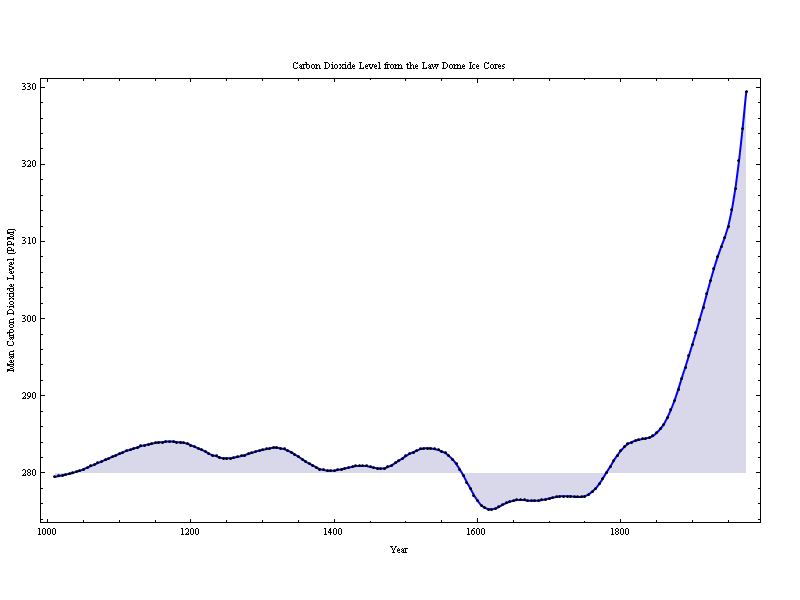
CO2, increasing since about 1750.
Temp, from about 1900.As for global warming itself, it could be fully or partially man caused. I don't know, but again, I don't think it's a problem either way, so I don't really give a crap.
Well, we've got a lot of science now, so we don't need to base our decisions on what you think.
It's entirely possible that the higher CO2 we're seeing is yet another rise following a climate change that we had no part in.
No it's not. It's from the combustion of fossil fuels.
And by the way, the arguments for stopping climate change so that we can save the economy are also incredibly stupid and self defeating.
Bullshit
We have not, even one time, seen a case where climate change has caused long term economic damage.
Meanwhile we have seen on well more than one occasion where stupid economic decisions cause global long term collapse. Hurting the economy for what is probably much ado about nothing is therefore pointless
The 10 state Regional Greenhouse Gas Initiative saw their combined economies increase by 1.6 billion in the first three years. Oh, the pain! The pain! Ouch! Stop the hurt!
Why did