Slashdot Mirror
Domain: nature.com
Stories and comments across the archive that link to nature.com.
Comments · 2,953
-
This demonstrates how little we actually understanIn this context, the news in my in-box from Nature ( Nature home page ) that "Megabase deletions of gene deserts result in viable mice" abstract is instructive. from the abstract "Viable mice homozygous for the deletions were generated and were indistinguishable from wild-type littermates with regard to morphology, reproductive fitness, growth, longevity and a variety of parameters assaying general homeostasis."
Essentially what they're saying is, mouse genomes contain large (millions of bases long) intervals which don't appear to do anything, and that there are no noticeable effects on the mouse if these sections of their genomes are removed. Which begs the BIG question, "What are those sections of the genome actually doing there?"
It is possible that they really do nothing , but such an "explanation" would be even more disturbing than finding that they do something which we don't understand yet.
Someone mentioned Greg Bear's "Darwin's Children" series of books, and I agree that Bear is a good writer. But his explanation of these oddities of genetics is equally unsatisfying too. Nice books though - and Bear does keep his finger on the pulse of the science. -
More info...
Nature.com states that the feathers are actually protofeathers which are more like hair. Instead of having a central shaft and barbs, they are single flexible filaments that would have covered the dinosaur's body.
Another interesting note from the article: The first Jurassic Park film featured scaly reptiles, but in the upcoming film Jurassic Park IV all the dinosaurs now will have feathers. -
"not much of a big deal"
According to this Nature article:
In an interview last week, Jerry Grey, director of aerospace policy at the American Institute of Aeronautics and Astronautics, credited Rutan and his team's achievements. "It's a tremendous engineering accomplishment. He's stimulated a new wave of interest."
"Rutan did it with private money," Grey says. "Other than that it's not much of a big deal." -
Re:Interesting warning on the site...
Sort of reminds me of COMP.BASILISK.
-
Re:Blame China
First post ever, my apologies if I foof up the links.
True, the Gulf Stream is a western boundary current (the Brazil, Agulhas, East Australian and Kuroshio Currents are as well). They are a "return" current caused by wind driven currents and the coreolis force. For example, in the Subtropical North Atlanic (Below 45 degrees N or so), the prevaling winds blow from west to east ("the westerlies"), which causes an equatorward drift. The Gulf Stream is the return flow of that drift "bunched up" on the western side of the the Atlantic. A bit of an oversimplification, you can read a bit more here.
The thermohaline circulation is related to deep circulation. In the North Atlantic (the Labrador, Norwegian and Greenland Seas), water can be cooled very rapidly during winter, which sets up convection cells - when cooled, the water becomes more dense and starts to sink; the formation of ice also removes pure water and increases density. So the cold, salty "deep water" sinks down (to somewhere between 1000 m and the bottom - about 4000 m), and drifts equatorward , underneath the gulf stream. That deep water is thought to make its way to the Southern Ocean, and around into the Pacific and Indian Oceans, where it eventually upwells. Deep water moves slowly, but is the counterpart to surface circulation (and there's a lot of it). This theory was put forward by an Oceanographer named Wally Broeker, who called it the "global conveyor belt" - it is thought to be very important for moving heat around.
There is some evidence for rapid climate changes in ice core records, and some have speculated that the conveyor belt could be shut down (a la The Day After Tomorrow), which had some pretty hilarious science, climate-wise). There is some geochemical evidence that it has happened in the past - for instance there's some evidence that two massive lakes filled with meltwater from the last glaciation drained into the North Atlantic over a very short period (following the failure of a massive ice dam) about 8200 years ago. The idea is that a surface layer of very fresh (i.e. low-salinity, hence low density) water, would "cap" the deepwater production areas. If it's already pretty fresh, ice formation wouldn't increase the salinity as much (and density is mostly from salinity, not temperature) - thus requiring much more cooling to make new deep water (which would be exacerbated by any warming). At some point deep water would not be created, and since the water from the Gulf Stream must go somewhere, it would "pile up" in the North Atlantic, eventually disrupting or stopping the Gulf Sream.
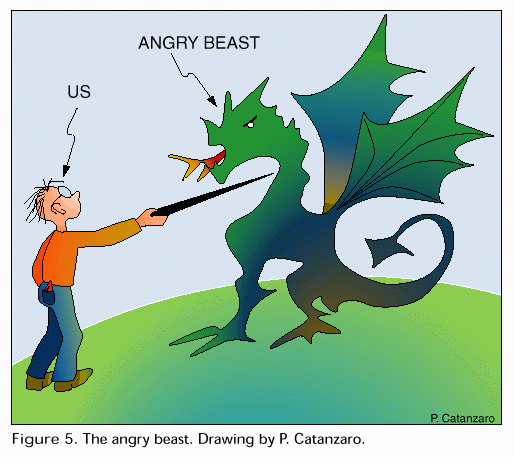
Obviously there aren't any glacial lakes that we need to worry about suddently draining into the North Atlantic, but the idea is that increased inputs of fresh water would eventually reduce the amount of deepwater formation. That would take a fairly large amount of warming, but is possible (~ a 20% chance in the next 50-100 IIRC). I'll refer you to a good article on the topic by Wally Broeker. It's five years old now, but still pretty much on the money. I'll refer you particularly to his figure 5.
Sorry also for my "excessive" use of "quotation marks" - bad habit.
-
Biotech is one place that NEEDS open source
I tend to agree with the many posted comments which judge the Fast Company article a bit overblown. There is enough to be gained even from the failures of the amateurs and nobody dies if their collaborations are stiffled by the interference of for-profit operations. ONE good effect of all the open source ferment has been to teach a lesson to the biotech industry. We are all hurt by the huge delays that patent litigation introduces into the process of biotech drug and therapy commercialization. The day before the Fast Company article and with a more fact-based report, the current issue of Nature had an article on "Open Source Biology about how biotechnologists who are willing to share their tool discoveries partly for the synergistic benefit that will have on the collective advancement of research and largely at frustration over the mire of patent litigation that gums up biotech research programs. [NPG charges for access to their content] The effort is spearheaded by Biological Inovation for Open Society and with the support of of the World Intellectual Property Organization are ushering in a new paradigm for science research.
-
Biotech is one place that NEEDS open source
I tend to agree with the many posted comments which judge the Fast Company article a bit overblown. There is enough to be gained even from the failures of the amateurs and nobody dies if their collaborations are stiffled by the interference of for-profit operations. ONE good effect of all the open source ferment has been to teach a lesson to the biotech industry. We are all hurt by the huge delays that patent litigation introduces into the process of biotech drug and therapy commercialization. The day before the Fast Company article and with a more fact-based report, the current issue of Nature had an article on "Open Source Biology about how biotechnologists who are willing to share their tool discoveries partly for the synergistic benefit that will have on the collective advancement of research and largely at frustration over the mire of patent litigation that gums up biotech research programs. [NPG charges for access to their content] The effort is spearheaded by Biological Inovation for Open Society and with the support of of the World Intellectual Property Organization are ushering in a new paradigm for science research.
-
Re:From a scientist: not just politics as usualNature's quick blurb "Manipulation of Science" is in fact something we should all be concerned about. Yes, scientists have biases too - just as we all do - but the purpose of science is to look past preconceived notions, test them, and get at the facts, as much as is possible. So if you ask scientists to study a problem, like weather patterns, or the effectiveness of birth control methods, and then disregard the advice you get on the basis of prior, ideological/political considerations, there's something really wrong.
Sadly, the claim that Bush doesn't listen to scientists on scientific issues fits a pattern: he doesn't listen to economists on economic issues, and he doesn't listen to military professionals on military issues. I guess this is why the Republicans are selling him as "decisive", and avoiding any discussion of the actual outcomes of his decisions.
-
Re:Flash?
Several people have linked the pdf version, also you can get the flash to fill your screen if you access it directly. I agree it's a horrible design, though. On the page it's set all the way down at 440x400 and most of the text isn't even on a clean background. Oo I had to go enable flash just to see it as well, since I usually have it off to avoid annoying ads.
-
Re:summary of responses
Kerry promises to join Kyoto protocol.
Furthermore, a Kerry-Edwards administration will not sign up to the Kyoto Protocol, partly because the short-term goals are unfeasible, says Devona Dolliole, a spokeswoman for the campaign. She says that they want to develop an alternative to Kyoto with more achievable targets.
Climate Change Overview -
Printable VersionPDF Version
It's a PDF, but it's much easier to read. I hate clicking a bunch of links to read a simple article.
-
Easier to read version
The flash player isn't exactly the most legible thing to read, so here is the more coherent printable version (PDF).
-
The printable version...
...in
-
Interesting Nature articles
I'm not sure if the texts are available to everyone else (I'm reading from a university with a site-license, I think), but here are two good articles published in Nature some time ago. Why do we age? (Thomas B. L. Kirkwood, Steven N. Austad)
Abstract Full Text
Oxidants, oxidative stress and the biology of ageing (Toren Finkel, Nikki J. Holbrook)
Abstract Full text -
Interesting Nature articles
I'm not sure if the texts are available to everyone else (I'm reading from a university with a site-license, I think), but here are two good articles published in Nature some time ago. Why do we age? (Thomas B. L. Kirkwood, Steven N. Austad)
Abstract Full Text
Oxidants, oxidative stress and the biology of ageing (Toren Finkel, Nikki J. Holbrook)
Abstract Full text -
Interesting Nature articles
I'm not sure if the texts are available to everyone else (I'm reading from a university with a site-license, I think), but here are two good articles published in Nature some time ago. Why do we age? (Thomas B. L. Kirkwood, Steven N. Austad)
Abstract Full Text
Oxidants, oxidative stress and the biology of ageing (Toren Finkel, Nikki J. Holbrook)
Abstract Full text -
Interesting Nature articles
I'm not sure if the texts are available to everyone else (I'm reading from a university with a site-license, I think), but here are two good articles published in Nature some time ago. Why do we age? (Thomas B. L. Kirkwood, Steven N. Austad)
Abstract Full Text
Oxidants, oxidative stress and the biology of ageing (Toren Finkel, Nikki J. Holbrook)
Abstract Full text -
public vs. private - publishing and beyond...
as a scientist, i have to say that its very important for the nih to address the public's access to publicly funded research results. i suspect that the nih is also trying to indirectly combat another problem - the enormous power and economic interest private science publishing groups wield. these publishing groups (nature publishing group is probably the best example) get to decide, by in large, what the scientific community pays attention to and what it ignores (.e. whats hot and whats not). this fact makes the nih nervous, as part of its policy mandate is to direct health research in the U.S.
the recognition that public investment implies public access in science research has important implications for pharmaceutical companies. these companies reap the benefits of publicly funded research in developing drugs (only 0.15c out of every drug company dollar is spent in R/D) and then make ridiculous profit selling drugs to the very same taxpayers who funded their development. if the nih were to extend this open access philosophy to the actual content of scientific publication, mandating that all publicly funded research remained in the public domain, the pharmaceutical industry as we know it would cease to exist. what would happen after that remains the subject of speculation - some say drug development would collapse due to the lack of (cash) incentive, others argue that it would revolutionize the healthcare industry by dramatically decreasing costs. either way, im glad to see the nih beginning to address these issues.
-
Study out today on Chinese vs. English DyslexiaI would love to see a study comparing how english is read to how chinese is read by native speakers
Actually, a closely releated study was published today in Nature saying "that a different area of the brain is affected in dyslexic Chinese children who read the character-based language than in Western youngsters who use an alphabet language."
More information in this Globe and Mail article and from Nature itself.
-
Whoa the Voyager Plaque
I am shocked by the blatant bias evident in the voyager plaque; Is this what "intelligent life" on planet Earth looks like? Where are the African-American brother, the obviously homosexual, the kid in a wheelchair, the nerk, and the "cheerfully chubby" munching on a burger? Those are "intelligent life" too, you know.
-
Very cool, related story in NatureThe journal Nature just ran a seperate news story a couple weeks ago about carban nanotubes' properties with regards to temperature. That story can be found here.
From the Nature article:
Ortwin Hess from the University of Surrey, Guildford, UK and colleagues say that if you took the temperature at one end of a 10-micrometre nanotube, it would not necessarily have the same temperature as the other end, no matter how long it was left to reach a thermal equilibrium. Such a nanotube is about as long as a sheet of paper is thick.
Now, I'm definitely no physicist so please pardon my ignorance--maybe someone can help me out. Does this mean that the temperature differential created on the carbon nanotube wire that causes the current to flow won't ever reach equilibrium? Doesn't this seem too good to be true? Just keep blowing gas over the wire, and you'll have limitless energy.
-
Very cool, related story in NatureThe journal Nature just ran a seperate news story a couple weeks ago about carban nanotubes' properties with regards to temperature. That story can be found here.
From the Nature article:
Ortwin Hess from the University of Surrey, Guildford, UK and colleagues say that if you took the temperature at one end of a 10-micrometre nanotube, it would not necessarily have the same temperature as the other end, no matter how long it was left to reach a thermal equilibrium. Such a nanotube is about as long as a sheet of paper is thick.
Now, I'm definitely no physicist so please pardon my ignorance--maybe someone can help me out. Does this mean that the temperature differential created on the carbon nanotube wire that causes the current to flow won't ever reach equilibrium? Doesn't this seem too good to be true? Just keep blowing gas over the wire, and you'll have limitless energy.
-
Nature's report...
Original news source comes from Nature'sreport...
-
Re:Finally... Heat can be put to good use
Actually this one would decrease the heat generated, as SiC is a better conductor, especially at higher frequencies. The nature article is a bit more interesting if you sometimes like to RT(F)A.
But then again the SiC chips will be pushed to their limit eventually, where they will be glowing red or something. -
Re:Only for people who could see at some time
There's actually an article (subscription) on this in this week's edition of Nature. It's about a guy who was blind from birth but - at the age of 52 - received a corneal graft that enabled him to see for the first time.
The psychologists were dumbfounded to discover that he could read the time on clocks and even the titles of books straight away, without any learning. It turned out that he had a "blind" watch (a clock without a cover over the face, so he could tell the time from feeling the positions of the fingers), and at school he'd been taught to recognise capital letters by their shape. Somehow this shape information was transferred from touch into sight ("cross-modal transfer").
However, when it came to objects that were out of his tactile knowledge, he was unable to respond to them properly - e.g. he had no way of estimating the distance of any object further away than the length of his arm, and pictures and photographs were just meaningless blobs of colour. -
This one's climbed a 'mountain'
NASA's mars exploration rover has just climbed a mountain to take a photo, read the article about the tough 3km climb, including making decisions about how to cope with 'injuries'... do you think AI is up to dealing with challanges like that yet?
-
Skip Roland's spam and stolen images
3D Holograms Detect Fake Signatures
Several sources reported last week that a new technique that produces 3D holograms of handwriting could be used to detect fake signatures on checks, credit card receipts or other important handwritten documents. Here are pointers to Nature , Scientific American or BBC News Online . Instead of using 2D techniques to look at the sequence of pen strokes in a signature, this new method is based on 3D micro-profilometry which permits to translate the writing into an image showing dips and furrows of the sample so that anomalies can be detected. If you plan to imitate your spouse's signature, beware! Forensics have a new and very efficient tool. As an example, for the use of ballpoint pens on normal paper, the success rate was 100%.
Nature describes the problem and its solution.
Suspect signatures are usually analysed by expert graphologists, who compare the appearance of different letters in a name with a verified original. However, they are restricted to looking at flat, two-dimensional writing, and good forgeries can sometimes slip through the net.
The new three-dimensional analysis reveals the sequence in which each pen stroke was made on the page. The technique also highlights differences in the pressure applied by the writer as they marked the page. Such pressure differences are extremely difficult to mimic.
Let's turn to BBC News for more details.
Conventionally, handwriting has been analysed by forensic experts in 2D, looking at the sequence of pen strokes in handwriting, like a signature.
But this is not entirely accurate, because the exact sequence of strokes is not always clear and can vary.
"Using virtual reality and image processing, it is possible solve two of the most difficult problems in graphology: strokes superposing and strokes direction.
"These, in particular in case of same inks, are not detectable in a objective way with the traditional methods," Lorenzo Cozzella, part of the research team, told BBC News Online.
Here is a an example of "profilometric acquisition by means of conoscopic holography. These strokes were made by a BIC pen on common paper. The investigation area is about 5 mm × 5 mm. (a) 3D view of the strokes' profile. It is possible to note the regularity in the (S) line. (b) 3D view of the strokes' profile. The presence of bumps is evident. (c) 3D view with a mirror along the z-axis."
The research work has been published by the Journal of Optics A: Pure and Applied Optics in its Septemebr issue under the name "Superposed strokes analysis by conoscopic holography as an aid for a handwriting expert." Here are two links to the abstract and the full paper (free registration needed, valid for 30 days, PDF format, 6 pages, 320 KB). The above images come from this paper.
How is this technique working? Surprisingly well, according to Nature.
To test their system, the scientists used a database of 126 letters, each written by a different author. In almost 90% of the cases they tested, the author of a particular letter could be identified by comparing details of how their pen strokes crossed with a set of verified writing samples. For ballpoint pens on normal paper, the success rate was 100%.
If you want to see the
-
Re:It's not black and white!
Can you possibly mean that lower priced journals are an unsolved technical problem?
Mostly, yes.
But whether they are run as nonprofits or not, academic journals have a near monopolistic ability to extract rents that far exceed their costs.
You're not asking why, are you? Look, this is not worth discussing without some background. Please go and read these articles. Some authors are clearly misguided, yet you need to understand where they are coming from.
It is not to say that I didn't support the confrontational attitude of the original PLoS letter, confrontation was effective, it has caught everybody's attention, and a very different approach is needed.
-
Information IS affected by gravity
See this (amongst others)
-
Re:The Paper Itself: Enjoy!
A link to Nature's copy: Watson & Crick 1953 (HTML)
and a PDF
Both contain the original drawing of the structure, as done by Crick's wife Odile Speed.
Simon -
Re:The Paper Itself: Enjoy!
A link to Nature's copy: Watson & Crick 1953 (HTML)
and a PDF
Both contain the original drawing of the structure, as done by Crick's wife Odile Speed.
Simon -
neural interfaces
I think we're in for a pretty interesting ride in this deptartment. There's some work being done with monkeys right now. I hear they can take on anyone in a round of 'Counter Strike'. I also hear they are kinda overweight and pasty white.
-
Nature article link
The actual article to appear in Nature can be found here, which I found at the CNSI web page.
I only wish that CNSI will complete construction before I graduate with my Master's in CS... Seems like it will be a great facility to do research on this sort of thing. Oh well, there's always CENS
- shadowmatter -
This happens frequently... not a reversalOkay yall... being a paleomagnetist and dealing with this topic all the time, I have to say that it is NOT LIKELY that this is the beginning of a reversal. The field goes up and down at all kinds of frequencies. If you look at a graph of the Sint 800 (sorry it's a tiny figure) you will see all sorts of ups and downs for the last 800000 years during the bruhnes normal period. The last big low is called the Laschamp and was about 35-40 thousand years ago. Today's field is so far above that.
The magnetic field is a 'random process'. There is no real good statistical predictor of when the next reversal will happen.
-
Re:Voyager?!
Yes we are still receiving stuff from the voyager craft I remember reading a paper about it rcently in Nature. A link to the abstract is here It may not be as pretty as the pictures we got from the outer planets but I find it amazing that such old technology can still help us do science despite the fact that it is so far away it warps your mind trying to think about it. I wonder how long the voyager craft will stay operational or what kind of computer hardware/software it used. I guess a google search could tell me but I don't have time for that now.
-
Re:If it was so easy...
I agree, but you have to look at the basic technology. Nuclear weapon's main issue is getting your hands on enough of the fissionable material. Doing that requires breeder reactors (not a small thing), massive chemical processing facilities, etc. (Until we figure out how to use Geobacter (Sorry about the soul sucking registration) to do it for us) It used to be very very tough to generate a custom IC. Hell, it used to be very very tough to generate a computer program. And get it to communicate (anyone remember Kermit ?). Biotech is experiencing the kind of wider quantuum leaps that IC technologies did in the 70's. As it continues to accelerate, and the tools get cheaper and easier to use, we'll definitely start seeing more oopses. My grandkids will learn whole new ways of dealing with crap like this. And nope, there's no way to 'stop it'. Science and development are driven by human curiosity and ingenuity.
-
Thats why some couples start looking alike?
I've wondered if that may be one of the reasons why some couples start looking more and more like each other.
The "two become one flesh" thing might be a bit more literal than some people might think. Using ones sense of smell to help choose a mate might be useful in getting a better genetic match - of course that's assuming you don't have artificial hormones and scents screwing things up. Some women's cycles cause them to flip from one preference (more similar genes) to another (more different) though...
Not sure what happens if a woman has children from many different men. Wonder how her immune system would handle the fetal cells with so many variations of DNA.
On a vaguely related note: human chimeras. Mosaicism and Chimerism. -
Re:Cool, but potential for weird/annoying uses.
Just wait till they start projecting basilisk images! o_O
-
Re:WHAT...
Yup, by Mayor and Queloz, see the abstract of the paper. There has been some argument as to whether it's a planet or not, but as far as I can tell it's now mostly agreed that it is- in fact, the site tmacd himself referenced lists it as entry #10 in its (non-chronologically ordered) list.
-
Linky!!!
-
Re:The CIA will love this
-
Re:No. Not Insightful.Most anti-GM's argue that selective breeding is not genetic engineering. If selective breeding is genetic engineering, then we have been engaged in genetic engineering for thousands of years.
You claim that the foreseeing is not done past next week/year/whatever. What is the basis of this claim? I have seen computer model studies investigating the impact of introduced genes and species spreading over dozens of generations. You claim simply that it is not done. I have seen it done, and I have read the reports that came out of those studies. Have you done the same?
Have you read the studies done over the past decade on the effects of GM crops? In case you haven't, here's the rundown: The primary impact is on biodiversity inside the farmland itself (and not always a reduction, it depends on the crop type). The studies independently concluded that the same effect would result from an advance in conventional herbicide technology. Basically, the species that have begun to thrive secondary to agriculture no longer get the benefit of that agriculture, while other species do get a benefit. But even that is only is some cases. Corn and wheat crops have no significant effect on supplementary populations. The overall impact is about the same as introducing agriculture into an area.
Carefully controlled and contained research? Like the stuff we've been doing in labs and experimental farms for the past 20 years? Read the research, not the propaganda. Go to PubMed, not the Drudge report.
You still have not proposed one mechanism. Not one scenario. Not even one gene. Show that you speak about GM technology from anything other than ignorance. People tend to fear what they do not understand. It's not that hard to understand, either. Go read about it. And read the real science. Start with Mendel and work up from there. Read the case studies that have been done, but no one seems to notice.
History is littered with failed biological experiments that were going to work "just fine".
I note a distinct lack of examples. Don't just shoot me an experiment that gave an unexpected result, give me one that had a detrimental result of the scale you speak of here.
Good set of links from a research journal on the subject of GM. It has links to some of the studies I mentioned.
-
Re:Argh!!! NOT teleport, NOT affects.
Normally I am not so pedantic but the poster repeatedly misrepresented what is happening in entanglement.
4 times in the post it was said that the particles teleport or communicate, they don't.
The headline on the cover of this weeks Nature reads "Quantum Teleportation with Atoms". What was observed is known in the field as quantum teleportation. While you may dislike this term, the poster was by no means misrepresenting the content of the research. -
New Scientist covered blackout over two weeks agoIndeed. Unless the editors are required to plug MS news, the scientific magazine's article is much more relevant since reduction of pollution is often considered a scientific issue. If nothing else, New Scientist had it two weeks earlier that MS news.
In addition to New Scientist, you can usually find good stuff on the same topic in Science News, Scientific American, Nature, and Science, to name a few.
-
Re:Embarrasment, not valid revocation...This is not correct at all.
Shoen had gotten his PhD from germany already and he was a postdoctoral researcher at bell labs (which is not a university)
The only "peer review" at that point that needed to be done was in the journals he was publishing in. He had, before the hoaxes were caught, already published in both nature and science, two of the more preeminent (and most rigorously peer reviewed) journals in the international community. In fact before the hoaxes were caught, there were quite a few famous people tallking about him being a Nobel Prize candidate.
Try reading this or this old ny times article -bloo
-
Re:Argh!
No pictures?! This screams for pictures! It's not even worth posting without pictures! Pictures!
Nature story with pictures. -
Re:Multi-dimensional
Google "overlapping reading frames", get something like this
-
Re:There is real naivete
Until recently though, math and systems theory have not been strengths of biologists in general - when I was in school, biology was what people took to be able to do science without a lot of math. Ask a biologist about Laplace, Linvill or Liapunov and you'll get a blank stare - which is truly scary if they're mucking around with living feedback systems being spread into the broader environment. There's still a generation that probably needs to be purged before the profession can be deemed "systems theory aware".
Oh please. You're conflating your high school biology teacher with serious research biologists, biochemists, genetisists, and biophysicists. Worse, you're using an ill-informed mainstream article to do your misdirection without even bothering to read the original article in question.
Clearly there is room for improvement in our understanding of all of these fields, which is why people doing biological research have been teaming up with computer scientists, mathematicians, physicists, and statisticians. I personally straddle a few of these fields every time I hoist a test tube and then analyze the data that comes back from it.
-
Interesting operators
What maybe a few people have missed is that there will be some incredibly interesting "hardware" out there in the future.
Some people have already demonstrated things like using DNA computers to solve travelling salesman problems, Quantum Computing and Grid Computers.
Perhaps what this article is suggesting is one way for developers of entirely new "hardware" to easily supply operators and types (syntax) to any programming language.
It would be interesting to be able to write program a that talked directly to the nervous system using fairly standard <your language of choice> syntax, that when compiled produced a real piece of nano "machinery". -
Re:... uh ...That's just the way I work. I have one mozilla for school related research open to Science Daily, Nature, and the like; the other instance has things like slashdot, other forums, and the art I am currently eBaying. You see I don't ever turn off my machines, as I use hibernate, so if I want to go to a website I just know by visual memory that slashdot is below the reload button in the second instance.
My home machine has 2 gig of ram. Currently Mozilla is taking up only 87 megs of that. My laptop is a different story as it only has 512 megs shared with the video card; damn it all, but I manage.