Slashdot Mirror
Domain: nature.com
Stories and comments across the archive that link to nature.com.
Comments · 2,953
-
Re:Depends on your definition of "life"
Indeed, there are tantalizing signs that Mars and Titan may harbor some form of life.
Mars: possibly.
Titan: what "tantalizing signs" are there for that? Titan is extremely cold, so any life, even single celled would have to be very different from what we know.
Not impossible, but very unlikely given our knowledge of chemistry and thermodynamics.which suggests that the leap from single-cell -> multicellular life is somewhat difficult
Nope, it took only 60 days in the lab for unicellular yeast to evolve to multicellular.
It took a bit longer for more complex forms, but give evolution a few million years and you're getting there.it starts to shift the odds towards one or more of:
4) The aliens communicate constantly, but they're not using our primitive technologies. Like cavemen put in our world wondering why no one makes or responds to smoke signals.
5) The distances in space and interstellar hydrogen ion clouds make long distance communication impossible. The universe is a very noisy place, and our strongest signals would drown away in noise when reaching even the nearest star. -
Re:Radiation is the Deal-Breaker
Outside the Earth's magnetic field, radiation becomes the biggest buzz-kill. It's nasty out there. There's concern that even going to the moon and back exposes you to enough high-energy radiation to cause cardio-vascular disease. Mars could be lethal, not just in getting there, but also after you arrive, because Mars has no magnetosphere strong enough to provide a shield (Earth says, "you're welcome"). Any deep-space research has to solve this problem or manned missions will be a death sentence.
There are lots of deal breakers. Radiation is just one of them. Another is loss of atmosphere. Spaceships leak. The ISS has to get constant resupply of gas because the atmosphere is constantly leaking out into space. They could take more with them as supplies and no doubt will, but that just makes the entire thing heavier and harder to get there. There will have to be some significant work on seals and keeping atmosphere from escaping over the periods of time a Mars mission will take (at least 22 months) before they will be able to go. The process of building something capable of carrying at least four people to Mars will also probably need some improvements and then comes the question of moving it out of orbit and on it's way to Mars which will require some more engineering advances as it's not something we've ever done before. At least we hopefully have the living in zero-G thing worked out with study on various space stations. Still, the ISS is the most expensive human project ever, and a Mars trip will be looking at building an even higher tech one of those and then moving it out of orbit to Mats where there will be landers and then return to the station and Earth. There will be countless deal breakers out there and nobody is even really considering putting forth the money to get them done any time soon.
-
Radiation is the Deal-Breaker
Outside the Earth's magnetic field, radiation becomes the biggest buzz-kill. It's nasty out there. There's concern that even going to the moon and back exposes you to enough high-energy radiation to cause cardio-vascular disease. Mars could be lethal, not just in getting there, but also after you arrive, because Mars has no magnetosphere strong enough to provide a shield (Earth says, "you're welcome"). Any deep-space research has to solve this problem or manned missions will be a death sentence.
-
Re:The only goog mosquitos
The mosquito release will have the beneficial side effect of driving away liberals who may have been infesting the area.
The role of mosquitoes in the ecosystem has already been studied, and there are plenty of other species, like damsel flies, that would take their place as fish and bat food. Besides, we would need to eliminate only a small number of species that bite humans:
http://www.nature.com/news/201...Replacing the lost liberals could be more of a problem. Scientists are not sure whether Republicans can be trained to save whales or help out at homeless missions. And how would whipping up date rape controversies at retirement homes even work?
-
Re:Why not use irradiated sterile mosquito
It may be with consideration of further DNA modifications.
http://www.nature.com/nbt/jour... - as an example.
This is an interesting technique which means that if you mate a wild mosquito, and a modified one, you get a modified male, or an infertile female.
This can spread through the population and wipe it out. -
Re:Maybe I'm missing something...
The problem is more from restrictions on federal research funds, and the rules against related research in labs receiving any federal funds. See here for an example.
-
Re:Slashdot Smear?
While it is written as a smear, I don't find it to be a very effective smear. It may be weird, but it's not like Gawker is saying "He SUCKS THE BLOOD OF CHILDREN FOR SEXUAL GRATIFICATION." It's not superstition or witchcraft or obviously morally wrong despite gawker's spin on it.
"Peter Thiel wants to live longer? OH DEAR GOD, WHAT A MONSTER! He should be content with living as long as God intended, a ripe old 45!"
I'm a biologist, and I think it's great that someone in silicone valley is funding something which could actually add years and health to my life rather than another app for sharing pictures people making duck faces. So maybe you're just not the right type of nerd, but I find it VERY germane here and interesting, and not a smear. -
Re:Ionizing radiation linked to circulatory diseas
I agree that the sample size of 7 is rot, the 95% confidence interval around a binomial with 3/7 is 10%-82%, in other words: "we don't have a clue".
However, neither TFA nor theMichael D. Delp, Jacqueline M. Charvat, Charles L. Limoli, Ruth K. Globus & Payal Ghosh, Apollo Lunar Astronauts Show Higher Cardiovascular Disease Mortality: Possible Deep Space Radiation Effects on the Vascular Endothelium, Nature Scientific Reports (open ac
Interestingly, they do claim statistical significance on the 7 astronaut "study", but I don't have time atm to have a better look...
-
Re: Technology Is Making Doctors Feel Like Glorifi
http://www.nature.com/scitable...
I'll stick with the medical abomination for now. -
Meat is the cause
When humans stop eating meat and switch to whole-food plant based diets, the rates of all leading causes of death (obesity, cancer, heart disease, and pretty diseases of inflammation) drop. To anyone with a scientific mind, modern nutritional-science's data should pretty much indict animal based foods as the direct cause of obesity, along with the consumption of heavily processed foods. It's no wonder that the nations with the highest meat consumption have the highest rates of lifestyle diseases like obesity, diabetes, heart disease, etc.
A tiny sample of the tens of thousands of papers stemming from clinical studies of meat's role in disease
Non-industry funded Research
Meat consumption is associated with obesity and central obesity among US adults
International Journal of Obesity (2009) 33, 621–628; doi:10.1038/ijo.2009.45; published online 24 March 2009
http://www.nature.com/ijo/journal/v33/n6/abs/ijo200945a.html
DIET, OBESITY, AND RISK OF FATAL PROSTATE CANCER
Am. J. Epidemiol. (1984) 120 (2): 244-250. 1.
http://aje.oxfordjournals.org/content/120/2/244.short
Diet and body mass index in 38000 EPIC-Oxford meat-eaters, fish-eaters, vegetarians and vegans
International Journal of Obesity (2003) 27, 728–734. doi:10.1038/sj.ijo.0802300
http://www.nature.com/ijo/journal/v27/n6/abs/0802300a.html
Prevalence of obesity is low in people who do not eat meat.
Key T, Davey G. BMJ: British Medical Journal. 1996;313(7060):816-817.
http://www.ncbi.nlm.nih.gov/pmc/articles/PMC2352221/
Meat consumption and prospective weight change in participants of the EPIC-PANACEA study.
Vergnaud AC1, Norat T, Romaguera D, Mouw T, May AM, Travier N, Luan J, Wareham N, Slimani N, Rinaldi S, Couto E, Clavel-Chapelon F, Boutron-Ruault MC, Cottet V, Palli D, Agnoli C, Panico S, Tumino R, Vineis P, Agudo A, Rodriguez L, Sanchez MJ, Amiano P, Barricarte A, Huerta JM, Key TJ, Spencer EA, Bueno-de-Mesquita B, Büchner FL, Orfanos P, Naska A, Trichopoulou A, Rohrmann S, Hermann S, Boeing H, Buijsse B, Johansson I, Hellstrom V, Manjer J, Wirfält E, Jakobsen MU, Overvad K, Tjonneland A, Halkjaer J, Lund E, Braaten T, Engeset D, Odysseos A, Riboli E, Peeters PH.
Am J Clin Nutr August 2010. vol. 92 no. 2 398-407
http://ajcn.nutrition.org/content/92/2/398.short
Type of Vegetarian Diet, Body Weight, and Prevalence of Type 2 Diabetes
Serena Tonstad, Terry Butler, Ru Yan, Gary E. Fraser. Diabetes Care May 2009, 32 (5) 791-796; DOI: 10.2337/dc08-1886
http://care.diabetesjournals.org/content/32/5/791.short -
Meat is the cause
When humans stop eating meat and switch to whole-food plant based diets, the rates of all leading causes of death (obesity, cancer, heart disease, and pretty diseases of inflammation) drop. To anyone with a scientific mind, modern nutritional-science's data should pretty much indict animal based foods as the direct cause of obesity, along with the consumption of heavily processed foods. It's no wonder that the nations with the highest meat consumption have the highest rates of lifestyle diseases like obesity, diabetes, heart disease, etc.
A tiny sample of the tens of thousands of papers stemming from clinical studies of meat's role in disease
Non-industry funded Research
Meat consumption is associated with obesity and central obesity among US adults
International Journal of Obesity (2009) 33, 621–628; doi:10.1038/ijo.2009.45; published online 24 March 2009
http://www.nature.com/ijo/journal/v33/n6/abs/ijo200945a.html
DIET, OBESITY, AND RISK OF FATAL PROSTATE CANCER
Am. J. Epidemiol. (1984) 120 (2): 244-250. 1.
http://aje.oxfordjournals.org/content/120/2/244.short
Diet and body mass index in 38000 EPIC-Oxford meat-eaters, fish-eaters, vegetarians and vegans
International Journal of Obesity (2003) 27, 728–734. doi:10.1038/sj.ijo.0802300
http://www.nature.com/ijo/journal/v27/n6/abs/0802300a.html
Prevalence of obesity is low in people who do not eat meat.
Key T, Davey G. BMJ: British Medical Journal. 1996;313(7060):816-817.
http://www.ncbi.nlm.nih.gov/pmc/articles/PMC2352221/
Meat consumption and prospective weight change in participants of the EPIC-PANACEA study.
Vergnaud AC1, Norat T, Romaguera D, Mouw T, May AM, Travier N, Luan J, Wareham N, Slimani N, Rinaldi S, Couto E, Clavel-Chapelon F, Boutron-Ruault MC, Cottet V, Palli D, Agnoli C, Panico S, Tumino R, Vineis P, Agudo A, Rodriguez L, Sanchez MJ, Amiano P, Barricarte A, Huerta JM, Key TJ, Spencer EA, Bueno-de-Mesquita B, Büchner FL, Orfanos P, Naska A, Trichopoulou A, Rohrmann S, Hermann S, Boeing H, Buijsse B, Johansson I, Hellstrom V, Manjer J, Wirfält E, Jakobsen MU, Overvad K, Tjonneland A, Halkjaer J, Lund E, Braaten T, Engeset D, Odysseos A, Riboli E, Peeters PH.
Am J Clin Nutr August 2010. vol. 92 no. 2 398-407
http://ajcn.nutrition.org/content/92/2/398.short
Type of Vegetarian Diet, Body Weight, and Prevalence of Type 2 Diabetes
Serena Tonstad, Terry Butler, Ru Yan, Gary E. Fraser. Diabetes Care May 2009, 32 (5) 791-796; DOI: 10.2337/dc08-1886
http://care.diabetesjournals.org/content/32/5/791.short -
Re:To put it into perspective
Umm... this is just a SWAG, but I estimate that the cost of recovering gold from an asteroid is orders of magnitude than recovering it from the Earth's core. Heck, we haven't even reached the mantle with the most ambitious drilling program.
-
Re:Chirality probably didn't come from space
There have been theories for some years that explain the preferred chirality of biological molecules (the ones which are chiral) because of the inherent asymmetry of the weak nuclear force. I've seen arguments that because of the weak force one enantiomer of a chiral molecule will be very slightly more tightly bound than the other and then due to biological selection (as you describe) and amplifying feedback effects during the rise of the first set biological molecules that the chirality we see today was preferred and not randomly selected. One quick recent reference: http://www.nature.com/news/for...
-
Re:In the lab, not production scales
Switching speed is not the limit of digital logic. The limit is derived from the inherent capacitance and inductance of the wires and channel. Signals optimally travel at 1/10th the speed of light (freespace) in silicon, when buffers are chaines and sized optimally. In non-optimal configurations, signals trvael slower. So the fundamental limitation is not the switching speed but the longest unclocked path in the circuit, more simply known as the critical path.
It is possible to reduce the critical path in a CPU somewhat in 2D gate arrays, at the expense of more pipeline stages, but this comes with it the greater proportion of time the CPU spends in a wait condition. The speed of a device can also be increased by increasing the Vds, but the power of a circuit scales approximately with f^2, so if you're not doing useful work with those cycles, you are just burning power needlessly vs. a lower clocked system with longer and fewer pipeline stages. It's not quite that simple, because with more pipeline stages, when they are not operating you can apply aggressive clock gating (power gating at those time scales would waste more energy through capacitive AC coupling).
If someone can figure out how to economically stack wells (doped regions of silicon), in a way that they don't capactively interfere with the cells above and beneath them, then we could see CPUs in the 10GHz+ regime. Besides that it's not really practical, due to the f^2 power scaling. The other approach would be to figure out how to make a device on a substrate with much better insulation (less capacitance and leakage current).
In practice, there is no point in making CPUs faster while memory access is still so damn slow. Getting on-chip optical memory interconnects working, as demonstrated in this paper by researchers at UCB and MIT would go a long way in improving computer performance, more than jacking up the ALU and LS clock frequency some more (remember that 1/10C speed limit in silicon thing, light in SiO2 is more like 7/10C).
*I am not any those researchers or affiliated with them, but their work is damn cool, and to top it off they are using the free and open Berkeley RISC-V ISA. Way cool.
-puddingpimp
-
Re:Senile?
we actually dont (free _will_)
http://www.nature.com/neuro/jo...
https://en.wikipedia.org/wiki/...one of defence mechanisms employed by human brain is building narratives fixing cognitive dissonance post facto, aka illusion of free will
-
Re:Stupid predictions
You could make an argument about beating chess not being AI, but that argument wouldn't hold for Go. With chess you don't have to program "intuition", it's evaluation of possible moves. With Go the possible number of boards is obscene : around 10^800 possible boards, where there are ~10^80 atoms in the universe. You can't just extrapolate and calculate possible moves, you have to program a deep neural net with a sort of AI "intuition". Very impressive feat, and the South Korean government immediately dumped billions into AI on hearing about the feat.
http://senseis.xmp.net/?Number...
http://www.nature.com/nature/j... -
Re:Bad arguments
Okay, now that I've had time to think.
I have no idea what that graph is trying to convey, but it does not address the demographic transition: that the more prosperous people are, the fewer children they have.
This doesn't support your argument. Your argument is, essentially, that certain demographics in a population exhibit a certain behavior; my argument is that a certain stimulus triggers a certain behavior.
Your argument completely ignores that a population with less scarcity can support more families. That means there can be more middle-class and rich families, or more poor families. There is physically more available to be distributed among each person without running out.
Notice here the relationship between GDP per capita in an area and the population (and population density) of that area.
Right. Hence, it makes sense that is desirable to increase their prosperity, so that they no longer are poor people who are, in your words, "breed like rats"
America has experienced huge prosperity increases. Take the past 100 years. Look at what the average family spent their money on.
1900: 43% of income spent on food; 14% on clothing. Housing (including shelter, maintenance, utilities) made up 23%. The average single-bedroom apartment was 400 square feet in this era.
1950: 30% food, 12% clothing, 28% on housing. I'll point out that the average new single-family home size in 1950 was 983sqft.
2003: 13% on food; 4% on clothing; 33% on housing, with an average new single-family home of 2,300 sqft. Your average American now spends more of his money on more and better healthcare, while also enjoying a much larger home and modern conveniences, and lots of non-essential discretionary spending. We eat out a lot more and cook in a lot less.
1900 United States population: 76,000,000. 1950: 152,000,000. 2003: 290,000,000.
Today, the average American family spends about 11% of our money on food and 3% on clothing. The United States population is 324 million.
The 1960 GDP per capita was $3,007. It was $39,677 in 2003, and is $53,041 today. These are inflation-adjusted numbers; GNP is unadjusted.
As America's prosperity has increased, so has its population. How do you explain this?
-
Re:GM coral
There's much more going on than "some research". Australia is actively breeding coral that is adapted to future conditions (lower pH, more CO2, higher temperatures) and is planning on releasing the results in the wild. I got this from the documentary about the Great Barrier Reef on Discovery Channel, but this article also describes it:
-
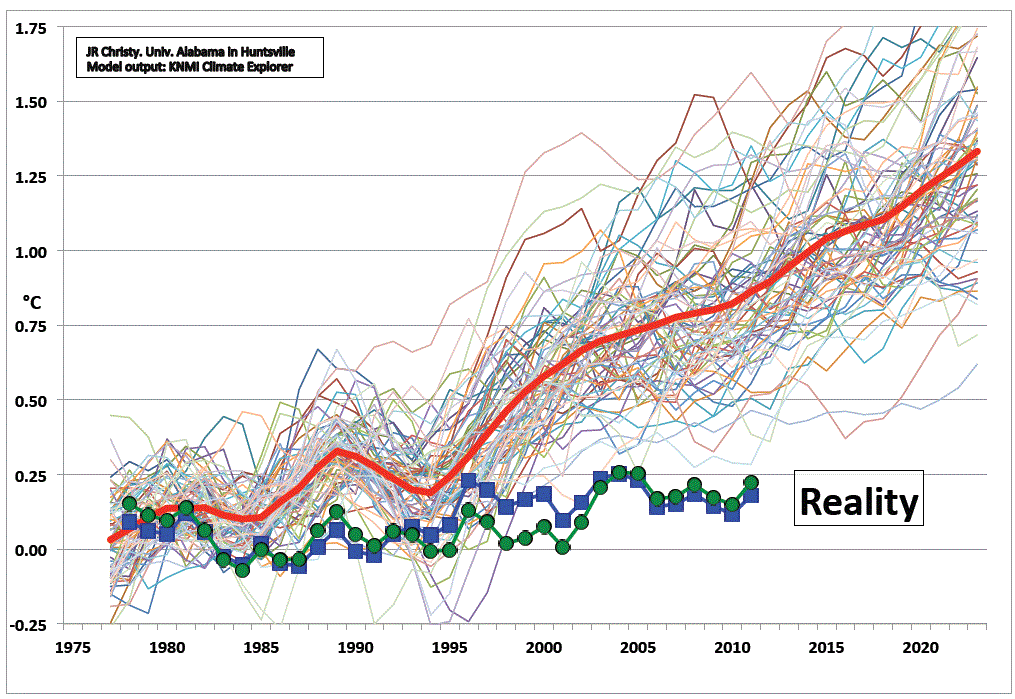
Re:Why believe the models?
I know there's been this contrarian myth circulating claiming that climate models predicted warming that never occurred. There's a nice, well-referenced debunking of it here [skepticalscience.com].
I see your ancient blog debunking, and raise you actual science:
Overestimating Global Warming Over the Past 20 Years
"much work remains before we can model hydroclimate variability accurately".
And here's a graph because pictures are fun! -
Re:Why believe the models?
I know there's been this contrarian myth circulating claiming that climate models predicted warming that never occurred. There's a nice, well-referenced debunking of it here [skepticalscience.com].
I see your ancient blog debunking, and raise you actual science:
Overestimating Global Warming Over the Past 20 Years
"much work remains before we can model hydroclimate variability accurately".
And here's a graph because pictures are fun! -
Re:of course it will burn.... IF
Secondly,
An approximately linear relationship between global warming and cumulative CO2 emissions is known to hold up to 2 EgC emissions on decadal to centennial timescales7, 8, 9, 10, 11; however, in some simple climate models the predicted warming at higher cumulative emissions is less than that predicted by such a linear relationship8. The climate response to five trillion tonnes of carbon
Every other modeler since Jean-Baptiste Joseph Fourier, and especialy Svante Arrhenius uses logarithmic relationship
if the quantity of carbonic acid [CO2] increases in geometric progression, the augmentation of the temperature will increase nearly in arithmetic progression.Svante Arrhenius
These guys are claiming the entire body of Climatological "Settled Science" is wrong and they are just throwing it out there like a bunch of assholes trolling click-bait; at least on Facebook the click-bait trolls give you some side-boob or camel-toed yoga-pants.
You're confusing two different things -- Fourier and Arrhenius (and everyone else) say that there is a logarithmic relationship between the increase in CO2 concentration and the increase in temperature.
This paper (as do many others) claims that there is a (near) linear relationship between emissions and temperature.
That's because doubling the amount we emit will more than double the atmospheric concentration, as the oceans will be taking up a smaller part of what we emit. Look for articles that talk about the TCRE "transient climate response to cumulative carbon emissions", e.g. Le Duc et al 2015
-
Re:of course it will burn.... IF
Firstly, "Purchase article full text and PDF $32", fuck that shit, if those whoremongers really believed that my actions was going to destroy the world their Greatgrandchildern need to live in, they would be paying me to read it!
Secondly,
An approximately linear relationship between global warming and cumulative CO2 emissions is known to hold up to 2 EgC emissions on decadal to centennial timescales7, 8, 9, 10, 11; however, in some simple climate models the predicted warming at higher cumulative emissions is less than that predicted by such a linear relationship8. The climate response to five trillion tonnes of carbon
Every other modeler since Jean-Baptiste Joseph Fourier, and especialy Svante Arrhenius uses logarithmic relationship
if the quantity of carbonic acid [CO2] increases in geometric progression, the augmentation of the temperature will increase nearly in arithmetic progression.Svante Arrhenius
These guys are claiming the entire body of Climatological "Settled Science" is wrong and they are just throwing it out there like a bunch of assholes trolling click-bait; at least on Facebook the click-bait trolls give you some side-boob or camel-toed yoga-pants.
-
Drinking Round up causes cancer
BTW, here's an example of what often happens when someone does actually publish evidence against Monsanto's interests: http://www.nature.com/news/wid...
You are seeing objections to the claims of round up causing cancer because it's false. The studies showing cancer in mice and rats was when exposing them round up used high doses. In practice, that means that eating round-up is probably carcinogenic, as reported. The trick is, in ag practice, people don't taste test chemical before putting them in a sprayer. After spraying round-up on a crop, it breaks down within days. By the time any crop hits the market, it's nearly impossible to find any trace of it, and that's looking at ppb. The cancer in rats quantity was many, many times higher. For reference, we might wanna measure radioactive isotopes on produce near coal plants too, it's probably at equally worrying levels as round up. That's proper scope of the 'problem'.
-
Re:Brace for shill accusations in
BTW, here's an example of what often happens when someone does actually publish evidence against Monsanto's interests: http://www.nature.com/news/wid...
-
Re: Post-modern America
Cutting science research would be a net hurt for the economy because for every dollar spent on research more value is created. Why do you want to condemn the country to have less innovation, less new industries, and less breakthroughs in the future?
-
The biomarker gasses are...
...discussed at length here:
http://www.nature.com/articles... -
Re:Intelligence is genetic and heritable, news at
Genetics and intelligence differences: five special findings: for intelligence, heritability increases linearly, from (approximately) 20% in infancy to 40% in adolescence, and to 60% in adulthood
-
Re:The real reason?
Maybe. Maybe not:
http://science.sciencemag.org/...
There have been several studies to date transplanting gut flora from "skinny" rats and mice into "obese" rats and mice resulting in weight loss with the same diet composition. They have also showed the reverse to be true.
Furthermore there seems to be some evidence that sugar-alcohols and artificial sweeteners may be better food for the growth of bacteria that favors an obese phenotype.
http://www.omicsonline.org/bac... http://www.scientificamerican.... http://www.nature.com/nature/j... http://www.nature.com/news/sug...
(FWIW - I am a doctor (MD) but I am not an endocrinologist/obesity researcher)
-
Re:The real reason?
Maybe. Maybe not:
http://science.sciencemag.org/...
There have been several studies to date transplanting gut flora from "skinny" rats and mice into "obese" rats and mice resulting in weight loss with the same diet composition. They have also showed the reverse to be true.
Furthermore there seems to be some evidence that sugar-alcohols and artificial sweeteners may be better food for the growth of bacteria that favors an obese phenotype.
http://www.omicsonline.org/bac... http://www.scientificamerican.... http://www.nature.com/nature/j... http://www.nature.com/news/sug...
(FWIW - I am a doctor (MD) but I am not an endocrinologist/obesity researcher)
-
Re:Green can include jets and internal combustion
Nonsense. Power generation by coal is quickly going away. Natural gas is far cleaner than gasoline, kerosene, or bio equivalents.
Actually, that is the nonsense. Nat Gas is still introducing sequestered carbon. Bio is not.
Your description of bio was BS. Cutting down the rain forest is not necessary. Massive fertilization is not necessary. Biofuel can be generated by bacteria. Ex: Intestinal bacterium producing propane.
http://www.nature.com/ncomms/2...
"The authors isolated bacteria that make high concentrations of alcohols including ethanol and 1-butanol, and other strains that make hydrocarbons, like hexane and octane. These compounds are similar to components already found in gasoline. Although the Department of Energy and many investors have invested millions of dollars trying to genetically engineer organisms like these, the scientists from Maryland led by UM professor Rick Korn say that such organisms are already common in nature."
http://www.biofuelsdigest.com/... -
Re:Not that hard.
No women needed in near future. In a technical tour de force, Japanese researchers created eggs and sperm in the laboratory.
http://www.npr.org/sections/health-shots/2012/10/04/162263750/scientists-create-fertile-eggs-from-mouse-stem-cells
-
Re:"CV of failures"
It's called a "shadow CV". Haushofer is hardly the first to post one.
For example, from 2012:
https://dynamicecology.wordpre...That is prominently noted in the second paragraph of Haushofer's CV. He cites a 2010 Nature paper by Melanie I. Stefan as a source of inspiration and provides 4 examples of similar works (see the CV for that - I'm not doing all your work for you - LOL).
-
Re:Immortal at last
Even if this body transplant surgery works perfectly, you are not immune from disease like Alzheimers and Parkinsons.
-
Re:Credibility of Climate Science
Successful predictions include surface warming and stratospheric cooling coincident with a rise in CO2 levels, and stronger warming effects at the poles. Are you under the misapprehension that producing fine-grained projections of global temperature is the only thing that climate scientists do?
The challenge I put forth asked for correctness of just 80% for any cited prediction
Studies usually already include their error margins. If a prediction comes in within its own error margin, that is a successful test. Surely you don't apply your own arbitrary standards to other physical sciences? As it happens, results within the error margins of prediction are true for Hansen et all (1988), linked previously, for Plass (1956), Arrhenius (linked previously), and most accurately by Sawyer (1972), who managed to get both the magnitude of increased emissions and the resulting temperature increase exactly correct. I apparently wasn't clear when I gave you the temperature predictions earlier for Sawyer, Plass, and Hansen. I assumed that you would be able to find a graph of global temperatures for the 20th Century. Here's a graph for you, which corroborates their findings. I hope it's not too much trouble to be able to look at my previous posts for the numbers.
Also, Arrhenius (1896) and Callendar (30s-40s) were confirmed in the mid-50s with CO2 and temperature measurements. You could also consider Plass and Kaplan (1952) to be confirmation of the previous work on the matter. Also, you will note that Hansen's spacial distribution of the temperature anomaly was very accurate. Looking at graphs in the 1995 IPCC report their prediction (p40) of the warming trend matches the observed warming through to the present quite well.
We see scary predictions published — even on Slashdot — about once a week.
If you're getting your scientific information from the popular press, you're probably being misinformed in some manner. In my experience newspaper articles are rarely peer reviewed, and I don't think I've seen very many cited, or that have citations. As it happens, I believe most of the articles on Slashdot are concerned with weather events and annual records.
does this mean, you admit, no predictions I seek have been made until "just recently"?
What you want isn't actually a test of the science in the way you think it is. Global climate models cannot be used to disprove AGW any more than epidemiological models can be used to disprove the germ theory of disease, and Kerbal Space Program is similarly not a test of relativity. Economists can construct models to show that rapid expansions of the monetary supply cause harmful inflation, and there is empirical evidence to support this idea. Constructing a model to predict the exact effects of the Fed's Quantitative Easing program would be something of a challenge. Failure to model something accurately means that your model is inaccurate, not that the theory is wrong. Are climate models inaccurate? Of course they are! Every model is inaccurate. All of science is inaccurate, it's inherent to empirical observation. The question is to what degree they are useful, and to begin to be able to answer that, I would suggest you start here or
-
Re: Good
Except that the large drug companies spend only a small fraction of their budgets on R&D, and spend more on marketing. It's small companies and universities that develop half of all new drugs in the US, despite raking in far lower profits.
Tell me, who do you think funds those studies and research? Who do you think pays for the stage I and II studies? The drug companies spin off little companies that do nothing but fund research and testing of a specific drug. And when the drug fails to prove out, as most do, the company goes bankrupt and is dissolved.
As for the military, has it ever occurred to you that most of us actually don't want there to be a giant hegemonic power (you) throwing around your military weight in the world?
Ah, excellent idea. Let the US abandon all military spending. Then when pirates shut down the Horn of Africa or the Indonesian Straits, no one will do anything about it. When Russia invades the Ukraine again, maybe Sweden can mobilize their social workers to help the invaders find alternate ways to deal with their anger.
The US is the world's police because other countries forced it into the role. No one in Europe would do the job, and the USSR/Russia and China certainly aren't trustworthy. -
Re: Good
Except that the large drug companies spend only a small fraction of their budgets on R&D, and spend more on marketing. It's small companies and universities that develop half of all new drugs in the US, despite raking in far lower profits.
As for the military, has it ever occurred to you that most of us actually don't want there to be a giant hegemonic power (you) throwing around your military weight in the world?
-
XXX
is this just a new form of 'square ice' http://www.nature.com/nature/j... , which was also supposed to have interesting flow properties?
-
Re:shut up before you kill us all
What's to say it's not? Neuroscience shows that free will is an illusion I mean if you believe that the universe follows a set of rules, even if we don't understand them (QM), then it is a big state machine and we're all automatons. How could free will even exist? It would be like a computer deciding that it did not want to take a particular branch this time around.
Free will is just a matter of semantics. Most people admit that "free will" is limited by physics; i.e. we can't flap our arms and fly no matter how much we want to. But this holds on the biomolecular level as well, inside our brains. Most people are materialists when it comes to consciousness these days, i.e. we believe that consciousness is the work of the brain so our decisions are going to be based on the physical characteristics of our brain, however complex that may be. If complex enough we think it pseudorandom, much the same way as in statistics we toss all the little causes we can't quantify as "noise" or "random error".
So the question is really the classic, how do the immaterial phenomenon of consciousness and the physical realm of the brain relate to each other? How does an immaterial thing affect a material thing? How does my consciousness manipulate the synapses in the neurons in my brain to make my arm move?
If you want to stay in the realm of science and out of the realm of mystical speculation, you're stuck with the actual thinking being done in the machinery there, and the immaterial stuff just along for the ride. -
Re:we're all scientists
He just said people that oppose him on climate change deserve to be jailed.
Oh, and BTW, here's an example of global warming 100,000 years *before* fossil fuel usage.
http://www.nature.com/nature/journal/v493/n7433/full/nature11789.html -
Re:shut up before you kill us all
What's to say it's not? Neuroscience shows that free will is an illusion I mean if you believe that the universe follows a set of rules, even if we don't understand them (QM), then it is a big state machine and we're all automatons. How could free will even exist? It would be like a computer deciding that it did not want to take a particular branch this time around.
-
Re:some questions
Well, that was the question when we first started modeling climate back in the 1950s (and really several decades before that)......von Neumann et al realized that weather was chaotic, and there was no way to simulate it accurately more than a week or so into the future.
The question then came is whether climate is also chaotic as well, or whether it can be modeled and predicted (or even controlled). So far, the answer is that no, it can't be modeled (see for example: http://www.nature.com/nature/j... ). Whether it is truly chaotic (that is, very small differences in the initial state cause dramatic differences in later state), is still undecided. Maybe improvements in modeling in the future will show that it's manageable. -
Building upon the retracted...
This gravitational wave garbage has already been retracted for months now.
http://www.forbes.com/sites/pa...
http://www.nature.com/news/no-... -
Re:May not continue for the long-term
I actually haven't read their work in great detail. http://www.nature.com/articles/nenergy201636.epdf has most of their argument, but it seems like it doesn't have all the details.
-
Re: Who needs the scientific method? We have CONSE
science is about the ability to reproduce results.
And when those results have been reproduced, and confirmed and corrorborated by hundreds of papers over decades of research, yet a few die-hards still insist that the evidence is invalid and the conclusions are all wrong? This happens regularly in science.
Consensus doesn't provide 100% definitive answers or "settle" the question once and for all (arguably an impossible task); new evidence can and has changed mainstream views (though even evidence is rarely definitive either). But given that there will always be some inevitable disagreement in any complex field, how else would you suggest choosing the current best scientific opinion to be given for laymen and policymakers? If you wait until agreement is 100% total, nothing will happen - science results will get "stalled in committee". Consensus isn't picking votes out of a hat, it's the considered expert opinions of the large majority of practicing scientists, and as the saying goes it may not always be perfect but it's useful.
-
Re:Who the fuck cares
Nah, here's some actual science: "much work remains before we can model hydroclimate variability accurately." Here's more science, if you are able to understand that kind of thing. If you can't understand scientific papers, then that's too bad, but you'll have to rely on propaganda from advocacy groups.
-
Re:Who the fuck cares
Nah, here's some actual science: "much work remains before we can model hydroclimate variability accurately." Here's more science, if you are able to understand that kind of thing. If you can't understand scientific papers, then that's too bad, but you'll have to rely on propaganda from advocacy groups.
-
Re:Climate science doesn't act like science
But this the same nonsense I debunked a year or more ago. Have you forgotten already?
You didn't debunk it. You posted some links to some crappy blogs. You are incapable of debunking it, because of your inability to read scientific papers, so you link to blogs instead. Pathetic.
Here's another one that supports my point: much work remains before we can model hydroclimate variability accurately -
Re:Climate science doesn't act like science
Turns out that this is not true [skepticalscience.com].
I see your crappy blog post, and answer it with an actual paper, quote:
This finding suggests that much work remains before we can model hydroclimate variability accurately,
Oh, and here's another one for your viewing pleasure.
Hint: stop getting your information from advocacy blogs, they will lead you astray from the science. -
Re:Climate science doesn't act like science
Turns out that this is not true [skepticalscience.com].
I see your crappy blog post, and answer it with an actual paper, quote:
This finding suggests that much work remains before we can model hydroclimate variability accurately,
Oh, and here's another one for your viewing pleasure.
Hint: stop getting your information from advocacy blogs, they will lead you astray from the science. -
Re:Plastics are about to be a million times cheape