Slashdot Mirror
Domain: nd.edu
Stories and comments across the archive that link to nd.edu.
Comments · 191
-
Off topic: Latin .sig
Populus vult decipi, ergo decipiatur.
Using the great and wonderful words program, I find you're using passive mood and subjunctives, but, alas, I never reached those chapters in my Latin text book.
I'm guessing "The people wish to be deceived, therefore they may be deceived." -
Re:Patent everything?Actually, you don't need to be a patent lawyer or have any other special qualifications to apply for and prosecute a patent on your own invention. The procedures and fees are documented at the USPTO web site. You have to pay the application and maintenance fees and you would need a lawyer to defend it in litigation.
From the USPTO's MPEP, section 401:
An applicant for patent may file and prosecute his or her own case, or he or she may be represented by a registered attorney, registered agent, or other individual authorized to practice before the Patent and Trademark Office in patent cases.
-
Re:Spare a thought for the testers
I fear that, despite the
"d00d" = vocative singular.
"que"=??? but "qu..." words are usually question words like which/what/who/where.
"significa" = an instruction to show (present active indicitive 2nd person singular.)
"su" = ?? Do you mean 'tu'?
(words is your friend.)
The
"Four things in this world are sacred: books, children, freedom and generosity."
I have a collection of other peoples Latin -
Re:ugh... 4.5 months - for this?
Jeeze, what planet (or university) are you from? Someplace where Google or Copernic is outlawed?
Mind you, this is a formal announcement, not an article. The technical details are for the researchers to announce, that's not RSA's reponsibility. And while the inital report of a factoring success -- and mention of any new technique -- usually spreads quickly over the Net (watch the Yahoo Prime Numbers group), academic papers take longer. And when you're dealing with experts at this level, they'll take their own bloody sweet time -- because they will have already chatted with the handful of peers who can appreciate what they did differently this time.(Even coordinating a "joint annoucement" among an international group of top academicians, and their respective corporations and universities, typically takes -- trust me -- the patience of Job;-)
And what are you demanding, anyway: a detailed explanation of how Franke et al tweaked their algorithm for lattice sieving? A report on their new implementation of the block Lanczos algorithm for sparse matrices over F2? You say you want an estimate of how your individual efforts might be compared to (sic) their's? Pleeeeeeese!
(You are also wrong to declare that the "last stage" -- the post-processing the siever output -- hasn't been implemented in a distributed fashion. Frankel and friends wrote parallel implementations for both the filtering and the Lanczos step, and they had them running them on a LINUX cluster at IAM in Bonn a couple of years ago.)
This is not really a hardware game yet. The difference between my LAN and the 100 workstations they used to crack RSA174 is neither the number nor speed of the CPUs they used -- rather, it's the touch of obsessive genius involved in constantly refining their algorithms, and adapting them to more distributed computing efforts. There's a reason that all these record-breaking factoring efforts involve the same dozen or so famous gentlemen!! Not even the NSA bothers to compete with them in basic research on factoring!
For a little perspective, visit NSFnet to study up on their G(S)NFS implementation, which was built, at least in part, around the effort to factor this RSA Challenge number.
There still isn't any efficient G(S)NSF implementation that an individual can use on his own computers to factor numbers over 100 digits.
Below 100 digits, however, there is Satoshi Tomabechi's PPSIQS.
See also Chris Monico's GGNFS, which has reportedly been used to successfully factor numbers up to 50 digits or so.
Please put a leash on your hubris. Demanding that genius be translated into vernacular (and quickly!) is unreasonable, as well as futile.
_Ararat -
Re:should have done this
Provide?
I'm sure it wouldn't be too hard.
but Support?
Why would they bother supporting (i.e. installation help, inevitable "my system was operating perfectly before I installed your application! [except for those 37.5 spyware programs in the system tray]") operating systems that even Microsoft can't be arsed to support, or for a family of operating systems with no generally recognized base configuration (Linux) when they can cover 99% of shipping home systems by supporting XP and OS X? -
Ludum Dare
ludum dare - to give free play to
Michael. -
You are right not alwaysComprise does not mean "compose"; it means "consist of". For example, a dozen comprises twelve eggs. Saying that something is "comprised of" something else makes no sense.
Don't tell the patent people.
In patents, "comprising" means "includes". It is open-ended, meaning that other elements can be added even though not listed, and the description will still fit.
example: a chair comprising three legs and a seat. A chair having a back or four legs or both satisfies this definition and would infringe such a patent claim.
"consisting of", however, basically means "is made of". It is close-ended, meaning that other elements cannot be added without going outside of the description.
example: a chair consisting of three legs and a seat. A chair with four legs or a back does not meet this definition and thus would not infringe such a patent claim.
for further info, see the USPTO discussion here.
-
A presentation
Barabasi and his group at Notre Dame have been pioneers in this area, especially their finding on the "diameter of the Web"!
You can have a look at his work at his website.
A good place to start could be this presentation (ppt file ~ 9.6MB) that seems to be more for the public audience. -
A presentation
Barabasi and his group at Notre Dame have been pioneers in this area, especially their finding on the "diameter of the Web"!
You can have a look at his work at his website.
A good place to start could be this presentation (ppt file ~ 9.6MB) that seems to be more for the public audience. -
If you want the real scoop on social networks......as well as any other "self-organizing" networks (such as the internet, and the brain) - you would do yourself good to read Albert-Laszlo Barabasi's book "Linked". This book will answer a whole lot of your questions (and in turn, it will inspire a whole slew more).
Furthermore, read a few books on emergence (like Kevin Kelly's "Out of Control"). Might as well also pick up and read Wolfram's "A New Kind of Science"...
I have said it before and I will say it again: Taken together, the knowledge within these three books could very well lead to some amazing breakthroughs in many of the sciences, in particular cognitive sciences and genetics. Even if some of the theories prove to be wrong, I think there is enough there to be a springboard for someone else - please read and decide for yourself!
-
Re:... and the brain
If you want to go further, read "Linked" by Albert-Laszlo Barabasi - they are similar, and their structure (basically nodes aren't randomly connected, but form "islands" and "supernodes", with weak-links between them. Some are isolated, but many link to each other. Due to isolation, however, it isn't possible to completely map by spidering the tree, regardless of the network. Thus, you end up with stuff like the "Invisible Web" - portions of the internet completely isolated from the main cluster. Social networks follow a similar pattern, and I suspect our brain does as well) leads to their robustness.
-
cogito = think, ergo = therefore, sum = am
Reposted 'cause I could use the mod points.What does "cogitoergosum" mean?
Cogito ergo sum:
http://lysy2.archives.nd.edu/cgi-bin/words.exe?co
Rene Descartes, Discourse on Methode, Part 4:g ito+ergo+sum [nd.edu]I AM in doubt as to the propriety of making my first meditations in the place above mentioned matter of discourse; for these are so metaphysical, and so uncommon, as not, perhaps, to be acceptable to every one. And yet, that it may be determined whether the foundations that I have laid are sufficiently secure, I find myself in a measure constrained to advert to them. I had long before remarked that, in (relation to) practice, it is sometimes necessary to adopt, as if above doubt, opinions which we discern to be highly uncertain, as has been already said; but as I then desired to give my attention solely to the search after truth, I thought that a procedure exactly the opposite was called for, and that I ought to reject as absolutely false all opinions in regard to which I could suppose the least ground for doubt, in order to ascertain whether after that there remained aught in my belief that was wholly indubitable. Accordingly, seeing that our senses sometimes deceive us, I was willing to suppose that there existed nothing really such as they presented to us; and because some men err in reasoning, and fall into paralogisms, even on the simplest matters of Geometry, I, convinced that I was as open to error as any other, rejected as false all the reasonings I had hitherto taken for demonstrations; and finally, when I considered that the very same thoughts (presentations) which we experience when awake may also be experienced when we are asleep, while there is at that time not one of them true, I supposed that all the objects (presentations) that had ever entered into my mind when awake, had in them no more truth than the illusions of my dreams. But immediately upon this I observed that, whilst I thus wished to think that all was false, it was absolutely necessary that I, who thus thought, should be somewhat; and as I observed that this truth, I think, hence I am, was so certain and of such evidence, that no ground of doubt, however extravagant, could be alleged by the Sceptics capable of shaking it, I concluded that I might, without scruple, accept it as the first principle of the Philosophy of which I was in search.
http://www.bartleby.com/34/1/4.html [bartleby.com]
-
cogito = think, ergo = therefore, sum = amWhat does "cogitoergosum" mean?
Cogito ergo sum:
http://lysy2.archives.nd.edu/cgi-bin/words.exe?co
Rene Descartes, Discourse on Methode, Part 4:g ito+ergo+sumI AM in doubt as to the propriety of making my first meditations in the place above mentioned matter of discourse; for these are so metaphysical, and so uncommon, as not, perhaps, to be acceptable to every one. And yet, that it may be determined whether the foundations that I have laid are sufficiently secure, I find myself in a measure constrained to advert to them. I had long before remarked that, in (relation to) practice, it is sometimes necessary to adopt, as if above doubt, opinions which we discern to be highly uncertain, as has been already said; but as I then desired to give my attention solely to the search after truth, I thought that a procedure exactly the opposite was called for, and that I ought to reject as absolutely false all opinions in regard to which I could suppose the least ground for doubt, in order to ascertain whether after that there remained aught in my belief that was wholly indubitable. Accordingly, seeing that our senses sometimes deceive us, I was willing to suppose that there existed nothing really such as they presented to us; and because some men err in reasoning, and fall into paralogisms, even on the simplest matters of Geometry, I, convinced that I was as open to error as any other, rejected as false all the reasonings I had hitherto taken for demonstrations; and finally, when I considered that the very same thoughts (presentations) which we experience when awake may also be experienced when we are asleep, while there is at that time not one of them true, I supposed that all the objects (presentations) that had ever entered into my mind when awake, had in them no more truth than the illusions of my dreams. But immediately upon this I observed that, whilst I thus wished to think that all was false, it was absolutely necessary that I, who thus thought, should be somewhat; and as I observed that this truth, I think, hence I am, was so certain and of such evidence, that no ground of doubt, however extravagant, could be alleged by the Sceptics capable of shaking it, I concluded that I might, without scruple, accept it as the first principle of the Philosophy of which I was in search.
-
Couldn't they add a U to that?
Maybe they should call it the "Ruby-centric Operating Uniformly System"...that way they'd already have a mascot.
-
Re:Don't forget...
lego (2) legere legi lectum [to collect , gather, pick, pick up]; 'fila', [to wind up, spin]; 'vela', [to furl]; of places, [to pass through, traverse, coast along]; with the eyes, [to survey, scan, read, peruse]; out of a number, [to pick out, choose, select]. Hence partic. lectus -a -um, [chosen, selected; choice, excellent].
Taken from The University of Notre Dame
No words in any langauge translate perfectly from one language to another. Latin in particular is famous for having a very limited vocabulary with every word having multiple modern equivalents based on context. As a result it is up to the translator often to examine in what contexts the romans used a particular word and how they used it, and then compare that to the current context in order to determine its correct meaning. -
Re:Fox News Didn't Consider Suing the Simpsons
I can completely believe that Matt Groening was relating a story about being yelled at for mocking Fox News, and that people thought he was serious.
And given The Simpsons' history of ridiculing (note to illiterate slashdotters: there is only one "e" in the word, "ridicule") the FOX network I can't see how anyone would take seriously anything that MG says. Maybe he and The Simpsons should be forced to implement a laugh track to placate the humourless. -
clearly, pliny was not consulted
While "claria" has several latin meanings involving shining brightly or being clear or bright, whitaker's Words also cites it as a "beetle infesting beehives."
Niiiiice.
-
Re-Examination explainedFrom the PTO's on-line glossary
at any time during the enforceability of the patent, any person may request reexamination by the Office of any claim of a patent on the basis of prior patents or printed publications cited under 37 CFR 1.501. In order for the request for reexamination to be granted, a substantial new question of patentability must be present with regard to at least one patent claim. The request must be in writing and must be accompanied by payment of a reexamination request filing fee as set forth in 37 CFR 1.20(c). -- see 37 U.S.C. 302, MPEP 2209, et seq., for more
My question is simple--why is W3C "urging US Under Secretary of Commerce for Intellectual Property James E. Rogan to initiate a re-examination of the patent because the critical prior art was neither considered at the time the patent was initially examined and granted, nor during recent patent infringement litigation."? Under the re-examination laws, any person is allowed to initiate a re-examination procedure (see MPEP 2212. It doesn't need to be started by the PTO. -
Re-Examination explainedFrom the PTO's on-line glossary
at any time during the enforceability of the patent, any person may request reexamination by the Office of any claim of a patent on the basis of prior patents or printed publications cited under 37 CFR 1.501. In order for the request for reexamination to be granted, a substantial new question of patentability must be present with regard to at least one patent claim. The request must be in writing and must be accompanied by payment of a reexamination request filing fee as set forth in 37 CFR 1.20(c). -- see 37 U.S.C. 302, MPEP 2209, et seq., for more
My question is simple--why is W3C "urging US Under Secretary of Commerce for Intellectual Property James E. Rogan to initiate a re-examination of the patent because the critical prior art was neither considered at the time the patent was initially examined and granted, nor during recent patent infringement litigation."? Under the re-examination laws, any person is allowed to initiate a re-examination procedure (see MPEP 2212. It doesn't need to be started by the PTO. -
Re:Size of key
If you look back at Dr Chris Monico's work at cracking ECC-109 you can get some more background on the equivalences and how they match up and how the two are compared and how they are very different. 109 took a lot of computational time (biggest ever so far I believe), and this is vastly bigger, as if I remember correctly ECC encryption doesn't grow linearly, but exponentially. The code used to crack ECC-109 has been somewhat improved in ECC2-109 based mainly on things Dr Monico saw in 109 and based on some research he and I did regarding a paper by Teske of Waterloo.
Hope that is informative. -
A court decisionIf there is ever a court case where this becomes an important point, I would expect that such 'copying' that is required for normal usage of the material falls squarely under fair use.
"The law also supports the conclusion that Peak's loading of copyrighted software into RAM creates a "copy" of that software in violation of the Copyright Act." MAI Systems Corp. v. Peak Computer, US 9th Circuit federal appeals court.
By the way, I believe that the Digital Millenium Copyright Act slightly narrowed this ruling by putting a special case provision into title 17 United State Code section 117 that only applied to software that was necessary for booting when hardware maintenance was being done by a third party provider.
I am not a lawyer. Please do not use this as legal advice.
-
Other living fossil plantsThis was really interesting so I googled. Cavet: IANA Paleobotanist.
Apparently ginkos are also extremely old and resemeble a Jurassic variety. And Cycads, which are woody plants that create seeds. They also seem to be quite poisonous although they are eaten as "beach tucker" after processing in the jungle. (link) Anyway here are some links.
Finally I there are also the extremely visually (and biochemically?) wierd Gymnopsperms like Welwitschia And Ephedra, which seem ancient, maybe same era..
All this because I was trying to figure out if the inch-long stem/leaf in my pocket which I snapped off a huge pencil plant was one of those. Not sure yet.. I remember my mother also has some kind of ancient plant which looks like a gray rock and does nothing, but then one day suddenly splits in half, and then each half will continue to split in the same way recursively. A very cool plant if anyone can figure out what it is!
-
Re:The Best RIAA QuoteMaybe I'm a sucker for humanity, but I believe most people don't shoplift because they think it is wrong, not because they will get caught...
Sadly, psychological research would probably disagree with you. Most people don't go far up the ladder of moral reasoning.
-
Re:That's the standardand yes, I know it's technically virii
No, even if you would write it in latin, it would be viri . Also note the meaning "poison". However "vir" (and plural "viri") also means "man".
As for your question, my guess will be: more viruses... There are already way too many people without an AV software, and not being able to pirate is not going to help the situation. Not that this is an excuse to pirate, but you know how people are when it's about buying software (with Symantec actually "getting a subscription")
-
Off topic response to .sig
> Si vis pacem, para bellum
Plus honestates in agro arato bene est quam in agro sanguine madido.
(The following is just my -
Off topic response to .sig
> Si vis pacem, para bellum
Plus honestates in agro arato bene est quam in agro sanguine madido.
(The following is just my -
...and of course decaf coffee is carcinogenic...
-
Re:Paging Lorraine
I suppose I should finish this by saying that DragonFly is a BSD with changes that make it operate more like a microkernel. System calls and device drivers communicate with messages.
Matt's trying to remove the MP lock (aka giant lock) bottleneck.
This page explains what FreeBSD does when you run top on an MP system and you see processes waiting for *Giant:
Approach 1: global kernel lock (aka Giant Lock)
- only one processor executing in kernel at any time
- acquire lock when entering kernel
- release lock when exiting kernel
- need to prevent interrupts on all CPUs
- disable locally, otherwise deadlock
- interrupts on other CPUs acquire lock
- simple first implementation of SMP kernel
- limits kernel concurrency
- limits performance for larger numbers of CPUs -
Countable concepts
Yes, apart from the grammatical problems, you are hinting at the problem that perhaps we do not need a plural for "virus".
That might be true for a translation like "slime", but it is not true when seeing a virus as a disease-causing agent, as we do nowadays.
Besides, pluralforms of not countable things exist. One beer, two beers. "Informationen" (German) vs "information" (English). Again, I'd recommend you this book I've been talking about (Words and Rules).
And yes, BTW:
virus -i n. [slimy liquid , slime; poison, esp. of snakes, venom; any harsh taste or smell].
Taken from here. Can anybody confirm this? Virus, -i, neutrum? What kind of declination is that? -
Ask and ye shall receive...and I say "Dammit, where are all the pretty pictures."
And don't forget this classic ($30 poster)
-T
-
Dinky pooh, you confuse me.Did you flunk the CTBS tests because of reading comprehension? The feature of NeXTStep "offered" by Windows 95 is the appearance. No, it does not look like NeXTStep, but it looks more like it than it does MacOS, especially MacOS 7 which I believe was the version in effect at the time.
Wow, you ask about apepearance and then you talk about file systems and performance of the underlying operating system, price performance and "compatibility".
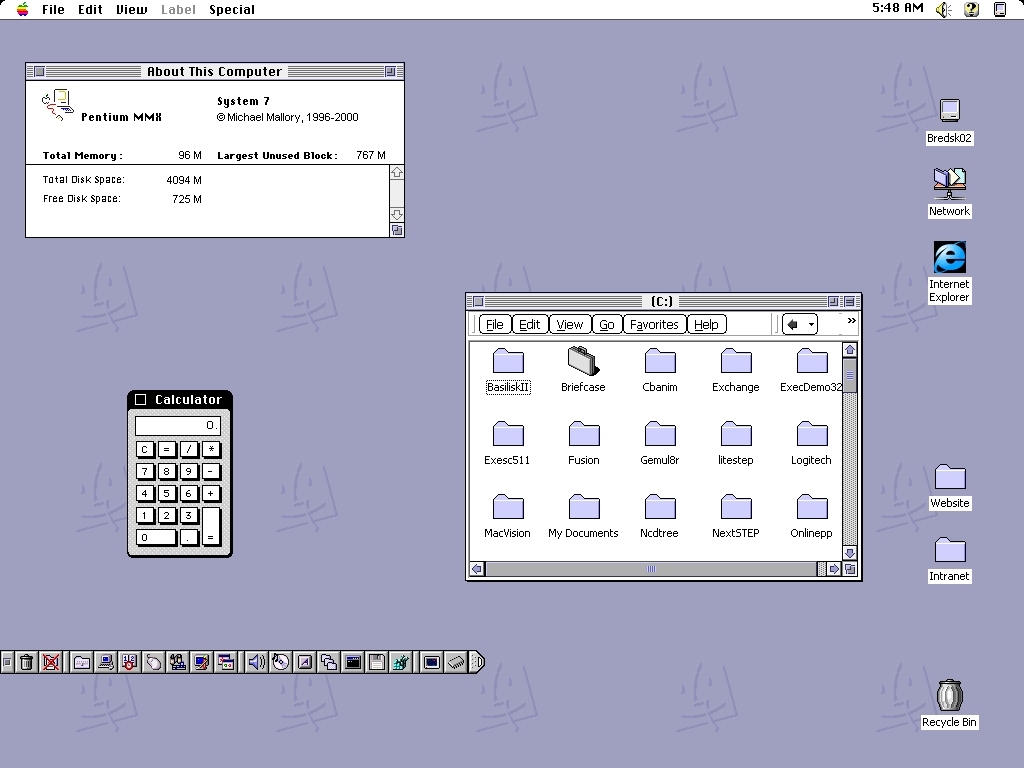
A quick look at a Mac OS 7 screenshot, convinces me more than the dissimilarity between Nextstep and windows 95 that you are full of shit. It's obvious that windoze 95 borrowed heavily from MacOS. Well, perphaps not from 7 as it came out in 1996, durring the deep darkness under the former Pepsi Lord. The tiny application bar at the bottom of the screen, combined with the tinny horizontal pannel at the top of the screen and bad taste make up the Windoze 95 GUI. That horizontal pannel has been a feature of the apple GUI at least since 1984 and the first Macs but is not found in Nextstep which simply puts the icons at the bottm of the screen, or wherever you want. Nextstep has a verticle docking station, which can be thought of as a pannel with much more flexibilty than Microsoft or Apple's. This page walks you through the evolution of the Mac GUI, a subject I'm not as familiar with as I am systems that run on x86.
In the end, I agree with you. Microsoft never innovated anything outside a court room. I think, howver, that they were only able to rip off stuff that was thrust into their faces and doubt anyone on thier campus used Next, much less were able to convice the powers that be there to persue the neater features of it. Being so "market driven" they would only rip off things proven to have wide market acceptance, despite lip service to ease of use research.
-
Re:Multicasting [... will never happen]Just to respond to this, there are a few people working on making multicast appealing to the masses (i.e. not just streaming video or file transfer). Take a look at some of the work that is going on at Notre Dame in Stealth Multicast, sort of a better way to get multicast out there.
-
Re:OT? Dumpster diving
Apparently this is for real. A quick Google search turned up:
The Dumpster Lady
Dumpster Diving for Treasure
Dumpster Diving: Treasure and Trash
alt.dumpster -
Isn't it amazing......that every now and then someone has an idea on how to make OSS development yet even better?
The whole point of OSS is that nobody actually tells (as in commands or orders) anyone to do anything. The success of Linux, Apache, BIND etc. are testament to the fact that successful software can be developed this way. Given, there are projects where I wish the developers would put more effort into one feature or into making it work at all, but the interesting thing is, that I can tell them (email or bugtracker etc.) and often enough they have listened.
But, the main reason why the community shouldn't, or probably couldn't change is because it just simply works. And this is all due to the fact that it is a self-organised network. These kind of networks have a enourmous capacity of stability and work rather effeciently (for more info on SO networks).
"Choice should not only be limited to two or three options, but all of them should also have a common code base."
Says who? And more importantly, why? Commercial companies don't (always) use the same methods, processes or technologies. Why? Simply because there is no one best way, as there is no one best code base on which to build the other options.
IMHO we should embrace the diversity of the different projects and enjoy the creativity the developers put into them and generate in others. Where necessary, the developers of competing projects are working together to interface their systems. If someone would make a case that we need "yet another senmail" or what have you, let them work on it. It's their time and nobody (or at least very few) pays them. It'll work in the end, maybe just not the way you expected.
-
Re:Another publicity stunt
Here's another link: the Observer
-
Re:Please do not mix sociopolitics with physics
Please stop drawing analogues between socioeconomical politics and physics.
If you had read the book (pp.93) and maybe this paper, you would have noticed that Bose-Einstein condensation is used to mathematically explain monopolies in the economic network. So, the analogy is a) explained and b) may be even valid.
From the book: "It is, simply, that in some networks the winner can take all. Just as in a Bose-Einstein condensate all particles crowd into the lowest energy level, leaving the rest of the energy levels unpopulated, in some networks the fittest node could theoretically grab all the links, leaving none for the rest of the nodes. The winner takes all."
Just my 2 Eurocents. -
Book's site
-
Book's site
-
Book's site
-
Unm
I am not sure how comfortable with this i am, not becuase i at all think linux is prone to fail but becuase linux is capable of failing. Kernel panics still happen, like, once in a billion years. Linux just never struck me as an OS you need when, like, it is absolutely essential that absolutely nothing go wrong ever. Like when you are running some kind of control system for an airplane, or controlling a robot drilling holes in people's skulls. I don't think linux or even bsd would be a great choice in those cases, though i sure as hell don't think windows should even be considered given their track record in such situations.
Aren't there any OSes about at the moment that are like all redundant and correctness-proven and stuff, like with NASA-like failure margins? Wouldn't it be better to be using those instead?
Is this reasonable of me to say? -
It's called sonificationVisualization of data is far more common than sonification. Both techniques have their uses. The visual system is good at spatial relations. Good visualization techniques take into account the strengths of human visual perception. Good visualization is a lot less common than it ought to be. We are awash in USA Today style visualization on the web. For instance we are very good at detecting differences in texture. Visualizations as texture are rarely used, but they can provide information about high dimensional relationships that are just impossible to convey in most of the commonly used methods.
Sonification is best used when high dimensional temporal relations are what is of interest. The human auditory system is adapted to extract high dimensional covariances in sonic signals. This is very difficult to convey visually.
For more information on sonification, try: (1) Scientific Sonification (2) ICAD -> International Community for Auditory Display
I teach a course on exploratory data analysis at Notre Dame. Go to the bottom of this page for the link to the course.
-
Re:Amatures - A total fraud - not his basement
Not sure if you are a troll, but, notice that he mentions his involvement in Team Vodka Martini These guys were mentioned on
-
Re:More info
-
Re:More info
-
Much faster than expectedAccording to Certicom, they expected the challenge to take 90 million machine-days to complete. But The Winners say they took 547 days, with 10308 members. They don't list how many machine days they got (presumably it ramped up as they went along), but that multiplies out to ~5.5 million machine-days.
So where's the discrepancy? Did we get really lucky and hit the answer 5% of the way through the search? Do the "10308 members" really represent 10 machines each? Did the initial estimate assume 500MHz machines and by 547 days later, most people were running 1.5GHz machines? Or did the implementers do some good programming hacks to make a much faster search program? Or was one of the implementors using Pixar's rendering cluster at night in between movies?
-
Worthwhile distributed computing
The more I see worthwhile DC projects out there like ECCp-109, Folding at home, and now ClimatePredition.net, the more I think I should participate in these rather than SETI@home (which I've been doing for 3+ year)
Maybe it just comes down to what can aid humanity vs. what is simply a shot in the dark. -
Re:Better links ...
(warning: karma whoring ahea
for those who prefer clicky links, and the use of www:
www.nd.edu/~alb/
www.nd.edu/~networks/PDF/NatureImmunol%202002.pdf -
Re:Better links ...
(warning: karma whoring ahea
for those who prefer clicky links, and the use of www:
www.nd.edu/~alb/
www.nd.edu/~networks/PDF/NatureImmunol%202002.pdf -
This Is Happening All Over
The University of Notre Dame is doing basically the same thing. Though they do not cite security reasons, they have stopped all support of Win9x. And if anyone thinks the schools and M$ are not in bed, then take a look at the increase in academic pricing. Windows used to be $25 (as well as Vis. Studio, et al) but now they've gone to $45. Funny how that happens as soon as they mandate the upgrade to a new OS. And WinXP is just as vulerable to all the worms that 2k is (for the most part). For example, I accidentally left a share open for no more than one hour and the open folder was filled with Nimda. In other news our LUG is planning an install fest in the near future.
-
Re:Interdiction and spoofing details
Don't underestimate Hillary Rosen, she has tremendous business savvy. She's even doing her own modeling in anti-piracy commercials.
Many business moguls revere her, and Playboy is rumored to be approaching her as well. I'm sure we can't wait for that. In the mean time there's always the Hillary Rosen blow-up doll.