Slashdot Mirror
Domain: nmsu.edu
Stories and comments across the archive that link to nmsu.edu.
Comments · 202
-
Mercury - the metal, not the planet
I believe this has all been planned in advance:
There's probably less to this story than the conspiracy theorists would like to believe.
The telescope sits on a liquid mercury bearing. From the linked document (p8):
Further, the TCS contains significant risk in its older server motors, mercury float bearings, and control software. Regular inspection and
maintenance is key to the longevity of the TCS. Fully documenting maintenance and risk, and implementing upgrades greatly reduces the risk associated with the TCS. As such, the telescope will be less expensive to operate, and much less liable to catastrophic failure. At minimum, the SSOC will require one telescope control engineer ready to assume full control and maintenance of the TCS in Oct 2018.So a mercury spill could be quite hazardous, and if you were of such a mind, that large amount of mercury could be an inviting target to steal.
-
Both sides are wrong
Both sides in the climate debate are ill-informed. Too many people spout opinions without researching the facts. The facts are:
1. The climate IS getting warmer.
2. The change most likely has an anthropgenic component.
3. The change is miniscule compared to prior climate changes over the Earth's history.
4. The changes that are occurring will likely affect us.
5. We will survive. The human race is not in danger from climate change.
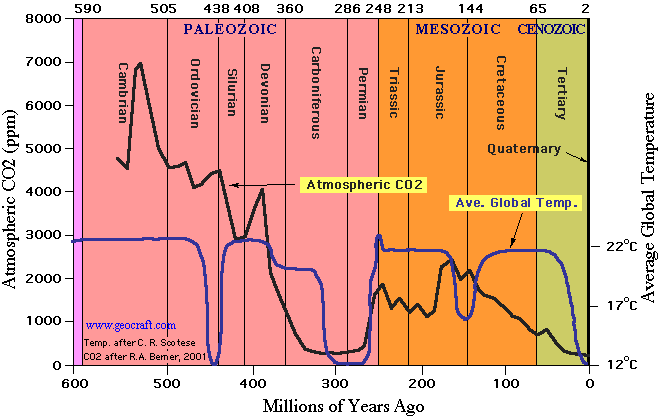
All one has to do is look at this graph:
http://astronomy.nmsu.edu/tharriso/ast110/carbondioxide.gifOne can see that the range of natural oscillations of CO2 is between 0 and 7000 ppm. That's right - 7000. We are all excited because it went from 300 to 400. During the 150 million years through which the dinosaurs roamed, the CO2 was over 1000ppm and the dinosaurs did just fine.
So as a moderate liberal, I can see that other liberals are speaking too soon when they brand "climate change skeptics" as such. Before you brand someone, get the facts!
-
60 mA to the heart can be fatal
Lethality of electric shock depends on way, way too many factors to make blanket statements such as above. For example, according to wikipedia, for a large contact area and dry skin, 5% of the population has a hand-to-hand impedance of 1,200 Ohms. 110/1200 ~ 100 mA, which is significantly above the 60 mA threshold for a fatal shock to the heart. 50% of the population are just about at the threshold. Also, broken skin, sweaty skin, duration of contact, etc. are all factors. This is also why you should never break the ground pin off of an electrical plug. Case in point: a Cleveland State prof. died in 2006 after touching a lamp with a broken-off ground pin.
-
Re:Well for all that
I suggest you talk to Stardock Systems. They are an indy software developer. Because of problems regarding publishing, they self published their last title, Galactic Civilizations 2. You can find it in just about every major game seller (though on the budget rack now because it is like 5 years old now). They are doing so again with their next title, Elemental. For that matter, they've published two titles for other companies, Sins of a Solar Empire by Ironclad and Demigod by Gas Powered Games. If this keeps up, they may not be an indy studio in 20 years.
No big development or advertising budget, no attachment to a major publisher, just some guys from Michigan that can make a good game and get it out there. You can ask them who did the distribution, they'll tell you (they posted it I just forgot who it was).
Uh, Galactic Civilizations 2 is close to 15 years old. Here is the original announcement, http://hobbes.nmsu.edu/download/pub/os2/info/galciv2.zip , and Stardock had a lot of help from IBM in distributing their products. When your game demos come with an operating system, they are much more likely to catch on.
-
Re:what determines the direction of the cone
Actually, as I understand it, most (maybe all) black holes spin due to momentum both already present before their collapse, and imparted during the collapse.
You are quite correct about the jets, though. Here's a classic example.
-
Re:I'd much rather...
Normalization implies you have other sources to compare sound levels against to maintain a constant volume. Guess what isn't a regular thing in the TV industry, since they focus mainly on video and not audio? Bingo! Normalization.
That is not so. The audio path is calibrated for 0 dBm and that's all you need to normalize your live audio. But if you insist on a comparison I will sell you an audio signal generator.
I'll bet the engineers already figured it out.
Long time ago, when telephone was invented. A dBm is defined as 1 mW into 600 Ohm, and that's a telephony configuration. You can't build a telephone system if all your signal levels are left to chance. When radio broadcasts started, the modulation level had to be also precisely controlled because overmodulation causes distortion and low modulation results in weak audio.
-
How is this new?
I thought all machines had sensory technology with reacted to the user's activity state. I just look forward to this being used for something besides making the machine malfunction when I need it the most.
-
Re:Frist prost
True, but even though it's April 1 I was being truthful. Derek's native port of Lynx:
http://hobbes.nmsu.edu/download/pub/os2/apps/internet/www/browser/os2lynx2_8.zip
is a rather different code base from the traditional POSIX port:
http://hobbes.nmsu.edu/download/pub/os2/apps/internet/www/browser/lx287d9.zip
Another source of Lynx for OS/2 for completeness:
http://www.os2site.com/sw/internet/browser/lynx/index.html
and of course the versions of Links which are available are well-documented here:
http://hobbes.nmsu.edu/download/pub/os2/apps/internet/www/browser/links-2.1pre14.zip
http://www.os2site.com/sw/internet/browser/links/index.htmlI've not actually used any eLinks port under OS/2, though.
http://hobbes.nmsu.edu/download/pub/os2/apps/internet/www/browser/elinks03pre3.zip
Oh yeah, and there's w3m as well:
http://hp.vector.co.jp/authors/VA000199/os2/w3m.html
I'm not a fan of w3m, though.
-
Re:Frist prost
True, but even though it's April 1 I was being truthful. Derek's native port of Lynx:
http://hobbes.nmsu.edu/download/pub/os2/apps/internet/www/browser/os2lynx2_8.zip
is a rather different code base from the traditional POSIX port:
http://hobbes.nmsu.edu/download/pub/os2/apps/internet/www/browser/lx287d9.zip
Another source of Lynx for OS/2 for completeness:
http://www.os2site.com/sw/internet/browser/lynx/index.html
and of course the versions of Links which are available are well-documented here:
http://hobbes.nmsu.edu/download/pub/os2/apps/internet/www/browser/links-2.1pre14.zip
http://www.os2site.com/sw/internet/browser/links/index.htmlI've not actually used any eLinks port under OS/2, though.
http://hobbes.nmsu.edu/download/pub/os2/apps/internet/www/browser/elinks03pre3.zip
Oh yeah, and there's w3m as well:
http://hp.vector.co.jp/authors/VA000199/os2/w3m.html
I'm not a fan of w3m, though.
-
Re:Frist prost
True, but even though it's April 1 I was being truthful. Derek's native port of Lynx:
http://hobbes.nmsu.edu/download/pub/os2/apps/internet/www/browser/os2lynx2_8.zip
is a rather different code base from the traditional POSIX port:
http://hobbes.nmsu.edu/download/pub/os2/apps/internet/www/browser/lx287d9.zip
Another source of Lynx for OS/2 for completeness:
http://www.os2site.com/sw/internet/browser/lynx/index.html
and of course the versions of Links which are available are well-documented here:
http://hobbes.nmsu.edu/download/pub/os2/apps/internet/www/browser/links-2.1pre14.zip
http://www.os2site.com/sw/internet/browser/links/index.htmlI've not actually used any eLinks port under OS/2, though.
http://hobbes.nmsu.edu/download/pub/os2/apps/internet/www/browser/elinks03pre3.zip
Oh yeah, and there's w3m as well:
http://hp.vector.co.jp/authors/VA000199/os2/w3m.html
I'm not a fan of w3m, though.
-
Re:Frist prost
True, but even though it's April 1 I was being truthful. Derek's native port of Lynx:
http://hobbes.nmsu.edu/download/pub/os2/apps/internet/www/browser/os2lynx2_8.zip
is a rather different code base from the traditional POSIX port:
http://hobbes.nmsu.edu/download/pub/os2/apps/internet/www/browser/lx287d9.zip
Another source of Lynx for OS/2 for completeness:
http://www.os2site.com/sw/internet/browser/lynx/index.html
and of course the versions of Links which are available are well-documented here:
http://hobbes.nmsu.edu/download/pub/os2/apps/internet/www/browser/links-2.1pre14.zip
http://www.os2site.com/sw/internet/browser/links/index.htmlI've not actually used any eLinks port under OS/2, though.
http://hobbes.nmsu.edu/download/pub/os2/apps/internet/www/browser/elinks03pre3.zip
Oh yeah, and there's w3m as well:
http://hp.vector.co.jp/authors/VA000199/os2/w3m.html
I'm not a fan of w3m, though.
-
FDA and farmer's market
there is the issue you are selling things for consumption...you don't think the FDA will require you to get a distribution license?
The FDA does not license farmer's markets or Farmers markets. Some states do though, apparently New Mexico does. Now that's not to say a license is not needed, a farmer may need a business license to operate such a market.
Falcon
-
Re:Not too uncommon for Asian math texts
I was surprised to see that this link (http://www-psych.nmsu.edu/regression/home.html) was still around. That one would probably get blocked at work here as well. (But probably not because of the Ren/Stimpy content. More like: "Well, you're not paid to do statistics, are you?")
While we're on the topic of oddball technical sites, I gotta wonder if the "Britney Spears Guide to Semiconductor Physics" is still online. (I don't even want to attempt looking for that one at work.
-
Re:Junk science strikes again
bfwebster wrote:
Uh, there are serious problems with this study, most notable that it relies upon self-reporting of sexual activity by at most a few dozen or so college-aged males (the total sample size is 200 men and women) who rank high in narcissistic, psychopathic, and manipulative behavior. Anyone else think there may be a problem with that
You get points for being skeptical and actually looking at the article, but you need to read down a little further. The article is actually about two studies, and I agree that the first one is weak, but this other one might be serious:
This observation seems to hold across cultures. David Schmitt of Bradley University in Peoria, Illinois, presented preliminary results at the same meeting from a survey of more than 35,000 people in 57 countries. He found a similar link between the dark triad and reproductive success in men. "It is universal across cultures for high dark triad scorers to be more active in short-term mating," Schmitt says. "They are more likely to try and poach other people's partners for a brief affair."
Now, myself I remain somewhat skeptical about this explanation in terms of "genetics" (I think it's a quirk of modern culture that we love these genetic explanations out of proportion to the evidence for them), but the problem here clearly isn't small sample size. I wonder how one even conducts a survey that ranges across 57 countries (consider the translation difficulties). So, what we have here is a pop science writer that wimped out on discussing the interesting details in favor of doing a fluff piece about a minor study conducted by a young dork out in New Mexico.
By the way, switching subjects to Western culture mating strategies: you might study the fellow's photo there if you're a geek worrying about the bad-boy paradox. I submit that while in practice many women may have an obsession with "bad boys" on some level, they're also mostly (1) sensible enough to know there are problems with this and (2) shallow enough to satisfy their "bad boy" urges with someone who just looks a little like a "bad boy" without actually being one.
-
Junk science strikes again
Uh, there are serious problems with this study, most notable that it relies upon self-reporting of sexual activity by at most a few dozen or so college-aged males (the total sample size is 200 men and women) who rank high in narcissistic, psychopathic, and manipulative behavior. Anyone else think there may be a problem with that?
Ironically, the lead author of this study has another one coming out entitled, "The power of prestige: Why young men report having more sex partners than young women."
I rant about all this a bit more here.
-
Re:RMS Proves One Thing....
I've written an interpreter... http://hobbes.nmsu.edu/cgi-bin/h-viewer?sh=1&fname=/pub/os2/apps/emulator/os2irl.zip
Every thing I post to slashdot gets marked as flamebait, including this post.
Nathan -
Re:Indeed, this is not new...
I'm not sure I can agree with your premise that you (us) tie your security to the well-being of others. In a global economy, your friends easily find new friends that are worth more to them than you were, the emphasis on 'were'.
China, for instance, is a pretty attractive partner to OPEC, certainly at least as attractive as the US is. Japan is less attractive to OPEC in many ways. Suddenly, we are not the best friend of Japan, unless we can help them with their petroleum needs, if OPEC decides to favor China over Japan. This plays out mostly when Venuzuela, for instance, decides to ship to China more, and Japan less. Does Japan pay more for oil as it is shipped from the Middle East, costing more possibly?
China is everyone's favorite trading partner, it seems. Cost is a big part of that, and the relative lack of environmental controls there. But we may be neglecting the reality that China has an enormous doemstic market. In time, and perhaps soon, they will reach the tipping point where their domestic demand is sufficient, and their domestic income adequate, to fuel their own consumer production. Then they need us a lot less than now, perhaps hardly at all. If China can choose its partners, do we get chosen? And do we want to be 'chosen'? Perhaps they choose based on which partner they can extract the most from, leaving that partner as empty a wallet as possible...
When we are not worth as much to China as a market as we are a threat to them, them expect trouble. And I think that day is a lot closer than we hope. Right now, today, what whould happen to China's economy if we reduced imports by half? Probably pretty damaging. What about 5 years from now? 10?
The Chinese seem to take a long view of the inevitable conflict between us. We must also. Keeping onshore manufacturing for critical needs will be an issue for us soon, if not immediately. If you think it's fun to fend off the worms, trojans, viruses, and other disguised but overt attacks on our information systems, imagine the joy of having to mistrust your BIOS, hard drive firmware, even RAM. Imagine a concerted effort by a non-US manufacturer to insert 'spyware' in systems at the hardware level. I don't think I'm describing anything new here, either, just in scale. For example, http://lib.nmsu.edu/instruction/lsc311/textbook/information&society.pdf describes the persistent rumor of such a tactic used on a very limited scale in Operation Desert Storm. Didn't get much press back then, did it...
We're on the cusp of proving something well known and fairly true. Technology will be exploited to its fullest in warfare.
And we will not always be able to choose our friends, nor keep them, when well-being is the test. Our friends must look further than their dinner plates, sometimes, to choose the right path. Even we will have to do that soon. -
Thermal balance of Venus is well understoodI'm sorry, but this essay about Velikovsky basically misunderstands the nature of our measurements of Venus. The thermal balance of Venus is well understood. The part where you mention "four probes landed on Venus" is the start of where you start to misunderstand how well the planet is understood. In fact, twelve probes landed on Venus; an additional five probes have entered and measured the atmosphere. The high temperature of Venus is a straightforward effect of the thick carbon dioxide atmosphere. You can calculate it to a decent first approximation simply by understanding the adiabatic lapse rate. The temperature of Venus at the altitude in the atmosphere where it has the same atmospheric pressure as Earth is, in fact, very similar to that of Earth; adibatic lapse means that the atmosphere gets cooler with altitude (i.e., hotter as you go lower)-- the adibatic lapse on Venus is about 10 degrees (C) per kilometer (roughly comparable to Earth). Internal heat is not needed.
I do not have the time or patience to go through the many many many measurements of the thermal parameters of the Venus atmosphere and explain your misconceptions, however, orbiting probes as well as infrared and radiotelescope measurements from Earth have very well confirmed that Venus is very close to thermal equilibrium. It is not correct that there is a large internal heat source contributing significantly to the surface temperature.
-
Re:does it...
Again, your lack of knowledge is astounding. The latest release of OS/2 was last year(2006). There is another release scheduled for the end of this year or the beginning of next.
I can find support for almost every add on card on the shelf right now at CompUSA or BestBuy. As a matter of fact, I was adding SATA drives to an older computer of mine and bought an off the shelf CompUSA SATA add in card. The DANI drivers from http://hobbes.nmsu.edu/ supported it.
The USB drivers for OS/2 support my Linksys 200M wireless USB Ethernet adapter to.
To further your knowledge on OS/2 why don't you try a live CD of the latest release of OS/2 http://www.ecomstation.com/democd/ It runs on every computer I have tried here at work. Why don't you download it and try to find a computer that it won't run on.
Sometimes I think it is funny the lack of knowledge people exhibit about OS/2 and then claim to be an authority on it.
Your lack of knowledge is just sad.
Nathan -
InformationVertical farming, hydroponics, food tech, etc. Just some collected information.
Nutrient film techniques (txt)
Hyperaccumulators bibliography
Hydroponic farm plan (aquafarm)
Aquaculture bibliography
Why is the food outlook gloomy? (txt)
Setting up a hydroponic herb garden
Spider: the future of farming
Artificial meat production-- ah, this looks useful:Vat-grown, or printed, meat products are produced using the same basic techniques as other forms of printed tissue culture. Tissue engineering of this type was first developed for medical use in the production of autologous tissue for organ replacement. However this sort of tissue culture was soon found to be useful for the direct production of meat for food on spacecraft and habitats in deep space. See bioforgery.
To achieve the goal of meat production, muscle and other flesh cells are grown on a specially constructed biopolymer scaffold, which replicates the natural extracellular matrix found in living animals. This scaffold is generally printed using a rapid 3d printer device, although several other related techniques such as foaming and self-assembly are also used. Cultured cells are then implanted into the scaffolding, and these cells are induced to bind together into muscle-like or vascular tissue. Once the meat block, known as `slab', is established, the tissue is supplied with nutrients and allowed to grow by as much as 400% by volume before harvesting. To ensure the slab has a healthy texture it is stimulated into regular contractions, simulating exercise; the slab is attached at each end to strain gauges to measure the force of contraction. Each slab is connected to a generous supply of nutrient fluid often closely resembling blood.Matter compilers in meat factories to produce foods. So, this looks like an interesting area of thought to explore further. Starting with cell culture techniques would be the smart thing to do, then confirming that we can identify particularly nutritious cells, and then working on some tissue growth techniques. Maybe this will start with burn victims?
Artificial cells, tissues, organs compilation,
Background notes on tissue engineering,
Engineering human tissue (paper),
An odd government website,
Obligatory Wikipedia article linkage,
Organ printing,
This source is claiming lab-grown meat in five years,
Fetal farming (what?),
New-Harvest.org for bringing cultivated meat closer to reality, -
Re:Hmph...
Just run the installer until it breaks when it hits a 16 bit executable, go to %TEMP% (or where ever it gets unpacked), copy the unpacked install somewhere and unzip this http://hobbes.nmsu.edu/pub/windows/win32inst.zip over the unpacked install and you have replaced the 16 bit parts with 32 bit parts. Then run setup.
-
Matthews is wrong
I worked on multiple NASA projects in the 1990s. During the mid-90s we used Rational http://www-306.ibm.com/software/rational/ for a short period of time (6 months) then dropped it. IME, the people who want these tools are architect that couldn't program their way out of a paper bag. Since Ive become an architect now, I prefer Visio http://www.microsoft.com/office/visio/ to most of these other tools - that's only if a pencil drawing doesn't cover everything good enough AND I need to make a presentation to someone with money.
IBM has many nice tools and the best bang for your buck hardware, but Rational ought to be buried into a deep, dark hole with a RADIOACTIVE sign outside. http://www.nmsu.edu/~safety/images/signs/sign_caut ion-rad-mat.jpg -
These systems are, in fact, under developmentno national aviation authority in the world will allow civil UAVs without a system for avoiding other aircraft. And no firm has even started development of one. How unfortunately misinformed. These systems have been in development for some time. Over three years ago I helped with a NASA contract through New Mexico State University's Physical Science Laboratory to establish a concept of operations and a roadmap to help bring UAVs into commercial airspace. This covered everything from systems and hardware that would need to be developed to FAA Certifications and Federal Aviation Regulations modifications. Some test flights with "See and Avoid" systems had already been performed (like this one, with Proteus, made by the same folks that made Space Ship One). The state of the art on commercial UAVs has already advanced quite a bit. There are yearly conferences, an international trade organization and more. This radio spectrum issue seems to me but a minor setback to which a workaround will be found sooner rather than later.
-
These systems are, in fact, under developmentno national aviation authority in the world will allow civil UAVs without a system for avoiding other aircraft. And no firm has even started development of one. How unfortunately misinformed. These systems have been in development for some time. Over three years ago I helped with a NASA contract through New Mexico State University's Physical Science Laboratory to establish a concept of operations and a roadmap to help bring UAVs into commercial airspace. This covered everything from systems and hardware that would need to be developed to FAA Certifications and Federal Aviation Regulations modifications. Some test flights with "See and Avoid" systems had already been performed (like this one, with Proteus, made by the same folks that made Space Ship One). The state of the art on commercial UAVs has already advanced quite a bit. There are yearly conferences, an international trade organization and more. This radio spectrum issue seems to me but a minor setback to which a workaround will be found sooner rather than later.
-
My college does offer a Software Developement clas
All CS majors at New Mexico State University take a class in Software Development. Here's a link to my prof's page on it. We had to work together on a fairly complex program (using GUIs and junk in Java). My team did end up using CVS to manage everything since our program used a parse/lexer along with some fairly hacked up GUI code.
-
Re:That's Pretty Neat
I too worked for a company that used Intermec janus hand scanners. Since it was a pain in the a$$ to debug code on them and we were using OS/2 I wrote an interpreter and debugger for it.
It is written for OS/2 but the C Source is included if you would like to compile it for another operating system.
Here is the link if you would like to try it out and run some of the code again.
http://hobbes.nmsu.edu/cgi-bin/h-viewer?sh=1&fname =/pub/os2/apps/emulator/os2irl.zip
Nathan -
Wrong. Incubation period is 1-3 days
The incubation period for the Flu is from 24 to 72 hours.
Source: http://www.yale.edu/yhp/departments/health_ed/Cold Overview.htm
The incubation period for the Common Cold is from 2 to 3 days.
Source: http://medplant.nmsu.edu/Diseases/cold/cold.htm
Mod parent down as Wrong. -
Re:Dear John, I mean Google....
Yohooo!!! I will protest then too.
I will protest against censoring materials related to nazism & fashism. What about racism censorship? Poor kids on the block were killing others for no reason - why not to give them one???
And why U.S. ban so much books? http://www.banned-books.com/bblist.html here and here http://onlinebooks.library.upenn.edu/banned-books. html or even http://horizon.nmsu.edu/101/pornography.html here. And I want to have no problems when searching for old Hindu symbol commonly known as swastika.
What about for example lolicon? In Japan it's pretty normal, over here in Europe as well as in USA it's considered to be paedophilia. Strangely enough, "hentai" what's normal pr0n for us, in fact is "freaking" for them...
You can hardly expect people to have the same morality standards when their cultures are only several thousand years apart. And censorship is all about morality. That's in general. As to China in particular. Memorize one saying of old: people deserve their rulers. It's not that chinese did something new. It's not USA stopped supporting them. (And it's not that USA has no censorship of their own. Who doesn't?) -
Re:OS/2 died on August 17, 1995
No. IBM's former CEO, Lou Gerstner, pulled the plug on new resources going into OS/2 in April, 1996. You can hear him say that in his own words in an
-
Re:My school has a MicroSat program tooSee also
- Utah State University
- New Mexico State University
- Washington University at St Louis
- University of Texas
- University of Colorado
- Arizona State University
- Pennsylvania State University
-
Re:Conspiracy!
Actually, my wife is working at an observatory where they are getting ready to shoot another laser at it. The observatory is Apache Point. They've gotten first light through the detector but have not yet fired the laser outside of the dome.
Click on the APOLLO Project link.
The principle is simple: shoot the laser into the secondary, it bounces off the primary and a 3.5 meter beam heads off at the speed of light. Half a million miles later, it's theoretically detected.
I'm looking forward to seeing it in action! -
M$ was aided on OS/2 by IBM's CEO Lou Gerstner
Gerstner pulled the plug on new resources going into OS/2 in April, 1996 at a time when OS/2 still had a small, but significant market share and was on the verge of releasing the much-improved v4. OS/2 was still selling a lot of licenses for v3 at the time and was a profitable business activity for IBM, although it would have certainly been much more profitable with a larger market share. IBM's OS/2 group still went ahead and released OS/2 Warp v4 in August, 1996 but it was a 'stealth' release that the IBM corporation was obviously no longer behind. There was no business reason for Gerstner to pull the plug on OS/2. You can hear Gerstner describing his decision to end new OS/2 development in an
-
Re:Misplaced priorities?
Did you mean "studying in the _US_ as an alternative to a U.K university. .
Of course, I imagine England is similar, too. -
Re:What Science Really is...
The misnaming of fields of study is so common as to lead to what might be
general systems laws. For example, Frank Harary once suggested the law that
any field that had the word "science" in its name was guaranteed thereby
not to be a science. He would cite as examples Military Science, Library
Science, Political Science, Homemaking Science, Social Science, and Computer
Science. Discuss the generality of this law, and possible reasons for its
predictive power.
-- Gerald Weinberg, "An Introduction to General Systems Thinking"
Frank Harary's home page. -
Re:First Post, yet no one caresI used to use a very similar environment under OS/2. It was very nice.
OS/2 had a package called EMX. EMX was to OS/2 what Cygwin is to Windows. With it, people would compile UNIX apps for OS/2, and they would just require a single DLL, not the entire craziness that Cygwin-compiled apps can be.
This compatibility was so good that all of X Windows could be compiled for OS/2, leading to XFree86OS/2 (some name, eh?). Windows now has the same thing with Cygwin/X, but OS/2 had it back in 1996...
It was really very nice to be able to run the real UNIX versions of things like Bind, Sendmail, IRCd, Apache and other such UNIX daemons. Of course, you could do the same with Linux, but like I said, this was back in the mid-90's. If you think Linux driver support can be bad today, try back then! At least OS/2 had *some* hardware drivers!
Even today, a ton of OS/2 software is ported to OS/2 using EMX, at least in the beginning: Mozilla Suite, Firefox, Thunderbird, and other such Linux Open Source projects.
The idea of building a UNIX (or Linux) subsystem for Windows is an *old* one. As TFA mentions, Posix "compatibility" was built into Windows NT from day one. The fact that it's still a steaming pile of cow dung shows how much of a desire there is for it. The Windows people couldn't care less, and the UNIX people would rather swallow swords than use the NT kernel, especially with FreeBSD and Linux out there... Is this doable? Absolutely. Is it worthwhile? People's words to the contrary, there hasn't been a huge groundswell of support...
-
H2G2
Are the original Hitch Hiker's Guide episodes available from bbc.co.uk? I haven't been able to find them there.
They're available from http://hobbes.nmsu.edu/cgi-bin/h-browse?sh=1&butto n=Browse&dir=%2Fpub%2F.arch-download%2Fhhgttg&sort =type anyway, in case anyone wants them. -
OS/2
And wasn't it the same Bill G. that said that OS/2 is the "platform for the 90s"?
wave
The same guy that did not notice the Internet... but then again he has billions worth of stock in that company. I would say anything to protect my wealth! Cheers -
The world would still use Windows...
IBM still has OS/2 to push, but Microsoft pushed Windows 3.0 for $$ reasons rather than technical ones. If there had been no protected mode applications on Windows 3.0, Microsoft probably would have just trumpeted that as a feature. The US DOJ vs Microsoft antitrust trial "Findings of Fact", based on some very compelling testimony by IBM executive, revealed for all time that the only reason that IBM backed away from OS/2 was due to pressure from Microsoft. Here are some relevant quotes:
These are from the section on IBM under 'The Similar Experiences of Other Firms in Dealing with Microsoft.' Here's some quotes:
"Of course, accepting the terms would have required IBM, as a practical matter, to abandon its own operating system, OS/2."
"The message was clear: IBM could resolve the impasse ostensibly blocking the issuance of a Windows 95 license -- the royalties audit -- by de-emphasizing those products of its own that competed with Microsoft and instead promoting Microsoft's products."
"In sum, from 1994 to 1997 Microsoft consistently pressured IBM to reduce its support for software products that competed with Microsoft's offerings, and it used its monopoly power in the market for Intel-compatible PC operating systems to punish IBM for its refusal to cooperate."
These were not opinions but were the conclusions of the court that were reached after all of the evidence was evaluated at trial. There were also findings on the application barrier to entry that prevented a non-Windows OS from gaining significant market share.
The result of the M$ vs IBM battle over OS/2 was probably a secret agreement that was likely similar in its effects on competition to the agreement that Sun recently reached with Microsoft. You can even hear Lou Gerstner, IBM's CEO at the time, describing his decision to stop fighting with Micosoft over OS/2 back in the mid-90s in this zipped up mp3. -
Adventures in Supercomputing Challenge
The New Mexico National Labs (Los Alamos, Sandia, the universities (NMSU, UNM, etc) and others came together in a rather awesome program about 13 years ago. The Adventures in Supercomputing Challenge Program gives high school students access to modern supercomputers to do scientific programming projects. They are given mentoring and instruction by volunteers as well as volunteered CPU time and access. Schools lacking net access are provided it by the participants, etc. After all their work, there is a competition based on how much was learned, presentations, science done, and final reports. It is a lot of fun. It's really hard.
I was originally a student in it waaaay back when it was getting underway (1990 & 1991) and then acted as a mentor for the next 5 years. I had a first place team and a third place team in those five years. I worked with kids that were often C students because they were bored as h*ll in class and often after seeing what they could do would go on to work harder to improve their grades to get into some very good universities.
Kids often rose to the challenge far and above what I would have thought they'd do. If the kids needed to learn the necessary math for the scienc they wanted to do we'd crash course it. I had kids that had been doing second year algebra doing partial differential equations by the end of the six months of work and able to understand it, frex. They always learned the science and programming that was required as well. This was their work, not mine. I could give guidance and knowledge, but couldn't do the work for them. Some of the science done was thermodynamics, astrophysics, environmental science, and fluid dyanmics, frex.
Now you may not be able to donate supercomputing time, but you might want keep this in mind when you go to think about what HS kids are interested in. Kids are often interested in a lot. You just have to be willing to teach them in a way that they'll remember, show them its useful, and make it interesting.
-
Re:Huh?
The dark box isn't necessary if you can restrict the light getting to the film some other way. The article mentioned that the detector would be attached to a telescope, so that would prevent light entering from any place other than the pinhole lens.
Most large telescopes don't have tubes either, since they aren't strictly needed, and they weigh a lot. See the photo of the scope at: http://gemini.physics.ox.ac.uk/photos/geminin-tele scope-lr.gif or at http://www.apo.nmsu.edu/Site/3.5m_Images/telescope 06.JPEG -
Ontology
I want to offer an alternative, as proposed by Victor Raskin at Purdue. I speak for neither Sergei Nirenburg nor Victor (who does enough talking for himself).
While this idea for more thorough, concise, and accurate searches is a good one, I would question whether embedding semantic tags into web pages is the way to go.
As outlined in Ontological Smenatics, there is an automated system of semantic processing already underway. Basically, it takes a text, then runs it through a parser, which looks up meanings in a lexicon, then reduces whatever translation it comes up with to a text-meaning representation (TMR), by pushing the concepts from the lexicon through an ontology / onomasticon / world-knowledge library. The TMR is basically the "pulp" of the semantics of the article, web page, book, or whatever it's been fed. It just contains the ideas, the things involved, and other relevant concepts, stripped of all other linguistic information.
TMR is great, becuase the TMR can be used then, by reversing the process and using the lexicon of another language, to translate a text from one language to another.
However, it seems to me that with the bits and pieces of the TMR stored in a search engine's index, this could be a huge boon for the search engine.
Instead of just trying to match keywords, by parsing the TMR of web pages and by parsing TMR of search strings, you no longer search for keywords, but keyconcepts.
The advantage to semantic searches / indexes by this implementation is manifold:
-Searches (and the web as a whole) will gain the richness Mr. Berners-Lee is advocating.
-Web authors will not be able to lie in their semantic tags, or otherwise misinform spiders what the page is about (remember tags?)
-No extra work is required in the actual construct of the web or *ML standards. The TMR is only generated and stored by the sites / processes that need it.
-Others?
Just an alternative solution, for fun -
MP3 of 1938 version is available online
Anyone interested in the MP3 version of the 1938 broadcast can download it here (please be gentle on the server):
http://hobbes.nmsu.edu/pub/multimedia/wave/mpeg/wa rworld.mp3 -
Yes, get the 56kbps MP3s here:
-
Re:Nope, wrong, invalid.. nothing to see here.
But did it ACTUALLY begin then? remember there was the issue of missing 10 days (section 2.3) If the Julian calendar was (and is) right then it's August 20th today instead of september 2nd
So maybe we're all wrong. -
Re:The Radio Shows (listen to them at KCRW)
Luckily, KCRW has them on-line at: http://kcrw.org/show/hg
For those preferring MP3 formats, another on-line source for the H2G2 Radio Show is New Mexico State University
(Sorry for posting AC, but I already did some moderating for this article...)
-
Re:Filesize?
In fact, the Sloan Digital Sky Survey (in which Fermilab also plays a major role) transfers its imaging data from the the observatory to Fermilab (where it is reduced) by FedExing DLT tapes. I do not know what it planned for the DEC.
-
Re:These people give all AnonCows a bad name.
-
found via google
-
Re:It's a futile effort...
Despite this being
-
http://quest.arc.nasa.gov/mars/background/terra2.
h tml -
http://ganymede.nmsu.edu/tharriso/ast301/class23.
h tml -
http://spacescience.com/headlines/y2000/ast22jun_
2 -
http://www.users.globalnet.co.uk/~mfogg/zubrin.ht
m
They may be wrong, I may be wrong, but simply claiming the fact that the current Martian atmosphere is very thin as proof that no sustainable atmosphere is possible on Mars, that does not cut it. I will grant you that a 99% earth-like biosphere is unlikely, but a lot less is needed for it to be of use to a colony. Even a slight increase in temperature and pressure would make it easier to live on Mars, some plants might be able to grow (genetically modified mountain plants), the domes (or whatever it might be) needed for habitation might have to handle a smaller difference in pressure, or the time an astronaut might survive in an accident might increase.
And besides, even if it only lasts a few thousand years, an atmosphere might still prove useful. Not that I think we should do something like this without considering the consequenses, but once we have the technology, the trade-offs and risks might prove to be small enough for us to attempt terraforming Mars.
-
http://quest.arc.nasa.gov/mars/background/terra2.
-
Re:OT: hotsprings?I'm confused as well. There are people who pay to soak in hot springs and volcanic mud.
And people drink hot spring water too. But I wouldn't drink water from any spring, hot or cold, that hadn't been tested.