Slashdot Mirror
Domain: noaa.gov
Stories and comments across the archive that link to noaa.gov.
Comments · 2,602
-
Earthquake In Nebraska Last Week
It strikes me as one hell of a coincidence that this article comes up shortly after Nebraska experienced a 3.3 magnitude earthquake last week (11/18/10). More information can be found here. The cows were producing curdled milk for days...
As an aside, why was this article tagged with "globalwarming"?
-
Test Launch of the "Coyote" ?
Test launch of the "Coyote" anti-missile missile? Rail launched RAM jet with some kind of booster to help get it up to ramjet speeds. From San Nicolas Island. All seems to fit though you would expect the military to announce the test in advance so that planes stay out of the way Link is to an environmental permit application for launches from San Nicolas Island. http://www.nmfs.noaa.gov/pr/pdfs/permits/sni_str_application.pdf
-
Re:Serious question? Here's a serious answer
Observations of the Earth's climate agrees with the climate models. The predictions of warming due to increased concentrations of carbon dioxide in the atmosphere date back to the 18th century, and we've observed the predicted warming and other effects for decades. We have high confidence because observations match predictions. That's how science is done.
-
Re:Oh, excellent...
as long as you can get there and survive there due to the hurricanes.
Increasing the total energy in the atmosphere will not result in a well-behaved warming, but in more variable and extreme weather patterns, and there will be more hurricanes and storms at seas.The science would like to have a word with you. The current theory is that increased warming will increase wind sheer in the atmosphere, decreasing the severity and number of hurricanes.
Unlike your unfounded alarmist (aka bullshit) claims, I am going to provide a source, from the NOAA.. a great friend of the warmers.
CLIMATE MODELS SUGGEST WARMING-INDUCED WIND SHEAR CHANGES COULD IMPACT HURRICANE DEVELOPMENT, INTENSITY -
Re:Tornado Strength?
Category 3 hurricane is Winds (1 min sustained winds): 111-130 mph Category F2 tornado is Significant Tornado: 112 - 157 mph
The hurricane scale goes higher - a level F3 tornado (158 - 206 mph) would be a category 5 hurricane (>155 mph) and there's no match for a F4 or F5 tornado. And thank you very much for that...
It should be noted that the scale used now is the Enhanced Fujita (EF), not the Fujita scale (F). The numbers change a little with that.
EF2: 113-135MPH
EF3: 136-165MPH
-
Re:Tornado Strength?
Category 3 hurricane is Winds (1 min sustained winds): 111-130 mph
Category F2 tornado is Significant Tornado: 112 - 157 mphThe hurricane scale goes higher - a level F3 tornado (158 - 206 mph) would be a category 5 hurricane (>155 mph) and there's no match for a F4 or F5 tornado. And thank you very much for that...
-
Re:The real issue...
And your understanding of the problem is obviously limited. At no point did I "Make shit up", or "Lie."
I said that after a certain concentration, CO2 becomes toxic. That range falls between 1% and 8%, afterwhich it stops being toxic, and becomes lethal. YOU were the one that extrapolated that to mean that I was intending the lethal concentration. "serious problems" start happening way before then, especially for organisms that are more sensitive to it than humans are. In fact, Ocean acidification is happening RIGHT NOW, and is killing marine organisms RIGHT NOW.
You dont need to reach the "fatal" dose of 8% concentration to have serious health effects.
Higher CO2 levels have been implicated in increased prevelence of asthma and other resperatory problems as a consequence of it inducing increased pollen yeilds, and increasing soil fungus sporulation, among other health risks.
So, "Kook" my white ass.
Enjoy your health problems and raging global temperatures. It is apparent that you have been warned repeatedly, and have simply refused to listen because you didn't like the message.
-
Re:It depends how you define complicated
It's actually uglier than "just trigonometry and vectors". If you're willing to use a spherical approximation to the globe then yes, but WGS84 is an ellipsoid. To get an idea of how complicated it is, check out this paper (and note the references to numerical analysis).
-
Re:How do you know what is real?
"I've just completed Mike's [Mann] Nature [The Science Journal] trick of adding in the real temps to each series for the last 20 years (ie, form 1981 onwards) and from 1961for Keith's to hide the decline."
Well, he used the words "hide the decline" in a private email, and the context of wrong-doing is fishy - certainly not enough to suspect Mann of wrong doing. And besides, it doesn't matter what he said in a private email, it matters what he published in his papers and says in a public fashion. He was not hiding anything at all - you can see this if you actually read the article in question. Northern Hemisphere Temperatures During the Millennium: Inferences, Uncertainties, and Limitations. Note the use of the word "uncertainties" in the very title of the article. Mann states "more widespread high-resolution data are needed before more confident conclusions can be reached and that the uncertainties were the point of the article." How could he be more clear than that? He wasn't hiding anything, he was bringing up questions. -
Re:They're gonna feel like...
[citation needed]
Global temps cooled and stayed there for 40 years during the post-WW2 economic boom. When carbon dioxide emissions were rising, and atmospheric co2 was rising, temps decreased.
I can go on... the warming-at-altitude problem. Greenhouse-based warming is supposed to heat the mid troposphere faster than the surface. But that's not what is happening. The troposphere is warming much slower than the surface.
The 2500 IPCC scientists who are "all in agreement"? Yeah, quite a few of those aren't scientists. And quite a few scientists didn't agree but got counted anyway.
I'm not saying AGW is impossible. It sure as hell isn't an undisputed fact. And guys like you frothing at the mouth... is that "sticking it to the man"? Toeing the AGW line is so NOT punk rock.
-
Re:The 'sensors in parking lots' data supports AGW
Read this (PDF)before you take surfacestations.org as gospel.
-
Re:Ololololo
Of course you ignore the study that was done comparing well sited to poorly sited stations (as defined on surfacestations.org) that showed if anything the poorly sited stations introduce a slight cooling bias.
You can read it here [PDF].
-
Check for yourself
This is something anyone on Slashdot should be able to do. First, go get the GISP2 ice core data at
Pull the data into Excel or R or your favourite tool and plot the most recent 10,000 years (period since the end of the last ice age). You'll find it easier to interpret if you convert the age to years AD and BC and normalize the temperatures to make them relative to current.
You'll see that the Mann Hockey Stick is right where it's supposed to be. What's surprising is how tiny it is (said the actress to the bishop).
What I find most interesting is that, since 8000BC, it's only been as cold as it is now three times, and for each time only 200 or so years. So is it going to get warmer? Yeah, that's a safe bet if we don't get an ice age first. It's going to get a lot warmer before it gets to what's been normal and comfortable for most of modern human history.
Does Mann demand an explanation? No--there's nothing exceptional about the current trend--it doesn't require an exceptional explanation. It's just the climate being the climate.
The next thing I did was superimpose the rise and fall of the great human cultures in both the Old World and the Americas, with a focus on equatorial civilizations. With a couple of exceptions, they all get their start during warming periods. A few, the Hittites, both Romes, Islam, see their fortunes literally rise and fall with temperature.
But don't take my word for it. It's an hour's work to see for yourself.
-
Re:Drilling Moratorium
I can't be bothered to research the number of offshore oil rigs in the world, but NOAA says there are about 4000 in the GOM.
I still can't be bothered to research whether there are environmental issues, but off the top of my head, the North Sea and the Persian Gulf are not known for their hurricanes.
-
Re:Drilling Moratorium
I can't be bothered to research the number of offshore oil rigs in the world, but NOAA says there are about 4000 in the GOM.
I still can't be bothered to research whether there are environmental issues, but off the top of my head, the North Sea and the Persian Gulf are not known for their hurricanes.
-
Re:Shutter speed
Very cool. I'm also interpreting it as better image capture in a natural environment, say 'x' meters below sea levels. Of course light won't reach certain depths but using ROVs scientific crews can always stage sub-sea lighting further away. Or here's a relevant project / application: http://oceanexplorer.noaa.gov/explorations/09bioluminescence/background/lowlight/lowlight.html
-
NOAAPort receiver?
Use it as a NOAAPort receiver: http://www.nws.noaa.gov/om/marine/noaaport.htm
-
NOAA 16 was NASA and NOAA
Well, a quick google on NOAA-16 leads to this:
http://www.publicaffairs.noaa.gov/releases2000/nov00/noaa00r323.html
"The NOAA-16 satellite is working beautifully," said Harry McCain, NASA's project manager for the Polar-orbiting Operational Environmental Satellite program.
"We're extremely pleased with the success of the verification process, and look forward to a successful mission for NOAA-16," said Mike Mignogno, NOAA's polar-orbiting operational environmental satellite manager.
"This success is due to the professionalism of a large team of NASA, NOAA and contractor personnel," McCain added.
So, you're right, "America" plus "Space" doesn't equal "NASA", but "NOAA-16" equals "NASA, NOAA plus contractors"
Apology accepted
-
Re:Well, it says a lot about the channel.
-
Re:Well, it says a lot about the channel.
There's that and the difficulty in keeping a camera lens clean when the water spray freezes on impact. Current conditions (as of 10:47pm GMT) look pretty gentle - 3' waves are nothing. I'm fairly sure that rough seas would be nearer an average of 27-30'. For freak waves, 55.8' waves have been observed by the Netherlands lifeboat association. In the North Sea off Scotland, waves have been recorded as high as 61' for multiple and 95' for an individual wave. I don't know if the North Sea gets more of them than other regions, but Discovery might want to consider that NOBODY has ever done a "reality TV show" that included freak waves, and only one or two have ever been filmed at all. Ever. And by far cheaper equipment than Discovery can get hold of. As for the crew's extreme improbability of surviving, it's television! Besides, the ratings would surge like anything, as all the freaks out there wait for the next true-life disaster.
-
Re:Hiding climate data - an urban myth
You are talking about the guys who go around taking photos of temperature measurement stations. Their goal seems to be to create doubt about the reality of the warming trend in the temperature record by showing pictures of "poorly sited" stations. Notably, they have carefully avoided doing any actual analysis. But others have
It turns out that using the "good" sites leads to basically the same results (i.e. showing warming) that are obtained when correcting for "heat island" effects by other methods
This won't surprise anybody who has thought seriously about the issue, since a badly sited measurement station will measure the same trend as a well-sited station, plus or minus a constant bias. An error in the trend will occur only when a station goes from poorly-sited to well sited, or the reverse.
And if there is still any doubt, the warming trend shown by land stations is corroborated by ocean measurements, satellite measurements, and weather balloon measurements, none of which are subject to the same sources of error.
-
Re:Free Aurora Alertshttp://www.swpc.noaa.gov/rt_plots/kp_3d.html Here's a link to the live K-index.
Based on my lat/lon, my magnetic lattitude is 53.2
Which basically means that anything less than 6 probably isn't worth my while to go outside for.
-
Free Aurora Alerts
If you want a warning when auroras are likely to be occuring without paying Spaceweather for alerts (so you can scurry outside and look), check out the NOAA's SWPC mailing lists. Go for the K-Index lists, and sign up for all those that apply for your location.
To figure out which minimum k-index results in visible aurora from your location, check out this helpful page; just enter in your latitude and longitude, and it'll give you your "magnetic latitude"; match that up with a k-index using the table, and you know which mailing lists to sign up for.
If your phone does email, you can get the alerts anywhere; if your phone doesn't but your provider has an email-to-sms gateway, you could just forward emails for the same effect.
-
Re:Man-made global warming
As shown by this guy [wordpress.com], weather stations are positioned next to asphalt parking lots and air conditioner units which produce an unnaturally high reading. So until these monitors are placed elsewhere we will be getting reading that can be several degrees higher than the actual temperature [wattsupwiththat.com], which will skew the results upwards.
Except
1) a detector next to a parking lot won't give you temperature increase over time unless the parking lot is getting hotter.
2) correcting for this effect doesn't make the warming go away.
3) satellite, weather balloon, and ocean measurements also show warming, despite the absence of parking lots.
4) restricting analysis to well-sited measuring stations doesn't make the warming go away -
Re:More Info & Dashboard
How are the carb levels on that red herring that you're serving up?
Pretty good. Fish is fat and protein, so you can eat as much as you want.
An extra 1.8 cents per kilowatt hour (the wind PTC) is hardly something that will make you walk to work, give up AC, running water, or fresh food. It's practically unnoticeable - $13 a month
Do that without subsidies, and maybe you're talking turkey. Distort the market with subsidies, and you're going to have both significant and unintended effects.
No matter how you arrange it, you experience the combination of weather and climate.
No, you experience weather. Climate is simply the average of lots of individual "weathers". You could have the same global "climate" of 12C with a much different weather distribution -> double the heat at the tropics, and decrease it accordingly at the poles. THIS would be catastrophic on a bazillion levels, because WEATHER matters, not climate. But if the global "climate" goes to 14C, and that extra 2C is simply warming of the poles, the weather experienced by everyone pretty much stays the same.
FYI, smog tends to make worse existing illnesses. It's especially bad for those with asthma, young children, the elderly, and those with heart and lung disease
How much worse? What illnesses? How would you *price* that? If I have asthma (which I do, but blame cats, not smog), and smog makes it worse, and I have a hard time breathing twice a day instead of once a day, what price are you going to put on that? Show your work!
Heck, I challenge you to find a *single* time when the oceans acidified when there *weren't* significant extinctions as a result.
Well, acidification is a function of temperature (since CO2 dissolves more), so let's just call out the entire Cretaceous period.
And anyway, the disparity is not great.
http://www.co-ops.nos.noaa.gov/faq2.html#26
Tides vary from near zero to upwards of 12m. No big deal, right?
The benefits found tend to only work for a few years before leveling back off as something else becomes a bottleneck -- nitrogen, water, etc. The benefits, when present, are small enough that when you factor in the other forecast changes (water, temperature, etc), these tend to dwarf them.
Ooh, I love this - CO2 benefits only work for a while because they're overwhelmed by other factors like....TEMPERATURE!
Okay, now rigorously apply that same sort of skepticism of magnitude of effect to CO2 concentrations on other things, including temperature, which can be effected by other factors that dwarf CO2. Show your work!
Gotcha. Religion = Peer-reviewed Science.
Certainly...lots of "peers" got to review the canonical bible, right? Don't forget climategate! We can make peer review *anything we want it to be*!
Far too short of a time period. That's the sort of time period over which other factors, such as ENSO, dominate. Several decades are needed for the climate signal to dominate.
I agree on your first bit, but I'd say several hundred years are need for the climate signal to dominate. But let's go with 30 years (several decades) - if the CO2 levels keep rising, but temps fall in the next 30 years, would you admit that the link is merely a phantom?
-
Yes, eventually
Global warming is a deceptively mellow term for what will potentially happen. At a certain turning point the entire atmosphere will change to make life on this planet entirely impossible. No hiding, no adaptation, no recourse: no one spared, not child, animal or plant. If we don't have interstellar travel and civilization methods by then, our best "hope" is a similar species evolving somewhere else.
Well, eventually. For a sufficiently large value of "eventually".
That's the Venus scenario. Since the sun is gradually getting brighter (about 10% every billion years), eventually the oceans will boil, and at that point, it's pretty much over unless life exhibits a lot more adaptation than we've currently seen.
I've seen calculations suggesting that this might happen as early as 500,000,000 years from now. But most peope think it will take longer.
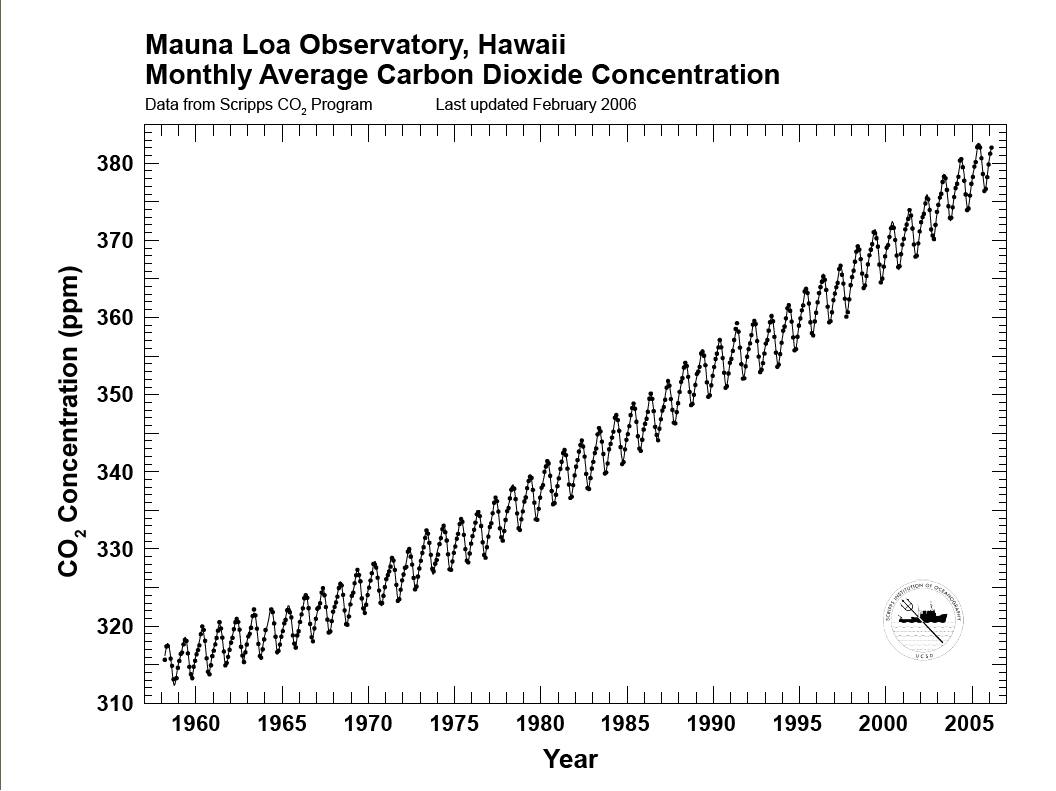
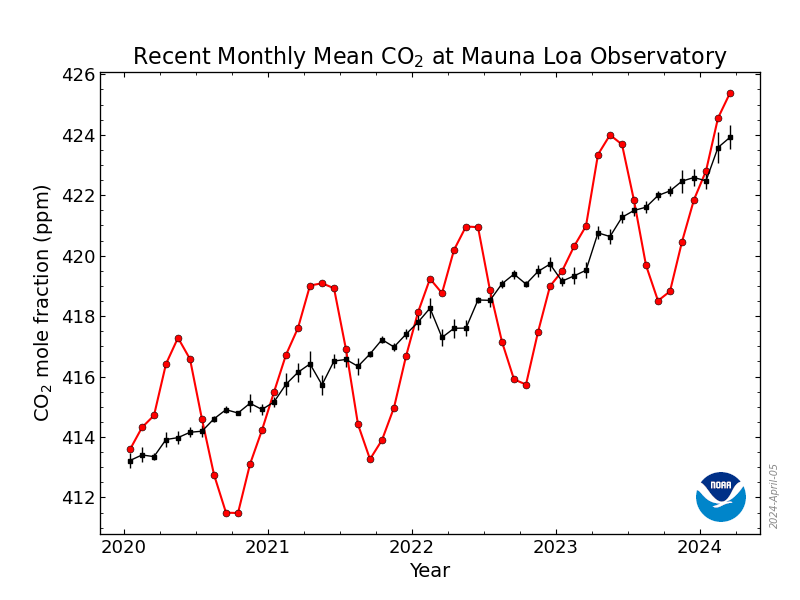
Of course, if by "child, animal, or plant" you don't count anaerobic life, we can make the planet uninhabitable faster just by converting the oxygen in the atmosphere entirely (or almost entirely) into CO2. (Yes, plants do need oxygen-- they may "breathe" CO2, but they also breathe oxygen). Looking at the slope of the atmospheric CO2 increase, http://www.esrl.noaa.gov/gmd/ccgg/trends/ , and fitting this to an exponential, I get roughly a thousand years for that to occur. Give or take. (Which is short compared to half a billion years.)
-
Re:Man-made global warming
Don't like ground based readings? You could look at the satellite data.
-
Hasn't been a "scorcher" here
Here is the yearly climate chart for my region.
As is easily seen, it's been colder than normal for the last six months, we're ahead on precipitation, February was unusually cold in a very consistent streak, snow continued into late May, quite late as compared to normal, and here, in late July, the temperatures continue to reach below normal ranges consistently, with only occasional excursions above.
One region does not by any means a global climate make, but I'm afraid I still have to take issue with "it's been a scorcher for folks all around the world." Not in this part of the world, it hasn't.
-
Re:More Info & Dashboard
No one is doubting Global Warming.
The question is: does the industrial revolution just correlate well with it, Or can you prove causation?Personally, I'm just glad I didn't have to suffer through the global cooling period:
http://www.climatewatch.noaa.gov/2009/articles/climate-change-global-temperature
-
Re:Soooooo
There has been no global reduction in CO2 production, despite some local efforts.
http://www.esrl.noaa.gov/gmd/webdata/ccgg/trends/co2_trend_mlo.png
http://www.esrl.noaa.gov/gmd/webdata/ccgg/trends/co2_data_mlo.png -
Re:Soooooo
There has been no global reduction in CO2 production, despite some local efforts.
http://www.esrl.noaa.gov/gmd/webdata/ccgg/trends/co2_trend_mlo.png
http://www.esrl.noaa.gov/gmd/webdata/ccgg/trends/co2_data_mlo.png -
Re:Global warming != anthropogenic
The data as presented indicates a recent warming trend, but does not say anything about whether this is man-made or not; a 0.5deg rise in 50 years is extremely small in the scheme of things, and drawing the usual alarmist conclusions from this is quite unfounded.
So read the report itself:
The NOAA Annual Greenhouse Gas Index (AGGI) shows radiative forcing relative to 1750, of all the long-lived greenhouse gases indexed to 1 for the year 1990. Since 1990, radiative forcing from greenhouse gases has increased 27.5%.
Nitrous oxide (N2O) and sulfur hexafluoride (SF6) are important atmospheric trace gases with significant man-made sources. Nitrous oxide has the third strongest anthropogenic climate forcing after CO2 and CH4 and is considered a major greenhouse gas (Butler 2009).
The atmospheric N2O budget is out of balance by one-third as a result of man-made emissions, primarily through emissions from nitrogen fertilizers (Crutzen et al. 2007).
Atmospheric greenhouse gas concentrations continued to rise, with CO2 increasing at a rate above the 1978 to 2008 average. The global ocean CO2 uptake flux for 2008, the most recent year for which analyzed data are available, is estimated to have been 1.23 Pg C yr-1, which is 0.25 Pg C yr-1 smaller than the long-term average and the lowest estimated ocean uptake in the last 27 years. At the same time, the total global ocean inventory of anthropogenic carbon stored in the ocean interior as of 2008 suggests an uptake and storage of anthropogenic CO2 at rates of 2.0 and 2.3 ±0.6 Pg C yr-1 for the decades of the 1990s and 2000s, respectively.
In the tropics this increase has been formally attributed to anthropogenic change over the 1988–2006 period (Santer et al. 2007).
all the time series show an underlying rise in OHC consistent with our understanding of anthropogenic climate change.
I mean, the evidence is all over the report. The only thing stopping them from saying that it is conclusively man made is that 1) it's probably impossible to prove it and 2) there might always be some evidence of non anthropogenic warming contributing to the cause but not accounting for all of it.
-
2009 State of the Climate report
The report that the article refers to is the 2009 State of the Climate report. More information about it is available at the NOAA website: http://www.noaanews.noaa.gov/stories2010/20100728_stateoftheclimate.html
-
More Info & DashboardThere's a really neat prototype dashboard that presents data surrounding climate change in an intuitive way. And the report is here (from the second link in the summary). And I submitted a story that got rejected a few weeks ago about NOAA's announcement:
So far, it's been a scorcher for folks all around the world. So it might come as no surprise that the National Oceanic and Atmospheric Administration has released a report revealing 2010 having the record for warmest June, warmest April to June and warmest year to date. The announcement said 'Each of the 10 warmest average global temperatures recorded since 1880 have occurred in the last fifteen years. The warmest year-to-date on record, through June, was 1998, and 2010 is warmer so far.' So far we are even surpassing 1998's records which held the warmest year (despite directly contradicting reports). It certainly seems the scads of winter precipitation we enjoyed were no indication of how we would swelter through our summer this year. Will 2010 turn it around or are we set to break more records?
Aside from that, I'm not really interested in making comments on this anymore because I'm so sick and tired of the armchair idiocy that follows (and somehow gets moderated up). Prediction: Not even 300 scientists from 48 countries and NOAA are going to convince everyone that global warming is real. At this point, I think it's just going to get worse.
-
More Info & DashboardThere's a really neat prototype dashboard that presents data surrounding climate change in an intuitive way. And the report is here (from the second link in the summary). And I submitted a story that got rejected a few weeks ago about NOAA's announcement:
So far, it's been a scorcher for folks all around the world. So it might come as no surprise that the National Oceanic and Atmospheric Administration has released a report revealing 2010 having the record for warmest June, warmest April to June and warmest year to date. The announcement said 'Each of the 10 warmest average global temperatures recorded since 1880 have occurred in the last fifteen years. The warmest year-to-date on record, through June, was 1998, and 2010 is warmer so far.' So far we are even surpassing 1998's records which held the warmest year (despite directly contradicting reports). It certainly seems the scads of winter precipitation we enjoyed were no indication of how we would swelter through our summer this year. Will 2010 turn it around or are we set to break more records?
Aside from that, I'm not really interested in making comments on this anymore because I'm so sick and tired of the armchair idiocy that follows (and somehow gets moderated up). Prediction: Not even 300 scientists from 48 countries and NOAA are going to convince everyone that global warming is real. At this point, I think it's just going to get worse.
-
Re:Global warming and you.
Both sides are distorting and cherry picking the facts to make their side look more plausible. Linking to the blogs of condescending one-sided pundits doesn't help convince anyone of the other side's position. Links to more neutral articles are preferable, rather than obviously one-sided diatribes that belittle others who don't believe in their way.
Scientists are usually pretty good at writing summaries and showing pretty graphs that the average person (myself included) can digest, so linking to accessible articles at the UN, NOAA, Journal of Climate, or even Nature magazine is preferable. There are many wiki articles that have active links to these articles. Or even just link to the wiki article on the global warming controversy
-
Re:Easier for denialists
It's only 2 or 3 mm per year. You're not really going to notice it if you're not paying pretty close attention. This NOAA tides and currents site has the information. For instance at Pensacola they have records going back to 1925 and it's averaged 2.1 mm/year, at Dauphin Island from 1965? it's averages 2.98 mm/year and at Galveston since 1957 it's averaged 6.84 mm/year (hmm, must be some subsidence going on there). Click on the station you want then sea level trends to see the graphs.
-
Re:Global warming and you.
In 2009, the CO2 global average concentration in Earth's atmosphere was about 0.0387% by volume.
Wow, that's a pretty amazing link. Just looking at the first graph alone, the CO2 concentration has increase by 23% since 1960. That is an amazing increase. And look at the third graph, which shows the cycle of CO2 over the last 400,000 years. That is pretty compelling evidence that what is happening this time around is nothing like the normal cycles.
Ahem, listen: zero point zero four percent. Isn't that within background noise range?
Let's put it into perspective. OSHA standards prohibit worker exposure to more than 50 parts of CO2 per million parts of air averaged during an 8-hour time period. That is one eighth of the levels in the atmosphere (fortunately it accumulates higher up). And to put the 50ppm into perspective, if the workers were exposed to 0.0087ppm of Sarin gas over that same period then they would die.
Yes, I know the human body is not the same as the atmosphere, but it is an indication while these numbers seem small to the untrained general public, they are still quite effective at having hugh effects. Who should we believe, the scientist who understands the physics involved, or an uneducated person who just looks at the number and says that it seems too small therefore the scientists must be wrong.
As for your link about the placement of weather monitoring stations, the problem is not that these stations are reporting that it is hot, but that it is getting hotter. It doesn't matter that some stations will be different than ones in other places, because that is why they calibrate them to a baseline.
If the stations just reported that it was constantly hot and that it wasn't changing, then nobody would be worrying. It wouldn't be global warming - just global warm. As it stands, the NOAA did test the pictured stations and found that no discrepency between the cited stations and others (PDF warning). So it appears that you are cherry picking the data by ignoring the fact that all the other monitoring stations agree with the ones you think are wrong.
-
Re:Easier for denialists
I see none of that data included in the NOAA report that was linked in the comment I replied to.
Temperature sources cited in the paper: http://www.ncdc.noaa.gov/oa/climate/ghcn-monthly/source-table1.html -
Re:And what season were these taken?
The derp is strong with this one.
http://www.ncdc.noaa.gov/sotc/?report=global
Argue with this for a while. I'll watch from a distance.
-
Re:Easier for denialists
How about this
-
Re:Great
He says NASA satellite data shows the average temperature in June was 0.43 degrees higher than normal. NOAA says it was 1.22 degrees higher.
That's because they measure completely different things. Satellites measure the lower troposphere, while NOAA uses ground based meteorological stations.
Especially in short time frames, the difference can be quite big. Over longer times, the average trend is similar, although some discrepancies have been observed too. See this page for a discussion: http://en.wikipedia.org/wiki/Satellite_temperature_measurements
He says too many of the weather stations NOAA uses are in warmer urban areas.
Funny how the NOAA anomaly map for 2010 shows hardly any warming in urban areas, and plenty of warming in thinly populated areas (Africa, Canada, and major oceans)
http://www.noaanews.noaa.gov/stories2010/images/map-blended-mntp-201001-201006.gif
-
Re:No problem, long as they charge at night
So how do you think normal driving for truck looks like ? In europe it is highway driving at constant speed, more or less constant load for hundreds miles.
To avoid each person having a different metric, we use standardized drivecycles. The drivecycle that the EU uses to model how people typically drive for vehicle mpg ratings is called the NEDC -- the New European Drive Cycle. It is a combination of urban and highway driving that approximates typical european driving patterns (which, by the way, are lower energy than typical US driving patterns -- hence the US uses FTP75 (city) and US06 (hwy), which are higher energy, and correspondingly leads to lower MPG figures for the same car in the US). You can see the NEDC here.
If you want to talk about pure highway driving, even that is not constant speed. Speed on the highway varies based on traffic density, random factors (passing, being passed, etc), current weather conditions, stops (gas, rest, etc), start and end accel/decel, exits (to surface streets or other highways), and driver randomness. Beyond speed, energy consumption varies based on weather and especially altitude changes. For an example, here are actual measurements taken from a vehicle in the US. Here's a test drive that starts with city and progresses to intra-urban freeway. Your mileage may vary.
(I have my own drive data recordings, but I am not at liberty to disclose them, so I'm linking to publicly available ones)
Highway driving runs an engine much more efficiently than city driving. You're closer to the peak efficiency (although not at it), you brake less, idling is basically eliminated, etc. Now, there's obviously a big downside -- your aero drag is *way* higher, and your rolling drag slightly higher (yes). In non-hybrid vehicles, the upsides outweigh the downsides (sometimes significantly). In hybrid vehicles, the downsides usually outweigh the upsides.
No this is not from wiki. It is from book called "Automobile fuels" (translated)
Right. Which is why I said, "If you had cited
I don't know how many times I need to stress this, but let me do so once more: There Is No Single Fuel Called Gasoline Or A Single Fuel Called Diesel. How about this -- how about I cite a bunch of random sources?
Simetric: 820-950kg/m^3
Alan Harvey, National Institutes of Standards and Technology: 850kg/m^3 typical, but 825-890.
Engineering Toolbox: 810-960kg/m^3
MSDS: 810-880kg/m^3Gasoline:
MSDS: 710-770 kg/m^3
Simetric: 737kg/m^3
Engineering Toolbox: 680-740kg/m^3 -
Re:New Campaign! Stop cretinous fools!
"All that gridding and normalization has destroyed the integrity of the original data, which has been "lost" somehow."
Here is the raw data, go and do some calculations and get back to us if you find a trend that significantly deviates from the accepted 0.14degC/decade. -
Re: 2009 one of North Americas coldest summers
BTW where I live (North America) 2009 was one of the coldest summers on record. I'm curious where all this supposed heat was? It certainly wasn't here.
And yet the global temperature was still higher than average:
June's 2009 Blended Land and Sea Surface Temperatures: +0.62C above the 20th century average
July's 2009 Blended Land and Sea Surface Temperatures: 0.57C above the 20th century average of 15.8C
August's 2009 Blended Land and Sea Surface Temperatures: 0.59C above the 20th century average of 15.6C -
Re: 2009 one of North Americas coldest summers
BTW where I live (North America) 2009 was one of the coldest summers on record. I'm curious where all this supposed heat was? It certainly wasn't here.
And yet the global temperature was still higher than average:
June's 2009 Blended Land and Sea Surface Temperatures: +0.62C above the 20th century average
July's 2009 Blended Land and Sea Surface Temperatures: 0.57C above the 20th century average of 15.8C
August's 2009 Blended Land and Sea Surface Temperatures: 0.59C above the 20th century average of 15.6C -
Re: 2009 one of North Americas coldest summers
BTW where I live (North America) 2009 was one of the coldest summers on record. I'm curious where all this supposed heat was? It certainly wasn't here.
And yet the global temperature was still higher than average:
June's 2009 Blended Land and Sea Surface Temperatures: +0.62C above the 20th century average
July's 2009 Blended Land and Sea Surface Temperatures: 0.57C above the 20th century average of 15.8C
August's 2009 Blended Land and Sea Surface Temperatures: 0.59C above the 20th century average of 15.6C -
Re:We All Wish
The heat capacity of the atmosphere and earth's surface is so low, that it varies drastically within a few hours every day. Bodies of water, on the other hand, hold about 100x as much heat per unit volume. I have been debating global warming for a damn long time, and NOBODY has ever had a damn thing to say about the real global heat content (including oceans), just debating bullshit air temperatures, which account for almost nothing compared to ocean temps.
Incidentally, I've discussed ocean heat content several times, and agree that it's a better diagnostic than air temperatures (subject to the caveats referenced in that post and those quoted at the very bottom of this post.)
Well, it's a little more complicated than that. I've previously said that human CO2 emissions are ~100x than those from volcanoes. This is the comparison that matters, so your summary is essentially correct. But the biosphere's yearly fluctuations are much larger than our yearly emissions, as you can see by the fact that the red line's annual amplitude is much smaller than its linear trend. The biosphere is a closed system, though, so it's not relevant to abrupt climate change.
-
Re:Oil, Tropical Storms, and Hurricanes
Another poster found this (PDF) which says that the oil spill will not have any significant impact on the hurricane and that hurricanes draw water vapor from a much larger area than is being covered by the oil slick.
-
Re:Black hurricanes
According to the National Hurricane Center (sorry,