Slashdot Mirror
Domain: noaa.gov
Stories and comments across the archive that link to noaa.gov.
Comments · 2,602
-
Re:Better solution exists
No. CO2 in the ocean is exchanged with the atmosphere at the water-air interface. The rising CO2 levels in the atmosphere have actually altered carbonate chemistry within the ocean, nearing the point at which the pH buffer breaks down. This would basically be disastrous.
http://www.oar.noaa.gov/spotlite/spot_gcc.html -
+5 insightful?
How about +5...
i mean, seriously. even dept of commerce branch NOAA *completely* disagrees with you.
please note this *peer-reviewed* info (yes, this entire site is a published study):
http://www.arctic.noaa.gov/detect/indicators.shtml
and yes, this is merely the most digestible and easily accessible of the info out there. -
Re:The way things are goingI was commenting on people's tendency toward distrust of the environmental movement due to beliefs like the one expressed above.
So the world can 'go to hell in a hand basket' because you don't 'like' how some on the left presents its views.
"Fuck the facts! If the uneducated masses move in the right direction, that's all that matters."My experience is that most (if not nearly every one) honestly believe in the early reports of climate change. characterizing them as dishonest is just propaganda, bully style. Trouble for you, and the rest of us, is that to prove them wrong we would need to poison the earth. I don't think that I'm breaking new ground in saying that 'it's the only one we have'.
I'm not sure where you got your facts from, as you didn't link anything, but this report shows steady increases in just CO2, and if you want a really good dose of CO2, just take a hike in the middle of a busy highway. Back in 1998 I was telling anyone who's ear I could grab, that the stock market was bubbling, did they listen, no, was I right, yes. More than two years ago I was saying that the housing market was crazy and about to burst (20% drop, I told them), I was right on that too. Am I ready to say that man is causing these increases, no, I'm not, but I think that we could eventually. Would you take the chance at passing such a world to our progenerate? I'm guessing that you are, mostly because you don't like those damn smelly hippies.
-
Re:mods?
Here is a graph of the total solar irradiance data if anyone cares. I don't even see the increase the article references. link
-
Re:SO..
That's a really horrifying thought, but given the way that McDonald's operates, it's possible that that is already happening. Time for me to move back to Alaska and a subsistence lifestyle, I think...global warming should take care of the 'snow' issue pretty soon.
-
Re:Which do you believe?
Apparently.
"Global surface temperatures have increased about 0.74C (plus or minus 0.18C) since the late-19th century, and the linear trend for the past 50 years of 0.13C (plus or minus 0.03C) per decade is nearly twice that for the past 100 years. The warming has not been globally uniform. Some areas (including parts of the southeastern U.S. and parts of the North Atlantic) have, in fact, cooled slightly over the last century. The recent warmth has been greatest over North America and Eurasia between 40 and 70N. Lastly, seven of the eight warmest years on record have occurred since 2001 and the 10 warmest years have all occurred since 1995."
From: http://www.ncdc.noaa.gov/oa/climate/globalwarming.html
Notice that ncdc in the URL? I wonder what that stands for? -
Re:Actually, it has been thought of and tried alot
Acutally, we get about 10 hits a year, with 2-3 deaths. We are one of the worse states for hits. In fact, given our size and population density, we are probably the worse state for lightening. Only Florida has more deaths (roughly double) and they have many time bigger population. We are 5 million and they are about 20 million. They should have about 3-4x our strikes.
And texans/californians account for about 20% of these. Now that does not sound like much, until you realize that a Coloradoans account for the majority of exposure. We probably account for about 90-95% of the exposure. Yet the texans/californians are hit as high as they are. It is disproportionate BECAUSE they are not thinking. They just assume that things are safe. After all, lightening is not a real issue in either of their states. It is because of this, that a number of CO emergency rooms are pushing that information on all of the information boards for tourists. -
Re:Uh, not due to climate change though...
The differences between what your saying and what I am saying is that your only concentrating on the anthropogenic aspects of the Ozone where I am looking at it as a whole, (natural and man made). You and I are not saying the same thing about the same subject. I am talking about it as a whole and you are incorrectly attempting to think I am limiting myself to anthropogenic causes. If man had never created CFCs, the hole (that isn't really a hole) would still be there because of natural Chlorines and HCLs in the atmosphere along with climatic anomalies specific to the polar regions.
I noticed you didn't answer all of my questions so I have to ask, do you not know the answers or do you think it will strengthen my position if you actually answered them. If all you know about the Ozone is the We have a problem stuff, then you probably aren't going to be as educated as you think. So here are those questions again and lets see if you can answer them blockquote> has ground level Ozone been a problem after we banned CFCs? Since the ban took effect and the phase out period expired in 1996, has the Ozone repaired itself? Is there natural causes that deplete the Ozone? How is it replenished? Why isn't that same process as useful or as effective around the poles where the holes are? how long has there been holes in the Ozone? Answer those questions and tell me I have said anything wrong. If you can answer them, you will know I was correct in my statements. Perhaps you have taken some preconceived notion of the situation and are the one confused.
Your explanation on CFCs staying in the atmosphere is a little simplified too. The CFCs don't react with Ozone themselves, it is their decayed elements that do. They get broke down relatively fast when exposed to UV radiation (about 21 days) but in the process a portion of the elements are left free which can in turn bond and react with O3 effectively creating o2 and picking up the charged O that would create o3. Now it isn't all of the Cl and Br that is left open for a constant interaction, a good portion of that is turned into HCL and ClONO2 which is further broken down if it remains in the upper atmosphere which turn into Cl and ClO which cause the damage. We are talking on average of 3 parts per billion for mixing ratios of natural and non natural Cl (some in CFC form still) where ozone is measured in part per million. the Broine concentrations are about 100 times smaller and end their reaction relatively fast in comparison.
You should take a look at Scientific Assessment of Ozone Depletion: 2002 which another poster pointed me too. Granted it is dated but it has all the pertinent information. Should you wish to forgo reading it all, you should be able to find everything I have said in the 20 questions sections. You will also find all the answers to the questions I asked you in there too. -
Re:Uh, not due to climate change though...
You're entire argument about the Ozone hole runs contrary to every scientific study done about it. Pretty much everything you said about it is wrong. For actual information, see for example http://www.esrl.noaa.gov/csd/assessments/2002/
You're similarly wrong in pretty much everything you said about Global Warming. I'd point you to the IPCC reports, but I'm sure they're just a bunch of hacks with political agendas and redistribution of wealth schemes in their head.
Hey, since Global Warming isn't a problem, I've got some choice sand bars I want to sell you. I'm sure in a few years they'll be beautiful islands off the coast of Florida.
And you might want to know the difference between effect and affect. You know, so you don't come across like a complete dumass. -
Re:Beer lovers get the shaft either way
You are correct that scientists are split in their opinion about the next solar cycle. Some say it will be more intense than the last one, and others say it will be less intense. But it doesn't have anything to do with any global warming debate.
-
Not true
If they don't move, they will need to build domes to live in.
"Funny that the last couple of hurricane seasons have been much quieter than predicted..."
Perhaps not:
http://www.nhc.noaa.gov/gifs/atlhist_lowres.gif
While your statement is technically* correct, your intent to imply there are fewer hurricanes as a trend is not.
Your confusing two issue. People who continue to buy houses in areas prone to disaster and people who have lived in the same place for hundreds of years and not having this disaster strike.
DO you know how nasty it is getting up there? berry's that have been pick for countless generations are dying in their pods, lakes of fish dying, land literally sinking, Ice that with no record of it melting, ever, is disappearing.
So enjoy your nice warm blanket of comfortable ignorance, but don't try and spread your crap around where people actually look at facts, and trends.
Fuckers lie you will continue to say there is no problem until they draw their breath. Then you will whine on how it's other peoples fault. -
Solar output
>It appears to me that those who said that the SUN was causing global warming due to increased sunspot activity, that has recently subsided, were correct.
Judge for yourself: the last almost-30 years of direct satellite measurement of solar output. Besides, increased solar output wouldn't make nights warm up faster than days. -
Re:Mistargeted law suit?
The oceans are currently absorbing 7 billion tons of CO2 more than they outgas each year, with terrestrial absorption at 5 billion tons net per year.
http://earthobservatory.nasa.gov/Library/CarbonCycle/carbon_cycle4.html (NASA's Earth Observatory site is currently offline)
(alternate link) http://www.visionlearning.com/library/module_viewer.php?mid=95
Solar irradiance does directly track historical temperatures; however, the past 30 years have shown increasing temperatures with steady solar irradiance.
Direct satellite measurements of solar irradiance find no rising trend since 1978, the start of measurements. Sunspot numbers have leveled out since 1950. The Max Planck Institute reconstruction shows that irradiance has been steady since 1950 and solar radio flux or flare activity shows no rising trend over the past 30 years.
An increase solar irradiance would warm all layers of the atmosphere as there would be more heat radiating through all atmospheric layers back out to space. An increased greenhouse effect would reflect more heat to the surface, thus warming the lower atmospheric layers and cooling the upper atmospheric layers. The second case is what is being observed.
http://www.mps.mpg.de/dokumente/publikationen/solanki/c153.pdf
http://www.pmodwrc.ch/pmod.php?topic=tsi/composite/SolarConstant
http://www.globalwarmingart.com/wiki/Image:Sunspot_Numbers_png
ftp://ftp.ngdc.noaa.gov/STP/SOLAR_DATA/SUNSPOT_NUMBERS/MONTHLY.PLT
http://www.globalwarmingart.com/wiki/Image:Solar_Cycle_Variations_png -
Re:I'm going to sue the Sun!
So why is it so hard to believe that a continued waning (solar activity is still going down, lower than the amounts that stabilized the temperature) will help drop the temperature?
Because we're very near solar minimum, so this is about all the cooling we're going to get. Now for another ten or so years of rising, followed by perhaps another plateau. -
Re:They'll be happy to know the Earth is Cooling
How does a 41,000 year cycle, or even a 500 year cycle, explain the past 30 years of temperature increase?
Astronomical Theory of Climate Change (Milankovitch Cycles) -
Re:immunization
"1) is there now a known lifetime vaccine for chicken pox?"
Just a few years ago, they thought that it would last 18-20 years. Just long enough to put every child that got it as recommended by the CDC at the point that they are uninsured and in a high risk taking group. Today they are saying ~5 years.
There is one known lifetime vaccine for chicken pox. It is called getting chicken pox. Actually catching the disease is the only known way to gain lifelong immunity.
I don't have good story on hand. The problem is that the CDC and the AMA recommend the vaccine for everyone. Once that happens, you are not likely to see a lot of dessent. Particularly when there is so much money to be made by supporting the recommendation. Here is a link to a document on the CDC's site that points out that the death rate from chicken pox prior to the vaccine was 100 per year. According to NASA, there are more people hit by lightning each than that and 92 a year of the strikes are fatal. We don't see a nationl push to start dressing our population in rubber suits. That and avoiding a lightning strike does not increase your odds of being killed by lightning later in life. No one is disagreeing that catching chicken pox as an adult is WAY more dangerous than as a kid. The pro-vaccine folks are just not discussing it at all.
Now, I don't suggest you take my word for it. Go to the very people that are recommending the vaccine. Just don't accept their recommendation. Look at their core data. Run the numbers yourself. Then ask yourself the appropriate questions. Does the immediate risk prevention outweigh the long term increase in risk. Is the chances of death REALLY more than what I take on a daily basis with hundreds of other activities I do? Is my child likely to be insured and able to afford to keep getting boosters for the rest of their life? Is my child going to actually go through the effort of keeping up on the booster shots for the rest of their life? Is the increased risk of adult death for my child worth the money I can make by not missing a weeks worth of work? Is it important enough to me that the public school gets that extra weeks worth of funding for my child not missing a week due to illness? -
The National Geodetic SurveyYou think adding the Government would help improve mapping products? I'll keep my tax dollars, thanks.
Good lord.
The NGS has been mapping the U.S. for 200 years. National Geodetic Surevy The U.S. Geological Durvey is an essential resource: Maps, Imagery and Publications
-
What?
Why would you bring up climate change? We've known for many years that the Sun flips its magnetic field every 11 years or so. This is simply the first time we've observed it in another star. The flipping of Sol's magnetic field causes a change in the number and size of sunspots which do affect solar output. This has been taken into account with climate models that show the earth is warming due to human influence. This news story offers absolutely no information pertinent to climate change.
I would like to point out that there are so very many things that we are not sure of or simply don't know.
Because we do not know some things does not mean we cannot know others. The fact that the theory of General Relativity does not work at atomic distances does not mean that we can't use it to determine clock skew in different gravity fields. GPS would not work without taking General Relativity into account if you want proof you can hold in your hand. Because we do not know everything about Quantum Mechanics does not mean that we cannot use the theory to create lasers, which are a direct result of quantum mechanical theory. You would not have CD and DVD drives if the theory wasn't mostly correct.
What you are basically saying is that we should throw up our hands and say that whether climate change is occurring due to human influence is unknowable. That sounds nothing like an 'INFORMED decision' as you put it. If you are truly interested, do some research yourself. I questioned man's influence on climate change also until I looked into it. Researchers who study the subject are almost completely of one mind, that humanity is influencing the climate and causing the world to be warmer that it has been in the past. These are people that spend their lives looking at all of the evidence, people that ask the questions you want the answers to and try their best to find them. The people that just throw their hands up and say that it is unknowable are the ones that deny global warming is happening. Some point to one of the warmest years on record being in the 1940s, but that is explainable due to normal cycles. Check out the trends though. Global warming is a FACT, that human influence is causing it is a theory with mountains of evidence supporting it and no evidence against it. The only other thing that people can point to as the cause for global warming is "something we don't know yet".
-
Re:In before global warming deniers
You Katrina comment is part of the problem. You are believing these made up relationship and ignoring the scientific data.
Also with gas prices the US is higher then some Europian countries once you eliminate the taxes. -
Re:Everything into NYC? [Geography & Routing]
Why do so many of those transatlantic cables seem to land in New York?
Two Reasons: Geography and Routing
1) Geography: First, the Guardian's map is a little oversimplified. Most of those cables come ashore in Eastern Long Island or along a relatively narrow stretch of New Jersey coastline, about 50 miles south of NYC proper. They're in those places because of submarine geography. The sea floor isn't flat- there are mountains and canyons, etc. Ever tried to run network cable through a crowded office? Pain in the neck, right? Now imagine doing it with six-foot long tweezers and a blindfold...for 3,000 miles. The cable-layers pick the flattest, least cluttered path they can. In the mid-1950s, we started to get good sonar maps of the North Atlantic sea floor. Laying undersea cable is *expensive*, and there was a big burst of it as those maps started to take the guesswork (and a lot of the risk) out of the equation. And once a company found a good route, they tended to keep using it.
Seafloor mapping:
http://oceanexplorer.noaa.gov/explorations/03fire/background/mapping/mapping.html
Timeline of transatlantic cables, 1951-2000:
http://www.atlantic-cable.com/Cables/CableTimeLine/index1951.htm
2) Routing. A *lot* of information passes through those cables. It's compressed (Hoffman encoding, anyone?), and at each end you have to decompress it and then route it back into the land line system. This is a big, complicated operation (Much more so in the '50s and '60s when so many of the US-Europe cables were laid), and it's cheaper to add capacity by laying more cables between existing terminals than to build new ones.
Overview of cable topography & operations for one big cable operator, Apollo Systems:
http://www.apollo-scs.com/networktopology/
Note that some companies (including Apollo) are starting to build new routes- the economics for doing that are getting better as cable gets cheaper and data traffic grows (shame on all the Americans downloading video files from peers in Sweden).
So yes, the undersea cable system *should* have much more redundancy, but it *won't* until somebody can make money building and selling that redundant capacity. And actually, these events will speed up that process; According to the Guardian, 50% of India's bandwidth is cut off. The people who own the pipes for the 50% that still works are having a *very* profitable week. -
Re:Announcing themselves?If you are hit by one of these UAVs, you are probably in the vicinity of a hurricane, well outside of an established flight route or flying in an announced exclusion area. I strongly doubt the FAA would let the UAVs fly into an air corridor. Here's a clip from NOAA lessons learned that should assuage your fears: 1. FAA clearances are a major UAS hurdle that needs to be streamlined. We were able to circumnavigate this issue for our lone Ophelia flight but this was in large part due to the fact Ophelia was stalled for 1-2 days prior to mission initiation. This in turn allowed the complicated flight clearance process to play out. In a nutshell, we were very fortunate. One seeming advantage for future UAS Aerosonde missions is that we fly into regions no commercial aircraft will go near let alone fly directly into (i.e. Hurricane environments). That fact alone should play in our favor when asking for future clearances.
-
Re:Boo-hoo
Agreed. Planes crash for more reasons than as a result of terrorism. What about the over 18,000 people who have died as a result of tornadoes in the US since 1875? Surely the grief of families who have lost loved ones to tornadoes is just as important. If 9/11 is a valid reason to remove a plane crash disaster, there are equally valid reasons to remove the others.
-
Re:NASA Shuttle Radar Topography Mission (SRTM)
Note, they also used the ground-zero/oceans to calibrate the device on every orbit of the earth which means it doesn't penetrate into the water.
It's true that radar doesn't penetrate the ocean's surface. However, the surface of the ocean is not spherical (or even oblate eillipsoidal) -- the water surface mirrors the topography of the ocean floor. (Strictly speaking, the water just follows the equipotential surface of earth's gravity field, which is influenced by the rocks in the seafloor.)
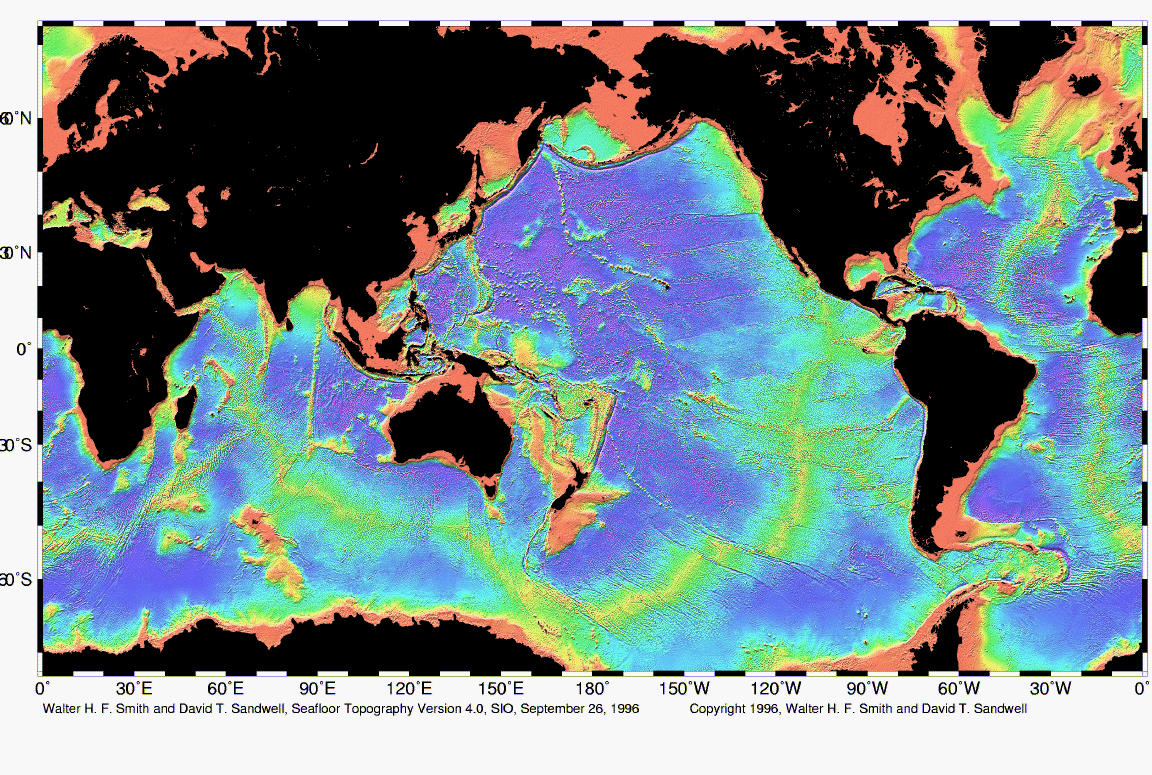
This was first done by Haxby using Seasat data back in the 70s -- see Mapping the sea's 'surface' reveals secrets of the deep - seafloor. The article mentions Sandwell and Smith, who are the scientists working on that problem today, and this is the latest topographical map of the ocean floor derived from gravity measurements.
-
Re:2mm, China's COMPASS and more on GLONASS
You can already do this with the US based GPS system using OPUS. Forgive my bad html, but here is the link:
You have to set up your reciever to log satilite observations over at least 2 hours, and take a reading at least every 5 minutes. Opus uses precises satilite orbital information to post process point information. The accuracy of your results depend upon how long you run your observations, and how many observations you log. I typicall run mine over 4 hours, and get an accuracy of around 4mm horizontal. Opus is a great tool when you need to tie your land survey to WGS84 coordinates, or State plane coordinates.
-
Re:Dec 19?
-
Re:Finally.
I've lived in Keweenaw Peninsula in the UP of Michigan for five years now. We've averaged 186 inches (15.5 feet) of snow per year since I've lived there, with one year at 230" or 19'. I've had a 2WD Ford Taurus station wagon and never had a problem, nor have I put anything but stock all-seasons on it. That 3.0L V6 got 30mpg when I'd take it on the highway. The only reason to *need* a truck or SUV is if you're such a bad driver that it's impossible to adapt to different weather environments. Basically, weak excuse, especially considering New England has averaged 40-ish inches/year the last how many years? The NCDC page for annual snowfall
-
Re:Lovely
For those interested in a map of light pollution in the US: Light Pollution Map
-
Re:Every June
Unfortunately, that is a very real risk associated with long-term hurricane forecasts: Assuming that because there may be a lot of storms, they may devastate an area in particular (something the mass media is particularly good at). A hurricane season can have dozens of storms, and having none affect land. On the other hand, a season may have very few storms but be extremely damaging, like 1992 was. It really takes only one bad storm, like Andrew in 1992 or Mitch in 1998, to turn lives around.
In reality, people have to realize that predicting weather is an inherently unstable mathematical problem, so longer-term forecasts are usually not that accurate. On the other hand, short-term forecasts keep getting better as the understanding of the physical phenomena increases, along with more computational power to throw at the good old models. A bit of preparation before hurricane season never hurts, though. -
Re:Every June
Unfortunately, that is a very real risk associated with long-term hurricane forecasts: Assuming that because there may be a lot of storms, they may devastate an area in particular (something the mass media is particularly good at). A hurricane season can have dozens of storms, and having none affect land. On the other hand, a season may have very few storms but be extremely damaging, like 1992 was. It really takes only one bad storm, like Andrew in 1992 or Mitch in 1998, to turn lives around.
In reality, people have to realize that predicting weather is an inherently unstable mathematical problem, so longer-term forecasts are usually not that accurate. On the other hand, short-term forecasts keep getting better as the understanding of the physical phenomena increases, along with more computational power to throw at the good old models. A bit of preparation before hurricane season never hurts, though. -
Re:WisconsinGood thing these fine young scholars are boldly venturing forth into the areas of meteorology most crucially important to the Midwestern region of the United States. Oceans drive climate systems across the entire planet. Surely you've heard of El Nino and La Nina? One is a 'warm ocean', and the other is a 'cool ocean'.
Furthermore, the positions of warm and cool spots in the ocean control where the jet streams flow, and the jet streams determine who gets rain and who gets drought. I understand that the warm anomalies are probably caused by underwater volcanic activity, but this is one aspect of the earth's geology that we have precious little data about - those underwater volcanoes are notoriously difficult to study...
Wisconsin has lots of farming which is dependent on rainfall, so it's entirely appropriate that they're trying to improve their forecasting models. -
water infrastructure/yes indeedy
You probably missed the news then, because congress just had the very first override of a presidential veto over a big water infrastructure bill, said bill being so important the bulk of the nations governors and senators and reps are mostly for it and it isn't because the water system is in great shape and they want to just polish the chrome faucet handles. And you probably have been missing the news of the huge droughts all over and how we don't have good enough storage capacity, and how the big everglades reclamation effort(the Florida water sponge) is stalled dead in the tracks from lack of funding, even with the new bill passed.
Really, I am not blowing smoke here, the national water infrastructure is severely stretched right now, google is your friend there,all over the nation really, along with the bridges and a lot of the normal roads. I could provide a lot more links to prove this point, but just run your own keyword searches there. Estimates for just reppairing what we have now to fix fall betweeen the OMG! and How many zeroes??!! levels. Want just a tiny example of how weird it is getting? Just in the past few months over 90,000 horses have been literally abandoned in the southeast US as people who have them no longer have the grass nor the water to keep them. I am contemplating getting a couple myself, but still not sure if we have adequate needs right now for our small cow herd (I live in north georgia on a big farm, but the drought over all has been bad here, although we did get 1.5 inches of rain this last weekend so that is welcome)(we only harvested 20% of our normal average haycrop this year), going to see how it goes the next month before making a decision. Long range weather is looking bad with la nina, real bad. And look at the mess going on with atlants water supply and water needs further downstream for power plants and to keep some fisheries going in florida. they are goping to run out! they are *mining* water now, it is not being replensihed at anywhere's near the rate it needs to be, and even with emergency restrictions there is a good chance that sucker is going down. There just isn't enough, and we needed a thousand(whatever, bignum there) more huge reservoirs built ten years ago all over the country. And they want billions to build a high speed maglev train to move plutocrats and gamblers around?? And my other point of the dismal state of national broadband still stands as well, we are way down the list on every ranking index I have seen and dropping yearly.
As to getting better cars out there, I agree, totally. They need to drastically increase cafe standards beyond a joke level and shake detroit to its very roots to get them to pay attention, and offer something like eliminating ad valorem and sales tax for plugin hybrids that achieve 60 mpg or better, or pure electrics, and stuff like that. I am also in favor of a national 100% tax credit for installation of active alternative energy solutions for homeowners and small business, to get a lot more points of production out there, and to keep it in place for at least a decade. a manhattan project or moonrace project effort, something of that scale, massive and *now*, right now, pass the damn bill as an emergency measure. If we wait for the economy to collapse further and oil get closer to two hundred a barrel than one hundred like now...well..we just won't be able to do it. The second (or third) worlding of the US will follow.
In other words, we don't need any more dumb fixes, we need smart fixes, cheap fixes, and multi billion wasted dollar magleve trains aren't even a fix, they are just rich peoples toys. -
Argo data
Here's a link to an online tool that lets you plot data from the Argo arrays. Got it from Wikipedia.
http://dapper.pmel.noaa.gov/dchart/ -
Venus' landscape is awesome
Wouldn't the rover just beam back "It's hot and everything's melted" over and over lol. If I remember correctly, there's no significant features to even study. You can't have mountains and ancient, dried up rivers and caves when everything's that hot. Mars is far more interesting.
It's hot and nothing is melted. On earth the melting point of rock is lowered by the amount of water they contain. Water acts as a flux. On Venus where the climate is intensely hot and dry, crustal rocks melt at a very high temperature and are very strong. They create some pretty wild landforms (scarps, cliffs...) as a result.
This or this don't seem so boring to me. The Maxwell Montes are higher than the Himalayas. With adiababic cooling their tops will be hundreds of degrees cooler than the planetary mean. Also, with all of the volcanism and mobile lava flows you can expect there to be some amazing lava rivers and lava tube caves.
-
Re:ALREADY HAPPENED (maybe)
Katrina really wasn't that mysterious. The Gulf of Mexico is a very warm basin of sea water in comparison to the surrounding Caribbean and Atlantic waters. A hurricane that happens to wander in there under favorable conditions (low wind shear) tends to blow up. It's the meteorological equivalent of a spark hitting a powder keg. If you really want to understand its "sudden change in course" there's a nice report on it.
-
Re:That's the Maunder Minimum
Yes, the models are constantly updated. As far as I know, NASA depends on the NOAA's Space Environment Center for it's historical and predicted solar activity data. The article by D. Whitlock on page 4 of this Orbital Debris Quarterly News (PDF) has some details. I see that the "near term" prediction, usually about two years, is getting shorter and shorter as the SEC hasn't predicted solar flux beyond Dec. 2007.
-
Re:Sunspot numbers
The cycles on that graph show peaks regularly every 10 or 11 years. That would put us right in a trough.
From Wikipedia:
A minimum in the eleven-year sunspot cycle is predicted for 2007 [1].
which references http://www.sec.noaa.gov/SolarCycle/
The lack of sunspots isn't the interesting part... it's the amount of time they were lacking. -
Re:Wikiphobia
You can look up weather data from the NOAA National Severe Storms Lab. They maintain the data from 1933 - present. You look up the station name, select a date range and you get the information.
The data is available here - just select "Online Data Access" from the menu.
-
Re:Early Data Points
So many uninformed people in this thread, it's quite depressing really...
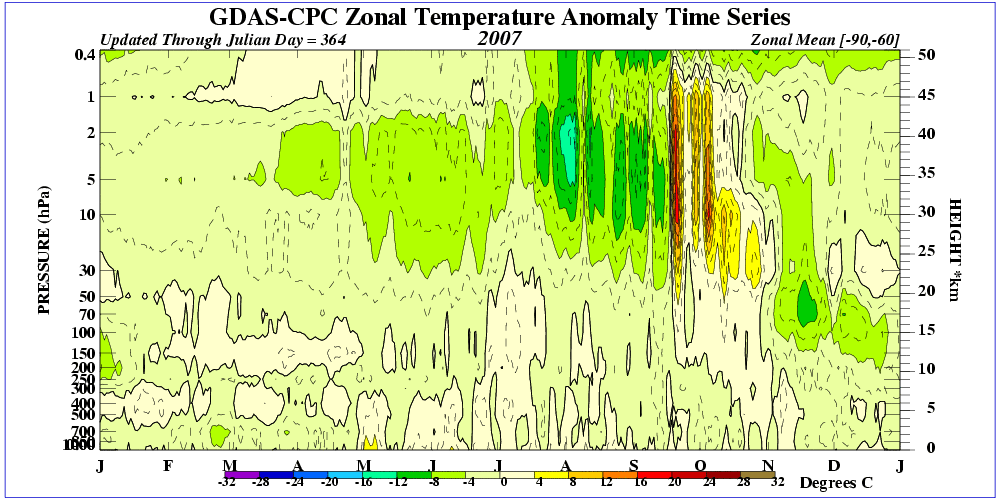
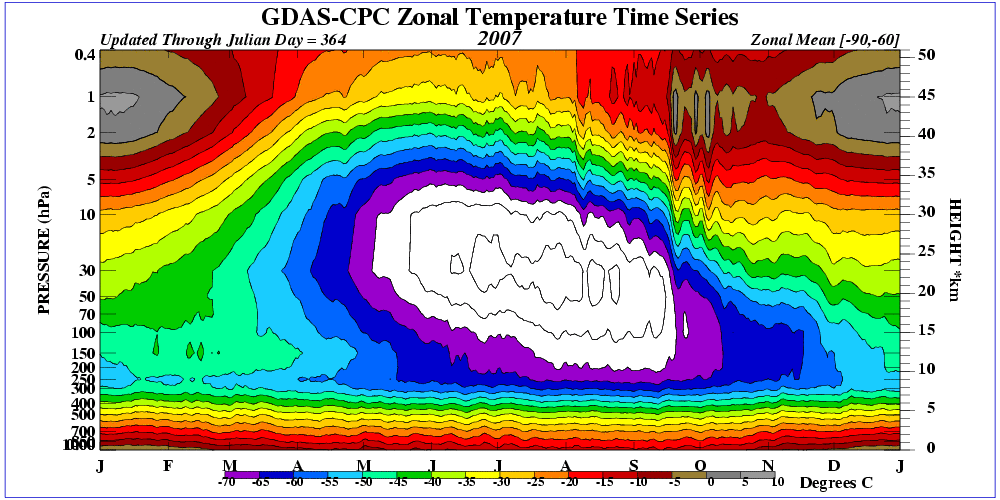
The hole in located in the south, because the temperatures in the southern stratosphere are lower than in the north. They are lower than -78C, which is the minimum temperature needed for CFC's to break down O3. This year's 30% decrease in size compared to the RECORD size of last year is caused by the temperatures over the south pole.
http://www.cpc.ncep.noaa.gov/products/stratosphere/strat-trop/gif_files/time_pres_TEMP_ANOM_ALL_SH_2007.gif
This graph shows this year's temperature anomalies (up until October obviously) over the south pole. Notice the fact that, though it was on average a bit too cold, it was much too warm last month.
Here are the average temperatures:
http://www.cpc.ncep.noaa.gov/products/stratosphere/strat-trop/gif_files/time_pres_TEMP_MEAN_ALL_SH_2007.gif
-78C is gone, and so is the massive breakdown of O3. Much earlier than last year.
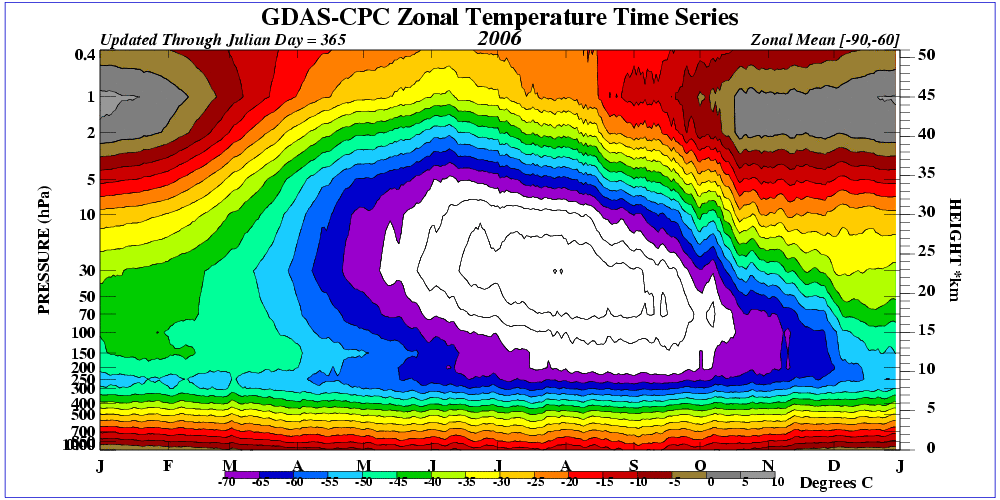
Now compare to last year.
http://www.cpc.ncep.noaa.gov/products/stratosphere/strat-trop/gif_files/time_pres_TEMP_ANOM_ALL_SH_2006.gif
Except for one small blob, it was too cold during the entire spring.
Average temperatures:
http://www.cpc.ncep.noaa.gov/products/stratosphere/strat-trop/gif_files/time_pres_TEMP_MEAN_ALL_SH_2006.gif
Easily -78C well up until November. An entire month extra of O3 breakdown. This is what caused the record size. Things are pretty much back to normal now, so I don't see what the fuss is all about: there still is a need to decrease the amount of CFC's, because the more there are up there, the more damage those cold months can cause.
Why are you people not checking the facts? Are you really waiting to jump to the next conclusion? To post the next big "conspiracy theory"? WTF are you people doing on Slashdot? You are childish cynics, not nerds. You lost your inquisitive attitude and you just mindlessly regurgitate whatever you're being fed. -
Re:Early Data Points
So many uninformed people in this thread, it's quite depressing really...
The hole in located in the south, because the temperatures in the southern stratosphere are lower than in the north. They are lower than -78C, which is the minimum temperature needed for CFC's to break down O3. This year's 30% decrease in size compared to the RECORD size of last year is caused by the temperatures over the south pole.
http://www.cpc.ncep.noaa.gov/products/stratosphere/strat-trop/gif_files/time_pres_TEMP_ANOM_ALL_SH_2007.gif
This graph shows this year's temperature anomalies (up until October obviously) over the south pole. Notice the fact that, though it was on average a bit too cold, it was much too warm last month.
Here are the average temperatures:
http://www.cpc.ncep.noaa.gov/products/stratosphere/strat-trop/gif_files/time_pres_TEMP_MEAN_ALL_SH_2007.gif
-78C is gone, and so is the massive breakdown of O3. Much earlier than last year.
Now compare to last year.
http://www.cpc.ncep.noaa.gov/products/stratosphere/strat-trop/gif_files/time_pres_TEMP_ANOM_ALL_SH_2006.gif
Except for one small blob, it was too cold during the entire spring.
Average temperatures:
http://www.cpc.ncep.noaa.gov/products/stratosphere/strat-trop/gif_files/time_pres_TEMP_MEAN_ALL_SH_2006.gif
Easily -78C well up until November. An entire month extra of O3 breakdown. This is what caused the record size. Things are pretty much back to normal now, so I don't see what the fuss is all about: there still is a need to decrease the amount of CFC's, because the more there are up there, the more damage those cold months can cause.
Why are you people not checking the facts? Are you really waiting to jump to the next conclusion? To post the next big "conspiracy theory"? WTF are you people doing on Slashdot? You are childish cynics, not nerds. You lost your inquisitive attitude and you just mindlessly regurgitate whatever you're being fed. -
Re:Early Data Points
So many uninformed people in this thread, it's quite depressing really...
The hole in located in the south, because the temperatures in the southern stratosphere are lower than in the north. They are lower than -78C, which is the minimum temperature needed for CFC's to break down O3. This year's 30% decrease in size compared to the RECORD size of last year is caused by the temperatures over the south pole.
http://www.cpc.ncep.noaa.gov/products/stratosphere/strat-trop/gif_files/time_pres_TEMP_ANOM_ALL_SH_2007.gif
This graph shows this year's temperature anomalies (up until October obviously) over the south pole. Notice the fact that, though it was on average a bit too cold, it was much too warm last month.
Here are the average temperatures:
http://www.cpc.ncep.noaa.gov/products/stratosphere/strat-trop/gif_files/time_pres_TEMP_MEAN_ALL_SH_2007.gif
-78C is gone, and so is the massive breakdown of O3. Much earlier than last year.
Now compare to last year.
http://www.cpc.ncep.noaa.gov/products/stratosphere/strat-trop/gif_files/time_pres_TEMP_ANOM_ALL_SH_2006.gif
Except for one small blob, it was too cold during the entire spring.
Average temperatures:
http://www.cpc.ncep.noaa.gov/products/stratosphere/strat-trop/gif_files/time_pres_TEMP_MEAN_ALL_SH_2006.gif
Easily -78C well up until November. An entire month extra of O3 breakdown. This is what caused the record size. Things are pretty much back to normal now, so I don't see what the fuss is all about: there still is a need to decrease the amount of CFC's, because the more there are up there, the more damage those cold months can cause.
Why are you people not checking the facts? Are you really waiting to jump to the next conclusion? To post the next big "conspiracy theory"? WTF are you people doing on Slashdot? You are childish cynics, not nerds. You lost your inquisitive attitude and you just mindlessly regurgitate whatever you're being fed. -
Re:Early Data Points
So many uninformed people in this thread, it's quite depressing really...
The hole in located in the south, because the temperatures in the southern stratosphere are lower than in the north. They are lower than -78C, which is the minimum temperature needed for CFC's to break down O3. This year's 30% decrease in size compared to the RECORD size of last year is caused by the temperatures over the south pole.
http://www.cpc.ncep.noaa.gov/products/stratosphere/strat-trop/gif_files/time_pres_TEMP_ANOM_ALL_SH_2007.gif
This graph shows this year's temperature anomalies (up until October obviously) over the south pole. Notice the fact that, though it was on average a bit too cold, it was much too warm last month.
Here are the average temperatures:
http://www.cpc.ncep.noaa.gov/products/stratosphere/strat-trop/gif_files/time_pres_TEMP_MEAN_ALL_SH_2007.gif
-78C is gone, and so is the massive breakdown of O3. Much earlier than last year.
Now compare to last year.
http://www.cpc.ncep.noaa.gov/products/stratosphere/strat-trop/gif_files/time_pres_TEMP_ANOM_ALL_SH_2006.gif
Except for one small blob, it was too cold during the entire spring.
Average temperatures:
http://www.cpc.ncep.noaa.gov/products/stratosphere/strat-trop/gif_files/time_pres_TEMP_MEAN_ALL_SH_2006.gif
Easily -78C well up until November. An entire month extra of O3 breakdown. This is what caused the record size. Things are pretty much back to normal now, so I don't see what the fuss is all about: there still is a need to decrease the amount of CFC's, because the more there are up there, the more damage those cold months can cause.
Why are you people not checking the facts? Are you really waiting to jump to the next conclusion? To post the next big "conspiracy theory"? WTF are you people doing on Slashdot? You are childish cynics, not nerds. You lost your inquisitive attitude and you just mindlessly regurgitate whatever you're being fed. -
We have enough
What, are you recycling anti-global warming propaganda now? We've known for 10-15 years that the ozone trend is not explicable by solar cycles. (Heck, see this report from 1994 — and we have 12 more years of data to back it up.) And we don't need ancient data to demonstrate that: we just need the solar data for the same period we have ozone data. We can see the solar cycle in the ozone measurements, but the solar trend doesn't match up with the ozone trend. Sure, more data would help, but it's not necessary to make the case.
-
+5 Insightful is easy when you lieYou have got to be kidding! We changed our behaviour and it worked? In such a short time frame? You know what? That's utter BS and most climatologists would concur. In fact, there is no clue why the hole shrank. You have provided no basis for your claim that "most" scientists agree with you. But hey, contradicting basic science makes you skeptical and cool, so rake in more mod points. Mustering an imaginary army of unnamed experts who support your claims can't hurt, right?
According to the World Meteorological Organization's 2006 assessment report on ozone depletion,
"By 2005, the total combined abundance of anthropogenic ozone-depleting gases in the troposphere had decreased by 8-9% from the peak value observed in the 1992-1994 time period. The overall magnitude of this decrease is attributable to the estimated changes in emissions and is consistent with the known atmospheric lifetimes and our understanding of transport processes."
I'm sure the WMO must be populated by renegade scientists who disagree with the majority findings.
Anyway, they also note,
"The shorter-lived gases (e.g., methyl chloroform and methyl bromide) continue to provide much of the decline in total combined effective abundances of anthropogenic chlorine-containing and bromine-containing ozone-depleting gases in the troposphere. The early removal of the shorter-lived gases means that later decreases in ozone-depleting substances will likely be dominated by the atmospheric removal of the longer-lived gases."
In other words, when we cut CFC emissions, we saw a significant and almost immediate change in trend as the short-lived CFCs were removed from the atmosphere (and we failed to replenish them). Now that the low-hanging fruit are gone, we're going to see a more gradual decrease in the future, as the longer-lived CFCs slowly disappear.
There are plenty of studies supporting these statements if you care to dig through the full report.
P.S. You also appear to be confusing atmospheric chemists with climatologists. There is some overlap, but mostly the ozone hole guys are not climatologists per se. -
Re:If the ice melts and there's nobody on the beac
It's the unprecedented rate of change that is "unatural" and a "clear and present danger".
False. Please check the Vostok data. Going all the way back to 400,000 years ago, the time resolution is about 500 years. No one can tell you what happened on the 50 year scale this long ago, and thus no one can say how quickly temperature fluctuated on this time scale back then. In fact, if you check the data, you will see that it only has data on the 50 year time scale going back about 5000 years. And on the 40 year time scale going back a mere 2000 years. Therefore we cannot say what precedent was set any farther back than this. (Notice how in a plot of this data, the short timescale fluctuations in temperature increase substantially as you get closer to the present. This is due to this resolution time scale.)
Now, if you look for examples of large change within this time frame, you can see a few. For example, from 397 to 552, 155 years, it changed 2.94C. From 397 to 420, 23 years, it changed 1C. From 2291 to 2331, 40 years, it changed 2.14C. But you can't look much farther than that, because ice core data smooths out all of the long timescale changes as you go farther back.
Any way you look at it, calling a 2C change over the next 50 years unprecedented is complete crap. (I mean no offense by this. You were probably just repeating what someone else told you, since there's a lot of propaganda flying around on this topic. But now hopefully you will correct people in the other direction in the future when this topic comes up.) -
Re:Arctic minimum, antarctic maximum
>Correlation is not causation.
Correct. Longwave absorption is causation.
We know from the lab that CO2 absorbs certain wavelengths, we know from thermodynamics that the earth reradiates at those wavelengths, and we know from satellite measurements that less energy is reaching space from the surface at those wavelengths.
We also know what solar output has been doing, for the last ~30 years quite precisely. -
Re:Oh boo hoo
If you ever want to check the weather, you should try the source
There are no ads. You already paid for this with your tax dollars, so nobody else needs to make a quick dirty buck off it. As a nice bonus, you can piss off people like Rick Santorum, who attempted to pass legislation banning the National Weather Service from providing weather information in order to benefit the crapware flash-ad bastards who ran a fraudulent weather website in his senate district.
Why does everything on the web have to be a money-geyser commercial nightmare? Why can't people leave the excellent, functional, downright usable sites alone? I like NOAAs site. I like craigslist. I'm tired of people trying to crap it up and make it worse to make a buck. -
Re:No flight plan? No beacon?
FYI, NOAA operates SARSAT. GPS Satellites are also part of the international system. The Air Force Rescue Coordination Center co-ordinates the SAR (Search And Rescue) mission, calling on the The Civil Air Patrol and any local or state orginizations that are appropriate.
-
Re:The bigger issue
You are mistaken that quality checks are not performed. Read this: http://www.ncdc.noaa.gov/oa/climate/research/ushc
n /hcntmptrends.php. I think that the other efforts you mention will confirm the soundness of the data for the purpose for which it is used. -
Re:ANOTHER FOOD-BASED FUEL CELL
You are right biofuels have various downsides but to get a realistic calculation the things get rather complicated. You have to consider which fuel/substances you are replacing, which crop you grow, how you grow it etc.
Depending what kind of battery you replace (with cadmium, mercury, or lead?). I think it would be good to have a sugar-driven alternative.
Right now the accelerated demand for biofuels in the US (among other factors) is ruining the Gulf of Mexico. This clearly shows a downside of biofuels, but depends on the cultivation method.
But whether the crop was grown ecologically or not is the bigger issue for all biofuels. Indeed it's not an issue for biofuels alone but for every agricultural product. And the best way surely is to reduce the need for fuel by using it more efficiently.
-
Re:Adverse changes?
Hey guys, it is mid-August in what was supposed to be a record hurricane season. No storms yet.
Huh? Concerning the Atlantic season, there's been five named storms so far, one reaching hurricane status (Dean, currently category 3, expected to increase as it moves into the Gulf).
And who said anything about a "record season?" The NHC is expecting an above normal one, but nobody said anything about "record."