Slashdot Mirror
Domain: nucleartourist.com
Stories and comments across the archive that link to nucleartourist.com.
Comments · 30
-
Re:Great
Good luck with that. IDB Reference Characteristics of LWR Nuclear Fuel Assemblies from the 1996 Integrated Database Report (copied from Nuclear Tourist) mentions a fuel rod assembly containing 185 kg uranium. In contrast, Little Boy which destroyed Hiroshima contained 64 kg uranium, and that was certainly not a 100% efficient fission reaction.
It is not realistic to design nuclear power plants to withstand the maximum energy you could get out of the reaction. That would kill off the nuclear industry.
Feel free to start discussing whether it is realistic to get all the energy out of the 185 kg uranium. You can argue that it is less highly enriched than bombs, and that it is entirely unlikely that uranium which is mostly U-238 is going to suddenly decide to fission. I completely agree, but then we are no longer protecting against the maximum energy that could get released.
-
Re:Loss of power was the big problem.
Really? It was my impression that even when scrammed there's enough self-reacting of a "spent" fuel rod that it takes weeks or months for the temperature to decrease to where you can remove it from a vessel, even to move to the pond to continue cooling until it's "cold".
It takes years before it reaches a state where little cooling is required. Cold shutdown, though, simply means that the reactor temperature is below the boiling point of water, the reactor vessel is at atmospheric pressure, and the fuel rods are submerged in water. In that state, a pressurized reactor can be opened at the top. The fuel rods can then be removed, one at a time, to the spent fuel pool. This is how normal refueling takes place.
-
Re:Morons
This disaster wouldn't have been nearly as bad if they had simply let the fuel rods melt instead of blasting the region with steam, xenon, and iodine. Speaking of which: why in the hell is steam vented to the atmosphere and not run through a condenser? Here's an idea: http://en.wikipedia.org/wiki/Electrostatic_precipitator Use corona discharge to clean the steam before it even gets to the fucking condensor! I'm living on the goddamn planet of the apes. I didn't even go to college and I have better ideas on how to manage this shit than PhDs. What the fuck is wrong with the world?
Maybe if you HAD gone to college you might see the difficulty in attaching the input feed of a condenser unit onto a collapsed and burning pile of radioactive rubble that's pouring steam out of every orifice? Or the danger in allowing nuclear fuel to melt through the bottom of the containment vessel/structure unopposed. Or if you're talking about before the accident, perhaps if you had gone to high school and learned how to Google BWR designs you'd see they do have a condenser after the steam turbines in the internal loop. But no, why bother to to do even precursory research to gain an understanding of the problem and situation when you can just arrogantly assume you live in a world of apes and all them college boys don't know what they're doing.
-
Re:Incompetence
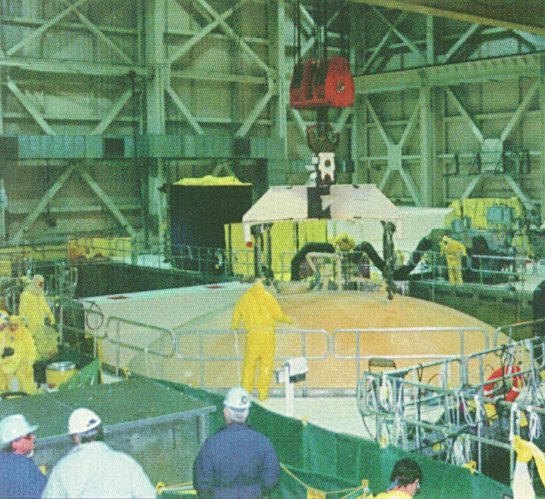
You can't compare #3 with #4 because #4 was shut down for refueling. During refueling, the containment cap is lifted off and laid down off to the side, probably in the corner. For example (this is not the same facitlity), here's a pic of the containment head being lifted off http://www.nucleartourist.com/images/headlift.jpg
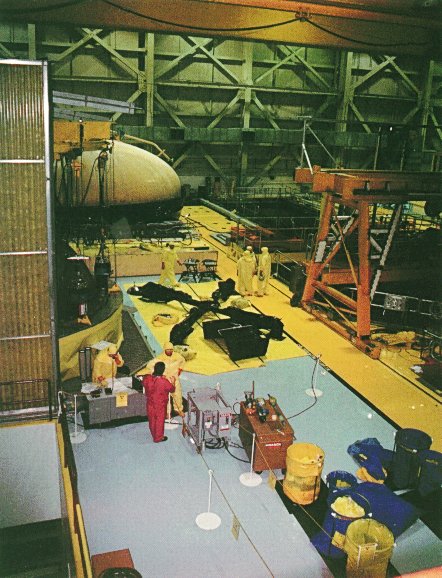
And here's another pic that shows refueling underway. http://www.nucleartourist.com/images/rflg-fl2.jpg
Notice the dome sitting on the floor in the back, out of the way. That is probably analogous to what the pictures of Fukushima Daiichi #4 building are showing. You can't assume the containment head position would be the same in the other reactor buildings. -
Re:Incompetence
You can't compare #3 with #4 because #4 was shut down for refueling. During refueling, the containment cap is lifted off and laid down off to the side, probably in the corner. For example (this is not the same facitlity), here's a pic of the containment head being lifted off http://www.nucleartourist.com/images/headlift.jpg
And here's another pic that shows refueling underway. http://www.nucleartourist.com/images/rflg-fl2.jpg
Notice the dome sitting on the floor in the back, out of the way. That is probably analogous to what the pictures of Fukushima Daiichi #4 building are showing. You can't assume the containment head position would be the same in the other reactor buildings. -
Cost per MW?
So what's the cost per Mw-hr?
How does it compare against Nuclear's $30 per Mw-hr?
http://www.nucleartourist.com/basics/costs.htm -
Re:This kind of upsets meSorry, I know you believe what you just wrote, but I
Looking at the issue of generating power, there are several choices available, and coal is one of those, but so also is nuclear, wind and solar. They're more expensive, and any tiny amount more expensive than oil means they wont be used right now, but they're not *massively* more expensive, its not like ten times or even a hundred times, it's like, well here is one view of coal vs nuclear which evalutes it as 30 dollars per megawatt hour instead of 29.1
Next, you discussed distribution of power, specifically I felt you feel that using coal to generate power means that it's no longer possible to power machinery on farms, or to power transport.
Even today, we have electric powered:
It seems reasonable to suppose that if we wished to, we could make electrically powered farm machinery too. Sure, there may be issues, like disposing of old batteries, but they are not I feel insurmountable issues, and I feel they are not issues that will push our civilisation back to the dawn of the 1900s are you are proposing...
-
power sources
In no small part because a Coal fired plant can spew a tremendous amount of general gunk into the air for "free" if they paid the "true cost" of the pollution they generate, perhaps the equation would be different?
I agree, and that's without including the subsidies coal gets. However in a market where businesses have to carry their own weight and don't pass external costs to others geothermal, solar, wind and other power sources would be more competitive. According to this, "Cost Comparison for Nuclear vs. Coal", nuclear compares favorably with coal. The $/Mw-hr cost for coal is 29.1 vs nuclear's 30.0. But as Benjamin Sovacool says they are both Faustian bargains. He says "By far the cheapest, cleanest, and quickest strategy to meet America's growing demand for electricity is energy efficiency and demand-side management."
It's even more fuzzy... But my point remains..
As does my point, nuclear power is expensive and more isn't needed.
Falcon
-
Re:Nuclear power is green power
It escapes into the environment all the time.
Sure, but compare the number of people impacted by every civilian radiation accident, and the fact that nuclear power plants produce less than 1% of what's released by a coal power plant.
I'd say it's you that's failing to understand this. At current usage rates we have about 40 years worth. We can get more, a lot more, but only at dramatically increased prices. Nuclear power is already too expensive, driving up fuel costs will make it worse.
They say the same thing about oil, and yet reserves keep turning up. And as far as being "too expensive", they're so low right now that people aren't even considering opening new mines, let alone doing surveys for them. The price is so low that the market is in danger of driving producers of it out of business! The fuel cost of a nuclear reactor is less than half of the cost of coal by weight alone. The main reason nuclear power is more expensive than coal is regulatory and decommissioning costs -- not a fault of the technology but the political environment.
The rise in price over the last couple of years has already resulted in plants being scaled back and expansion plans ending all over the place.
False. There's a price slump in the market right now.
I'm sure the Ukrainians would dispute that "fact".
They tend to dispute a lot of things. That doesn't make them right.
I'm a supporter of nuclear power, in general. You're whitewashing of its very real problems, and your willingness to demonize and simply write off its opponents, does nothing for your argument. "hysterical opponents"? Really now.
You're quite right -- they're not hysterical opponents, they're uneducated as you've just proven.
-
Re:Just Takes One
1. If a Primary coolant pipe leaked it would be contained because it is would be in the containment building that is one of the reasons you have them.
2Whoosh..
Even bringing up the Titanic is yet another simple minded attempt to bring fear into this.
What did it have anything to do with anything. It was silly.
But if you want to work with it I will your bringing up that Chernobyl when talking about a modern western light water reactor is kind of like someone bringing up that Titanic as a reason for not going on a modern cruise ship!
"Lets go on a cruise."
"No it is too dangerous remember that Titanic."
"But this ship will have enough lifeboats unlike the Titanic."
"No remember the Titanic it could still sink too fast to get in the life boats!"
"But it has Radar and GPS and satellite communications so it can avoid storm, reefs, and even icebergs!"
"But it could run into one that is totally under water!"
"But we are going on a Caribbean Cruise! There are no icebergs!"
"Just because nobody has ever seen one doesn't mean that they are not there"!
Bringing up Chernobyl or the Titanic when talking about a modern western reactor is NOTHING BUT A FEAR TACTIC.
The both have the same validity to the subject. Nothing at all.Okay want some sources that disagree with yours
http://www.world-nuclear.org/info/inf02.html
http://www.nucleartourist.com/basics/costs.htm
http://www.nei.org/keyissues/
Of these are pro nuclear sites but before you dismiss them just realise this. If there where studies of nuclear power that positive results wouldn't pro-nuclear sites post them?
Also wouldn't anti-nuclear sites dismiss them?Plus you know that France gets the majority of their power from nuclear, Japan gets a lot of from Nuclear, and China is planning on building more reactors "made by GE no less". I find it hard to believe that those nations are being "taken in" and building plants that are no economic to build and run.
And your source isn't a journal of technology, physics, engineering, or economics!
It is a journal of sociology which can include some economics but would probably lack the technical expertise in the subject of Nuclear Engineering or even power generation.
I have seen similar studies. They all use older US plants as the source of their cost data. That is going to give you skewed data because those plants are all over 30 years old in design and each of them was a custom design. The had huge cost over runs because of that. Add in the problems with regulators after TMI and the costs are terrible. If you use modern standardized reactor designs like those used in France and China the costs totally differentOh and here is one final article but not a study.
It is from one of the founders of Greenpeace about why he was wrong about Nuclear and now supports it along with the reasons.
http://www.newsweek.com/id/131753?GT1=43002Simple fact seems that you fear nuclear power. No study or history of safe plant operation in the West will convince you because you have made up your mind. Anything that confirms your fear you will embrace and that which contradicts you will reject.
The West had decades of experience running nuclear power plants with France getting something like 80 of it's power from nuclear and Sweden getting around 50% all with reasonable costs and very good safety. The US also has a very good safety record even with TMI. -
Re:Seriously, WTF?
In general, yes: Spending money to get energy from inefficient sources only makes mankind poorer. But you are not considering the effects of technology and research.
Capitalists ARE attempting to harness all those sources. The Economist had an article on marine energy in April 2007 I believe and again just in the last couple of months.
And I think you are underestimating the power of the entrenched power companies (including oil, gas, and nuclear). They can dictate political policies that prevent other alternatives from being explored until such time that the alternatives are inevitable. The article in the Economist mentioned how nuclear companies pressured the government in the UK to stop funding efforts to exploit marine energy.
I'm sure you don't think that nuclear reactors just sprang into existence. It took time and money to make nuclear energy a reasonable alternative to coal. Here's a link that compares the cost of nuclear and coal: http://www.nucleartourist.com/basics/costs.htm Now, I don't have facts on this, but I'm guessing that nuclear used to cost much more, just because it was a new technology, the efficiency wasn't as good, etc. -
Re:That's some expensive electricity!
"How many year (nee: decades) will it take to pay one of those off?"
Typical supercritical cycle gasified coal plants average around 625MW output. Here's a typical example:
http://www.usatoday.com/money/industries/energy/environment/2007-12-26-coal-main_N.htm
I'll take a wild stab and guess they'll average 400MW output (the wind farm in the article is expected to average about 2MW output). That equates to 3,500 GWh per year, or about 200 times as much as the wind farm.
"As for maintainence costs; how much does it cost to maintain a coal fired plant? How much does it cost to maintain a nuclear plant? How much does it cost to handle the waste product from same? How much ongoing environmental impact is there?"
This was easy to find:
http://www.nucleartourist.com/basics/costs.htm
$30 per MWh, or $0.03 per KWh.
Over 10 years that 2 billion amounts to 5.7 cents per KWh, plus 3 cents operating cost, yielding 9 cents per kilowatt hour for a payoff time of 10 years. Or less.
"I'm no tree hugger by any stretch, but the fact that a town was able to generate an annual surplus of natural energy with no environmental by-products is a pretty decent little achievement."
Agreed, but NOT AT THOSE PRICES!
FYI, a little research yesterday indicated John Deere is using Suzlon 1.25 MW S64 wind turbines. Other projects seem to average 2 million per turbine plus tower construction costs and transport. So I'm guessing that someone slipped a decimal point somewhere and the cost is 9 million, not 90 million.
And at 90 million, over 10 years, that's 7 cents per KWh plus maintenance and interest, which sounds a LOT better to me. Meaning we'll probably see more of them. -
Re:Nothing Remarkable?
Oh, having generation capacity offline is remarkable from a financial aspect (and the associated problems with buying power generated from some other source), but this is spun as being related to some nuclear plant problem, not a river volume/river temperature problem. Previously discharge permits for higher river temperatures were granted by state (other?) governments as the threat to human health from lack of electricity for air conditioning/fans was deemed too urgent. Now granting those permits is less likely than in previous years, though I am unaware as to the reason for the change.
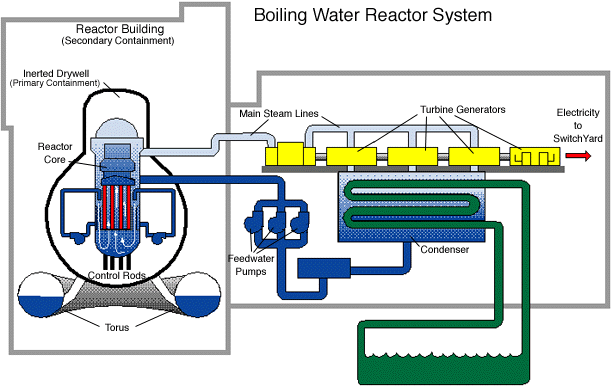
Of note, all reactors at Browns Ferry are BWR (boiling water reactors). BWRs have the advantage of NOT being Xenon-precluded because the Void coefficient of reactivity is non-existent. Thus, startup won't be delayed due to waiting for Xenon to decay.
A useful site on nuclear power in general: http://www.nucleartourist.com/ -
Shippingport
Westingthouse built the reactor for the successful Shippingport (Pittsburgh) demonstration project in the mid-fifties. Pressurized Water Reactor (PWR)
-
Re:Thank you, Greenpeace
[QUOTE]If not for the hysterical campaigns against nuclear energy, we would not be having this awful dependency on oil and other grossly unhealthy fossil fuels...[/QUOTE]
Nuclear is currently used primarily for non transport energy so would have near zero impact on our oil dependency unless and until we switch to hyrogen for transport and use nuclear energy as the source to generate the hydrogen. Non transport energy sector is dominated by coal for electricty and natural gas.
The cost per kWh for nuclear is more expensive than coal for total costs. You need to include all costs for an accurate comparision, this site includes all costs (some are pretty far off - ie capital costs for coal are substantially cheaper than a nuclear) your typical pro nuclear site excludes many of the larger costs such as the cost of capital, and usually just include fuel + operation and maintenance costs.
http://www.nucleartourist.com/basics/costs.htm
[QUOTE]It seriously set the nuclear power industry back, which is a shame. Old plants continue to operate, but new ones are very slow to appear. Safe and non-polluting technologies were available for decades and we are wising up to using them only now.[/QUOTE]
Capital costs are the major setback for nuclear, new designs have lowered the capital costs, that is the real reason for nuclears return to being considered. It has historically had a huge up front cost which has been heavily subsidized by most countries.
LetterRip -
Re:Nuclear is Expensive
I'd put a nuclear power plant in my backyard if 1) I got the profits for the electricity and 2) I was the regulator (or the NRC...they know a thing or two).
As for expensive, well, not really. The prices are largely comparable to other energy sources and could be cheaper if the regulatory environment were relaxed comparable to the advances in technology. -
mostly FUD here, move along...
Most of the downsides of Hybrids can also be applied to the downsides of any electric vehicle. The envo-friendly people dont understand that when you push for electric vehicles you are only "moving" the pollution from one source to the other.
large powerplants are significantly more efficient than small gasoline engines. See this
Never mind the fact that it's significantly easier to clean up 1 powerplant than 100,000 tailpipes...
But, they dont care, as long as the pollution isnt around "them"... which creates the need for more electric plants, but they dont have any place to put the electric plants since no one wants a nuclear facility in their backyard... or coal burning, or, etc, etc.
There's plenty of spare capacity at night. My Aunt in Phoenix already has a nuclear facility in her backyard (Palo Verde). She's got a dual rate plan, and pays $.04/KWh after 9pm. If I had an electric vehicle that was relatively inefficient, and used 500Wh/mile (charging inefficiencies included), it'd still only cost me $.02 to go 1 mile, as long as I charge up at night.
As you can see, everyone wants all the benefits, but none of the downsides. What are we going to do with these millions of batteries when they need to be disposed?
Lead-Acid batteries are relatively easy to recycle. Do some research, and you'll find that the benefits of electric vehicles far outway the downsides.
AC Propulsion's website has some good articles on the superiority of electric vehicles... -
Re:Solar?Well I would rather have Yucca filled up than have all that waste in nuclear power plants around the country. They make easy marks for terrorism.
Up to 5 years ago you could sneak into Palo Verde pretty easily, my friend has a dozen acres near there and showed me. They fixed the ability only a year before 9/11.
-
Re:That's a little... extreme
Subs generally utilize light water reactors instead of the more difficult to maintain liquid metal reactors.. Here is a page that gives a quick description of early Liquid Cooled reactors.
More links:
http://www.nuc.berkeley.edu/~gav/almr/01.intro.htm l
http://www.nuc.berkeley.edu/thyd/ne161/shir/projec t5.html
http://www.nucleartourist.com/type/metal.htm -
London? vs Sellafield or is that Windscale.
1. Sellafield is nowhere near London.
Sellafield is well known for mistakes, so well known in fact that it changed it's name to Sellafield, it's old name was Windscale.
Nothing new here, please move along.
http://www.nucleartourist.com/events/windscal.htm -
Re:Other green energy sources
I call bullshit on this - otherwise you would never have been clueless enough to made the concrete and steel comment. Exotic, expensive, and very interesting materials are used in areas exposed to radiation. Please ask your science teacher to post here, they may say something useful.
Believe me, or don't... it doesn't matter. However, you may be interested in the following web pages, which will tell you a little bit more about the materials used in nuclear reactors. By and large, fairly common steels and concretes are used. The "exotic" materials are generally found in fuel (uranium, gadolinium, erbium), control rods (boron carbide, silver, indium, cadmium, hafnium), and detectors (too many to list here).
- http://www.world-nuclear.org/info/inf32.htm
- http://www.nucleartourist.com/areas/cntm-ovu.htm
- http://www.azom.com/details.asp?ArticleID=2139#_M
a terials_For_Light
Anything else?
-
One step further.
Everyone is going further and further up the chain in terms of the effect on the environment or health etc of Nuclear, Wind, Solar etc etc. So I thought I would throw in another missing number from the number of deaths in the industry dept.
Three points I would like to make (keeping in mind that I am generally pro nuclear over coal):
How many people are aware of the number of deaths each year just in Coal Mines alone.
Quoted from China D-News:
"The figure for China is around 7,000 (Official figures indicate more than 7,000 workers die each year in China's coal mines, mainly from poor control of gas density, flooding and lack of safety awareness. However, Hong Kong-based human rights group China Labor Bulletin puts the number of industry deaths at around 20,000."
Secondly, I suspect that a lot of the hysteria and paranoia around nuclear fired power stations is because people relate fission power stations with Nuclear weapons. How many average Joes could tell you the difference between the two? I was shocked recently when I asked quite a few family and friends as to what sort of explosion occured in Chernobyl. Almost without exception they all replied matter-of-factly that it was a nuclear explosion (not hydrogen). Mind you who cares how the rasdioactive material ends up in the atmosphere, its the fact that its there that counts. However there is no blinding flash of radiation, or nuclear winds...etc etc that people associate with Nuclear weapons.
Thirdly, there seems to be a bit of a misconception that Nuclear is both cheaper and cleaner. I wont weigh into the cleaner debate, I have already chosen my horse on that one, but as for cheaper... I live in Australia which has some of the worlds largest uranium deposits however Coal is still a (shit load) cheaper than uranium here. Add that to the comparison between plant build costs and dont expect nuclear to give you a power bill reduction any time soon. - The Nuclear Tourist lists the costs as slightly dearer for Nuclear than coal fired, however this would differ from country to country.
I know I only said three points...but some final things for consideration. In my mind (and I will state here once again that I am generally pro-nuclear) the real safet issues around Nuclear generation are those of politics not engineering or technology (those have for the most part been solved already). The real issue comes about when once responsible governments are replaced by irresponsible governments or economics change etc etc. Suddnely you have the issues of
reduced capital expenditure on equipment leading to aged plants
reduced focus on safety and controls as costs are cut
the possibility of enriched uranium being sold on black markets to help fund poorly managed economies
the possibility of uranium reactors and their resultant technology being used to research enrichment and possible weapons grade material
inability or unwillingess to deal with waste due to political or financial factors.
Like most things the biggest problem with technology is the people who use or abuse it.
I think there is far too much extremism in this debate (always has been). Until you can define problems both on your side of the fence and your enemies, you will never be able to actually work towards trying to solve them.
-
I trust that 200,000-year figure...
...about as much as I trust the statements that CD-R's will last for a century.
After all, it's such a confident, unqualified statement. The process, they say, "will enable nuclear waste to be stored safely for 200,000 years." Now, me, I'm no expert and I'm constantly getting taken by surprise by little adjustments in our understanding of the physical universe... you know, like plate tectonics and black holes and asteroid collisions causing the extinction of the dinosaurs.
So, I'm really glad there are people that know what will happen over the next 200,000 years. People who can also assure me "We know that nuclear plants work and are safe." I'd been getting a little nervous after things like Browns Ferry and EBR-1 and Detroit Fermi and Three Mile Island and Chernobyl.
But those Brits are real experts. After all, they've hardly had any nuclear accidents except Windscale. -
Russian R.B.M.K reactors were badly designed ...
the sad part is, some of them are still running
The following is the Paper everyone will link to. And the following provides some nice diagrams to look at
And just for kicks: Some really freaky pictures. (The second one really gets to people, he is working IN the bloody thing!!)
Sunny Dubey -
Re:It's a lessonYou sound as if you are thinking that any radiation is bad or that radiation itself is bad.
It is. That is exactly what I am saying. In another example of me knowing more about this than you, there is NO safe level of exposure to ionizing radiation, natural or not. It isn't like a chemical or biological exposures where there are minimum affective doses. ANY radiation passing through your body has the potential to mutate that one single unlucky cell into a cancer cell.
Slow down there cowboy. Your cells have mechanisms in place to repair DNA. In fact, every second of every day your cells are getting some small amount of DNA damage from chemical byproducts of your metabolism (free radicals), UV radiation, and natural background radiation. There is some probability that a strand break can occur and not be repaired, and that can sometime lead to cancer. But the fact is that you can get cancer just from living and breathing (ie. your metabolism). It's not at all clear that any additional dose of radiation is necessarily dangerous. In fact, there is some evidence that radiation exposure activates protective mechanisms in cells to improve DNA repair - look up "radiation hormeisis". Your statement about no minimum damage threshold is not on a very firm scientific basis; it is an assumption made by regulatory agencies who are trying to be conservative, not a scientific fact.
Dose/mortality rates used in setting health standards are based on extrapolation from survivors of Horoshima and Nagasaki. You have to understand that the doses and dose rates they received are 5-10 orders of magnitude greater than the rates you are likely to encounter walking around Chernobyl today. As any decent scientist will tell you, when you extrapolate a linear trend across that many orders of magnitude, you are basically just making shit up.
Since there are trillions of neutrons per m3 in Chernobyl
I call bullshit. That statement tells me that you are talking out your ass. There are NO neutrons anywhere except deep in the remainder of the core itself, where you still have fissile material. What you have in the surrounding area is alpha, beta and gamma radiation. Neutrons are produced by fission, and you don't have a trillion fissions/sec/m3 in the area. That would be producing something like 30 Watts per cubic meter; the place would be HOT, thermally. It isn't, so I doubt your number pretty strongly.
According to her maps the dose rates were something like 80 micro-roentgen/hr. That's about 700 millirem/year. Natural background radiation levels are typically 300 milliorem/yr, but can be up to 15,000 millirem/year.
there are different types of radiation and the type of radiation at Chernobyl is the really, really bad kind.
How so? Becuase it is Communist? I THINK you mean that there is a lot of alpha-emitting dust around, which is indeed not good to breathe. But I think she pointed out that unless you went indoors, there wasn't actually much dust. That was 18 years ago - a lot of the material gets buried in that time, because it's not particularly biologically active (i.e. doesn't get incorporated into plants - there aren't many proteins with americium in the active sites). The stuff that does get incorporated, such as strontium (which displaces calcium), is not an alpha emitter. All this being said, I don't think you should be farming in the dead zone. But a few trips through on a motorbike is really no big deal.
-
Re:Only damage to the Dollar
-
Re:Nuclear Power is the futureFurthermore I'd hesitate to call nuclear energy 'clean'. It maybe so at the actual power station site, but the production of the fuel rods (digging up and enriching uranium) and the actual power station both require a lot of clean-up.
I would respectfully argue that digging up uranium is no dirtier than any other mining operation--and due to the very high energy density of the fuel, its mining may result in less overall environmental damage than other fuels (coal, I'm looking at you.) Granted, solar and wind power are quite clean in terms of gathering their fuel, but actually building the power plants requires significant resources. Steel and aluminum require mining; the preparation of silicon or gallium arsenide for solar cells isn't exactly pristine.
Enriched uranium is not necessarily required for civilian nuclear reactors. Canada's CANDU reactors use a more efficient deuterated water moderator that permits the use of unenriched uranium oxide fuel.
For what it's worth, I'm quite fond of both solar and wind power (my family cottage is off the grid and uses solar for a large portion of its energy), but neither technology should be considered a panacea.
-
Re:Dead End
I would love it if we could get back on the nuclear energy bandwagon. If stored properly we could elimanate almost all pollution related to the production of energy. And if we can stop bickering over where to store the material we could start moving forward. Please see the following link for more reasons:
www.nucleartourist.com
In the future if we can build a space elevator, we can even take nuclear waste into high orbit and then launch it out into the sun.
later,
Epicstruggle -
Re:Yet you feel free to use electricity
"Also, you say 'right now' in your post - it's right now and looking like forever. There haven't been any new nuke plants commissioned since 1979. All orders after 1973 have been cancelled. Nuclear power is on its way out as a consumer power supply."
Wrong wrong wrong! No new nuclear plants have been ordered since 1979. There were several plants that completed construction and low power testing and received full power licenses all through the 1980's and even the first part of the 1990's! Look up the Seabrook Station (1990) in NH and check out it's entering commercial service date. Also ANO2 (1980), San Onofre (1984), Diablo Canyon (1985), Commanche Peak (1993), Watts Bar (1996). I could go on and on. But facts aren't going to dissuade you obviously, never mind. -
Re:Dang
Oh dear, you must be an American. Try looking at http://www.polity.org.za/ which has information about SA, and links to most of the government web sites. We don't exactly need free hosting on Geocities; in fact we have already hosted an online debate on electronic commerce regulations (which is far more forward-looking than most developed nations).
Oh, by the by: [nucleartourist.com] (South Africa) ESKOM is the 5th largest utility in the world. They operate the 2 Koeburg reactors, each with a capacity of ~900 MWe. They do have a page listing their generating facilities with capacity.
ESKOM also developed and are prototyping pebble-based molecular reactors, which Germany and France gave up (citing as impractical) nearly two decades ago. These promise to provide cheap, clean and safe energy to anything up to a small city, and can be located where needed. They promise to be a solution to the energy problem in the third world.