Slashdot Mirror
Domain: nuclearweaponarchive.org
Stories and comments across the archive that link to nuclearweaponarchive.org.
Comments · 166
-
Re:Perhaps I'm just not clever enough....Yeah, and you'd think a country like Iran would have other ways to get this kind of information. Like, I dunno, stealing it from Pakistan. Yes, most of the information is public domain at this point. Although, I've never seen a sketch with specific weights in the wild before. Those you would need to "steal" from Dr. Khan.
-
Re:This is an opportunity
All isotopes of plutonium are fissile, it's just that some of them are such strong neutron emitters that it's hard to make much of a bomb from them without predetonation sapping the yield, unless you've got a really good fusion boosted design. Some isotopes also give out a huge amount of heat due to spontaneous fission, making them unsuitable for bomb designs but great for RTGs, which is the real reason why NASA uses it: According to the Nuclear Weapons FAQ (http://nuclearweaponarchive.org/Nwfaq/Nfaq6.html#nfaq6.2), Pu-238 generates 567 W/kg due to radioactive heating. The NWFAQ mentions that for RTG purposes Pu-238 is normally generated by neutron bombardment of Neptunium-237, not by buying it from the Russians. Weapons-grade plutonium has only a miniscule amount of the stuff, and even reactor-grade isn't very rich in it. It's also hard to separate out since the mass difference compared to Pu-239, which is the main isotope, is so small.
-
Re:Time for Space tankers to start taking flight
I can suggest at least one use for Helium-3. Just ask out friends over in South Carolina. From what I hear, they play with it all the time.
-
Re:Well...
There is this thing called COMPELLING GOVERNMENT INTEREST that seems to be ignored in this age of civil rights and political correctness. In the interests of national security there ought to be departments that should look like Hart-Celler never became law. Persons with sufficient pedigree to allow a runback to their ancestral lands should not be seen in such departments. Praat jy Amerikaans?
-
Re:quite possibly the cruelest weapon made
Which, to be fair, is basically what any high-explosive bomb does. With regards to the first one, if you're trapped in the actual fuel-air mixture, you're also going to be right at the center of the explosive shock, so I'm not sure that suffocation is likely to be an issue. The second and third are basically what happens whenever you're close to a large explosion: either you're close enough that the pressure wave kills you directly, or you're close enough that the pressure wave throws you into buildings and/or collapses them on top of you, or you're far enough away that you get "only" blown eardrums, shrapnel injuries, burns, and the like.
(Nuclear explosions have a few other nasty ways to kill you, because they actually have regions where the temperature shock wave is strong enough to hurt you even when the pressure shock wave isn't; these bombs don't come anywhere close to that level of power. This sort of thing is discussed extensively in the nuclear weapons FAQ for those who are interested.) -
Re:Farthest Man Made Object? I duno....Two actually... this one has more confirmation that it actually was launched, and had a better chance of escaping earth.
tm
-
Farthest Man Made Object? I duno....Voyager 1 currently is the farthest human-made object at a distance from the sun of about 9.7 billion miles (15.6 billion kilometers). Voyager 2 is about 7.8 billion miles (12.6 billion kilometers).
I think theres Another contender for that title...
Tm
-
Re:Think the other way
(It's also the same thing that creates the first flaming fireball in the nuke. The shockwave compresses the air so hard, it becomes glowing plasma.)
I think you have it somewhat backwards. The fireball is created by the air around the exploding weapon absorbing the high energy thermal radiation emitted by the weapon itself. The shockwave compression happens after hydrodynamic separation, and in fact, the opacity of the incandescent gas causes the fireball to appear dimmer. See this bit for details.
-
Re:Breeder reactors
The US *is* getting rid of nuclear weapons. By the Treaty on Strategic Offensive Reductions, the US is scheduled to reduce that 5021 to 2200 by year 2012 The W62 retirement started in October 2006, W87's taken from decommisioned MX missiles will replace the older W62's so those Minuteman IIIs will have those warheads. No new nuclear warheads have been built in the US since *1989* Even the "designing new nuclear weapons" comment you make needs a addendum, I'm guessing you mean the bunker buster B61 Mod 11. If this was even done, this is not a building of a new warhead but just reusing an already existing B61 warheads modified to tolerate the impact of ground penetration. There is also a life extension program, this is needed because as you reduce your total stockpile, due to warhead aging you have to rebuild some of those to keep the reduced stockpile effective. Arsenals aren't every good for deterrent if the enemy doesn't think you maintain them thus causing a 90% failure rate. Also, if you don't rebuild warheads, the engineers eventually go off and find other jobs, warhead construction/rebuilding is nearly an art. You don't just go get anybody to do this. The submarine industry has the same problem, if the pentagon completely quits making subs because the cold war is over, the engineering base will dry up. Eventually we'll need to replace a submarine or two and will find no industrial base there to do it. REF: http://nuclearweaponarchive.org/Usa/Weapons/Wpnga
l l.html -
Re:no surprise hereWhy do you think the French built the "force de frappe"?
French pride and the loss of her colonies as a result of defeat in Viet Nam were the most immediate reasons. The French started nuclear programs right after WW2, and they wanted to nuke the Viet Minh guerillas that surrounded, and ultimately defeated, their troops at Dien Bien Phu in 1954. Lacking nukes of their own at the time, the French almost convinced the US to do it for them, but not quite. In the 1956 Suez Crisis, the Soviet Union threatened to intervene on behalf of Egypt, and attack Paris and London with rockets. Just think of it, if the French had nuclear weapons of their own in 1954, they would have nuked the Viet Minh, kept their overseas empire, and gone into Suez with nukes, either allowing them to take what they wanted in Africa, or perhaps to have engaged in nuclear warfare in Western Europe. But, as usual, the US is the bad guy.
Charles De Gaulle and the Force de FrappeOne of the predominate motivations for French policy toward nuclear weapons and French international policy in general stems from Charles de Gaulle and his idea of an independent nuclear striking force or force de frappe. Initially, it was de Gaulle's Provisional Government that laid the grounds for development of nuclear weapons with the creation of the Commissariat a l'Energie Atomique (Atmoic Energy Commission) in late 1945. This set the stage for later decisions by de Gaulle about France and her defense strategy.
Charles de Gaulle firmly believed that France needed to remain politically independent from all other countries. He also believed that in order for a country to truly remain independent it needed a strong defense force. More importantly, the defense force must also be independent. To support this claim, Gough has quoted de Gaulle as saying, "The defense of France must be French." It was this type of reasoning that led de Gaulle to be a driving force for the independent development of nuclear weapons, even when he was not in office, in order to have an independent nuclear force.
Origin of the Force de FrappeOfficial approval for developing nuclear weapons was not authorized until late 1954, even though by then the necessary plutonium production program was well advanced. Following the route of French forces at Dien Bien Phu, and the loss of then French Indochina, France's interest in nuclear weapons to bolster its national prestige took a sharp upswing. On 26 December 1954, Prime Minister Pierre Mendes-France met with his cabinet and authorized a program to develop an atomic bomb. On 28 December a new Bureau of General Studies (Bureau d'Etudes Generales) was created with General Albert Buchalet as head to pursue this option. In 1955 the Armed Forces Ministry (Ministre des Armees) began transferring funds in large amounts to this program.
-
Re:antistatic brushes
I've seen reliable calculations (I.E. from actual nuclear experts), that it would take 200 antistatic brushes to provide the amount of polonium that Litvenko likely ingested. That of course assumes 100% extraction (the Polonium in antistatic brushes is alloyed and plated onto foil), and that an insignificant quantity of the Polonium has decayed (since it has a fairly short half-life).
-
Re:Wow...
According to here: http://en.wikipedia.org/wiki/Polonium
"The maximum allowable body burden for ingested polonium is only 1,100 becquerels (0.03 microcurie), which is equivalent to a particle weighing only 6.8 × 10⁻¹² gram. Weight for weight, polonium is approximately 2.5 × 10¹¹ (250 billion) times as toxic as hydrogen cyanide. The maximum permissible concentration for airborne soluble polonium compounds is about 7,500 Bq/m3 (2 × 10-11 Ci/cm3). The biological halflife of polonium in humans is 30 to 50 days.[18]"
The toxic dose is 0.03 micro-curies
According to Carey Sublette the Wikipedia is wrong. -
Re:It doesn't matterWith all the information that is public, it *is* trivial to create a bomb.
This is gross abuse of the word "trivial".
Not all that gross. Not if you have access to engineering resources on the level of a nation. The physical principles of a nuclear bomb are very simple, and the basic mechanical operation is widely known and public. The main obstacle to building a working bomb is getting hold of the fissile material. Given that, it is indeed easy to build a bomb. Perhaps not an efficient bomb, perhaps not a powerful bomb, but a bomb nonetheless. Most of the secrets so highly prized by the great powers are on engineering tricks to make bombs smaller and lighter and use less plutonium.
That said, my bet on this issue is that North Korea messed up the engineering of an implosion bomb, which then fizzled. It exploded, but with nowhere near the designed force. It was a nuclear detonation... but not a very good one. So I wouldn't say it's trivial to do, but it's hardly a gross abuse of the word.
-
Re:It doesn't matterWith all the information that is public, it *is* trivial to create a bomb.
This is gross abuse of the word "trivial".
Not all that gross. Not if you have access to engineering resources on the level of a nation. The physical principles of a nuclear bomb are very simple, and the basic mechanical operation is widely known and public. The main obstacle to building a working bomb is getting hold of the fissile material. Given that, it is indeed easy to build a bomb. Perhaps not an efficient bomb, perhaps not a powerful bomb, but a bomb nonetheless. Most of the secrets so highly prized by the great powers are on engineering tricks to make bombs smaller and lighter and use less plutonium.
That said, my bet on this issue is that North Korea messed up the engineering of an implosion bomb, which then fizzled. It exploded, but with nowhere near the designed force. It was a nuclear detonation... but not a very good one. So I wouldn't say it's trivial to do, but it's hardly a gross abuse of the word.
-
Re:So what's the yeild amount?
However, any fissile material of high enough enrichment can be made into the simple shotgun type bomb of the design of the bomb dropped on Hiroshima (although that one used uranium as fuel).
No. Gun assembly is not viable for a plutonium weapon, as it does not achieve sufficient assembly velocity to overcome the problem of predetonation.
http://nuclearweaponarchive.org/Nwfaq/Nfaq4-1.html #Nfaq4.1.5.3Simple designs which may use plutonium as fissile material, such as the flying plate design, are technically much simpler than spherical implosion designs (and even resemble gun assembly, superficially), but they are much more sophisticated than naive gun assembly.
-
Re:So what's the yeild amount?
that would be about 10 times the size of the 100 ton test. I'm not sure how that was set off, but I doubt it can be any harder than the precise coordination needed for an implosion bomb.
-
Your numbers don't seem quite right.
If the North Koreans detonated a 10-30 kiloton device, several times 1013 neutrinos from it should have passed through Kamiokande.
Assuming it was a nuke, the chemical explosive component should be neglectable. According to Wikipedia, 1 kiloton-TNT is 4.184 TJ. According to a quick search (matching what I recall from NE301 a decade back), average fission energy yield is around 200 MeV per. This gives about 4E24 fissions. Assuming you get on the order of 1 antineutrino per, at a radius of 1000 km and assuming even sterradial distribution, gives on the order of 300 billion antineutrinos per fission.
Anyone who wants to find the detector capture efficiency and make a guess at its cross-sectional area is welcome to refine the numbers further. I have some sleep to not-get.
-
Re:Why Only U.S. & Russia?
1. Which really has nothing to do with Pakistan and India.
2. Larger than the Tsar Bomb? I think not! (*poof* again) -
Re:Probably only works once
Israel is pretty much known to have nukes, see http://www.nuclearweaponarchive.org/ , but they developed them apparently with the help of South Africa. The US wouldn't give them weapons; it would be a political nightmare if used. Ditto for technology to build a US-style bomb. With South African uranium, it's not as if Israel lacks the tech and science base to figure out what high school kids these days can figure out and build workable bombs.
-
Fission Bombs Simple; Fusion is Complex
You're wrong about the designs. Any fissionable material can be used in the "gun" type of fission bomb, wherein two or more pieces of fissionable material are pushed together by an explosion. Hell, you can even do it by hand, as proven in some of the early accidents with nuclear materials. So fission bombs can be dirt simple. Fusion bombs OTOH are complex. See the Nuclear Weapon Archive for details (but remember: "Don't believe everything you read!").
-
Re:Dangerous but not deadly
Correction: You can make an implosion weapon with uranium too. But you cant make one with plutonium. (the high number of neutrons emmited by it would make it detonate early, generating a fizzle). And while a gun-device is larger than an implosion device, it doesnt need to be as large as fat man. Remember: 1945 tecnology, in the middle of a war.
Besides this, i think they should get their nuclear weapon. At least the USA wont get so easy their natural resources (see: Iraq x North Korea). And they wont use it because that would put them in a nuclear winter.
The truly big problem is freaks (of any type: be it muslims, white-power, etc) with nuclear weapons. At this moment, the entire world is at gun point because of the christian-supremacist freaks with nuclear weapons (Bush government).
Sources: http://nuclearweaponarchive.org/
http://en.wikipedia.org/wiki/Nuclear_weapon -
Re:Missing the point.
Fission? Not enough uranium, unless you want to spread nuclear weapons technology around the world via fast breeder reactors.
Just to nitpick... A crude nuclear weapon is pitifully easy to make if you have the requisite materials (Take one subcritical mass, shoot it at another - Yes, Plutonium would predetonate, but it's still 10K times more powerful than a chemical bomb). Breeder reactors would spread the materials, not the technology.
Fusion? If anyone can ever get it to work, and what about all that dangerous radioactive tritium that's bound to leak out all the time?
Given a choice of nuclear disasters, I'd take the Tritium leak. It's half-life is only 12.4 years, and the radiation it emits is pitiful compared to most (~18Kev beta and no gamma); See Nuclear Weapons FAQ section 6.3.1.2. If it's a gas, let it float away, if it's water don't drink it and you'll be fine.
Is anyone doing any research into quantum energy sources? What about tapping the Higgs field? Could there be a better way to utilize E=MC^2 than just making hot water to power a steam/turbine engine? There's got to be a better way to liberate the energy locked into normal matter. Who's looking into that?
Don't know about tapping quantum energy or vacuum energy other than via the Casimir effect, but ought to be possible to funnel the charged particles from a nuclear reactor down conductive coils, generating power directly by induction. Have miniscule lengths of wire arranged pointing toward the center of the reactor, connected to full-wave bridge rectifiers; As the particle shoot by, they drive a current into the wires that can be tapped. My dumb theory
NASA studied space based solar power in 1976 and again in 1995. They shelved it each time. Why? Why can't we tap the unimaginably huge amount of sun generated energy that's just wafting by between the Earth and the Moon? It's not a question of how- we know several ways how. It's a question of cost and politics. What technologies need to be improved, invented, or abandoned to make it cost competitive with coal? What politics can we get involved in? Are there even better solutions than solar power?
First we need to create rectennas that can work in wavelengths up to blue light. Devices have already been created that work up to 1000nm wavelength; They convert any EM wave longer than that into DC at ~50% efficiency (Optica Rectenna paper Warning 1M pdf). Put a fresnel lens over one of these and let the cheap power roll.
Hope I helped! -
They still are...One could certainly argue today about that difference when compared to things like fuel bombs and daisycutters, but it was etched into our collective minds as different.
Only an insane man would argue that a fuel-air bomb or daisycutter is somehow near equivalent to a nuclear bomb, even one of Hiroshima vintage. To say that about modern day nuclear bombs would be outright false. All one has to do is look at some of the past's above ground bomb tests to know that this is false. Let me present you one:
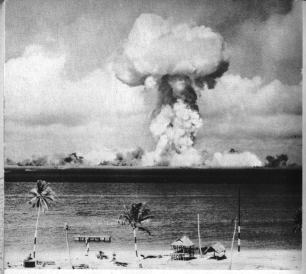
Take a look at the Baker test (1946), which was part of Operation Crossroads. Notice the mushroom cloud of water - from the site:
At its greatest extent, the water column was 2000 feet (600 m) across, with walls 300 feet (100 m) thick, and 6000 feet (2 km) tall, holding a million tons of water.
Now, let's compare this blast to daisycutters and MOABs - please reference these links:
GBU-43/B "Mother Of All Bombs"
MOAB (Massive Ordnance Air Burst)
Now, these sites seem to reference the fact that the destructive area for both of these conventional devices are about "600 yards", or 1800 feet, across. This area is only, at most, the size of just the water column of the Baker test. I can guarantee you that had that test been conducted on a real target, the destructive area (for just blast effects, mind you) would not have been localized just to the column of the mushroom cloud. Please note that the Baker test had only a yield of 23 kilotons. From the Operation Crossroads web page again:
This was only blast effects on the ships, which don't count the radiation aspect. Since MOABs and daisycutters do not have this aspect, I won't post about it here, though it can't really be discounted if you want a comparison of such conventional weapons to nuclear weapons.
Finally, we must also note that the Baker test was only a standard fission bomb test, of relatively low yield (compared to say, the more modern W87 warhead, which has a yield of 300-475 kilotons). One should also note that when a target is selected for these weapons, multiple warheads are targetted for a single target in most cases (since they tend to be larger cities or bases). Even so, a single modern warhead has the equivalent destructive power as 15-20 Baker tests.
How anybody - the media, the layperson, generals, the president - anybody - can equate the two in destructive power, that they can somehow be used (or should be used) interchangibly - is sheer madness. They aren't interchangible, they in no way compare in destructive power, and once you calculate in radiation effects, one can only see that such devices are in fact madness and tributes of hubris to our destructiveness as a species. To claim otherwise is to show a lack of knowledge and humbleness about these devices.
Sometimes I wonder if the test ban treaties over the years have been a wrong thing. By only being able to "test" these devices on computers and such other simulations, we have removed an effective deterrent to the use of these devices. All we have left now are the pictures and movies of past tests. I doubt nothing else could cement the destructive power capabilities in the minds of generals and others, outside of a personally witnessed live test, while at the same sh
-
They still are...One could certainly argue today about that difference when compared to things like fuel bombs and daisycutters, but it was etched into our collective minds as different.
Only an insane man would argue that a fuel-air bomb or daisycutter is somehow near equivalent to a nuclear bomb, even one of Hiroshima vintage. To say that about modern day nuclear bombs would be outright false. All one has to do is look at some of the past's above ground bomb tests to know that this is false. Let me present you one:
Take a look at the Baker test (1946), which was part of Operation Crossroads. Notice the mushroom cloud of water - from the site:
At its greatest extent, the water column was 2000 feet (600 m) across, with walls 300 feet (100 m) thick, and 6000 feet (2 km) tall, holding a million tons of water.
Now, let's compare this blast to daisycutters and MOABs - please reference these links:
GBU-43/B "Mother Of All Bombs"
MOAB (Massive Ordnance Air Burst)
Now, these sites seem to reference the fact that the destructive area for both of these conventional devices are about "600 yards", or 1800 feet, across. This area is only, at most, the size of just the water column of the Baker test. I can guarantee you that had that test been conducted on a real target, the destructive area (for just blast effects, mind you) would not have been localized just to the column of the mushroom cloud. Please note that the Baker test had only a yield of 23 kilotons. From the Operation Crossroads web page again:
This was only blast effects on the ships, which don't count the radiation aspect. Since MOABs and daisycutters do not have this aspect, I won't post about it here, though it can't really be discounted if you want a comparison of such conventional weapons to nuclear weapons.
Finally, we must also note that the Baker test was only a standard fission bomb test, of relatively low yield (compared to say, the more modern W87 warhead, which has a yield of 300-475 kilotons). One should also note that when a target is selected for these weapons, multiple warheads are targetted for a single target in most cases (since they tend to be larger cities or bases). Even so, a single modern warhead has the equivalent destructive power as 15-20 Baker tests.
How anybody - the media, the layperson, generals, the president - anybody - can equate the two in destructive power, that they can somehow be used (or should be used) interchangibly - is sheer madness. They aren't interchangible, they in no way compare in destructive power, and once you calculate in radiation effects, one can only see that such devices are in fact madness and tributes of hubris to our destructiveness as a species. To claim otherwise is to show a lack of knowledge and humbleness about these devices.
Sometimes I wonder if the test ban treaties over the years have been a wrong thing. By only being able to "test" these devices on computers and such other simulations, we have removed an effective deterrent to the use of these devices. All we have left now are the pictures and movies of past tests. I doubt nothing else could cement the destructive power capabilities in the minds of generals and others, outside of a personally witnessed live test, while at the same sh
-
Here is a picture of it during boot up
-
Only *two*
-
Re:Nuclear reactors
There's huge, huge, huge differences between a nuclear power plant and a nuclear weapon. Nuke plants are not and will never be capable of the same level of destructiveness as a bomb. This is not to say that a meltdown doesn't release very crappy pollution, but it's not an explosive on the same level as a designed weapon.
(The specifics of why X != Y far overflows the capacity of the
Probably the absolute worst that could be done with remote software would be a chernobyl-type event. And that assumes the target country's engineers blithly accept any plans given to them without taking a single look at fail-off safety measures (i.e. plant shuts down when critical failures occur rather than heating up further like the soviet design did). More likely you'd have either a minor three-mile-island type thing or a passive shutdown (no lights, but no harmful releases either).
-
Re:OK, so posit a seatainer...
I don't know where you are getting 1 MT from as a likely figure for a modern nuke, but I would encourage you to do a little reading on that.
http://www.nuclearweaponarchive.org/
Pay particular attention to the yield ranges for fission bombs and the size (weight) of a particular bomb for its yield.
I think you will find that, for a nuke developed on a shoestring budget by someone with just enough means and know-how to get a simple "little boy" bomb to work, 30 kt is going to be the upper limit to the practical size. -
Re:Key Application Overlooked
Modern nuclear weapons are around 1 MT, usually a bit less, as that's the optimal size for a weapon you can target accurately. The larger nukes of old were designed to crack silos with a near miss, were extremely expensive for their mission, and were taken out of service long ago. If a terrorist gets a nuclear weapon, it's either going to be a sub-MT military weapon, or a quite a bit smaller "home made" fission only device (modern nukes are pretty sophisticated fusion-pumped-fission devices).
Let's do the math. A 1 MT nuke detonated at optimal blast height will knock down residential structures at a radius of 10 km, more solid buildings at 7 km, and at 5 km knock down reinfored buildings and kill people outright from the blast (and all other effects, such as high doses of radiation, have smaller radii). A surface blast would have a far smaller effect. The only real point of a surface blast is to generate radioactive fallout (an air blast generates surprisingly little, though it would still hinder clean-up and rebuilding).
So yes, in theory, a terrorist with a high-quality military nuke (let's imagine a few were sold out of the old USSR armory, and somehow still worked today (the tritium would have to be replaced, which is quite technical, but lets imagine a scientist came with the bomb)) could sit a couple of kilometers off the coast and destroy some structures along the coast. Good for psycological impact, but not much else, and insanely expensive to carry out. A 50 kt fission bomb, a far more likely scenario for a terrorist, would have less than 40% of the blast radius of the high quality military bomb, and would probably need to be within 1 km to be effective.
A surface blast over *land* is what a terrorist wants, because the radioactive fallout would cause a world of hurt. You'd get very little of that even 1 km off the coast, and even a ship at a dock would produce far less fallout than a bomb 1 km inland. It's *definitely* worth checking for nukes at ports of entry: the threat just goes down very fast as the bomb moves away from land. -
Re:Explosion
What I really noticed about this article was the claim that some TV-companies added an explosion sound to the footage.
On the DVD Trinity and Beyond , one of the special features is raw footage of a nuclear test.
One thing noticable was a delay between the explosion and the sound, which makes sense. Given that the camera is usually a few miles away from ground zero, the sound would take several seconds to reach the microphone (approx. 5 seconds per mile).
Most films (both fiction and documentary) with explosions show the explosion and sound at the same time.
The only movie I can think of that had a sound-delay after an explosion was Red Dawn (the first gas station scene, when the protagonists gathering supplies). And maybe The Beast , which was directed by Kevin Reynolds, who wrote Red Dawn. -
Re:Does anyone remember that old DOS game?
I remember the Cold War. A bunch of the video games and movies in the 80s were about it in one way or another.
I don't know what megaton bombs you are talking about, we have very little that is over 1MT, and we don't have 100,000 of anything, even if you count individual warheads and not missiles.
From the Nuclear Weapons FAQ
The only thing we have potentially over 1MT is the B83 Bomb, but it's "dial a yield", it can be set.
Everything else we have is under 500kt, many around 150kt We have 8300 warheads not in storage (deployed), about about 1000 more in storage.
Russia has less than 1000 warheads. They are also under 1MT each.
That's no where near 100,000 1MT bombs. This is exactly the kind of myth that should be dispelled.
The entire world stockpile is something more like 10,000 warheads, with the average running about 300kt.
If all were detonated, with absolutely no overlap, it would take out about 325,000 square kilometers. That's about the same land area of the state of New Mexico.
Not huge parts of the world. It could deal a big blow to many major cities though.
Fallout and "nuclear winter" possibilities are not a big thing. Fallout decays quickly to safe levels (measured in weeks), and low yield bombs do not loft dust into the stratosphere, and thus can't create a nuclear winter scenario, as the dust is rained out quickly. -
Re:Does anyone remember that old DOS game?
Anyway, I'd love to know what the name of that game was (Dad always called it "Simulation"; but I think that's a silly name for a video game, so I never believed him)
Do you mean this? -
Re:Too Complex
Nevada won't be covered in sand and dust, it'll be covered with glass.
-
Re:Simple: UK has no suitable launch sitesThe idea of us ringing up the Australians and saying "What ho! We're going to build a rocket base in your outback. Look, I know you chaps think you're independent now, but Queen Liz says to tell you to bally well stuff off" is just not going to fly, I'm afraid.
It seems that the Australians wouldn't have too much problem with letting Britain launch some rockets from their country, considering that they've previously agreed to let them nuke it.
-
Re:If there's a (thermo)nuclear attack...
It's caused by massive electron migration away from the blast which produces a huge current. The EMP effect is strongest at the edge of the atmosphere where there is space to the upper side of the weapon or at ground level where the earth prevents any movement of electrons. In the middle the movement of electrons is symmetrical and cancels itself out.
It's in the High energy weapons FAQ somewhere (sorry working you'll have to find it -
Re:Nice timing...
http://nuclearweaponarchive.org/Usa/Weapons/W87.h
t ml The last link there said they were merely being moved into other warheads. So they are still going to be used, just not 10 at a time. -
Re:Mutual?
Yes,
The most thorough site I've found about nuclear bomb effects. -
Re:Pre-emption a severe move with these weaponsThe Soviet Tsar bomb was actually a 100Mt design that had its final fission stage (presumably a DU tamper) removed for testing.
See: Tsar Bomba.
I'm really rather glad they didn't test it in the 100Mt form!
-
Re:Mutual?
Have a look here: http://nuclearweaponarchive.org/Russia/TsarBomba.
h tml
From the article:
The Tsar Bomba (referred to as the Big Bomb by Sakharov in his Memoirs [Sakharov 1990]) was the largest nuclear weapon ever constructed or detonated. This three stage weapon was actually a 100 megaton bomb design, but the uranium fusion stage tamper of the tertiary (and possibly the secondary) stage(s) was replaced by one(s) made of lead. This reduced the yield by 50% by eliminating the fast fissioning of the uranium tamper by the fusion neutrons, and eliminated 97% of the fallout (1.5 megatons of fission, instead of 51.5), yet still proved the full yield design. The result was the "cleanest" weapon ever tested with 97% of the energy coming from fusion reactions. The effect of this bomb at full yield on global fallout would have been tremendous. It would have increased the world's total fission fallout since the invention of the atomic bomb by 25%.
So, no, I'd say your figures might be a few years out of date. Sure, this thing weighed 18 tons, but it woulda made a pretty damn big bang. And from memory, the US had manufactered 50+ megaton fusion weapons, but none were ever tested. -
A note about the tsar bomba.
The tsar bomba, as it was tested was one of the cleanest weapons fired.
The full bomb, however would have made a very big mess, though.
BTW, something that can cause third degree burns at 100km away is pretty impressive (even if that monster bomb was impractical). -
CA is safe now
They could just rent a few of those vessels and get through those nasty brownouts they didn't have this year.
This is also not a big political issue as those barges could be pulled away to say Alaska or Mexico when election time comes. One could even put up a long cable and place the ship in international waters - electrical energy out of nowhere.
Oh, barge with something nuclear on it - this reminds me of something:
http://nuclearweaponarchive.org/Usa/Tests/Castle.h tml
Castle Romeo is the first barge shot.
Enough rambling. -
Re:a question
You've got which nuke was untested confused. The first bomb used in combat, on Hiroshima, was the Uranium gun bomb - It was the first and only of it's kind ever built (because it had such a low efficiency and was so dangerous to it's owners). The second bomb, dropped on Nagasaki, was the same type as the device that was tested in New Mexico - a Plutonium implosion bomb.
Also, it would not have taken months to create another nuclear weapon. After the sucessful use of both designs, the creation of weapons was an engineering task. The nuclear reactors at Hartford and the separators at Oak Ridge, TN were separating/synthesizing enough Uranium and Plutonium for several bombs every month. A second plutonium bomb core was available on Aug. 13, ready to be shipped to Tinian Island.
See the Nuclear Weapons FAQ for more (8.1.5 on additional bombs). -
Re:Someone say breakeven?
In fact, even the most modern thermonuclear devices have an efficiency ratio of "only" 20% or so.
That's not true. Or rather, is such an oversimplification as to be grossly inaccurate.It's possible to build boosted fission primaries with fission efficiency up to about 50%. Such have been built and weaponized. Modern US devices have less efficiency (around 15%, in rough terms) because they are designed to use as little fissile material as possible and to be one-point safe, and also to have limited overall fission yield. Those requirements lead to less efficient weapons than are possible and were used in the past.
Second, fusion, stages can be both highly efficient (50% or more of the possible fusion energy content) and have very high multiplication ratios of input to output energy (factor of 25 is possible, with factors of 8-15 in deployed US weapons), even before you double it again with a fissionable tamper third stage.
Look at references like the Nuclear Weapons FAQ at http://nuclearweaponarchive.org/
-
Re:So much for stopping nuclear proliferation.
Not quite. The Nuclear weapons Archive story about it has this to say.
The Tsar Bomba (referred to as the Big Bomb by Sakharov in his Memoirs [Sakharov 1990]) was the largest nuclear weapon ever constructed or detonated. This three stage weapon was actually a 100 megaton bomb design, but the uranium fusion stage tamper of the tertiary (and possibly the secondary) stage(s) was replaced by one(s) made of lead. This reduced the yield by 50% by eliminating the fast fissioning of the uranium tamper by the fusion neutrons, and eliminated 97% of the fallout (1.5 megatons of fission, instead of 51.5), yet still proved the full yield design. The result was the "cleanest" weapon ever tested with 97% of the energy coming from fusion reactions. The effect of this bomb at full yield on global fallout would have been tremendous. It would have increased the world's total fission fallout since the invention of the atomic bomb by 25%.
There was some bickering as to weither it had a yield of 50 or 57MT. The designed yield was 50MT, but the americans believed it was 57 based on what fallout they managed to sample, and shortly thereafter the soviets started using this figure as well. -
Pictures
of the Trinity test can be found at the Nuclear Weapon Archive, and Trinity site, and even the DOE is trying to make a buck on the side by selling the movie.
-
More than that...
The upper end of your scale, 5 kg, amounts to E = m * c^2 = 5 * 9e+16 = 4e+17 Joules.
The Russian Tsar Bomba ---the World's largest nuclear weapon ever detonated on Earth--- yielded 50 Megatons of energy, or about 50e6 * 4e9 = 2e+17 Joules.
That bomb didn't kill us, so 5 kg of antimatter won't kill us all.
To put things in perspective, the Hiroshima bomb (15 kton) destroyed about 1.5 grams of matter. The Tsuami quake on the Pacific, last year, yielded about 30 Gigaton, or 6.4e+19 Joules. That amounts to about 600 to 700 kg of destroyed matter.
-
No need to invent it....
-
Re:Way cool
1000 lbs, that's like 500 kg or half a ton, I think both the US and Russia has fusion warheads that small.
Think about the MIRW technology for the ICBM's, The sattelite versions of the missiles can loft a 5 ton sattelite into orbit, but at the same time can loft a MIRV (with multiple warheads) half way across the world.
After approx 1 min of googling i found this link to the W88 warhead with an approx weight of less than 800 lbs and a yield of approx 450 kton (a fusion device to be sure).
Yours Yazeran
Plan: To go to Mars one day with a hammer. -
I guess not.
It was Enwetak. Go figure. See link. The first explosion over a megaton (Oct 31, 1952) is what you're looking for. It's the first fusion bomb. The next is in 1954, and is at Bikini Atoll.
http://nuclearweaponarchive.org/Library/Catalog -
Re:Wow.
For those of you who dont RTFA a small excerpt
It should be pointed out that this is the effect of a 15-kiloton air-burst nuke. Consider the effects of a 50-megaton hydrogen bomb such as what the russians tested.
As a result of the explosion of the bomb at 8:15, almost the entire city was destroyed by a single blow. Only small outlying districts in the southern and eastern parts of the town excaped complete destruction. The bomb exploded over the center of the city. As a result of the blast, all the small Japanese houses in a diameter of five kilometers, which encompassed 99% of the city, collapsed or were blown up. Those who were in the houses were buried in the ruins. Those who were in the open sustained burns resulting from contact with the substance or rays omitted by the bomb. Where the substance struck in quantity, fires sprung up. these spread rapidly. The heat which rose from the center created a whirlwind which was effective in spreading fire throughout the whole city
On second thought, maybe we shouldn't get kids to read this - it'd give them nightmares for the rest of their lives.