Slashdot Mirror
Domain: obsolyte.com
Stories and comments across the archive that link to obsolyte.com.
Comments · 39
-
Re:I must be getting old
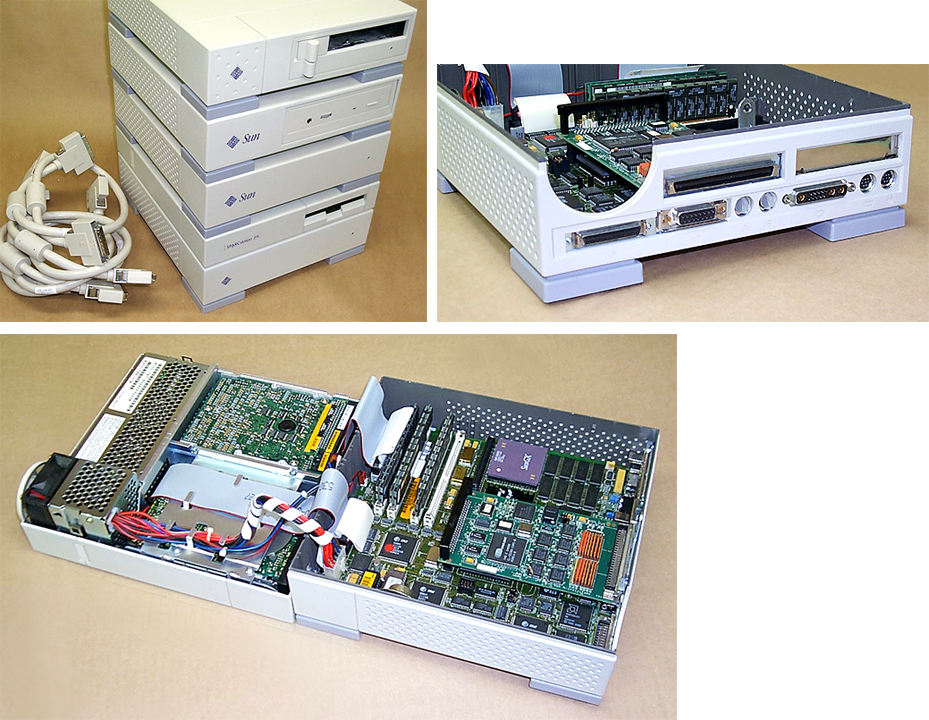
Heh. 'Old' was the Sparcstation IPX I had until a couple of years ago. http://www.obsolyte.com/sun_ipx/
Really old would be the 486 I first ran Linux on back in the early 90s.
These young whippersnappers don't know old.
Necron69
-
Re:NO DISASSEMBLE ALTOS!
My Emulator II from 1985 still has the original hard drive, and it's working fine. I've never taken the beast to a rehearsal, let alone gigged with it, but the previous owner did. I also use a mid 1980s Commodore 1541 floppy drive with my E-mu SP-12, and until a couple of years back I owned a 1987 vintage Vaxstation 2000 that still booted up from the original hard drive (it was probably felt slower to use than the Altos).
-
Re:BRING BACK THE CHROME CUBE LOGO
That's the Indigo2 you are talking about which was extremely ugly and packed tight because of its pizza-box style box. The Indigo was a much nicer design and I don't know many people who wouldn't have drooled over it when it was current.
Here try this link at the same site: http://www.obsolyte.com/sgi_indigo/
-
Re:BRING BACK THE CHROME CUBE LOGO
Ugh, those damn things were ugly. They may have been built like tanks, but taking one apart was like trying to solve a Rubik's cube. (an angled case fan?!) One has to be extra careful when pulling out the graphics card because it was easy to catch its cap on the frame and rip it right off!
The Oxygen and O2 were far more elegant designs. I wished that regular PCs had that kind of setup (the CPU and boards were covered with massive heatsinks but no dedicated fans, but the chassis had two huge master fans keeping the whole thing cool). And all SGI machines were very picky about their hardware. Sometimes solving a hanging boot meant changing the DIMMS around. -
Re:Great news!lol, me too - I have a Sparcstation IPC serving as a monitor stand.
IBM, where's my $8,000???? I have a 25 Mhz CPU I'd like to trade in!
-
Re:Echoes of the "Sidewinder"
You're mixing up two similar (in form factor) machines, that were otherwise quite different in architecture and time of availability.
One is the Alpha-based DEC Multia/UDB, from way back in the mid '90s. LITTLE-KNOWN FACT: Slashdot was originally run on one of these.
The other is the StrongARM-based Netwinder, which appeared around the year 2000.
They did have one thing in common other than their size - they both tended to overheat if they weren't stood up vertically. -
Re:I just don't understand one thing
that's second most importantly. I'm thinking of ordering one to see how well it runs Solaris. The SparcStation IPC rides again!
-
Obsolyte!
As a collector of some of this old hardware (See my website, http://www.obsolyte.com/ ), I can tell you that for every "gem" you find, you also aquire about 2.5 tons of useless crap. It's very difficult to figure what machines will become the iconic collectables, and which ones will just be considered trash.
The Apple Lisa is highly prized (although at one point, Apple was filling landfills with 'em and Sun Remarketing was selling what remained for $200 a pop), but the Mac 512k is pretty much ignored (although the original 128k Mac is valuable).
I have no idea what my old NeXT-Station is worth, but, it'll never be worth what the original Cube is. I have a pretty decent collection of SGI gear, but, does anyone care about SGI at this point? If you look on ebay, people can't even give that stuff away.
And while the Amiga may be the greatest computer ever made, you'd have trouble these days selling your A2000, no matter how tricked out it is (free Video toaster!). The Amiga collector market is saturated, anybody that wants an Amiga probably already has more than 2.
And you'll still find the venerable C=64 and Apple
Of course, should you have an original Altair in your basement, that's another story entirely.
TTYL
Brian Cirulnick -
Re:Ideas for "vintage" equipment
Since we are taking a walking down memory lane with ancient DEC toys. How about a Multia?
http://www.obsolyte.com/dec/multia/
I have one and I've run Windows NT as well as OpenVMS-Alpha on it. -
Similar...
If you open up a Sun SparcStation IPX, you'll see a cat etched on the motherboard.
-
Re:Slashdot history!
-
Re:Slashdot history!
DEC Multia, to be exact. Not to be confused with something cool like an AlphaServer,
The Multia is Alpha, albeit rather anemic even back then.
http://www.obsolyte.com/dec/multia/ -
Re:What a drag ...
Don't forget this baby: SGI Indigo. Astounding graphics, raw power, and a gorgeous blue case.
Blue? More like purple. Never mind.
Anyway, thank you for giving me the chane to post as follows.
I recall that I would have been in the position to afford an Indigo @ ~DM 10K from the person (Dr. Fred Hantelmann, biggest asshole in the known universe, always sitting on his finger) who wrote a review on this machine (when it was state-of-the-art; do not buy the article here) but who refused the deal (he was granted a rebate on behalf of him writing this review from Heise). I got over it when I managed to have the department buy a Personal Iris 4D35 @ (roughly) DM 120.000 for me (it had the sound of a vacuum cleaner
CC. -
Re:Golly, I WONDER where they got that idea!
Sure Macs had the first Small form factor Computer in the G4 Cube...
"First" small form factor was the G4 Cube?! You kids these days! Ever heard of the Sun IPC? -
Re:perfect match for my Sparc IPC box...
i had a sparc LX that I used for a few years in college in my dorm. it ran RedHat 4.0 back when Dave Miller was doing a LOT of the initial sparc porting at Rutgers.
it was a fun little box. i had an external cdrom, and an external 400mb drive. we thought it was hot stuff! some of my earliest posts on usenet are from 1995 about that system. -
perfect match for my Sparc IPC box...
Seems like Apple might have borrowed one from the Sun playbook:
Sun IPX Workstation
Anyone else remember the boxy little IPC/IPX boxes from Sun? They were a stacking nightmare with the limited space inside, but if you could navigate the labyrinth of SCSI cables things were quite usable. -
Re:it's in the new MoMA...
-
Elegant sun hardwareObsolyte has a great archive of Sun hardware pictures.
http://www.obsolyte.com/sunPICS/ The SparcStation 20 is my favorite example, though several later products (in particular, the E450) exhibit similar design sensibilities.
-
SparcStation IPX
SparcStation IPX (or even IPC) I ran one of these clever little buggers for a few years, very low on power, quiet as a churchmouse and houses one harddrive (but at todays disk sizes that's plenty) the architecture is pretty fast and 64MB of RAM was more than adequate. You can pick these little beasties up on eBay for next to nothing so spare parts shouldn't be a problem, either (I actually bought a second for spares.) I was running RedHat 6.1 for months at a time without a hiccup.
-
Slashdot History
Slashdot ran for the first 7 or 8 months off an Alpha box.
If memory serves, Slashdot ran on a Multia.
LK -
Re:NOT the first full 64 bit
[...] Alpha never made PC's
Digital released the DEC Mulita in 1995. Definitely 64-bit. Ran Windows NT. Was targetted for the PC niche (not home niche though) - it was designed to be small and cheap, even using a 2.5" disk drive. It was a PC.Also regarding Apple's claim, the Opteron had been out for a while, and it's hard to think of any good metrics for distinguishing between workstations and PCs that would exclude Opteron-based machines and include the G5.
Lastly, the G5 may be a 64-bit processor, but one can't call OS X a 64-bit operating system, at least not yet.
-
Re:As A Mac User
I mean, not any geek could hack on a purple box.
Actually, I learned to hack on a purple box once upon a time, and it sure wasn't made by Apple. And, even though systems like the Indy seem ancient now, old IRIX users will be glad to tell you that SGI figured out how to make UNIX sexy long before OS X came along.
Anyway, It's interesting that you mention the attitude of Mac users just now, because I just recently had a conversation with two friends who are proud Apple fans. They joked with eachother about how anti-establishment and rebellious they were. I then pointed out that, if anything, my OS (now Gentoo Linux) was the counterculture, revolutionary one. The Mac, I'd say, is now a very trendy, high-fashion platform (at least within my age demographic, that of the college student). Of course, its users take a certain pride in their small numbers. After all, if the Mac began to approach Windows' level of market share, they'd lose their fashionable elitism. My Mac user friends were actually inclined to agree with my analysis.
So, to summarize:
Windows = The Gap
Mac = Prada
Linux = Thrift Store (or, in my case...)
Gentoo = I sowed these myself. -
My first computers
Ahh my first loves, that PDP 11 that was on the other end of the 9600 baud dedicated circuit when I was 10. Then came our first home computer, chicklet keyboards, basic and I got it at Radio Shack - wow - what a stunner, color graphics and everything. Yes my 6809E powered Color computer
It all went downhill from there - in the room with me now are 3 alpha powered multias. Including the First box I ever ran Linux on. Now I'm surrounded by obsolete sparq boxes, some old X86s and somewhere around here is a
dragon 32 I've been thinking of playing with for X10 stuff. Eventually I'll have to get a pdp 11, just so I can say I've come full circle.
AngryPeopleRule -
Consumers are hard to findThey've already dropped their prices as far as they can. This is not a commodity product. It's got a lot of proprietary or specialized technology. A lot less than it use to (unlike a Sun workstation, you can plug in an ordinary PC keyboard) but still a lot.
Nor could you sell this kind of specialized system through Best Buy. Sales channels like that barely have the expertise to deal with ordinary PCs, never mind fancy workstations with proprietary OSs.
SGI did try to do a system for the masses: the Indy. But not enough people decided it was a practical alternative to a PC or Mac. Cost them a bundle.
-
Re:Nice...
I used to own both an old Indy and an Indigo2, both of which would be the equivilant of an 8086 in PeeCee computing terms..
Actually, no, they aren't. A more accurate comparison would be a P5 series processor at a similar clock rate.
You forget the several previous generations of machines such as the Indigo or the Personal Iris and they were drastically faster than an 8086... To find the first machines produced you have to go waaaaay back to 1983 and the Iris 1X00.
-
Re:Possible reasons
And I've noticed many smirks or at least raised eyebrows when someone trundles in a 3-year old, heavy-as-hell-with-passive-matrix-screen laptop into a meeting. And many if not most of the laptop-advocates here are familiar with the satisfaction of hauling in the newest, coolest laptop, hearing the oohs-and-ahhs and having the neatest toy in the board room for the next month or so.
Actually I ENJOY bringing in the oldest laptop, and showing off the fact that there's no HD (everything lives on a 2MB "card" in the Toshiba T-1000 SE), and how it's a DOS-only, 8088 powered laptop and yet, I can type notes in it just as fast as the newest laptops, and, because there's NO HD, I can drop it without worrying that my data is going to be destroyed. Oh, and I bought it for $10 at a garage sale.... And the battery still holds a decent charge, and there's lots of room inside to hack in some extra stuff.
In fact, many people look at my laptop simply because they've never seen one so old that WORKS.
But then again, if you visit my website, you'll understand why I like old laptops (and old computers). -
Re:fr1st ps0t #2
Ahh, the planar system...
We were cleaning out old computers at netmar, and we unearthed a Sun 3/160 (check here for pictures of a 3/160). It's not really a computer, in it's present form. It's just a VME backplane with 12 full-height slots for plugging anything you want into it.
We found the origional processor board, which had a 17 Mhz processor and 4MB of ram (1986, folks). But, we found out, you can swap anything into it. When we pulled out another double-decker board, we were thrilled to find a bonanza of upgrades: 2 M-bus slots, each with 2 Ross HyperSparcs (we think they're 40 Mhz, making it 160Mhz total), 64 MB of ram (in 4MB 30pin simms), and onboard scsi.
Must have been nice to buy a computer in 1986, and then swap out the mainboard for 1992 hardware, but keep the same config. Of course, that's the least you should expect when you essentially spend $30,000 on a glorified backplane.
Oh, FYI - 160 Mhz of multi-threaded Sun 4m is still a beast of a machine.
~Will -
Re:Made a quick comparison
Now, I could not find the speed of the CDRW/DVD on the Mac anywhere.
It didn't take long to find this page with all the apple specs, including:
"10/100/1000BASE-T Ethernet connector (RJ-45)"
"SuperDrive (DVD-R/CD-RW); writes DVD-R discs at 2x speed, reads DVDs at 6x speed, writes CD-R discs at 8x speed, writes CD-RW discs at 4x speed, reads CDs at 24x speed "
and
"Your Power Mac G4 comes with 90 days of telephone support and a one-year limited warranty. Purchase the AppleCare Protection Plan to extend your service and support to three full years."
I still wouldn't pay that much for either system. I would be interested in the SparcClassic-sized box though. My current PC project is putting one of these mobos into one of these Sun 411 cases. As soon as I can figure out a sensible PSU for it, anyway. A G4 cube board in the same case would be very nice. -
Iris Scanners.....
... Well we've only got an SGI Indigo2 in our office. If I needed to take it on a trip to and from Canada, would it be compatible with their Iris scanners?
-
Re:Go for a used Sun
For info on old Sun hardware, check out Obsolyte.com. I just set up a home firewall with a tiny SparcStation IPX. Not the most high performance server, but it's fun, ya know. -
Re:Go for a used Sun
For info on old Sun hardware, check out Obsolyte.com. I just set up a home firewall with a tiny SparcStation IPX. Not the most high performance server, but it's fun, ya know. -
Yeah but...I basically agree, but I might as well play devil's advocate. Or try to.
Some machines have special hardware features. Usually you can get the same features with a PCI card, but not always. However, this is no longer something you'll see on a consumer-level machine.
SGI is a prime example. They sell some impressive graphics systems that don't have any real competition in the PC or Mac worlds. But these are not toys for individuals -- they're expensive tools that big companies buy, and then only after carefully weighing the alternatives.
Over the years, SGI has tried to market its alternatives to the commodity PC. Kind of pointless -- people who need PCs buy PCs. They did finally wise up to this, but much too late.
There used to be more systems like this (the Amiga is a prime example), but all except the Mac have essentially disappeared. And even the Mac makes little comprimises with the commodity marketplace -- like that obscene PC-compatible keyboard.
If you're thinking that owning a Sun will offer you a novel user experience, forget it. Solaris totally lags behind in UI design. That's why Sun has turned to the GNOME people to help them update it. People buy Sun workstations to run high-performance software -- from the command line!
Whoops! I seem to have ended up totally agreeing with crow. Oh well!
-
Want to know about older Sparc hardware?
Visit http://www.obsolyte.com and click on any of the Sun links. I've got specs for most of the popular models from the IPC to the later machines. I'm hoping to cover Ultras soon, but I haven't got the dough to get one yet and examine it in detail.
Hope this helpful. If you want to run older SUNOS AND solaris 8, you might need two different machines, as the ones that SUpport SUNOS might not be supported under Solaris 8 (or run Solaris 8 too slowly to be usuable in any real sense). -
Sites for info on old Sun hardware
Also, the "Xserver jumbo patch" is just the SunOS or Solaris patch for the Xserver, available from sunsolve.sun.com. (For most OS versions, it's included in the OpenWindows patches and labeled as the Xsun patch.)
-
Hey, I'll take all the old machines!
If you've got one you don't want, send it to me - if your machine is antique and/or unique, I'll make it a part of my museum, and give it a page on my "Obsolyte" web site.
Otherwise, I can always use the spare parts! I have found good homes for many of the machines I've recovered from dumpsters!
ObsolYte! - where the antique is ElYte! -
Re: Old Machines
You can use 8088 machines with an ISA ethernet card and the use a dos version of NCSA telnet to access servers on a network. The whole thing can fit on a floppy if you're good. I recently did this with a 386 laptop I found in the trash. Used an obsolete Xircom pocket adapter too, going through the parallel port and giving me ethernet.
Works great!
More obsolete hardware at ObsolYte! Where the antique is ElYte! -
Before there were distributions...
Before distros existed, people put this stuff together on their own. The first distros were people who did the work and shared it with others.
I'm not trying to recommend that everyone cobble together Sparc Linux on their own, but maybe if enough of us collaborate, we can keep something alive if we're willing to make the effort.
I use RedHat 6.0 for Sparc on my website (www.obsolyte.com), and I can tell you that, for an antique Sparc IPX, Solaris simply wasn't an option --- unless I used a version as out-of-date as the machine itself. That left Linux or BSD as options, and I was more familiar with Linux.
Want to know more about antique sparc hardware (and other vintage workstations/servers)? Visit my site!
And I'm willing to help out to keep a distribution alive. -
Re:I got one for $20
Aren't these things a bargain! According to the Sun Hardware Reference, my SPARCstation 2 with a GX framebuffer cost $17,995 new, and my LX cost $7,995 new. Of course that was in 1991 and 1993 respectively, so we should adjust for inflation.
-
It also lives in GNU/Linux...While CDE is the standard commercial UNIX desktop, some of the most popular GNU/Linux window managers are inspired by or clones of the slick NeXTstep interface. The most popular is undoubtedly GNUStep is a fairly complete clone which is also the "official" GNOME WM. (Bugger off, E-freaks!
AfterStep actually used to be CmdrTaco's fave window manager, before he sold out to the Enlightenment camp. Fun fact: Taco is the author of the dockable CD applet "ascd", which looks really cool but dumps core more often than Shaft smacks hoes.
Apple may be trying some NeXTstepish things with OS X, but IMHO they should instead bring back the NeXT tradition of awesome, sleek black hardware. It is my hope, even though I don't use Macs, that the iMac's successor embodies this aesthetic philosophy... but I'm not holding my breath; despite the fact that Jobs wants to appear rebellious and artsy, he will never again sell a machine whose external appearance might frighten their now-core userbase of little kids and grandmas.
All generalizations are false.