Slashdot Mirror
Domain: oecd.org
Stories and comments across the archive that link to oecd.org.
Comments · 349
-
Re: joy
You're a moron aren't you. Look up profit shifting some time.
Profit shifting doesn't undercut anything written above. An inability to write a post without resorting to playground insults, however, does undercut your credibility.
Profit shifting is a problem actively being tackled by the G20. It is not an excuse to have one country operating by entirely different taxation means than the rest of the world, a system that doesn't prevent BEPS but does introduce brand new headaches, both for itself and for the rest of the world.
-
Re:We Don't Care
Comparable educational levels in less time: http://www.nationmaster.com/co... [nationmaster.com]
Yes, and the highest private education spending in OECD
Get free healthcare. Giving better life expectancy (and lower teenage pregnacy rates): http://www.nationmaster.com/co... [nationmaster.com]
Yes, for the simple reason that healthcare spending has little to do with either life expectancy or teenage pregnancy rates. So why are you dragging it into this discussion?
Whatever you think of "other countries" that were "stupid enough to allow taxes to get so high" applies to the US, not to the UK.
Actually, the UK has about average taxes among OECD countries at around 35% of GDP; the US is on the low side at about 26%. Of course, given that US per capita GDP is about 35% higher than that of the UK, the US actually collects more in taxes per capita than the UK, and it spends even more because it runs a deficit.
-
it's middle class taxes
What makes the average tax burden in Europe so high is middle-class taxes: that's what pays for the European welfare state. So, when you hear the Warrens, Clintons, and Sanders out there saying that the US should become more like Europe, you need to understand that in order to pay for that, taxes on people making $50000 and up would have to go up by 10-15%; US top marginal tax rates are already comparable to European top marginal tax rates.
For example, an average wage earner in Germany pays 39.6% income tax, while he pays 25.8% in the US (the difference is even more pronounced because the average income earner in Germany earns substantially less than in the US, even in terms of $PPP).
-
Re:So you exclude half the taxes and what you get?
Actually, no. The USA is right in the middle of the OECD average. We're on-par with Germany, the UK, Italy, etc.
-
Re: FRost
How much do you think an old pensioner really makes?
In the US, 1 out of 4 seniors lives in poverty. And the older they get, the higher the ratio rises. It's also biased against women, with women being more likely to be living in poverty.
Seniors don't have under-18 children living with them to bring in supplementary entitlements to boost their household income. You don't hear anyone carping about seniors who are "welfare queens". Just doesn't exist. There are families on welfare who make more than many seniors.
-
Re:The benefits of Single Payer
http://stats.oecd.org/Index.as...
Almost every country that is better than the US in all sorts of health-related statistics have socialised healthcare. But keep deluding yourself into thinking that the US has it better than anyone else, those of us who will get to live longer than you, will ultimately have the last laugh.
-
Re:Reduce work time
where does that money come from?
Profits! Nowadays, low worker's income makes goods and service demand too weak. As a result, investments in real economy have low returns, and investors prefer to invest profits in speculative financial products. But without enough demand from real economy, these investments will bubble and burst, causing yet another financial crisis.
Wealth production is always somehow shared between labor and capital, and if one side takes to much to the other, things go bad. For 30 years, we went too far toward increasing capital's share. See for instance OECD report
-
Re:Ban temporary lifted for the wrong reasons
Have we ever considered it's a BAD thing to steal all these talented people from their own societies and hog them all for ourselves?
The program was started after research showed that there was a net drain of talented people out of the U.S. (i.e. to use your terminology, other countries were stealing talented people from the U.S.), and that a disproportionate number of students at U.S. colleges were foreigners who came here for the education, then went right back home, thus ostensibly depriving an American of a spot in that college. Most other developed countries have similar programs (Annex 5.D).
And you do realize the same reasoning works for political and economic refugees, right? The repressive government in the country these people are fleeing will only go away when citizens of that country upset by the government overthrow it. But by accepting refugees, we're depriving the opposition to the repressive government of potential members and fighters. Thus accepting political refugees and people seeking better economic conditions to immigrate also allows repressive foreign government to remain in power longer.
Personally, I intensely disagree with your implicit assumption that each country "owns" its citizens like cattle, and that providing incentives for people to move from one country to another is "stealing". Freedom of movement is a fundamental human right. If a person wishes to change their citizenship to another country, that is their decision to make and theirs alone. I grew up during the Cold War, when half the people on earth were deprived of their right to leave their country of birth. The country of your current citizenship should have no say in whether an individual can leave - all it can do is try to make domestic conditions better to entice you to stay.
So programs like this in first world countries do actually provide a service to developing countries - it encourages them to develop in a way which provides more opportunity and better living conditions for its citizens, lest they flee. Without it, the developing nation can (or is even likely to) develop into a feudal state, where a few people in political power rule over the masses by oppression. Failure to recognize this possibility is what doomed the socialist idealists who implemented Communism. -
Re:No
I hear people say that about health care and it's hilariously stupid because the US pays the most per capita for health care and covers way less people than other countries do.
That was the most common argument i saw for Obamacare. Unfortunately, it's wrong. Before Obamacare was passed, the U.S. already spent just about as much government money ("public expenditure") as percent of GDP and per capita as Canada did on its single payer system. Since Obamacare, it's actually gotten worse, with the U.S. government now spending 25% more per capita on health care than Canada.
The reason for the high health care costs in the U.S. isn't because of lack of government provided health care as the socialists want to think it is. In fact, given that medicare ("public expenditure") recipients are only 17% of the population but account for roughly half of the U.S. health care costs, there's a strong argument to be made that government-provided health care is the problem. -
Re:I did
Because every other country has active measures in society to combat that pressure from companies. And in the others they are at least partially successful. Not entirely - much of Europe is having the exact same problem as Japan though at an earlier stage and not as severe yet. That's one reason it's ridiculous of Europe not to welcome the refugees with open arms - they desperately need an influx of able-bodied young people to keep their economies working.
Every other country... That sounds like a sweeping generalization without any knowledge or data to support it. Let's have a look at working hours to see how far along Japan is. Here, https://stats.oecd.org/Index.a...
Turns out Japan is more lenient on working hours than USA, on par with Italy, and far nicer than Greece or Mexico. So, your hypothesis would mean birthrates in the US should be below that of Japan, birthrates in Italy should be on par, and birthrates in Greece/Mexico should be much lower than Japan.
How does that play out? Let's check http://www.indexmundi.com/g/r.... or more directly https://www.cia.gov/library/pu... . The US is above Japan, so that didn't align, Italy is even, so that's correct, Greece is even, so that's wrong, and Mexico is way higher, which is again, wrong. Your hypothesis was highly inconsistent with the data.
Japan is the furthest along that road, and thus gets to serve as the great big warning sign of where that road leads, but you're an idiot if you think those other places aren't on the exact same road and measurably moving forward on it. They are moving slower because of policies designed to combat this corporate pressure. Those policies, however, are being steadily eroded - which will accelerate the trip.
Or, perhaps the idiot is the one that makes absurd claims that contradict the known data?
They need to be significantly strengthened if you want to change course. That means things like paid family leave, maternity leave with job protection, paternity leave with job protection, good (and affordable) childcare options - so that people don't have to choose between life and work.
A healthy society needs people who work to live. When everybody lives to work - that society is doomed.Sweden and Norway both have all of those and more, along with some of the lowest working hours in the world. And where are they on the fertility graph? Below Mexico, which is not known as a champion of employee protections.
At this point we should entertain the notion that you are incorrect, and that the numbers we see fit much much much better to the graph of economic development and wellbeing, i.e. rich people have fewer babies while poor people have more.
-
Blaming the wrong thing
"The most critical learning resources that teachers need are often exercise books, pen and paper, but incentives built into the process steer educators to request and receive Google hardware, rather than humble classroom staples,"
The U.S. is near the top in education spending per student among OECD countries (change Perspectives to "primary to non-tertiary" to eliminate college costs). Only Austria, Norway, Switzerland, and Luxembourg spend more. If a U.S. teacher doesn't have enough money for "humble classroom staples" like exercise books, and pen and paper, it is not Google's fault.
About 5 years ago I stumbled across a full internal accounting report of a local school district online. The biggest expense wasn't teacher salaries, classroom supplies, or building construction and maintenance. It was administrative salaries. Think about that. The administrators at the school - the people who sit in offices, push paper, and rarely interact with parents or kids - take a bigger chunk of the school's budget than the teachers.
I'm convinced the administrators massage the numbers to cover their tracks in the official budgets. You can see a side-effect of this in the published stats. According to ED, the salaries of teachers, student support, and instructional staff is $4271, $388, and $291 per student respectively - total $4950. The benefits these teachers resceive is $1596, $142, and $102 per student - $1840 total.
The student to teacher ratio has been about 16:1 since 2000. So according to these ED stats, the average teacher salary is $80,000/yr, and benefits just under $30k/yr. Yet ED lists the average teacher salary as just $56,383. These numbers don't match up, not by a long shot. My hunch is administrators have shifted some of their salaries into the teacher salary figures to hide just how big a slice of the pie they're taking.
I suspect what's going on is a scam of epic proportions. Every time the education budget is cut, instead of applying the cuts to the least important programs and staff like any good business, the administrators apply the cuts to the most essential items like exercise books, pen and paper. They tell the teachers there's not enough money in the budget, and the teachers go into a frenzy telling the public we're not spending enough on education. When the education budget is increased, the administrators spend a few dollars per student to restore the textbooks, pen and paper, and siphon off most of the increase for themselves. How else can you explain teachers not having money for exercise books, pen and paper, when we spend more on education per student than all but 4 other countries on Earth?
Anyhow, Google is donating money - giving it for free. Don't look a gift horse in the mouth. Yeah it would've been great if the donation didn't have restrictions on how the money was to be used. But from the school's perspective, a donation with restrictions is still better than no donation at all. -
Re:The evidence cited seems pretty thin.
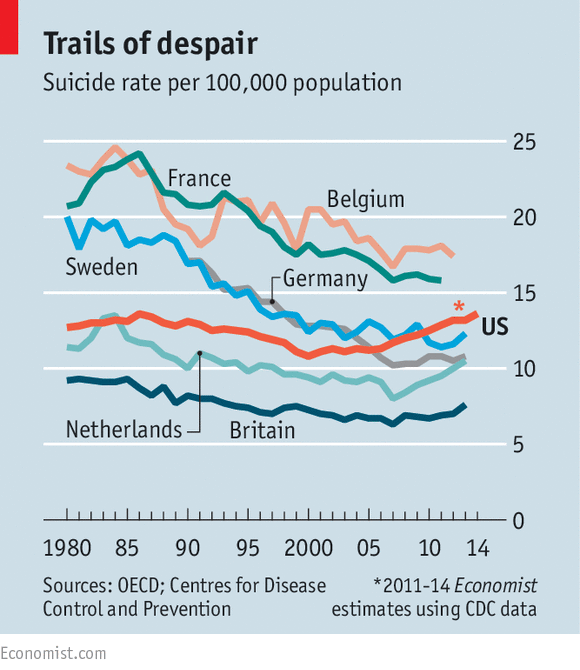
(1) Suicide rates -- In the US I think the increase in suicide rate is likely attributable to increased firearm ownership.
Suicide rates are up in many OECD countries over the last 10 years, many of whom have strict restrictions on firearm ownership. Several countries which ban or restrict guns have higher suicide rates than the U.S.. Also, it's predominantly males in the U.S. who opt for suicide by gun; females usually try to overdose or slit their wrists. Yet the ratio of male to female suicide rate is practically the same for the U.S. (3.73), UK (3.77), Germany (3.54), France (3.22), Spain (3.73), and Italy (4.0). Suggesting that guns are merely a tool of choice among male U.S. suicides, not an enabler of higher suicide success rates.
The U.S. is more diligent about collecting this sort of data and making it available to the public. So global trends tend to show up sooner in U.S. data sets. Not because the U.S. is special or atypical. Most of the OECD suicide stats I was able to find still date from 2011. It took quite a bit of searching to find that chart of suicide rates in non-U.S. countries up to 2013. -
Re:What does THAT have to do with anything?
I take this as a sign that you are frustrated by your general lack of success in persuading people who are suspicious about "social justice".
Once again you have created an entire backstory to rant against that is unsupportable. That comment would make more sense if it wasn't my first post for this story. I will admit though, it is the second time this week that I have had to reply to some opinionated posters who obviously hadn't read even the first couple of paragraphs of the article about which they ranted.
Do you want to know why I felt qualified to make such a diagnose for someone that I hadn't even met? I recognise the symptoms because I am exactly the same. I too saw that they only asked women and wondered why. In my teenage years, I would have ranted and raged about it too. I would have used my own insecurities to project motives on people. But as I get older, I now know I should actually follow the links to find out the full story before I jump to conclusions. It's the only way that you can have an informed opinion.
In this case, I found out that they did this for Computer Science Education Week. I found out that in OECD countries less than 1 in 5 computer science graduates are girls. Do either of those things sound implausible to you?
Why would Microsoft care about this? Apart from the public naming and shaming of companies that have wide gender imbalances (which I'm sure you don't care about), TFA had this reason (among others):
By 2020, the U.S. Bureau of Labor Statistics predicts that there will be 1.4 million computing jobs but just 400,000 computer science students with the skills to apply for those jobs.
So aside from any pure motives of wanting gender equality, this problem will actually affect their ability to employ staff in the future. Hence, they want to encourage girls to take up STEM careers. You could also say that they want to offset the discouragement some girls receive because they are told that this entire field is just a boys club. Does any of that sound implausible?
So why is it so implausible that they would want to do something to encourage girls and that they decided to survey "17 women within Microsoft's global research organization" about what is going to happen in the year '17?
Anyway the given reason is not plausible. It implies that the question was only brought up as an excuse to ask women something. If we want this question answered because it is important, then we should focus on having it answered and not performing some gender equality stunt.
I see. Your problem is that we are actually taking their answers seriously. You seem to think that because they are women they are not qualified to talk about their fields. If you think that this question is important enough that we should focus on having it answered, why didn't you follow the link to the blog post to find out what the answers were? Why wasn't your argument that they seemed like low quality answers? I think that it's because you just can't get past the fact that they are women.
I'm afraid you have no point and little awareness of the broader picture.
Perhaps if you bothered to look at the specifics of this case rather than worrying about the broader picture then you would actually be able to make an accurate assessment. But if you can't be bothered looking at the facts of the case, how can we deem your idea of the broader picture to be valid? If you are so set in your opinions that even having the article quoted to you to show where you are wrong just gets ignored, then I feel my diagnosis of you having a coloured view of the world stands. You shou
-
Re:"Likley grow" - Bullshit
Now and since before there was a USA.
-
Re:Oh boy, not this shit againErm, let's try that again. Typo in my HTML.
Well, profiting off the ill and going bankrupt for getting cancer isn't right either.
How many peoples' lives is that worth? In this world, we have routinely have trade offs between choices. A key health care problem universal throughout the developed world has been rising health care costs (see "Exhibit 7a" which is from the OECD, showing decade by decade increases as a fraction of GDP of selected countries).
In the linked article, fifteen developed world countries (including of course, the US's crazy rise in health care costs since 1970) show considerable growth in their health care costs as measured as a fraction of their GDP (and maintained over the course of the recession, see this 2013 snapshot also from the OECD).
And there's no obvious level of activity that will stop at. While the average growth (averaged over countries) from 1970 to 1980 is larger than any other decade, the average growth in the GDP fraction of health care costs is 2.6% from 1970 to 1990, while it is 2.3% from 1990 to 2010. That's not much of a slow down in the rate of growth of the share of GDP devoted to the health care industry.
Perhaps the for profit nature of the US industry is driving the higher relative costs of US health care (ignoring other factors like subsidizing of health care as a tax free employee benefit), but everyone's health care costs are increasing considerably faster than the ability of their economies to pay for those health care costs.
I think why is encapsulated in the reasoning further down this thread. A lot of people need or will need expensive medical care and they'll vote for any policy that gets them the medical care. Costs will continue to rise IMHO because we're just smearing more and more expensive lipstick on a pig. Under the current model of medical care, we will die in a rather short period of time, triggering progressively more and more expensive treatments as we get closer to dying.
Sure, technology can radically change that. But it hasn't yet. -
Re:NSF is training researchers in marketing
There is a lot of room between severely limited resources and unlimited resources. Sufficient resources is doable in many cases if we had the will to invest in the future as a society instead of leaving the funding of science to profiteers.
Last I checked as a percentage of GDP (keep in mind that GDP has been increasing for everyone as well over the span of decades), research funding, including public funding, is as high as it's ever been outside of the Second World War (such things as the Manhattan Project). I can't find any support for that, but I do see solid indications that research spending has been going up over the recent past (here and here).
Maybe more money isn't going to fix a problem that wasn't due to level of funding in the first place? -
Re:Participation rate and unemployment
Flat unemployment rates:
US unemployment: 6.1
France unemployment: 10.4
https://data.oecd.org/unemp/un...These are people who are seeking work of course. If you 'give up' searching for work, you fall off the board.
For raw employment rates:
US: 68.2
France: 63.6
https://data.oecd.org/emp/empl...Assuming you subtract the difference, you're left with roughly the same number of people 'not seeking employment' in either country:
US: 25.7%
France: 26% -
Re:Participation rate and unemployment
Flat unemployment rates:
US unemployment: 6.1
France unemployment: 10.4
https://data.oecd.org/unemp/un...These are people who are seeking work of course. If you 'give up' searching for work, you fall off the board.
For raw employment rates:
US: 68.2
France: 63.6
https://data.oecd.org/emp/empl...Assuming you subtract the difference, you're left with roughly the same number of people 'not seeking employment' in either country:
US: 25.7%
France: 26% -
Re:Look at the historical data
Also, compare the study findings to what the OECD publishes: http://stats.oecd.org/Index.aspx?DataSetCode=ANHRS
-
Re:What have they got to show for it?
https://stats.oecd.org/Index.a...
Yes the US puts in a lot of hours and a high productivity.
But what do your workers get in return?
A good quality of living is worth more than lots of money.
http://www.usnews.com/news/bes... -
Re:Two points ...
Before you go too far down arguing about "the vast majority of the population", you might like to check out some facts.
Or not, of course. If you want to support post-fact politics, that's your call.
-
Re:clarification
Coalition Theory 101 states that in any coalition, the largest party gets the worst deal. This is rarely, if ever, incorrect.
It's a bit rich for them to bitch at us, and insist on being given more money in the context of something they already abused to their advantage, whilst I'm sitting here unable to go to a specialist because I'm poor and my country (unlike Denmark) spent all of its billions on military bases instead of medical subsidy.
Hold on there. The US spends a larger proportion of its GDP and more per capita on health care than Denmark does. It's not Denmark's fault that you as a nation mis-spend it.
-
Re:not gonna happen
The number I took is from:
http://www.ekonomifakta.se/Fak...
"In recent years the tax burden in Sweden dropped slightly , but we are still above the OECD average. The tax burden or tax ratio , calculated as the ratio of total tax revenues and GDP."I would assume it counted everything and _I_ don't count anything it's a number which already existed.
Government spending per GDP says 38.10% here:
http://www.tradingeconomics.co...
Don't you have any public taxes and spending beyond what the government spend? No state taxes and spending? As far as taxation goes I think VAT should be included?This number is _SPENDING_ though, not _TAXATION_, and as we know the US budget is running at a huge national deficit.
Debt as percent of GDP 2015
USA - 104.17% (76% in 2008.)
Finland - 63.1% (32.7% in 2008.)
Sweden - 43.4% (36.8% in 2008.)
Denmark - 40.2% (33.4% in 2008.)
(This site was used: http://www.tradingeconomics.co...)So even if the US spend 41% of the GDP it doesn't _TAX_ that much. Though the difference between 2010-2015 relative GDP is very low, from 2007 to 2010 the debt increased from 64.8% to 95.2% of the GDP (which most likely fell during the same period though..), USA may have at-least some of it back with their strong and growing economy now though.
Quite a difference in the amount of debt. The Swedish house-holds have lots in debt though.
https://data.oecd.org/hha/hous...:
Household debt - Total, % of net disposable income, 2014:
Denmark - 308%
Sweden - 174%
Finland - 127%
United states - 113%(Hopefully you own something worth it for all that debt
Estonia household debt sat at 83%, they have a governmental debt of just 9.7%, complete tax pressure (above) of 32.9% and spent their 2% of GDP on the military just like NATO wishes. They are the only country which follow both the Euro zone rules for their public debt and the NATO rule for military spending.
May be a very well run country. What Sweden should have been (I doubt they look up at Sweden now any longer.. Or Estonian friends -
Re:Not normal
"Your two year sample doesn't do that."
Well obviously you know nothing about geopolitcs and the global economic situation if you believe that because you're simply wrong.
"Norway has unusually high productivity because of the size of its oil and hydroelectric generation per capita. It's a different sort of cherry picking you do here. Sure, if the entire world could be massive oil producers with huge hydro reserves exporting to some immense buyer, then we could all enjoy the level of productivity of Norway."
Except the US has those resources, but fails to do the same, highlighting the fact that productivity from working hours and holiday days is irrelevant compared to things like poor resource management. Which, you know, was my point, so thanks for finally agreeing.
"Then by all means show this. One country with an unusual level of natural resources doesn't qualify as "plenty of examples" though."
Yet, I also pointed out that the UK has some of the highest working hours and lowest holidays in Europe and is still less productive than those countries with shorter working hours and more holidays like Germany and France. I guess you ignored that example though because you've moved into the usual "Fuck, looks like I am wrong, but there's no way I'll admit it on the internet because I'm way too insecure for that" territory.
"No, what annoys me are the Pollyannas who just assert stuff without considering even in the slightest the drawbacks of their schemes. If all you consider are the benefits, then anything looks wonderful."
But you've not explained what the drawbacks are exactly, they're certainly not the things you state because there is no evidence at all that greater working hours and less holidays actually lead to more productivity. There have been a number of studies showing the opposite however (feel free to Google them, I can't be arsed). If you want something interactive though then see here, you can add the US to the chart. You might not want to though, because it'll be embarasing for your argument.
-
Re:It's a private business.
Where am I wrong?
You're wrong because the items that compose the yearly GDP are only accounted for ONCE, either as the revenues generated by the economic system, or according to how these revenues are spent or invested by the government, companies and consumers, so by definition nothing is double-counted, it's two ways to analyze the same thing. This confirms what I was saying before: you have no clue of what the GDP actually is and how it is calculated, hence you shouldn't have even started arguing about it
Mixed is mixed. If capitalism and free markets were so horrible, then why doesn't Norway abandon them completely?
Because non-stategic businesses, especially small and medium enterprises, can be operated by private entities without damaging the public well-being or increasing wealth inequality, especially in a country where half of the economy is government-run, and the other half is heavily regulated.
Obesity is a modern Western diet problem that is growing around the world
Nope, obesity is really a US problem, not "western": https://www.oecd.org/els/healt...
And life expectancy is still pretty high for the United States (82 vs 79 for France vs US, for example
Nope, 79 years is not "pretty high" at all in the western world, and a 3-year difference (and even more with respect to other countries) is pretty relevant, since western countries should be supposed to enjoy very similar living standards, technology and, most importantly, healthcare services.
Why do you have no answers for China's dramatic improvement when they moved towards capitalism and free market ideas?
I don't know: maybe because the Chinese government owns roughly 70% the Chinese stock market capitalization?
Within China, WisdomTree estimates that approximately 70% of the market cap could be classified as SOEs
https://www.wisdomtree.com/blo...Do you know what the big problem of the internet is? It's easy to be ridiculed if you're not informed. Have a good weekend.
-
Re:Australia had the UNESCO report censored.
so where is the revenue from the now defunct dirty polluters going to come from, the revenue that was promised to the people to offset the costs of going green?
That's a ways off yet, but by then, the industry adaption schemes will be done with, the renewables early-investment subsidies won't be needed any longer (as the market will have matured to cover the whole energy sector), and the consumer tax cuts can be slowly scaled back, if needed.
Remember also that getting off coal will save hundreds of billions annually in the US alone, mostly in avoided health costs ($1.7 trillion over the whole OECD). So overall we'll be significantly better off.
-
Re:If you takers want to see it
I think you need to talk about all Federal taxes together. Income tax, capital gains tax, social security, tariffs... They all have an impact on the GDP growth of the country. And if Hauser's law continues to hold (over the long term - on a decade or more basis - it's been quite accurate) then the best way to increase revenues is to increase GDP growth.
The OECD has a report that deals with taxation and GDP growth, and their conclusion is that lowering high marginal tax rates (and our corporate tax rate is the highest in the world) helps grow the GDP considerably. That would mean an increase in total Federal revenues - and we've seen that manifest and confirmed by President Obama for at least capital gains taxes.
President Reagan dramatically slashed the top tax rates and many have said we paid a steep price for it. However, looking at the actual Federal receipts as a percent of GDP (where we would see if the cuts stimulated the economy enough to offset revenue) we see that the average Federal take was higher for the 1980s than any decade since WWII. President Clinton kept the tax rates pretty low, and we see that the Federal receipts continued to increase.
I would argue that we try for a flatter, simpler, lower tax rate but with fewer deductions. Many point to the 1950s/1960s as our "golden years" when the top statutory rate was 90%! But at the same time, the Federal Government, per capita and adjusted for inflation, was taking in HALF what it does today. Those top statutory tax rates were fantasies because of the deductions allowed. The actual, effective tax rates people paid in the 1950s and 1960s was half what they pay today.
Personally, I'd cut it down to a single personal income tax rate: 15%. And it's a flat rate, paid by everyone on every penny of earned income. No deductions, not adjustments, not exclusions. EVERYONE pays. The current average tax rate for all earners is 13%; this 15% actually represents a tax increase for everyone, on average. And I would completely eliminate the corporate tax rate - set it to zero for all US domiciled and based companies. The catch: to qualify as US domiciled and based, at least 75% of all worldwide corporate profits must be repatriated to the US, and at least 51% of all executives at the VP level and higher - as well as 51% of all board members - must reside within the US for at least 183 days a year (meaning they are subject to US taxation). That would not only bring back the trillions held overseas (for investment in the US) it would make the US the world's greatest tax haven. And there would be a flood of upper-income earners (those execs) who would necessarily pay 15% of their income to the Federal Government.
I would also raise our tariffs and simplify - a flat 5% on all goods imported. Historically our tariffs have been a lot higher - dropping below 5% only after 1975. Simplifying the tariffs, and leveling them across all industries (they vary all over the place now) would make doing business easier, and it may drive out some industries in the US. However it would also greatly expand many industries, such as high tech. Right now China has a 4% export tariff on high tech goods, and the US has a ~1% import tax on those same goods. Raising the tariff on electronics, and combining it with the tax advantages of being based in the US (no taxation) would definitely give many companies a reason to relocate their assembly factories to the US. Google built the Moto X in the US for about the same labor cost as an iPhone in China. Costs stay about the same, tariffs are lower (hence selling price becomes more competitive) and profits taxation is gone (zero corporate income tax) and there is a VERY compelling argument to move manufacturing back domestically.
Anyw
-
Japan
Seriously, as much as the World Economic Forum is crap in a lot of ways in actually measuring gender gap, Japan does have an obvious social and economic gender gap. Yet their record on education shows virtually no inequality. Meanwhile, this study shows a measurable difference in equality in math in Sweden.
Sounds like a meta analysis using a bunch of junk studies.
-
Re: Stupid people punishing smart people
If only it could be boiled down to a simple number. That'd make life easy.
The source for your linked article hints at much deeper insight:
Socio-economic background has a significant impact on student performance in the United States, with some 15% of the variation in student performance explained by this, similar to the OECD average. Although this impact has weakened over time, disadvantaged students show less engagement, drive, motivation and self-beliefs.
This is further elaborated on in other pages of the report. Basically, there are a number of factors, starting with the US having a higher percentage of disadvantaged students and schools. While those schools have equally-qualified teachers, their educational environment is less conducive to learning. There is also an observed correlation between teacher morale and student performance.
One interesting point in the study is that Common Core would likely improve things:
The analysis suggests that a successful implementation of the Common Core Standards would yield significant performance gains also in PISA. The prominence of modeling in U.S. high school standards has already influenced developers of large-scale assessments in the United States. If more students work on more and better modeling tasks than they do today, then one could reasonably expect PISA performance to improve.
Considering Slashdot's hatred of Common Core, I suggest that anyone commenting on this matter actually read the standards.
In short, we can spend all the money we want on making prison-like schools, but US education isn't going to improve until we make the schools a learning-oriented environment. Curently, we spend a lot of "education" money on making a big show of security to look like we're keeping our children safe, when that money would perhaps be better spent on community programs to improve those disadvantaged areas.
-
Re:Welcome to the First World, China!
Nope, it is actually an american thing, and several "affluent" countries have far lower obesity rates. I have no idea how the W.H.O. can think it can forecast the future, just look at current actual data instead:
-
Re:well
Firstly, it would still be far lower than the US, whose obesity rate is 35% (see below). Secondly, that sample is only among adults whose age is 40-45. Weird statistics, those data are not comparable with other countries. A more proper comparison can be done using OECD data, which ranks all of its member countries and says that the Norwegian rate is only 10%:
https://www.oecd.org/health/Ob...Note all the other western countries whose obesity rates are far lower than the US.
-
Re:It's all relative
Lol, you've never even seen a car from the eastern bloc, have you?
Cheap? Sure, for the average Westerner. Barely affordable for most people living in the countries they were made in.
Reliable? Hahahahahaha. No they weren't. They were fairly easy to fix, without specialized tools and parts, which was an absolute necessity because you couldn't buy decent tools or parts anywhere.
And Germans aren't actually all that socialist compared to the US. For 2013, German government spending was 44.5% of their GDP, in the US it was 38.8%. A difference, yeah, but not a huge one. The US is almost as socialist as most European countries. https://data.oecd.org/gga/general-government-spending.htm/
-
Re:vote with your feet
The US spends about the same percentage of GDP on social welfare as Switzerland and Australia, and significantly more than Canada.
At last some real objective data. This makes for so much more interesting debate than just citing you own conservative propaganda.
So based on your own data, Norway spends more on welfare, and has a higher standard of living than the US, and is socialist. Do you agree or disagree?In absolute terms, the US spends more on social welfare per capita than any other major country. Canada, Switzerland, Australia, New Zealand, Singapore, and the UK
It's a bit silly to use absolute terms when the US has 3 times more people than all those countries combined.
As above, percentage of GDP gives a better indicator, and if you toggle the down arrow to sort highest to lowest, the US is near the bottom.all rank higher on economic liberty than the US.
Yes because economic liberty has little to do with socialism. As your own references show, you can be socialist AND have economic freedom.
So again the socialist countries like NZ, Australia, Canada, Iceland seem to be performing better than the US, agree or disagree?And the US has the highest corporate tax rates among OECD countries.
Interesting. Although where is this money going?Maybe you're blowing it all on Defence and Prisons instead on health and education?
I'm also aware that the US spends a fair bit on health and education but just isn't getting the same results. I wonder why that is?
Also, just paying higher tax isn't a socialist concept, unless that money is going to benefit those at the bottom, which it clearly isn't in the US.So, the idea that those other countries are "socialist", even in the sense of being a welfare state, while the US is supposedly not is untenable.
So you're seriously going to try and argue the the US is socialist too now? Or that all the other countries aren't?
Actually I might agree somewhat, the US is a little bit socialist, because it does have some social programs, but your original argument is that socialism is evil, and only small government can succeed is clearly flawed. You've clearly demonstrated that there is a strong correlation between socialist policy and quality of living.In terms of economic factors (housing, jobs, income), the US outranks all other OECD members.
But this argument isn't about who is the richest, it's about quality of life. Would you rather be rich and unhappy, or mostly rich and happy?
If you ranked countries like Sweden and Germany among US states, they would be among the poorest US states.
As above, slightly less rich, but with better services and higher quality of life overall. I would gladly sacrifice a few extra percent of my income to not have some poor soul have to live on the streets - actually I already do. Would you?
Having lived in several of the countries you list, that agrees with my experience. In particular, I rejected emigrating both to Canada and Australia because I consider the economic opportunities and standard of living to be too low in those countries.
Even though the
-
Re:vote with your feet
Good one. So you conveniently pretend Norway, Australia, Denmark, Netherlands, Germany and Ireland aren't there? Or are you man enough to admit that yes, there are a few socialist countries with higher standard of living than the US?
The US spends about the same percentage of GDP on social welfare as Switzerland and Australia, and significantly more than Canada. In absolute terms, the US spends more on social welfare per capita than any other major country. Canada, Switzerland, Australia, New Zealand, Singapore, and the UK all rank higher on economic liberty than the US. And the US has the highest corporate tax rates among OECD countries. So, the idea that those other countries are "socialist", even in the sense of being a welfare state, while the US is supposedly not is untenable.
In terms of economic factors (housing, jobs, income), the US outranks all other OECD members. If you ranked countries like Sweden and Germany among US states, they would be among the poorest US states. Having lived in several of the countries you list, that agrees with my experience. In particular, I rejected emigrating both to Canada and Australia because I consider the economic opportunities and standard of living to be too low in those countries.
And if we take the wealth inequality of the US into account, then for 99% of Americans, Canada, New Zealand, Singapore, Hong Kong, Liechtenstein, Sweden, UK, Iceland etc etc have higher standards of living too?
Most comparisons of living standards already look at median incomes or exclude the top 1%, so arguments about "if you take wealth inequality into account" are rooted in a misunderstanding of what that data shows. Furthermore, the levels of inequality in the US are not much higher than other countries; pretax, they are the same or lower than the UK, Spain, Poland, Germany, Finland, Ireland, the Netherlands, and Sweden. Post tax, they are similar to the UK, Canada, Spain, and Australia (0.42 vs. 0.41 and 0.38).
Overall, I agree: the US should be more like Canada, Australia, and Ireland: we should cut back our corporate tax rates to lower levels, and cut back our social welfare spending to the lower levels found in those other countries.
-
Re:The U.S government is EXTREMELY corrupt.
Yet 23.8% is still lower than the effective 30% tax rate paid by average US citizens: http://www.oecd.org/ctp/tax-po... - and this doesn't include the sales tax.
-
Re:The only hope
Education is one of those problems that simply throwing money at it, doesn't fix it. The US spends more per student than practically any European nation, and we have less to show for it. Source: http://www.oecd.org/education/... (page 206 for a nice chart). Are you really saying that the 40% more we spend than Germany is working, when I'm pretty sure just about everyone would argue that German primary education is superior?
-
Re:No. That is not the strategy
Not by dollar spent, it isn't. Most of the money is on the private side
About half is right. 8% of GDP is public spending, 8.9% is private spending.
The private side of the US health care system spends vastly more than any European or Asian country, that is beyond dispute.
Incorrect. The OECD average for total healthcare spending is 9.3% of GDP. So 22 of the 33 non-U.S. OECD countries spend more on healthcare than just the private sector of the U.S. 24 OECD countries spend more than just the public sector of the U.S. If you're trying to portray private healthcare in the U.S. as the villain, you're going to fail miserably.
It's worth pointing out that pre-Obamacare, the amount of public money the U.S. spent per capita on health care was almost the same as Canada. In 2004, the U.S. government actually spent more per capita on healthcare than Canada. If you wanted a Canadian-style single payer system, the U.S. government was already spending enough money for it. A point whitewashed by the media and the Democrats to help push Obamacare through. (Just like they whitewash how big Medicare has grown. It's the second biggest chunk of the Federal budget now - nearly 1.7x military spending.)
The problem with the U.S. healthcare system isn't something with a quick and simple fix like a single payer system. If you think that, you clearly have only been listening to the talking points of your party, and not digging up your own numbers and analyzing. The problem is deeper and more endemic - inefficiencies and corruption within the small gears and cogs of the entire system which need to be individually rooted out and addressed. -
Re:So many posts criticizing the EMPLOYEE
The US really is a toxic hellhole of everything bad about capitalism. I will laugh when you die starving in the streets.
Look who's actually starving in the streets: http://www.oecd.org/newsroom/h... 50% youth unemployment in Spain and Greece. I bet those kids would be overjoyed to have the kind of job Talia Jane is complaining about.
Take it from someone who emigrated from Europe: Europe is the "toxic hellhole", where people have no future and the economy and society are falling apart.
-
Re:Bet Alsop isn't used to being fired
We have the highest worker productivity in the world, and we don't even have the newest or most updated machinery. We just work harder, and more hours.
Nope. Norway, Luxembourg and Ireland all have higher GDP/hour worked. http://stats.oecd.org/Index.as...
-
Not "So Much", but "So Long"
The title is wrong, because it only refers to a duration (40 hours) and not a work quantity. It should have been "Why Do Americans Work So Long?".
You should check the OECD Stats, where you can find the GDP per hour worked, which should be a better indicator (not perfect, but better)
http://stats.oecd.org/Index.as...As an example, Norway or Irish people would work less time to generate more GDP, per capita.
-
Re:First world problems...
Having a service where you are cheating customers by not revealing a major part of how a service works is a serious problem. Countries where people are more trusting of other people, corporations and their governments do better economically, and are better by a variety of other metrics (such as Gini coefficient). While there are serious correlation v. causation issues here, it is likely that a big part of this is that people are more willing to engage in transactions with people or institutions they aren't directly familiar with. See e.g. http://www.huffingtonpost.com/2011/04/20/trust-wealth_n_851519.html, http://www.pewglobal.org/2008/04/15/where-trust-is-high-crime-and-corruption-are-low/, https://agenda.weforum.org/2015/10/how-trusting-are-european-nations/, and http://www.oecd.org/forum/the-cost-of-mistrust.htm. This means that large corporations bilking customers is damaging to all of us at a large scale.
-
Re:How embarrassing
He's right though. We spend much more per person on healthcare than even the yuuros do, and we die sooner despite that (fig 1). That's not to say that our hospitals are bad (though some states really fail at not killing people), or that we aren't awesomely good at treating specific diseases, but none of that means you'll live any longer than the slackers across the pond.
Even worse, despite being a nominally private healthcare system, our government still spends more per person than even the UK (fig 3). As in, we'd have less government in medicine if we went full-retard universal care.
That's not to say I'm a fan of single payor systems--our nanny state is already trying to micromanage how many ounces are in a soda even when they're not paying for your fat ass. But, it's simply wrong to say that the single-payor systems don't provide better care for less money.
That said, I'd much rather we emulate Singapore. They make you pay for everything out of pocket from a savings account drawn off your paycheck. Paying cash for everything keeps prices in check, the mandatory contributions mean no one's "uninsured," and no insurer or HMO limits what you can buy. Subsidies help the truly indigent, and you can draw on it like a 401(k) in your dotage should you prove unusually resilient.
The Little Red Dot lets you be as much of a fat-ass as you care to pay for, and ain't that the American way. Japan, in the meanwhile, has an honest-to-God fat tax.
-
Re:I love Tim O'Reilly; he's just wrong here
Let me complete the sentence for you,
Nowhere did I say that there should be no taxes at all. I merely illustrated that rejecting taxes on market transactions is not the same as rejecting all laws.
If socialist rule is so bad , why are the richest nations also the most socialist?
Norway, Sweden, Denmark, and Finland are not "socialist", they are small Nordic welfare states. In terms of economic liberty, they are comparable to the US.
Norway is wealthy because it has oil and isn't in the EU. Sweden, Denmark, and Finland are significantly worse off than the US economically.
Historically, both the Nordic countries had higher degrees of economic liberty, which was important in the rapid post-WWII growth of their economy. Once they were wealthy, they strongly increased social spending, something they could get away with also because of demographics. More recently, they have been reducing that trend again because because it's not sustainable.
In terms of economic liberties they rank about as high as the US.
Furthermore, per capita social welfare spending in the US as percentage of GDP is one of the highest in the world, according to the OECD:
http://www.oecd.org/els/soc/OE...
In absolute terms, that makes the US per capita social welfare spending much larger than any other nation.
-
Re:Because economics isn't a science
"So, the fact that Western economies make life longer...
Get your head out of your ass."Exactly the kind of thing being talked about here: on these kind of topics people let them go by their gut feelings, even when hard data can be easily found.
Life expectancy at birth, years 1985-1995*1:
USA | Cuba
1985 74.56 | 76.34
1986 74.61 | 76.43
1987 74.77 | 76.34
1988 74.77 | 76.49
1989 75.02 | 76.53
1990 75.21 | 76.53
1991 75.37 | 76.59
1992 75.64 | 76.65
1993 75.42 | 76.65
1994 75.57 | 76.65
1995 75.62 | 76.65So no, "western economies" doesn't make life longer and, in fact, USA has always done merely so-so in this regard: look at the OECD tables and you'll see it belongs to the awkward squad, and the OECD doesn't even publish data about USA's infant mortality rates, probably because they are outright embarrasing for a first world country*3.
*1http://www.indexmundi.com/
*2 https://data.oecd.org/healthst...
*3 https://www.cia.gov/library/pu... -
Re:What will be funny...
Yeah! We're number 16! We're number 16!
American exceptionalism for the "win"...
-
Re:Self inflicted damage
You are arguing your emotion-drenched opinion, not fact. Remember that.
Which part? Certainly not the part where I corrected Ledow about compensation or coal miner strikes.
And certainly not the part about "Europeans view work as... the necessary evil to earn money to enjoy the rest of your life" or that Americans are "workaholics", because that's Ledow's statement, not mine. All I did there was agree with him: it matches my observations, being from Europe and all that. It also matches data (e.g., http://www.oecd.org/els/public... ). Of course, those are generalities and stereotypes, but those are what happens to drive voting and politics. And if you knew a bit about history (fat chance), you'd understand where those cultural attitudes come from.
But you are absolutely right: the rest is my "emotion drenched opinion": it is my "emotion drenched opinion" that the European view is idiotic, that spending half your waking hours doing something just to earn money for the other half makes no sense. I believe that people should pick jobs that fulfill and satisfy them, jobs that they are passionate about and that they love doing.
The reason for your prickly response is that you realize deep down that I'm right.
-
Re:as always....
I guess that applies here to - it's pegged to the CPI.
Note that the CPI in reality isn't a constant basket of goods and services, it's an expanding basket. But the US keeps adding on new benefits on top of the basic welfare system: food, health care, housing, phone service, Internet service, etc.
No disagreement there - though I find the late trend of saying that poverty is a choice morally offensive.
The problem is that welfare isn't poverty:
http://blogs.wsj.com/economics...
In fact, "poverty" in the US (and Australia I imagine) has largely been eliminated. The term "poverty" these days is defined as "relative poverty"; it has little to do with lack of material resources, it's just another measure of the spread of the income distribution.
I don't know of a solution but I suspect that education and integrated public housing may help reduce problems in the future.
I don't think so. Since poverty is defined in relative terms, raising the general level of education doesn't affect poverty rates at all, even if it makes everybody more productive. Public housing has been a failure, and you can't force people to live next to people they don't want to live next to.
Welfare increases are pegged to the CPI. It's financed by an old piece of legislation that takes the money from income taxes. Welfare is soley the domain of the federal government (no food stamps).
Here's an interesting report on social expenditures in the OECD:
http://www.oecd.org/els/soc/OE...
The US is pretty middle of the road, and actually a bit more on the side of supporting low income people (a lot of social spending in places like France and Germany goes to people who don't need it).
Anyway, I think empirically, spending more on public education or other programs doesn't work. I think the real problem is massively regressive taxation, combined with massive regulations due to rent seeking, that greatly increase the cost of simply existing as a breathing human being.
-
Re:Outside help
The OECD published 87 concrete recommendations for reducing administrative burdens in Greece, which are an unnecessary 3 billion Euro burden on Greek businesses annually.
Some of the OECD suggestions include things like "simplify annual leave records", "streamline start-up notifications to the Labour Inspectorate for construction sites", "establish a clear VAT registration threshold at EUR 10 000", "remove inactive VAT taxable persons from the VAT register", "simplify the periodic VAT return", "Allow full electronic submission of all notifications to Registry (company changes and annual financial statements)", "simplify financial statements of small and micro companies","Streamline payment process for all GEMH notifications to allow payments without visiting an office", etc.
Of course the OECD was not willing to say the most reasonable thing - Greece should have labor laws like the US. Fire people whenever you want, no crazy contracts, no crazy severance pay or vacations.
We know that the Hartz Reforms on labor regulations is what brought German unemployment rates down from 10% in the early part of the 2000's and is why they survived the financial crisis so well.
I concur that Greece ranks last in the Eurozone in Transparency International's corruption ratings. However I believe that corruption thrives when unclear and burdensome regulations make doing reasonable business impossible without paying someone off.
-
Re:Does Uber need executives in France?
Interestingly, France has a heavily unionized workforce
Rubbish. France has one of the least unionised workforces among industrialised countries, even lower that the US.
(France, 2012 7.7% USA, 2012, 11.1%)
Source: https://stats.oecd.org/Index.aspx?DataSetCode=UN_DEN
-
Re:Does Uber need executives in France?
France has a heavily unionized workforce
Nope. Norway or Italy have heavily unionized workforces, whereas France has the least-unionized workforce (7.7%) in Europe save for Estonia (6.8%).
However, France has some of the richest, most politically influential unions, by a huge margin. To put it simply, unions in France are like parallel political parties, with their own occult sources of funding, high-ranking members inflitrated in every institution, and legal priviledges that protect their position.
But french taxis V.S. Uber is an entirely different, though related, issue.
To make light of the sorry state of Uber in France, you only need to know a few things:
- just a few months ago, Agnès Saal was mediatically ousted from her position as head of the INA for allegedly squandering taxpayers' money on... taxi rides (40 000 euros' worth)
- then a couple weeks ago, we learned that the amount squandered was actually an order of magnitude larger than previously stated - there was simply noway to spend that much on taxis
- also notice that Jean-Jacques Augier, the previous CEO of G7 taxis, the biggest taxi company in France, was the financing director of François Hollande's presidential campaign in 2012
- G7 taxis' current CEO is a close friend of Hollande's Parti Socialiste, and was involved in François Mitterrand's own campaigns tooThe intimidation campaign that is raging on against Uber in France is simply how the politicians currently in power are defending some of their illegal sources of funding. The seemingly "out of proportion" violence of this campaign is simply a reminder that, in France, you just don't ask about political parties' or unions' money unless you're ready to die (just like Robert Boulin, Pierre Bérégovoy and judge Pierre Michel died).