Slashdot Mirror
Domain: opendarwin.org
Stories and comments across the archive that link to opendarwin.org.
Comments · 379
-
Re:GAIM? Fire too
Or Adium, a quite nice interface that can use your adressbook to display informations (and a picture) about your chat partners
They are all directly installable via the "darwinports" port system -
WINE and other things PC
-
Re:Full Text (images already /.'ed)
boring...
Whats next? portage for OpenBSD? Well at least OpenBSD could make use of a 2nd port system... instead of Darwin getting the 3rd one.
With DarwinPorts and Fink there is already a source based and a binary based system for 3rd party applications.
Wonder what portage could brings us that isn't already there... -
Is BSM implemented?
The other day, I was looking around the Darwin kernel code and I saw references to BSM support in kern_audit.c and the like. But I couldn't find any userspace utilities designed to enable or extract information for the kernel's audit log. Am I missing something? or is this just a stub that is being filled in as they go along?
-
YDL
How do you classify Yellow Dog Linux as 'old'? They update it regularly, in my experience--I guess you can't get nightly builds, or even once a month; but it's not that far behind.
And it's probably your best bet. Unless you want to hack on Darwin, which gets rid of the non-free parts of OS X. -
Re:I'm holding out for OS X 10.5
"Kitten"
Or maybe Feral Tabby.
-
Re:Yes, I am a Mac fan
Does Mac have a repository of free software? (it's a genuine question - not a rant).
A couple. The most popular is Fink, but Darwin Ports has a following of its own.Most common opensource packages compile out of the box on OS X as well, so you can roll your own of your prefer.
-
Re:Namig Convention
How many felines are left? Even including "cat" and others, they are bound to run out, aren't they?
At least one rather famous Apple employee likes the name fuzzy hairball - so there are some more (Cougar, Lynx).
Maybe for OS 11 (OS X1?) they will start doing canines or something... Wolf, Coyote, Bear?
The name for the next OpenDarwin release actually is Coyote. So stay tuned for more lupine names here. -
Re:Namig Convention
How many felines are left? Even including "cat" and others, they are bound to run out, aren't they?
At least one rather famous Apple employee likes the name fuzzy hairball - so there are some more (Cougar, Lynx).
Maybe for OS 11 (OS X1?) they will start doing canines or something... Wolf, Coyote, Bear?
The name for the next OpenDarwin release actually is Coyote. So stay tuned for more lupine names here. -
Re:OS X Panther Here
I recently upgraded eight Macs to 10.3, and they generally took 35-50 minutes to upgrade from OSX 10.2 to OSX 10.3. All of these computers are 1.0-1.25 ghz G4s with 0.75-1.0 GB of ram; a couple of them have dual processors. These were full upgrade installs of most system components, including BSD & X11, but not including the full package of printer drivers (only HP support was needed) and not including any of the localization packages. I took notes and would be happy to get into detail if anyone is curious, but to give an overview:
- On a dual 1.25 ghz G4 with 768mb of ram took 20 minutes to finish disc 1 of the Panther install, and the full install took about 35 minutes. A twin of this machine came in at about the same time.
- A single 1.0 ghz G4 with 768mb of ram took about 45 minutes.
- Two single 1.0 ghz G4s with 1 gb of ram each took about 30 minutes.
- Another single 1.0 ghz G4 with 1gb of ram took about 50 minutes, but for that one I forgot to deselect the localization files so it had to spend time installing half a gigabyte or so of localized interface data.
- Another single 1.0 ghz G4 with 1 gb of ram took about 70 minutes, but I'm not sure what the bottleneck was. This was the first one I upgraded and I wasn't taking as many notes of the process. Going from start to install disc 2 alone took 60 minutes, but it may be that I was away from the desk and simply gave it more time than necessary to finish.
These times are from booting the machine from the first Panther install disc through to the initial login screen. These times don't include installation of XCode, the 10.3.3 upgrade, or other system patches that Apple has released since Panther came out; if you include that stuff, then the average installation time goes over an hour for these computers.
You say you got a 400mhz G3 iMac to install Panther in 10 minutes? I say baloney. Either you're only counting the time for a partial install, you're not really paying attention to how long it's taking, or you're pulling some kind of trick to make things run faster.
If you have such a trick for speeding up the process, I'd love to know what it is. I was taking such careful notes because I was looking for ways to speed things up, or at least figure out where I could get things going in parallel. The only promising looking ways I found to speed things up seemed to be either a command line or single user console mode installs (but I wasn't able to get anywhere with that) or by setting up OSX Server and doing netboot (which I'd like to try, but that's a bigger project).
I just didn't see any way to get a normal, graphical install of OSX to take any less than half an hour or so on reasonably current (no more than a year old) hardware. Ten minutes for an old iMac? Sorry, but I don't believe you.
-
And...
DarWine--the WINE app for Mac OS X, which actually uses Winelib!
-
seems superfluous...
superb. Mono is available via DarwinPorts for a rather long time already.
Why should we need this so urgently? There is no package for Debian or FreeBSD either... no one with a brain would think about making packages for those! -
Re:Explanation of /opt/local and /usr/local
DarwinPorts also uses
-
Re:That would be great!
already done. why use portage when you can use the real thing. keep in mind ports is a bsd thing...
-
Re:This is a mistake.....
Mono is available from Darwin Ports,, among others.
Not that I've tried it:-) -
Re:Works in reverse, too...I think!
Specifying '-arch i386' on MacOS X doesn't work though. OSX doesn't ship with fat libraries, so it isn't possible to generate an x86 executable using the gcc switches. To make this work, you need to recompile several system frameworks and libraries and install them on your box. This is hairy. I saw instructions on how to do this about 2 years ago somewhere...
Compiling ppc on x86 or x86 on ppc is actually a bit easier using OpenDarwin. You can run this fat on your hardware and emit fat executables just as the man page suggests.
cr -
Re:Good news!
I'm typing this on a 1998 PowerBook (G3 300) with 10.3.2 installed with a little help from XPostFacto. And OS X has gotten faster with each successive release. Don't let the higher initial cost fool you; PowerBooks maintain their value for a long time. Check eBay and see how much my PB is going for these days; one sold the other day with specs similar to mine for ~$300. Not too bad 6 years later.
And yes, I've said this before. No, I am not a karma whore. Yes, I want to change some perceptions regarding the Macintosh platform.
(I should add that XPostFacto has broken a couple of things,
(tig) -
Re:The real solution
Almost all of Apple X11 is in XFree CVS. Also, the Darwin team has several FreeBSD members in it (for instance, the head is Jordan K. Hubbard).
You should also look at OpenDarwin. -
Re:I know I'm being lazy but...
if you're even remotely a *nix user in os x, you should already have fink and darwinports already installed. it's a simple port install ethereal and you're done.
-
Re:This could work if the price is right
Does Apple support anything like apt-get? Do they even *offer* anything like it?
You can use Fink for APT packages, but to be perfectly honest, I'm trying to figure out how to get that mess off my hard drive. It's completely unnatural to the Mac environment. All the OS software I use is either from OpenDarwin's WebDAV server, or from Mac apps that integrate Open Source software (e.g. KHTML -> Safari, LAME -> MP3 Encoder, CDRecord -> ToastCD, VideoLAN, etc.).
Mac apps are usually installed by dragging the application from the mounted DMG file (a compressed file system) into the Applications folder. Much easier than apt-get or Windows installers.
-
Re:Same difference
Well, normally you have to use an installer even though the method you describe (copy
I'm typing on a Mac right now, and I can assure you that most programs come in DMG files *without* installers. The only programs with installers are ones that need to insert system components of some sort. Even Office X is as simple as drag and drop.
However, this is beside the point. To install a typical Free/Open Source program on Mac OS X, you normally have to recompile it! And sometimes even that doesn't work, because the coders used linux-only features that are not available on the BSD-based Mac OS X.
I use tons of Open Source on my Mac, and I have never needed to compile anything. I usually get them from OpenDarwin via WebDAV.
If you install software made (packaged) for Mac OS X, it's easy. But if you use Fedora and install software made (packaged) for Fedora, that's easy too. Or if you use Debian and install software made (packaged) for Debian.
Sorry, the packages themselves tend to be easy, but almost no one is helpful enough to give you all the dependencies that you need before installing. Mac software comes with all the dependencies inside the -
Re:Apple
Interestingly, there are ways ways to install OS X on unsupported machines. Granted, these are simply legacy Mac's but perhaps with more tweaking one could eventually install OS X on those killer dual 1.4GHz G5 prototypes from Momentum Computing.
-
Re:1.1.1 is available *if* you build it yourself
Darwinports worked pretty well for me installing subversion. I can't remember now, but I think it still requires some compiling and setup to get darwinports working, but once it is done, just type port install subversion, and it compiles and installs, without depending on anything stupid like X if it isn't needed.
-
Who cares about open office?
I was using it on Linux daily, I have not used MS Office for years. When I switched 20 months ago, I had to learn that OO.org is sucking on OS X and nobody really cares about it. It does not look native, slow, big and buggy. Suddenly it just sucked. Macs spoiled me. OS X spoiled me. And it's a good thing. I have changed from hardcore geek to somebody wo does not want to use slow unusable crap.
I wanted the ultimative usability experience and OO.org could not satisfy any of that. Since 20 months I am on search for The Office package. Haven't found one yet. I hope Apple is coming up with one soon, my another hope goes to the KDE + Qt/Mac porting project especially the koffice part of it. I gave AbiWord a shot, but it did not performe well. And there is no matching Spreadsheet app.
OO.org is dead for me. Big, slow, and too many of itch-scratch people working on it. No innovations. -
Re:good or bad?
Apple bad for Linux? Here's where you can find the most beautiful Linux box you could ever have hoped for. Cluster them if it makes you happy---it's supported. But you say Unix based operating systems are more scalable for clusters and render farms. What do you think Mac OS X/Darwin is? Do you want to look at the source? Try starting here.
What propaganda are you talking about, anyway? Are you a troll or could you really just be this stupid? The Virginia Tech cluster was not made at the prompting of Apple, but some researcher did his homework and decided to use it. They came up with something that worked better than anything for the money and also landed third place in the Top 500 honestly. That's not just marketing spiel. A third party decided to use Macs for their cluster, and a third party that ranks these things honestly gave the cluster a well deserved third place. Do you honestly think Apple has no right to use this fact to promote their product?
As for the media thing, I don't know how anyone could honestly argue that Linux is easier to use for photography and movies than the Mac with its native software. What FUD has Apple spread about Linux with respect to media? Why would they have to? In this area, they don't even need to so much as acknowledge the existence of Linux because the people using Linux for media would use it anyway and no one else would bother using Linux for that. Life's too short.
-
Re:iTMS: apple's only hope.
You are new at trolling, arn'tcha?
entry-level home video.
Yeah...Hollywood would be surprised to know that Final Cut Pro and DVD Studio Pro are entry level
For most types of applications there are no Mac equivalents
More hand waving... got a category? Let me suggest a few:
Photo, video, music, publishing, illustration, network tools, number crunching, word processing,
Heh - even MS Word on the Mac has features that are NOT found in the Win version.
I can only think of one category of software where OSX Macs have none and Windows has many many many many more than you can count. Can you guess which category?
Clearly we'll never catch up to your unsurmountable lead. Chaps my hide to say that. [wipes grin off face]
ar fewer choices available on the Mac.
Yup, Win may 10 software titles in a catagory, 8 of them crap...Macs may have only 2 but they are the top rated ones. Feel free to gloat over your 10 "choices" in Windows.
Since there is no Mac app, you have to program one yourself.
Oh really? Another clueless moron. Bye. -
Re:From the FAQ
You could install OpenDarwin on your x86 box to substitute for OSX.
-
Re:YellowDog? Re:XboxAqua and Quartz are libraries that run on top of Darwin (the kernel), once Darwin runs on a PPC machine, running OS X is quite easy. You don't need to recompile any of the frameworks. In fact this is the way OS X can be run on machine Apple does not support.
You can run OS X without Quartz Extreme, in fact this is the case on older Macs who don't have graphics cards that are powerful enough. This simply taxes the CPU more and disables some fancy effects. Of course, if the graphic card supports the right OpenGL operations, Quartz Extreme will run.
-
Inline Assembly in GamesThis may help get games ported to tha mac(at least the G5) since it will make game developers do PPC ports of their inline assembly.
There is still the DirectX API and all... but with PPC Wine working or just even winelib that may not be a big problem after all.
I wonder if Transgaming will be getting even more OSX game porting business.
-
Re:Screenshots!I'd be willing to bet the NT kernel runs as an OS X application, much like OS 9 does in the Classic environment. Back when OS X was just a gleam in the eyes of Mac users, there was talk of Apple doing a Windows compatibility environment so people could run Windows apps right alongside their Mac apps. I believe it was called the "blue box," and back then Classic was known as the "yellow box," but don't quote me.
Blue box was/is Classic, I think the Windows part was rumored to be the red box. Note: it was just a rumor though, I don't think there's any evidence that it actually existed.
Now there actually is a project that combines Wine with X86 emulation for OS X.
-
Re:From the article
All you need to do is to type "port install gimp2" into your Mac OS X terminal.
Well, you need to have installed darwinports beforehand. But since darwinports allows to create image files also, it's just a matter of time until someone creates that file you can drop onto the finder and start using gimp.
Your arguments are so badly researched, it is obvious how much of a troll you are. -
Re:In related news
XEmacs compiles with no problem on Mac OS X (assuming you have X11, the Developer Tools, and the X11 SDK). It's also available from DarwinPorts.
-
Just two weeks ago, I got my first Apple machine..
It's an iBook G4. I'm now a happy and proud owner of such a machine, and user of both MacOS X Panther an Linux on it.
The first thing I did when I got my hands on it was to re-partition it's hard drive and install Panther. Then I followed the instructions on setting up the mother of all Linux distributions on it from here.
I did the initial install of the Debian GNU/Linux base system (not without having to use a different kernel image for the ATA support, among other things to fiddle with), but then I started to take a serious look at OS X. It's an impressive operating system, with such a lovely and responsive GUI but the real power of UNIX I'm all used to underneath. I installed lots of open source software that I've get used to and couldn't live without. It all works so smoothly and nicely along other native applications, such as iTunes, Mail.app, Safari, Keynote, etc. - you get the best of both worlds. You have fink, you have darwinports, there's even OpenOffice.org. And if you're a developer, you also got Xcode from Apple. As I said, the both of worlds. And for some extra bucks you can get back some of your most beloved features from the Linux world: WindowShade X is a fine example of it.
Panther is also packed with some neat features not present anywhere else. Finder, for example, if one of the best file manager I've ever used. And Expose - I really miss it when working on Linux. One of the most useful enhancements a desktop environment could have get, it's not only eyecandy.
But then the necessity came and striked me hard. I have a small Linux consulting company. I was in a meeting with a customer the other day, and he wasn't so convinced that Linux could be a _viable_ alternative on the desktop. He thought it was just a black screen with UNIX-y commands and such. And there I was, with my iBook with Debian loaded on it but with no desktop environment to show off. Just a black screen with UNIX-y commands and such.
So I spent the whole night that day googling around and finally got my iBook to work nicely with Linux 2.6.2, supporting almost every single feature that's present on it except for Airport Extreme and the sleep functionality, which are not supported: sound, networking, USB 2.0, firewire, the combo drive, the ATI Radeon 9200 with DRI, the special function keys, the CPU frequency scaling. I even configured it to use an hfsplus partition for the
There are still some things that Linux can do better than OS X. Like OpenOffice.org or GIMP. Certainly both programs do exist for OS X but their performance and overall integration with the rest of the system is not so good.
The conclusion of it is that, even if MacOS X is one hell of an operating system, Linux is fun. I love to use the same plataform on my x86 desktop I've grown used to for more than 6 years than on my PPC based laptop. And I still have the chance to reboot and use Panther for the amusement of it.
Regards, -
Re:Obviously you haven't used OS X on older hardwa
Try Jaguar on a 7300. Or Panther on a 9600. Or even Panther on a beige G3. For those of us who love Apple hardware, can't afford gear more recent than four years old, and want to get some UNIX out of it, Linux just blows OS X right out of the water.
I have Puma on my 8600 and Jaguar on my Beige G3, atm. Have a look at X Post Facto.
Linux doesn't care about my video chipset.
If you want to run X11, then yes it does. Have a look at
The Debian "Software Update" (apt) updates EVERY APPLICATION ON THE SYSTEM.
Only if you only install Debian packages. As soon as you install something from another source, you have to maintain it yourself. Just as you would on OS X.
OS X also has the benefits of being a BSD: no ugly klunky SysV init, a classy signal handling mechanism, and Ceren. But it's a ++BSD; have a look at the System Starter. Marvel at the way you can compile a single binary that will run on multiple architectures. Drool over the dynamic loader. Whimper in awe at the Mach threading system.
-
Re:Motivations
There is a FreeBSD port IIRC
Here's the OS X Darwin Port.
Btw dotgnu.org has a screenshot of Winforms running on OS X . -
Re:don't forget the unofficial mirror
FYI, this is *not* a mirror, and it is not affiliated in anyway with the DarwinPorts project. The official website is here.
-
Re:Who cares? OS X kicks both.
Read the OpenDarwin FAQ: here.
The code is mostly 4.4BSD-Lite2. There is a good thread on OSNews about OS X that goes into comparing the source code, and it supports the idea that, while there are many changes, most parts of the BSD subsystem is still plain 4.4BSD-Lite2 code. -
Re:This article doesn't make sense.....Then he came out of a meeting the other day and found the screen frozen with an immobile mouse cursor- the thing had locked up spontaneously while he was gone. So he did some Googling and found a lot of people complaining about a problem with the G5 motherboards.
I'm suspicious. I do suffer occasional screen lockups (on my 400MHz G3 PowerBook), but I find that ssh teaches me more than Google: usually, the logic board (and the rest of the hardware) is running fine, and only the UI processes are somehow locked up. Not good, but...
I'm sure that (a) shutting down; (b) replacing the logic board; and (c) restarting would fix the problem, but I find step (c) alone to be much quicker.
Back to the original topic: having failed in at least 10 attempts each at installing Mandrake and Yellow Dog on a G3-upgraded PowerMac 7500, I am not at all guilty about continuing to use OS X 10.2 on it (via XPostFacto).
-
Re:Speculation
There is an Aqua port (if you count running on native Qt/Mac), and the Dot reported on it. There is an article about it in eWeek. You can even get the binaries on the kde.opendarwin.org page.
Sure, it's a bit rough around the edges, but it is certainly coming along nicely! -
OS X Native
-
KOffice for OS X still moving forward
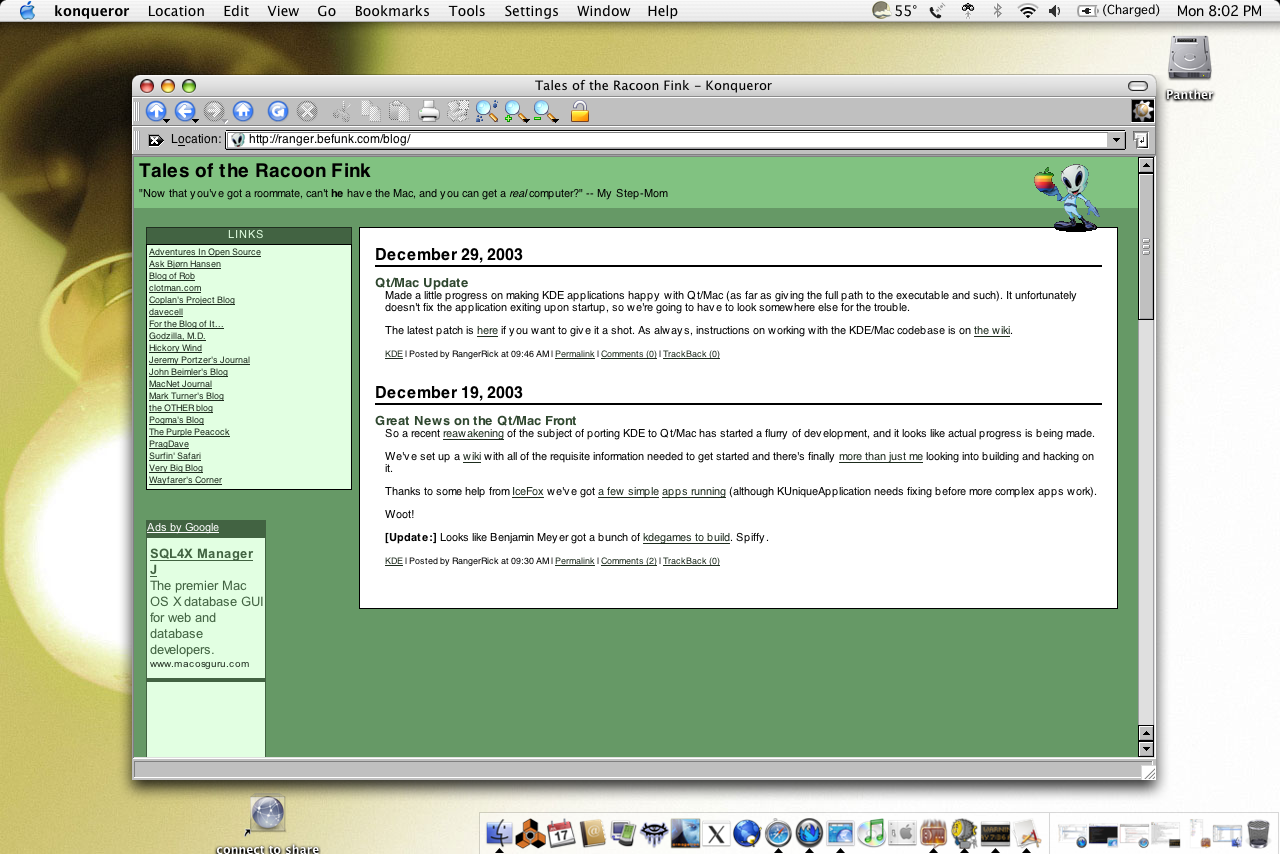
And, don't forget that Ranger Rick is still working on porting KOffice to OS X. There are now binaries available and if you're going to download all the KDE-on-OSX packages, you may as well use the all-packages torrent.
-
KOffice for OS X still moving forward
And, don't forget that Ranger Rick is still working on porting KOffice to OS X. There are now binaries available and if you're going to download all the KDE-on-OSX packages, you may as well use the all-packages torrent.
-
Re:pepsi
Hooray for Darwin indeed.
-
Re:MacOS X
The OpenDarwin FAQ is where my facts came from:
Justin Walker's description of Darwin's heritage is: Mac OS X began life as a child of OpenStep 4.x. The first stage in the evolution was the move from OpenStep 4.x to Rhapsody, which was based on BSD Lite2, with a batch of NeXT-instigated changes. When we shifted to Mac OS X from Rhapsody/Mac OS X Server, we incorporated FreeBSD 3.2 changes for the networking piece. The rest of the BSD portion of the kernel remained more or less as it was. At the same time, we (i.e., Fred, with your [Darwin's] help) pulled in command and library updates. Most of these are from FreeBSD, although I'm not positive about the heritage of the pieces that are now in the system.
-Jem -
Re:hm
I could be off base here, I don't have an XServe, but I am considering it.
The main reason one might want to use OS X Server over GNU/Linux or one of the other BSDs is the UI to the meat of your configuration. As many others have said, if you are a small design shop, you already have a person in house that keeps things running smooth. Odss are good that that person doesn't know or want to know Linux.
You can run quite a bit of your free software on an OS X box also, just look here and here.
The main reason I am looking at an XServe is that dollar for dollar it seems to beat up the competition.
I would really like to see a head to head between a Dual Proc. Xserve, comparable Opteron and comparable Xeon doing mundane tasks like Web/DB. -
Re:It's not that they're devils ....
It's not just associated with valour and giving ones life for "liberty".
It's a direct reference to a specific photograph of Iwo Jima. It is also associated with WWII. Landover Baptist might have a problem with the daemons, but the rest of the world might have a problem with the association with the US military.
Plus, it really is a crappy logo. It's a cute cartoon, and I appreciate its sentiment, but it's not going to get used in any magazine article on NetBSD, though. Not nearly as cool as Hexley, the Darwin logo. (He's a platypus wearing a daemon costume. Get it? Isn't he cute! If he weren't so dark skinned, they'd use him in magazines *everywhere*.) -
No point in discussing this with Apple
Finks has no association with Apple. There is a ports in the works. Its called DarwinPorts.
Doesn't have nearly as many packages as Fink does however. -
Re:Minor iNitRight here I guess in mach_init.tproj/bootstrap.c:
* If we are pid one, we have to exec init. Before doing so, we'll
* fork a child, and that will become the true mach_init.
* (...)
*/ -
Most of it.
Darwin is the core of OS X; but you don't get the higher level APIs.
-
Re:OS X on x86, I wish
Maybe if they offered some sort of lite x86 version
You can get Darwin (the OS X kernel) for x86 at http://developer.apple.com/darwin/
This is a single Installer CD that will boot and install Darwin on Macintosh computers supported by Mac OS X 10.3, as well as certain x86-based personal computers. The version of Darwin installed by this CD corresponds to the open source core of Mac OS X 10.3 and is available at the following URLs:
http://www.opensource.apple.com/darwinsource/image s/darwin-701.iso.gz
http://www.opendarwin.org/downloads/7.0.1/darwin-7 01.iso.gz
MD5 (darwin-701.iso.gz) = 57e9cb37e9595436596b2fa5975d5569