Slashdot Mirror
Domain: ornl.gov
Stories and comments across the archive that link to ornl.gov.
Comments · 647
-
Re:NEWS ALERT: Buttons on the TV can change channeThat is conveniently ignoring the fact that China has actually reduced their carbon emissions [peopledaily.com.cn] while developing their economy
The article you cite is very strange. In one section it talks about reducing emissions by 17% while in another part it says that it's emissions have increased by half the rate of growth of the economy. In other words, their emissions are still increasing, just not increasing as fast as the economy. That'd still be good, but it's curious which is right: Did their emissions decrease 17% or did they increase 18% (which is half the 36% rate of GDP growth?).
These are the kind of inconsistencies that you will constantly find in most of these articles. As the article also mentioned, this information was in rebuttle to President Bush citing the problem of emission exemptions in third world countries. Obviously they had to come back with something to rebut that. The fact is, the article itself says that since the 1980's China's emissions have increased 18%.
Regardless of whether or not they have reduced or increased emissions, the concern of the U.S. remains valid. If you slap emission restrictions on the developed world, the third world WILL pollute more. Whether or not China has done well in the last 5 years or so is irrelevant. If you chase industries out of the industrialized world with emission limits, believe me, past performance will be no indicator of future success.
as well as the fact that the U.S. was and still is the biggest polluter in the world.
We also are the most productive. If you look at it from a per-capita standpoint, UAE pollutes more than the U.S.. If you look at it from a per capita GDP, U.S. falls way down the list. I don't have a link for that because I haven't found that information published; but simply divide carbon emissions by per-capita GDP to get a better idea of how U.S. ranks.
You can't expect the largest, and one of the most efficient economies in the world to be so without polluting. Sure, an American might pollute 20 times as much someone from Sudan, but that American probably also generates 100 times more income (these are examples, I don't have the numbers handy).
I will not dispute that the U.S. is the largest polluter. I will dispute whether that single evaluation matters. You must compare pollution on a per capita GDP basis. Otherwise you are comparing apples to oranges.
Me: We are NOT witnessing an increase in surface temperature. Please explain to me why the satellite and radiosonde records both show global cooling and only the relatively unreliable surface record shows any warming whatsoever?
You: I'd like you to give me your sources on this, I'd be curious to read it.Sources on what? I believe I already provided a link to the radiosonde/satellite/surface record. But let me give you some links:
NASA: Radiosonde/satellite show cooling, surface record whows warming
Cooling trend found, slight warming due to strong El NiñoI'd like to provide more, but my wife is waiting so I must make this fast. Getting all these links together in one place is why I'm working on a site that will provide all this information quickly and easily without having to go to Google each time.
In fact, the only thing the discrepancy in surface measurments vs. satellite/radiosonde results indicates is that the real atmosphere is more complicated that the computer models we have of it so far (duh!).
Uh, the satellite/radiosonde record not coinciding with surface measurements has nothing to do with computer models. The surface record itself is inaccurate. That is to say, not surprisingly, it is much more accurate to send up electronic radiosondes and calibrated satellites than to depend on thousands of people checking thousands of different stations at thousands of different locations subject to thousands of potential anomolies.
That the computer models are broken isn't even an issue. The fact is, if you feed a working model broken (surface record) data it'll obviously break. If they want to come up with a valid model, they ought to be using valid data--and that would come from the radiosonde/satellite data. And that data shows a slight cooling trend over at least the last 23 years.
I don't doubt that the environmentalists could turn that satellite cooling trend into global warming over the next 50 years though. It's amazing what their models can produce, so leave it to them to take data that shows cooling and somehow conclude that there will be warming and rising sea levels 50 years from now.
it does not by itself substantially alter the expectation that some amount of global warming will occur in the future."
Can you not see the inherent bias? They are saying, "Well, here's data that shows global cooling over the last 23 years. But don't get complacent! That doesn't mean there won't be global warming." The disclaimer itself is telling.
The fact that there is a discrepancy doesn't mean that the surface temperature isn't in fact increasing - the only thing that has been questioned following the discovery of these differences is the computer model used to predict atmospheric changes, not the surface measurements!
Again, you're jumping the gun. We're not talking about computer models that are broken. We're talking about historic surface record data from the last 150 years that is the only record which suggests global warming is occurring--and that record seems to be substantially flawed when compared with what we know to be very accurate measurements of radiosondes and satellites.
If the satellites and radiosondes for the last 23 (satellites) to 50 (radiosondes) years are showing a slight cooling and the surface record shows heating, the surface measurements are not reliable. If the recent surface record over the last 25-50 years isn't even reliable, are we really to believe it was any more reliable 100 or 150 years ago?
I'm not even discussing whether or not the models work or not. I'm saying that even if the models were right, the environmentalists are feeding it bad data--GIGO. If you feed the models corrupt data that shows warming in the last 23 years during a time where satellites have shown that there hasn't been any, what do you expect the models to produce?
which according to NASA does not invalidate the fact that surface temperature are increasing
Please re-read the article and check for yourself what "satellite record" and "surface record" refers to. The satellite record is the temperature of ALL the atmosphere (from the surface on up) as recorded accurately by satellites. The "surface record" refers to measurements made by mini-weather stations around the world subject to individual station-by-station errors, human errors, expanding cities.
It's not a matter of the temperature of the surface. It's a matter of how the temperature was taken. The "surface record" is not reliable.
Even if it is not as bad as we may have thought, that doesn't mean it's not there - it just means we've bought some time to do the right thing.
In other words, "Global warming is probably real. But if it isn't, we should act like it is since all it means is that it isn't happening now but will probably happen someday."
I can't argue with that logic. If that's the way you see it then we might as well abandon all research--if our actions with or without global warming are the same, there's no reason to research it.
Incentives are not at all a way to "force" people. You don't have to follow them.
True, that's why I said they were incentives and not truly "forcing" anyone to do anything.
Let's say it another way. "Incentives" are a way of making a minority (or majority) do something they wouldn't otherwise do because the "majority" (government) thinks it's right.
I'm sure you already have taken up on government-sponsored incentives, wether it's tax breaks for retirement funds, or whatever. So that argument doesn't seem to be getting you anywhere.
Actually, I haven't. I work for myself and instead of getting tax breaks I get hit with unemployment tax. I'm funding someone elses incentives, apparently. Which is why it further pisses me off when they give incentives for something I don't even agree with. They're taking MY money to push ME to do something I don't want to.
Anyway, we're drifting. My real interest is in debating global warming. The whole "how big should government be" is a topic for another thread; and actually a topic I don't usually get into because it's a matter of opinion.
No, but he's not particularly friendly towards the United States and that could affect oil prices. It's a variable the Bush administration could do without, for sure. This is a clear case of national interests.
Perhaps you see it as such. I haven't seen Venezuela much affect oil prices except during the coup itself. Oil prices seem much more sensitive to the middle east, war on terror, demand, etc.
Well, it seems to me that the job of the media should be to report the truth, not try to manipulate public opinion against an elected leader because a single person (the owner) has decided so.
I agree. But what if the truth happens to agree with the owner? Then it's not manipulating, it's just a matter of the owner being right and the truth affecting public opinion, not "manipulating it."
the press covers up the truth and paints a darker picture than there really is, because its owner has a clear (and avowed) political agenda, showing soaps instead of images that would disprove its fabricated editorial line. Is that what you are defending? Because that is the analysis of about every independent media, despite the official Bush administration line.
First, I don't even know the Bush administration line.
Second, have you lived in Latin America? I currently live in Mexico and have for the past 6 years. I can assure you, the type of media you are describing in Venezuela is not unique to Venezuela. It's pretty much the norm for most Latin American countries because the governments are downright corrupt. It's difficult to find anything encouraging to report about any of them. And that's the TRUTH. I live here and can attest to it.
But in this case (and we are talking about a precise case, not some hypothetical future) the people didn't want him out - they demonstrated after the coup, causing it to misfire and fail.
And as such he's back in power and I accept that as much as him being out of power.
it's called voting, and in a democracy - even an grossly imperfect one - it is the only legitimate way to do it.
Let me answer my own question above: It is clear you haven't lived in Latin America and don't have much knowledge about what you're talking about.
That's the basic principle of democracy, and you can't say it doesn't apply when the situation doesn't suit your own interest. That is simply undemocratic, and nothing you have said challenges this argument.
Well, we really have diverged from the global warming debate and I'm not going to put much effort into the political side of this for the reasons mentioned above.
I also want to say that I'm in favor of emocracy 100%. I think it's the greatest thing since capitalism.
That said, having lived in Mexico which is now "moderately" democratic (having finally escaped 60+ years of domination by a single "democratic" party), I can also tell you that there comes a time when it becomes clear to a society that the government is so corrupt and the voting process so fraudulent that the only way to create a democracy is to tear it down and start again.
I truly believe that. So did the founding fathers of my country. Your mileage may vary.
I probably won't respond to anything else you say on the politial part of this subthread since what I'm really interested in debating is the global warming part.
-
Re:very disappointing
Hm.. the big issue is not really from whom the genome came from, but the fact that they used only one human to claim their complete sequence dataset. More serious attempts to map the human genome requires a lot more thorough examination, repeats, multiple sequencings etc.
The stakeholders should not complain about from whom the genome came form, but instead that the data generated is uncertain. I mean.. a scientific experiment with only one source, which was until now even not known to the public (or stakeholders). -
Re:Hydrogen is not free
Just set these bacteria loose in your swimming pool!
-
Re:Surprised it's intel based...
For single processor applications, the Athlon can keep pace in many tasks with the POWER-IV, but the Athlon can't match the internal bandwidth of the POWER IV nodes (4/8 proc cores on a module, higher L2 and memory bandwidth, etc). That does, of course, show up in that price tag
-
Re:1,800 intel processors?
Nah - 1800 POWER IV procs... now *that* would be some power (pun intended).
Kinda like this one. And that one is still pretty small (only 24 TB of disk, 4 TFLOPS... but *much* better memory/inter-proc bandwidth... -
Radioactivity in Coal
Yes. Here is a link.
Excerpt:
"Using these data, the releases of radioactive materials per typical plant can be calculated for any year. For the year 1982, assuming coal contains uranium and thorium concentrations of 1.3 ppm and 3.2 ppm, respectively, each typical plant released 5.2 tons of uranium (containing 74 pounds of uranium-235) and 12.8 tons of thorium that year. Total U.S. releases in 1982 (from 154 typical plants) amounted to 801 tons of uranium (containing 11,371 pounds of uranium-235) and 1971 tons of thorium. These figures account for only 74% of releases from combustion of coal from all sources. Releases in 1982 from worldwide combustion of 2800 million tons of coal totaled 3640 tons of uranium (containing 51,700 pounds of uranium-235) and 8960 tons of thorium.
Based on the predicted combustion of 2516 million tons of coal in the United States and 12,580 million tons worldwide during the year 2040, cumulative releases for the 100 years of coal combustion following 1937 are predicted to be:
U.S. release (from combustion of 111,716 million tons):
Uranium: 145,230 tons (containing 1031 tons of uranium-235)
Thorium: 357,491 tons
Worldwide release (from combustion of 637,409 million tons):
Uranium: 828,632 tons (containing 5883 tons of uranium-235)
Thorium: 2,039,709 tons"
And:
"Thus, by combining U.S. coal combustion from 1937 (440 million tons) through 1987 (661 million tons) with an estimated total in the year 2040 (2516 million tons), the total expected U.S. radioactivity release to the environment by 2040 can be determined. That total comes from the expected combustion of 111,716 million tons of coal with the release of 477,027,320 millicuries in the United States. Global releases of radioactivity from the predicted combustion of 637,409 million tons of coal would be 2,721,736,430 millicuries.
For comparison, according to NCRP Reports No. 92 and No. 95, population exposure from operation of 1000-MWe nuclear and coal-fired power plants amounts to 490 person-rem/year for coal plants and 4.8 person-rem/year for nuclear plants. Thus, the population effective dose equivalent from coal plants is 100 times that from nuclear plants. For the complete nuclear fuel cycle, from mining to reactor operation to waste disposal, the radiation dose is cited as 136 person-rem/year; the equivalent dose for coal use, from mining to power plant operation to waste disposal, is not listed in this report and is probably unknown."
-
This is a ways off. Until then
We can use nuclear power until cheap solar, and hydrogen from solar power, becomes a reality. We can build lotsa nuclear plants to make hydrogen to power pollutant-free hydrogen fuel cell cars.
One of the big culprits of smog is obviosly cars. We need to switch to hydrogen fuel cell cars. However, many people seem to think of hydrogen as an energy source. It isn't. You need electricity to make hydrogen.
Until we have cheap solar, you need to get the electricity from one of our old sources: coal, oil, nuclear, natural gas, etc.
Coal pollutes too much. We'd be overrun with smog if we built many more coal plants for hydrogen cars, much more so than if we used gasoline engines. We don't have enough oil to be energy independant. Natural gas is too expensive and we will run out of it in about 30 years. That leaves us with nuclear. Nuclear power is not as dangerous as people think. Also, Chernobyl-scale meltdowns in U.S. PWR are impossible. The Chernobyl reactor was a crappy commie RBMK reactor with no containment building. Of course we had the TMI reactor problem. However, that killed or injured no one. And, according to the World Health Org, only 31 people were killed in Chernobyl.
Fears of nuclear power are overblown. Radiation is just like any other pollutant. And you need a shyteload of radiation to really harm you. Nuclear power has killed a grand total of 35 people in it's entire exsistence. Coal power has killed somewhere in the neighborhood of 5 million people in this century, of emphysema, lung cancer, etc, etc.
Little known fact, but according to the Lawrence Livermore Nat'l lab, coal power realeases more radiation than nuclear power. Coal naturally contains some thorium and uranium. When you burn coal, this is realesed into the air. We burn so much fscking coal that we realease around 150 thousand tons of uranium and 350 thousand tons of thorium!!! The study is here. Nuclear power is also cheap. With some new tech, they have gotten the cost of some nuclear power plants below the cost of coal.
There is not mountains of nuclear waste made by our plants. Each plant only uses several tons of uranium a year. That would fit in an area just a few feet square. The total amount of waste ever created for a whole family for their whole lives would fit in a shoebox. If we reprocessed our fuel, it would fit in a pill bottle. Compare that to mountains of highly toxic coal waste with arsenic, cyanide, and other good stuff that just sits on the ground and leaches poisons into the groundwater.
Nuclear waste storage is very good. It's not like they are hauling it around in thin metal barrels like the environmentalists want you to think. No. The waste is transported in thick metal containers that have been tested by being thrown off cliffs, rammed into locomotives, and all sorts of crap. In Yucca mountain, the waste is stored inside these metal casks, which are in turn inside an ultra-thick concrete subterrainean room. Also, the storage place is 2,000 feet above the water table, so you're OK there.
Anyway, this plastic solar thing looks like it could be amazingly cheap and very clean. It would probably be easier for everyone to have these solar cells at their own homes. If Joe Smith put up 3,000 dollars worth of these solar cells, he could power his house for much cheaper than coal or nuclear.
However, you still have the energy storage problem. What happens to the power after dark or when it's cloudy? With this, you have an electrolyzer that takes some of your solar cell power during the daytime and splits it into hydrogen and oxygen. Then at night you recombine these components in a fuel cell to get power.
Home based solar plants are better than centralized ones for a few reasons:
1. Power loss over the lines. You lose over 10% of your electicity in the lines. Plus loss in transformers, etc.
2. Fuel cells are small devices. They are more suited for home use.
3. Independance from power companies (i.e. Enron)
Anyway, I don't think these solar cells will be ready for another 30 years or more. That is just my gut feeling. In the meantime:
1.Replace your incandescent bulbs with compact flourescent!!! The better brands put off a better, more natural light than even incandescent. They use so little electicity and last for so goddamn long that they are cheaper in the longrun.
2. Turn off the lights when you are not in the room!!!! There is no reason to have all the lights on. If you live in a house with you and your spouse, only one or two rooms should have the lights on. If you have your whole house lighted at night, you are really wasting energy.
3. During the daytime, set your hot water heater to "vacation." You don't need it to keep your water continously warm when you are at work. Turn it on when you get home. By dinnertime you will have plenty of hot water.
4. Buy "Energy Star" appliances. These will save you money in the long run.
For more info, go here.
It's pushback.com, San Francisco talk show host Dr. Bill Wattenburg's website. Lots of info on energy conservation and lots of other stuff, coming from someone with a doctorate, a masters, and a B.S., whos worked for Lockheed Missile and Space company, IBM, Lawrence Livermore, and other places. He is a rocket scientist. Listen to what he has to say. -
Re:Woo hoo!This won't solve our energy problems. It will help some though. It is only worth putting tidal plants in areas with large differences between high and low tide. These places are few and far between. Even when they do put plants in these places, they only produce a fraction of the power of a convetional plant.
To really solve the energy crisis w/o polluting, we need to build more nuclear power plants.
It's not so bad as people think. It doesn't pollute like coal. It's not expensive like natural gas. (which, BTW, also pollutes)
Coal pollutes too much. We'd be overrun with smog, much more so than if we used gasoline engines. We don't have enough oil to be energy independant. Natural gas is too expensive and we will run out of it in about 30 years. That leaves us with nuclear. Nuclear power is not as dangerous as people think. Also, a Chernobyl-scale meltdowns in U.S. PWR are impossible. The Chernobyl reactor was a crappy commie RBMK reactor with no containment building. Of course we had the TMI reactor problem. However, that killed or injured no one. And, according to the World Health Org, only 31 people were killed in Chernobyl.
Fears of nuclear power are overblown. Radiation is just like any other pollutant. And you need a shyteload of radiation to really harm you. Nuclear power has killed a grand total of 35-50 people in it's entire exsistence. Coal power has killed somewhere in the neighborhood of 5 million people.
Little known fact, but according to the Lawrence Livermore Nat'l lab, coal power realeases more radiation than nuclear power. Coal naturally contains some thorium and uranium. When you burn coal, this is realesed into the air. We burn so much fscking coal that we realease around 150 thousand tons of uranium and 350 thousand tons of thorium into the atmosphere!!! The study is here. Nuclear power is also cheap. With some new tech, they have gotten the cost of some nuclear power plants below the cost of coal.
There is not mountains of nuclear waste made by our plants. Each plant only uses several tons pounds of uranium a year. That would fit in an area just a few feet square. The total amount of waste ever created for a whole family for their whole lives would fit in a shoebox. If we reprocessed our fuel, it would fit in a pill bottle. Compare that to mountains of highly toxic coal waste with arsenic, cyanide, and other good stuff that just sits on the ground and leaches poisons into the groundwater.
Nuclear waste storage is very good. It's not like they are hauling it around in thin metal barrels like the environmentalists want you to think. No. The waste is transported in thick metal containers that have been tested by being thrown off cliffs, rammed into locomotives, and all sorts of crap. In Yucca mountain, the waste is stored inside these metal casks, which are in turn inside an ultra-thick concrete subterrainean room. Also, the storage place is 1,000 feet above the water table, so you're OK there. -
On cause and effectMore CO2 does not mean "more plants". Consider - plants are not spontaneously generated from CO2; instead, they grow from other plants. Increased CO2 levels don't somehow make plants more fertile, either. In addition, balance out the possible increase in plants due to CO2 with the decrease in plants due to human territorial expansion - you're still losing plants. Finally, plants need oxgen too. A balanced atmosphere is necessary for them as well; plants engage in both photosynthesis (during which CO2 is taken in and O2 emitted) and oxidative respiration, during which O2 is taken in. So, you end up with a net loss of plants and an atmosphere that's less breathable for humans, because there's less O2 (due to lack of plants) and more CO2. This is good how? Without the addition of CO2 by human industry, CO2 levels ought to stay relatively stable. Note in this graph that they have risen. This CO2 increase is directly tied to us, and it could affect us rather negatively.
Also - CFCs are merely a subset of greenhouse gasses. CO2, for example, is also a greenhouse gas. It doesn't matter how much we produce in net terms; what matters is how much we increase the amount of greenhouse gasses above natural levels, and whether the environment can tolerate those levels and facilitate conditions like those of our world today.
Sure, the planet's natural processes are formidable. But we can and do alter the environment with our activities, mostly negatively. We are not helpless; we should not deny responsibility for what we have done; we should not pretend that we couldn't, with some effort, make some minor changes for the better.
-
Devil's AdvocateThe majority of the posts I've seen seem to scoff at the idea the collapse of the Larsen Ice Shelf has any global signifigance, or that global warming is a problem. And they have some valid points - sure, the Earth's temperature has fluctuated wildly in the past; sure, not all of the recent increase in average global temperature is due to humans. But that doesn't make us innocent, or safe. The Earth and life as a whole may have weathered huge climactic shifts before - look at the end of the Ice Age. But such shifts tend to cause a lot of extinctions, and it is undeniable that the effects of human industry, territorial expansion, etc. have already caused many extinctions/endangered species/etc. So this climactic change is coming at a point when the global ecosystem is already stressed.
Global warming, whether caused by humans or not, is nothing to scoff at, either. Many people, particularly in third world nations, live on the coastline, in areas that would (and will) be innundated if and when a higher global temperature causes ocean levels to rise. This is a serious threat to the lives and livelihoods of many people. People in the third world can't simply move and buy another house, nor can they afford to maintain a system of dikes like those of the Netherlands. Whether or not humans caused global warming, it exists, as the collapse of the Larsen Ice Shelf indicates, and it is a threat.
In addition, it's true that a certain amount of melting, calving of icebergs, and such occurs with the change of seasons in Antartica. Thank you, whoever noted that sun causes ice to melt, for stating the obvious. But the Larsen Shelf was not noted for being susceptible to such seasonal oscillations - indeed, it was incredibly stable, and old. Ice sheets that are 200 meters thick and more than 3000 square miles big don't form or melt overnight. The instability which caused the collapse was a relatively recent development. That such a stable chunk of the Antarctican ice should disintegrate is of great concern.
Finally, while man may not have created global warming, our industrial revolution has certainly contributed. A previous poster listed these graphs. A temperature spike and carbon dioxide spike, coinciding with the industrial revolution, are clearly visible. We have contributed to global warming. Sure, we can't stop industry, and sure, we don't have effective alternative energy sources. But we can adopt less wasteful methods of doing things, and cleaner manufacturing processes. And if we never start seriously investigating alternative energy sources, we will certainly never make any progress in that realm. So don't dismiss global warming as a liberal joke, or a tool for Greenpeace. Perhaps humans didn't create it, but the Larsen Shelf's collapse joins a growing bank of data suggesting that warming does exist, and that humans have contributed to some extent. We should be concerned, because this does affect us, and our future.
-
Two graphs to consider.
If you're unsure where you stand on the issue of global warming, you might want to look at the following two graphs. The first shows that carbon dioxide levels are rapidly rising. There is no real question that this is much human induced. At the same time, global temperatures are also dramatically rising. Here the extent of human influence is more debatable. It is possible that an apparent cause (rising CO2) and an apparent effect (rising temperatures) are both happening independently but, coincidentally, at the same time. And, also at the same time, there is some other, unknown force causing the entire planet to heat. It truly is possible. But I wouldn't personally bet the world on that.
-
Re:CLI
and telling us that DNA = Distributed interNet Applications and != deoxyribonucleic acid...
of cause MS knows better than the Hunam Genome Program...
-
Re:Why folding?Protein folding is the "great problem" of bio-science today. The Human Genome Project is small taters next to the -real- big issue--The Proteome Project.
Genes are nice, they certainly ~do~ indicate predilictions towards diseases, behaviors etc, but proteisn are the actual workhorses of the body and the actual CAUSE of the diseases etc. The more we understand about proteins, the closer we are to understanding, well, just about everything about us. Read here for a nice intro.
And folding is the real stinker. We can get the gene that codes for a protein. We can see the little ribosomes chug along and make the protein. And then the protein folds up and that's why it works. If it folds like ~this~ it's normal, all friendly. If it folds like ~that~ it's a prion that convinces other normal proteins to fold up just like it and you die of Creutzfeldt-Jacob disease.
Finding some alien radio transmitter sure would be nice, but finding out why folks die from cystic fibrosis might be a better way to spend downtime.
-
DMCA ain't nothin' new...
-
Re:we ARE destroying the ecosystem
Actualy, the ozone hole has been disappearing for the past couple of years. We have only been monitoring the ozone layer for a few decades. It's stupid to say that freon emissions, for sure, caused the hole. It is most likely just natural fluctuations. Just saying the ozone is dissapearing from our meager 40 years of studying it is like watching the ocean tide going out and concluding that the ocean is dissapearing.
Which brings me to my next point: Global Warming.
We are having global warming. There is no question of that. The question is what is it caused by. Little known fact, but volcanism emits much more greenhouse gas than industry. More than likely, we're just entering into another warm period. Warm and cool periods (not ice ages or hell ages, much more mild) run in cycles about every 500 years. We entered into the present cool period in the middle ages, so we should be due to come out of it right about now.
Some environmentalists are well meaning. Others like "environmental lawyers", and the Sierra Club and Greenpeace head hanchos, are just in it for the money. A lot of things they do are counter-productive, like their opposition to nuclear power, even though it is cleaner and safer than coal.
Some environmentalists just like to whine about some issue. They may not be well informed about the subject, but they have a strong opinion anyway.
Take nuclear power: It is cheap and produces no pollution. A chernobly-scale meltdown (killing 31 according to the WHO) could not happen in our reactors. Nuclear waste does not last for 30,000 years. The highly radioactive fission byproducts decay in several decades. The rest of the waste is not highly radioactive. It decays to the level of Uranium ore in about 400 years. Also, it's not stored in thin metal drums. With Yucca Mountain, it will stored in thick lead, surrounded by thick steel, all inside a concrete-lined underground cavern. It's not going to contaminate the groundwater. If it somehow did contaminate the groundwater, no worries. Yucca mountain is in the middle of a restricted area where they have blown up hundreds of bombs anyway. Anyway, Plutonium Oxide like you have in nuke waste is not highly toxic. You can eat a few grams of it no problem. It passes right out of your system. Compare that to coal, mountains of arsenic and cyanide laced toxic ash that lasts forever not just 400 years. Also coal kills around 50000 each year in the US. That's like having hundreds of Chernobyls. Little known fact, but according the this Oak Ridge Nat'l Laboratory study here coal power realeases more radiation each year than dozens of reactor fuel loadings.
That is just one example of environmentalists not putting their thinking-caps on.
Another is genetic engineering:
When food is genetically engineered, they put a specific gene in. They know what that gene does! Also, a gene codes for a protein, nothing more. You can't get a mutant killer pig from genetic engineering. This is in contrast to normal crossbreeding with different varieties. Crossbreeding mixes the whole genome. The output is random. Back in the 60's, crossbreeding produced a carrot that was slightly toxic. Genetic Engineering could never make such a mistake. It's not "frankenfood". Yes, BT corn with its nontoxic-to-humans BT insecticide, could kill monarch butterflies. But that's not as bad as spraying highly toxic instecticide from a plane. I'm sure sprayed insecticide kills many more butterflies. Another argument is that GM crops could "contaminate" local populations of plants. The danger is no greater than highly modified regular crops contaminating a wild genepool. Genetic engineering could go a long way toward solving food problems. Theyv
-
Re:Treknologies?
-
pvm for windows has been around for ages.
our beowulf team (http://home.cwru.edu/beowulf) used pvm for linux, but pvm runs on everything including the kitchen sink. there are new builds of the win9x/nt versions of pvm out on http://www.csm.ornl.gov/pvm/ . it is a good system, i suggest putting all the doc files in one huge binder. not that bad to work with though...
-
Ofcourse you can cluster it!
Since the middleware runs on WinNT and friends, so will your applications (when properly ported ofcourse).
For example PVM, there are MPI implementations for WinNT too, I just don't remember any links of the top of my head.
-
Re:The study
All these scientists that signed the 2nd paper discounted what the
1st guys said and they did it with an overwhelming number of people
Last time I looked, the scientific method did not include petition drives
and petition signing contests. What you may not know about the "2nd
petition" that you mention is that it was circulated, like a piece of junk
mail, to many thousands of people having no expertise in climatology. I
know this because *I* got a copy, requesting my signature, even though my
work is in computer science and engineering. *Anyone* can sign that
"2nd petition" online, right here
. This petition drive is being lead by Frederick Seitz, President Emeritus,
Rockefeller University. Anyone recall
how the Rockefellers made their fortune?
The "2nd petition" is debunked in a
letter written by top scientists from the American Meteorological Society
(AMS) and the University Corporation for Atmospheric Research (UCAR).
It is a fact that
CO2 in the atmosphere is increasing, it is a matter of simple physics
that increased atmospheric CO2 will lead to higher temperatures. What,
to me, still seems debatable, is what the effects of those higher temperatures
will be on the Earth's ecosystems, and human civilization in particular.
Change is certain, but the nature of the change, and the relative benefits
and drawbacks, are unknown.
-
Global Warming Myths
After seeing loads of pseudo-science (on both sides), I took the time several months ago to look at the scientific literature and try to learn about the validity of claims that many laypeople made about global warming. The parent touched on a few of these, and I couldn't resist digging in...
1) Global temperature is decreasing.
No. Even the most cursory look into the subject should show this to be false. For an example, check out the graph on this page. Almost all of the literature I have read agrees on this. The debate comes in when you start talking about how much/why/is this natural?
2) The atmosphere already contains carbon dioxide and needs it in order to keep the Earth warm. Thus, more carbon dioxide is not bad.
While the atmosphere does contain significant amounts of CO2, the thing to remember is that it needs to maintain a balance. As an analogy, think of your body. If you don't have enough iron, you get sick (e.g. anemia). If you have too much iron, you also get sick.
One of the biggest sources of natural atmospheric CO2 is plant matter. At the end of the 19th century, human CO2 emissions were comparable to global plant matter emissions (~150 MMt). By the end of the 20th century, human emissions were 40 times greater than the plant CO2 emissions. You can check this up at the CDIAC site.
3) Global temperature increases can be explained by volcanic emissions.
Also not the case. In fact, one of the landmark papers (Mass, Portman 1989) actually showed that the net effect of each of the several largest 20th century volcanic eruptions was a decrease in global temperature. The reason for this is that, while volcanos do put significant amounts of CO2 into the atmosphere, they also release substantial quantities of particulate matter (e.g. ash). The effect of the latter is to decrease the net amount of sunlight reaching the Earth's surface.
4) Global warming can be explained via sun spots, orbit variations (Earth and/or lunar), etc.
I was unable to find very much evidence of this in the literature. I was, however, able to find a significant amount of "pop sci" articles supporting these theories.
The general consensus is that scientists do not know enough to fully evaluate the problem, but that humans do have a measurable effect on the atmosphere. The scientific side of the debate centers around the size of this effect, and whether or not it is significant. The atmosphere is incredibly complex, and we may never be able to fully describe it. To me, this appears to be as good an argument in favor of reducing emissions as any other.
On a side note, I found the following to be generally true of articles/papers about global warming: The "seriousness" and scientific legitimacy of such an article are inversely proportional to the concreteness of the claims. Papers claiming that "global warming is just a myth", that "global warming can be explained by some never-before-heard theory", or that "global warming is already upon us and will put most of the Earth's land underwater in the next few years" almost never appear in peer-reviewed scientific journals, while papers claiming that "we really don't know enough yet to make firm conclusions" almost never appear in pop sci magazines. -
Re:They said it enough - it must be true!Unfortunately you are assuming that the only waste product a coal fired power plant produces is nitrous oxide. However, coal plants release a wide variety of nasty substances such as, mercury, arsenic, chlorine, and lead as well as radioactive uranium and thorium. Oak Ridge National Lab has an article about the ammounts of radioactive pollutants released from nuclear as well as coal fired power plants.
Hooptie
-
Re:They said it enough - it must be true!Unfortunately you are assuming that the only waste product a coal fired power plant produces is nitrous oxide. However, coal plants release a wide variety of nasty substances such as, mercury, arsenic, chlorine, and lead as well as radioactive uranium and thorium. Oak Ridge National Lab has an article about the ammounts of radioactive pollutants released from nuclear as well as coal fired power plants.
Hooptie
-
Scaling using a server ring/tree
If you care about scaling... what about a server ring, in a kind like irc. You can add trusted servers (trusted on cheating sense) and balance the load between them on connection or even hotly using some kind of server change message.
You may also use a server tree in order to reduce the latency and keep a centralized data source, while keeping the circle for load balancing and other 'latency/inconsistency don't matter' tasks.
I have already constructed a load balancing system like that in PVM programs. I may help you in constructing such system if you are insterested in, althought my code and coding skills leds to C++ and I am not interested at all in learning C# vokimon.at.jet.dot.es
Vokimon.
-
Re:Implications?
People need to calm down about those "dirty bombs."
A kilogram of plutonium (huge amount by transuranic standards) could irradiate a small area. If you took a largish TNT bomb, you could spread the plutonium around a several-block wide area. According to Dr. Bill Watenberg, a prominint nuclear scientist with 2 PHD's, the people in this area would get about as much radiation as they would get from a chest X-ray. The real danger would be from the bomb blast and the resulting panic.
Plutonium is actualy heavier than lead, so plutonium particulates settle to the ground fast. And you don't have to worry about drinking contaminated water. You can orally take a couple of grams of plutonium with no ill effect. A 747 ramming into a reactor building probably wouldn't break through, so you don't need to really worry about terrorists ramming nuclear reactors.
Nuclear power has a suberb safety record, (chernobly killed i think 32) with no deaths in the US. Coal power kills around ~50,000 people a year. Read this report by Oak Ridge National Laboratory on coal radioactivity compared to nuclear power radioactivty. Coal plants are dumping more radioactivity (and other crap) into our atmosphere than we'd get if we just spread our nuke waste on the ground somewhere. And you can thank the non-logical retards at the Sierra Club and Greenpeace for our continued dependance on coal. Solar and wind are expensive and unreliable. Nuclear power, and ultimately fusion, is the answer to our energy problems.
Also, visit this site. Sorry, I just had to blow off some steam there. -
Re:The real trick is...
You got nuke power all wrong. Fission does not pollute. All radioactive waste ever created in all power plants would fit into a high scool gym. The rad waste is not as toxic as people say either. You could eat a few grams of plutonium with no ill effects. Also, believe it or not, coal power realeases more radioactivity than if we just dumped all of our nuke waste on the ground somewhere. Coal power realeases a grand total of about three million tons of uranium and thorium a year.Read the Oak Ridge National Lab report on this here. Meltdowns aren't as big of deals as people say either. Chernobyl only killed 31 people according to the World Health Organization. By comparison, coal power kills about ~50,000 people every year in the U.S. alone! Three Mile Island didn't kill or hurt anyone. A Chernobyl-type meltdown cannot happen in a US reactor. Our reactors have thick containment buildings designed to withstand a 747 impact. If there is a core meltdown, the radiation is contained. Chernobyl was a bad commie RBMK reactor that could meltdown easily. Also, it had no containment building, so the rad materials could escape fairly easily. With radioactive waste, I think most people have the conception of thin-metal barrels full of green sludge being callously dropped into the Yucca Mountain repository. It's not like that. First of all, the Yucca Mountain walls are of thick concrete. The waste itself is stored in thick metal, double walled containers. It's not going anywhere. Also, it's not leaky green sludge. It's metal! Not liquid or sludgy at all. If a magnitude 20 earthquake occured, the waste containers broke, and the metal burrowed all by itself 2000 feet through solid rock intil it hit the water table, it still wouldn't hurt anything. If taken in orally, as it would if it leaked into the water, plutonium is less toxic than aspirin. You'd have to drink several grams to hurt you. Radioactive waste declines in radioactivity by half in a few decades, and it decays down to the normal radioactivity of Uranium Ore in 500 years. If we reproccesed our fuel and used breeder reactors, the waste would be reduced by 2 orders of magnitude, and it would only last for 50 years. As for Fusion, the only radioactive thing is Tritium, an isotope of hydrogen. It has a half life of I think about 11 years or somthing. It is produced inside of the reactor as neutrons strike the lithium outer walls of the reactor. Tritium is not that dangerous. In the most horrific Fusion accident envisionable, the radioactivity realeased wouldn't even mean nearby houses would need to be evacuated. However, practical, cheap fusion is about 50 years off. For now, the best thing for our energy needs is hydrogen produced by fission power. It's cheaper than coal and doesn't pollute. Don't listen to the Sierra Club
-
You have plenty of accessAh, but you DO have access to cyclotrons and such. Most large facilities at government research labs have research user programs. There is a proposal process where you submit a research proposal There is a review process where the proposal committee sorts through the many that they get and decides which ones warrant time on whatever instrument was requested. Then the time on the instrument is scheduled and the researcher is told when to buy his plane ticket. It actually works quite well. Here are some samples of the places that you can get access to, provided that you have real science you want to do and the knowledge required to someday publish your results:
-
For those interested in the ethical/moral issues..
Though most of the issues are readily apparent and most people are at least partially familiar with them, there are some that I foun to be quite interesting (especially the commercialization aspect of genetic code):
Ethical, legal, and social issues -
Re:Actually ...Go here to get some info on gene patenting. From that site:
Gene Tests
As disease genes are found, complementary gene tests are developed to screen for the gene in humans who suspect they may be at risk for developing the disease. These tests are usually patented and licensed by the owners of the disease gene patent. Royalties are due the patent holder each time the tests are administered, and only licensed entities can conduct the tests.I bet this was what the 60 minutes episode was about. They patent the detection test, not the naturally occurring gene.
I do agree that there are problems with gene patenting, but it is not the issue most in the public think it is. They think companies are patenting the genes in their body (probably from watching misleading 60 minutes episodes
-
Re:A quick look at the Ac-225 decay chain...
so I poked around the chart of the nuclides to see how one would make Ac-225[...]But Ac-225 doesn't seem to have any such nice precursor decay paths with short half-lives.
I did a bit of web searching (with my CRC "Table of the Isotopes" handy), and it looks like the key is Uranium-233.
U-233 can be formed in a breeder reactor from Th-232, by: Th-232 + n -> Th-233 -> Pa-233 + e- -> U-233 + e-
Once you have the U-233, U-233 -> Th-229 + alpha -> Ra-225 + alpha -> Ac-225 + e-
This page at ORNL indicates they have a stockpile of 400kg of Uranium-233, and are "the only significant source of bismuth-213 [3 decays down from Ac-225, also useful for cancer treatment] in the western hemisphere". -
At the risk of slashdotting them...More stuff on Buckminster Fullerine (an outstanding name for a molecule if ever there was one!) can be found here:
- US National Labs rotating Java model (doesn't show the bonds though).
- loads of static models at Rice.edu.
-
Maybe something here ...I have never set one up, but maybe visiting the Beowulf might be a good starting point. Other links include the Beowulf Clusters page at Yahoo and the Oak Ridge Extreme Linux Page.
If you don't find any answers to your quest then you could always buy 10 dual-processor machines, configure one and then copy its HD image to the other 9 ( I have never tried this ).
-
Re:US foreign policy, not global trade, the issue
You're right it is innapropriate. Lava, at 1,000 to 1,500 degrees kelvin, is only three to five times hotter than my bathwater, which I like to keep between 300 and 310 degrees kelvin. It doesn't seem particularly ridiculous to suggest that concentrated Uranium 238 could be three to five times as radioactive as my monitor. Of course, comparing the electromagnetic radiation of a computer monitor to the nuclear radiation from uranium is comparing apples to oranges anyway.
Let's try, oh, mercury concentrations in your drinking water instead of this temperature bullshit. Multiplying the amount of mercury in your drinking water by ten isn't going to result in any premature death.
I wasn't talking about the electromagnetic radiation from your monitor, I was talking about the natural radioactivity as a result of trace radioactive elements in the monitor's structure.
As for using U238 for radiation shielding... I'm sure you could. It would make about as much sense as using acetic acid to wash hydrochloric acid out of your eyes instead of water or, better yet, saline solution. In other words, sure you could, but non-radioctive lead would more sense. The only reason you would want to is if you wanted to deal with something extremely radiactive and the U238 was the only sheilding available.
More like using tap water to wash out your eyes instead of distilled water.
According to http://www.ieer.org/fctsheet/pu-props.html, the radioactivity of Plutonium is 17.3 curies/gram. http://www.physics.isu.edu/radinf/natural.htm puts the radioactivity of Uranium at 0.7pCi/g, around twenty million times less. And lastly, http://www.pu.org/main/facts/pu.html has a picture of a guy handling a big lump of plutonium just wrapped in plastic, wearing nothing but some rubber gloves.
Actually, yes. I worry about radon too, but it's not an issue in my appartment.
I wasn't talking about radon, I was talking about uranium in the coal exhaust. According to http://www.ornl.gov/ORNLReview/rev26-34/text/colma in.html, worldwide about 5,000 tons of uranium and 12,000 tons of thorium were released into the atmosphere by coal burning.
And yet nobody seems to worry about that anywhere near like people worry about the much smaller amount of uranium involved in the A-10's depleted uranium ammunition.
Yes. It never ceases to amaze me either. That's why I wrote a reply in response to a poster who claimed that so-called "depleted" uranium isn't radioactive.
I didn't say it wasn't radioactive, just that it's not radioactive enough to worry about.
Now that one of us has quoted some numbers to support his argument, is the other one going to? Something tells me it's just going to be more of the same bullshit. -
Re:It has to be said, and said early on...
Imagine a Beowulf cluster of these!
Less funny than you think. Appropriately one of the first Beowulf clusters was called the Stone Soupercomputer. Not that they built it out of stone; it was named after the parable of the Stone Soup.
There's an article about it in this month's Scientific American.
-
Coal-fired power plants and Bombs
Any nation with a coal-fired power plant has access to nuclear materials. And I quote:
Funny that no one is worried about keeping track of any of this weapons material.
-nukebuddy -
Government codes are "open source"Almost all the code for this kind of thing is, "Open Source". Anyone who needs it will get it as a source code distribution. They don't make binary distributions because of all the different hardware this is run on. See Oak Ridge's order page as an example. NT junk, yeah, there are some packages that have been distributed as Win executables, but they are troublesome to maintain and are generally on the same disk as the source itself. I know of one package that was broken by changes from 95 to 98 for example.
They may not be Free, and they might even cost you money, but no scientist would ever trust a closed source binary for important work.
-NuclearArchaologist posting as anonymous with broken cookies and without his password
-
Re:Government Code Centers
While someone involved may mean well, the fee is $1150 per package to the general public. http://www-rsicc.ornl.gov/ORDER.html In the internet age that doesn't sound "nominal" to me for casual use or education. The license also does not allow redistribution or making derivative works. This is our tax dollars at work? How do they justify these fees or prevention of derivative works? How can an independent scientist afford to verify the workings of these code packages to see that the assumptions in them are reasonable? My opinion is all publicly funded content should be released under a free license (copyleft or not), although I acknowledge that rights of privacy, authors moral rights, and national security issues should also be respected.
-
Government Code CentersThe Department of Energy does have requirements that code developed with govement funding must be released through a code center. In my field (Nuclear Engineering) the code center is the Radiation Shielding Information Computational Center (RSICC). They have distributed codes for a nominal distribution fee for decades.
For more info see:
-
There comes a time when more speed doesn't matter
So, I have a 1.2GHZ athelon. Do I really need a Xeon. No. There compes a point where the marginal benefit of speed increases becomes negligable, and the cost effectiveness of upgrading to get that additional marginal performance, disappears. I believe that occurred when we entered the GHZ range of measurement for clock speeds. Aside from compiling kernels (which an earlier poster correctly pointed out, should only happen infrequently) What does your adverage user need this kind of speed for?
Is it so we can tell our friends "My Computer is bigger than yours" ?
Do we really need to continue to upgrade at this point? I grant you the marginal benefit of moving from 9 Mhz to 16Mhz is extremely large, as is the marginal benefit of moving to 33 and 66 mhz. As soon as we hit 90 though, that benefit began to dwindle. It became a crutch for bad code, an excuse for Microsoft to write bloated operating systems.
Then AMD began competing heavily and forced a shortening of the product cycle... Was this truly good for consumers? I ended up upgrading my system three times in two years. It gets expensive after a while, and with OS vendors all too happy to force consumers onto new hardware, through distribution of poorly written overdone and over-typed software, the consumer doesn't truly benefit at all.
Certainly hardware vendors benefit, but when it comes down to it you have to ask yourself, Do we really need all this speed?
OK, to be perfectly fair, some of us do; yah, those of us who are processing data from the Genome Project in our spare time...
--CTH
-- -
Coal Plant == RadiationCoal fired power plants release much more radiation
There is more information on this aviable at http://www.ornl.gov/ORNLReview/rev26-34/text/coal
m ain.html.
----- -
Re:I disagree.
Whatever your political persuasion is, I think you ought to be really scared about the possibility of this. There's a good reason that the ethics committee from the Human Genome Project unanimously decided that insurance companies should not have access to this sort of information. You want to know who loses? Listen to the experts.
"I may not have morals, but I have standards." -
Re:Earth's oceans are essential to climate
Here are the correct image URLs (from Quarternary Environment Project) should work:
- US vegetation for Gulf Stream OFF (Ice Age conditions)
- US vegetation for Gulf Stream ON (present day conditions)
-
Re: point well missedOr maybe misrepresented on my original post so here goes...
yes encryption IS a good thing for people like NIST to put resources into. You need people at the top of the field, and it helps that the organization's interests fall right in line with having an open, secure encryption system.
Agreed, but lets take a quick look at some of the branches of government doing the same, when one should be enough. Why can't one agency focus on this? Isn't NIST supposed to be the standard?
Sandia researchers develop world's fastest encryptor
ORNL Helps Develop Electronic Notebooks (read article to see crypto stuff)
GRIP -- Gigabit Rate IPSec (Army)
Cancer research (I never knew cancer genes needed encryption)
WING (DARPA)
NASA (why can't they look to NIST?)
Key Agile ATM (DARPA)
And theres a slew more. I agree that government should promote better standards, but instead of spending X millions on a bunch of bs, they should look to consolidate it all, which is what my main post should've stated I guess. Some of this so called research, or development never even sees the light of day due to timing situations. One part of government may intend to develop and deploy something, but it won't always happen, meaning all that money used for those projects are now gone, and they're left to ask for more money for some new project, never using their own resources to see if another agency can assist them. -
Re:stupid q: but WHat IS?
They were also discovered (I think) by scientifical-types who were shooting lasers at graphite , for some reason. This somehow made buckyballs, adn they said to themselves 'this is nifty. I bet we could put a bunch of shit in here'.
According to my semi-unreliable memory, buckyballs are fairly toxic, and make a fine black powder when they're together.
Scientists have also found buckyballs filled with helium in the ground where comet/meteor strikes have occured. This article on popular science has some details about that.
Brant -
Re:"Stone Soup"?
Here's the story, along with (sigh!) a (pretty cool) BEOWOLF CLUSTER!
I hate to do it, but it's actually on topic.
-
This isn't earth-shattering kids...Gridware isn't all that new, and it isn't a reaction to Mosix or SETI@home.
Batch systems have been around a long time in the HPC world. Gridware was orginally developed by GENIAS Software GmbH. GENIAS produced a batch scheduler called Codine, which was a commercial version of DQS. In fact, Sun's Grid Engine FAQ even states that Sun Grid Engine is a new name for CODINE.
Of course, DQS/Codine/Grid isn't the only batch-scheduling/cycle-scavenging game around. Other players are:
- Condor
- openPBS and it's commercial version PBS Pro
- Load Leveler (which IIRC is IBM's commercial implementation derived from Condor)
- LSF which is the product Sun was previously co-marketing until they purchased Gridware (probably because of the high per CPU cost of LSF).
- and lots of others that I've forgotten, many based on the once-common NQS/NQE batch system.
- There are also systems like Legion that represent a sort of ``next step'' computing enviroment.
Many of these predate newcomers like SETI@home and Mosix by serveral years. Most also provide hooks into parallel computing APIs like MPI, PVM, openMP, or something similar.
Batch scheduling and cycle-scavening are old concepts. Having wasted away my years as a graduate student submitting large quantum chem jobs to Crays, it's nice to see lots of groups continuing to squeeze every useful cycle out of existing hardware. Sun's recent annoucements are just the latest update to an old product---not a new idea, and not a Mosix/SETI rip-off.
-
Global warming could cause new ice age
What can global warming do? According to the widely accepted Rahmstorf bifurcation model of Atlantic thermohaline circulation, small increases above a threshold level in freshwater precipitation over the North Atlantic region can trigger a long-term Gulf Stream shutdown, a.k.a. an Ice Age.A super-threshold increase in freshwater supply to the North Atlantic area is one of the most stable effects predicted in simulations by coupled ocean-atmosphere models of climate for any future increased levels of atmospheric CO2.
Would an ice age be so bad? Well, which of the two states below do you prefer?
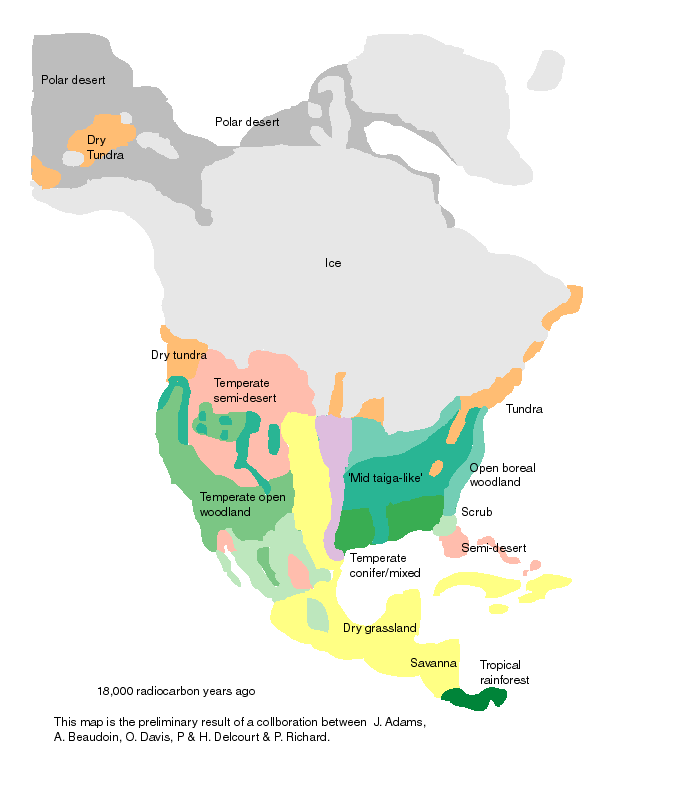
A. Gulf Stream OFF image of US vegetation (Ice Age conditions)
or
B. Gulf Stream ON image of US vegetation (present day conditions)
What does an ice age do? On land, agricultural productivity in the major food producers like the US and N.Europe would collapse due to freezing temperatures. Reduced ocean circulation would also cut precipitation in other regions of the world, creating droughts. In the sea, the much reduced ocean circulation would be unable to replenish marine nutrients in vital high-latitude oceans, i.e., marine productivity and fishing harvests would also collapse.
-
Global warming could cause new ice age
What can global warming do? According to the widely accepted Rahmstorf bifurcation model of Atlantic thermohaline circulation, small increases above a threshold level in freshwater precipitation over the North Atlantic region can trigger a long-term Gulf Stream shutdown, a.k.a. an Ice Age.A super-threshold increase in freshwater supply to the North Atlantic area is one of the most stable effects predicted in simulations by coupled ocean-atmosphere models of climate for any future increased levels of atmospheric CO2.
Would an ice age be so bad? Well, which of the two states below do you prefer?
A. Gulf Stream OFF image of US vegetation (Ice Age conditions)
or
B. Gulf Stream ON image of US vegetation (present day conditions)
What does an ice age do? On land, agricultural productivity in the major food producers like the US and N.Europe would collapse due to freezing temperatures. Reduced ocean circulation would also cut precipitation in other regions of the world, creating droughts. In the sea, the much reduced ocean circulation would be unable to replenish marine nutrients in vital high-latitude oceans, i.e., marine productivity and fishing harvests would also collapse.
-
MTOPS is an invalid scale
Not that I can think of a better one right now.
We all know that if you take enough low-powered machines, of the sort that anyone can get hold of, such as low-end pentiums, even 486's, etc. and stick them in a big enough warehouse, you can build machines that will out-compute any commercially available off-the-shelf single supercomputer. You only have to look at the Stone SouperComputer to see what is possible.
Hopefully, Saddam hasn't got the hang of -
Re:I wonder.The math is not that hard. The failed Chernobyl plant was producing 1600 megawatts (now the limit is 700MW for that type of reactor). A U.S. style 1,000MW coal-fired power plant burns 4 million tons of coal a year and emits 5.2 tons of uranium and 12.8 tons of thorium. These emit 17,100 millicuries of radiation per power plant.
2 coal plants to replace the failed Chernobyl one emit 10.4 tons of uranium and 25.6 tons of thorium, and a total of 34,200 millicuries (34 curies) of radiation per year. So operating for a million years they would emit 34 million curies.
8 tons of Chernobyl fuel was blasted out of the plant, in addition to radioactive gas leaks. "Several million curies" to "50 million curies" were released.
-
US needs Gulf Stream on or else ICE AGE!