Slashdot Mirror
Domain: ornl.gov
Stories and comments across the archive that link to ornl.gov.
Comments · 647
-
Re:DNA upon arrest and those awaiting trial
your DNA is not very likely to be there
It may surprise you to know that DNA "matches" do not compare the entire genome. So, based on a partial genome match "your" DNA just might be there. http://www.ornl.gov/sci/techresources/Human_Genome/elsi/forensics.shtmlIf you have a reasonable excuse as to why it may have been there, the DNA is automatically useless.
Care to bet YOUR life on that?When some one is killed violently and your DNA is found...
See the first response. -
Re:Job's got it right....
TMI wasn't caused by a computer failure but the accident was made vastly worse by an error of computer design. Specifically, TMI-2 had a terrible user interface.
See, See. UI is important!!!!
I'm a nuclear engineer and I think the use of the term UI for the control room is somewhat 'simplistic'. I personally think a major issue was over design in a certain area (redundant alarms), and lack of safety systems that would prevent the core from melting even with a LOCA in place. It was two hours after the shutdown when the fuel melting began at TMI-2. This was a scenario where the operators couldn't understand what was happening. Now from an operator's perspective (who sits in the operator room) you're not looking at a "UI" in the traditional CS sense. Here is an image of a control room: http://www.ornl.gov/info/ornlreview/v38_1_05/images/a11_controls_full.jpg The events leading up to the disaster started on the secondary side (non-core) leading to a LOCA (Loss of Coolant Accident). For those unfamiliar with the term "secondary side". The secondary side of a Nuclear Power Plant is similar to that of any power generating plant, meaning the secondary side does not contain the reactor core.
-
Re:Satellite smoke
It should be pretty though. Iridium comes from the greek word for rainbow, iris: think of all the pretty shiny bits strewn across the sky.
It's a shame it was Iridium-33 that got pummelled. If it were Iridium-192, it would have decayed into platinum and made that rainbow so much more beautiful.
-
radware in nuclear physics
This is a big suite of software used for nuclear physics experiments (gamma-ray spectroscopy). It was open-source before the term "open-source" was invented. I believe all the acquisition software for big gamma-ray detector arrays is also open-source stuff written mostly at Berkeley.
-
Re:Nuclear Dump
Data is old but still interesting
http://www.ornl.gov/info/ornlreview/rev26-34/text/colmain.html
-
Re:Mystery Pits
Excuse me, Sir? With all due respect, you're full of crap. Not a single point in your post is correct. Conventional explosives are NOT sufficient to aresolise nuclear materials, conventional explosives are NOT sufficient to disperse the materials over a wide area, Uranium is NOT highly radioactive, some forms of Plutonium ARE reasonably radioactive but primarily degrade as Alpha radiation (effectively harmless since aresolising Pu-238 is difficult and ineffective), being near Uranium or Plutonium does NOT pose a significant health hazard, millions of people will not die, and you sir have become a pawn of terrorism. Just as the media has. There is no real-world basis for the claims you are making about dirty bombs.
If you want to save lives from radiation dispersion, stop coal plants from dispersing radioactive materials in their smoke. Stop people from smoking cigarettes. Stop the use of oil and natural gas. Stop foreign nations from performing nuclear tests. (The US and Russia already contaminated the world back in the 50s and 60s.) Because those are the REAL sources of contamination. Coal burning alone outweighs the effects of a dirty bomb by several orders of magnitude.
So with all due respect, please educate yourself before propagating misinformation.
-
Re:"little known" ???
Ya, if the climate dictates, you'd have to make it deeper.
I did a little more research on this today. I lost my old bookmarks (switching computers too much, and reinstalling for fun), so I don't have the good sites. I did find a couple pages on Wikipedia though. Search "Ground-coupled heat exchanger" and "Geothermal heat pump".
I was talking to a friend in Alaska about this. A long time ago, I had read about setting up for the nuclear tests at Amchitka, Alaska. If I remember the details right, when they dug down to make the cavern, at about 100 feet, they were working in total darkness and effectively deaf due to the digging machine noises. The temperature was over 100 degrees due to geothermal activity. That's a long way from Anchorage though, even though both are geologically unstable (expect your pipes to break in the next earthquake). He took the opportunity to tell me about an earthquake in the 1964 that destroyed over 100 buildings in Anchorage. He noted one part of town that I drove through, that was a small valley, was flat land previous to 1964.
I was trying to find how deep they'd have to go in the Anchorage area to find warm ground. I found the building codes dictate all underground water pipes must be 10 feet deep. My friend confirmed that, but said even at 10 feet, they have water pipe freezes and bursts in the winter.
The purpose of that mental exercise was to find a way to warm a friend's cabin, in the middle of nowhere. The air temperature recently was 35F below zero, and that didn't account for the wind chill. Brrr.
I found this page which they tested such a system, where the air temperature would reach 10F. They buried their pipes 4 feet deep, but ran electric heat for 4 months of the year. They should have gone deeper.
I still haven't found a good answer for "how deep", but obviously 10 feet isn't enough in Anchorage. It probably requires a prolonged test with thermometers at different depths, to test the local conditions. I know soil composition makes a big difference too.
Here in Florida, if you go too deep, you find ground water pretty easily. Water wells can be as shallow as just a few feet here. When I was a kid, we had a water well, that was dug into a cavern at just about 30 feet.
-
Numbers don't seem to add up
Some facts as I understand them snarfed from the web - corrections welcomed...
rough cost of (wholesale) energy per kilowatt hour (kwh): ~5c
CO2 cost per kwh: ~1kg (coal power: http://cdiac.ornl.gov/pns/faq.html)
time for my (small) 1 litre (~ 1kw) kettle to boil when full is ~ 5 minutes which compares well with the theoretical energy for a 1litre at ~350kj, or 350 seconds time for 1kw . Hence power for a small boiled kettle is a killowatt for 1/10 of an hour, or 0.1 kwhSo I get...
Kettle boiling: costs ~.5c, and ~ 100g,If the article was true, Google doing "more than 200m" searches a day would spend ~ $20m a day on power, or ~ $7billion a year, consuming 100,000 megawatt hours, or a continuous drain of 4,000 megawatts (about the power output of a small US state). On the authors figures, total power consumption would be ~ 650 megawatts, which is still pretty huge, and would still be spending ~ $1billion a year.
Google use cheap, mass produced low power units in gigantic numbers - estimates are hard to come by, I will estimate 200,000 based on inflating some public estimates (e.g. http://arnab.org/blog/how-many-computers-does-google-have).
Energy cost of networking is significant, but I do not believe as great as machines; I'll add 50% for good luck. Utility server machines are dropping in power (~100-200w) but also require cooling, UPSs and network etc., so let's call it 500w all up (figures are difficult to get; everyone is selling something power center wise) - so I get 100 megawatts; or 1/6th of the author's estimate, or 1/40th of the true kettle figure.
I'd say that the author is overstating the case to make a political point - if I was cynical I'd point out the author has also just launched a business to 'green your web site' by installing monitoring software, estimating the energy cost of searches to it, and then buying carbon offsets on your behalf, so it is in his interests to overestimate such usage..
-
Re:This again!
Toxic yes, however nobody can find the radioactive waste. That is an assumption of pollution controls as a simple black box from a paper in the 1970s among other flaws.
Thorium and uranium aren't radioactive?
ORNL report (ORNL = government funded nuclear research lab)
Trace quantities of uranium in coal range from less than 1 part per million (ppm) in some samples to around 10 ppm in others. Generally, the amount of thorium contained in coal is about 2.5 times greater than the amount of uranium. For a large number of coal samples, according to Environmental Protection Agency figures released in 1984, average values of uranium and thorium content have been determined to be 1.3 ppm and 3.2 ppm, respectively.
The concentration of fissionable uranium-235 (the current fuel for nuclear power plants) has been established to be 0.71% of uranium content.
Total U.S. releases in 1982 (from 154 typical plants) amounted to 801 tons of uranium (containing 11,371 pounds of uranium-235) and 1971 tons of thorium.
Feel free to argue specific numbers, but here are the facts:
1. Coal contains thorium and uranium
2. Burning coal releases coal ash into the air
3. Coal ash contains (surprise!) thorium and uranium
4. Thorium and uranium are radioactive
5. Therefore, burning coal releases radioactive waste into the environment.We've had more than thirty years to try to find the stuff. So much for "definitely".
We found it in 1978. And 1982. And 1984. And in the 1990s. Yes, coal definitely contains thorium and uranium.
We've had more than thirty years to find radioactive elements in coal, and every time we look, we find them!
A lot of these studies are old mostly because there's no real reason to do them again. Coal emits both toxic and radioactive waste into the environment. We know this. We (mostly) don't care.
As I keep saying in different ways, people die from the use of coal by various real events so we don't have to make new ones up. This bullshit was just a "why worry about nuclear waste, coal is nuclear waste too" stunt by a PR firm that should have known better (it didn't help the nuclear lobby either) and unfortunately it stuck in people's heads
PR stunt or not, it is correct.
Here's some more reading:
"Coal Ash Is More Radioactive than Nuclear Waste" from Scientific American.I can find tons of screaming eco-freak sites about coal radioactivity, but I've tried to stick to rational, scientific sources.
Coal ash is (very slightly) radioactive due to it containing trace amounts of thorium and uranium. It's not actually a big deal overall, unless you happen to live near a coal plant - which some people do. Oops. Sucks to be those people!
-
Re:Let me guess...
That's the thing that kind of bugs me is that Global Climate change gets all of the attention at the expense, it seems, over other issues. For example, coal fired power plants.
Coal-fired power-stations DO contribute to global warming.
And sadly, you've proven GPs point. You're worried about the CO2 emissions of coal plants, while completely oblivious to the other emissions coal plants produce. But no... we can't save the environment from nuclear radiation. Let's all wait while another
-
Jaguar fastest for "open scientific research"
Contrary to our discussion a few days back, IBM's last-minute upgrade of RoadRunner salvaged the top spot for Big Blue.
While the IBM machine is still technically the world's fastest, the referenced article claims that Jaguar is the world's fastest supercomputer for OPEN SCIENTIFIC RESEARCH, which is true. The Roadrunner system, on the other hand, is mainly used in classified research.
-
Re:Please no climate modelling!
Who says the climate modeling they are doing is related to global warming?
Oak Ridge does: "Climate scientists are calculating the potential consequences of greenhouse gas emissions and the potential benefits of limiting these emissions."
-
not that great
It's been offline a lot this month...
-
Re:In other news...
EVERYTHING in the universe is radioactive to some degree. Except for iron.
Someone tell that to Iron 55.
-
Re:Amazing that we are forgetting the simple ones
According to this article, we're absorbing more light than only 8000 years ago:
http://www.esd.ornl.gov/projects/qen/nercNORTHAMERICA.html
Lots more forest coverage (plants are good, right?) means that we're absorbing a lot more heat from the light just because we aren't cutting down as many trees. Ice is retreating, which is also absorbing more heat... I think I agree with you. 1% more reflected is not going to make much of a dent.
-
Re:Like something out of Robinson's work
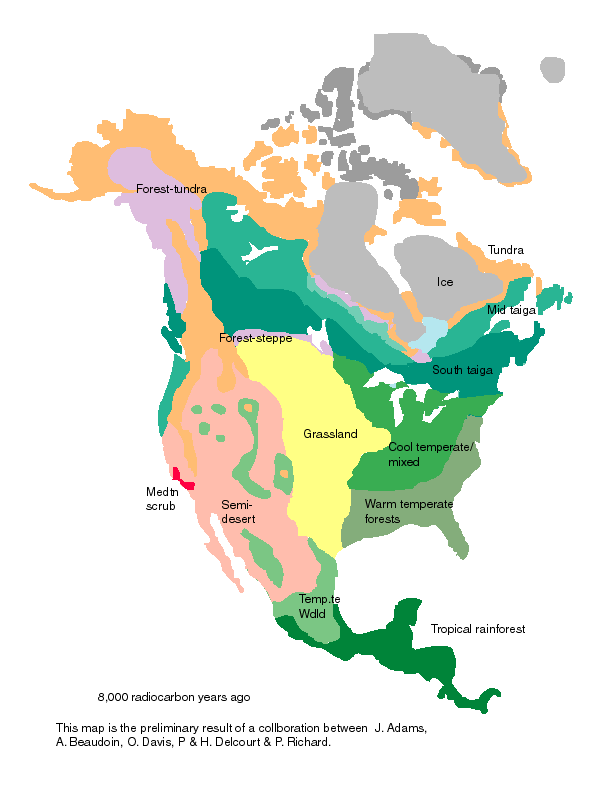
Wanna see something interesting? Here's North America 8000 years ago:
http://www.esd.ornl.gov/projects/qen/NA8kyr.gif
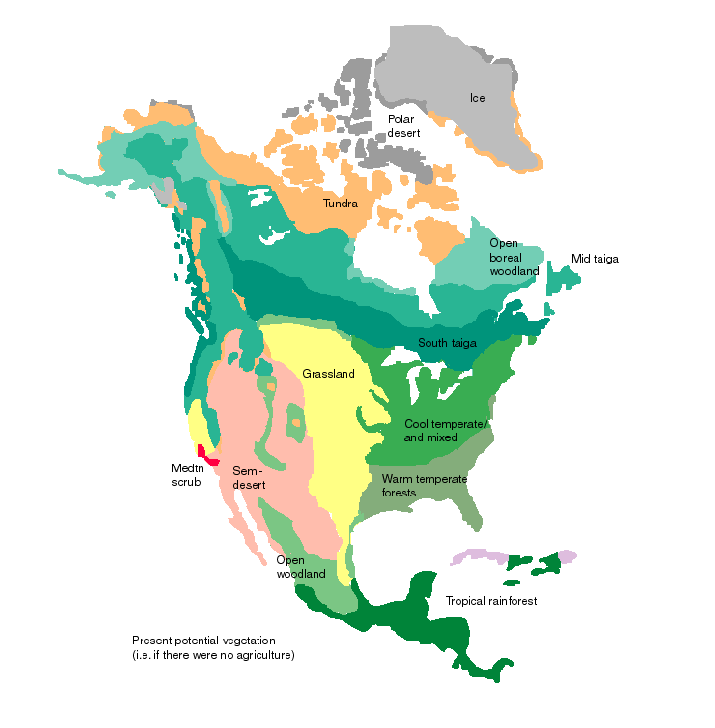
And here it is today:
http://www.esd.ornl.gov/projects/qen/NAprsnt.gif
Looks like we're already seeing lots of "terraforming" and reflection changing, due to the amount of plant cover, which makes the planet absorb significantly more heat from the sun (dark colors from plant cover = more energy absorption).
Things change. We save the trees like the environmentalists want, and it makes the earth warmer. Not a very hard thing to understand, and all the mechanisms are well vetted.
Those images are from here: http://www.esd.ornl.gov/projects/qen/nercNORTHAMERICA.html
-
Re:Like something out of Robinson's work
Wanna see something interesting? Here's North America 8000 years ago:
http://www.esd.ornl.gov/projects/qen/NA8kyr.gif
And here it is today:
http://www.esd.ornl.gov/projects/qen/NAprsnt.gif
Looks like we're already seeing lots of "terraforming" and reflection changing, due to the amount of plant cover, which makes the planet absorb significantly more heat from the sun (dark colors from plant cover = more energy absorption).
Things change. We save the trees like the environmentalists want, and it makes the earth warmer. Not a very hard thing to understand, and all the mechanisms are well vetted.
Those images are from here: http://www.esd.ornl.gov/projects/qen/nercNORTHAMERICA.html
-
Re:Like something out of Robinson's work
Wanna see something interesting? Here's North America 8000 years ago:
http://www.esd.ornl.gov/projects/qen/NA8kyr.gif
And here it is today:
http://www.esd.ornl.gov/projects/qen/NAprsnt.gif
Looks like we're already seeing lots of "terraforming" and reflection changing, due to the amount of plant cover, which makes the planet absorb significantly more heat from the sun (dark colors from plant cover = more energy absorption).
Things change. We save the trees like the environmentalists want, and it makes the earth warmer. Not a very hard thing to understand, and all the mechanisms are well vetted.
Those images are from here: http://www.esd.ornl.gov/projects/qen/nercNORTHAMERICA.html
-
Re:Los Alamos' Green Freedom
>>The sad thing is that people make what should be serious economic arguments based on urban myths.
Right, like nuclear reactors being dangerous.
I'd much rather live next to a nuclear plant than a coal one.
>>What killed nuclear power in the US was decades of low energy prices.
No, it was The China Syndrome, Chernobyl, and decades of amazingly misguided environmental protests. They're still protesting nuclear plants, and doing everything they can to block new ones from being made, which is why Bush gave a guarantee to people wanting to build nuclear plants that the government would cover the cost of dealing with NIMBY lawsuits. We're also still paying a surcharge here in California to decommission our nuclear plants.
>>A nuclear plant that costed as little per kw as a coal fired plant probably would leak radiation -- just not be design. Modern coal fired power plant cost about $1300/kw of capacity, as opposed to over $2000/kw for nuclear plants.
Nuclear is the only energy source which gives comparable cost per KW to coal.
>>With respect to radiation, it's a natural aspect of the environment.
Sure, but we're talking about 490 person-REMs per year for people living nearby a coal plant.
http://www.ornl.gov/info/ornlreview/rev26-34/text/colmain.html
>>Bigger concerns includethe waste generated from processing fuel, dealing with spent fuel, and decommissioning the plants
France has solved all of these issues with breeder reactors; all of their waste is held in a single swimming pool.
-
Re:Don't worry about global warming
Please post here the measured atmospheric carbon dioxide levels and global temperatures for that period in the 1940s that you mentioned.
Temperatures are here. For CO2, direct measurements didn't start until the late 1950s. You can see those here. Earlier than that, you have to look at ice cores (which also extend later than that, although nobody uses them for times when instrumental data is available). You can see those here.
If nobody can provide the data, I'm going to assume that this global warming stuff is all just alarmism, and not actually objective science at all.
That is a pretty silly statement. How paranoid do you have to be to believe that we don't even have data on global warming? It just shows how polarized the skeptics have become.
-
Re:stepsHow much stupid can you fit into a post? No wonder you posted anonymously. A coal plant releases more radiation than a nuclear power plant you twit.
http://www.ornl.gov/info/ornlreview/rev26-34/text/colmain.html
Former ORNL researchers J. P. McBride, R. E. Moore, J. P. Witherspoon, and R. E. Blanco made this point in their article "Radiological Impact of Airborne Effluents of Coal and Nuclear Plants" in the December 8, 1978, issue of Science magazine. They concluded that Americans living near coal-fired power plants are exposed to higher radiation doses than those living near nuclear power plants that meet government regulations. This ironic situation remains true today and is addressed in this article.
-
Re:That will teach me to be glib
there is some C14 but it's contribution is dwarfed by radon.
Keep guessing, you're getting there. Radon, as a byproduct of Uranium decay is there, but it's the Uranium and Thorium in the fly ash that's the "horror show". The fly ash is more radioactive than nuclear waste. Still,
In most areas, the ash contains less uranium than some common rocks. In Tennessee's Chattanooga shale, for example, there is more uranium in phosphate rock.
and
...McBride and his co-authors emphasize that other products of coal power, like emissions of acid rain-producing sulfur dioxide and smog-forming nitrous oxide, pose greater health risks than radiation.
-
Re:Good grief...
I said per kilowatt-hour produced. Geesh... did you even pay attention to what I had to say?
Chernobyl was awful, and I don't dispute that. I also noted it was a major exception to the general rule. The one thing that makes Chernobyl so incredibly awful is due to the fact that all of the material is concentrated in one place. The reason I hesitate about how damaging it was in comparison to coal is due to the fact that Chernobyl is not only a major facility, but that it is still supplying electricity to the Grid in Eastern Europe.
It is likely that Chernobyl would beat out a coal plant using sources particularly high in radioactive elements in terms of kilowatt-hours of energy produced, but I don't think it would be several orders of magnitude higher. Keep in mind that the coal plants spew this "waste" willy-nilly all over the entire area where they are located, and over the course of decades and not all at once like the Chernobyl disaster did. I also lack all of the specific numbers to do a strict comparison.
That facility is also an example of awful engineering that simply wouldn't happen in the regulatory environment of western governments, but that is a separate issue.
As far as citations or evidence, I could give dozens here. Here are a couple that perhaps you ought to read if you don't want to believe little old me:
- http://www.ornl.gov/info/ornlreview/rev26-34/text/colmain.html
- http://www.sciam.com/article.cfm?id=coal-ash-is-more-radioactive-than-nuclear-waste
At least so far as some "common sense" stuff, keep in mind that coal comes from underground sources and that often that coal is mixed with a whole bunch of other elements, including nearly every naturally occurring radioactive element on the Earth. Trace amounts of Uranium alone is sufficient to spread huge amounts of low-level radiation over nearly all of the soot fall-out that comes from the burning of coal... and that goes right up the chimney.
BTW, as far as the nuclear industry being aware of this... it has been "common knowledge" for decades. They have used this argument, but very few people are really paying attention. Certainly not the "greens" that get into an uproar over the construction of nuclear power plants. This isn't in the major news media outlets because it isn't really even news. There isn't anything "new" about this sort of information, even if it may be a revelation to you.
-
Links, video, and a follow-up program?
Here's a bit more detail from the ORNL web site: http://www.ornl.gov/info/ornlreview/v40_3_07/article13.shtml and http://www.ornl.gov/sci/electricdelivery/vis_VERDE.html where there are links to: VERDE video (WMV 81.2MB) (13m 54s)
In the first-listed link above, I found this:
"Major power outages in the United States over the past decade have a recurring theme--the lack of wide-area situational understanding," says Tom King, manager of electric transmission and distribution technologies for ORNL's Energy Efficiency and Renewable Energy Program. (emphasis added)
As a follow-up, I hear they are planning a "Wide-Area Situational Understanding Program", aka WASUP!
-
Links, video, and a follow-up program?
Here's a bit more detail from the ORNL web site: http://www.ornl.gov/info/ornlreview/v40_3_07/article13.shtml and http://www.ornl.gov/sci/electricdelivery/vis_VERDE.html where there are links to: VERDE video (WMV 81.2MB) (13m 54s)
In the first-listed link above, I found this:
"Major power outages in the United States over the past decade have a recurring theme--the lack of wide-area situational understanding," says Tom King, manager of electric transmission and distribution technologies for ORNL's Energy Efficiency and Renewable Energy Program. (emphasis added)
As a follow-up, I hear they are planning a "Wide-Area Situational Understanding Program", aka WASUP!
-
Links, video, and a follow-up program?
Here's a bit more detail from the ORNL web site: http://www.ornl.gov/info/ornlreview/v40_3_07/article13.shtml and http://www.ornl.gov/sci/electricdelivery/vis_VERDE.html where there are links to: VERDE video (WMV 81.2MB) (13m 54s)
In the first-listed link above, I found this:
"Major power outages in the United States over the past decade have a recurring theme--the lack of wide-area situational understanding," says Tom King, manager of electric transmission and distribution technologies for ORNL's Energy Efficiency and Renewable Energy Program. (emphasis added)
As a follow-up, I hear they are planning a "Wide-Area Situational Understanding Program", aka WASUP!
-
Re:End-of-life open sourcing
-
Re:Seriously, WTF?There's a lot of angry, paranoid, and warrantless criticism of environmentalists.
Nuclear plants have been around for 60 years, and there are only a few hundred. In that time, there have been a number of disasters, and a much larger number of near disasters. Nuclear plants are complicated, and multiple systems can and have failed. Low-level releases have occurred. Every time some know-it-all asshole says it can't possibly happen to the "new" stuff, real engineers should be shaking their heads. It can ALWAYS happen. If you deny that, you instantly show yourself to be either foolish or hopelessly naive.
It's nonsense to talk about Yucca mountain, or anywhere else. The only structures humans have built that lasted thousands of years have been simple piles of rocks like the pyramids. We have no experience building complex systems for the long term, and no way to guarantee a stable society that will maintain them.
The estimates of plant safety that do exist in the industry are based on a lot of handwaving. But let's be practical. The real measure of safety is that no one is stupid enough to ensure them except the government. By Murphy's law, of course one will go some day, and every insurance company knows it. Whether by human design, or stupidity. And you cannot possibly guarantee it won't happen. Charles Officer, a geologist, can give you an idea of one potential issue among many http://www.amazon.com/Big-One-Earthquake-America-Science/dp/B000A176Y2/ref=sr_1_1?ie=UTF8&s=books&qid=1213915580&sr=1-1
If nothing else, a nuclear plant near a center of population is a huge potential dispersal hazard which anyone with a sequence of attacks can defeat. If the terrorists on 9/11 had dropped both planes on the reactor building at Indian Point, all of the New York metro area would be unlivable. The containment building is designed to withstand a SINGLE airplane crash. Granted, that would have been technically tough to achieve. But what about a few dozen GPS-based cruise missiles in a sequence? This kind of thing is going to happen some day.
The new gen IV plants are clever, but not clever enough. They do solve a lot of the mechanical issues, but there is still massive environmental damage from mining, and all the activities that go into making the fuel along the chain, leaking poison into the ecosystem at ever turn. The bottom line is, there is only one sensible reason to have nuclear power, and that is if you have nano technology that can "filter feed" radioactive isotopes out of materials. I welcome anyone who wants to slurp U235, Radium, etc out of area where homes are being built to lower the Radon count in people's houses, and even then, the concentrated radio-isotopes should be generating power far away. Having said that, there is far more than 1,000 years of Thorium at current levels if you breed fuel. It's just a very stupid idea to do so.
On the other hand, coal is a worse radiological hazard than current nuclear plants, it's just that it is slowly raising the background level of contaminants rather than a single disaster. It's only recently that we finally are forcing all coal plants to filter their output. There are Mercury advisories on fish in 49 states. And an unbelievable amount of Uranium and Thorium is released. In fact, in this admittedly slanted pro nuclear article, there is more energy in the discarded Uranium and Thorium than in all the coal that has been burned. The article is: http://www.ornl.gov/info/ornlreview/rev26-34/text/colmain.html
The sensible thing to do, which seems fairly close at hand, is to massively build out wind, wave, and distributed solar, as it doesn't matter what technology you use to generate power, having a distributed grid is a worthwhile endeavor for civil defense.
Then, fusion
-
Re:Why talk
there's a really cool terrestrial (as oppose to aquatic) plant called misanthus giganteus which has biomass growth rates ~6 dry tons/acre. ( http://bioenergy.ornl.gov/papers/miscanthus/miscanthus.html )
dry biomass contains ~17GJ/ton ( http://bioenergy.ornl.gov/papers/misc/energy_conv.html ), so if you assume no loss of energy in conversion, you get a maximum energy production there of ~100GJ/year per acre.
The US fuel consumption is ~20,687,000 barrels/day ( http://www.eia.doe.gov/basics/quickoil.html ), which is 460 million acres of land.
luckily, this doesn;t need to be grown on farmland (we have 450M acres of farmland in the US), but for comparison, doing this with corn would take about twice as much land, and much more nutritional fertilizer.
algae is another possible way to sustainably grow that much biomass, but having researched it extensively, it;s too expensive, and requires a lot of labor. miscanthus only requires normal farming techniques, so is very cheap to produce (maybe cheaper than shipping the amazon up here?) -
Re:Why talk
there's a really cool terrestrial (as oppose to aquatic) plant called misanthus giganteus which has biomass growth rates ~6 dry tons/acre. ( http://bioenergy.ornl.gov/papers/miscanthus/miscanthus.html )
dry biomass contains ~17GJ/ton ( http://bioenergy.ornl.gov/papers/misc/energy_conv.html ), so if you assume no loss of energy in conversion, you get a maximum energy production there of ~100GJ/year per acre.
The US fuel consumption is ~20,687,000 barrels/day ( http://www.eia.doe.gov/basics/quickoil.html ), which is 460 million acres of land.
luckily, this doesn;t need to be grown on farmland (we have 450M acres of farmland in the US), but for comparison, doing this with corn would take about twice as much land, and much more nutritional fertilizer.
algae is another possible way to sustainably grow that much biomass, but having researched it extensively, it;s too expensive, and requires a lot of labor. miscanthus only requires normal farming techniques, so is very cheap to produce (maybe cheaper than shipping the amazon up here?) -
Re:Let me guess...
Super heated oil storage is being used now.
Super heated molten salt is being developed now.
http://en.wikipedia.org/wiki/Molten_salt_battery
http://www.ornl.gov/sci/scale/pubs/SOL-05-1048_1.pdf
A hybrid of ORNL plans and the prior link could be the
super solution to night energy storage.
Especially if you could use something like a giant empty salt mine.
http://simple.wikipedia.org/wiki/Salt_mine -
algae and hydrogen
I'm pretty sure those hydrocarbons are getting their hydrogen from somewhere, and it isn't from CO2.
Sure they do, algae takes CO2 from the atmosphere and to make hydrogen, and oxygen.
Falcon -
Re:So...
-
Re:Data centers in tundra environments
Planting trees in cold climates would increase warming not decrease or slow it.
Hmmm... hadn't thought of that. Are tundra areas typically covered with snow most of the time?
It depends on where the tundra is I guess. Arizona has tundra, approximately five square kilometers of alpine tundra exist above 3,500 meters on Mt. Humphreys in the San Francisco Peaks, yet I somehow don't think it's covered with snow most of the tyme.
I just had a look in wikipedia and a lot of the examples were more rocky than snowy, and also with grasses and small plants.
Also check the Google image search results for tundra biome. I may be wrong but I wouldn't think the rocks would adsorb as much heat as trees and the grass and small plants don't have the mass a tree does.
It also depends on how much difference a few trees would make to the albedo of the earth at that latitube vs the lower carbon footprint of the data center (due to less cooling requirements)
Actually the heat generated in the server rooms could be used to heat the rest of the buildings.
and the carbon that the trees themselves are sucking out of the air.
The effects o CO2 levels on tree growth appears to be varied, some research is showing some trees grow slower in CO2 rich environs while others show some plants grow faster. Poison Ivy is one of the plants that grows faster, ready to be itchier and have more rashes?
Falcon -
Another indication of how broken it all is
When a company, a non corporeal legal entity, has more rights than the meat sacks something is seriously out of whack.
Companies now hold more of an interest in the inner workings of your own body than you do, and have laid successful claim to elements of orbital mechanics.
What's next? Patents being issued on the revitalizing and energizing properties of sunshine? The hydrating effects of water?
What are 1000 patent lawyers at the bottom of the ocean?
A good start. -
Re:Its about damned time...But, as I've already said, and provided links for, WMD's were found in Iraq. Except its all bullshit "wmds" that posed zero threat. Like a mustard gas shell with all the mustard gas having leaked out over a decade ago, or VX and sarin that had degraded into harmless components in the mid to early 90s.
Bush and co have repeatedly said that there are no wmds in iraq.
So, which is it? Bush either lied beforehand about WMDs or, according to you, lied afterwards about WMDs. -
Re:Mistargeted law suit?
Oh please learn how nasty coal mining and power production is.
Coal contains uranium at 1.3ppm and thorium at 3.2ppm.
For electricity use we get 6000 kWH/ton out of coal and 2000000000 kWH/ton out of uranium.
To produce 1000kWH of electricity we use 5g of uranium plant. In a coal plant we release 0.2g of uranium and 0.5g of thorium into the atmosphere.
For equivalent radioactive output from a uranium plant, you have to grind up 4% of it's fuel and release it into the atmosphere directly over the plant.
http://www.spiked-online.com/index.php?/site/article/4259/
http://www.ornl.gov/info/ornlreview/rev26-34/text/colmain.html
The deaths due to Chernobyl are disputed but WHO estimates about 10000 people which is a lot less than your million people number. Hiroshima estimates are around 100,000 deaths with the highest estimates at 200,000 deaths - and that's for a nuclear weapon targeted directly at a civilian population.
Basically your numbers are made up and your comparisons flawed. -
Re:To Be used by Which Application?
Try Climate & Weather Codes, Fusion, Combustion, CFD, Bio (genomics), and
a host of large science/engineering, partial differential equation=based applications
requiring the solution of large systems of matrix equations,... Check out:
http://www.ornl.gov/info/press_releases/get_press_release.cfm?ReleaseNumber=mr20061025-00 -
Re:Correlation != Causation.
e)We have detailed records of the amount of fossil fuels we have consumed, so we know how much we put into the atmosphere.
We do, do we? Okay, how much fossil fuel was consumed in 1851, worldwide?
For that matter, how much was consumed in 1899 in Asia?
Indeed we do (that is, we know pretty much how much was consumed, not the exact who-did-what). It only took a quick Google, and then a dive into a Wikipedia image's cite.
In 1851, we consumed enough fossil fuel to release about 54 million metric tons of carbon.
In 1899, the world consumed enough to release about 507 million metric tons. I can't give you the specific number from Asia, though.
See http://cdiac.esd.ornl.gov/ftp/ndp030/global.1751_2004.ems. They express their units as "metric tons of carbon" (I assume they mean carbon atoms) so I presume you can convert it to "metric tons of X fossil fuel" yourself, based upon average percent mass of carbon in that fossil fuel.
Note that, at these early dates, even if we're off by a factor or 2 or 3, the error hardly matters compared to the thousands of millions of metric tons in the 20th century. What does 500 million metric tons make in the sum total of 300 billion?
-
Re:RTFA
Well the solution is to have a DESIGN STANDARD
Assuming that were the real problem. I wonder why NY would want to ban geiger counters for air monitoring devices? Could it be because "the energy content of nuclear fuel released in coal combustion is more than that of the coal consumed"? Didn't Mirant New York have to shut down a couple of coal fired plants recently because of their failure to meet emission standards? Hmmm..... seems someone doesn't like nosy people with geiger counters running around.
-
Re:Nuclear Power and Global Warming
Those do not incur the risk of radioactive contamination, which has long-term consequences that are more worrying than those resulting directly from the incident (I'm not saying every nuclear incident goes the way of Chernobyl -- just pointing out there is a risk). So it's not just a matter of comparing casualties resulting from the particular explosion/meltdown/whatever.
Coal mining accidents might not incur the risk of significant radioactive contamination, but the combustion of coal does release massive amounts of radioactive material into the atmosphere, and people living near coal-fired power plants are exposed to more radiation than those living near nuclear power plants.
I've always found these statistics to be interesting:
For comparison, according to NCRP Reports No. 92 and No. 95, population exposure from operation of 1000-MWe nuclear and coal-fired power plants amounts to 490 person-rem/year for coal plants and 4.8 person-rem/year for nuclear plants. Thus, the population effective dose equivalent from coal plants is 100 times that from nuclear plants.
Of course, in the case of an extreme nuclear accident, as in Chernobyl, we have a very big problem to deal with right away that wouldn't be possible with coal. But I think it's worth remembering that a great deal of radioactive material is accumulating from coal-fired power plants, and that could someday be a major problem too. Nuclear power is not the only source of radiation released because of human activity.
-
Ethanol 89 MJ/gallon, Gasoline 132 MJ/gallon
According to the gubmint So that's $1.48 a gallon of gas. I haven't seen that price on gas in a loooooooong time.
-
RFID and Walmart and moreMaybe I'm missing something here, but this seems like the kind of application we should be supporting. I agree, without much analysis, to me it seems Walmart is pushing their partners in the right direction: enhanced efficiency for everyone.
Let me act as a karma whore (not that I care about virtual karma). Last May Walmart was announcing their embrace of the RFID tech, underlining the "green" component of this tech. Then,
Other RFID stories that I find pertinent: a successful implementation of RFID tags at the Oak Ridge National Laboratory's Washington Navy Yard. Don't forget we discussed over -
water repellant material from oak ridge
Last week, Oak Ridge announced development of a material that is virtually unwettable, a nanoetched powder that acts on surface tension and can be applied as a coating to almost any surface. A boat with a coated hull would become a water strider - one continuous stride. Much cooler news than this article.
-
Re:Please explain
- How are we 'maxxed out' on hydro?? I guess I'm thinking in terms of Canada too.
Transporting electricity long distances isn't cheap, so more hydro in parts of Canada isn't an ideal solution. Also, much of the US is in a drought stage (which may be status-quo and we mis-interpreted good years as typical) so it's looking like we've over-maxxed out hydro. Also, hydro can have some pretty harmful side effects too.
- Why did she skip from hydro to fossil fuels and nuclear? What happened to wind, solar hot water heat, energy conservation - increased energy efficiency, etc? I know that in my Canadian home town... they are close to approving the largest wind project in Canada for my county- the first one in the county. Proof that we are far from 'maxxed out' on wind for example.
Similar to hydro, wind power has a significant problem of being geographically sensitive, as you have to use in a high wind area. It also has consistency issues (as does solar) and isn't cheap initially, particularly in land area cost. Obviously most of Canada has an advantage here compared to more densely populated areas.
- If the sudden popularity of compact fluorescent lightbulbs has just recently taken off and can make such a difference, as well as Walmart's push for concentrated laundry detergent, etc, etc, isn't this a sign that we have many, many more areas where efficiency improvements can be made. Lets look at trimming the waste.
Certainly, and I don't think most advocates for nuclear power would disagree, but that misses the point. Currently the majority of our power (power grid + transportation) comes from burning coal, oil and gas, with millions of tons of harmful emissions. If we reduce our fossil fuel use (which we need to do) then something has to take it's place, and currently nuclear power is the only thing that can generate the power needed 24/7 and at most geographic locations.
- What REALLY is the solution to nuclear waste? Isn't it kind of a joke to assume that any human government or corporation will be around and responsible enough to babysit these waste storage locations for 50 or a hundred thousand years? That's THOUSANDS of generations of humans!!! Puh-lease!
Integral Fast Reactors. As been stated elsewhere in this thread, allow the reprocessing of fuel (typical reactors used in the US use ~1% of available energy, IFR 99%+) and the volume of waste would be greatly diminished. (There are other reactor types that solve this problem, IFR looks to me, as an interested non-professional, like the best solution.) What makes nuclear waste dangerous is what makes it still usable as a power source, so if we get most of the energy out then we have ~200 year waste in a smaller quantity (small enough to even store on-site), not the many tons 100k year waste.
- It seems to me that it's kind of a give-up to say nuclear is the 'only' solution.
I definitely agree. Solar, wind, geothermal, tidal, bio(waste|diesel), ethanol, clean coal, etc., all have their place (and a more significant one than they do currently), and intelligent reduction of resource usage is very much needed. However, nuclear power alone is usable most everywhere (no need for highly specific geographies like wind paths, coastlines, geothermal vents, etc.,) is highly available (24/7 power,) has manageable emissions, and is doable now with today's technology. The safety issue is largely settled, as TMI would illustrate from the fact that there were no deaths as a result and the long history of successful safe operations elsewhere (France, US navy,
-
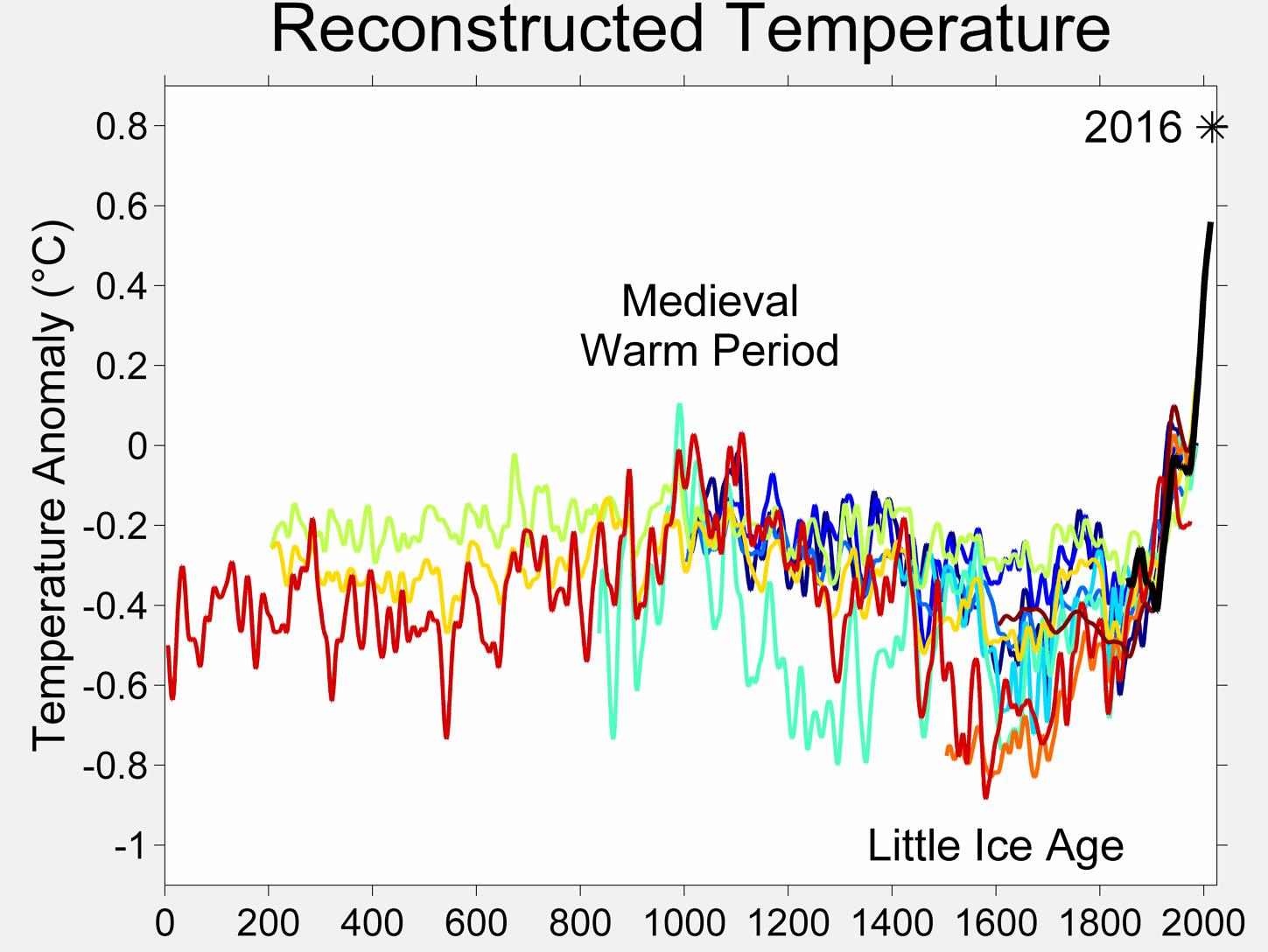
Re:the problem are clathrates, not cows.As for the methane being trapped in tundra, yeah, I can see that happening. But temperatures have been warmer than today even in historic times (going back 10,000 years). Greenland has a triving and growing community before 1000 A.D., but died off because of Global cooling. It seems as though this is merely a return to that climate which existed during the time of Leif Erikson. Please explain to me what is different today than in 800 A.D. in terms of overall temperatures and ground conditions... and why a methane-induced runaway global warming didn't occur then? Were we (or our ancestors from 1000 years ago) simply lucky?
Well... sort of...
The warming during the medieval period was not as hot as it is today. This is a chart that comports with what I have seen elsewhere from reputable sources.
And if you look at THIS you will see that right now we are very close to the highest inter-glacial temperatures. Basically, beyond our present temperature is something that is pre-Holocene. Unfortunately, the tundra and ocean floor, due to the consistently lower temps for the past few million years (punctuated by short periods of warmth) have been storing up the methane like crazy. If present temperature increases continue, and there is presently no reason for them not too, and a lot of research showing that it will, and will increase at a faster rate than ever, it puts the entire biosphere at risk.
One can argue that humans are not responsible for the warming - it doesn't matter - the point is we ARE contributing to it, and that must stop ASAP. It's the right and reasonable thing to do.
RS
-
Re:Not until there's a permanent solution for wast
But we shouldn't even consider building any until we have a *completed* (very) long-term storage/disposal solution for nuclear waste. Deferring it to the next generation is not OK.
That's like saying we should continue crapping in our house until we're absolutely certain that the toilet is completely functional and operational. According to the Union of Concerned Scientists, a typical coal plant generates millions of tons of CO2 and tens of tousands of tons of sulfur dioxide and nitrogen oxides in a year. Coal also contains trace amounts of radioactive materials that are released when burned. In 1982 a typical 1000 MW coal plant released "5.2 tons of uranium (containing 74 pounds of uranium-235) and 12.8 tons of thorium" into the atmosphere.In contrast, According to Greenpeace, a 1000 MW nuclear plant generates 27 tons of highly radioactive waste and less than 1000 tons of total radioactive waste. (Realistic amounts are probably lower, but I'll use Greenpeace as an upper bound). The total amount of spent nuclear fuel generated by all nuclear power in the U.S. since 1951-2003 is about 49,000 tons. At a density of about 8-10 tons per cubic meter, this represents a cube about 18 meters on a side, about the volume of two olympic-sized swimming pools.
So what do we do? Continue dumping billions of tons of pollutants, and thousands of tons of uranium and thorium into the atmosphere killing an estimated 24,000 each year? Because we aren't sure it's safer to switch to a power source which has had zero fatalities in 50+ years, and we aren't yet sure what to do with the two swimming pools of waste it's generated in that time?
-
Re:space tourism and resources
...using ethanol which is renewable as a fuel source for his jets....
He can have fun with that when his jets' range gets decreased by around 40%* (or the useful payload is decreased by 40% because of the extra fuel required for the same range) because of the difference in energy content between ethanol (which is already partially oxidized) and Jet-A. There's a good reason why we use petrochemicals as vehicle fuel, and it's not simply because at one time they were less expensive.
Mass and volume energy density are important characteristics of fuel... and petrochemicals win that battle by quite a fair margin to all other fuels that are safe enough to be used in common vehicles.
* according to this, petrodiesel (which is close to Jet-A) has energy content of 43.3MJ/kg, and ethanol only has 26.7 MJ/kg (using the LHV; the results are slightly different, though the trend the same, using HHV). That's a substantial difference, and mass is extremely important when it comes to aircraft fuel. -
Re:Computer models of Supernovae
Two of the "someone's" are John Blondin at NCSU and Tony Mezzacappa at Oak Ridge National Labs. Here's a link to a press release from ORNL giving a very brief overview of the research project.
Full disclosure: John was my PhD thesis advisor, and I did my research on the evolution of supernova remnants well after the initial explosion. I graduated in the 90s, back when such high-res 3D simulations were merely dreams. -
Re:Should've gone to Bush, actually...
Nations like Germany can't seem to follow the Kyoto requirements. So, they are failing in their part of the Treaty.
Germany is reducing it's carbon emissions. This must be the new conservative talking point or something because this is like the third time I've heard this view espoused. The fact is that on the whole the EU may not be meeting it's obligations, but for the most part that can be blamed on Spain and Italy whose industrial capacities are expanding. Germany, Scandinavia, France I are all doing okay.