Slashdot Mirror
Domain: paypal.com
Stories and comments across the archive that link to paypal.com.
Stories · 36
-
The 600+ Companies PayPal Shares Your Data With (schneier.com)
AmiMoJo shares a report from Schneier on Security: One of the effects of GDPR -- the new EU General Data Protection Regulation -- is that we're all going to be learning a lot more about who collects our data and what they do with it. Consider PayPal, that just released a list of over 600 companies they share customer data with. Here's a good visualization of that data. Is 600 companies unusual? Is it more than average? Less? We'll soon know. -
Microsoft and PayPal Add 'Send Money' Feature To Skype (paypal.com)
BrianFagioli quotes BetaNews: Microsoft has partnered with PayPal for a new way to transfer funds using Skype... "Today, we're excited to announce that PayPal is now partnering with Skype to allow users in 22 countries to send money to other Skype users with PayPal via their Skype mobile app. With over one billion Skype mobile downloads to date globally, users will be able to use PayPal directly from their Skype app to seamlessly send money in the moment...across the country or internationally," says John Kunze, VP of Xoom, PayPal.
It's part of a push to make it easier to share money, PayPal writes: Over the past year, we've partnered with Apple, Slack and Microsoft to enable peer-to-peer payments with PayPal and Venmo in more places and in more contexts where people are connecting online and on mobile, such as a voice command with Siri, in chat with iMessage and Slack, and in email via Microsoft's Outlook.com. -
PayPal's 'Policy Update' Includes Price Hikes (paypal.com)
"Buying and selling items on the internet is about to get a bit more expensive if you use PayPal to transfer money," reports MLive, noting that some of PayPal's fees will be increasing on March 29. Slashdot reader turbotalon also complains PayPal is disguising news of the price hikes as a "policy update". Roughly one quarter of the "policy changes" are rate hikes, yet their emailed summary glosses over the rate hike, focussing instead on a few of the "policy changes" with one sentence at the end about "changing some of the fees we charge". Additionally, they have added a "non-discouragement clause" for sellers that provides:
"In representations to your customers or in public communications, you agree not to mischaracterize PayPal as a payment method. At all of your points of sale (in whatever form), you agree not to try to dissuade or inhibit your customers from using PayPal; and, if you enable your customers to pay you with PayPal, you agree to treat PayPal's payment mark at least at par with other payment methods offered." -
PayPal To Suspend Business Operations In Turkey Following License Denial (thestack.com)
An anonymous reader quotes a report from The Stack: PayPal has announced the suspension of its business operations in Turkey as of June 6, citing failure to obtain a new license for its service in the country. Turkey has made recent efforts to promote its own domestic tech sector, advancing censorship laws and other regulation to push large international companies out of the market. PayPal, as the latest victim on this trail, posted a statement on its local Turkish website today: "PayPal's priority has always been its customers. However, a local financial regulator has denied our Turkish payments license and we have had to regretfully comply with its instruction to discontinue our activities in Turkey." The denial of PayPal's license, by local financial regulator BDDK, comes following the introduction of new national rules in Turkey which require IT systems to be based within the country itself. PayPal runs its global business from a large portfolio of IT centers around the world. Turkey isn't the only country tightening its grip on the Internet. The Iranian government has given companies behind popular messaging apps one year to move their data onto servers in Iran. -
PayPal Pulls North Carolina Plan After Transgender Bathroom Law (reuters.com)
An anonymous reader quotes a report from Reuters: PayPal Holdings Inc on Tuesday canceled plans to open a global operations center in Charlotte, North Carolina and invest $3.6 million in the area after the state passed a controversial law targeting lesbian, gay, bisexual and transgender (LGBT) citizens. In a letter on March 29, founders and chief executives of more than a hundred companies, including Apple Inc, Twitter Inc, and Alphabet Inc urged North Carolina Governor Pat McCrory to repeal the legislation. PayPal is one of the first companies to protest the controversial measure requiring people to use bathrooms or locker rooms in schools and other public facilities that match the gender on their birth certificate rather than their gender identity. "The new law perpetuates discrimination and it violates the values and principles that are at the core of PayPal's mission and culture," Chief Executive Officer Dan Schulman said in a statement. PayPal's original plan was to open the operations center in Charlotte and employ 400 skilled workers there. -
Four Facepalm Bugs In USPS Label-Printing Site
"The United States Postal Service "Click-N-Ship" site suffered no outages or slowdowns during Christmas rush," writes Bennett Haselton. "It just has bugs that make the process more annoying than just standing in line at the post office, which defeats the purpose. The most frustrating part is that most of these bugs could have been fixed, just by having some testers run through the ordering process and make a note of anything that seems confusing or wrong. (Although I've included notes on how to work around all the bugs, so you really can print your own labels and skip the line.)" Read on for the rest; what other gripes do you have about the current package delivery regime, and how would you resolve them? This suggestion on the LifeProTips subreddit reminded me that I'd been meaning to try printing my own USPS mailing labels to skip the lines at the post office. I'd been putting it off because I knew that I'd be determined to find the most efficient way of doing everything through the site, and if the site didn't steer me towards exactly the best options, I'd end up forcing myself to reverse-engineer their whole algorithm in order to find the most efficient way myself. That's why I always appreciate it when a website just tells me the best option instead of making me second-guess them.Right away, the USPS website failed that test because it does not allow you to print first-class mail labels, instead steering you towards the more expensive Priority Mail and Priority Mail Express options. Online users have complained about the lack of first-class-mail options on USPS.com for years, and users on several forums suggested using the PayPal Ship Now site instead, which does let you print first class mailing labels online, along with Priority Mail labels other options.
In my case it was a moot point because I had to use the Priority Mail labels in order for my packages to arrive by Christmas, but the deception was still hugely aggravating. Not just because of the thought of millions of people wasting money (and the finite resources of the postal system) due to the USPS site tricking them into a more expensive upgrade that they didn't need. But because it now meant I'd have to second-guess every recommendation they made, wondering if they were steering me toward something that was worse for me and better for them. The reason sites like Amazon are so stress-free to use is because, for the most part, they do display the options that are best for you, even at the expense of their own short-term profit. Some third-party merchant is selling a book for less than Amazon's list price? They'll let the seller list the book right on their site and undercut Amazon's own sales. The benefit to the user is not just the cost savings, but knowing that you don't have to feel like a chump for not wasting time on search engines trying to find a cheaper deal.
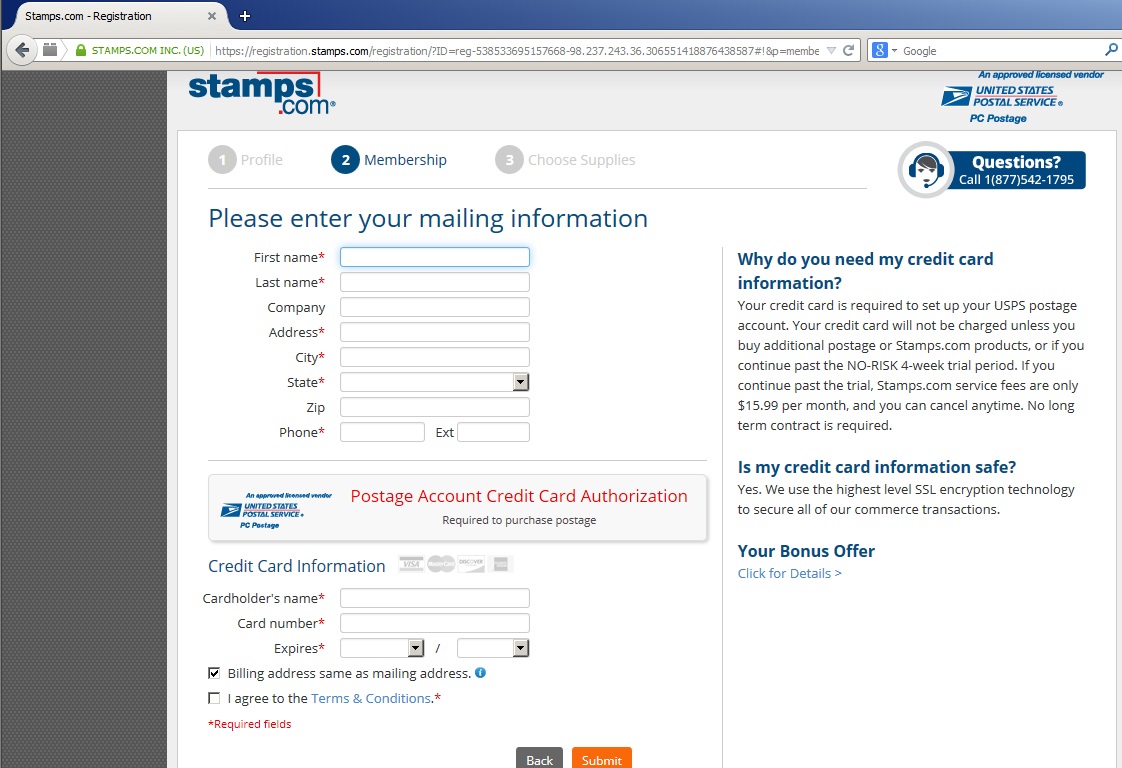
Once I realized the USPS site was concealing the cheaper options, in my determination to avoid getting ripped off by the USPS I almost ended up getting ripped off much worse by one of their "partners". I remembered an ad on a Google search mentioning Stamps.com, so I signed up for an account there and downloaded their software, which does in fact let you print first-class postage. It was only after reading a warning in the original subreddit that I realized I had unwittingly "agreed" to a $15.99/month charge. It turns out that the Stamps.com registration page says above the credit card form that your card info is "required to purchase postage", but this is misleading -- the fine print in the sidebar says you will be charged $15.99 per month if you don't cancel. (And neither the software nor the website gives you a link to cancel -- you have to call their customer service number.) Fortunately, I did call and cancel after realizing I'd been duped, but I was not surprised to learn on Wikipedia that the company had been the subject of over 1,000 Better Business Bureau complaints from users regarding the unauthorized monthly charges. (The part on Wikipedia about "long hold times" is out of date, though -- the automated prompts recognized my account by my phone number and let me cancel without any waiting.)
What does that have to do with USPS.com? Because it never would have happened if the USPS website had been on my side in the first place, giving me all the mailing options that I actually needed. It's bad enough when a private company does this, but the USPS works for us, don't they?
So that's not a "bug" in the traditional sense, but I'm counting it: #1: Not giving users all the mailing options they want to know about.
Most of the other bugs are not self-serving tricks; rather, they're just unclear directions where you have to pause and puzzle out what you're really supposed to do, which is different from what the site tells you to do. For example:
#2: Listing boxes as shipping options that don't fit the dimensions that you've already entered
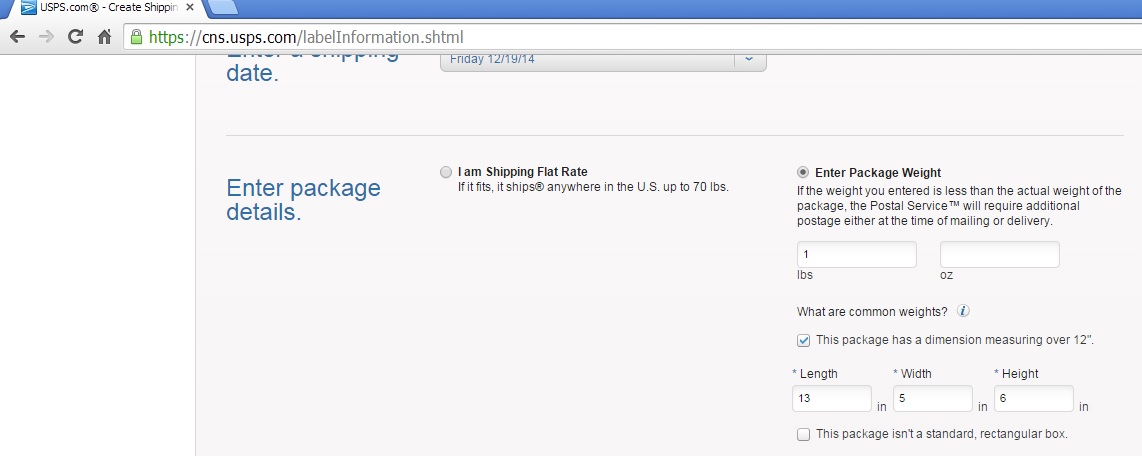
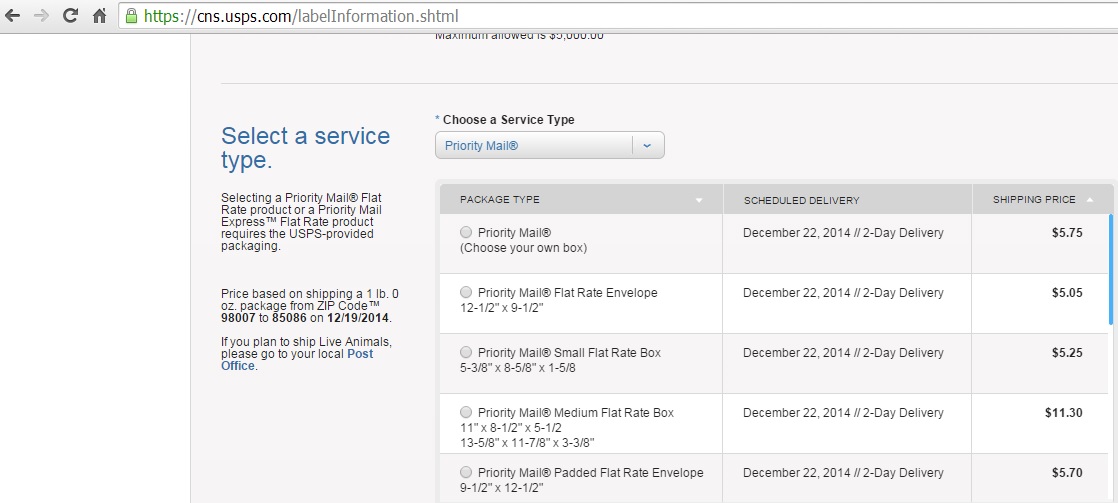
On the label printing page (requires a USPS.com login if you don't have one) is the option to enter package dimensions. If you specify package details of 1 lbs and 13x5x6 inches, and click to calculate "available Services and Prices" based on the details you've entered, you're presented with a list of options that include 'Priority Mail Flat Rate Envelope 12-1/2" x 9-1/2"', 'Priority Mail Small Flat Rate Box 5-3/8" x 8-5/8" x 1-5/8"', 'Priority Mail Medium Flat Rate Box 11" x 8-1/2" x 5-1/2"', 'Priority Mail Medium Flat Rate Box 13-5/8" x 11-7/8" x 3-3/8"', and 'Priority Mail Padded Flat Rate Envelope 9-1/2" x 12-1/2"' -- all of which, of course, are too small to hold the package whose dimensions you just specified.
You could argue that it's the user's responsibility to make sure their package fits into the box they select, but a user could reasonably assume that the whole point of entering the length, width and height is so that the USPS can recommend only those boxes that will hold the item. Remember, the user usually doesn't have these boxes in front of them at the time they're printing the label. They could end up selecting a box option, printing the label, taking it all the way to the post office along with their package, only to find out that the package doesn't fit into the box that they printed the label for, and that they have to wait in line anwyay to pay for an alternate method.
It's a middle-school-level programming exercise to take the length, width, and height of a package as an input, take as a second input a list of boxes of varying lengths, widths, heights, and costs, and find the lowest-cost box that will hold the package (keeping in mind that the package can be rotated to different orientations so that the "height" becomes the "width", etc.). It's reasonable to expect the postal service to be able to do this too.
#3: Everything wrong with the "print your labels" page
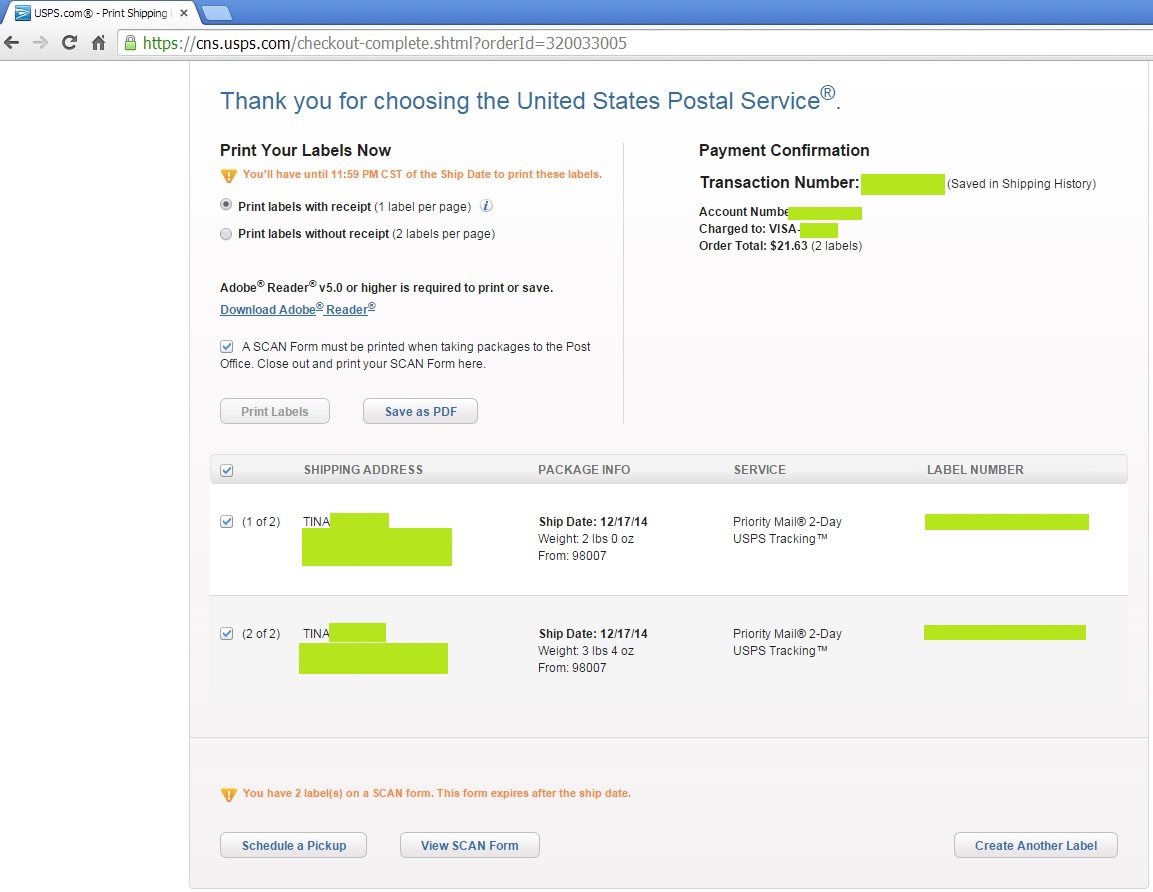
Here's a screen grab of the "print your labels" page that appears after you've paid, which you can use to play the Highlights "What's Wrong?" game:
-
The text at the top says "You'll have until 11:59 PM CST of the Ship Date to print these labels." OK, but if I print them at 11:59 PM, what good does it do if the post office closed at 6? Are the labels only valid on the ship date, or will they still work if I take them to the post office the next day? This should be more clear.
-
Text says "A SCAN Form must be printed when taking packages to the Post Office." Fine, but there's a checkbox next to that sentence. If that sentence describes a postal regulation, what does it mean if I un-check the box? That the regulation no longer applies to me? Can someone tell me if the drug laws work that way as well?
-
The next sentence says: "Close out and print your SCAN Form here." I have no idea what that sentence means. Close out of the browser? And where is "here"? When it's not hyperlinked, "here" means here.
-
WHY IS THE "PRINT LABELS" BUTTON DISABLED?? I have the checkboxes checked for both labels. I want to print them. What else do you want me to DO? (My PC has a printer, which the Chrome browser is aware of -- it lets me print from other webpages with no problem.) I got it to work by saving the PDF and printing that, but I never figured out why the Print button was just sitting there, mocking me from behind its veil of grey.
-
The "Schedule a Pickup" button at the bottom -- same problem as the "print until 11:59 PM" message at the top. Since I printed these labels with the ship date specified as today, it should be more clear if the labels will still be considered valid tomorrow, which is the soonest time that a pickup could be scheduled.
#4: Over an hour on hold and never got through.
As an adherent to the touchingly quaint notion that a reporter should talk to the subjects of their story before running it, and also because I just wanted clarification on some of these questions, I called the USPS help line and waited on hold for 30 minutes before their help line disconnected me. I called back and waited for another 40 minutes before I hung up this time. OK, strictly speaking that's not a "bug". They just suck.
In the end, after reverse-engineering their pricing options as I had vowed to do, I determined what appeared to be their rules, (applies only to domestic Priority Mail), which you may find handy:
- If you're shipping in a Flat Rate box, the weight of the package doesn't matter (up to the 70 lb limit), only the dimensions, to the extent that they determine which Flat Rate box you can fit it into, with the bigger ones being more expensive.
- On the other hand, if you pick the Priority Mail "Use your own box" option, then the dimensions don't matter (unless you exceed the allowed limits), only the weight -- a 5 lb, 3"x3"x3" package and a 5 lb, 21"x21"x21" package both ship for $15.22, but if you change the weight, that's when the price changes. (If you try to ship a 22"x22"x22" package, you get an error that you've exceeded the dimensions for a Click-N-Ship.)
Using this, I was able to strategically break my one shipment, which would have cost about $30, into two separate shipments which cost $12 and $8. All told, with the effort to reverse-engineer their pricing options and to document all of the bugs for posterity, it took me about an hour to figure out that $10 savings and to print labels that I could take to the post office and skip the line -- which, it turned out, looked only about 3 minutes long -- in order to experience what one redditor described as "feeling the hate from the people standing in line as I casually stroll up and drop my packages off at the front desk". But the important thing is, I did it efficiently.
-
-
PayPal Integrates Bitcoin Processors BitPay, Coinbase and GoCoin
An anonymous reader writes: PayPal today announced partnerships with three major Bitcoin payment processors: BitPay, Coinbase and GoCoin. The eBay-owned company wants to help digital goods merchants accept Bitcoin payments, although it is starting with those located in the U.S. and Canada first ("We are considering expanding to other markets," a PayPal spokesperson told TNW. "Stay tuned.")
PayPal says it chose to integrate the third-party functionality directly in the PayPal Payments Hub because the aforementioned trio already offers its customers protections when dealing with the virtual currency. The company envisions anything that can be obtained digitally, such as video games and music, being sold in Bitcoin. -
Five predictions for (Bit)coin
Contributor Tom Geller writes: "I recently wrote an article about Bitcoin and the law for Communications of the Association for Computing Machinery. In researching it I ran into plenty of wishful thinkers, ridiculous greedheads, and out-and-out nutbags promising a rosy future. I also found the expected blowback from vehement naysayers who think the best way to combat crazy is with more crazy. But despite that, I walked away believing that Bitcoin — or a decentralized cryptocurrency like it (let's call it "Coin") — is here to stay. As an interested outsider to the Coin economy, and a long-time technology commentator, here's what I think its future holds." Read on for Tom's predictions. Coin's primary use will continue to be in international transactions.
While people wonder "When will I be able to pay for groceries and utilities with Bitcoin?", that use might never come. But Coin already shines in international transactions, where it provides a clear advantage over current systems, which are expensive and complicated hassles. That's why PayPal has become the go-to solution: it just works, albeit with typical fees around 3-5%.
Coin reduces that fee to a small fraction of 1% (when sent directly), and is available in places where PayPal fears to tread (Zimbabwe, Pakistan, etc.). Coin transactions occur instantly, with no intermediary, and — for better or worse — without recourse.
That leads to Coin's second primary use: to store liquid value in places where other stores (such as national currency) are unreliable. For all the cries that Bitcoin is "unstable", it seems to have settled quite nicely after its April spike. Certainly it looks appealing to anyone in an unstable country, and it's even tempting for those in places where the currency's been on a long, slow slide, like Argentina.
Coin's big vulnerability is its interface with national currencies ("real money").
None of this matters if you can't get your money out again. And that's where governments are taking a close look at Coin — with good reason. First, Coin exchanges have a terrible track record; second, such points of exchange are bottlenecks through which financial crimes often flow.
In the U.S., the government's Financial Crimes Enforcement Network (FinCEN) issued guidance asserting its right to regulate "Money Services Businesses", and defining exchanges dealing in virtual currencies (including Bitcoin) as such. That's a problem for many existing Coin exchanges, as the costs for complying with regulations are high. But if there's not a stable and reliable way to get national currency in and out of Coin, its value will plummet.
Conversely, Coin's value is likely to shoot up if this interface gets easier. Right now, it's surprisingly hard to buy Bitcoin (et al.) directly with U.S. dollars. Most methods require bank wires, tricky multi-step workarounds, and high fees. (I found Coinbase to be the most accessible, albeit with long delays and a bank verification procedure similar to PayPal's.) If Coin becomes as easy to buy as a gift card and redeemable at every bank, its practical utility will soar for everyday people.
No government will make Coin illegal.
Despite bloviation by a few politicians and baseless statements in the press, Coin is not per se illegal, and there have been no serious attempts to make it so. The FinCEN guidance mentioned earlier explicitly says that ordinary users — those who buy and sell using Coin — are "not subject to FinCEN's... regulations for MSBs". It's possible that other government agencies will continue to claim authority, but there doesn't seem to be much support for it.
A lot of noise has been made about Coin's use in illegal business, for example on Silk Road (where it's the only currency). But law enforcement is realizing that the currency isn't to blame, much as they've started to say that Craigslist isn't responsible for crimes organized through its ads. I predict that that distraction will continue to surface from time to time, but will essentially die soon.
Even if governments attempt to illegalize Coin, there's only so much they could do to criminalize ordinary users. Again, Coin's real vulnerabilities are higher up the chain. However....
If Coin succeeds, governments will get involved — for the better.
"Noooo!!!" scream the cryptoanarchists who are Coin's pioneers. "Keep the government out of this! Coin can't be controlled! Nobody can take away our freedoms!" What they don't realize is that this attitude doesn't reflect the values of Coin's future users. The benefits of "freedom" matter to the innovators; convenience and safety matter to those who follow.
"Government" in this case could also be a government-size corporation, syndicate, or other entity. The important thing is that it's big enough to administer, back, and enforce initiatives to protect the Coin economy. Whatever that "bully entity" is, Coin adopters will welcome it because of two major flaws currently in (Bit)Coin's design.
First, Coin is ridiculously easy to destroy by accident. If you lose the private cryptographic key that identifies your coin, it's gone. Not just stolen, but removed entirely from the economy, so nobody will ever own it again. Consider these stories on Bitcointalk.org, where within a few messages the cumulative total tops 10,000 BTC — currently valued around a million dollars. A central authority could address this in several ways such as tracking, restitution, etc.. People don't care that their cash is anonymous when the rent money disappears.
Second, the entire system is vulnerable to a brute-force attack. Without getting into the specifics, Coin (well, Bitcoin) works because it assumes that at least 50% of the computer power on the network is held by honest players. But a recent 51% attack on Feathercoin (a Coin with much lower capitalization) showed that it's possible for a single party (or syndicate) to trump that.
Let's do the math for Bitcoin, the Coin with by far the highest capitalization, at just north of USD$1 billion (1 x 10^9). To reliably overwhelm the network, you'd need computing power delivering about 100,000 gigahashes per second. Computers optimized for Bitcoin processing are currently available for about $1,000/gigahash, so sufficient computing power can be bought for $100 million. Electricity cost for the deed would be about $200,000/day.
O.K., it's not something a basement hacker could whip up. But there are over 400 people, and thousands of syndicates with a billion dollars in the U.S. alone. Perhaps at least one of them is crazy enough to drop 1% of the wealth to partially control (or completely destroy) a billion-dollar system. (Hell, one of them recently spent 1/10th of that price tag on his wedding.)
Those are only the two biggest technical concerns. Then there's the galaxy of financial services (such as insurance) that's available for fiat money, but which would be hard or impossible to provision for Coin without a central authority. Time could overcome these barriers; a bully entity would overcome them faster, and with greater public buy-in.
Bitcoin is not the end game.
Along those lines, I don't believe that Bitcoin will be the ultimate winner in this game. It's the 1.0, and a brilliant first effort at that. But it's not perfect, and several pretenders to the throne already claim to fix some of its bugs. In fact, shifting conditions may require periodic issuance of new Coin as a matter of course. (As I said before, I believe such issuances will involve a central authority.)
These predictions all assume that Coin will grow, and there are many reasons it might not. However, I'm bullish on it for the long-term. It's already proven its value in use; the public is used to handling Coin-like money (viz. Square Wallet); and its first major hurdles are in the past. Now it's ready to enter a fascinating future.
- - - - -
Tom Geller (tomgeller.com) writes about technology and business. He's best known for Drupal-related work that includes eight video courses for lynda.com, a book for Peachpit Press, and corporate work for Acquia, Commerce Guys, and others. He first became involved in computers as a grade-school student in 1976, playing "Hunt the Wumpus" on a 100-pound monster that spewed tractor-feed paper onto the floor. He lives in Oberlin, Ohio. -
Five predictions for (Bit)coin
Contributor Tom Geller writes: "I recently wrote an article about Bitcoin and the law for Communications of the Association for Computing Machinery. In researching it I ran into plenty of wishful thinkers, ridiculous greedheads, and out-and-out nutbags promising a rosy future. I also found the expected blowback from vehement naysayers who think the best way to combat crazy is with more crazy. But despite that, I walked away believing that Bitcoin — or a decentralized cryptocurrency like it (let's call it "Coin") — is here to stay. As an interested outsider to the Coin economy, and a long-time technology commentator, here's what I think its future holds." Read on for Tom's predictions. Coin's primary use will continue to be in international transactions.
While people wonder "When will I be able to pay for groceries and utilities with Bitcoin?", that use might never come. But Coin already shines in international transactions, where it provides a clear advantage over current systems, which are expensive and complicated hassles. That's why PayPal has become the go-to solution: it just works, albeit with typical fees around 3-5%.
Coin reduces that fee to a small fraction of 1% (when sent directly), and is available in places where PayPal fears to tread (Zimbabwe, Pakistan, etc.). Coin transactions occur instantly, with no intermediary, and — for better or worse — without recourse.
That leads to Coin's second primary use: to store liquid value in places where other stores (such as national currency) are unreliable. For all the cries that Bitcoin is "unstable", it seems to have settled quite nicely after its April spike. Certainly it looks appealing to anyone in an unstable country, and it's even tempting for those in places where the currency's been on a long, slow slide, like Argentina.
Coin's big vulnerability is its interface with national currencies ("real money").
None of this matters if you can't get your money out again. And that's where governments are taking a close look at Coin — with good reason. First, Coin exchanges have a terrible track record; second, such points of exchange are bottlenecks through which financial crimes often flow.
In the U.S., the government's Financial Crimes Enforcement Network (FinCEN) issued guidance asserting its right to regulate "Money Services Businesses", and defining exchanges dealing in virtual currencies (including Bitcoin) as such. That's a problem for many existing Coin exchanges, as the costs for complying with regulations are high. But if there's not a stable and reliable way to get national currency in and out of Coin, its value will plummet.
Conversely, Coin's value is likely to shoot up if this interface gets easier. Right now, it's surprisingly hard to buy Bitcoin (et al.) directly with U.S. dollars. Most methods require bank wires, tricky multi-step workarounds, and high fees. (I found Coinbase to be the most accessible, albeit with long delays and a bank verification procedure similar to PayPal's.) If Coin becomes as easy to buy as a gift card and redeemable at every bank, its practical utility will soar for everyday people.
No government will make Coin illegal.
Despite bloviation by a few politicians and baseless statements in the press, Coin is not per se illegal, and there have been no serious attempts to make it so. The FinCEN guidance mentioned earlier explicitly says that ordinary users — those who buy and sell using Coin — are "not subject to FinCEN's... regulations for MSBs". It's possible that other government agencies will continue to claim authority, but there doesn't seem to be much support for it.
A lot of noise has been made about Coin's use in illegal business, for example on Silk Road (where it's the only currency). But law enforcement is realizing that the currency isn't to blame, much as they've started to say that Craigslist isn't responsible for crimes organized through its ads. I predict that that distraction will continue to surface from time to time, but will essentially die soon.
Even if governments attempt to illegalize Coin, there's only so much they could do to criminalize ordinary users. Again, Coin's real vulnerabilities are higher up the chain. However....
If Coin succeeds, governments will get involved — for the better.
"Noooo!!!" scream the cryptoanarchists who are Coin's pioneers. "Keep the government out of this! Coin can't be controlled! Nobody can take away our freedoms!" What they don't realize is that this attitude doesn't reflect the values of Coin's future users. The benefits of "freedom" matter to the innovators; convenience and safety matter to those who follow.
"Government" in this case could also be a government-size corporation, syndicate, or other entity. The important thing is that it's big enough to administer, back, and enforce initiatives to protect the Coin economy. Whatever that "bully entity" is, Coin adopters will welcome it because of two major flaws currently in (Bit)Coin's design.
First, Coin is ridiculously easy to destroy by accident. If you lose the private cryptographic key that identifies your coin, it's gone. Not just stolen, but removed entirely from the economy, so nobody will ever own it again. Consider these stories on Bitcointalk.org, where within a few messages the cumulative total tops 10,000 BTC — currently valued around a million dollars. A central authority could address this in several ways such as tracking, restitution, etc.. People don't care that their cash is anonymous when the rent money disappears.
Second, the entire system is vulnerable to a brute-force attack. Without getting into the specifics, Coin (well, Bitcoin) works because it assumes that at least 50% of the computer power on the network is held by honest players. But a recent 51% attack on Feathercoin (a Coin with much lower capitalization) showed that it's possible for a single party (or syndicate) to trump that.
Let's do the math for Bitcoin, the Coin with by far the highest capitalization, at just north of USD$1 billion (1 x 10^9). To reliably overwhelm the network, you'd need computing power delivering about 100,000 gigahashes per second. Computers optimized for Bitcoin processing are currently available for about $1,000/gigahash, so sufficient computing power can be bought for $100 million. Electricity cost for the deed would be about $200,000/day.
O.K., it's not something a basement hacker could whip up. But there are over 400 people, and thousands of syndicates with a billion dollars in the U.S. alone. Perhaps at least one of them is crazy enough to drop 1% of the wealth to partially control (or completely destroy) a billion-dollar system. (Hell, one of them recently spent 1/10th of that price tag on his wedding.)
Those are only the two biggest technical concerns. Then there's the galaxy of financial services (such as insurance) that's available for fiat money, but which would be hard or impossible to provision for Coin without a central authority. Time could overcome these barriers; a bully entity would overcome them faster, and with greater public buy-in.
Bitcoin is not the end game.
Along those lines, I don't believe that Bitcoin will be the ultimate winner in this game. It's the 1.0, and a brilliant first effort at that. But it's not perfect, and several pretenders to the throne already claim to fix some of its bugs. In fact, shifting conditions may require periodic issuance of new Coin as a matter of course. (As I said before, I believe such issuances will involve a central authority.)
These predictions all assume that Coin will grow, and there are many reasons it might not. However, I'm bullish on it for the long-term. It's already proven its value in use; the public is used to handling Coin-like money (viz. Square Wallet); and its first major hurdles are in the past. Now it's ready to enter a fascinating future.
- - - - -
Tom Geller (tomgeller.com) writes about technology and business. He's best known for Drupal-related work that includes eight video courses for lynda.com, a book for Peachpit Press, and corporate work for Acquia, Commerce Guys, and others. He first became involved in computers as a grade-school student in 1976, playing "Hunt the Wumpus" on a 100-pound monster that spewed tractor-feed paper onto the floor. He lives in Oberlin, Ohio. -
PayPal Security Holes Expose Customer Card Data, Personal Details
mask.of.sanity writes "Dangerous website flaws have been discovered in PayPal that grant attackers access to customer credit card data, account balances and purchase histories. The holes still exist. One was publicly disclosed after a failed effort in July to responsibly disclose them under PayPal's bug bounty program. PayPal is working to close the holes." -
Paypal Slips 'No Class Action' Clause Into Policy Update
First time accepted submitter Guru80 writes "PayPal recently posted a new Policy Update which includes changes to the PayPal User Agreement. The update to the User Agreement is effective November 1, 2012 and contains several changes, including changes that affect how claims you and PayPal have against each other are resolved. You will, with limited exception, be required to submit claims you have against PayPal to binding and final arbitration, unless you opt out of the Agreement to Arbitrate (Section 14.3) by December 1, 2012. Unless you opt out: (1) you will only be permitted to pursue claims against PayPal on an individual basis, not as a plaintiff or class member in any class or representative action or proceeding and (2) you will only be permitted to seek relief (including monetary, injunctive, and declaratory relief) on an individual basis. With so many privacy policies changing to include such wording, does it really hold any weight if some obscure and buried opt-out option isn't checked?" -
Alternatives To Paypal's Virtual Credit Card Service?
An anonymous reader writes "Paypal has quietly killed the Paypal plugin and the related virtual-card service. The service generated on-the-fly, one-time-use credit card numbers. When I called in and inquired about the service, I was told that the service has been discontinued, but may be relaunching something similar depending on interest. They are treating inquiries as a sort of petition, taking down names and contact info. The forums seem to be a lost cause, as no Paypal reps have replied to the numerous posts regarding virtual cards being discontinued. Does anyone know of a good alternative source of one-time-use credit card numbers?" -
PayPal Launches Virtual Debit Card
IpSo_ writes "You can now use PayPal via a Virtual Debit Card when making online purchases anywhere MasterCard is accepted. Basically it generates a virtual card number each time you make a transaction online so you don't have to use your personal debit or credit card number. Will people be more comfortable making online purchases with this, or will it flop because its too much of an inconvenience?" -
Restricted Financial Support for Open-Source?
Anonymous Writer asks: "PayPal has become the standard for making donations to Open-Source projects, and in many cases the only way. Out of the 247 countries and territories represented by top-level domains on the Internet, credit cards are available in 128. However, PayPal only accepts credit cards from 45 of these countries, which excludes 83 from using their service. Nearly two-thirds of the countries on the Internet with valid credit card billing services are currently prevented from making donations using PayPal. Even credit cards issued from those 45 accepted countries with billing addresses not among them are excluded, which affects people working overseas and expatriots. If you want to support the Open-Source Software movement but don't live in a PayPal-accepted country, what are your alternatives?" -
Restricted Financial Support for Open-Source?
Anonymous Writer asks: "PayPal has become the standard for making donations to Open-Source projects, and in many cases the only way. Out of the 247 countries and territories represented by top-level domains on the Internet, credit cards are available in 128. However, PayPal only accepts credit cards from 45 of these countries, which excludes 83 from using their service. Nearly two-thirds of the countries on the Internet with valid credit card billing services are currently prevented from making donations using PayPal. Even credit cards issued from those 45 accepted countries with billing addresses not among them are excluded, which affects people working overseas and expatriots. If you want to support the Open-Source Software movement but don't live in a PayPal-accepted country, what are your alternatives?" -
Yahoo Shuts Down Their PayPal Competitor
LostCluster writes "MSNBC and ZDnet are both reporting that Yahoo and HSBC have announced a shutdown plan for their PayDirect service which was their rival to PayPal. Since CitiBank abandoned their c2it service last year, PayPal now seems to be a monopoly by default." There are other players in this field, though, like bidpay and worldpay. -
Paypal Grinds To A Halt
BillBrasky writes "After a 'Monthly Software Update', it appears that PayPal started having problems. There were reports all weekend of troubles, and as of Monday night here, I can't access it at all (connection time out). One user even reported that his PayPal Debit card was getting refused!" A message on the site now says the site is expected to be back at 8:10 PM PDT, not long from now. -
Micropayments Going Mainstream? Not Yet.
DotEdu writes "Today's NY Times has an interesting article on two new micropayment companies, BitPass and Peppercoin, and the venerable PayPal. More interesting than the companies are the critique: Micropayments are not the silver bullet. You still need to actually have a viable product that you can sell." -
Whatever Happened to Micropayments?
prostoalex writes "Remember Flooz? Or Beenz? With a few notable successes (PayPal, and that's about it) online micropayment industry is saving its success stories for future generations. New York Times reports about two nascent micropayment systems, one coming out of Stanford, one out of MIT, that are supposed to help the content producers and Internet users to engage in less-than-a-dollar financial transactions without huge overhead costs, so typical of credit card payments. BitPass requires you to purchase a virtual debit card with a certain amount on it to pay for products and services, and PepperCoin consolidates numerous micropayments into one bill that is then split between the content providers that managed to sell their product to the Internet user." I still believe that single penny transactions will revolutionize the net. -
Slashback: Australia, Nomenclature, Books
Slashback tonight brings a few updates on topics ranging from linux.conf.au and free books online to how you can help pay off Dan Peng's legal debt to the RIAA. Read on below for the details. Since you can never hear enough about linux.conf.au Kimberly Shelt writes: "Actually I wrote a whole article about it this month. Complete with hype about Kfishes, miniconf etc :) It included the direct link to the current LCA2004 pages :) and a tiny pic of scrubby :) what more can you want :)"Please, no more name changing. suqur writes "As a follow-up to many stories previously posted, News.com reports that the recently renamed Mozilla Firebird browser (previously known as Phoenix) has finally given up on its new name, and relinquished the name. The new names for the Mozilla Firebird and Mozilla Thunderbird will be Mozilla Browser and Mozilla Mail, respectively. Looks like they're right back where they started, eh?"
Whatever the name, Mozilla is still only almost perfect: GeekLife.com writes "An old Mozilla exploit continues to crash almost any version/flavor of Mozilla with just 5 lines of plain HTML code (no JavaScript, ActiveX, etc.). If you're very brave, you can test/crash your Mozilla by going here.
It's important to report fairly on issues like this, or people will come to think of the Open Source journals as biased, uninformative, irresponsible propaganda machines, which will greatly harm any legitimate cause that the OS folks are promoting."Books to download, at varying prices. Scott Pendergrast writes "We're working here at Fictionwise to convince publishers to release Neal Stephenson's works as eBooks. Recently his Cryptonomicon work finally became available in Secure Microsoft and Palm Reader formats (yes, the irony of this title being sold in an encrypted format is not missed ;-)
To encourage sales of this title, which hopefully will result in more of his works becoming ebooks, we're offering a 50% micropay rebate on it (so we're actually losing a bit on each sale)."
If you like your books free and non-fiction, though, mindpixel writes "I am not lying. The National Academies Press which was created by the National Academies to publish the reports issued by the National Academy of Sciences, the National Academy of Engineering, the Institute of Medicine, and the National Research Council, all operating under a charter granted by the Congress of the United States, has more than 2,500 free, searchable, high quality books online. Some random examples:
- The Genomic Revolution: Unveiling the Unity of Life
- Strange Matters: Undiscovered Ideas at the Frontiers of Space and Time
- Who Goes There?: Authentication Through the Lens of Privacy
- Microbial Threats to Health: Emergence, Detection, and Response"
This ought to be tax-deductable, too! ThreeToe writes "Recently the RIAA settled a lawsuit with four college students; one of them was Daniel Peng of Princeton University. Daniel is accepting donations to help pay his $15,000 settlement fee along with related legal fees. You can send money via paypal by clicking here. Remember that Daniel simply wrote an MP3 search engine; he didn't distribute MP3s himself. Those who share my belief that this lawsuit was wrong-headed should make a statement by assisting Daniel."
- The Genomic Revolution: Unveiling the Unity of Life
-
Paypal Charged Under PATRIOT Act
A reader writes: "Yahoo has the story: Paypal has been charged under the PATRIOT act for accepting and profiting from transactions with illegal gambling sites. According to their new rules they will no longer allow gambling payments due to the higher chargeback risk. It's good to see them charged for something, even if they have never had to atone for the thousands of customer dollars they have stolen." I know of a number people who've had problems, but I will say that I've had no problems with PayPal - on both my personal account and on the Subscription side of things. -
Salvaging Possessions from Smoke Damage?
SnowDeath asks: "My home caught on fire last Wednesday while my girlfriend and I were off watching the new Harry Potter movie and now we are pretty much left with crap. Most of our stuff didn't get damaged by fire, but rather severly smoke damaged. Does anyone have any suggestions for getting that horid smoke damage out of out clothes, furniture, and computer parts (our mobos were destroyed by smoke)?" Those who would like to donate a buck or two to SnowDeath's "Oh crap, my house caught fire and now I have nothing!" relief fund can go here. -
Slashback: Salon, Privacy, Pricedrops
Slashback with more on Salon's struggle to balance ads and subscriptions, online retailers versus online bargain hunters, the not-at-all-secret government proposal to obtain "Total Information Awareness" (including information about you), and more.Circumventing the upsell, but not all of it. Responding to the recent post about cable service a la carte, alta writes "I got a response from Jane Black (who wrote the original article) and she said slashdot jumped the gun. You can not pick and choose which channel you want. You can just choose to get basic limited and premium without getting the 2 steps in between. Here's the actual piece of law:
"Buy-through of other tiers prohibited - A cable operator may not require the subscription to any tier other than the basic service tier required by paragraph (7) as a condition of access to video programming offered on a per channel or per program basis. A cable operator may not discriminate between subscribers to the basic service tier and other subscribers with regard to the rates charged for video programming offered on a per channel or per program basis.
Read it all here. Here's what Jane said:'But please make sure you understand the rule (Slashdot's headline was misleading indeed.) You can't just choose which channels you want. The new rule says that you can get basic (the network and cspan etc) plus HBO/Starz/Showtime *without* having to buy the standard package as well. If you want AMC, Lifetime, whatever, you still need to buy the whole package. Make sense?'
If you still need it, you can find more about the law here. Just type 543 in the "Section" field. The citation is: Section 623(b)(8) of the Communications Act of 1934, as amended. Found at volume 47 of the US Code Section 543(b)(8)"The Salon dilemma. A Slashdot post last week reported that Salon was in serious financial trouble, and had dropped its premium section and instituted giant ads. Salon has now moved to over-the-counter trading. "While we valued the prestige of a NASDAQ listing, this move to the OTC market should not affect our core business," says Salon's president and CEO in the story. Update: 11/26 00:42 GMT by J : One correction: Salon has not dropped its premium section.
Dole, or Hormel? MacAndrew writes "As briefly discussed in slashdot a few weeks ago, Senator-elect Elizabeth Dole has been sued by a constituent who received eight unsolicited emails from her. He claims $100 damages including "emotional distress for having received spam from someone who should know better." Salon has now published an article focusing on the critical political versus commercial speech aspect of the case. Courts have recognized political speech as the innermost circle of free speech protection, and groups such as the Electronic Frontier Foundation believe spam laws that interfere with it may be not just unwise but unconstitutional."
Surely, someone's wallet will end up fat. In reaction to the recent story about provisions of the DMCA being used to prevent the posting of post-Thanksgiving sales prices from large retailers, Brian McWilliams writes "I finished up my story about FatWallet after you posted that link on Slashdot. Might help explain some stuff."
Well, we thought this here panopticon would be a nice idea ... McLuhanesque writes "DARPA has posted the architecture for their Total Information Awareness Systems , the uber-database that purports to suck in every scrap of electronic information about everyone, mix in some Human ID at a Distance technology, among other stuff, and profile ... well, just about everyone. More of their proposed fun and games are listed here." And Declan McCullagh writes: "Just posted the transcript of the Pentagon news briefing (worth a read) on Politech. Note this is on the TIA program, not 'eDNA.'
$10,000 is nothing to sneeze at. The idea of buying code into the world of Free software (aka code Ransom, as mentioned on Slashdot a few days ago) is drawing interest. waxed writes "FreePepper is an effort to collect enough money to purchase the source code for the multiplatform text editor Pepper from its author, Maarten Hekkelman, who has ceased development of it and re-release it under a BSD-style license. Donations may be made via PayPal or cheque."
-
US Geeks Recycle GNU/Linux Boxes for Ecuador
An anonymous submitter writes: "According to this article on Salon, geeks involved with Indymedia are recycling 300 GNU/Linux boxes to send to independent media activists in Ecuador. The machines will be used to create free public computer labs across South America, networked with donated wireless 802.11b cards. Anyone wanna chip in to help cover the shipping costs?" -
Mastercard Cuts Off Third Party Transactions
strredwolf writes "Mastercard has cut out third parties from charging on behalf of merchants. This affects folks paying their auctions and goods via Paypal, Yahoo! Paydirect, and potentially ebay's Billpoint. It may also affect Paypal's Mastercard-backed Debit Card, but there's no word from Paypal as far as I can tell." Word has it paypal is trying to negotiate a side deal with Mastercard. -
Ogg Vorbis RC3 Released
xercist writes: "Let's start 2002 off with some good news! The long awaited RC3 release of the Ogg project's Vorbis codec is now out. Major changes include much improvement in the quality to bitrate ratio, ability to specify a hard bitrate min/max to the encoder (good for streaming), and an entirely new bitrate management engine which can emulate CBR, do constrained bitrates, and will accept quality settings via the -q flag from 0 through 10 in .00000001 increments (currently only tuned for 44.1 KHz modes). Vorbis has kicked MP3's, WMA's, and Real's asses for a long time now, hopefully this release will change the minds of anyone yet undecided. Download RC3, then show your appreciation for all their hard work and dedication by making a donation to support the project." -
FreeBSD Foundation accepting donations via Pay Pal
mbadolato writes: "From an email which was sent out to the freebsd announcements list: The FreeBSD Foundation is pleased to announce that it is now accepting credit card donations via PayPal. Donations can be made via the Foundation's home page or direct from PayPal. The Foundation's account with PayPal is donations@freebsdfoundation.org. This is a great way to help support a great OS initiative. Funds we donate could be used to help offset the legal fees incurred whilst negotiating the inclusion of Java (as reported on /. recently)" -
Slashback: Gaping, Wristwear, Screenies
Slashback with ever more on ... the massive bust of illegal software producers reported on last week, the gaping security hole moaned at by those confined to the Microsoft asylum, another review of the new Linux+Java Zaurus from Sharp, and how to get the binary watch you've always wanted. Enjoy!Too bad there isn't a lot of good Free software. aka-ed writes: "A small update on the "Drink Or Die" busts: Apparently, the feds' move has borne preventative fruit. According to this post from one of the major commercial Usnet services, binaries traffic on Usenet has taken a noticeable hit since the bust, for reasons speculated upon in the post itself."
Open wide, and say "mmmmghrfgghfgr." atreus42 writes: "Microsoft has released a patch to fix the Gaping Security Hole(TM) in Internet Explorer 5.5 and 6.0. This security bulletin details the file extension/content header spoofing bug that would allow bad people to disguise a downloadable executable file as text. The internet isn't doomed after all..."
How to make my Visor look slow and lowly. Sindre Lia writes "Sharp's new Zaurus SL5500 is the first PDA device from a major manufacturer in a long time that uses a new operating system and a new user interface.
According to preliminary reports from infoSync staffers Larry Garfield and Janice Karin that attended the launch of the SL-5500 and got hands-on experience with the new device, the GUI still needs polishing and to some degree also the hardware, but the device has according to them a lot of potential if some first-generation problems can be fixed.
See all the pictures of the new OS here!"At least this letter is not in binary ... Dog and Pony writes with a lengthy letter (informative, if you have odd taste in watches). "Slashdot recently ran a story about a pretty silly binary watch. Well, anyways, being a silly person, I thought one would be cool to have, even though I normally don't wear watches.
Problem was, they only shipped inside Norway... so I sent them a polite mail, asking them to notify me if they would start shipping internationally. And today I got an answer.
Too bad it seems a really cumbersome process to get that watch... have these guys never heard of PayPal? And offering payment via the www in 2003? 'Course, you gotta have goals...
Here is a copy of the mail:
> Dear Customer
> Please note the binary watch is released World-Wide Sale
> To be able to expedite your orders please follow instructions below
> 1.0
> Order Your watch by using or online home page:rsi-digital.com
> 2.0
> US$ 35 must be transfer from your local bank to
> ATT
> NORDEA BANK NORWAY
> Middelthuns Gt 17
> Postboks 1166.Centrum
> 0107 OSLO
> ACCOUNT NUMBER: 6527 05 04641
> Research & Supplier International A/S
> Postboks 236
> 4201 Sauda
> Norway
> 3.0
> Original receipt must be faxed to +47 52 78 88 01 or send scanned and send by mail to arramsta@online.no
> 4.0
> Your order will than be expedite from our sales office
> Delivery time is estimated to be 10 to 14 days after received confirmed payment by fax or mail as stated above
> 5.0
> Note: RSI will from 2003 offer payment by using WWW.
> 6.0
> Payment 35USD cover cost of watch 28 USD handling and postage 7 USD
> Total:
> =35 USD
> Best Regards
> Tone Yven
> Sales engineer
I am still thinking that black one....
On a side note, to us non-native English speakers, that has spent too much time in Dilbert-land, "Sales engineer" really sounds like an oxymoron." -
Online e-Commerce Issues w/ PayPal?
A concerned entrepreneur submitted this question for your consideration: "I run a very small online company and the main method we obtain payments for products is via PayPal. In this digital age having an easy way to accept payments for goods is critical to small business survival. Have you had problems with PayPal freezing your accounts, have you had any issues with PayPal harming any of your credit? Neither has happened to me but it it still is a concern. Recently, I was sent this site, became concerned and wanted to ask Slashdot readers for their input on security and any problems they may have had with this service." If you send your money to a website for safekeeping, you expect it to be safe, and a large part of this perception is based on dependable customer support. According the warning site, it sounds like PayPal might be a bit deficient on this end. Have any of you experienced similar problems?"I don't necessarily trust the website I linked to, nor PayPal's statements. PayPal requires you to register your credit card AND your checking account and could conceivably and legally(?) remove any and all funds and stop you from withdrawing a dime from your PayPal account as well as your own checking account at their whim. What is a small business to do?"
Just an aside, if you are signing up for a personal account, you only need your credit card. It's merchants who want to use PayPal's premium features who have to specify banking information as well.
-
Online e-Commerce Issues w/ PayPal?
A concerned entrepreneur submitted this question for your consideration: "I run a very small online company and the main method we obtain payments for products is via PayPal. In this digital age having an easy way to accept payments for goods is critical to small business survival. Have you had problems with PayPal freezing your accounts, have you had any issues with PayPal harming any of your credit? Neither has happened to me but it it still is a concern. Recently, I was sent this site, became concerned and wanted to ask Slashdot readers for their input on security and any problems they may have had with this service." If you send your money to a website for safekeeping, you expect it to be safe, and a large part of this perception is based on dependable customer support. According the warning site, it sounds like PayPal might be a bit deficient on this end. Have any of you experienced similar problems?"I don't necessarily trust the website I linked to, nor PayPal's statements. PayPal requires you to register your credit card AND your checking account and could conceivably and legally(?) remove any and all funds and stop you from withdrawing a dime from your PayPal account as well as your own checking account at their whim. What is a small business to do?"
Just an aside, if you are signing up for a personal account, you only need your credit card. It's merchants who want to use PayPal's premium features who have to specify banking information as well.
-
PayPal Announces Intent To IPO
seek31337 was the first to write to us with the word-direct-from-the-mouth that PayPal has announced its intention to IPO. Not much other details, but interesting nonetheless. -
Further Updates On Terrorist Attack
Further news of the events going on around the world following the attacks earlier today on New York and Washington. To follow things even more closely, you are encouraged to join realtime CNN coverage in channel #cnn_newsfeed on irc.idlenet.org. (Doubtless there are other similar IRC and IM feeds going on -- please post them in comments.) In addition to the news below, note that CNN has reported that multiple suspects were arrested with a van loaded with explosives in the vicinity of New York's George Washington Bridge. Update: 09/12 04:29 AM GMT by T : Many readers have reported that the van in question was found not to contain explosives, though its occupants were held for questioning. And Giacomo DiGrigoli, international product manager at PayPal.com, wrote with word of a donation fund on the PayPal website where folks can make donations to the American Red Cross.Contradicting earlier reports, reader Adam Brookman writes: "I can guarantee that no car bomb went off in front of the State Dept. in DC. My father is part of the critical personel at State dept. When I read that I called him. He said he heard the same thing and he also heard that the building was hit by a plane, but neither were true."
Worth reading is this analysis of the motives and some possible suspects in today's violence, at Jane's International Security News. They've picked three plausible attackers. Motive aside, Jack Bryar has a convincing take on who is really most hurt by the attacks today.
babyruth writes: "amazon.com has a Red Cross Relief fund set up on their homepage, where you can contribute online. Only several hundred have contributed so far, let the power of /. help!" Iridium provides a link straight to the donations page, noting that "All standard fees are waived -- all proceeds go directly to the Red Cross." Of course, the Red Cross is -still- in desperate need of blood. If you can donate, please call 1-800-HELP-NOW to find the donation center nearest to you.
iggyflashbulb writes: "CNN reports some oddball group not associated with bin Laden is attacking Kabul at night. Are they taking advantage of the NY situation or did they create it?"
An anonymous reader writes: "Following the sad (and outrageous) mess of these terrorist attacks, results are already starting to impact the country. When a RSM failed on one of our 5500 Ciscos, we recieved the following notice
'Due to a national emergency completion of your case, delivery of your parts or engineer will be delayed until further notice. Several areas of the country have restricted transportation and currently no air traffic is available. Cisco will notify you as soon a we are able to dispatch your order.'
There doesn't seem to any information on Cisco's site."
CERT is in action as well: SilentTone writes: "Ween Hall at Carnegie-Mellon University was evacuated today so the the Computer Emergency Response Team could go into action."
Many readers have been assembling mirrors for the overloaded news sites of the world. Jon Anhold writes: "I've compiled more photos and what not, mirrored many of the sites around to help the load. They're available here: http://ziggy.dreamland.net/wtc/"
Owen Bossola writes: "This is a simple webpage I put up with shots I took all day of the World Trade Center. I go to school across the river at Stevens Institute of Technology and I watched the whole thing from campus. It is absolutely nuts, I'm looking out my window and for the first time, downtown NYC is dark, and there aren't two large buildings gleaming back at me."
rhyder writes: "I was last in the World Trade Center and the attached World Financial Center on Saturday evening. Many people I know work in those buildings, even more live and work in the shadow of those 2 towers.
From the Port Authority of NY and NJ:
- The Port Authority
- Trade Center Concourse Level Map
- Trade Center Plaza Level Map
- Trade Center Complex Overview
- Area Map showing southern tip of Manhattan and the Trade Center location."
Anyone else able to confirm this rumor?
Jon Bishop asks: "Why Today? Why did this attack happen on September 11, 2001. Here is a guess. I played with the date commonly used for programming. YYYYMMDD returns 20010911. 911...in 2001. Is this play on numbers intentional or coincidence?" It may be significant that the anniversary of a Congressional resolution "favoring a Jewish homeland in Palestine" falls on this date. Then again, if you go back a century or two, you may find a lot of anniversaries that seem just as significant.
Carl Merritt writes: "Since many sites seem to be creaking under the load today I've dumped every relevant picture and video I can find onto my server, please feel free to suck up some of my unused bandwidth with downloads or links: http://www.binaryvista.com/WTC/ I'll probably leave it up for a couple weeks, or until CNN asks me to remove their pictures ;-)."
An Anonymous Coward writes "I just want to remind everyone that there is still active air cover over at least Chicago. A tanker is orbiting O'Hare and at least what appear to be two F-15s are making the rounds. If you would like more information including frequencies I suggest subscribing to the CARMA mailing list at QTH.net for up to date monitoring information."
Disheartening news from Egypt: soulflakes points to this story of some Egyptians celebrating the attacks today. Here's a BBC piece which indicates the feeling is shared in some other African countries. This doesn't mean that all or most people in any country feel the same way.
yoda389 writes: "I'm getting reports from friends that gas prices are jumping to as much as $5.00 a gallon. There are huge lines at all gas stations here in my hometown someplace in Wisconsin." And ikohl1 writes: "A friend just informed me of how gas prices were raised to $3.50 in a town near where i live. I didn't believe him at first but I found this article on Yahoo."
Gas prices may fluctuate in the short term, but in the long haul, effects on exports of goods physical and abstract may be affected just as drastically: elliotj writes: "MSNBC has a Steven Levy opinion piece on the possible implications of today's attack on America and governmental policy on encryption export restrictions. Personally, I think we need to determine exactly what happened before blaming physical or electronic security measures for a role in the tragedy. I heard the planes were hi-jacked with knives ... that doesn't sound very high-tech or a sign of significant security failings to me. It is the act itself that is so shocking and sickening."
- The Port Authority
-
Avoiding The Content Apocalypse?
ObligatoryUserName asks: "Recently, a gaggle of Amazon Honor System, and PayPal logos (or cheeky text equivalents) have been proliferating on a number of great, beloved and/or famous/infamous web sites. While still other sites are turning to membership programs. The advertising model seems to have failed (or is in the process of failing) and according to yesterday's great interview, micropayments aren't going to work out either. So, I was wondering, how can we save these sites? Is the major cost bandwidth? (Sites with bandwidth sponsors seem, so far, less likely to ask for micropayments.) Is most of the money going to the salaries of content creators? If some non-profit organization or the government (as per PBS) were to pay for bandwidth for exceptional/popular sites, how much would it help?" It's a decent question, and one that I keep bringing up because a workable solution has yet to present itself. Before, the chorus was micropayments (as the minor chord chimes in with the yet-to-be-tested Street Performer's Protocol). With micropayments in doubt, what other routes can sites follow for the funding they need to exist? -
Micropayment Wars Are Over... PayPal Wins?
Snocone writes "Cringely's latest column asserts that PayPal is now sufficiently dominant that it is pretty well certain to achieve de facto standard for micropayments over the net. Goes into the history of PayPal and why their model works where no one else's has. Even if you don't agree with him, there's some good insights into digital currency infrastructure to be found here." I now use paypal to pay my girlfriend back when she picks up dinner and my roommate pays his share of the rent using PayPal. Its great... although with the $5 they pay in referrals, plus the $5 they pay to new users, ya gotta wonder ... (if anyone wants to use me as their referral, thats cool *grin*). its actually making the Tipping Jar concept practically feasible. I mean, can I tip artists a few bucks when I enjoy their MP3? Can I tip a few bucks when I enjoy reading someone's website? The potential to change a lot of things is within reach. -
Slashback: Behaviorism, Attrition, Elimination
Welcome to another episode of Slashback, laden with bits about the psychology of the Apple Cube, damage-control parity among handhelds, mourning the passing of a Linux-friendly ISP, technicalities of credit, and aliens. Can you ever read enough about aliens, anyhow? Enjoy.Its maddening combination of color and shape drive one completely in -- No, wrong cube. Savage Henry Matisse writes: "There's a really super article analyzing the psychology behind Jobs' most recent flight of fancy, posted here. The thrust of it is that, rather than being a replay of the NeXT FUBAR or another instance of being too-far-ahead-of-his-time, the CUBE is really a very sly piece of manuevering meant to shoehorn Macs into the corporate compu-hierarchy from the top down. Very insightful-- an analysis kinda along the same lines as Neal Stephenson's In the Beginning was the Command Line" And for those who prefer the practical to the theoretical, RevAaron writes: "Many of us have been wondering about some of the details of Apple's newly released Power Macintosh G4 Cube, including whether or not it has an AGP slot or just a chip soldered onto the board. Listen to the story from the lead designer of the cube here at MacSlash."
Well technically, they'd still block excess light from your eyes ... FroBugg writes "Handspring has just released an OS upgrade for all their Visor handhelds, which is supposed to fix the DRAM problem that caused crashes and data corruption. Go get it here." This is the same RAM Problem Palm devices have as reported a few weeks ago, at which point no fix was out for Visors.
The end of a (very brief era): dubious_1 writes "The free internet service provider http://www.freewwweb.com has ceased operation. The service provided by freewwweb used ppp and pap authentication for its dialup making it available to users of any operating system. Users of freewwweb agreed to set their web browsers home page to a page used by freewwweb, to allow them to support the service through ad revenue. According to the web page you are redirected to when accessing the previous freewwweb.com site, the service lost by the demise of freewwweb is now being filled by Juno however, this service is only available for users of MS Windows 9x and nt. Unlike freewwweb, Juno uses a proprietary front end to authenticate users on their service. The web site specifically says that this client program is not available for either Linux or MacOS."
One recurrent Ask Slashdot question is about this very issue -- Where are free ISPs for Linux users? I wonder if there are any good answers now that freewwweb has snuffed it. Surely if billions of dollars are there to be made with free-for-the-viewing television programming, there's no reason that ad-supported ISPs should be uncommon. Can you say "target market"?
Credit where credit is due. We mentioned a fraudulent site established to mimic the look of online personal credit-card site PayPal. Jawed Karim writes, "You incorrectly mention that your credit card can get stolen by becoming a victim to the fake PayPal site. This is not true. The credit card is not exposed when you log into your PayPal account. Just wanted to make this clear. (The same correction has been made to the MSNBC article, at the bottom of it)"
Well, isn't the danger that customers lulled into thinking they were on the right site would be also lulled into giving their information away? Someone sure wants to steal credit card information with this site, but yes, it's more of a social engineering trick than an automated number grabber.
Yes sir, we know that the damn cat is still in the box. Swede2048 writes: "Lots of people think that SETI is a hopeless adventure, and mostly a waste of time and processing cycles. [including many who read yesterday about the "SETI-on-a-board product" ;) -- t] For those who haven't read it yet, last month's Scientific American had a great article describing the results SETI has already provided. By NOT finding e.t.life in the searched sky, SETI has placed some restrictions on what kinds of e.t life can exist."
-
Jordan Pollack Answers AI And IP Questions
Professor Pollack put a lot of time and thought into answering your questions, and it shows. What follows is a "deeper than we expected" series of comments about Artificial Intelligence and intellectual property distribution from one of the acknowledged leaders in both fields. How do you justify your expectations? (Score:5, Interesting) by Anonymous Coward For the past 40 years, AI has just been 10 years or so away.It's still just 10 years or so away.
It's not getting any closer.
How do you justify any degree of optimism about the future of AI at this point? What makes now fundamentally different from anytime in the past 40 years?
It is funny, this is the same question I asked Marvin Minsky, the father of AI, at ALife 5 in Japan. He attacked every modern approach, including neural nets, fuzzy logic, evolutionary algorithms, and so on for over an hour, suggesting that his student's (Winston's) thesis should have been the paradigm of the field! I asked, "If AI sucks so much, why are you still in the field after 40 years?"
Hypocrite! Here I am, still in the field after 20 years! As soon as I've convinced myself one approach to AI is too slow, I find another, leaving quietly without attacking the friends I've made. AI is a big wide open field with a lot of smart people trying different things. (Savage attacks by insiders exiting are the worst thing in science, such as Bar Hillel's attack on Machine Translation in the 60's. Forty Years later, MT is "cool" again, in this month's issue of Wired.)
So I can say that, from my perspective as having worked on many different approaches to AI, writing problem space search algorithms for solving puzzles will not result in a general problem solver. Automating predicate logic won't make a computer equivalent to a philosopher. A computer can't do natural language any better than Eliza, without an internal need to communicate to survive and a large blessing of custom hardware. Neural nets are great function approximators with good mathematical results on limited kinds of learning, but we can't set 12 weights to get what we want, let alone 10 billion weights. And even though simple nonlinear systems give off chaos and fractals, Kolmogorov's law tells us simple systems are still simple. Evolution is one path to complexity, but most genetic algorithms simply search a finite search space and optimize a fixed goal.
So I'm locally pessimistic but globally optimistic! Who said AI is 10 years away? It's here now, in limited forms, yielding a lot of economic value, as your mouse clickstream is datamined so the ads which pop up are for things you might actually buy. But the SF ideal of a humanoid robot like Commander Data is centuries away.
I hold the view that any system which responds to its environment in a conditional way based on some internal state, even a thermostat, has a bit of intelligence. Immune systems, ecologies, and economies design things and solve problems. Every computer program you write has a bit of intelligence captured in it. The problem is, real AI of the sort you are alluding to is an organization which might be realizable as a 10 billion line program or a 10 billion weight dynamical neural system, and no human software engineering team can write autonomous code which is more than 10-100 million lines. Even Windows is just DOS with wallpaper, and big applications always require a human in the loop, selecting subprograms from menus or command lines.
Since 1994, we've been working on how to automatically evolve physical symbol systems which would have 10 billion unique moving parts, what we call "Biologically Complex" systems. When I say "We," it is because everything I do is in collaboration with my Ph.D students! A 10 Billion Line program is an absurd goal obviously, but it drives our research to focus in on the process of growth itself, rather than on what shortcuts we can accomplish by hand. We look at co-evolution, which involves machine learners training each other, and on questions of what kinds of substrates for computing could provide a universe of functionality while being constrained in a way which reduces the size or dimensionality of the search space. This constraint is called inductive bias. We seek minimal inductive bias systems, in which the human hints, or "gradient engineering" tricks are fully explicit. (Sevan Ficici, Richard Watson) We still work on neural nets and fractals as a substrate, and have made some progress in understanding how they work (Ofer Melnik, Simon Levy).
It's been more than five years, and while we are not even at the million line mark yet, I am still optimistic and haven't given up on co-evolution to move to a new field. I think that my lab has made progress in understanding why Hillis's sorting networks and Tesauro's Backgammon player were such breakthroughs and where they were limited. (Hugue Juille, Alan Blair). I think we have begun to understand the nature of mediocrity as an attractor in educational systems and how to change the utility functions to avoid collusion, and apply this to human learning (Elizabeth Sklar). We have become more applied, bring co-evolution to the Internet and to robotics, replicating and extending the beautiful results of Karl Sims from 1994 (Pablo Funes, Greg Hornby, Hod Lipson). All the work is available to study at the laboratory's Web site.
AI and ethics. (Score:5, Interesting) by kwsNI What do you say to the people that feel it is unethical to try to create "intelligence"?I take this as a shorter version of the longer religious question the editor thankfully didn't select. I've talked to myrabbi, perhaps one of the great theologians around today. Even though I am an atheist, he thinks I am on a spiritual quest to understand [God as] the principles of the universe which allow self-organization of life as a chemical process far from equilibrium which dissipates energy and creates structure that exploits emergent properties of physics. Can a spiritual quest be unethical? I suggest that people with this question read Three Scientists and Their God, by Robert Wright, or watch the Morris documentary "Fast, Cheap and Out of Control".
A second ethical question, besides usurping God's rights, is how can you take funding from national and military agencies like NSF, Darpa and ONR? For the past 50 years at least, they have been the seed capital for the science behind most of the technological progress I know about. With the venture capital economy, that curiosity-based seed function may be privatized, if some of the big VC funds dedicate 10% for long range science, and the ethical question of whether you are doing something for public good or private gain begins to dominate over the religious and military questions. That is the same question many scientists and Linux hackers ask themselves daily: Can I do good and make money without a conflict of interest?
Turing award. (Score:5, Funny) by V. Do we win something if we can fool him into answering a computer-generated question? ;)It has always been the case that limiting the range of dialog leads to more successful masquerading. In our CEL online educational game, for example, the only interactions between players are the actual plays, which enables artificial agents to be accepted as game partners.
BTW, the Turing Award is an annual lifetime achievement award in computer science, which has gone to people like John Backus for his eloquent apology for Fortran when he should have given us APL and LISP. The Turing Test is the name given to Alan Turing's proposal for testing for successful AI. Given that we don't deny airplanes fly, I think if AI ever flies, we won't question it. So I propose using the Louis Armstrong Test, his answer to the question "What is jazz?"
How should an amateur get started working on AI? (Score:5,Interesting) by Henry House It seems to me that a significant problem holding back the development of AI is that few non-professionals grok AI well enough to offer any contribution to the AI and open-source communities. What do you suggest that I, as a person interested in both AI and open source, do about this? What are the professionals in the AI field doing about this?Reading is fundamental.
Frankenstein (Score:5, Interesting) by Borealis For a long time there has been a fear of a Frankenstein being incarnated with AI. Movies like The Matrix and the recent essay by Bill Joy both express worries that AI (in the form of self replicating robots with some AI agenda) can possibly overcome us if we are not careful. Personally I have always considered the idea rather outlandish, but I'm wondering what an actual expert thinks about the idea.Do you believe that there is any foundation for worry? If so, what areas should we concentrate on to be sure to avoid any problems? If not, what are the limiting factors that prevent an "evil" AI?
AI doesn't kill People. AI might make guns smart enough to sense the weight or handsize of the user, preventing children from killing each other. Everything ever invented is capable of good or evil. Evil arises most often when masses of humans are denied fundamental rights. The Evil Rate and Unemployment Rate are closely linked.
I read Bill Joy's article in Wired last month. And I loved the Unabomber's excerpt because it is based on some of the best Philip Dick paranoid Science Fiction, like: Vulcan's Hammer, We Can Build You, and the Simulacrum. There is a lot of SF on the Golem question and one of my favorites is Marge Piercy's He, She, and It , which proposes a moratorium on AI inside humanoid robots. You can have smart software on the Web, and human looking idiobots, but you can't put real AI inside human looking robots, or you have to pay the price.
My lab is indeed working on self-replicating robotics and were worried for a split second about getting the fetal brain tissue reaction when our paper comes out shortly. We can now envision the "third bootstrap", after precision manufacturing and computation, where machines make the machines which make themselves, just as machine tools are used to make more machine tools, and computers compile their own programs. But the replication loop is quite a sophisticated automatic manufacturing process, which requires a large industrial infrastructure, and a lot of liability insurance. So far, no VC's, Saudi Princes, or government agencies have offered the necessary $500M first round of financing for fullyautomateddesign.com.
It would be wrong of me to say leave my frankenbots alone, and go after frankenfoods and frankenano. I think Joe Weizenbaum's book should be required reading, because every few years somebody else comes up with the idea of inserting computers inside animal bodies, so that the first act of any war will be to exterminate all nonhuman life forms. But I do think we have to worry more about large scale industrial and agricultural processes which are allowed to externalize their by-products affecting the environment, than we need worry about robotic ice-9. We will die quicker from e-mail spam caused by viral marketing customer acquisition schemes or from global warming and ozone depletion triggering major climactic change, red tide or another pollutant taking out fish from the food chain, or even from people throwing away old EGA screens and 386 motherboards in landfills, poisoning the aquifers. I promise that for every robot we build, there will be another robot to recycle it when its job is complete.
Anyhow, IMO Joy's angst must reflect the Sun setting on any instruction set architecture besides x86, but that's a different discussion. Talk to me about the ethics, when your very own open source movement leads to the inevitability of an Intel instruction set monopoly by providing a useful alternative to Microsoft :)
Questions based on your academic path (Score:5, Interesting) by Anonymous Coward The way to the field of AI isn't always extremely clear. What type of background do they expect? Is it mostly a researching position or is it treated like a normal job with normal goals? Are there any classes or subjects or schools you recommend to make it into the AI field? Also, how exactly did you get into the field? How did AI intrigue you into what you do now, despite all the controversy to create an intelligence that could possibly be considered a "god" compared to the human existence? Very interesting to say the least, and something I'm interested in.There is no AI business field to speak of which is differentiated from the general software business. Most companies which were "AI companies" in an earlier generation of university spin-offs for Lisp Machines, and Expert Systems Shells, failed miserably. Venture Capitalists won't fall into the same sinkhole twice. There are industrial process control companies which use refined bits of AI, e.g. in visual inspection of manufacturing processes, and Neural Network companies, like HNC, who have changed business plans and are now "pattern-recognition e-commerce security." companies. The Speech recognition industry has condensed into one company. Web- based AI means search engines and Language Engines. Ask Jeeves and Google and Direct Hit and many others may use bits of AI and adaptive technologies in their system.
Jobs in AI are just like software jobs everywhere: chain you to a workstation and make you work out boring details in exchange for salary and very little equity. But find a great graduate program in computer science, and you will likely find fun and exciting work for no salary and no equity! And you have to be great at both real and discrete mathematics as well as a natural born programming genius.
As for me, I started programming computers in APL as a freshman in college, and because it was such a high level language and I didn't sleep much, I wrote an awful lot of code in a few years. I was naturally drawn to building heuristic puzzle solvers, game players, and logical theorem provers. Before I met my wife, friends thought I was in love with computers. After working at IBM, I went to graduate school in Urbana and worked with David Waltz on LISP hacking, natural language processing, and reinvented neural networks, which were censored from the AI curriculum of the early 80's. I came to the limit of what could be done with neural networks for intelligence by 1988, and at Ohio State University, started looking at fractals and chaos as a source for generativity. Unfortunately, interesting behavior requires lots of levels and lots of parameters, which is why we started looking at evolution for selecting and adjusting lots of parameters, a focus since I've been at Brandeis.
While there is a lot of detailed work and dead ends, the search for mechanical intelligence is one of the great unsolved problems, which is in some way deeply equivalent to questions on the origin of life, human language, morphogenesis, child development, and human cultural and economic change. John Casti's book is a great place to start reading about these big problems.
Human brain - AI connection - is there? (Score:5, Interesting) Do you think that a greater understanding of the human brain and how intelligence has emerged in us is crucial to the creation of AI, or do you think that the two are unconnected? Will a greater understanding of memory and thought aid in development, or will AI be different enough so that such knowledge isn't required?
Also, what do you think about the potential of the models used today to attempt to achieve a working AI? Do you think that the models themselves (e.g. the neural net model) are correct and have the potential to produce an AI given enough power and configuration, or do you think that our current models are just a stepping stone along the way to a better model which is required for success?
Obviously there are clear medicinal benefits to brain research. And the study of any real biological system leads to interesting metaphors which can be the basis for a novel computational model. But I think it is unlikely that research into the biology of the brain is crucial to understanding cognition or replicating intelligence. It's like studying the width of wires in integrated circuits of a computer. Even if you get the whole wiring diagram for a computer, it still tells you little about the programs running on it. I think understanding the brain is a problem which is underestimated. I heard 25,000 scientists attend the annual Neurosciences meeting, three times the largest ever interested in AI. It could be called the Mandelsciences meeting, and different labs compete to describe what they find in those little windows on the Mandelbrot set! But I have a lot of friends who are neuroscientists, and I can be just as facetious about linguistics.
Seriously, I believe we have to understand and replicate the processes which lead to the development of the brain and its behavior, not replicate the mammalian brain itself.
The second part of your question "how intelligence has emerged in us" can be interpreted as a more interesting direction. Here, there is a lot of opportunity to relate human intelligence as animal intelligence plus a little more. The fields of evolutionary epistemology, adaptive behavior, and computational neuroethology are quite interesting. It is a great question to understand cognition as it appears in other animals, insects, worms, and even bacterial colonies. The basic principles of multicellular cooperation are more important than the millions of specific adaptations of the human brain.
As for models question, it is sort of like asking whether a chair is built out of metal, wood, plastic, rubber, or cardboard. It doesn't matter, as long as it are strong enough. The organization of molecules has to provide a surface and a normal force at the right height for sitting. As for the organization of 10 billion things which might make an AI? Doesn't matter if it is c, java, lisp, neurons, or tightly coupled markovian 2nd order polynomial fuzzy sets. Will it stand, or collapse under its own weight?
most likely path? (Score:5, Interesting) by Anonymous Coward Dr Jordan:Do you think that AI is more likely to arise as the result of explicit efforts to create an intelligent system by programmers, or by evolution of artificial life entities? Or on the third hand, do you think efforts like Cog (training the machine like a child, with a long, human aided learning process) will be the first to create a thinking machine?
We are taking the second path, seeking the principles for self-organization so we can harness them to create and invent forms of organization.. There is a 4th path you don't mention, which is the terminator/Truenames hypothesis, that AI will simply arise among the powerful router machines of the internet. How would we recognize coherent behavior arising in telecom infrastructure if it didn't wake up talking English? I think a SETI for coherent intentional behavior emerging out of the infrastructure would be a fun project to do for the people worrying about risks to the information infrastructure.
Software Market & Open Source (Score:5, Insightful) by Breace In your 'hyperbook' about your idea of a software market I noticed that you say that Open Source evangelists should support your movement because it will be (quote) A way for your next team to be rewarded for their creative work if it turns into Sendmail, Apache, or Linux.I assume (from reading other parts) that you are talking about a monetary reward. My question is (and this is not meant as a flame by any means), do you really think that that's what the Open Source community is after, after all? Do you think that people like Torvalds or RMS are unhappy for not being rewarded enough?
If the OS community doesn't care about monetary rewards, is there an other benefit in having your proposed Software Market?
According to economic theory, utility is what motivates you to make decisions in your own self interest. Simple games, like the prisoner's dilemma, rationalize utility with numeric values to illustrate the concept, but it isn't money at all. If someone behaves in an unpredictable way, we must have our definition of their utility wrong.
There are plenty of motivations for writing open source code, including the challenge and the feeling of altruism, both of which have utility. A lot of people may write open source for credit in the community, which also has utility. If RMS was a radical advocate of anonymity who wrote the GPL so you couldn't put your name on the source code because it promoted the glorification of the individual, participating might provide less utility.
Why not Write a Screensaver? (Score:5, Interesting) by peteshaw First of all, it is indeed an honor to pester a big name scientist with my puny little questions! Hopefully I will not arouse angst with the simplicity of my perceptions. Aha! I toss my Wheaties on Mount Olympus and hope to see golden flakes drift down from the sky!I have always thought that distributed computing naturally lends itself to large scale AI problems, specifically your Neural Networks and Dynamical Systems work. I am thinking specifically of the SETI@home project, and the distributed.net projects. Have you thought about, or to your knowledge has anyone thought about harnessing the power of collective geekdom for sort of a brute force approach to neural networks. I don't know how NN normally work, but it seems that you could write a very small, lightweight client, and embed it into a screen saver a'la SETI@home. This SS would really be really a simple client 'node'. You could then add some cute graphics like a picture of a human brain and some brightly colored synapses or what have you.
Once the /.ers got their hands on such a geek toy I have no doubt you'd have the equivalent of several hundred thousand hours or more of free computer time, and who knows, maybe we could all make a brain together! I would love to think of my computer as a small cog in some vast neural network, or at least I would until Arnold Schwarzenegger got sent back in time to kill my mom. Whaddayathink, Jordan? Is this a good idea, or am I an idiot?
No, its very imaginative. You could be one of my AI grad students. But rather than focusing on neural networks, which, because of matrix multiplication, do not distribute well, people are looking at such systems for evolutionary computation. You can evolve individuals on networked workstations and collect them, or evolve populations which interact occasionally and pass dna around. Look at Tom Ray's Net Tierra project to see how it is going. My colleague Hod Lipson is developing a screensaver for our evolutionary robotics project, but release 1 will be Windows rather than Linux compatible (./sorry)
Actually, one of my early business plans for the Internet, circa the first working java browsers, was to show naughty pictures while harvesting cycles from your computer and reselling them to people needing computer time. All was needed was an assembly language interpreter in java and some interfacing. The problem is that most computationally intense problems people want to solve have large data flow requirements which conflict with the download of the naughty pictures! When I recently tried to corner the market in pig latin domain names for my new "incubator", panies.com panies.com, I didn't secure putation.com because it sounded bad. One week later I realized it was a pretty good name for a distributed computation service, but somebody else had grabbed the URL!
However, there is a critical piece missing from all these visions. intelligence is a property of an organization of computation, it is not computation itself. The problem of robotics is not the limited power of microcomputers, since we could drive any robot from a supercomputer if we knew what to write! We can get infinite cycles already, but nobody can write a coherent program bigger than 10M lines. We have figure out to use cycles towards discovery of a process of self-organization, rather than on a known software organization itself.
AI Metrics (Score:5, Interesting) by john_many_jars I have read several coffee table science books on the subject and often find myself asking for a way to measure AI. As has been noted, AI is always elusive and is just around the corner. My question is how do you gauge how far AI has come and what is AI?For instance, what's the difference between your TRON demonstration and a highly advanced system of solving a (very specific) non-linear differential equation to find relative and (hopefully absolute) extrema in the wildly complicated space of TRON strategies? Or, is that the definition of intelligence?
This is a very hard question which I won't be able to joke my way out of. I think that system performance in specific domains can be measured, like a rating system for a game likeTRON. I think we might be able to get a measure of the generative capacity of a system in all possible environments, by capturing strings of symbols representing different actions, and looking at the grammar of behavior. In general, however, observers have an effect on their observations of computational capacity. I usually think of intelligence as a measurement, not the thing being measured, sort of like the difference between temperature and heat, or weight and mass. It could be a measurement of operational knowledge (programmed, not static in a database), or of efficient use of knowledge resources. This measurement is applied to an organization. So committees of very smart people can operate idiotically, and groups of dumb insects can be very intelligent.
My current best working definition is that intelligence is the ratio of the amount of problem-solving accomplished to the number of cycles wasted. When I say we need 10B lines of code, it is not to say that raw program size is a measure of intelligence, but to express the idea that inside that code are enough different heuristics and gizmos to solve lots of problems effectively.
And what about Freedom? (Score:5, Insightful) by Hobbex Mr. Pollack,I read your article about "information property" and was surprised to find you dealt with the matter completely from the point of view of advancing the market. Their are those of us who would argue that the wellbeing of the market is, at most, a second order concern, and that the important issues that Information age gives rise regarding the perceived ownership of information are really about Freedom and integrity.
These issues range from the simple desire to have the right to do whatever one wants with data that one has access to, to the simple futility and danger of trying to limit to paying individuals something that by nature, mathematics, and now technology is Free. They concern the fact that our machines are now so integral in our lives that they have become a part of our identity, with our computers as the extension of ourselves into "cyberspace", and that any proposal which aims to keep the total right to control over everything in the computer away from the user is thus an invasion into our integrity, personality, and freedom.
Do you consider the economics of the market to be a greater concern than individual freedom?
This is a beautiful question, thank you. My book is exactly about freedom and rights: The freedom to sell a copy of a book you are done reading. The freedom to share in the rewards when something you design or write is in demand by millions of people. The right to own what you buy.
I see an inexorable movement towards dispossessionism, both coming from the "right," with UCITA, secured digital rights, anti-crypto-tampering in the DMCA, and ASP subscription models, and coming from the "left", with ideas that we should give our writing up into free collectivist projects.
The Internet is the beginning of Goldstein's "celestial jukebox," the encyclopedia of everything anyone has ever written, every episode of every TV show, and every song by every band. It sounds wonderful until you realize that you will have to pay per view! Bill Gates now has the money to deploy satellites which will force you to rent his word processor for $1/hour, the same rate for renting a movie. The laws on theft of satellite programs, unfortunately, as legal doctrine goes, considers decoding satellite broadcasts as theft of cable services, rather than as protected first amendment rights to receive radio broadcasts. Once secure distribution of programs on a rental basis is established, all content publishing will move inexorably into that mode to maximize profits. No more books, no more records. No more ownership. Dispossession.
The Free software movement, League for Programming Freedom, Open Source Software, on the other hand, talk idealistic young individuals out of their writing. "Contribute it towards a greater good." Be rewarded by occasional e-mails of thanks from your peers. The Free Music movement, or "let's RIP our CD's and trade MP3s through Napster" isn't as politically as economically motivated, but is also making musicians contribute their work for the greater good, at least of dormitories! Dispossession.
Fascism and Communism, while they have philosophical appeal for their mimetic simplicity, have proven themselves consistently the enemies of freedom, enterprise and creativity. Ordinary people are "dispossessed" of their property, which ends up, not surprisingly, in the pockets of the promoters of the simple philosophy.
My purpose in writing License to Bill is to begin a discussion not only on a societal remedy to the microsoft problem, but to secure, as a human right, the right to own information properties I buy, rather than just being able to rent them. I especially want the right to own and sell copies of my own creations, and to own a library of other's creations, reasonably priced based on supply and demand, without fear that a change in technology will render my investments worthless..
A market is just a mechanism which humanity uses to allocate resources fairly. It is neither good nor evil.
To which I would add... (Score:5, Interesting) by joss I also read your IP proposal, and agree with the points mentioned above.However, I also have a problem with your proposal from an economic perspective:
Property laws developed as a mechanism for optimal utilization of scarce resources. The laws and ethics for standard property make little sense when the cost of replication is $0. The market is the best mechanism for distributing scarce resources, so you propose we make all IP resources scarce so that IP behaves like other commodities and all the laws of the market apply.
We are rapidly entering a world where most wealth is held as a form of IP. Free replication of IP increases the net wealth of the planet. If everybody on earth had access to all the IP on earth, then everybody would be far richer - it's not a zero sum game. Of course, we're several decades at least from this being a viable option since we've reached a local minima. (Need equivalent to starship replicators first - nanotech...)
Artificially pretending that IP is a scarce resource will keep the lawyers, accountants, politicians in work, and will also allow some money to flow back to the creatives, but at the cost of impoverishing humanity.
I could actually see your proposal being adopted, and I can see how it will maintain capitalism as the dominant model, but I also believe that it is the most damaging economic suggestion in human history
Could you tell me why I'm wrong.
Wow! "I also believe that it is the most damaging economic suggestion in human history" Surely this is a wonderful compliment.
The history and future of money is very interesting, and one you can read about in various books, including one byMilton Friedman, and one from the Cato Institute. I think today's software houses who force upgrades on their customers are like the wildcat banks of the nineteenth century, printing up banknotes, and then declaring bankruptcy, vanishing with the deposits and setting up shop in another town.
Before money, there was simply trade in raw and polished goods. Then there was weighing and coinage. Lots of people thought coins were the real value and heartily resisted paper money. The gold and silver standards gave way, and eventually the idea that there was gold for every dollar bill was revealed as a hoax, and now "money" is simply a record in your bank's computer that there is a certain amount you are entitled to withdraw based on the amounts other banks have deposited for you. The only essential different between a rich and poor person is what the bank computers and the registrar of deeds say it is, backed by military force. And the money supply and international exchanges now somehow represents our national wealth with respect to other nations, and other nation's confidence that our banking system isn't duplicating dollars. Instead of objects of trade, money is information about potential trade.
While you might not like the idea that money is abstract and in limited supply, and you have more or less than you want, it is the soft underbelly of "Starship Economics" that Gene Roddenberry died before coming up with the backstory for how to have a non-mediocre society with unlimited replication for all.
I once invented a transporter machine for paper using public key crypto and fax technology. It would hold the source paper in a metal box, verify the copy was printed, and then destroy the original and legitimize the copy. With this system, you could fax a dollar bill to a friend! Now: is a dollar bill is just the likeness of a dollar bill on a crinkly piece of thermal paper, or the actual piece of green stuff? If Paypal can figure out how you can beam money from your palmpilot to mine, but a bug lets you keep a copy of the money, I bet their valuation would go way down.
I am simply saying that permanent use and resale licenses to changeable information (software, art, literature, music, movies) which can be traded securely, without loss or duplication, in a public market, is a form of currency.
Unlimited replication of currency just doesn't work, any more than two copies of William Shatner.
I stake the middle ground. Both the "right" copyright publishers who make currency loss through expiring keys and forced upgrades, and the "left" copyright violators who duplicate currency, will be welcome at my table when they see the light.
----------
Thanks for your interesting questions. My comments do not reflect the official position of my employer Brandeis University, the sponsors of my laboratory's research, or the companies i am involved with, Abuzz, Xilicon, or Thinmail.
Humbly yours,
Jordan Pollack
Bigname@scientist.com
P.S. you too can be a scientist thanks to mail.com:)